
March 20, 27 A.D.  –  The “Other” Good Samaritan — The Year of the Lord’s Favor #76

Week 56 — The “Other” Good Samaritan
Luke 17:12-19

After raising Lazarus from the dead, we discussed last week how the Sanhedrin met, and the high priest Caiaphus concluded that Jesus must die.  But Jesus was on God’s schedule, not Caiaphus’.  Caiaphus would rather arrest Jesus and kill him right now.  Passover is coming up, and it is a time when the population of Jerusalem in Jesus’ day would swell from around 125,000 to over 600,000 as pilgrims came from everywhere for this required feast.  From Caiaphus’ perspective, that would be the absolute worst time to do away with Jesus when all of his followers from Galilee are there.  He is trying to avoid the possible riot that would cause Rome to intervene.    He would rather kill Jesus quietly.

But God determined long ago the day and the hour Jesus would die on the cross. The same day and hour as the final Passover lamb was killed.  God wanted to ensure we don’t miss the picture he is painting in history.  Jesus will be killed as a Passover lamb to defeat the enemy of death, just as the blood of the first Passover lamb prevented the death of the firstborn in Egypt.  That is God’s timing.  That is Jesus’ kairos.

Since it is not quite time for Jesus to die,  he has time to make one last tour to teach and preach in Samaria and Galilee.  John 11:54 tells us that after raising Lazarus, due to the increased pressure on Jesus, he withdraws to a small Village, Ephraim, for a few weeks.  Jesus will then head through Samaria and then through Galilee one last time.  There, he will join the people from Galilee on their pilgrimage to Jerusalem for Passover.

So, at the time of our scripture this morning, Jesus has spent time in Ephraim and passed through the region of Samaria to arrive at the northernmost part of Samaria.  It is just outside a small village near the border with Galilee where our story this morning takes place.  We have talked previously about the racial conflict between the Samaritans and the Jews.  By Jesus’ day, it was 600 years in the making.  J. Daniel Hays, in his book “From Every People and Nation: A Biblical Theory of Race,” said, “The ethnic and cultural boundary between the Jews and the Samaritans was every bit as hostile as the current boundary between Blacks and Whites in the most racist areas of the United States.1. It was as ugly and as frequently violent as the worst times of racial problems in our country.

The first time Jesus passed through Samaria was in May. Most Jews avoided traveling through Samaria altogether, so Jesus shocked his disciples by choosing this route. They would never consider going there. But it is there, on his first journey through Samaria, that Jesus met the Samaritan woman at the well. Remember, Jesus asked her for a drink of water.  

John 4:9   The Samaritan woman said to him, “How is it that you, a Jew, ask for a drink from me, a woman of Samaria?” (For Jews have no dealings with Samaritans.) 

She is shocked that this Jew would even be in Samaria, much less speak to her.  But she is most surprised that he would drink from her vessel.  Can you imagine someone refusing to give water to someone in the heat of the day?  Can you imagine people refusing to drink water from the same vessel as another just because they are a different race?  For those of us in the US who remember the 1960s, it is not hard to imagine.

Jesus traveled through Samaria again in October when they went to Jerusalem for the Feast of Tabernacles. On this second trip through the region, he sent some disciples ahead of him to arrange a place to stay in a village of Samaria. But the Samaritans there refused to let Jews stay. This, too, is not hard for Americans to imagine.  The disciples were angry at being turned away by the Samaritans, and James and John asked Jesus if they could retaliate:

Luke 9:54  And when his disciples James and John saw it, they said, “Lord, do you want us to tell fire to come down from heaven and consume them?”

And how does Jesus react?  

Luke 9:55-56   But he turned and rebuked them.  And they went on to another village.

I wish I knew what Jesus said in his rebuke of them. Did he just give them a look or roll his eyes, or did he launch into a fiery sermon? We don’t know, but we do know that six weeks later, Jesus tells a parable to combat these racist attitudes further.

We all know the parable of the Good Samaritan.  The story is told in answer to the law expert’s two questions, “How can I make sure I get eternal life?” and “Who is my neighbor?”  The story’s surprise is how the Samaritan shows love to people that the current culture says he is supposed to hate. The Samaritan, not the priest or the Levite, is righteous in the story. Jesus tells the law expert if he wants to live life God’s way, he will have to drop any racism and treat those he viewed as enemies as a neighbor to love.  

And now, in Jesus’ last few weeks before his crucifixion, we find him purposely teaching in Samaria for a third time, demonstrating the same lesson.  Jesus is trying to undo 600 years of racial tensions between the Jews and Samaritans.  And later, in the Book of Acts, we discover that the disciples finally understood.   In Acts chapter 8, right after the stoning of Stephen, the persecution of the Christians by Saul and the Jews increased, and Jesus’ followers fled Judea.

Acts 8:4-8   Now those who were scattered went about preaching the word.  Philip went down to the city of Samaria and proclaimed to them the Christ.  And the crowds with one accord paid attention to what was being said by Philip, when they heard him and saw the signs that he did.  For unclean spirits, crying out with a loud voice, came out of many who had them, and many who were paralyzed or lame were healed.  So there was much joy in that city.

And here, near the border of Samaria and Galilee, just outside a village, Jesus meets 10 lepers.

Luke 17:12   And as he entered a village, he was met by ten lepers, who stood at a distance and lifted up their voices, saying, “Jesus, Master, have mercy on us.”

We have discussed before what your English translations say is leprosy.  Remember that the Greek ‘lepra’ is not the disease we identify as leprosy today.  Lepra was a collection of skin diseases that were not medically harmful but did lead to social isolation due to the Levitical purity laws.  A person with lepra was ritually impure.  They were required to live outside the camp or village.  There was no known medical treatment.

So these 10 stayed together outside this small village on the northern border of Samaria and Galilee.  They call out to Jesus from a distance, asking him to have mercy on them.  Jesus doesn’t tell them they are healed but tells them to go and show themselves to the priests.  If a person with lepra was healed, then under Levitical law, they were not allowed to reenter the city until they completed an 8-day process. First, they had to appear at the gates and ask for a priest to inspect them.  If the priest pronounces them healed, they would make the prescribed sacrifices and, after a 7-day waiting period, Would do a ritual bath, or mikvah, in the chamber of lepers in the temple.  Finally, they would present a sacrifice again at the Nicanor Gate in the Temple.  Again, Jesus does not say they are healed, but by telling them to show themselves to the priests, he is letting them know they will be healed and asking them to act in faith like they are already healed. Though they can see nothing has happened, they do as he said.  

Perhaps they had read their Bible. There was precedent for this.  They knew the story of Naaman.

So go back to 2 Kings chapter 5, 850 years before Jesus, when Israel was at war with Syria.  Namaan was a commander in the army of Syria who had contracted lepra.  There was an Israelite girl who had been captured and was one of his wife’s servants.  She told them of a prophet in Israel, Elisha, who could heal him.  So Naaman loaded up a caravan with 75 pounds of silver, 15 pounds of gold, and a rack of nice clothes.  In today’s valuation, that is $500,000 of precious metals.  This man is willing to travel into enemy territory and pay any amount of money to be cured.  So he makes his way to Samaria, very near where Jesus is in our story today, finds Elisha, and knocks on the door.

2 Kings 5:9-10    So Naaman came with his horses and chariots and stood at the door of Elisha’s house.  And Elisha sent a messenger to him, saying, “Go and wash in the Jordan seven times, and your flesh shall be restored, and you shall be clean.”

Elisha doesn’t even come to the door himself but sends a messenger to tell Naaman to go wash in the Jordan. How does Naaman react?   Naaman is beside himself.  Doesn’t Elisha know who he is and how wealthy he is?  He is fit to be tied.

2 Kings 5:11-12   But Naaman was angry and went away, saying, “Behold, I thought that he would surely come out to me and stand and call upon the name of Yehovah his God, and wave his hand over the place and cure the leper.  Are not Abana and Pharpar, the rivers of Damascus, better than all the waters of Israel?  Could I not wash in them and be clean?”  So he turned and went away in a rage.

He was expecting a grand display from the prophet, but all he got was a messenger who told him to jump in the river seven times.  Fortunately, Naaman’s servant persuaded him to try it anyway.  He does, and he is healed.  Then Naaman returns to Elisha’s home to try to persuade him to take some payment, but Elisha refuses.  (Read 2 Kings 5 for the rest of the story.)

This story of Naaman has several similarities to our story of Jesus and the 10 lepers.   They both involve lepers being healed in the same area of Samaria.  In both stories, the healing is not spectacular.  There is no prayer, waving of arms, unique words, or actions.  In both stories, the lepers are not healed instantly, but only when they do as they were told.  So perhaps the ten lepers were aware of this story of Naaman’s healing.

And as they go, they are healed.

Luke 17:15-16   Then one of them, when he saw that he was healed, turned back, praising God with a loud voice; and he fell on his face at Jesus’ feet, giving him thanks. Now he was a Samaritan.   Then Jesus answered, “Were not ten cleansed? Where are the nine?   Was no one found to return and give praise to God except this foreigner?”

One of them, on recognizing that he was healed, like Naaman in 2 Kings, turned around and headed back to the prophet who healed him.  And he, like Naaman, begins praising God.  And then we learn that he, like Naaman, is called a foreigner.   He is a Samaritan.  He, too, is seen by the Jews as the enemy.  

And like Jesus’ parable of the good Samaritan, this Samaritan is the one who acted righteously.  He is the other ‘good Samaritan.’  The Greek word Jesus used here for ‘foreigner’ is ‘allogenes.’   ‘Allo’ means ‘different,’ and ‘genes’ means ‘family group.’  That is where our words ‘genes’ and ‘genetics’ come from.  So it means ‘born to another family’ or born with different genetics.  In Jesus’ day, for many, it had the racist cultural connotation of being ‘born to the wrong family.’   That is the attitude that Jesus came to change. 

Though the word’ allogenes’ is not found anywhere else in the Greek New Testament, everyone in Jesus’ day knew it. It was used in the wording of the barrier placed around the Temple that forbade non-Jews from entering the temple area in Jerusalem.

This is a rendering of Herod’s Temple.  A wall about 4.5 feet tall separated the court of the Gentiles from the main temple area. Only Jews were allowed to pass through the openings in that wall.  No Gentiles could enter the actual temple.  There were signs all along the wall, warning that any Gentile passing through would be killed.  Note also the Chamber of Lepers in the temple where the former lepers who passed inspection by the priests would wait 7 days for their mikvah and final offering.

Here is one of the actual warning signs from that dividing wall, which was found intact in 1871 and is now on display in a museum in Istanbul.  Another partial sign is housed in the Israel Museum.
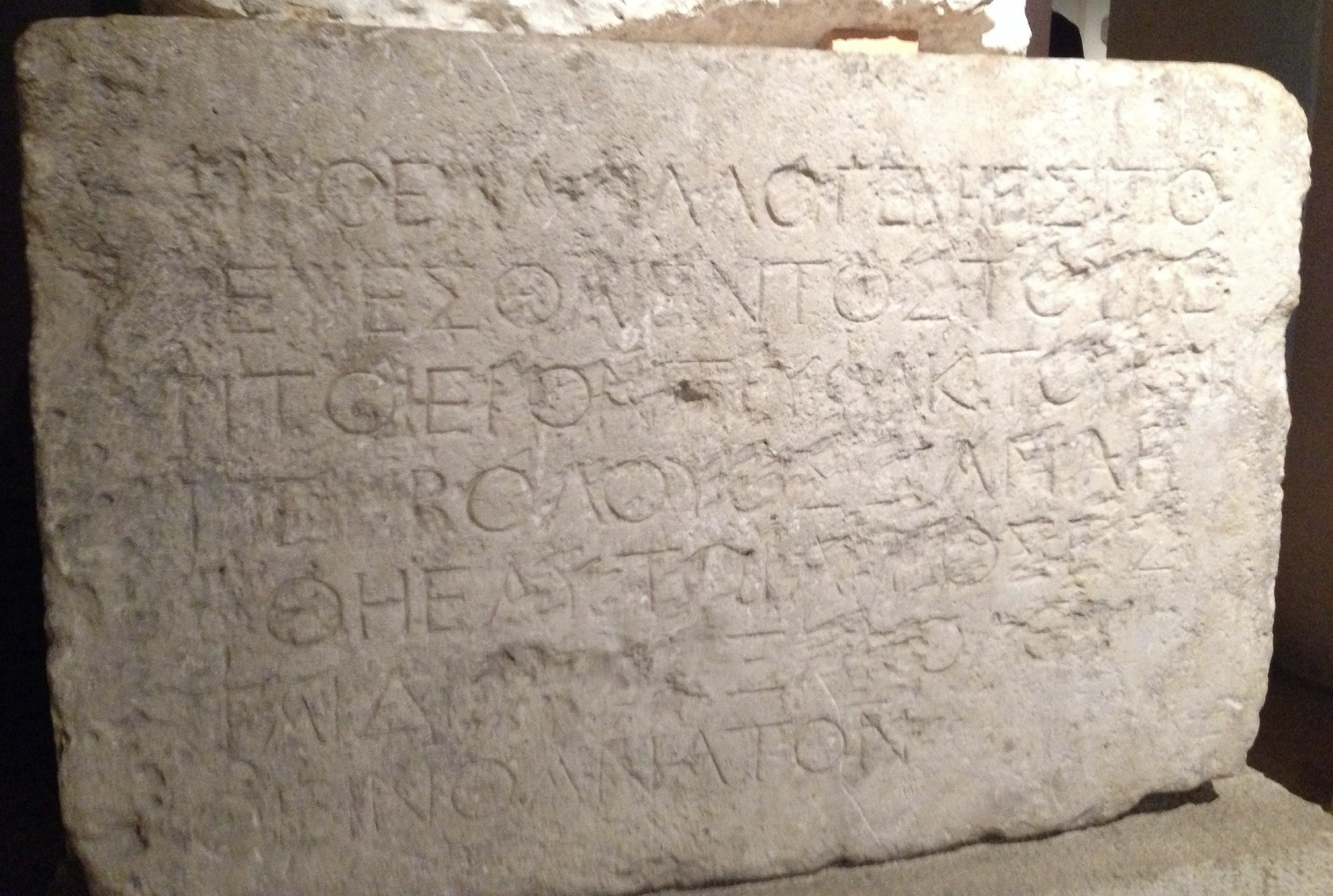
It says, “No foreigner is to enter within this balustrade round the temple and enclosure.  Whoever is caught will be responsible for his ensuing death.”

No foreigner, no allogenes.  This is the word that Jesus uses to describe the Samaritan leper.   Someone born of a different family (than the Jews.)

So you see, this Samaritan could not go with the other 9 to the Temple in Jerusalem to be pronounced clean, for he would not be allowed to enter the area to complete his cleansing.   

This over 4 feet tall dividing wall kept this man and other Samaritans from God.  They could not worship in the place where Yehovah said he would place his name forever because the Priests and Rabbis said they were of the wrong race.  Presumably, he could visit the Samaritan’s temple on Mt Gerazim to see a priest.  But it was not the true temple of God. So he elected instead to show himself to a different priest, Jesus, who would become our high priest.  This is Jesus’ third trip to minister to Samaritans, and he came to break down barriers between people.

And we see this temple barrier wall become a big issue in the Book of Acts.   In Acts chapter 21, some Jews from Asia were in Jerusalem for Pentecost and wanted to attack Paul because he was ministering to ‘foreigners.’ They drag Paul out of the temple and are going to kill him right there, but the Roman troops intervene. They then make some false charges against Paul and manage to have him arrested.  Paul ends up imprisoned for 2 years and then sent to Rome to be judged by Caesar.

 And what was the false charge they brought against Paul that led to all this? They said he brought foreigners past the dividing wall into the temple.  Paul spoke about this wall in his letter to the Ephesians. 

Ephesians 2:11-14   Therefore remember that at one time you Gentiles in the flesh… remember that you were at that time separated from Christ, alienated from the commonwealth of Israel and strangers to the covenants of promise, having no hope and without God in the world.  But now in Christ Jesus you who once were far off have been brought near by the blood of Christ.  For he himself is our peace, who has made us both one and has broken down in his flesh the dividing wall of hostility

Don’t miss that Paul is talking about everyone in this room.  Before Jesus came, we were all allogenes.  We would not have been allowed to enter the Temple.   That was never what God intended.  The Jews were supposed to take God’s message to the nations, but they built a wall to keep everyone else out.  Jesus came to break down these racial barriers, and because of Jesus, anyone can be grafted into God’s family. 

Galatians 3:26-29   For in Christ Jesus you are all sons of God, through faith.  For as many of you as were baptized into Christ have put on Christ.  There is neither Jew nor Greek, there is neither slave nor free, there is no male and female, for you are all one in Christ Jesus.  And if you are Christ’s, then you are Abraham’s offspring, heirs according to promise.

We are adopted into His family.  And once again, in our story today, Jesus has shown a Samaritan, one born of the wrong race, is the one who is righteous in Jesus’ eyes.

Luke 17:15-16   Then one of them, when he saw that he was healed, turned back, npraising God with a loud voice; 16 and ohe fell on his face at Jesus’ feet, giving him thanks. Now he was a Samaritan.   Then Jesus answered, “Were not ten cleansed? Where are the nine?   Was no one found to return and give praise to God except this foreigner?”

While the nine were on their way to Jerusalem, rejoicing over the gift, this Samaritan was praising and thanking the giver. He fell down in worship at Jesus’ feet.

There is a difference between being thankful for the gift and giving thanks and praise to the Giver.

How do you feel when you look at the beauty of creation, when you see a fantastic sunset, a waterfall, or majestic mountains like we saw this past fall in Glacier Bay, Alaska?  Many people were on that ship’s deck with us, looking at the beauty of the mountains and glaciers. Many were just admiring the view. But to some, it was much more; they were moved to admire not just the creation but the creator, the one who made the mountains.  Is it the gift of the giver you admire?

How do you enjoy the great things in life?  How do you appreciate a beautiful view, a great meal, or music?  Do you only see the gift and neglect to thank the giver?  How do you appreciate your health? All 10 men were glad they were healed, but only one was moved beyond appreciation of good health to worship the giver of life.   We don’t worship creation; we worship the creator.  We don’t worship the gift; we worship the giver.

Then Jesus says something very interesting to the Samaritan who used to have a skin disease.

Luke 17:19. And he told him, “Get up and go on your way. Your faith has saved you.”

Now, your version may say:

Luke 17:19. And he said to him, “Rise and go your way; your faith has made you well.”

Well, which is it?  Was he healed from lepra, or was he also saved from sin?  The word translated as “saved you” or “made you well” is ‘sozo.’

Sozo is found in the New Testament 106 times.  Let’s look at the first two instances:

When the angel tells Joseph what to name Jesus:

Matthew 1:21.  She will bear a son, and you shall call his name Jesus, for he will save his people from their sins.”

When the disciples are scared they will die in the boat in a storm:

Matthew 8:25.  And they went and woke him, saying, “Save us, Lord; we are perishing.”

Sozo is the idea of deliverance — from disease, from danger, and from sin.

So, in verse 19, is Jesus talking about physical deliverance from disease or spiritual deliverance from sin and death? Jesus is speaking of spiritual salvation here. As told in verse 14, all 10 have been healed. They all have had physical deliverance from disease. But this Samaritan’s second encounter with Jesus brings more.

This former leper turned back and praised God. He fell on his face before Jesus and thanked him. Like Naaman in the Old Testament, he recognized Yehovah as the source of healing and the one true God.  

Naaman said:
2 Kings 5:11-17  “Behold, I know that there is no God in all the earth but in Israel…from now on your servant will not offer burnt offering or sacrifice to any god but Yehovah.`

This Samaritan praised God for his healing.  He acknowledged his unworthiness by falling on his face at Jesus’ feet.  His actions were that of a repentant heart.  He recognizes Jesus as the source of his healing.  He thanks the giver of the gift.  He didn’t need to raise a hand, walk an aisle, or repeat a sinner’s prayer.  He demonstrated all of that in what he said and did.  And he received much more than physical healing; he received a relationship with the Son of God, the Messiah, that day.  But the nine.  They left jumping for joy and grateful for the gift of healing.  But their happiness was only for the gift, not for the giver. 

We can go through life being joyful for the good times, the beauty, the food, health, and the air we breathe.  Or we can see all of these things and return to Jesus, the creator and sustainer of all, bow down and give him thanks.  In Jesus’ day, children were taught to be thankful for everything.  There were over 100 Jewish blessings a day.  “Blessed are you, Yehovah, king of the universe, who gave me breath this morning.  Blessed are you, Lord our God, who gave me eyes to see today.  Blessed is He who has allowed me to live to this day and see His faithfulness displayed in this answered prayer.  Blessed are you, Yehovah, who have given us food to eat.”

One hundred blessings a day is not a lot.  Your heart will beat over 100,000 times a day.  And each one is a gift from God.  The psalmist said, “How shall I make a return to the Lord for all the good he has done for me?”(Psalm 116:12).  How can we ever thank God enough for how he sustains us and provides for us every minute of every day?  It is that awareness of how much we have received that changes our focus from what we lack to the great abundance we have. 

The LORD is my shepherd I shall not want.

In Ephesians 5:20, Paul says we should ” give thanks always and for everything to God the Father in the name of our Lord Jesus Christ.” Television and social media push us into an endless cycle of discontent, constantly reminding us of what we lack. This attitude of gratitude to God for every gift combats the world’s negativity by recognizing the Giver of the gift. It is a demonstration of faith.  

Have you ever considered how thanking God is related to faith?  

Colossians 2:7 “Let your roots grow down into him, and let your lives be built on him. Then your faith will grow strong in the truth you were taught, and you will overflow with thankfulness.”

When we live in the mode of thankfulness, when we feel the 100 blessings a day in our hearts, then we are keeping our eyes on God.  Then we are worshiping our creator, not the creation, the giver, not the gift.  Remember when Peter was walking on the water and took his eyes off Jesus and looked at the storm with the angry waves? He began to sink. Gratitude keeps our eyes focused on the one who calms us in the storm and increases our faith.  

Thanksgiving is the voice of faith.  Notice what Jesus has done here.  Jesus is so good.  He is determined to strike against hundreds of years of racist attitudes by showing that Samaritans are God’s people, too.  He tells us the story of a ‘Good Samaritan,’ and then he has an actual encounter with a ‘Good Samaritan.’   And he uses these two ‘Good Samaritans’ to teach what he said were the two Greatest Commandments.

The story of the Good Samaritan teaches us the second greatest commandment: “Love your neighbor as yourself.”  The actions of this former leper, this other Good Samaritan, teach us about the greatest commandment –  Jesus quoted it from 

Deuteronomy 6:4-5 Hear, O Israel: Yehovah is our God, Yehovah alone.  You shall love Yehovah, your God, with all your heart, and with all your soul, and with all your might.

Yehovah is God alone; don’t worship anything else. We don’t worship the sun, moon, or stars.  We don’t worship idols.  We don’t worship the beauty of creation, and we don’t worship our health.  We don’t worship the creation; we worship the creator.  Yehovah is God alone.  Like the other Good Samaritan, for every blessing we receive, let us return to Jesus.   Let us bow down before our Creator and thank him constantly for every good gift.

1.  Hays, J. Daniel.  From Every People and Nation: A Biblical Theory of Race. p. 63.

November 28, 27 A.D.  –  Good Samaritan, Bad Questions —   The Year of the Lord’s Favor #60

Week 41 ——— Good Samaritan, Bad Questions
Luke 10:25-37 

Jesus’ disciples will be on their two-month mission for a few more weeks. So, we continue to examine some of his teachings. Today, we discuss his most well-known parable, The Good Samaritan.

We talked about parables back in August when we discussed the parable of the four soils.  To review, remember, that was a parable about parables.  As you read the gospels, one-third of Jesus’s teaching is in parables. “Why parables, Jesus? Why don’t you just say what you mean?”

A parable is an ordinary life story told to make a point or teach a lesson.  One definition says a parable is “an allusive narrative which is told for an ulterior motive.  The well-known situation in the story disarms the listener, who is then hit with the lesson.  Soren Kierkegaard (a Danish theologian) said it this way: Parables are a form of indirect communication intended to deceive the hearer into the truth.

It is a way to tell a truth to someone who otherwise might not listen.  We see this in the parable of Nathan in 2 Samuel 12.  David has committed adultery with Bathsheba and murdered her husband.  But David is king and accountable to no one but God.  So Nathan tells David the story of a poor man with only one lamb.  Then, a wealthy man with many herds of sheep takes the poor man’s lamb from him, leaving him with nothing.  The king then becomes angry and says this wealthy man deserves to die. Nathan responds, “You are that man!”  Nathan told a story with an ulterior motive, and it worked.

So when you read a parable, you have to be on the lookout for what truth Jesus’ is trying to convey that someone may not want to hear.  And usually, there is a reason Jesus tells a parable.  There is a background story.   So, let’s start with the background story for the parable of the Good Samaritan.

Luke 10:25-29   And behold, a lawyer stood up to put him to the test, saying, “Teacher, what shall I do to inherit eternal life?”   He said to him, “What is written in the Law? How do you read it?”   And he answered, “You shall love the Lord your God with all your heart and with all your soul and with all your strength and with all your mind, and your neighbor as yourself.”   And he said to him, “You have answered correctly; do this, and you will live.”

It is a lawyer who comes to Jesus.  This is an expert not in civil law but in Scripture, in the Mosiac Law.  They are typically priests who are not currently functioning in the temple.   He asks Jesus a question, 

“Teacher, what shall I do to inherit eternal life?”

How would you answer that question?   Here is the standard answer I get:

  1. Confess that you are a sinner
  2. Repent of your sins.
  3. Accept Jesus as your Lord and Savior

Don’t forget that this is not how Jesus answered the question. Jesus frequently answers with a question (actually, two questions). 

What is written in the Law, and how do you follow it?

  1. What is in the law?  (He is asking the expert in the law.)
  2. How do you read it?     How do you understand it?    There is a difference between reading and understanding.  My son, Andrew, has a degree in Math and a PhD in Economics.  Now, I can read papers he has written, but understanding them is another thing.  But there is an even more significant difference here.  In Hebrew, understanding is not just a mental process.  To understand is to do.

And he answered, “You shall love the Lord your God with all your heart and with all your soul and with all your strength and with all your mind, and your neighbor as yourself.”

Now, we have heard this answer before.  In the week Jesus will be crucified, scribes come and ask Jesus what the greatest commandment is, and Jesus gives this answer.   He is quoting Deuteronomy 6:4  and Leviticus 19:18.

And he said to him, “You have answered correctly; do this, and you will live.”

And Jesus says, “Great answer!”  So it seems the lawyer and Jesus agree, but then we get to verse 29.

Luke 10:29   But he, desiring to justify himself, said to Jesus, “And who is my neighbor?” 

Why does he need to justify himself?  Didn’t they just agree with each other?   As we read, we see they are not on the same page.  The lawyer has the correct answer, but he has the wrong question.  Why are they not in agreement?  The answer is in the tense of the Greek verb, to do.  The Lawyer asks, ‘What shall I do?’  That verb tense suggests a single limited action — What one thing can I do once and be done?

Amy Jill Levine, in her book Short Stories by Jesus: “The lawyer is thinking of something to check off his to-do list: recite a prayer, offer a sacrifice, drop off a box of macaroni for a food drive, put a 20 in the collection plate. If he is efficient, he can inherit eternal life before lunch.”1

The lawyer asks, “What one thing can I do right now to ensure I have eternal life?

The lawyer’s question seeks a “one and done” answer.  It is a bad question, so Jesus changed it for him.  Jesus says, “Do this, and you will live.”  That “do” Jesus uses is a different tense in Greek.  Whereas the Lawyer’s question is what is the one thing I can do, Jesus’s comment is, ‘Keep doing these things.’  Continually do these things.  Jesus’ imperative “do” focuses not on a single action but on a continuing relationship.

Whereas the lawyer asked about “eternal life,” Jesus reframes what is at stake by urging, “Do this and live.”   The lawyer wants to make sure he will be there in Jesus’ kingdom to come.  But Jesus says if you keep doing those two commandments, you will experience the fullness of life starting right now.  Abundant life with Jesus is forever, but it is not just the length of life but the quality of life you live.  

So, there is a big difference in what the lawyer and Jesus are saying.

We make the same mistake.  Again, if someone goes to any seminary campus and stops a preacher student on the sidewalk and asks,  What is the one thing I can do today to have eternal life?  He gets the answer: Confess your sins and Repent.  Accept Jesus as your lord and savior.  Get baptized.  Check the box. You are done.  You have punched your ticket.  You have your “Get out of Hell Free” card.  

But Jesus tells him there is no one-and-done answer.  The key to living an abundant life is living the way God wants us to live.  It is continually following God step by step. It is about a relationship.

The lawyer realizes that Jesus changed his question on two crucial points.   So, his follow-up question is an attempt to clarify.  “Who is my neighbor?”  But if you ask, “Who is my neighbor?” you ask, “Who is not my neighbor?”  If you ask, “Who am I supposed to love?” you are also asking, “Who do I not have to love? Who is undeserving of my love?  Who can I mark off my list?”

So when Jesus hears that the expert doesn’t understand, he says, “I’m going to need to tell a story.”

Luke 10:30-37  Jesus replied, “A man was going down from Jerusalem to Jericho, and he fell among robbers, who stripped him and beat him and departed, leaving him half dead.   Now by chance a priest was going down that road, and when he saw him he passed by on the other side.   So likewise a Levite, when he came to the place and saw him, passed by on the other side.   But a Samaritan, as he journeyed, came to where he was, and when he saw him, he had compassion.   He went to him and bound up his wounds, pouring on oil and wine. Then he set him on his own animal and brought him to an inn and took care of him.

And the next day he took out two denarii and gave them to the innkeeper, saying, ‘Take care of him, and whatever more you spend, I will repay you when I come back.’   Which of these three, do you think, proved to be a neighbor to the man who fell among the robbers?”  He said, “The one who showed him mercy.” And Jesus said to him, “You go, and do likewise.”

First, see how Jesus described the man who falls victim to the robbers.  He is “A man” (generic, no identifier).  There were two ways to identify someone in Jesus’ day:  by how they dressed and by their speech (their language  or accent.)  In the story, Jesus removes both.  So this could be anybody in need.  It could be a Jew, it could be a Roman. There is no way to tell.  There is no way to see if this man fits into a category of people that you would consider helping.  And this is very important.

Then, a priest and a Levite pass by. Priests and Levites were both groups of people descended from Levi. Priests made the sacrifices in the temple at the altar and the incense altar. Levites also worked in the temple, but they were guards, craftsmen, singers, or performed some other supporting function.

They pass by on “the other side.”  Now, Jesus’ audience knew something you don’t know.  They knew the path from Jerusalem to Jericho. It is a journey you don’t take alone, as thieves and bandits hide on the trail.   You have heard it called the ‘Jericho Road,’ but it is nothing like a road.  I have seen it.  It is a path, and there is no “other side.”  They probably snickered when Jesus said, “the other side.”  

Why were the priest and the Levite not willing to help? I have heard people talk about their worries about uncleanness, but this was not a problem with uncleanness. A statute in the Mishna says, “A priest may contract uncleanness because of a neglected corpse.”

The Talmud states,  “As long as there are no other people to look after the burial of a corpse, the duty is incumbent on the first Jew that passes by, without exception, to perform the burial” (Nazir 43b; Jerusalem Talmud, Nazir 56a). Judaism still takes this mandate seriously. That is why Jews stood vigil at Ground Zero until every corpse was recovered. Burying the dead is one of the most important commandments in Judaism, for it is one of the few acts that cannot be repaid by the person who benefits from it.

Similarly, there is the law of Pikuach Nefesh —  saving a life.  You can break almost any command in the Scripture to save a life (laws of ritual purity, Sabbath rest rules, or food rules.)  Saving a life overrules most other commandments.  They can’t tell if he is dead or alive, but either way, God’s law commands them to help him.  But they pass by, struggling to climb over rocks off the trail to avoid helping him.

Let me reference another story from Amy Jill Levine’s book Short Stories by Jesus. This book is an excellent resource for understanding Jesus’ parables.

The best explanation she said she had heard for the refusal of the priest and the Levite to come to the aid of the man in the ditch comes from Martin Luther King Jr.  The last sermon he preached on the Sunday before he was assassinated was about the Good Samaritan.  “I’m going to tell you what my imagination tells me. It’s possible these men were afraid. . . . And so the first question that the priest [and] the Levite asked was, ‘If I stop to help this man, what will happen to me?’ . . . But then the Good Samaritan came by, and he reversed the question: ‘If I do not stop to help this man, what will happen to him?’” In that sermon, King announced that he was going to Memphis to support the sanitation workers who were being treated as less than human by the city of Memphis.  King said, “I can not ask, “What will happen to me if I go to Memphis?’  I have to ask, “If I do not stop to help the sanitation workers, what will happen to them?” King then went to Memphis, where on Wednesday, he gave his “I Have a Dream speech,” and the following day, he was assassinated. There are bandits on the road.  But our decisions in this life must not be made out of fear, but out of love.2

Jesus continues, “But a Samaritan….”  Suddenly, his listeners are shocked!  It was like saying a dirty word.

We discussed the Samaritans when we talked about Jesus meeting the woman at the well in Samaria.  Simply put, the Samaritans were the people from the Northern Kingdom of Israel who were rejected by the Jews in Judea.  They were not allowed to participate in rebuilding the temple, so they built their own temple on Mt Gerazim.  There were conflicts between the Samaritans and the Jews to the point that in Jesus’ day, they were bitter enemies.  Jesus chooses an enemy to be the hero of his story.  And this makes his point. Neighbor means all, even enemies.

Luke 10:35-37  Which of these three, do you think, proved to be a neighbor to the man who fell among the robbers?”  He said, “The one who showed him mercy.” And Jesus said to him, “You go, and do likewise.”

The lawyer can’t even bring himself to say the word ‘Samaritan’ (a curse word).  He did not have a category for a ‘good’ Samaritan. It would be like a modern-day Israelite saying ‘the good Hamas member’ or you saying ‘the good Taliban’ or ‘the good Nazi.’ Jesus’ point is, ‘If we can’t love those we disagree with, then we don’t have a clue what it means to follow me.’

This brings us back to another of Jesus’ messages from the Sermon on the Mount.

Matthew 5:43-45   “You have heard that it was said, ‘You shall love your neighbor and hate your enemy.’   But I say to you, Love your enemies and pray for those who persecute you, so that you may be sons of your Father who is in heaven. For he makes his sun rise on the evil and on the good, and sends rain on the just and on the unjust. 

We have discussed several of these “you have heard it said” statements in the past two weeks. Jesus takes an Old Testament teaching and explains God’s wisdom and heart behind it. While it is natural to hate your enemy, Jesus asks us to be like our heavenly Father, who loves all, regardless of their attitude toward him or his laws.

And Jesus concludes with the lawyer, “You go, and do likewise.”  This is the same tense of “do” Jesus used before.  You go and continually do what this Samaritan did.  Day after day, keep doing this, following the path God laid before you.  Again, it is not a one-and-done but a lifetime of being the kind of person God wants us to be.

Jesus didn’t make up this story out of thin air.  Last week, we discussed how Jesus’ story about making an offering when you are fighting with a brother came from Genesis 4, the Bible story of Cain and Abel.  This parable of the Good Samaritan is also straight out of the Old Testament.  Jesus knew the Scriptures.  He knew they contained the wisdom of the Father.  So, he retells these stories in parable form.  Let’s look at the Old Testament real-life story of loving your enemy that inspired the parable of the good Samaritan.

First, the background:
Solomon died in 931 BC, and the kingdom was divided into the northern section, called “Israel,” and the southern section, called “Judah.” Jerusalem is the capital of the south, and Samaria is the capital of the north. At times, they were allies; at times, they were enemies. In 2 Chronicles 28, they were enemies.

2 Chronicles 28:1-4   Ahaz was twenty years old when he began to reign, and he reigned sixteen years in Jerusalem. And he did not do what was right in the eyes of Yehovah, as his father David had done, but he walked in the ways of the kings of Israel. He even made metal images for the Baals, and he made offerings in the Valley of the Son of Hinnom and burned his sons as an offering, according to the abominations of the nations whom Yehovah drove out before the people of Israel.  And he sacrificed and made offerings on the high places and on the hills and under every green tree.

In other words, this king of Judah, Ahaz, was evil.

2 Chronicles 28:5-7   Therefore Yehovah his God gave him into the hand of the king of Syria, who defeated him and took captive a great number of his people and brought them to Damascus. He was also given into the hand of the king of Israel, who struck him with great force.  For Pekah the son of Remaliah [king of Syria] killed 120,000 from Judah in one day, all of them men of valor, because they had forsaken Yehovah, the God of their fathers.  

Because the king of Judah was so wicked, God let the Syrian army attack and took many of them as slaves back to Syria. After Syria wipes out Judah, while they are defenseless, Pekah, the king of the Northern Kingdom of Israel, decides it is a good time to attack Judah also.  They killed over 120 thousand in one day and took 200 thousand captive to become slaves.

2 Chronicles 28:8-11   The men of Israel took captive 200,000 of their relatives, women, sons, and daughters. They also took much spoil from them and brought the spoil to Samaria.   But a prophet of Yehovah was there, whose name was Oded, and he went out to meet the army that came to Samaria and said to them, “Behold, because Yehovah, the God of your fathers, was angry with Judah, he gave them into your hand, but you have killed them in a rage that has reached up to heaven.   And now you intend to subjugate the people of Judah and Jerusalem, male and female, as your slaves. Have you not sins of your own against Yehovah your God?   Now hear me, and send back the captives from your relatives whom you have taken, for the fierce wrath of Yehovah is upon you.”

The prophet Oded calls out the men of the Northern kingdom for their cruelty against their brothers from the South.   The prophet said God is about to pour his wrath on you for the way you treated your neighbors to the South.  So look at how they reacted:

2 Chronicles 28:15 And the men who have been mentioned by name rose and took the captives, and with the spoil they clothed all who were naked among them. They clothed them, gave them sandals, provided them with food and drink, and anointed them, and carrying all the feeble among them on donkeys, they brought them to their kinsfolk at Jericho, the city of palm trees. Then they returned to Samaria.

Look at the story’s details and notice they are the exact details of Jesus’s story. The Samaritan clothed the man who was naked. The Samaritan anointed him with oil and wine as a healing balm. The good Samaritan puts the man on his own donkey. He took him to Jericho. The people in 2 Chronicles were from Samaria, what will be the territory of the Samaritans.  This has all happened before.  Jesus takes an event from the Old Testament Scripture, an unusual story where the people at war choose to love their enemies.  Jesus sees the wisdom of God in this story and then uses it to teach a lesson from the law to the expert in the law. 

So the Lawyer asked, “Who is my neighbor?” But Jesus turned his question around again.  His parable doesn’t answer the question of what people fall into the neighbor category because Jesus says there is no category.  All people are neighbors.  All people are worthy of your love and help.  Even enemies should be shown love and care.

.The critical question in this passage is not, “Who is my neighbor?” but “Am I a neighbor?”   Am I treating everyone I pass by as worthy of love and care?  That person on the side of the road who needs help, do I look at them and consider whether they are worthy of you stopping to help them?  Do I categorize people as worthy or unworthy of my help?  It is not about who they are but about who I am.  Am I like my heavenly father who shows love to all?  

  1. Levine, Amy-Jill. Short Stories by Jesus (p. 84). HarperOne. Kindle Edition. 
  2. Ibid, (p. 102). 

May 18-24, 27 A.D.  The Samaritan Woman at the Well- The Year of the Lord’s Favor #32

Week 14 ———  The Samaritan Woman at the Well
John 4:5-42

Several stories in the Bible begin with a man meeting a woman at a well. This setting is where Rebecca is found as a wife for Isaac, where Jacob meets his future wife Rachel, and where Moses meets Zipporah whom he will marry. All of these stories all end in marriage, but today’s story is different.

You have probably heard several sermons on this story.  I have, and they all pretty much go the same way:  The disgraced, sinful woman encounters Jesus, and he reveals her sin, and she comes to believe in him.

Here is a typical rendering, from ‘Got Questions Ministry’ “What we can learn from the woman at the well”:

“…she was an outcast and looked down upon by her own people. This is evidenced by the fact that she came alone to draw water from the community well when, during biblical times, drawing water and chatting at the well was the social highpoint of a woman’s day. However, this woman was ostracized and marked as immoral, an unmarried woman living openly with the sixth in a series of men. The story of the woman at the well teaches us that God loves us in spite of our bankrupt lives.”

And another traditional view from John Piper, in his sermon titled: ‘God Seeks People to Worship Him in Spirit and Truth’:

“If people are spiritually asleep, you have to shock them, startle them, scandalize them, if you want them to hear what you say. Jesus was especially good at this. When he wants to teach us something about worship, he uses a whore.”

That is the traditional interpretation.   Today I want to challenge that interpretation.

Forever this story has been read with the assumption that this woman was of ill repute.  One of my Hebrew teachers, Eli Lizorkin, wrote a book in 2015, on the gospel of John. In the chapter on John 4 he questions that presupposition.  Then this past week, I read a book by Caryn Reeder that focused on the problems with the traditional approach to this woman (and many other women in scripture.)

So, let’s take a new look at this story.

The location is Sycar, a village near Shechem, where Jacob’s well was. This was one of the first pieces of land in Israel owned by the Hebrews, and it is where Joseph’s bones were brought from Egypt to rest. 

Joshua 24:32   As for the bones of Joseph, which the people of Israel brought up from Egypt, they buried them at Shechem.

A divine appointment.

Jesus is waiting for her when she arrives at the well at an unusual time, noon.  Most people would have already made their daily trip for water in the morning. The suggestion is that she is intentionally avoiding others.  This had led pastors for centuries to say that she was a sinful woman, having been married multiple times and now living with a man out of wedlock.  These pastors describe her as shunned by her village.  This is a reasonable conclusion based on our modern culture.  But this story didn’t happen in our culture.  So let’s place the story back into its original setting.

Why all the marriages?   There are two ways marriages can end in Israel in the first-century culture: divorce or death.

In Jesus’ day, divorce was not uncommon, but only men could file for divorce, and they could do it for pretty much any reason.  This was a subject of much debate by the Pharisees of the day, and they questioned Jesus on his opinion in Matthew 19.1 One of the common reasons for divorce was that the woman could not bear a child.  There was no procedure for women to file for divorce.2  If divorced, a woman did not take anything from the marriage, including anything the husband had given them during the marriage.  They had the right to take the original dowery, but this often didn’t happen.  So many women left with almost nothing and no way to provide for their needs.   

Women in Jesus’ culture typically were married when they were 12 – 15 years old, and husbands were usually 10-15 years older.  With the state of medical care, accidents and illnesses would mean many would not live past their mid-30s.  As in divorce, if her husband died, the wife did not inherit anything from the husband’s estate; it all went to his heirs.  That included the family home.  She again only had the right to her dowery.  Often, this meant she had no place to live.  If she had an adult son, he might be able to care for her. Any younger children belonged to the husband’s family. So frequently, in a divorce or the death of a husband, the wife would lose almost everything, including her home and children.  

“The man you now have is not your husband.”  We jump to the conclusion (based on our prior assumption of her character) that she is living out of wedlock.  If she has had and lost five husbands, no matter the reason, she will unlikely marry again.  A single woman in this culture could not live on her own. Women who cannot marry seek refuge with some male relative who can help support them. She may be living with a relative or another man out of necessity.  We don’t know.3

One other thing has always bothered me about the traditional characterization of this woman.  If she was seen by her community as a ‘horrible non-repentant sinner’, how is it possible that she can run in the village bearing witness to the Messiah, and suddenly everyone follows her back to the well?  That seems unlikely.  If she, instead, was pitied by her community for her misfortune and depression, it is more reasonable that this sudden change of spirits would lead them to take the hike to the well to investigate. 

Given this culture and these uncertainties, you can certainly not jump to the conclusion that she is a sinful woman. How odd is it that sermons on this story seem to always focus on her sin when sin is never mentioned in Jesus’ conversation with the woman?   Jesus doesn’t identify her relationships as sinful, nor does he offer her forgiveness. Jesus does not ask her to repent or change her life. Elsewhere in the Gospel of John, we see Jesus freely discussing sin — the woman caught in adultery is told to “go and sin no more”.  He tells the paralytic, “Your sins are forgiven.”  But the omission of any mention of sin here is striking.4

Remember, this is a shame/honor culture.  If you have read much of the Old Testament, you understand the shame of a woman who is not married and the even worse shame of a woman who can not bear children.  Whether this Samaritan woman is at fault for her prior relationships or not, her position is the same.  She lives in shame in her community, from either their accusations or their pity.  It seems Jesus doesn’t focus on why she is living as she is.  His concern is not who is at fault.  He looks past the blame and sees a hurting woman he can help.

How unlike Jesus we can be.  We are very quick to decide if we are willing to help people based on how much they deserve our help.  We are much more likely to support an innocent victim than we are someone whose bad behavior got them into a mess.  We have seen this over and over in our homeless ministry.  A father loses his job, and his family with three young children finds themselves homeless.  People rush in to help.  We get more offers for help for them than we can handle.  But a young man comes in the same day who made bad decisions and became involved with drugs and lost his home — that rush of offers never comes.  He sees the response that the churches have to the family with kids while he is ignored.  What does he learn about the church?  Some people deserve grace, and some people do not.  That is a poor reflection of Jesus.

People say, “He got what he deserved.”  That is a very common response.  But is it a Christ-like response?   One of my friends said about the young man, “He made his bed, now he has to sleep in it.”  How ironic. The problem is that right now he doesn’t have a bed to sleep in or a place to put one.  He may be at fault, but he is also in need.

We often reserve our mercy and grace for those we deem worthy. But aren’t we grateful that Jesus dispenses grace and mercy freely, even when we don’t deserve it? None of us can earn God’s grace through our actions. Isn’t it a comfort to know that Jesus offers grace unconditionally? I don’t know anyone who wants to stand in front of God at judgment and ask to be given what they deserve.

As we discussed last week, Jesus went out of his way to meet this woman. He drags his disciples down what they feel is a wrong and dangerous path to have this one encounter. They do not see these Samaritans as worthy of their attention or God’s love. But Jesus comes to bring her hope, healing, and salvation.

But first, he has to break through some problematic barriers.   Remember, the Samaritans and Jews are bitter enemies with a long history of strife.  No Jew would share a meal with a Samaritan or drink from a Samaritan’s vessel.  Remember the quote from the Mishna:

Mishna Shebiith 8:10  “He that eats the bread of the Samaritans is like to one that eats the flesh of swine.”

Jesus starts the conversation by asking her for water, breaking any expectations she might have had about this Jew.   He then turns the conversation to ‘living water’, which he can offer her.  She initially does not understand this concept.5  Jesus then reveals himself as a prophet, and she responds by asking him the critical question regarding worship for a Samaritan.  Where is the proper place to worship?  Remember, the Samaritans had been, at times, not allowed to participate in temple worship in Jerusalem.  They had built their temple on Mt Gerizim, which the Jews had destroyed around 130 years before this encounter.  So there is no temple for her to worship in.  And this woman could not go to the Jerusalem temple due to racial strife.  But even if she could, she would have been restricted to the outer court, the “Women’s Court” simply because she was a woman. Women had a lower place in the religious culture of Jesus’ day.  This was not God’s idea.  There is no Biblical command for a court of women in the Tabernacle or the Temple.  It is an invention of the culture of men.  Sadly, some religions still refuse to admit women to certain areas of the church just because they are women.  Further, this woman would have a hard time even going to the local synagogue because of her shame.  

So she asks, where is the proper place to worship?  This is an important question that we still fail to grasp today.  Jesus tells her that salvation comes through the Jews, but now worship can happen anywhere and has no racial restrictions. God is to be worshiped in spirit and truth. Jesus tells her that the day is here, that the location won’t matter, and that she will have full access to God. Can you imagine what this would mean to her?

It is not about where.  Not this mountain or that mountain.  Not this temple or that temple.  Not this church or that church.  It is not about methods.  Not this denomination or that denomination.  Not with this style of music or that.  Worship is our response to the awe and wonder of a mighty God.  The Hebrew word for worship is avad which is also the word for work.  Worship is not simply a state of mind; it is doing the work that God demands. We call the church building a place of worship.  If this is the only place you worship, then you don’t comprehend what Jesus said to this woman.  What Jesus is saying is that place doesn’t matter.  The place of worship is anywhere the spirit is.  Anywhere you go is a place of worship.  Your occupation, your home, your grocery store, your friend’s house – these are all places of worship.  Worship is what we do every day of the week as we walk in obedience to him. We call this a worship service. Do you see that?  Service is the work a servant does. But the community worship we do for one hour on Sunday morning is just a tiny part of our week.  The other 167 hours in the week we worship as we walk with God and do his work.  We do not work to earn salvation. We do the work of God because that is our way to worship every day of our lives.  Jesus said we show our love for him by following his commandments.  Worship is doing justice, loving mercy, and walking humbly with God.  (Micah 6:8)

This is all too good for her to believe, even coming from a prophet.  ‘That’s nice, Mr. Prophet, but only the Messiah can reveal that truth when he comes.’And that is when Jesus tells her he is the Messiah.  She is the first person he reveals himself to.  And now she knows what is too good to be true — it has just become true.  She drops her water jars and runs into town.

Then Jesus speaks with his disciples an often quoted verse:

“Do you not say, ‘There are yet four months, then comes the harvest’? Look, I tell you, lift up your eyes, and see that the fields are white for harvest.”  John 4:35

Do you understand the significance of the placement of this verse right here in this story?   Jesus speaks of a field ready for harvest, and then verse 41 tells us: “And many more believed because of his word.”  The field Jesus is talking about is a field that the disciples would have never considered to be their responsibility to harvest, never considered to be capable of harvest.  This was a field of enemies.  A field full of hated people.  They were people who had polluted their worship and were unclean.  But not to Jesus.  

We can not set limits on God’s view of the harvest.

Do you see the trouble Jesus has gone through to teach the disciples and us this lesson?

God’s original plan was for the Jews to be his kingdom of priests to carry his message to the whole world.  But they were not obedient to this plan.  Their view of God’s kingdom was too small.  Samaritans part of the Kingdom?  No way. We don’t even talk to them, we don’t drink from their water jars, and we don’t allow them to come to our temple.  They are our enemies.  A woman?  Are you serious?  We keep them in the outer courts.7  Now a Samaritan woman who is living in shame?  She is probably a horrible sinner.  She has no place in God’s harvest.

But Jesus says, “Yes!”  Samaritan’s? “Yes!”  Enemies? “Yes!”  Women? “Yes!”  Sinners? “Yes!”

How big is your view of God’s kingdom?  Is it for the poor, is it for the prisoner, is it for the Hamas member, is it for your neighbor who is rude or mean, Is it for the people who are public sinners as well as those who we pity?  This woman dropped everything and ran to tell people about the Messiah.  And here we sit, clutching our water pots.

  1. Note that Jesus in Matthew 19 is not giving an exhaustive teaching on divorce, but answering a specific question.
  2. An exception is that the very wealthy or highly politically connected women could, in certain situations file for divorce.
  3. Caryn Reeder notes in her book, The Samaritan Woman’s Story: Reconsidering John 4 After #ChurchToo, “The characterization of the Samaritan woman as an adulterer or prostitute exemplifies the dehumanizing, reductive sexualization of women in the theology and practice of the church. This pattern of interpretation endlessly repeats: Deborah and Jael, Bathsheba, Mary Magdalene, the woman who anoints Jesus in Luke 7: 36-50. These women (among many others) are categorized and defined on the basis of gender and sexuality.”
  4. And the centuries of male-dominated church leaders’ insistence on proclaiming the sin of this woman is even more striking.
  5. It is interesting to compare this one-on-one conversation with Jesus’ conversation with Nicodemus in the previous chapter.   Nicodemus is a leader of the Jews, a great teacher, and held in high esteem by the community.  She is of the lowest social status.  She is not even given a name.  She encounters Jesus in the middle of the day while Nicodemus comes at night, and Jesus says a lot to him about the light and the dark. They both initially have trouble understanding Jesus’ symbolism (born again, living water.)  But in a surprising twist, Nicodemus says little in his conversation with Jesus, while this woman holds her own.  And this unnamed Samaritan woman becomes the model for us to believe and witness, not the great Pharisee, Nicodemus.
  6. Since the Samaritans only had the first five books of the Bible, their primary prophecy on the Messiah was Deuteronomy 18:18 which refers to a prophet like Moses that will come and speak the very words of God.
  7. “It is frighteningly easy for a woman in the church to absorb a message that she is lesser, inferior, and lacking in some way.”  Lucy Peppiatt, in Recovering Scripture’s Vision for Women.