December 17, 2025 –  Unlikely Choices and Impossible Tasks— Acts #25

December 17, 2025 –  Unlikely Choices and Impossible Tasks— Acts #25
Acts 9:10-19

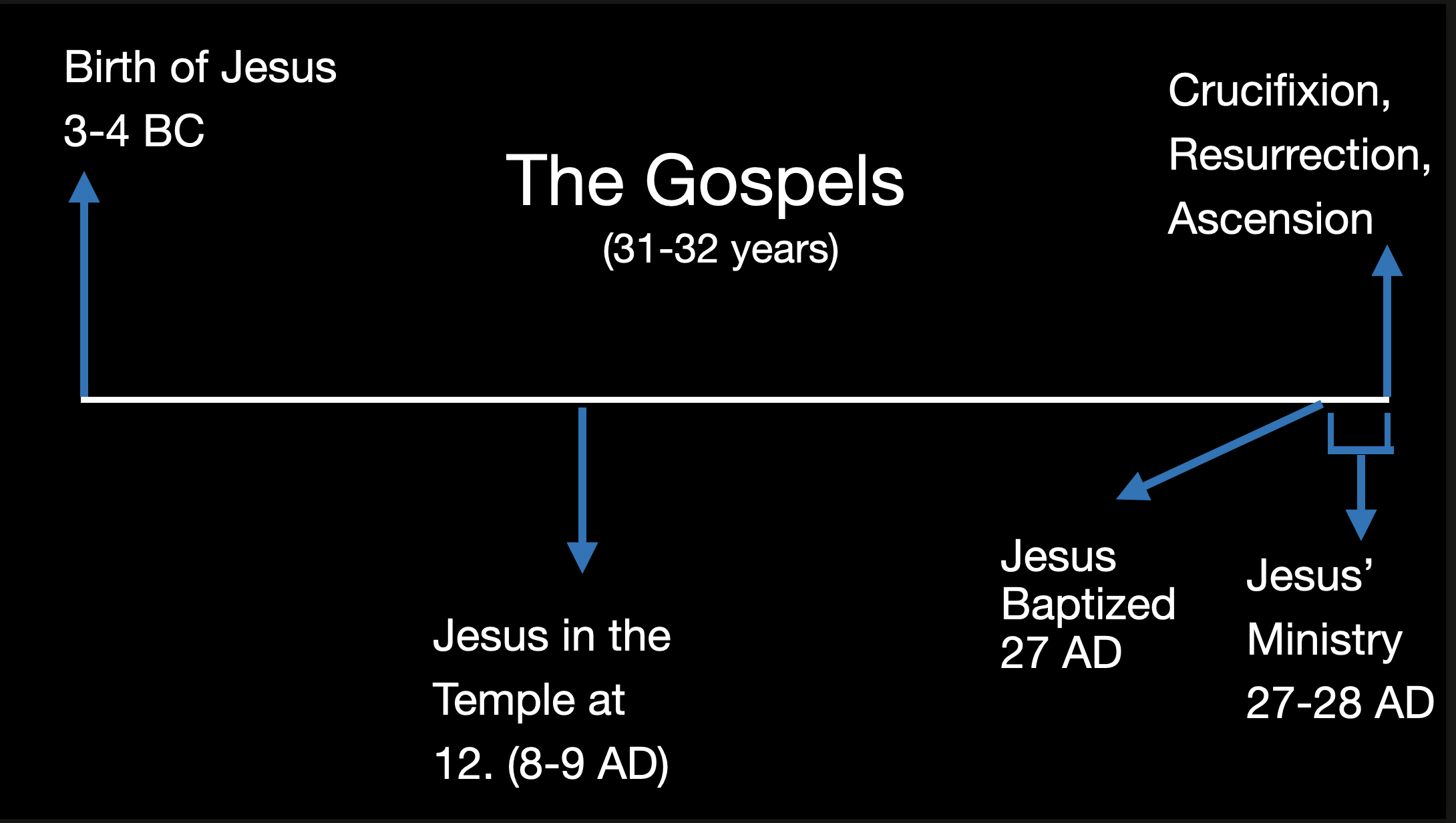
Before we continue in Acts, I want to talk about the timeline.  (You will not find universal agreement on the actual dates, but it is the division of time I want you to see here.)   The Gospels begin with the story of John the Baptist’s and Jesus’ birth around 4 BC and end with his crucifixion, resurrection, and ascension in 28 AD, covering 31-32 years.  But other than the birth narrative and the visit to the temple at 12 years old, everything else in the Gospels happens in this 1 1/2 year or 70-week period.  When we covered the ministry of Jesus, we went pretty much week by week, following him through the Gospels in real time.

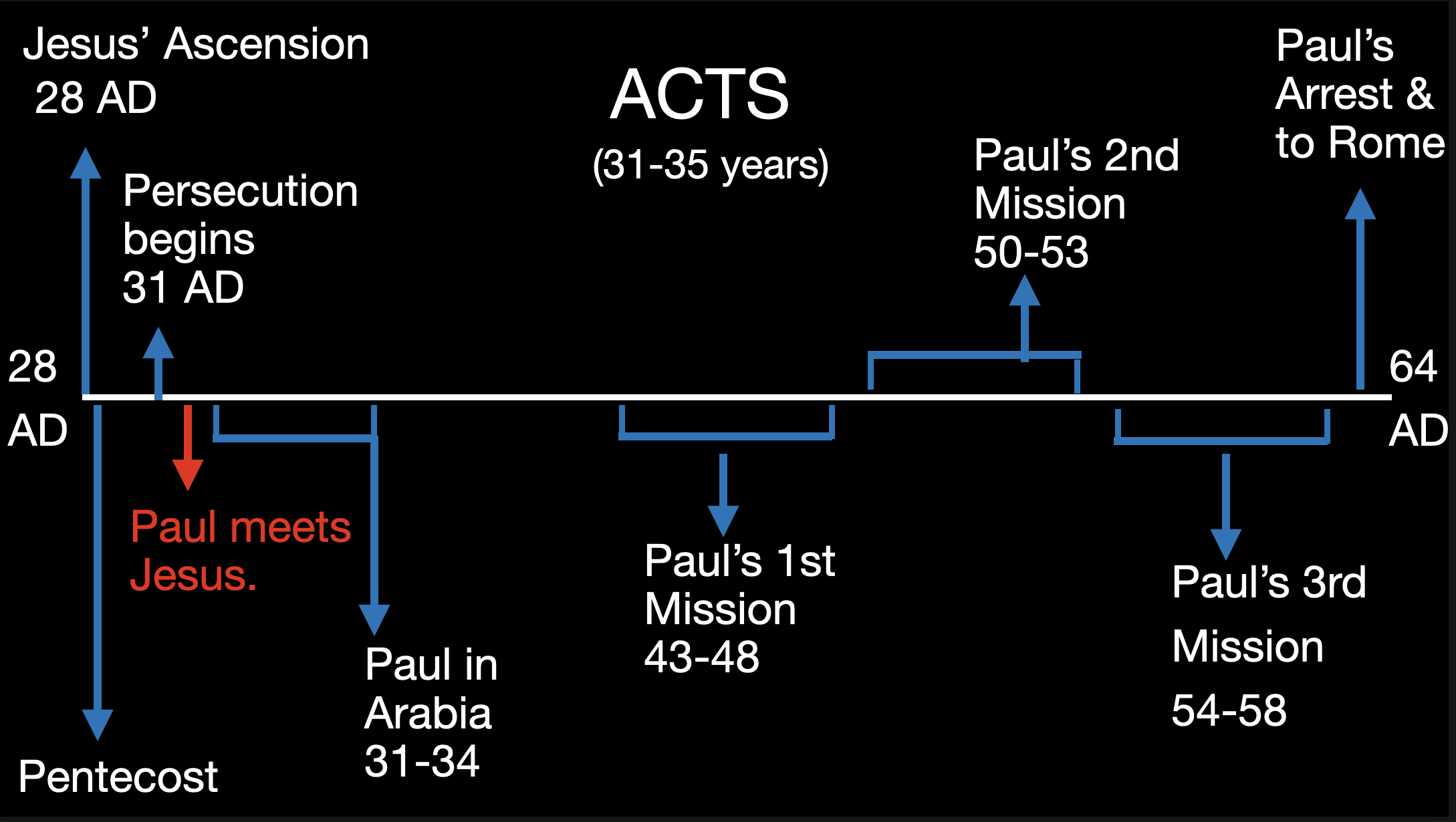
The Timeline for Acts is also around 30-35 years, but the action is not concentrated at a single point.  Acts begins with the Ascension of Jesus and Pentecost, which would have been in June of 28 AD. So we have covered the first 8.5 chapters of Acts in the past 6 months, but that encompasses 2-3 years.  By the 9th chapter of Acts, it is now 2-3 years since Jesus’s crucifixion, resurrection, and the events of Pentecost.  The church has grown in numbers, and persecution has begun.  The rest of Acts covers the 3 years Paul spent in Arabia and his three missionary journeys.

Again, today, in Acts 9, we are at the red arrow above.  Saul met Jesus near Damascus and had been in the city for 3 days.

Acts 9:10-19   Now there was a disciple at Damascus named Ananias. Yehovah said to him in a vision, “Ananias.” And he said, “Here I am, Lord.” And Yehovah said to him, “Rise and go to the street called Straight, and at the house of Judas look for a man of Tarsus named Saul, for behold, he is praying, and he has seen in a vision a man named Ananias come in and lay his hands on him so that he might regain his sight.” But Ananias answered, “Lord, I have heard from many about this man, how much evil he has done to your saints at Jerusalem. And here he has authority from the chief priests to bind all who call on your name.” But Yehovah said to him, “Go, for he is a chosen instrument of mine to carry my name before the Gentiles and kings and the children of Israel. For I will show him how much he must suffer for the sake of my name.” So Ananias departed and entered the house. And laying his hands on him he said, “Brother Saul, Yehovah Jesus who appeared to you on the road by which you came has sent me so that you may regain your sight and be filled with the Holy Spirit.” And immediately something like scales fell from his eyes, and he regained his sight. Then he rose and was baptized; and taking food, he was strengthened.

“Now there was a disciple named Ananias.” (Acts 9:10)   Where did this disciple come from?  Saul is on his way to Damascus to find the followers of Jesus who escaped from Jerusalem.  But Ananias is not one of this group, for in his conversation with Jesus, he says this:

Acts 9:13   But Ananias answered, “Lord, I have heard from many about this man, how much evil he has done to your saints at Jerusalem.

He may be a new follower of Jesus through the gospel spread by these escapees from Jerusalem, but it is more likely he has been a follower of Jesus in Damascus for some time.   Saul says in his personal account of the story in Acts 22:

Acts 22:12   And one Ananias, a devout man according to the law, well spoken of by all the Jews who lived there…

Notice that Ananias is considered a devout man by all the Jews in Damascus.  And we have already seen that he was a disciple of Jesus.  Don’t miss that followers of Jesus can worship alongside Jews in the synagogue.  And these Jews consider the Christians devout, because the Christians are keeping the law.  Again, these followers were not changing religions when they went from the Judaism they grew up in to a belief that their Jewish Messiah had come in Jesus. 

So somehow, Ananias became a follower of Jesus some time ago.  But Jesus never went to Damascus.  Damascus is a long way from anywhere Jesus went.  The closest Jesus came was Caesarea Philippi (about 40 miles away), and there was no public ministry by Jesus there that we have recorded.  

But the message spread through people whose names have never been recorded.  Someone shared the gospel of Jesus with Ananias, and now God has chosen him to correct Saul’s vision problem.  We are not told he is a leader in the church.  He has no title.  He is just an ordinary guy worshiping with all the Jews in the synagogue every Sabbath.  And they all speak well of him.  He is a man of character, well respected by all. 

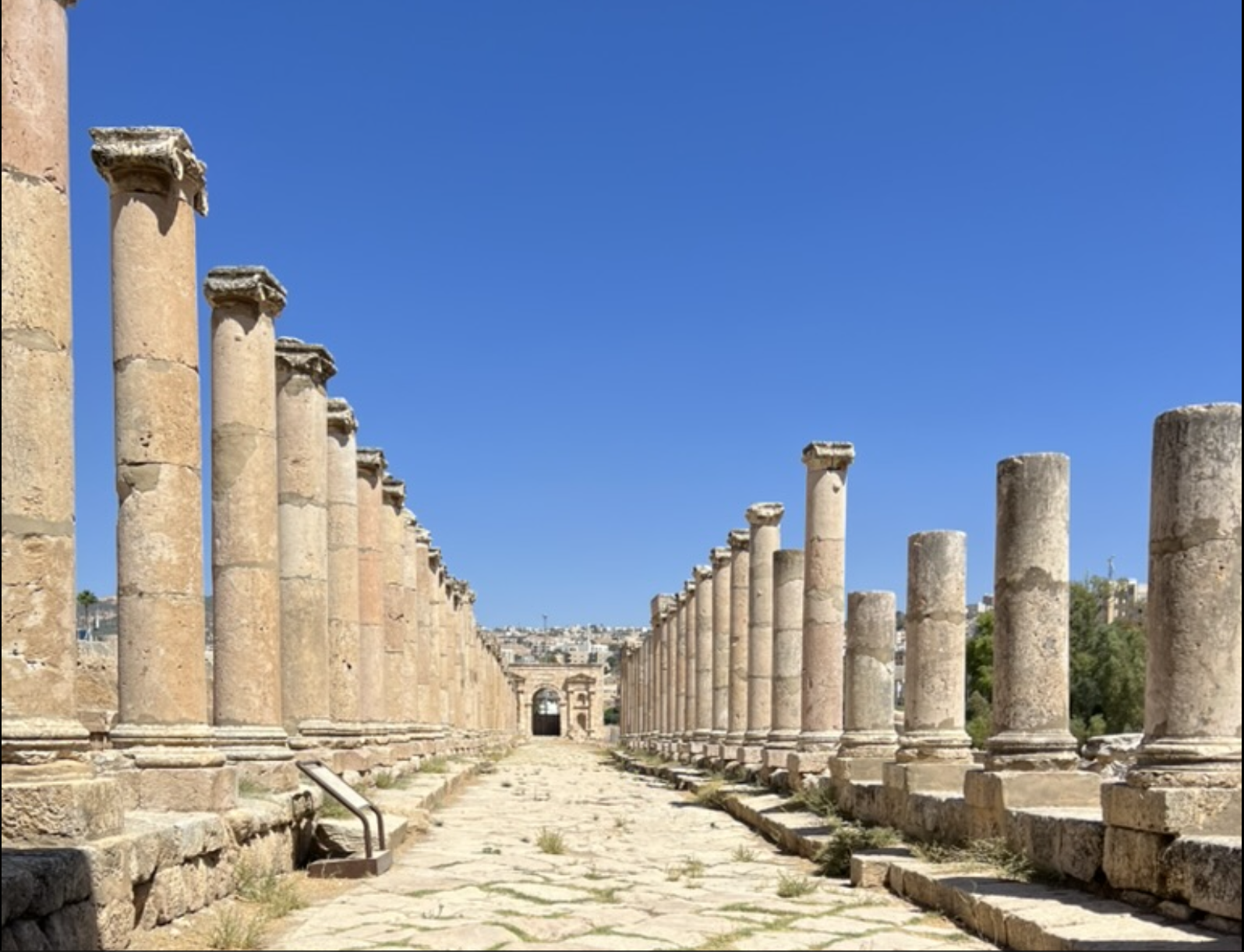
God calls this ordinary man, Ananias, to do a task.   Go to Judas’ house on Straight Street to see a man for me.  The “street called straight” would be the major east-west street in the center of the city, called the decumanus maximus.  (The major North-South street is called the cardo.) You can see this street in the old town of Damascus today.  But in Ananias’ day, it would have looked more like this colonaded Roman decumanus (Straight Street) in Jerash, Jordan.

In Saul’s day, there would have been houses and shops all along these streets.  So God tells Ananias to go to the home of Judas to see a man named Saul, who has been praying, and who God had shown in a vision that you are coming.  God has really set the table for Ananias.  Have you had a witnessing experience like this: God performed a miracle to get someone’s attention, told you that you personally were coming to help them, and then told you exactly where to go?  I wonder if it wouldn’t happen more if we made a practice of listening for God’s voice.  

But this is no ordinary person that Ananias is being sent to.  Imagine Ananias’ surprise: “His name is Saul?   Saul from Tarsus?    Wait a minute!   You mean the guy who put all the Jesus followers in prison in Jerusalem, the guy who chased some of them all the way up here to tie them up and take them back there to be beaten or worse?    And you want me to go see him?” Well, to cut to the end, Ananias does go; he lays hands on Saul, and his blindness is healed, and Saul is given his call to be a minister.

Two things I want us to see in this story.  First, that God uses ordinary people like Ananias to do his work. Secondly, that God works through very unexpected ways, seeing the potential in people that we often do not see.  And I want to illustrate that by comparing this story in Acts to a very similar story in 1 Samuel. So let’s take a look at 1 Samuel 16:1-13.  Remember 2 weeks ago when we talked about King Saul?  He disobeyed God so often that God fired him as king.  So God tells Samuel to anoint someone else to be king.

1 Samuel 16:1-13   Yehovah said to Samuel, “How long will you grieve over Saul, since I have rejected him from being king over Israel?  Fill your horn with oil, and go. I will send you to Jesse the Bethlehemite, for I have provided for myself a king among his sons.” And Samuel said, “How can I go? If Saul hears it, he will kill me.” And Yehovah said, “Take a heifer with you and say, ‘I have come to sacrifice to Yehovah.’ And invite Jesse to the sacrifice, and I will show you what you shall do. And you shall anoint for me him whom I declare to you.

Samuel did what Yehovah commanded and came to Bethlehem. The elders of the city came to meet him trembling and said, “Do you come peaceably?” And he said, “Peaceably; I have come to sacrifice to Yehovah. Consecrate yourselves, and come with me to the sacrifice.” And he consecrated Jesse and his sons and invited them to the sacrifice.

When they came, he looked on Eliab and thought, “Surely Yehovah’s anointed is before him.” But Yehovah said to Samuel, “Do not look on his appearance or on the height of his stature, because I have rejected him. For Yehovah sees not as man sees: man looks on the outward appearance, but Yehovah looks on the heart.” Then Jesse called Abinadab and made him pass before Samuel. And he said, “Neither has Yehovah chosen this one.” Then Jesse made Shammah pass by. And he said, “Neither has Yehovah chosen this one.” And Jesse made seven of his sons pass before Samuel. And Samuel said to Jesse, “Yehovah has not chosen these.”

Then Samuel said to Jesse, “Are all your sons here?” And he said, “There remains yet the youngest, but behold, he is keeping the sheep.” And Samuel said to Jesse, “Send and get him, for we will not sit down till he comes here.” And he sent and brought him in. Now he was ruddy and had beautiful eyes and was handsome. And Yehovah said, “Arise, anoint him, for this is he.” Then Samuel took the horn of oil and anointed him in the midst of his brothers. And the Spirit of Yehovah rushed upon David from that day forward. And Samuel rose up and went to Ramah.

In both stories, God chooses one of his followers to anoint someone who will become a great leader.  He chose the prophet Samuel to anoint David and an ordinary man, Ananias, to anoint Saul.  Notice that both of these choices for future leaders are people who would not have been chosen by popular vote at the time.  David was the youngest son of an unremarkable family in a tiny town.  He had no political experience, no political connections, and no political aspirations.  His family was not wealthy.  Anyone alive then would tell you there was no good reason to choose this shepherd boy as king.  Yet he was God’s choice.  David had the one requirement God seeks – obedience. 

Because anything else, God can provide.  You don’t have the wealth?  God can take care of that.  You have no experience?  God has already supplied you in ways you don’t even realize, and he will continue to give you what you need.  You don’t have the right connections?  God knows everyone you need to know.  Rest assured that the creator and sustainer of this universe is quite capable of supplying all your needs.

Philippians 4:19 “And my God will supply every need of yours according to his riches in glory in Christ Jesus.”

But as we discussed several weeks ago, there is one thing God can not supply — your obedience.  God’s plan for our lives will fail if we are not obedient.  Notice I said his plan for your life will fail if you fail him.  But God will see to it that His plan is carried out.  He will give you another chance, or he will find someone else who is willing to work with him.   

Over and over in the Bible, God chooses people to do a task for which they are not fully equipped.   David does not have the prerequisites to become a king.  At the burning bush, Moses gives God all the reasons he is a poor choice.  Moses provides all his excuses, and God answers him, “I will be with you, and I will empower you.”  None of the young men Jesus chose to be disciples would have been selected by any other rabbi of the day.   Poor untrained fishermen, rash impetuous Peter, a tax collector hated by everyone, a zealot?

As with Ananias, God isn’t looking for anyone exceptional.  He doesn’t choose the wisest or the richest or the smartest.   And Saul of Tarsus … he was the one in charge of hunting down and punishing any followers of Jesus.  If you were choosing someone to be the greatest missionary of the first century and the writer of 1/4 of the New Testament, he would have been the unanimous last choice.  What do we learn from this?  Don’t judge people as you see them.  What did God tell Samuel when Samuel thought he had found the best choice for king among Jesse’s boys? 

1 Samuel 16:7   Do not look on his appearance or on the height of his stature, because I have rejected him. For Yehovah sees not as man sees: man looks on the outward appearance, but Yehovah looks on the heart.

We have to learn not to trust our own perception of people, because we tend to see only the surface, while God looks at the heart.  In the same way, we are not to trust our own judgment of right and wrong, because our vision is limited.

The first sin in the Bible was when Adam and Eve decided that the fruit looked okay to them.   They said, “I don’t see anything wrong with this fruit.”  But the sin was that they were not to decide what is right or wrong.  Only God can determine what is good and what is evil.  The minute we begin asking ourselves if something is good or bad, we have sinned.  The correct question to ask is, “Does God say this is good or bad?”  And it is the same with judging people.  It is not up to Samuel to decide which of Jesse’s sons would make a great king.  That is for God to choose, because he is God and we are not.  Isaiah said it this way:

Isaiah 55:8-9  “For my thoughts are not your thoughts, neither are your ways my ways, declares Yehovah.  For as the heavens are higher than the earth, so are my ways higher than your ways and my thoughts than your thoughts.

God is brighter than any of us.  And the level that he thinks about things is as much higher than our level of thinking as the sky is higher than the ground.  We are stuck thinking earthly, while God thinks heavenly.  So we should not be surprised when God does things very differently from the way we would.

This was a problem for the religious leaders in Jerusalem with Jesus.  No one would choose a country boy from the podunk town of Nazareth to be the Messiah.  He was not from the right family.  He had no formal rabbinic training. He did not follow all of their traditions.  He didn’t even spend much time in Jerusalem, but mainly stayed in the sticks up in Galilee.  He was nobody’s choice.  But God chose to send him specifically this way.  And part of the reason is that God wanted to show us what really matters.  

Search the Scriptures.  You will see God using unconventional methods and people no one would choose to get the job done over and over.   Say it is 1400 BC, and you want to take the most heavily defended fortified city in the world?  Not a single General in the Pentagon would come up with this strategy:   Take no weapons but trumpets and walk around the city seven times, and shout.   But that was how God had the Israelites take Jericho.

God wants Israel to defeat the army of Midian. How does he accomplish that?  First, He chose this unknown guy as a leader for the people.  A person you would have never selected because he is so scared of the Midianites that he’s hiding underground to thresh his wheat.  And then God looks at the Midianite army with over 130,000 soldiers, and then at Gideon’s army with his 32,000 soldiers, and He says, “Okay, Gideon, they outnumber you 4 to 1.  You clearly have too many soldiers, so send most of them home.”  “Okay, now you have 300 soldiers against their 130,000; they outnumber us over 400 to 1. That is much better, God says, I like those odds.

The children of Israel escape from Egypt, but Pharaoh decides to pursue them.   The Israelites are trapped by a body of water behind them, and the Egyptian army is charging at them with hundreds of chariots and the finest weapons of the day, while they have no weapons at all.  And God says, “Now we have the Egyptians right where we want them.”  Why does God consistently want to accomplish his mission with the odds stacked so high against his people? Paul answered this question in one of his letters to the Corinthians:

1 Corinthians 1:26-2:1 (NIV)   Brothers and sisters, think of what you were when you were called. Not many of you were wise by human standards; not many were influential; not many were of noble birth. But God chose the foolish things of the world to shame the wise; God chose the weak things of the world to shame the strong. God chose the lowly things of this world and the despised things—and the things that are not—to nullify the things that are, so that….

“So that…”  Wait a minute.  Slow down here.  We don’t often get explanations of why God does things.  (That is probably because we are not able to understand the explanations, much like my parents telling 3-year-old me why I shouldn’t cross the street by myself.)  So here comes the why:

…so that no one may boast before him. It is because of him that you are in Christ Jesus, who has become for us wisdom from God—that is, our righteousness, holiness, and redemption. Therefore, as it is written: “Let the one who boasts boast in the Lord.”

God does this so that no one can boast, saying, “Look what I did.”  Do you think any of Gideon’s 300 soldiers went home after that battle and bragged to their wives about how they fought so well and defeated the 130,000 Midianites?  Nobody would believe them.  God fixed it so everyone would know He won the battle.  He defeated the Egyptians in the Sea of Reeds.  Everyone left those situations praising God and boasting of God’s power and his victory.  Salvation – whether it is deliverance from the enemies of this world or deliverance from the enemy of sin and death, salvation has always been about what God does; it is not of our works, lest any man should boast.  Paul repeats it:

Ephesians 2:8-9   For by grace you have been saved through faith. And this is not your own doing; it is the gift of God, not a result of works, so that no one may boast.

See, soldiers of Gideon, it was by God’s grace you were saved.  Hey Israelites strolling through dry ground between walls of water, guess what?   God did this, and you didn’t do anything to deserve it; he did it out of his chesed (his loyal covenant love and grace).  Hey church member, you can’t earn your salvation either.  Your obedience is your way of telling God you love Him.

I sat in a deacon’s meeting one day and listened to a discussion about whether our church should join with other local churches to form a mission to the poor and marginalized of our county.  And the debate went as you would expect, with men raising reasonable questions, such as: “Do we have the financial resources to participate in this?”  “Do we have the people who will volunteer to fill the roles needed?”  “Is this something we are capable of doing?”  “How long a commitment would we be making?”  There were 20 minutes spent analyzing the situation as a CEO would consider the pros and cons of opening a new business location, or as a general would consider the options for fighting a battle.  I asked the question that I thought was the only important one: “But does God want this to be done?”

But the discussion soon returned to the logistics. Someone actually said, “Well, if God wanted us to do it, He would have already given us the resources to do it.”   And in the end, it was decided that we would not participate in the project.  Without this large church’s support, the plan for that mission fell apart. And I believe that day, God’s plan was temporarily delayed by our disobedience.  But God wanted this mission to happen, so he found another church that would do it.   And it became a very successful outreach to many poor and marginalized in our community for many years.  The idea that was missed in that meeting was that God calls and then, as you go about being obedient, He equips you for the task, supplying your every need.  

If we only attempt to do the things we currently have the resources for, we have no faith.  If we only attempt tasks we are capable of doing, there is no need for God to join us.  We complete the task, but there is no growth in our faith, no growth in our relationship with God.  If we are called to attempt impossible tasks, then we leave room for God to join with us.  We do the task under his power, not our own. With resources He supplies from His riches.  That experience deepens our faith in God and strengthens our relationship with God.  Of course, God could do all these things without us.  He could have rescued the Israelites without Moses; He didn’t need Moses’s staff to part the sea or win a battle.  But he chooses to call us alongside him to do the work because he wants our relationship with him to grow.  

We looked at two stories of two different Sauls.  Acts 9 of Saul and Ananias, and 1 Samuel 16, of King Saul and Samuel.  The Hebrew word Shaul is a verb meaning ‘to ask’. As a name, it means ‘one who is asked’.  Saul in the Old Testament was asked to be king of Israel.  He was asked to be a king who was obedient to God, who would lead the people in the way God directed.  Saul in the New Testament, was asked by God to be a leader, a missionary to Jews, Gentiles, and kings.  Two Sauls, one a colossal failure and the other recorded in the Bible as one of God’s best servants, and the difference is obedience.

And these two stories illustrate the unlikely people God chooses to do his work.  We see them as unlikely because we don’t see them as God sees them.  The people in Acts 9, including Ananias, looked at Saul and saw a threat.  A man who could cause them harm.  What did God see when he looked at Saul?   A man who wanted to fight for God.  A man who was not comfortable just complaining about a problem but was willing to give 100% to solve a problem. A man of high commitment and zeal.  Sure, Saul was wrong, but in God’s thinking, what a fantastic missionary a man like this could be if he turned toward the truth.  We need to see people with God’s eyes. 

Where we see threats and danger, God sees purpose and commitment.  Where we see Insignificance, God sees potential.  Where we see impossibility, God sees opportunity to grow our faith.  And where we see broken pasts, God sees redeemed futures.

Let us seek to see the world through God’s eyes, not our own.  Let us see people as God sees them, looking for the potential within them.  And let us always be open to respond obediently to God’s call on us to do things that are beyond our ability, for then we partner with Him and grow in Him. 

December 10, 2025 –  Shalom, and the War You Didn’t Realize You Were Fighting— Acts #24

December 10, 2025 –  Shalom, and the War You Didn’t Realize You Were Fighting— Acts #24
Acts 9:1-9

Words in Hebrew have very rich meanings. Last time, we discussed the Hebrew word ‘shema’Shema means listen, but more than listen, it means listen and obey.  Obedience is not optional.  If you did not obey, then you did not hear.  Jesus said, “He who has ears to hear, let him hear.” You will find a version of this 15 times in the New Testament. That isn’t just a poetic phrase Jesus threw out there.  He isn’t speaking English.  It is about shema.  Jesus is talking about obedience.   “If you hear what I am saying, then be obedient.”

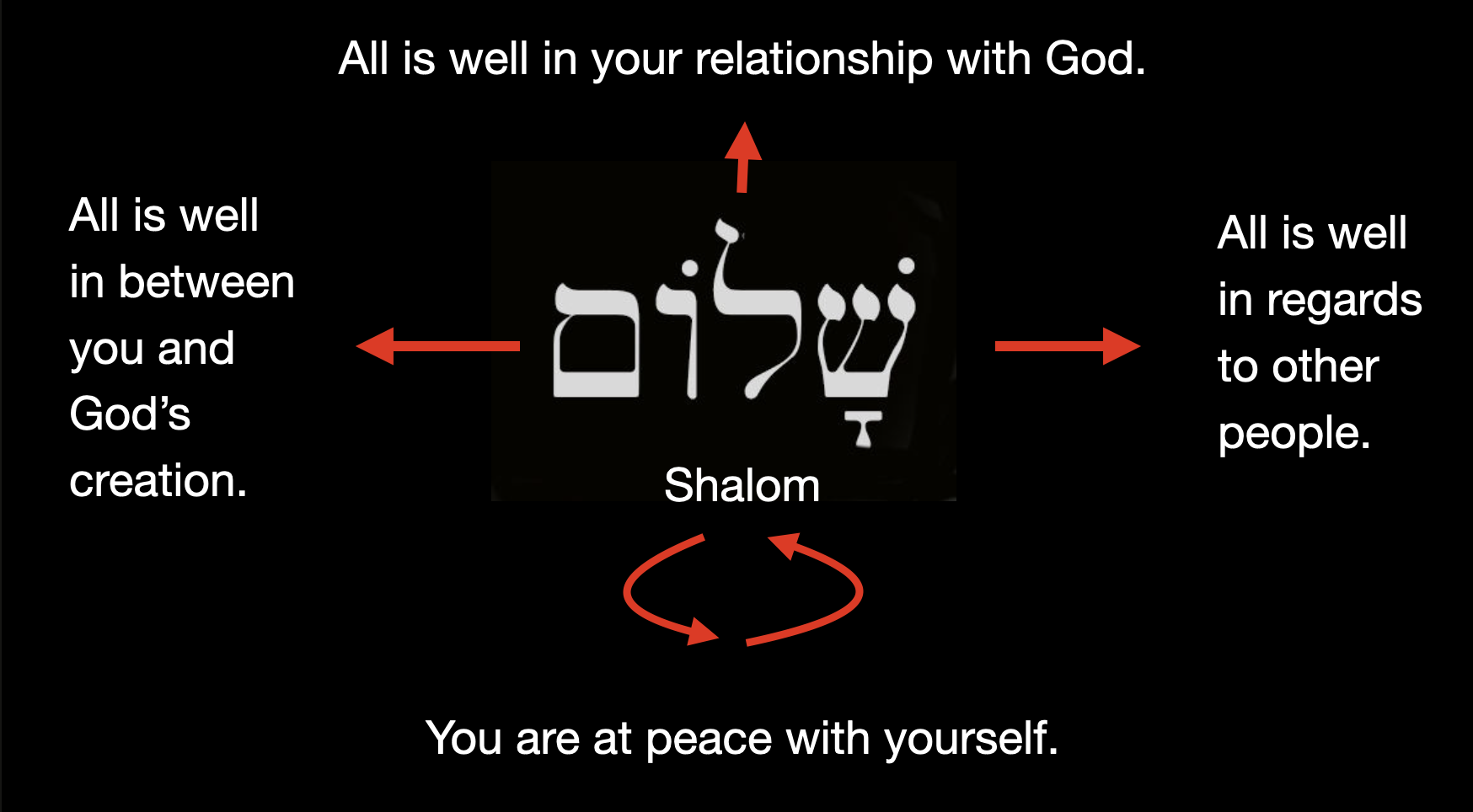
Today, we look at the word Shalom.  It begins with the same letter, ש (shin).  It means peace.  And peace is the candle that many of you lit this past week for Advent.  But like the Hebrew word shema, this word has a richer meaning.  Shalom means more than our concept of peace.  It carries the idea of wholeness, that all is well, that all is well with you, and with your relationship with your neighbor, and in your relationship with God.

  In Acts 8, Shalom was disturbed due to this great persecution of the followers of Jesus.

Acts 8:3  But Saul was ravaging the church, and entering house after house, he dragged off men and women and committed them to prison.

All was not well.   And when this persecution hit hard, as we discussed the last few weeks, the people scattered.  Philip ended up in Samaria.  Some went further north up to Damascus in Syria.  That brings us to chapter 9.

Acts 9:1-9   But Saul, still breathing threats and murder against the disciples of the Lord, went to the high priest and asked him for letters to the synagogues at Damascus, so that if he found any belonging to the Way, men or women, he might bring them bound to Jerusalem. Now, as he went on his way, he approached Damascus, and suddenly a light from heaven shone around him. And falling to the ground, he heard a voice saying to him, “Saul, Saul, why are you persecuting me?  And he said, “Who are you, Lord?” And he said, “I am Jesus, whom you are persecuting. But rise and enter the city, and you will be told what you are to do.” The men who were traveling with him stood speechless, hearing the voice but seeing no one. Saul rose from the ground, and although his eyes were opened, he saw nothing. So they led him by the hand and brought him into Damascus. And for three days he was without sight, and neither ate nor drank.

We have all heard news reports of rare incidents in which police mistakenly raid the wrong house.   Imagine waking up in the middle of the night to the sound of your front door being bashed open, a flash-bang grenade going off in your living room, and then a heavily armed SWAT team entering your home.  Unfortunately, it happens.  Sometimes the tip the police received was incorrect, or the address was incomplete, or a simple error was made. The police did not mean to raid the wrong house.  They had warrants signed by a judge granting them authority to enter the home at that address.  They were well-trained.  They were putting forth their best effort in the raid.  They were highly motivated to apprehend the suspect and protect the public. But they were utterly wrong.

That is what is happening with Saul in Acts 9.  Saul has papers from the high priest authorizing him to go into homes, arrest people, and bring them back to Jerusalem.  Saul is one of the best-trained scholars of scripture alive in his day.  He is giving 100% effort to rid the country of these Jesus followers, to protect the public from heresy.  He is highly motivated, going into homes and dragging out the followers of this splinter group.  And he is entirely wrong.  

In Saul’s mind, he is a soldier defending God’s honor. He is cleaning up Israel. He is protecting the faith. If anyone asked Saul, “Why are you doing this?” he would have said, “Because I love God!”  But he is 100% wrong.  Because sincerity does not make you right, commitment does not equal correctness, and power does not equal purity.   Legal process does not equal morality, nor does strength of conviction make you holy.   Passion without truth is dangerous.  

God has to intervene.  So he throws his own flashbang grenade at Saul’s feet, knocking him to the ground and blinding him.   And the voice from heaven asks Saul, “Saul, Saul, why are you persecuting me?”  Not why are you persecuting these people, or why are you persecuting these followers, but why are you persecuting me?  Then Saul asks an essential question: “Who are you, Lord?”

At this point, Paul is aware he is not dealing with humanity.  This blinding flash of light was nothing any human could produce.  Is he dealing with an angel, or God himself?  So he asks, “Who are you, Lord?  (Lord being the equivalent of us saying a very respectful “sir”.)  The voice responds: “I am Jesus, whom you are persecuting.”  This is a lot for Saul.  First, the voice is Jesus, whom he had been told was dead, crucified as a criminal, a blasphemer.  But instead, Jesus is very much alive.  And Jesus wields the power of God.  And Saul finds that he is not rescuing people from a heresy, but waging war against God himself.  So God gives Saul a three-day timeout.  Three days to consider all of this.  Three days when he can not see.  And he fasts from food and drink.  And you can bet blind Saul prayed, and prayed hard.

Saul thought he was waging war with these heretics who had disturbed the peace of Jerusalem.  But it was Saul who was disturbing the shalom of God by waging this war.  This story is an example of a great paradox of the message of Jesus.  As many of you read in our Advent reading this past week, the prophets say that the Messiah will come as the Prince of Peace.

Isaiah 9:6   For unto us a child is born, to us a son is given; and the government shall be upon his shoulder: and his name shall be called Wonderful, Counsellor, Mighty God, Everlasting Father, Prince of Peace.”

The Messiah is the ‘Prince of Peace.’  And the first to hear the news of Jesus’ birth were the shepherds in the field with their sheep, who heard it from the angels.  We sing it in the hymn, “It Came Upon the Midnight Clear”:

“It Came Upon the Midnight Clear, 
That glorious song of old.
From angels bending near the earth,
To touch their harps of gold;
“Peace on the earth, goodwill to men, 
From Heav’n’s all-gracious King.”

Isaiah said He is the ‘Prince of Peace’.  The angels sang that he comes to bring peace on earth.  But then how do we reconcile what Jesus says here:

Matthew 10:34-36   Do not think that I have come to bring peace to the earth. I have not come to bring peace, but a sword. For I have come to set a man against his father, and a daughter against her mother, and a daughter-in-law against her mother-in-law. And a person’s enemies will be those of his own household.

 How do we reconcile these two passages?  The peace that Jesus brings is first and foremost peace with God.  True shalom with God.  Before Jesus, we had no peace with God.  Paul says it this way:

Romans 8:7-8  “For the mind that is set on the flesh is hostile to God, for it does not submit to God’s law; indeed, it cannot. Those who are in the flesh cannot please God.  

When you are in your sin, there is hostility towards God.  You are living on the king’s land, but you do not follow the king’s rules.  You are a rebel.  You are waging war with God.  The only way to end your rebellion is to ask for forgiveness, which God freely grants through Jesus. And then to begin to live a different life that is not in rebellion to the king’s rule, but to follow him in obedience.  As Paul says in the preceding verse:  

Romans 8:6 “For to set the mind on the flesh is death, but to set the mind on the Spirit is life and peace.

You can choose peace with God (shalom) or hostility towards God.  There is no middle ground.  See this again in James:  

James 4:4 (NLT)  Don’t you realize that friendship with the world makes you an enemy of God? I say it again: If you want to be a friend of the world, you make yourself an enemy of God. 

You have to choose.  Jesus told his disciples that peace with God can be theirs:

John 14:27 (NLT)   I am leaving you with a gift—peace of mind and heart.  And the peace I give is a gift the world cannot give.  So don’t be troubled or afraid.

And the Bible is consistent.  For though the carol said “it came upon the midnight clear,” “Peace on the earth, goodwill to men, from Heaven’s all-gracious King.”  That is not what the angels said.  Here is what the angels actually said:

Luke 2:14 “Glory to God in the highest, and on earth peace among those with whom he is pleased! 

Wait, there is a catch to that peace with God the angels sang about.  The only ones who get peace are those with whom God is pleased.  Those who are in right relationship with him.  Those who follow his son Jesus in salvation and obedience.  They have peace, shalom, with God. Everyone else is still at war with God.  So let’s see that in a carol that gets it right, “Hark! the Herald Angels Sing”.  

Hark! The herald angels sing,  
Glory to the newborn King!  
Peace on earth, and mercy mild, 
God and sinners reconciled.

Peace on earth is tied to this:  God and sinners reconciled.  There is no peace for us with God until we are reconciled to him through the forgiveness of our sins and the promise we make to follow him as our Lord and live in obedience to him.  

Now look what happens with Saul.  Saul discovers on the Damascus Road that he and his SWAT teams are raiding the wrong house.  He is an enemy of God.  Once Saul stops fighting Jesus, he begins an incredible journey of reconciliation.  After he is reconciled to God, he will eventually seek fellowship with the same followers he persecuted.  And he will become a leader in this fellowship, a missionary of reconciliation.

Paul calls peace a fruit of the Holy Spirit living within us, and he says:

Romans 12:18 If possible, so far as it depends on you, live peaceably with all.

But none of that can happen until his heart is made right with God.  Jesus tried to make this clear to his disciples in John 16:

John 16:33  I have said these things to you, that in me you may have peace…

You may have shalom, peace with God.  You are at peace with God when you are in a right relationship with Him. But that is not the end of the verse.  Keep reading to see the paradox.

John 16:33  I have said these things to you, that in me you may have peace.  In the world, you will have tribulation.

If you don’t understand shalom, if you don’t understand the kind of peace Jesus is talking about, then this verse makes no sense.  “Which is it, Jesus, peace or tribulation?”  But when you have peace with God, you are then at war with the world.  You will have tribulation.  And now, finish the verse to see the best news.  

John 16:33  I have said these things to you, that in me you may have peace. In the world, you will have tribulation.  But take heart; I have overcome the world.

Your enemy, the world, has already been defeated.  The way of this world, what the Bible calls the way of the flesh, was defeated on the cross of Jesus.  Sin, which kept us enemies of God, was defeated, so now we can be friends with God.  And then death was defeated.  Jesus has overcome.  The outcome of the war has been decided.  But the battle still rages within us as long as we persist in disobedience. 

Peace can be ours now if we seek Him and obey Him.  And complete peace, complete shalom, will exist in this world one day.   The Prince of Peace will reign over all, and there will be no more enemies.  Come, Lord Jesus, come.  

Saul’s transformation begins with two simple questions: the first, “Who are You, Lord?”  This is the most critical question.  Who is Jesus to Saul at this moment of the blinding light?  He is no one to Saul, just a teacher whom the Romans killed.  But it is in this moment that Saul realizes who Jesus really is, the living Son of God.  And this makes all the difference for Saul.

Then the second question:  “What do you want me to do?” Now that Saul knows who Jesus is, he wants to listen to Jesus and obey him.  This is shema, hear and obey.  And that leads to peace with God.   Shema leads to shalom.  You have to shema (listen and obey) before you find shalom, peace with God.  Peace with God requires listening and obeying.  In Acts 8, Saul’s relationship with God is like a child pulling on a rope in a tug-of-war against his father.  He pulls with all his strength until he is exhausted. It is hopeless.  Finally, the father smiles at the child.  And the child puts the rope aside, and the father embraces the child. The child’s peace didn’t come from winning the battle—it came from surrendering into the father’s arms.   It is here in Acts 9 that Saul drops the rope and surrenders to Jesus. So must we.

It was Christmas Day, and Henry Wadsworth Longfellow was listening to the church bells ring out, representing the angels’ proclamation of peace on earth, goodwill to men.  But Longfellow had no peace.  It is 1863.  He recently lost his wife in a tragic accident.  And his son, Charles, was away fighting in our country’s brutal Civil War. And in the midst of this turmoil, he pens these words:

I heard the bells on Christmas Day
, Their old, familiar carols play,
And wild and sweet
The words repeat
Of peace on earth, goodwill to men!

And thought how, as the day had come,
The belfries of all Christendom
Had rolled along
The unbroken song
Of peace on earth, goodwill to men!

Till ringing, singing on its way,
The world revolved from night to day,
A voice, a chime,
A chant sublime
Of peace on earth, goodwill to men!

Then from each black, accursed mouth
The cannon thundered in the South,
And with the sound
The carols drowned
Of peace on earth, goodwill to men!

It was as if an earthquake rent
the hearthstones of a continent,
and made forlorn
the households born
of peace on earth, goodwill to men!

And in despair I bowed my head;
“There is no peace on earth,” I said;
“For hate is strong,
And mocks the song
Of peace on earth, goodwill to men!”

Then pealed the bells more loud and deep:
“God is not dead, nor doth He sleep;
The Wrong shall fail,
The Right prevail,
With peace on earth, goodwill to men.”

God is not dead, nor doth he sleep.  Jesus is indeed the Prince of Peace.  Jesus wants us to have that shalom with him, that right relationship that comes with His forgiveness and salvation.  The peace that comes by shema — listening to the voice of God and being obedient.  

This Christmas season, I want you to consider your peace with God.  How is that relationship?  Could it use more communication?  Could it use more obedience?  We earnestly seek the peace of God in our lives, even as we yearn for the day when God’s peace will reign supreme in this world.  We look forward to that day when God redeems the earth, that day when all is well.

November 13, 2025 –  Stephen, Stoning, and Getting What You Deserve— Acts # 20

November 13, 2025 –  Stephen, Stoning, and Getting What You Deserve— Acts # 20
Acts 7:54 – 8;1

Acts 7:54-60   Now when they heard these things they were enraged, and they ground their teeth at him. But he, full of the Holy Spirit, gazed into heaven and saw the glory of God, and Jesus standing at the right hand of God. And he said, “Behold, I see the heavens opened, and the Son of Man standing at the right hand of God.” But they cried out with a loud voice and stopped their ears and rushed together at him. Then they cast him out of the city and stoned him. And the witnesses laid down their garments at the feet of a young man named Saul. And as they were stoning Stephen, he called out, “Lord Jesus, receive my spirit.” And falling to his knees he cried out with a loud voice, “Lord, do not hold this sin against them.” And when he had said this, he fell asleep.

Imagine if you were one of the over 5000 Jewish followers of Jesus on this day.   One of your leaders has just been stoned to death by the people in charge of the Jewish Religion, your religion.  All Jesus-followers at this time were Jewish, and they did not think they had stopped being Jewish when they followed the apostles and Jesus.  You see, all their life they had been raised by their Jewish parents, their Jewish community at synagogue, and the leaders of the Jewish religion, the priests, scribes, and Pharisees, to pray every day for the Messiah that would one day come.  So if you are a Jesus follower on this day, you have no reason to believe you have stopped being Jewish.  In fact, that Jewish prayer you prayed every day, for the Jewish Messiah to come, has come true, just as the Jewish prophets foretold.   You are a Jew who believes your Messiah has come.

And the people in charge of your religion, the ones in charge of the temple where you worship, and the ones who hold the power to excommunicate you from the religion or even kill you, these people just killed one of the most helpful, kind, Spirit-filled men you have ever known.  And the charge against him, blasphemy, was for saying the same things you were speaking to a friend yesterday.  How would you feel?  Would you be wondering if they were coming for you next?  

Acts 7:58   Then they cast him out of the city and stoned him.

You have heard Bible stories about stoning and have probably at one time read the rules about stoning in Leviticus and Deuteronomy, but since many people fall asleep reading Leviticus and since we don’t know the culture well, let’s review a little about stoning.

Stoning was a common form of punishment in ancient times.  It is found in the law codes of several cultures.  In the Old Testament, sins punishable by stoning are in two categories:

  1. Those that deal with man’s relationship to God.   This includes those who tempt others to engage in idolatry (Deuteronomy 13:7,11), those who participate in idolatry themselves (Deuteronomy 17:5), those who use God’s name in a curse (Leviticus 24:16), those who offer their children to Molech (Leviticus 20:2), people who serve as mediums or necromancers (Leviticus 20:27) and a special case of a man who gathered wood on a Sabbath (Numbers 15:32-36).
  2. Social Crimes.   It is the fate prescribed for the wayward and defiant son (Deut 21:18-21), whose actions are accounted a capital offence to emphasise the gravity of disrespect for parents.   This sounds incredibly harsh to us, but understand the context.  First, it was not uncommon at all in these times for a father to kill his son for disobedience. Many cultures saw this as a fitting punishment, either death or being sold into slavery. But Biblical law is more restrictive and deprives the father of his authority to exert capital punishment on his own.  It is for the community elders to decide.  Secondly, in Jewish history, this was never done.  The Talmud states, “It never happened and it never will happen.”  Like many of our law codes today, there are specific maximum punishments on the books that are never used.  In Old Testament times, extreme cases of rebellious sons usually resulted in disinheritance.  The punishment of stoning was carried out in some cases of adultery, and there are several cases discussed in the Old Testament (and one in the New Testament).   Again, this maximum punishment was not always carried out, and apparently, the spouse had the right to insist on a lesser sentence.

Stoning took place outside the camp or city.  

Leviticus 24:13-14   Then Yehovah spoke to Moses, saying, “Bring out of the camp the one who cursed, and let all who heard him lay their hands on his head, and let all the congregation stone him.”

This was to ensure that the blood of the guilty would not contaminate the camp or city.  Remember that contact with a dead body made a person ritually unclean for seven days. 

Numbers 19:14-16   This is the law when someone dies in a tent: everyone who comes into the tent and everyone who is in the tent shall be unclean seven days. And every open vessel that has no cover fastened on it is unclean. Whoever in the open field touches someone who was killed with a sword or who died naturally, or touches a human bone or a grave, shall be unclean seven days.

Remember that Jesus was crucified and Stephen was stoned just outside the city walls.  (The exception to this was adultery.  If a woman was convicted of the crime of not being a virgin when she married, she was to be stoned at the door of her father’s house, implying parental responsibility for their child’s sexual behavior.)

Initially, stoning was done by throwing stones at the guilty person until they were dead.  By New Testament times, stoning was frequently done by pushing the guilty off a roof or a cliff.   If they did not die from the fall, a large rock was placed on their chest to make breathing difficult.  If they survived that, then they would cast stones.  Note this quote from the Mishna, the first written collection of the Jewish oral law that had been passed down for centuries.

“The elevation of the stoning grounds was twice the height of a man. One of the witnesses to the crime pushes him by his hips [so that he falls on his side]. If he falls onto his chest, he is turned onto his hips. If he dies [from the fall], the court has fulfilled its obligation. If he is still alive, the second witness takes a stone and places it on his chest. If the condemned man dies, the court has fulfilled its obligation.  If he is not dead, he is stoned by all of Israel…”

This quote from the Mishna (Sanhedrin 45) was written after 200 AD, but was considered the practice in the first century as well. The rabbis noted that the change in method was to fulfil Leviticus 19:18 (“Love your neighbor as yourself”) as seen in this quotation from Sanhedrin 45a: “Love your fellow as yourself, by choosing for him a better way to die.”  

This method of stoning is seen when the leaders of the synagogue in Nazareth decided that Jesus had committed blasphemy and needed to be killed. 

Luke 4:29   And they rose up and drove him out of the town and brought him to the brow of the hill on which their town was built, so that they could throw him down the cliff.

They intended to stone Jesus in the usual manner of the day, by pushing him off the cliff.  But God did not allow it that day.

Stoning was a form of public execution, not just observed by the public but carried out by it.  

Leviticus 20:2   The people of the land shall stone him with stones.

The community was responsible for carrying out the punishment.  Again, this may seem odd to us because our culture does not operate under the same assumption of community guilt as the culture of the Bible (though it should).   According to scripture, the community bears some of the guilt of any member who sins.  If a family member sinned, it brought guilt and shame on the family.  If a member of their community or nation sinned, this too brought guilt and shame on every member.   By participating in the stoning, they removed the guilt the lawbreaker had brought on the community.

And when the stoning was the sentence of a court hearing, the witnesses in the hearing were to throw the first stone.

Deuteronomy 17:7   The hand of the witnesses shall be first against him to put him to death, and afterward the hand of all the people. So you shall purge the evil from your midst.

The Scripture is clear that there must be two or three witnesses, and that God takes the idea of false witness very seriously.  It is one of the ten commandments.

Exodus 20:16.  You shall not bear false witness against your neighbor.

By requiring the witnesses to throw the first stone, the witnesses are directly responsible for the execution, so if their testimony was false, then they are guilty of murder.   

Knowing this information about stoning gives us some insight into the story in John 8 of Jesus and the adulterous woman. 

John 8:2-7   Early in the morning, Jesus came again to the temple. All the people came to him, and he sat down and taught them. The scribes and the Pharisees brought a woman who had been caught in adultery, and placing her in the midst, they said to him, “Teacher, this woman has been caught in the act of adultery. Now in the Law, Moses commanded us to stone such women. So what do you say?” This they said to test him, that they might have some charge to bring against him. Jesus bent down and wrote with his finger on the ground. And as they continued to ask him, he stood up and said to them, “Let him who is without sin among you be the first to throw a stone at her.”

If you pictured the crowd of accusers picking up stones and then dropping them as they walked away, then know it didn’t happen that way.  They would not have stoned her there in the city, much less in the most holy place, the Temple.  We are told that this woman was caught in the act.  It is somewhat odd that she was caught in the act, but only the woman was brought to Jesus as the guilty party.  And they misquote the Scripture specifying the woman should be stoned when both of the scriptures that mention this (Leviticus 20:10 and Deuteronomy 22:22)  refer to both the man and the woman (and do not specify stoning). 

Then Jesus said, “Let him who is without sin among you be the first to throw a stone at her.” 

 First, understand that the Greek word for ‘throw a stone at her’ (“ballo”) can also be translated as ‘put or place a stone on her.’  Any of those 3 English words can be used.  The translator has to choose which English word to use based on the context.  This is the same Greek word, translated as “put” in this verse in James:

James 3:3   If we put bits into the mouths of horses so that they obey us, we guide their whole bodies as well.

I am glad our translators chose ‘put’ in this verse in James instead of ‘throw’.  It would take perfect aim and timing to throw a bit into a horse’s mouth, and I do not recommend trying this.  But the original English translators of the Bible were unaware of the change in method for stoning when they translated, so they chose to use “throw” instead of “put” or “place”.  But knowing what we know now, we see that what Jesus said is indeed consistent with the practice of the day, placing stones on the guilty party if the guilty party did not die from the fall. 

Secondly, when Jesus said, “Let him who is without sin place the first stone,” he is not asking who in the crowd is perfect and without sin (as I have usually heard it interpreted).  He is referring to the specific command in Deuteronomy 17 that the witnesses are to be the first to throw (or place) stones.  He is reminding these people who have come forward as ‘witnesses’ to this woman’s sin that it is a sin to be a false witness, and they had better be willing to fulfill their responsibility to begin the sentence if, indeed, they are without the sin of false testimony.   

Suddenly, no one is willing to be a ‘witness’ to this adultery, as apparently, no one is willing to commit the sin of false witness and murder.  There is no one left to condemn her.

But the false witnesses in our story of Stephen in Acts 7 were indeed willing to take on that sin.  How would you feel if this were your friend that people had lied about in court to have him killed?  What if you were Stephen’s mother or father?  How would you respond?  And these convicting him are members of their synagogues, and church leaders and priests.  How could God allow this?  They all deserve death.

Would you be angry?  Would you want to take revenge on the person who did this to your friend?  Would you pray and ask God to punish them severely for this horrible sin?  Would you want God to open up a hole in the earth and swallow them right away?  There may have been people in Stephen’s day who prayed that very prayer, who wanted to take vengeance into their own hands.  But how did Stephen respond?

Acts 7:59-60  And as they were stoning Stephen, he called out, “Lord Jesus, receive my spirit.” And falling to his knees, he cried out with a loud voice, “Lord, do not hold this sin against them.” And when he had said this, he fell asleep.”

His dying words were, “Lord, do not hold this sin against them.”  What a Jesus-like attitude to have.  Jesus said the same thing from the cross.  He, too, was condemned by false witnesses and the court of the priests.  Those who were responsible for maintaining the integrity of religious practice, but committed the worst possible evil.  

We know the names of some who were in the court that convicted Stephen.  Annas and Ciaphas were there for sure.  But there is one other person who had a part in deciding Stephen’s fate, who you know very well.  Later on in this person’s life, he confesses to this sin.  He admits that he voted to put them to death.  And we know without a doubt that he was there for Stephen’s trial. He says this:

Acts 26:9-10   I myself was convinced that I ought to do many things in opposing the name of Jesus of Nazareth. And I did so in Jerusalem. I not only locked up many of the saints in prison after receiving authority from the chief priests, but when they were put to death, I cast my vote against them.

“I cast my vote against them.”  There is no other place to cast a vote like this except in the Sanhedrin, the court that tried and convicted Stephen.  The person speaking here is the apostle Paul.  He admits he voted in the court to have Stephen and others killed.  He admits the sins he committed.

And the Scripture specifically records his presence there.  

Acts 7:58-60  Then they cast Stephen out of the city and stoned him. And the witnesses laid down their garments at the feet of a young man named Saul. And as they were stoning Stephen, he called out, “Lord Jesus, receive my spirit.” And falling to his knees he cried out with a loud voice, “Lord, do not hold this sin against them.” And when he had said this, he fell asleep.

Though oddly, when chapter divisions were added to the Bible in the 13th century, Mr Langton separated the last sentence of this story of Stephen into a different chapter. (I leave it to you to contemplate his motive.)  So the final sentence of this story is in chapter 8:

Acts 8:1   And Saul approved of his execution.

And Saul approved of his execution.  In Greek, “approved” or “agreed to.”  This young rabbi, trained by the most respected rabbi of his day, was in the council voting to have this innocent man stoned to death.  Now, what is the penalty for condemning an innocent man?  What should God do with these men?  What do they deserve?  What does Saul deserve?

But God did not give them what they deserved.  There are plenty of times when God does give people what they deserve throughout the Old Testament, and we discussed the story of Ananias and Sapphira just a few weeks ago, who received their punishment immediately.  How about these people who sent Jesus to the Romans for crucifixion and those who sent this innocent man, Stephen, to his death?  I can’t help but wonder whether the reason they didn’t get what they deserved is that one of God’s dear children prayed that they wouldn’t.  

Jesus:  “Father, forgive them for they really don’t understand what they are doing”
Stephen: “Lord, do not hold this sin against them.”  

I can’t speak for the outcome of all of these men who voted to kill Jesus or Stephen.  But I can talk about one of them.  God did not hold the young man Saul’s sin that day against him.  God did not give Saul what he deserved.  In fact, Jesus makes a very dramatic effort to reveal himself to this very man, appearing to him on the Damascus road.  Do you think the prayer of Stephen asking God to forgive those who condemned him (including Saul) had anything to do with God’s miraculous intervention with Saul?

There is an interesting comment Jesus makes to the disciples on the day of his resurrection.  They are gathered together.

John 20:22-23.  And when Jesus had said this, he breathed on them and said to them, “Receive the Holy Spirit. If you forgive the sins of any, they are forgiven them; if you withhold forgiveness from any, it is withheld.”

We don’t have time now to discuss these verses thoroughly.  Perhaps another day.  But know that different denominations interpret this differently.  The Catholic Church uses this passage as Biblical evidence for the rite of confession.  They maintain that Jesus is giving his apostles the ability to choose which sins are forgiven and which are not, and that this is passed on through apostolic succession to priests.  (The priests don’t forgive the sin, but they say he has the power to convey or confer the forgiveness of God.)   Some Protestant denominations explain that these verses do not give church leaders this power, but are saying that we can pass on the knowledge of the path to salvation so that men can become saved through Jesus and thus receive forgiveness of sins.  

Let me add my interpretation. I believe in prayer. I believe prayer matters.  I see examples in the Bible of people praying and God listening and responding to their prayers.  And I think one way God answered that prayer that Stephen prays to forgive his accusers was to meet Saul on the Damascus Road.   I believe an answer to Stephen’s prayer is the apostle Paul.  Because God sought out Saul, who deserved to die right then and there, the gospel spread throughout much of the world, and we have much of the New Testament.  And this knowledge demands that I pray earnestly for God to forgive others, especially those who have harmed me.

Regardless of how you interpret these verses, know that we have a responsibility to forgive sin, even the sins of those who are our enemies, those who persecute us. 

Matthew 5:44:  But I tell you, love your enemies and pray for those who persecute you.
Luke 6:28   Bless those who curse you, pray for those who abuse you.
Matthew 6:14-15  For if you forgive other people when they sin against you, your heavenly Father will also forgive you.  But if you do not forgive others their sins, your Father will not forgive your sins.

Do you have an enemy?  Has someone done you wrong?  Has someone treated you so poorly that you want God to punish them?  Then pray for his forgiveness.  Pray that he will seek the forgiveness of Jesus.  In Paul’s second letter to Timothy, he says this:

2 Timothy 2:25-26   Opponents must be gently instructed, in the hope that God will grant them repentance leading them to a knowledge of the truth, and that they will come to their senses and escape from the trap of the devil, who has taken them captive to do his will.

What if Stephen had not prayed for Saul’s forgiveness?   What if, instead, he prayed for Saul to be given what he deserved?   Would it have changed the outcome?

I can’t pray for people to get what they deserve, because God certainly didn’t give me what I deserved.  I was a sinner, lost and without hope.  I deserved death and eternal separation from God.  I deserved hell.  But grace.  God’s grace did not give me what I deserved, but what I needed.  Love and mercy and grace.  Forgiveness of sins and God’s Holy Spirit were placed within me.   I thank God every day that Saul didn’t get what he deserved.  Then we wouldn’t have these rich letters of scripture he wrote.  I thank god every day that I didn’t get what I deserved.   And I then have no choice but to pray to God that, even for those who have treated me harshly, God will grant them repentance.