December 10, 2025 –  Shalom, and the War You Didn’t Realize You Were Fighting— Acts #24

December 10, 2025 –  Shalom, and the War You Didn’t Realize You Were Fighting— Acts #24
Acts 9:1-9

Words in Hebrew have very rich meanings. Last time, we discussed the Hebrew word ‘shema’Shema means listen, but more than listen, it means listen and obey.  Obedience is not optional.  If you did not obey, then you did not hear.  Jesus said, “He who has ears to hear, let him hear.” You will find a version of this 15 times in the New Testament. That isn’t just a poetic phrase Jesus threw out there.  He isn’t speaking English.  It is about shema.  Jesus is talking about obedience.   “If you hear what I am saying, then be obedient.”

Today, we look at the word Shalom.  It begins with the same letter, ש (shin).  It means peace.  And peace is the candle that many of you lit this past week for Advent.  But like the Hebrew word shema, this word has a richer meaning.  Shalom means more than our concept of peace.  It carries the idea of wholeness, that all is well, that all is well with you, and with your relationship with your neighbor, and in your relationship with God.
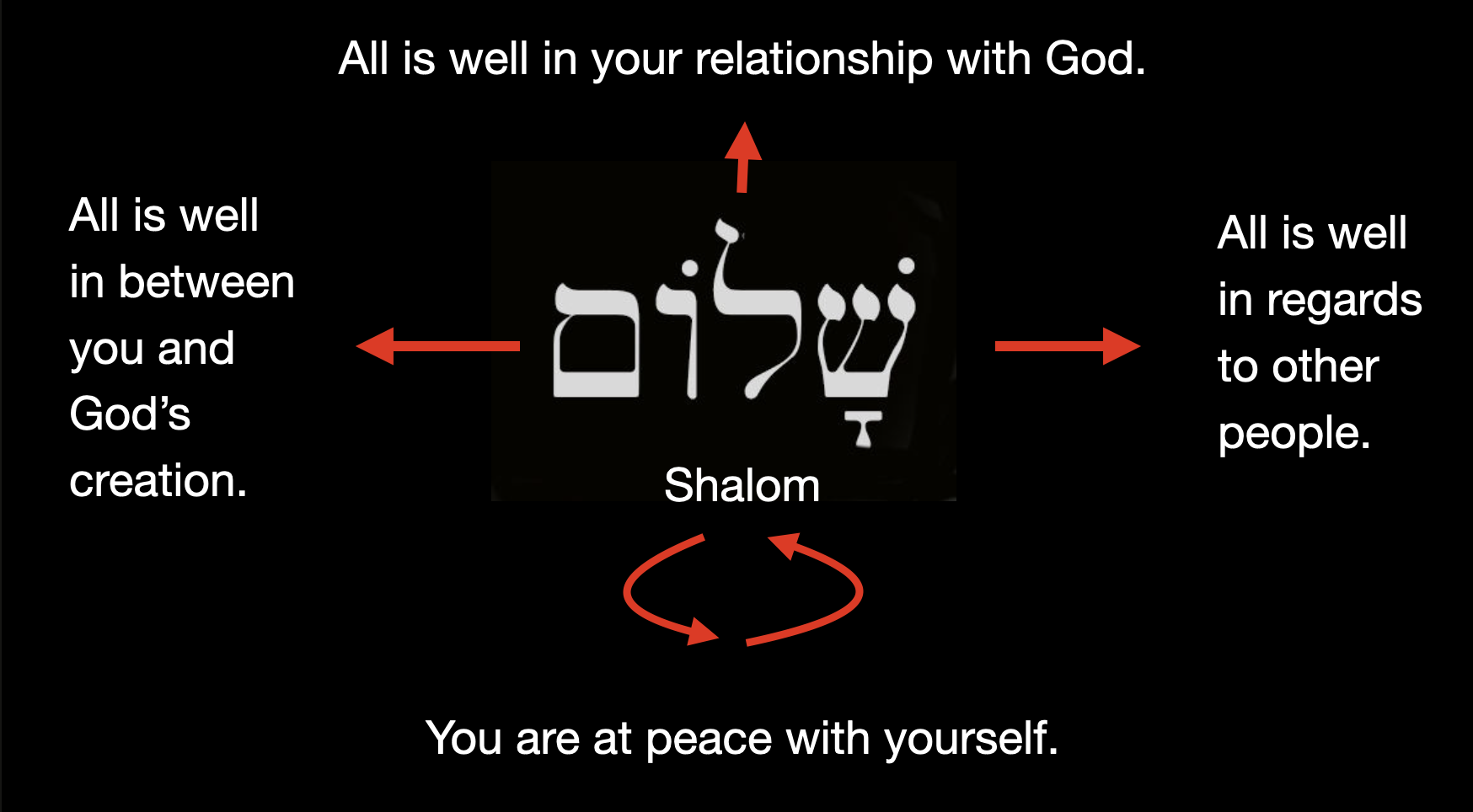
  In Acts 8, Shalom was disturbed due to this great persecution of the followers of Jesus.

Acts 8:3  But Saul was ravaging the church, and entering house after house, he dragged off men and women and committed them to prison.

All was not well.   And when this persecution hit hard, as we discussed the last few weeks, the people scattered.  Philip ended up in Samaria.  Some went further north up to Damascus in Syria.  That brings us to chapter 9.

Acts 9:1-9   But Saul, still breathing threats and murder against the disciples of the Lord, went to the high priest and asked him for letters to the synagogues at Damascus, so that if he found any belonging to the Way, men or women, he might bring them bound to Jerusalem. Now, as he went on his way, he approached Damascus, and suddenly a light from heaven shone around him. And falling to the ground, he heard a voice saying to him, “Saul, Saul, why are you persecuting me?  And he said, “Who are you, Lord?” And he said, “I am Jesus, whom you are persecuting. But rise and enter the city, and you will be told what you are to do.” The men who were traveling with him stood speechless, hearing the voice but seeing no one. Saul rose from the ground, and although his eyes were opened, he saw nothing. So they led him by the hand and brought him into Damascus. And for three days he was without sight, and neither ate nor drank.

We have all heard news reports of rare incidents in which police mistakenly raid the wrong house.   Imagine waking up in the middle of the night to the sound of your front door being bashed open, a flash-bang grenade going off in your living room, and then a heavily armed SWAT team entering your home.  Unfortunately, it happens.  Sometimes the tip the police received was incorrect, or the address was incomplete, or a simple error was made. The police did not mean to raid the wrong house.  They had warrants signed by a judge granting them authority to enter the home at that address.  They were well-trained.  They were putting forth their best effort in the raid.  They were highly motivated to apprehend the suspect and protect the public. But they were utterly wrong.

That is what is happening with Saul in Acts 9.  Saul has papers from the high priest authorizing him to go into homes, arrest people, and bring them back to Jerusalem.  Saul is one of the best-trained scholars of scripture alive in his day.  He is giving 100% effort to rid the country of these Jesus followers, to protect the public from heresy.  He is highly motivated, going into homes and dragging out the followers of this splinter group.  And he is entirely wrong.  

In Saul’s mind, he is a soldier defending God’s honor. He is cleaning up Israel. He is protecting the faith. If anyone asked Saul, “Why are you doing this?” he would have said, “Because I love God!”  But he is 100% wrong.  Because sincerity does not make you right, commitment does not equal correctness, and power does not equal purity.   Legal process does not equal morality, nor does strength of conviction make you holy.   Passion without truth is dangerous.  

God has to intervene.  So he throws his own flashbang grenade at Saul’s feet, knocking him to the ground and blinding him.   And the voice from heaven asks Saul, “Saul, Saul, why are you persecuting me?”  Not why are you persecuting these people, or why are you persecuting these followers, but why are you persecuting me?  Then Saul asks an essential question: “Who are you, Lord?”

At this point, Paul is aware he is not dealing with humanity.  This blinding flash of light was nothing any human could produce.  Is he dealing with an angel, or God himself?  So he asks, “Who are you, Lord?  (Lord being the equivalent of us saying a very respectful “sir”.)  The voice responds: “I am Jesus, whom you are persecuting.”  This is a lot for Saul.  First, the voice is Jesus, whom he had been told was dead, crucified as a criminal, a blasphemer.  But instead, Jesus is very much alive.  And Jesus wields the power of God.  And Saul finds that he is not rescuing people from a heresy, but waging war against God himself.  So God gives Saul a three-day timeout.  Three days to consider all of this.  Three days when he can not see.  And he fasts from food and drink.  And you can bet blind Saul prayed, and prayed hard.

Saul thought he was waging war with these heretics who had disturbed the peace of Jerusalem.  But it was Saul who was disturbing the shalom of God by waging this war.  This story is an example of a great paradox of the message of Jesus.  As many of you read in our Advent reading this past week, the prophets say that the Messiah will come as the Prince of Peace.

Isaiah 9:6   For unto us a child is born, to us a son is given; and the government shall be upon his shoulder: and his name shall be called Wonderful, Counsellor, Mighty God, Everlasting Father, Prince of Peace.”

The Messiah is the ‘Prince of Peace.’  And the first to hear the news of Jesus’ birth were the shepherds in the field with their sheep, who heard it from the angels.  We sing it in the hymn, “It Came Upon the Midnight Clear”:

“It Came Upon the Midnight Clear, 
That glorious song of old.
From angels bending near the earth,
To touch their harps of gold;
“Peace on the earth, goodwill to men, 
From Heav’n’s all-gracious King.”

Isaiah said He is the ‘Prince of Peace’.  The angels sang that he comes to bring peace on earth.  But then how do we reconcile what Jesus says here:

Matthew 10:34-36   Do not think that I have come to bring peace to the earth. I have not come to bring peace, but a sword. For I have come to set a man against his father, and a daughter against her mother, and a daughter-in-law against her mother-in-law. And a person’s enemies will be those of his own household.

 How do we reconcile these two passages?  The peace that Jesus brings is first and foremost peace with God.  True shalom with God.  Before Jesus, we had no peace with God.  Paul says it this way:

Romans 8:7-8  “For the mind that is set on the flesh is hostile to God, for it does not submit to God’s law; indeed, it cannot. Those who are in the flesh cannot please God.  

When you are in your sin, there is hostility towards God.  You are living on the king’s land, but you do not follow the king’s rules.  You are a rebel.  You are waging war with God.  The only way to end your rebellion is to ask for forgiveness, which God freely grants through Jesus. And then to begin to live a different life that is not in rebellion to the king’s rule, but to follow him in obedience.  As Paul says in the preceding verse:  

Romans 8:6 “For to set the mind on the flesh is death, but to set the mind on the Spirit is life and peace.

You can choose peace with God (shalom) or hostility towards God.  There is no middle ground.  See this again in James:  

James 4:4 (NLT)  Don’t you realize that friendship with the world makes you an enemy of God? I say it again: If you want to be a friend of the world, you make yourself an enemy of God. 

You have to choose.  Jesus told his disciples that peace with God can be theirs:

John 14:27 (NLT)   I am leaving you with a gift—peace of mind and heart.  And the peace I give is a gift the world cannot give.  So don’t be troubled or afraid.

And the Bible is consistent.  For though the carol said “it came upon the midnight clear,” “Peace on the earth, goodwill to men, from Heaven’s all-gracious King.”  That is not what the angels said.  Here is what the angels actually said:

Luke 2:14 “Glory to God in the highest, and on earth peace among those with whom he is pleased! 

Wait, there is a catch to that peace with God the angels sang about.  The only ones who get peace are those with whom God is pleased.  Those who are in right relationship with him.  Those who follow his son Jesus in salvation and obedience.  They have peace, shalom, with God. Everyone else is still at war with God.  So let’s see that in a carol that gets it right, “Hark! the Herald Angels Sing”.  

Hark! The herald angels sing,  
Glory to the newborn King!  
Peace on earth, and mercy mild, 
God and sinners reconciled.

Peace on earth is tied to this:  God and sinners reconciled.  There is no peace for us with God until we are reconciled to him through the forgiveness of our sins and the promise we make to follow him as our Lord and live in obedience to him.  

Now look what happens with Saul.  Saul discovers on the Damascus Road that he and his SWAT teams are raiding the wrong house.  He is an enemy of God.  Once Saul stops fighting Jesus, he begins an incredible journey of reconciliation.  After he is reconciled to God, he will eventually seek fellowship with the same followers he persecuted.  And he will become a leader in this fellowship, a missionary of reconciliation.

Paul calls peace a fruit of the Holy Spirit living within us, and he says:

Romans 12:18 If possible, so far as it depends on you, live peaceably with all.

But none of that can happen until his heart is made right with God.  Jesus tried to make this clear to his disciples in John 16:

John 16:33  I have said these things to you, that in me you may have peace…

You may have shalom, peace with God.  You are at peace with God when you are in a right relationship with Him. But that is not the end of the verse.  Keep reading to see the paradox.

John 16:33  I have said these things to you, that in me you may have peace.  In the world, you will have tribulation.

If you don’t understand shalom, if you don’t understand the kind of peace Jesus is talking about, then this verse makes no sense.  “Which is it, Jesus, peace or tribulation?”  But when you have peace with God, you are then at war with the world.  You will have tribulation.  And now, finish the verse to see the best news.  

John 16:33  I have said these things to you, that in me you may have peace. In the world, you will have tribulation.  But take heart; I have overcome the world.

Your enemy, the world, has already been defeated.  The way of this world, what the Bible calls the way of the flesh, was defeated on the cross of Jesus.  Sin, which kept us enemies of God, was defeated, so now we can be friends with God.  And then death was defeated.  Jesus has overcome.  The outcome of the war has been decided.  But the battle still rages within us as long as we persist in disobedience. 

Peace can be ours now if we seek Him and obey Him.  And complete peace, complete shalom, will exist in this world one day.   The Prince of Peace will reign over all, and there will be no more enemies.  Come, Lord Jesus, come.  

Saul’s transformation begins with two simple questions: the first, “Who are You, Lord?”  This is the most critical question.  Who is Jesus to Saul at this moment of the blinding light?  He is no one to Saul, just a teacher whom the Romans killed.  But it is in this moment that Saul realizes who Jesus really is, the living Son of God.  And this makes all the difference for Saul.

Then the second question:  “What do you want me to do?” Now that Saul knows who Jesus is, he wants to listen to Jesus and obey him.  This is shema, hear and obey.  And that leads to peace with God.   Shema leads to shalom.  You have to shema (listen and obey) before you find shalom, peace with God.  Peace with God requires listening and obeying.  In Acts 8, Saul’s relationship with God is like a child pulling on a rope in a tug-of-war against his father.  He pulls with all his strength until he is exhausted. It is hopeless.  Finally, the father smiles at the child.  And the child puts the rope aside, and the father embraces the child. The child’s peace didn’t come from winning the battle—it came from surrendering into the father’s arms.   It is here in Acts 9 that Saul drops the rope and surrenders to Jesus. So must we.

It was Christmas Day, and Henry Wadsworth Longfellow was listening to the church bells ring out, representing the angels’ proclamation of peace on earth, goodwill to men.  But Longfellow had no peace.  It is 1863.  He recently lost his wife in a tragic accident.  And his son, Charles, was away fighting in our country’s brutal Civil War. And in the midst of this turmoil, he pens these words:

I heard the bells on Christmas Day
, Their old, familiar carols play,
And wild and sweet
The words repeat
Of peace on earth, goodwill to men!

And thought how, as the day had come,
The belfries of all Christendom
Had rolled along
The unbroken song
Of peace on earth, goodwill to men!

Till ringing, singing on its way,
The world revolved from night to day,
A voice, a chime,
A chant sublime
Of peace on earth, goodwill to men!

Then from each black, accursed mouth
The cannon thundered in the South,
And with the sound
The carols drowned
Of peace on earth, goodwill to men!

It was as if an earthquake rent
the hearthstones of a continent,
and made forlorn
the households born
of peace on earth, goodwill to men!

And in despair I bowed my head;
“There is no peace on earth,” I said;
“For hate is strong,
And mocks the song
Of peace on earth, goodwill to men!”

Then pealed the bells more loud and deep:
“God is not dead, nor doth He sleep;
The Wrong shall fail,
The Right prevail,
With peace on earth, goodwill to men.”

God is not dead, nor doth he sleep.  Jesus is indeed the Prince of Peace.  Jesus wants us to have that shalom with him, that right relationship that comes with His forgiveness and salvation.  The peace that comes by shema — listening to the voice of God and being obedient.  

This Christmas season, I want you to consider your peace with God.  How is that relationship?  Could it use more communication?  Could it use more obedience?  We earnestly seek the peace of God in our lives, even as we yearn for the day when God’s peace will reign supreme in this world.  We look forward to that day when God redeems the earth, that day when all is well.
May 31, 27 A.D.  Healing at the Pool of Bethesda – The Year of the Lord’s Favor #34

Week 15 ———  Healing at the Pool of Bethesda
John 5:1-18

John 5:1  After this, there was a feast of the Jews, and Jesus went up to Jerusalem.
2   Now there is in Jerusalem by the Sheep Gate a pool, in Hebrew called Bethesda, which has five roofed colonnades. 
3   In these lay a multitude of invalids—blind, lame, and paralyzed. 
5   One man was there who had been an invalid for thirty-eight years. 
6   When Jesus saw him lying there and knew that he had already been there a long time, he said to him, “Do you want to be healed?” 
7   The sick man answered him, “Sir, I have no one to put me into the pool when the water is stirred up, and while I am going another steps down before me.” 
8   Jesus said to him, “Get up, take up your bed, and walk.” 
9   And at once the man was healed, and he took up his bed and walked.  Now that day was the Sabbath. 
10  So the Jews said to the man who had been healed, “It is the Sabbath, and it is not lawful for you to take up your bed.”
11   But he answered them, “The man who healed me, that man said to me, ‘Take up your bed, and walk.’” 
12   They asked him, “Who is the man who said to you, ‘Take up your bed and walk’?” 
13   Now the man who had been healed did not know who it was, for Jesus had withdrawn, as there was a crowd in the place. 
14   Afterward Jesus found him in the temple and said to him, “See, you are well! Sin no more, that nothing worse may happen to you.” 
15   The man went away and told the Jews that it was Jesus who had healed him. 
16   And this was why the Jews were persecuting Jesus because he was doing these things  on the Sabbath. 
17   But Jesus answered them, “My Father is working until now, and I am working.”
18   This was why the Jews were seeking all the more to kill him, because not only was he breaking the Sabbath, but he was even calling God his own Father, making himself equal with God

John 5:1 After this, there was a feast of the Jews, and Jesus went up to Jerusalem.
John doesn’t specify this feast. You know which feast comes next if you have studied the Old Testament. Those with only cursory knowledge might know of only Passover and not the other ‘appointed times,’ which may lead to their assuming every feast is Passover. (If this was another Passover, then a year has passed since John 2, and there is another Passover in John 6:4, which means that almost nothing happens in 2 years of their presumed 3-year ministry of Jesus.)  The timing we are using in this 70-week ministry of Jesus fits well, and we know that the next feast is Shavuot (the Feast of Weeks), which is 50 days after Passover.  

The physical setting of this story is the Pool of Bethesda, and the story of this pool is complicated. John’s gospel has two stories of healing in Jerusalem, and they both involve pools. For centuries, scholars said these pools did not exist and that the Gospel of John was historically unreliable, written by someone (not John, the disciple) who had never been to Jerusalem. They said the pools didn’t exist because they had not found evidence of them in excavations yet.  

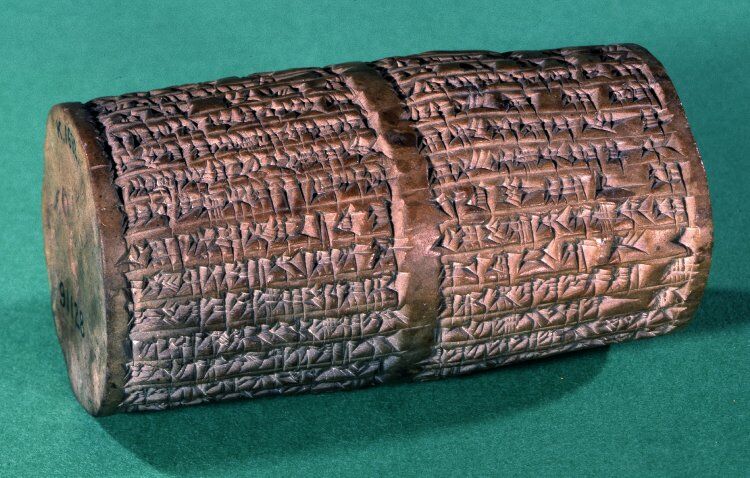
This is a recurring theme—the science of archeology disproves the Bible because we haven’t found it yet. Scholars said that Belshazzar, the king of Babylon in Daniel, never existed, for there was no record of him; thus, the book of Daniel was fiction. That is until they found this clay cylinder in 1854 that told the story of Belshazzar, forcing them to rewrite their history books to match the Bible.

The Hittites are mentioned throughout the Old Testament, but scholars maintained the Bible just made them up.  They insisted they never existed because they couldn’t find mention of the empire anywhere.  Now, it is one thing to deny the presence of one man, but it is a whole other level to deny the existence of an entire nation.  Then, in the early 1900s, they discovered in modern-day Turkey the city of Hattusha, a vast city of the Hittites with a library with over 10,000 tablets.  Again, the history books must be rewritten to align with Biblical History.

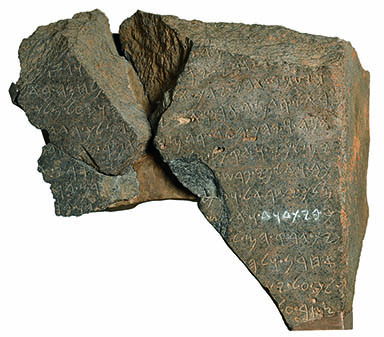
Scholars also had no evidence of a king over Israel named David or a House of David as his descendants who reigned in Israel. The House of David is a significant historical fact in a large portion of the Bible and is essential in the lineage of the Messiah. Scholars said David was merely an Israeli legend—until 1993 when a stele was found that describes the kings who were descendants of David as from the “house of David.”  

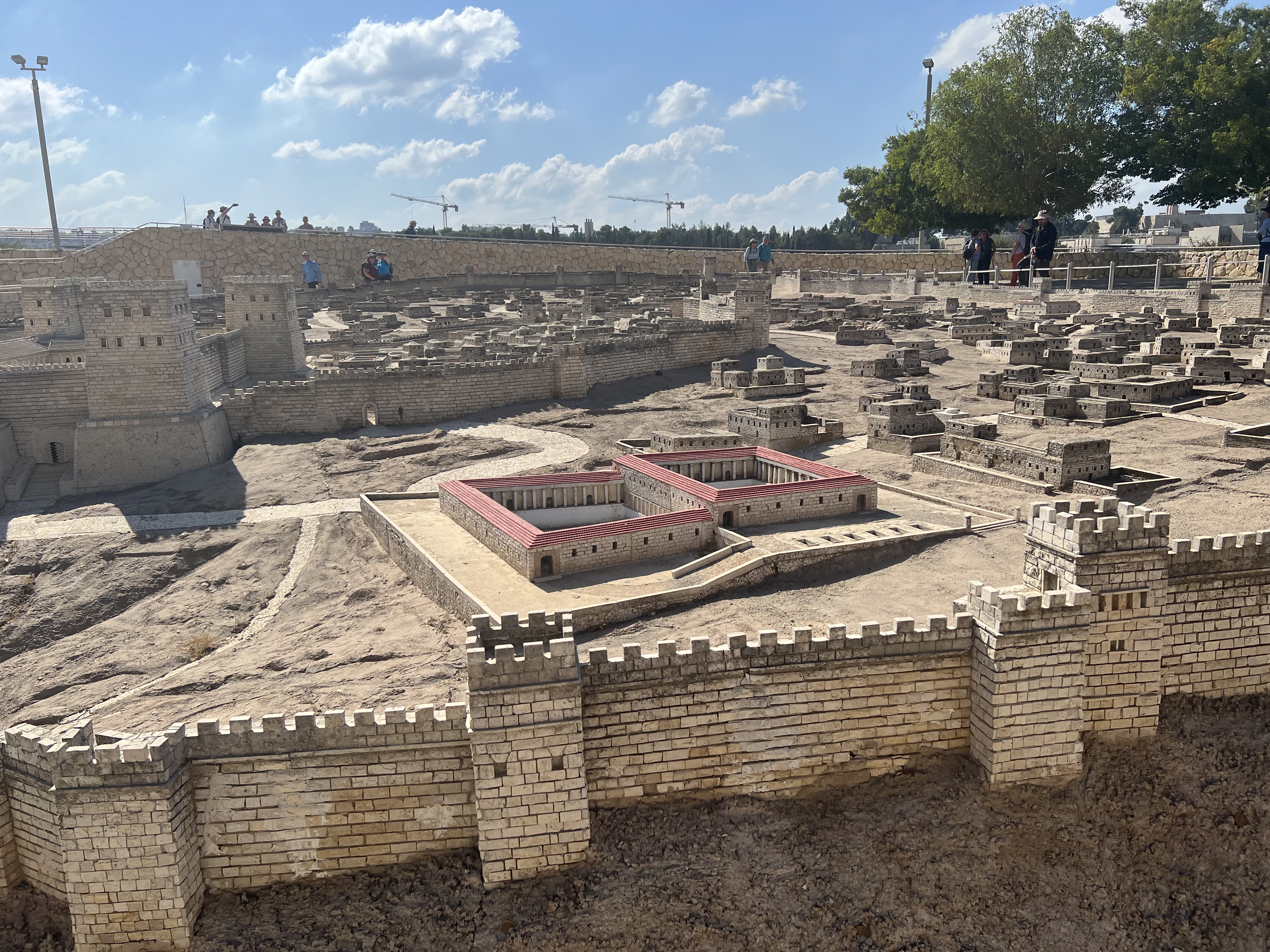
Archeology and history are important and developing sciences that have brought us a better understanding of the culture of the Bible.  But to say something does not exist because we haven’t found it yet is unreasonable. (If you ever lose your car keys, don’t call a historian and an archeologist to help you look for them; they will say that your car never had any keys and the keys don’t exist.) The pool of Bethesda is described as having five porticos (covered porches).  Archeologists had looked for a pool with five sides but found none.  Then, they found this double pool in the late 1800s with a dividing portico. (Thus, there are four side porticos and one between the pools.)  It is located just south of the temple area in Jerusalem.   Here it is in the model of First Century Jerusalem.1

Look back on our scripture from this morning.  Notice anything missing?  
There is no verse 4 in this ESV version.  In fact, verse 4 is missing from most modern translations.  Here is verse 4 in the King James Version:

4  For an angel went down at a certain season into the pool, and troubled the water: whosoever then first after the troubling of the water stepped in was made whole of whatsoever disease he had.

This is one of several examples where notes were inserted into later versions and became part of the text.  It is easy to see how this one happened.  Verse seven has the man saying, 

“Sir, I have no one to put me into the pool when the water is stirred up, and while I am going another steps down before me.”

Remember that until the invention of the printing press in the 1400s, all scripture (and all other books) was copied by hand.  What likely happened is that when copying the Bible, someone added a note explaining the reason the invalid needs to go into the pool when the water is stirred up.  Frequently, scribes add notes in the margin of the text when copying.  The problem is that the next scribe copying his work thinks that the writing in the margin is a verse that he accidentally omitted and had to write in the margin.  So that next scribe inserts it into the text. The first scribe’s note has become part of the ‘scripture.’

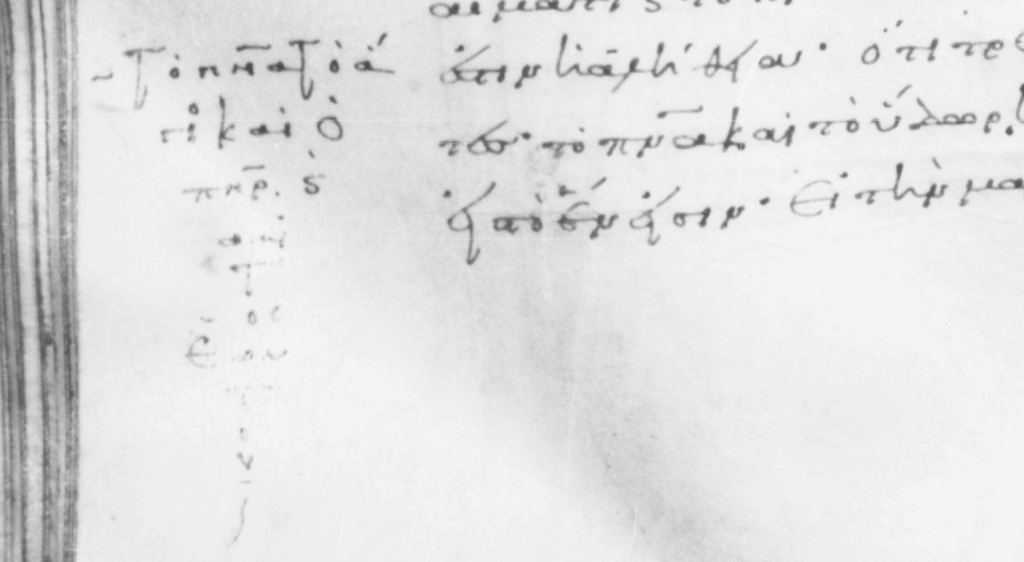
Here is a clear example of this.  In this copy of 1 John, the copyist wrote a note in the margin.  You can look at the earlier version of this exact text; the note is not there.  The version copied from this one incorporates the note into the text as if it were part of the original text. (1 John 5:7b-8)

Our oldest and most reliable texts do not have verse four in this passage.  The KJV relied on manuscripts after 1100 AD, while we now have manuscripts almost 1000 years earlier.  None of our texts before 500 AD have verse 4. 

 There was quite a stir when the NIV was published, and there were 49 verses “missing.” Oddly, I found this same dire warning on a friend’s FaceBook post this week after I wrote this.  Do not let this trouble you.  We are just trying to ensure we are using the most accurate copies.  I have friends who write notes in the margins of their Bibles.  I don’t think any of them want their notes to be incorporated into scripture.  In a few weeks, I will show you the one I am sure the NIV should have left out but did not.

The set of two pools functioned well as a mikvah for ceremonial bathing, which was required before entering the Temple.2  The water in mikveh had to be “living water,” flowing water from a natural source, not drawn from a well.  The upper pool would catch rainwater as it fell and serve as a holding tank.  Then, as needed, a door was opened in the wall between the pools to allow water to flow into the lower pool.   This would ensure the lower pool would not become stagnant.  When the water flowed, it was not hard to imagine that it would be ‘stirred.’   Then, it became a superstition or legend to the point that there was a multitude of people there who were “blind, lame, or paralyzed.”  People desperate for healing will believe and try almost anything. 

I am not fond of the word ‘invalid.’  I know it literally means “not strong,” and we have taken it to mean ‘weak from disease or injury,’ but it is too close to ‘invalidate’ and makes it sound (to me) like we are saying ‘worthless.’  When you have been sick for a long time, it is easy to feel worthless. And this man had been in this position for 38 years.  And now he has put his hope on healing on a pagan myth.  

Jesus sees him and doesn’t see him as worthless.  He doesn’t preach to him about his pagan thoughts.  He sees a man who has suffered for a long time and is now hopeless.  There is a lot we could talk about in this passage.  The Pharisees make a big deal because this healing took place on a Sabbath, and the man was carrying his mat, breaking their rules.  ‘Bethesda’ means house of mercy.  They ignore the miracle; they care nothing about the mercy shown and that this man is now able to walk; they focus on their own picky rule about what you can and can’t carry on the Sabbath because Jesus is a threat to their system.  But I want to focus on two things I think are important in this passage: First, Jesus’s aspect of healing, and Second, how about the other people who were there for healing but were not healed?

Jesus asks this man an odd question, and the King James Version does a better job with this translation:  “Wilt thou be made whole?”  Other versions say “…be made well” or “…be healed,” but wholeness is what Jesus is really talking about. He could have said, “Do you want to be able to walk?” but that is only one thing this man needs. He needs more than the use of his legs.  

There is a difference between being well and being whole.  There is a word in Hebrew for wholeness that I suspect Jesus would have used when he talked to this man.  It is ‘shalom.’  Shalom can be translated strictly as ‘peace.’  We define peace as an absence of war with our enemies.  The Hebrew definition is not just an absence of war but whole and complete relations with everyone and God.  Shalom is how God meant the world to be, how he created the garden in Eden to be — a place where people are in proper relations with others and with God.  Sin destroys shalom.  It breaks our relationship with others and with God.  And God is in the process of returning the world to the way it was in the garden.

When Isaiah predicts the coming Messiah, he calls him the ‘Prince of Shalom.’  Why is Jesus called the ‘Prince of Peace’?  Because only through what Jesus accomplishes on the cross can we again have true peace with God.  

Rom. 5:1   Therefore, since we have been justified by faith, we
                  have shalom with God through our Lord Jesus Christ.

Our sins broke the relationship, broke the peace.  By taking away our sins, our shalom with God can be restored.  But shalom with God is more than just a removal of our sins.  It is walking with God hand in hand, as Adam did in the garden.  Note that walking with God means walking in the same direction.  We must go God’s way to be in step with God.  If you are setting your own path and not depending on God to pick the path, then you can not walk with God.

Wholeness begins with a right relationship with God.  It is essential to get this vertical relationship settled first.  You can’t have proper relationships with any other person (horizontal relationship) until you are whole in your relationship with God.  We live in a world where over 50% of marriages end in divorce.  Why do so many relationships fail? Les Parrot, a professor of psychology, ordained pastor, and New York Times bestselling author, says the primary problem is that people believe in the romantic fairy tale and that we need to find that person who will make us whole.  We have bought into the fairy tale that there is one person out there who will make us complete.  He says most relationships fail because we rush into them before we are whole -before we settle the most important relationship with God.  Wholeness begins with a right relationship with God but does not end there.

To have true shalom, you must also be in the right relationship with others. You can’t have a broken relationship with one of God’s children and a right relationship with the Father.  

1 John 4:20-21   If anyone says, “I love God,” and hates his brother, he is a liar; for he who does not love his brother whom he has seen cannot love God whom, he has not seen. And this commandment we have from him: whoever loves God must also love his brother.

Again, you can’t be in a feud with one of God’s kids and say you love the Father.  This is why Jesus says, “Love your enemies”. 

In the Sermon on the Mount, Jesus says, “You have heard it said, do not murder, but I say to you, don’t be angry with your brother.”  Jesus has zero tolerance for broken relationships.  He wants us to have Shalom. (note)

In that same passage, Jesus tells us to walk out of the church and not to give an offering.

Matthew 5:23-24   So, if you are offering your gift at the altar and there remember that your brother has something against you, leave your gift there before the altar and go. First, be reconciled to your brother, and then come and offer your gift. 

I am still waiting for a preacher to stand up before the offering and say, “If you are about to put some money in the offering plate, and there is any person that you are not getting along with, then do not put the money in the offering plate until you have gone to them and made things right.”

Do you see how important shalom is to God?  It is so important that it became the traditional greeting of people when they met in the Old Testament, and it is still among those who speak Hebrew today.  Typically, you hear “Shalom aleichem,”  which means “peace be unto you.”  And the usual response is “Aleichem shalom,” meaning “Unto you peace.”   We often greet people with “How are you?” or “How is it going?”  The Hebrew equivalent of this is “Mah Shalomcha,”  or “How is your shalom,” or “How is your peace?”  The idea of peace and proper relations with God and others is so important.4

So Jesus asks this man, “Do you want to be whole?”  Because wholeness is more than regaining the ability to walk.  He has been down for 38 years.  Have you ever been sick for an extended period of time?  There is depression. There are thoughts that God has forgotten you or doesn’t care about you. There are feelings of uselessness. You begin to see the world differently and develop attitudes that harm your relationship with others.  Jesus sees a man who needs more than physical healing.  He needs shalom.

The man answers Jesus:
“Sir, I have no one to put me into the pool when the water is stirred up, and while I am going another steps down before me.”

He tells Jesus why he can’t get the pagan healing he is waiting for.  And Jesus does not rebuke him for his pagan beliefs.  He does not ask him to correct his theology.3  He simply says, “Rise up and walk.”   And he does.  Jesus starts him on a path to shalom by removing what this man saw as his primary problem.  Then Jesus leaves so quickly that the man doesn’t have time to get his name.   That brings me to the more difficult question this morning.   We know that there was a ‘multitude’ of sick people there at the pool.  Why did Jesus only heal this one and then quickly leave?  We could reason out some possible answers, such as that he knew the Pharisees would be after him if he hung around.  However, as we read the scriptures, there are other people Jesus doesn’t heal.  

For example, the man Peter and John see at the gate of the Temple in Acts 3:
Acts 3:1-10   Now Peter and John were going up to the temple at the hour of prayer, the ninth hour.  And a man lame from birth was being carried, whom they laid daily at the gate of the temple that is called the Beautiful Gate to ask alms of those entering the temple.   Seeing Peter and John about to go into the temple, he asked to receive alms.  And Peter directed his gaze at him, as did John, and said, “Look at us.”  And he fixed his attention on them, expecting to receive something from them.  But Peter said, “I have no silver and gold, but what I do have I give to you.  In the name of Jesus Christ of Nazareth, rise up and walk!”  And he took him by the right hand and raised him up, and immediately his feet and ankles were made strong.   And leaping up, he stood and began to walk, and entered the temple with them, walking and leaping and praising God.   And all the people saw him walking and praising God, and recognized him as the one who sat at the Beautiful Gate of the temple, asking for alms. And they were filled with wonder and amazement at what had happened to him.

This man has been daily at this gate of the Temple for a long time.  Acts 4:22 tells us he is 40 years old.  He is well-known to many people who pass by him frequently.  Jesus likely passed by him many times, but he was not healed then.  We know Jesus healed in the Temple.

Matt. 21:14   And the blind and the lame came to him in the temple, and he healed them.

Why was he not in the group healed then?  Why was he passed by without healing?  We can ask the same question ourselves.  Why doesn’t God heal everyone?

In High School, I had a friend hit by a car.  I prayed hard for him that he would survive.  He did not.  I spent hours beside my little friend Patrick’s bed when I was a resident at Children’s Hospital in Boston.  I could not bear the thought of this sweet 4-year-old dying after his Bone Marrow Transplant.  He had been through so much with Leukemia and remissions.  I had taken care of him for years.  He did not survive.  Last year, I got the call that my brother was being rushed to the hospital in serious condition.  Many prayed.  He did not recover.  Far too many times, I have found myself praying while I am in the middle of resuscitating a premature newborn that God will perform a miracle and allow these too-young lungs to function.  Far too many times, I have had to walk into a room and tell young parents the baby did not make it. We all know friends and family that we have prayed for who did not receive healing.

Why does God not heal everyone?  
He could. Sometimes, we don’t help people because we lack the resources. Some wonderful people read this blog.  I would love to give each person who reads this blog one million dollars just to see what they could do with it.  I’d like to, but I don’t have the resources. That is not God’s problem.  But there are other reasons we don’t help sometimes. We have learned this in our homeless ministry.  We have gotten calls from people to try to help get them out of jail.  But at that point in their life, jail is the best place for them.  Sometimes, you must let people hit rock bottom before they see they need to change their lives.  Sometimes, helping someone prevents them from ever learning to help themselves.  It creates dependence on you or others when they need to learn to handle their own problems.

For another explanation of why God doesn’t heal everyone, watch this clip from The Chosen.  Here, James the lesser (little James) is portrayed as a man with a severe limp.  He has just been told that the disciples will be sent out two by two and will be given the power to heal others.  James is puzzled by the fact that he will be able to heal others, but he himself has not been healed.  

Why did Jesus not heal this man?
For this man lame from birth, the Bible may give a clue in the name of the gate where he was placed.   The Greek word is ‘horaios,’ and the definition listed in Strong’s Greek Dictionary is “belonging to the right hour or season (timely), i.e. (by implication) flourishing (beauteous (figuratively)): — beautiful.”   It carries the idea of beauty due to its ‘ripeness,’ like a fruit ripens at a particular time or a flower blooms and is beautiful for just that moment.5  The writer of Ecclesiastes has that same idea:

Ecc. 3:11   He has made everything beautiful in its time. 

There is no record of a gate called “Beautiful” in any ancient document except in this section of Acts.  Therefore, we have no idea which gate they are referring to.  Perhaps it is because ‘beautiful’ is not the name of the gate but the situation.  This man was at the gate of ‘horaios, the right hour or season.’  It was the perfect time. And while he was hugging Peter and John, a stunned crowd gathers… and Peter preaches, and a thousand or more believe.  God had a purpose for that healing to happen at that exact chosen moment.  It was horaios – and it was beautiful. 

 I believe God will heal everyone one day.  One day, he will correct all wrong, cure all diseases, and bring about perfect justice.  Until then, we wait in a world full of sin and chaos for His promises to come.  We are told God will only give us good gifts.  It is hard to view horrible disease or death as good.  But we look through a glass darkly with our limited vision and understanding.  We also fail to see that our primary purpose in this world is not to live a carefree, uncomplicated life.  It is to bring glory to God.  Perhaps our illness or death will be the best way to fulfill that duty.  This is where we have to trust God.  He won’t ask us to suffer more than he asked Jesus to suffer.  The pain that Jesus endured was to bring glory to God and fulfill his will so that we may be saved.  But at the time, who could see that?  

So, how should we pray?  Most importantly, we should pray honestly.  If you study Psalms, you will see that the Psalmists are not afraid to express their deepest emotion to God, even if we might not think it is the “proper” way to speak to Yehovah.  We should, as the psalmist, pour our hearts out to God in requests for healing.  God knows your heart anyway.  But it is also acceptable to add to our heartfelt cry that we understand that God’s will may not be what we desire to happen and that we relinquish our will and ask Him to do His will.  This is how Jesus prayed in the garden.  “My Father, if it be possible, let this cup pass from me; nevertheless, not as I will, but as you will” (Matt 26.39).  This does not demonstrate a lack of faith to pray in this manner.  It was not for Jesus, and it is not for you.  In fact, it demonstrates your trust in God to vocalize your willingness to seek his will and not your own.

There is so much sickness, depression, and suffering in this world.  Many are waiting by the ‘beautiful gate’ for God’s perfect time for their healing; let it be now, or let it be in the world to come, but while we wait, let us seek wholeness, let us seek shalom.  Let us strive to be first in proper relationship with God and then in good relations with everyone.  And may our life give glory to the Father above in all we say and do.

  1. The Siloam pool, discussed in John 9, was rediscovered during excavation work for a sewer in the autumn of 2004.
  2. There is also a debate on whether the pool was built for ceremonial washing ( a mikvah) or was a pagan pool for the cult of Asclepius, or healing.  It was used as an Asclepion after the fall of Jerusalem, but I don’t think it was in the time of Jesus.  Certainly, Pharisees would not have been seen in such a pagan place.  Also, the steps are designed to function well as a mikvah.
  3. Good lesson.  Do what Jesus would do.  Just because someone’s theology seems wrong to you (even if you are right), sometimes you give them the help they need before you think about preaching to them.
  4. Paul, in Romans 12:18 says, “If possible, so far as it depends on you, live peaceably with all.”  Some people refuse to be reconciled no matter how hard you try.  (Jesus definitely understands this.)
  5. Greek has several words for time. Chronos is the usual generic word for time and is the root for our word chronology and others. Kairos refers to a special or appointed time or season. When Jesus says, “My hour has come,” the word for ‘hour’ is ‘kairos’. ‘Horaios is a smaller window of time than Kairos, a sacred moment, and is only seen four times in the New Testament, two of them in this passage.