
December 10, 2025 –  Shalom, and the War You Didn’t Realize You Were Fighting— Acts #24

December 10, 2025 –  Shalom, and the War You Didn’t Realize You Were Fighting— Acts #24
Acts 9:1-9

Words in Hebrew have very rich meanings. Last time, we discussed the Hebrew word ‘shema’Shema means listen, but more than listen, it means listen and obey.  Obedience is not optional.  If you did not obey, then you did not hear.  Jesus said, “He who has ears to hear, let him hear.” You will find a version of this 15 times in the New Testament. That isn’t just a poetic phrase Jesus threw out there.  He isn’t speaking English.  It is about shema.  Jesus is talking about obedience.   “If you hear what I am saying, then be obedient.”

Today, we look at the word Shalom.  It begins with the same letter, ש (shin).  It means peace.  And peace is the candle that many of you lit this past week for Advent.  But like the Hebrew word shema, this word has a richer meaning.  Shalom means more than our concept of peace.  It carries the idea of wholeness, that all is well, that all is well with you, and with your relationship with your neighbor, and in your relationship with God.
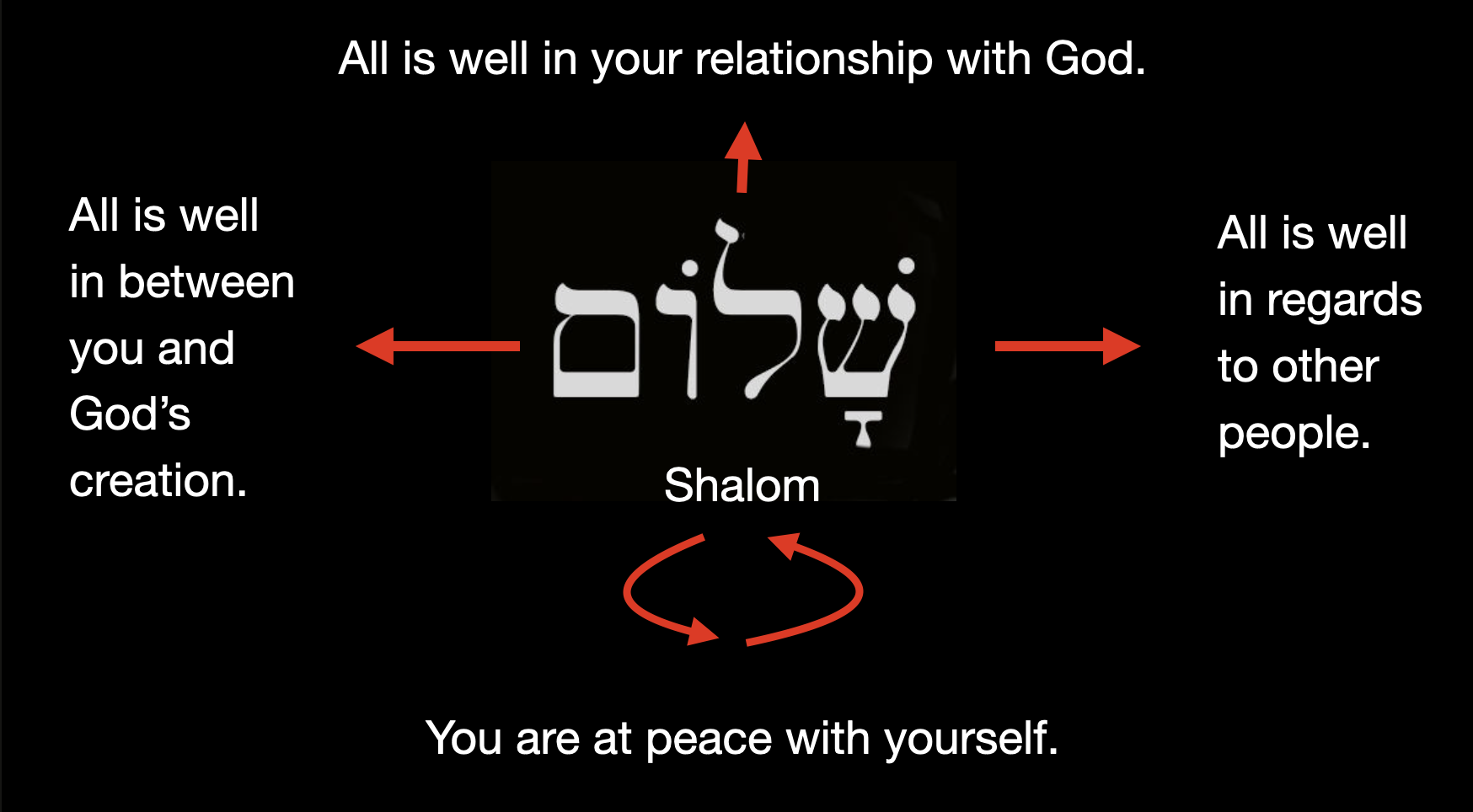
  In Acts 8, Shalom was disturbed due to this great persecution of the followers of Jesus.

Acts 8:3  But Saul was ravaging the church, and entering house after house, he dragged off men and women and committed them to prison.

All was not well.   And when this persecution hit hard, as we discussed the last few weeks, the people scattered.  Philip ended up in Samaria.  Some went further north up to Damascus in Syria.  That brings us to chapter 9.

Acts 9:1-9   But Saul, still breathing threats and murder against the disciples of the Lord, went to the high priest and asked him for letters to the synagogues at Damascus, so that if he found any belonging to the Way, men or women, he might bring them bound to Jerusalem. Now, as he went on his way, he approached Damascus, and suddenly a light from heaven shone around him. And falling to the ground, he heard a voice saying to him, “Saul, Saul, why are you persecuting me?  And he said, “Who are you, Lord?” And he said, “I am Jesus, whom you are persecuting. But rise and enter the city, and you will be told what you are to do.” The men who were traveling with him stood speechless, hearing the voice but seeing no one. Saul rose from the ground, and although his eyes were opened, he saw nothing. So they led him by the hand and brought him into Damascus. And for three days he was without sight, and neither ate nor drank.

We have all heard news reports of rare incidents in which police mistakenly raid the wrong house.   Imagine waking up in the middle of the night to the sound of your front door being bashed open, a flash-bang grenade going off in your living room, and then a heavily armed SWAT team entering your home.  Unfortunately, it happens.  Sometimes the tip the police received was incorrect, or the address was incomplete, or a simple error was made. The police did not mean to raid the wrong house.  They had warrants signed by a judge granting them authority to enter the home at that address.  They were well-trained.  They were putting forth their best effort in the raid.  They were highly motivated to apprehend the suspect and protect the public. But they were utterly wrong.

That is what is happening with Saul in Acts 9.  Saul has papers from the high priest authorizing him to go into homes, arrest people, and bring them back to Jerusalem.  Saul is one of the best-trained scholars of scripture alive in his day.  He is giving 100% effort to rid the country of these Jesus followers, to protect the public from heresy.  He is highly motivated, going into homes and dragging out the followers of this splinter group.  And he is entirely wrong.  

In Saul’s mind, he is a soldier defending God’s honor. He is cleaning up Israel. He is protecting the faith. If anyone asked Saul, “Why are you doing this?” he would have said, “Because I love God!”  But he is 100% wrong.  Because sincerity does not make you right, commitment does not equal correctness, and power does not equal purity.   Legal process does not equal morality, nor does strength of conviction make you holy.   Passion without truth is dangerous.  

God has to intervene.  So he throws his own flashbang grenade at Saul’s feet, knocking him to the ground and blinding him.   And the voice from heaven asks Saul, “Saul, Saul, why are you persecuting me?”  Not why are you persecuting these people, or why are you persecuting these followers, but why are you persecuting me?  Then Saul asks an essential question: “Who are you, Lord?”

At this point, Paul is aware he is not dealing with humanity.  This blinding flash of light was nothing any human could produce.  Is he dealing with an angel, or God himself?  So he asks, “Who are you, Lord?  (Lord being the equivalent of us saying a very respectful “sir”.)  The voice responds: “I am Jesus, whom you are persecuting.”  This is a lot for Saul.  First, the voice is Jesus, whom he had been told was dead, crucified as a criminal, a blasphemer.  But instead, Jesus is very much alive.  And Jesus wields the power of God.  And Saul finds that he is not rescuing people from a heresy, but waging war against God himself.  So God gives Saul a three-day timeout.  Three days to consider all of this.  Three days when he can not see.  And he fasts from food and drink.  And you can bet blind Saul prayed, and prayed hard.

Saul thought he was waging war with these heretics who had disturbed the peace of Jerusalem.  But it was Saul who was disturbing the shalom of God by waging this war.  This story is an example of a great paradox of the message of Jesus.  As many of you read in our Advent reading this past week, the prophets say that the Messiah will come as the Prince of Peace.

Isaiah 9:6   For unto us a child is born, to us a son is given; and the government shall be upon his shoulder: and his name shall be called Wonderful, Counsellor, Mighty God, Everlasting Father, Prince of Peace.”

The Messiah is the ‘Prince of Peace.’  And the first to hear the news of Jesus’ birth were the shepherds in the field with their sheep, who heard it from the angels.  We sing it in the hymn, “It Came Upon the Midnight Clear”:

“It Came Upon the Midnight Clear, 
That glorious song of old.
From angels bending near the earth,
To touch their harps of gold;
“Peace on the earth, goodwill to men, 
From Heav’n’s all-gracious King.”

Isaiah said He is the ‘Prince of Peace’.  The angels sang that he comes to bring peace on earth.  But then how do we reconcile what Jesus says here:

Matthew 10:34-36   Do not think that I have come to bring peace to the earth. I have not come to bring peace, but a sword. For I have come to set a man against his father, and a daughter against her mother, and a daughter-in-law against her mother-in-law. And a person’s enemies will be those of his own household.

 How do we reconcile these two passages?  The peace that Jesus brings is first and foremost peace with God.  True shalom with God.  Before Jesus, we had no peace with God.  Paul says it this way:

Romans 8:7-8  “For the mind that is set on the flesh is hostile to God, for it does not submit to God’s law; indeed, it cannot. Those who are in the flesh cannot please God.  

When you are in your sin, there is hostility towards God.  You are living on the king’s land, but you do not follow the king’s rules.  You are a rebel.  You are waging war with God.  The only way to end your rebellion is to ask for forgiveness, which God freely grants through Jesus. And then to begin to live a different life that is not in rebellion to the king’s rule, but to follow him in obedience.  As Paul says in the preceding verse:  

Romans 8:6 “For to set the mind on the flesh is death, but to set the mind on the Spirit is life and peace.

You can choose peace with God (shalom) or hostility towards God.  There is no middle ground.  See this again in James:  

James 4:4 (NLT)  Don’t you realize that friendship with the world makes you an enemy of God? I say it again: If you want to be a friend of the world, you make yourself an enemy of God. 

You have to choose.  Jesus told his disciples that peace with God can be theirs:

John 14:27 (NLT)   I am leaving you with a gift—peace of mind and heart.  And the peace I give is a gift the world cannot give.  So don’t be troubled or afraid.

And the Bible is consistent.  For though the carol said “it came upon the midnight clear,” “Peace on the earth, goodwill to men, from Heaven’s all-gracious King.”  That is not what the angels said.  Here is what the angels actually said:

Luke 2:14 “Glory to God in the highest, and on earth peace among those with whom he is pleased! 

Wait, there is a catch to that peace with God the angels sang about.  The only ones who get peace are those with whom God is pleased.  Those who are in right relationship with him.  Those who follow his son Jesus in salvation and obedience.  They have peace, shalom, with God. Everyone else is still at war with God.  So let’s see that in a carol that gets it right, “Hark! the Herald Angels Sing”.  

Hark! The herald angels sing,  
Glory to the newborn King!  
Peace on earth, and mercy mild, 
God and sinners reconciled.

Peace on earth is tied to this:  God and sinners reconciled.  There is no peace for us with God until we are reconciled to him through the forgiveness of our sins and the promise we make to follow him as our Lord and live in obedience to him.  

Now look what happens with Saul.  Saul discovers on the Damascus Road that he and his SWAT teams are raiding the wrong house.  He is an enemy of God.  Once Saul stops fighting Jesus, he begins an incredible journey of reconciliation.  After he is reconciled to God, he will eventually seek fellowship with the same followers he persecuted.  And he will become a leader in this fellowship, a missionary of reconciliation.

Paul calls peace a fruit of the Holy Spirit living within us, and he says:

Romans 12:18 If possible, so far as it depends on you, live peaceably with all.

But none of that can happen until his heart is made right with God.  Jesus tried to make this clear to his disciples in John 16:

John 16:33  I have said these things to you, that in me you may have peace…

You may have shalom, peace with God.  You are at peace with God when you are in a right relationship with Him. But that is not the end of the verse.  Keep reading to see the paradox.

John 16:33  I have said these things to you, that in me you may have peace.  In the world, you will have tribulation.

If you don’t understand shalom, if you don’t understand the kind of peace Jesus is talking about, then this verse makes no sense.  “Which is it, Jesus, peace or tribulation?”  But when you have peace with God, you are then at war with the world.  You will have tribulation.  And now, finish the verse to see the best news.  

John 16:33  I have said these things to you, that in me you may have peace. In the world, you will have tribulation.  But take heart; I have overcome the world.

Your enemy, the world, has already been defeated.  The way of this world, what the Bible calls the way of the flesh, was defeated on the cross of Jesus.  Sin, which kept us enemies of God, was defeated, so now we can be friends with God.  And then death was defeated.  Jesus has overcome.  The outcome of the war has been decided.  But the battle still rages within us as long as we persist in disobedience. 

Peace can be ours now if we seek Him and obey Him.  And complete peace, complete shalom, will exist in this world one day.   The Prince of Peace will reign over all, and there will be no more enemies.  Come, Lord Jesus, come.  

Saul’s transformation begins with two simple questions: the first, “Who are You, Lord?”  This is the most critical question.  Who is Jesus to Saul at this moment of the blinding light?  He is no one to Saul, just a teacher whom the Romans killed.  But it is in this moment that Saul realizes who Jesus really is, the living Son of God.  And this makes all the difference for Saul.

Then the second question:  “What do you want me to do?” Now that Saul knows who Jesus is, he wants to listen to Jesus and obey him.  This is shema, hear and obey.  And that leads to peace with God.   Shema leads to shalom.  You have to shema (listen and obey) before you find shalom, peace with God.  Peace with God requires listening and obeying.  In Acts 8, Saul’s relationship with God is like a child pulling on a rope in a tug-of-war against his father.  He pulls with all his strength until he is exhausted. It is hopeless.  Finally, the father smiles at the child.  And the child puts the rope aside, and the father embraces the child. The child’s peace didn’t come from winning the battle—it came from surrendering into the father’s arms.   It is here in Acts 9 that Saul drops the rope and surrenders to Jesus. So must we.

It was Christmas Day, and Henry Wadsworth Longfellow was listening to the church bells ring out, representing the angels’ proclamation of peace on earth, goodwill to men.  But Longfellow had no peace.  It is 1863.  He recently lost his wife in a tragic accident.  And his son, Charles, was away fighting in our country’s brutal Civil War. And in the midst of this turmoil, he pens these words:

I heard the bells on Christmas Day
, Their old, familiar carols play,
And wild and sweet
The words repeat
Of peace on earth, goodwill to men!

And thought how, as the day had come,
The belfries of all Christendom
Had rolled along
The unbroken song
Of peace on earth, goodwill to men!

Till ringing, singing on its way,
The world revolved from night to day,
A voice, a chime,
A chant sublime
Of peace on earth, goodwill to men!

Then from each black, accursed mouth
The cannon thundered in the South,
And with the sound
The carols drowned
Of peace on earth, goodwill to men!

It was as if an earthquake rent
the hearthstones of a continent,
and made forlorn
the households born
of peace on earth, goodwill to men!

And in despair I bowed my head;
“There is no peace on earth,” I said;
“For hate is strong,
And mocks the song
Of peace on earth, goodwill to men!”

Then pealed the bells more loud and deep:
“God is not dead, nor doth He sleep;
The Wrong shall fail,
The Right prevail,
With peace on earth, goodwill to men.”

God is not dead, nor doth he sleep.  Jesus is indeed the Prince of Peace.  Jesus wants us to have that shalom with him, that right relationship that comes with His forgiveness and salvation.  The peace that comes by shema — listening to the voice of God and being obedient.  

This Christmas season, I want you to consider your peace with God.  How is that relationship?  Could it use more communication?  Could it use more obedience?  We earnestly seek the peace of God in our lives, even as we yearn for the day when God’s peace will reign supreme in this world.  We look forward to that day when God redeems the earth, that day when all is well.

December 3, 2025 –  Philip follows the Holy Spirit – Shema— Acts #23

December 3, 2025 –  Philip follows the Holy Spirit – Shema— Acts #23
Acts 8:26-40

Are you ready to be a disciple?

Shema – it means “listen” in Hebrew, but it means much more than “listen”.  Because in the Jewish culture of the Old Testament, listening implies obedience.  There is no concept of listening to God without being obedient.  It is just wrong; it is a sin.

This word is so important. It is the title and the first word of the prayer every Jewish person has prayed several times a day for thousands of years.  The prayer is a collection of passages from Deuteronomy.  And this is the first prayer Mary and Joseph taught Jesus as a small boy.  And he prayed this prayer every day.  And this concept of shema is critical to a follower of Jesus. 

We continue our story of Philip in Acts 8, and in this story, Philip shows us what it looks like to listen for God’s voice and obey without delay.  Through him, God brings salvation to a man who was seeking truth but didn’t yet know where to find it.

Acts 8:26-40   Now an angel of the Lord said to Philip, “Rise and go toward the south to the road that goes down from Jerusalem to Gaza.” This is a desert place. And he rose and went. And there was an Ethiopian, a eunuch, a court official of Candace, queen of the Ethiopians, who was in charge of all her treasure. He had come to Jerusalem to worship and was returning, seated in his chariot, and he was reading the prophet Isaiah.
And the Spirit said to Philip, “Go over and join this chariot.” So Philip ran to him and heard him reading Isaiah the prophet and asked, “Do you understand what you are reading?” And he said, “How can I, unless someone guides me?” And he invited Philip to come up and sit with him.
Now the passage of the Scripture that he was reading was this: “Like a sheep he was led to the slaughter and like a lamb before its shearer is silent, so he opens not his mouth.
In his humiliation justice was denied him. Who can describe his generation? For his life is taken away from the earth.”
And the eunuch said to Philip, “About whom, I ask you, does the prophet say this, about himself or about someone else?” Then Philip opened his mouth, and beginning with this Scripture he told him the good news about Jesus. And as they were going along the road they came to some water, and the eunuch said, “See, here is water! What prevents me from being baptized?” 
And he commanded the chariot to stop, and they both went down into the water, Philip and the eunuch, and he baptized him. And when they came up out of the water, the Spirit of the Lord carried Philip away, and the eunuch saw him no more, and went on his way rejoicing. But Philip found himself at Azotus, and as he passed through he preached the gospel to all the towns until he came to Caesarea.”

Philip was in Samaria experiencing revival.  Things were going great!  People were coming to know Jesus as their Messiah.  Lives were being changed.  Miracles were happening.  People were being healed.  Crowds were eager to hear the Gospel.  It was the perfect situation for a church leader.  Then God says, “Go south to the desert road.”  Everything is going great, so go to the desert.  How does that make sense?  Leave the crowds?  Leave success?  Leave the work God is blessing? For a desert road?   No preacher today with any sense would leave a place of great success and go to a deserted land.  (You notice preachers rarely get called to leave a big, successful church and go to a tiny, struggling church in the middle of nowhere.) That desert road led to Gaza.  Now that is a place that you probably wouldn’t want to go today.  It wasn’t much better in Philip’s day.  But God had an assignment for Philip, and Philip didn’t argue… he listened and obeyed.

Many of God’s most significant assignments begin with an interruption in routine and a disruption in comfort. Abraham is minding his own business at home, and God calls him to leave everything he knows.  Moses is tending sheep, just as he has done every day for the past 40 years.  He has a good life in Midian. He has no thoughts of ever returning to the country he was kicked out of.  But God interrupts his life and gives him a difficult task. Mary is engaged to be married.  It was an exciting time in her life. She was planning a wedding, getting everything ready to set up a household with Joseph.  And then God interrupts her in a significant way.

God’s task assignments often come with few details.  Now this can be frustrating at times.  We like to know the whole plan, including all the details, before we set out on a project.  We want to know how long it will last, how much it will cost, and what equipment we will need. But God only gave Philip step 1:   Rise and go toward the south to the road that goes down from Jerusalem to Gaza.    No mention of why.  No mention of what he would do there. But this is the way God usually works.  He rarely gives anyone the big picture up front.

We often miss this when we read the scripture in the psalms:

Psalm 119:105   Your word is a lamp to my feet… 

What is a lamp to my feet?  They didn’t have flashlights in those days.  They used oil lamps held by a string near their feet.  It provided just enough light for the next step.  They couldn’t see any further ahead.  And this is typically how God reveals his plans or tasks for us.  Just one step at a time.  That requires trust.  That requires faith.  

God sends a messenger to Philip.  (That is literally what the word translated ‘angel’ in our English Bibles means.  Both ‘angelos’ in Greek and ‘malach’ in Hebrew mean messenger.)  A few verses later in this passage, it says, “And the Spirit said to Philip…”  I am not sure that there is a big difference in these two statements of the delivery of God’s message to Philip.  In Jewish thought, there is little distinction, as seen in Acts 23:9.

Acts 23:9   Then a great clamor arose, and some of the scribes of the Pharisees’ party stood up and contended sharply, “We find nothing wrong in this man. What if a spirit or an angel spoke to him?”

God very rarely speaks through messengers who take human form.  And contrary to every painting you have ever seen, angels do not have wings.   Angels in human form are the least frequent way God sends messages.  He occasionally speaks through dreams or visions, but the most common way God speaks is through scripture. When you read the Bible, it is God’s word to you.  It is God speaking to you.  And we pray to converse with God.  Mark Batterson says that God most frequently speaks in whispers.  In his book, “Whisper”, Batterson notes that to hear someone whisper, you have to draw close to them.  God speaks to those who draw close.  And God speaks to those who listen.

But the question is: Do we give God a chance to speak to us?  

Do we allow God to speak in our prayer time?  Are we listening, not just talking?  Prayer is meant to be a conversation, not a monologue.  

When we read Scripture, do we allow time for God to speak? Tim Makie of the Bible Project frequently refers to the Bible as meditation literature.  It is not meant to be read like a cookie recipe.  It is not meant to be read like a newspaper or a history book.  It is intended to be read slowly and meditated upon.  Often God has something to whisper to you when you read scripture.  (That is when I most often hear God speak to me.)

Do we make space for God to speak to us?  If every moment of our life is filled with noise, we will miss the whisper of God.  Have you ever wondered why printed books have margins?  They could save a lot of paper if they just used all the space on the page instead of leaving an inch on all sides.  But pages printed to the edge are harder to read.  Your eyes can’t track the lines as well.  The margins are necessary.   And we need margin in our lives.  We fill every moment with constant input, from others or from a television or radio.  There is no blank time, no margin.  It is in quietness that the Spirit often whispers.

God speaks — but do we pause long enough to hear Him?

God speaks to the obedient.   You may not hear God speak because you weren’t obedient to the last request.  If Philip had not been obedient to God’s order to go to the desert, He would not have been in a position for the next instruction.  Only after he has followed God to the desert can he see the chariot, the Ethiopian, and the scroll.  You have to be obedient in the small things that you may not understand to be in a position to do the task God has for you.

But Philip follows God’s instruction to travel to the desert road.  Then he sees a man from south of Egypt, the land called Cush in the Old Testament.  (Currently known as northern Sudan.  This man is an official in the court of the Kandake (the queen mother).  (“The king of Ethiopia was venerated as the child of the sun and regarded as too sacred a personage to discharge the secular functions of royalty; these were performed on his behalf by the queen-mother, who bore the dynastic title Kandakē.”  NICNT  FF Bruce 

He has apparently been to the recent Jewish festival of Pentecost.  He is what they called a God-fearer.  He believes there is a god named Yehovah, and he is convinced of His power, but he has not fully committed. Today, we would call him a seeker.   He may have witnessed, or at least heard about, the commotion in the temple courtyard at Pentecost, and may have heard some talk about Jesus.  But he is going home confused.

God’s plan is good.  His timing is flawless.  Look at this: This person, who has been seeking God but not understanding everything, is alone on the road (he has time on his hands) and trying to read scripture about the Messiah.  He wants to understand it, but he needs help.  So God arranged Philip to be there at that moment.   It is a perfect plan.  But it all hinges on one thing—the obedience of Philip.

God’s great plan will fail if Philip does not follow it.  What happens is Philip says no?  If Philip says, “No way God is calling me to go down that desert road.  That road to Gaza is dangerous.  I am needed here in Samaria.  I am leading a massive movement here.  I am too important to the work being done here to waste that time on the road.  Notice that from Samaria, Philip will travel 50-70 miles on foot.  It will be a 3-4 day journey each way.  This will take Philip away from his work in Samaria for more than a week. And why?  He does not know any details.  The only answer he has to the question of why is obedience.

So what happens to that Ethiopian if Philip is not obedient?  Even if Philip quits on God, God is not going to quit on that Ethiopian.  God is not going to abandon a seeker.  What does God do when people fail to follow and mess up his plan?  Well, fortunately, there is a book that tells us precisely what  God does and how he deals with people.  So let’s look in the Old Testament to see two ways God accomplishes his plan when we are disobedient. 

1.  He gives the disobedient person another chance to follow.  Our example is Jonah.  God had a great plan for turning Nineveh, the capital of the nation of Assyria, to him.  It was up to Jonah to go and preach.  But Jonah was disobedient and got on a boat headed in the opposite direction.  Did God give up on Ninevah?  Did God give up on Jonah?  No.  God created a storm, and God ordained the sailors’ lots to tell them Jonah was the problem.  And then God rescued Jonah from drowning with a great fish.  And then God asks Jonah again, “So how about now, Jonah?  What do you think about going to Nineveh today?

God went to a lot of trouble to encourage Jonah to be obedient, to give him another chance.  God is forgiving of Jonah’s disobedience.  He shows Jonah great mercy.  Do you remember why Jonah didn’t want to go to Nineveh in the first place?  Because he knew God was merciful and forgiving.  Jonah knew that God would give the Ninevites a chance to repent.   And Jonah didn’t really want the Ninevites to have an opportunity for repentance.  They were his enemy.  But Jonah finally obeys and goes, and God shows mercy on the people of Nineveh.  And the end of the 4-chapter book teaches much about mercy to all people. But what would God have done if Jonah had not finally decided to be obedient? 

2.  If God’s chosen person for a task refuses to be obedient, then God chooses another person to do the task.  For an example of this, we look at King Saul in the Old Testament in 1 Samuel 13-16.  God chose Saul to be king over Israel and lead his people faithfully.  But Saul repeatedly disobeyed God’s commands.  I’ll briefly mention two specific examples: He was impatient and did not wait for the priest Samuel to perform the sacrifices before battle, so he offered them himself.  He was not a priest and was not authorized to make any sacrifices.  Secondly, he refused to carry out God’s instructions concerning the Amalekites.   The Amalekites were the nation that refused the children of Israel passage through their land, forcing them to take a considerable detour.  So Saul was to conquer the Amalekites, and everything in the city belonged to God.  No man of Saul’s army was to take any plunder from the attack.  And Saul conquered the Amalekites but allowed his people to take cattle and sheep from the land, even though God had forbidden it.  So after a long history of Saul’s disobedience, God tells the prophet, Samuel, this:

1 Samuel 15:10-11   The word of Yehovah came to Samuel: “I regret that I have made Saul king, for he has turned back from following me and has not performed my commandments.

God has watched Saul, his chosen person, be disobedient so many times that God regrets giving him the job of king.  God has given him chance after chance, but Saul refuses to be obedient. So Samuel goes to Saul, who tells him, “Look, I destroyed the Amalekites just as God said to do.”  And Samuel asks Saul, “Then what are all these sheep and cattle doing here?”  “Oh,” Saul says, “we took the best of the sheep and cattle from the Amalakites to sacrifice them to God.”   So Samuel says:

1 Samuel 15:22-23   And Samuel said, “Has Yehovah as great delight in burnt offerings and sacrifices, as in obeying the voice of Yehovah? Behold, to obey is better than sacrifice, and to listen than the fat of rams.  For rebellion is as the sin of divination, and presumption is as iniquity and idolatry. Because you have rejected the word of Yehovah, he has also rejected you from being king.

In other words, “You’re fired.”  God will appoint someone else to do the job of king, because you can not be obedient.  God then sent Samuel to Bethlehem to anoint a new king, David, a young shepherd boy, whose best qualification for kingship is his obedience.

Look at what Samuel said.  Listen and obey — shema.  What Saul did would be like someone today doing something in disobedience to God to make a lot of money and then excusing their behavior by saying, “Well, I’m going to give some of that money to the church.”  God doesn’t need your money.  He wants you to obey his voice.  He wants you to listen and obey.  You can not obey if you don’t listen.

Thankfully, Philip in Acts 8 listened and was obedient.  He went without hesitation to the desert road. Had he hesitated, he would have missed that divine appointment.  But he was able to explain the scriptures of Isaiah to the Ethiopian who accepted Jesus and asked to be baptized. There are people around us who are spiritually hungry — often quietly.  Like the Ethiopian, they may have status, authority, wealth, education, or influence.  But what they really need is understanding.  There are many people you encounter who look like they have it all together, but they are quietly asking:  How do I make sense of life?  Is this Jesus stuff real?  What am I missing?  God wants to position obedient disciples alongside searching souls, but the disciples must listen and be obedient to the call.  Sometimes all you have to do is walk across the room.  

Do you hear God’s message to you?

Some people say they have never heard God speak.  Maybe you haven’t heard God’s voice, but you have seen its evidence.  God’s initial word, spoken to the cosmos in Genesis 1, is still echoing through the universe.  He said, “Let there be light”, and “let there be stars”, and in our universe, we now have evidence that stars are still being formed.  God’s word is not finished.

Does God still speak?   I can testify that God is still speaking.  You may never experience an angel, a divine messenger.  Most people in the Bible never did either.  But He speaks through his word and through others, and through whispers.   The real question is:  Are you listening? Or is God’s voice crowded out by other voices?   We also see in this passage that God honors those who seek him.  I challenge you to seek God this next week earnestly.  Spend some time in the quiet.  Spend time meditating on His word.  Listen for his whispers.  And be obedient.  As Samuel said, 

1 Samuel 3:10.  Speak, Lord, for your servant is listening.

February 16 – March 27, 27 A.D.  Jesus in the Wilderness – The Year of the Lord’s Favor #16

Week 3 ——- What did Jesus do in the Wilderness?  (Part 3)

Matthew 4:1,2  —  Luke 4:1-2

Some of my best Bible studies began because someone asked me a question.  One of our group with us on this 70-week journey with Jesus asked me, “So what did Jesus do in the wilderness for 40 days?”  That is a great question!  The Bible simply said he fasted.  But as we have learned, fasting is a demonstration that you desire God more than you desire food, so it is not mere avoidance of food but the seeking of God instead that makes it a fast.  So he spent time with God alone as we do, through Bible study and prayer.  As I talked with my friend about this, he said, “Well, I can’t imagine Jesus carrying around a bunch of scrolls in the desert for 40 days, so what did he do?  True. Jesus didn’t own a personal copy of the Scriptures, at least not as we think.

Jesus certainly spent time with the Father in the wilderness.  He didn’t have a Bible to read; he grew up as a Jewish boy in the first century.  The scrolls were in the synagogue, but the Word lived in the people’s hearts.  The first scripture he and all the others memorized was Deuteronomy 6:4 and the following.  This would become the beginning of the Shema, the prayer he would pray every day of his life, at least twice a day.   He would have learned to read with the same primary reader everyone else used then – Leviticus.  Yes, while I learned to read with Dick, Jane, and Spot, Jesus read Leviticus. By age ten, many Jewish boys would have already memorized the first five books of the Bible and then begin to learn the rest.  Exceptional students would continue after 13 years old, and many would know most of the Scriptures and much of the oral commentary. 

Jesus would have memorized most, if not all, of the Scriptures.   All of his words are peppered with scripture quotes.  His response to the devil in the temptations, his prayers, his conversations, his lessons, his words from the cross — all from scripture.

And we know Jesus was an exceptional student.  Remember the story of 12-year-old Jesus in the Temple?

“After three days, they found him in the temple, sitting among the teachers, listening to them and asking them questions. And all who heard him were amazed at his understanding and his answers.”  Luke 2:46-47.

They were amazed at Jesus’ scripture knowledge, so he must have been in that group that had all of the Scripture memorized.  This amount of memorization may sound incredible or impossible to you, but you have to understand the culture that Jesus grew up in.  Look at that passage in Deuteronomy 6:

“Hear, O Israel: The LORD our God, the LORD is one.  You shall love the LORD, your God, with all your heart, with all your soul, and with all your might.  And these words that I command you today shall be on your heart. You shall teach them diligently to your children, and shall talk of them when you sit in your house, and when you walk by the way, and when you lie down, and when you rise.  You shall bind them as a sign on your hand, and they shall be as frontlets between your eyes.  You shall write them on the doorposts of your house and on your gates.”

What do we talk about as we sit in our house, as we walk, when we lie down, and when we rise?  Is God’s word our baseline normal conversation, or is it work, sports, or recreation?  Or is there conversation at all?  Is the primary conversation in your home coming from a television speaker? Is family conversation limited to logistics (who is picking up who? Who has what schedule today? Where will we eat?).   Moses said we need to create a culture in our home where God is central, and his Word is our conversation.   What are we diligently teaching our children?

I was challenged by a friend, Chad, eight years ago after listening to him quote the Sermon on the Mount (while we were standing in that very location by the Sea of Galilee!)  He asked me to consider making scripture memory a part of my life.  Sadly, I knew then that my brain was filled with more song lyrics than scripture.  I had memorized a few verses here or there, but no long passages or whole chapters.  (But I could sing almost every word of every TV show theme song from the 70’s.1)  So I memorized 2 Timothy alongside him.  And three months later, we were done. (Actually, Chad finished 2-3 weeks ahead of me, but hey, I finished.2)  I can not tell you how much memorizing those four chapters has meant to me spiritually.  Those verses came alive to me.  I felt what Paul felt as he wrote them in that prison in Rome.  On a trip there, I planned to recite those four chapters in that dungeon prison where we know he wrote them.  Saying the words, I was so overcome with Paul’s emotion that I broke down in tears (every attempt).  So I failed to recite them in that place, but I succeeded in placing them in my heart.  And once a year, I spend a few weeks with those words that have become my friends to keep the memory fresh.  Sadly, I have failed to get anyone else to join me in a memorization study.  (Maybe one of you will!)

I can not overstate how seriously people in Jesus’ day took the Scripture.  The rabbis felt that study of the scriptures was the highest form of worship.   They said we speak to God in prayer, but God speaks to us in the Scriptures. Shmuel Safrai, in his epic 2 volume set on 1st-century Jewish culture:

“Torah study was a remarkable feature in Jewish life at the time of the Second Temple and during the period following it. It was not restricted to the formal setting of schools and synagogue, nor to sages only, but became an integral part of ordinary Jewish life. The Torah was studied at all possible times, even if only a little at a time . . . The sound of Torah learning issuing from houses at night was a common phenomenon. When people assembled for a joyous occasion such as a circumcision or a wedding, a group might withdraw to engage in study of the Law.”3

Now, call me a ‘Bible Nerd’ (go ahead, I know you already have), but the day someone pulls me aside at a party and wants to discuss a passage of scripture will be a wonderful day!  I love the Word.  I can’t wait to get up in the morning and study.  

I have 50 translations of the Bible, about 20 sets of commentaries, 22 Hebrew and Greek dictionaries, and over 300 books about ‘religion’ sitting in my lap right now (on my laptop), and that’s not counting the almost endless access to other sources and resources available in the internet.  How many Bibles do you have in your house?  We have more access but, sadly, less knowledge.  “These words,” as Moses said, “are to be on your heart,” not your shelf.

So Jesus had the Scriptures with him — they were on his heart, as God instructed through Moses.4  He considered the wisdom of the Scriptures within him.  And we know that he prayed.  Cultural studies have brought us much information as to the prayer life of people in Jesus’ day. 

In the first century, Jesus (and any other practicing Jews) would say the Shema (pronounced ‘shmah’) twice daily, usually in public. ‘Shema’ means ‘hear,’ and that is the first word of the prayer, quoted from Deuteronomy 6:4,5: “Hear, O Israel: The LORD our God, the LORD is one.  You shall love the LORD your God with all your heart and with all your soul and with all your might.…”  Jesus quotes this first part of the Shema in Matthew 22:37, calling it the great and first commandment.  

The Amidah is another prayer Jesus would have prayed several times a day.  ‘Amidah’ means ‘standing,’ and the prayer is always prayed standing up.  It has been done three times a day since the first century.5 It is also called “The Eighteen” because it was initially composed of 18 blessings. (A nineteenth blessing was added in 100 A.D.)  The wording today is not exactly as Jesus would have prayed, as the wording was not formalized until around 100 A.D. by the grandson of Gamaliel (Paul’s rabbi).  Some scholars have said that the prayer Jesus taught the disciples bears resemblance to much of the Amidah.6

Besides these formalized prayers, Jews in Jesus’ day often prayed ‘unstructured prayers.’  “An observant Jew recited at least 100 blessings a day”7  In Jesus’ day, these blessings typically began, “Blessed is He who….”.  Sometime after 200 A.D., the rabbis insisted that all blessings should recognize God as “King of the universe.” Hence, the modern blessings begin, “Blessed are you, O LORD, our God, King of the universe.”8  There are blessings said upon opening your eyes in the morning “Blessed is He who opens the eyes of the blind.” — upon hearing tragic news, “Blessed is He who is the true judge.” There is a blessing for everything.  Does this remind you of Paul’s encouragement to “pray without ceasing”?   My small group decided to try to do 100 blessings a day for a week.  None of us succeeded in reaching 100 each day, but we all agreed that this changed our attitude toward life.  Keeping God in every part of our lives and recognizing his provision for everything makes a difference.  Paul also said that we should be “always giving thanks to God the Father for everything.” (Ephesians 5:20)

This is a concise introduction to a very worthwhile topic.  Jesus’ time in the wilderness was spent reflecting on God’s Word and praying to His Father.  If you haven’t read Ann Spangler and Lois Tverberg’s book on Jesus’ Jewish background, you need to.  It is a short, easy-to-read introduction to the world Jesus grew up in.  Reading this book began my study of our Jewish roots, and I could probably footnote this book throughout my writing.  There are much deeper studies, but this book is the best place to start.9

For a moment, imagine you are in the first century.  You have finished your evening meal.  What do you do now?  There aren’t a lot of options.  Netflix is down then; it is between sports seasons, and cell service is non-existent in Jesus’ day.  What would you do?  Our culture has more leisure time than any that came before.  What do we do with it?  Again, I want to encourage you to go into the wilderness sometime in these weeks to understand Jesus better.  Perhaps a more structured prayer time would be beneficial for you.  Maybe it is time to hide some of God’s Word in your heart.  You might want to spend a few days blessing God for everything that happens.  You may not hit 100 a day, but I promise it will change your outlook.

Blessed are you, O LORD, our God, King of the universe, who has given us his Word to instruct us and who listens to heartfelt prayer.

————

Like all Jewish prayers, both of these prayers are full of Scriptures.

The Shema

“Hear, O Israel: The LORD our God, the LORD is one. Love the LORD your God with all your heart and with all your soul and with all your strength. These commandments that I give you today are to be upon your hearts. Impress them on your children. Talk about them when you sit at home and when you walk along the road, when you lie down and when you get up. Tie them as symbols on your hands and bind them on your foreheads. Write them on the doorframes of your houses and on your gates. (Deuteronomy 6: 4–9)

 So if you faithfully obey the commands I am giving you today—to love the LORD your God and to serve him with all your heart and with all your soul—then I will send rain on your land in its season, both autumn and spring rains, so that you may gather in your grain, new wine and oil. I will provide grass in the fields for your cattle, and you will eat and be satisfied. 

Be careful, or you will be enticed to turn away and worship other gods and bow down to them. Then the LORD’s anger will burn against you, and he will shut the heavens so that it will not rain and the ground will yield no produce, and you will soon perish from the good land the LORD is giving you. Fix these words of mine in your hearts and minds; tie them as symbols on your hands and bind them on your foreheads. Teach them to your children, talking about them when you sit at home and when you walk along the road, when you lie down and when you get up. Write them on the doorframes of your houses and on your gates, so that your days and the days of your children may be many in the land that the LORD swore to give your forefathers, as many as the days that the heavens are above the earth. (Deuteronomy 11: 13–21)”

(The last section, below, is repeated only in the morning, because the tallit, which carries the tassels, is only worn during daylight hours.) 

The LORD said to Moses, “Speak to the Israelites and say to them: ‘Throughout the generations to come you are to make tassels on the corners of your garments, with a blue cord on each tassel. You will have these tassels to look at and so you will remember all the commands of the LORD, that you may obey them and not prostitute yourselves by going after the lusts of your own hearts and eyes. Then you will remember to obey all my commands and will be consecrated to your God. I am the LORD your God, who brought you out of Egypt to be your God. I am the LORD your God.’ ” (Numbers 15:37 – 41)10

The Amidah

“(1) Blessed are you, O LORD, our God and God of our fathers—God of Abraham, God of Isaac, and God of Jacob. The great, the mighty, and the awesome God, God Most High, who bestows loving-kindness and is the creator of all. Who remembers the love of our Fathers, and will lovingly send a redeemer for their children’s children, for the sake of your name. O King, Helper, Savior, and Shield—blessed are you, Shield of Abraham. 

(2) You are mighty forever, O LORD, you resurrect the dead, you are great to save. Sustaining the living in loving-kindness, resurrecting the dead in abundant mercy, you support the falling and heal the sick, set free the captives, and keep faith with those who sleep in the dust. Who is like you, master of mighty deeds, and who may be compared unto you? O king, who sends death and revives again, and causes salvation to sprout forth. You are surely believed to resurrect the dead. Blessed are you, O LORD, who revives the dead. 

(3) You are holy and your name is holy, and the holy ones praise you every day. Blessed are you, O LORD, the holy God.* 

(4) You graciously give knowledge to man, and teach mortals understanding. Favor us with your knowledge, understanding, and intelligence. Blessed are you, O LORD, who graciously gives understanding.

(5) Lead us back, our Father, to your Torah; bring us near, our King, to your services, and cause us to return in perfect repentance before you. Blessed are you, O LORD, who accepts repentance. 

(6) Forgive us, our Father, for we have sinned; pardon us, our King, for we have transgressed, for you pardon and forgive. Blessed are you, O gracious one, who multiplies forgiveness. 

(7) Look upon our affliction and fight our fight, and redeem us speedily for the sake of your name, for you are a strong redeemer. Blessed are you, O LORD, the Redeemer of Israel. 

(8) Heal us and we shall be healed, help us and we shall be helped, for you are our joy. Grant full healing for all our wounds, for you, O God and King, are a true and merciful physician. Blessed are you, O LORD, who heals the sick of his people Israel. 

(9) Bless for us, O LORD our God, this year and all of its yield for good and shower down a blessing upon the face of the earth. Fill us with your bounty and bless our year that it be as the good years. Blessed are you, O LORD, who blesses the years. 

(10) Blow the great trumpet for our liberation, and lift a banner to gather our exiles, and gather us into one body from the four corners of the earth. Blessed are you, O LORD, who gathers the dispersed of your people Israel. 

(11) Restore our judges as before, and our counselors as in the beginning, and remove from us grief and sighing. Reign over us, O LORD, you alone, in loving-kindness and compassion, and clear us in judgment. Blessed are you, O LORD the King, who loves righteousness and justice. 

(Note that #12 was only added after 100 A.D. and was not part of the prayer Jesus would have prayed.)

(12) May no hope be left to the slanderers, but may wickedness perish in a moment. May all your enemies be soon cut off, and speedily uproot the arrogant. Shatter and humble them speedily in our days. Blessed are you, O LORD, who strikes down enemies and humbles the arrogant.** 

(13) May your compassion, O LORD our God, be stirred over the righteous and over the pious and over the elders of your people, the House of Israel; over the remnant of their scribes, over the proselytes, and over us. Grant a good reward upon them who truly trust in your name, and assign our portion with them forever. May we not come to shame because we have trusted in you. Blessed are you, O LORD, the stronghold and assurance of the righteous. 

(14) To Jerusalem your city return in mercy, and dwell in her midst as you have promised. Build her speedily in our days as an everlasting structure, and quickly establish there the throne of David. Blessed are you, O LORD, the builder of Jerusalem. 

(15) May the descendant of David, your servant, be brought forth speedily, and may he be exalted through your salvation, for we hope for your salvation every day. Blessed are you, O LORD, who brings forth the horn of salvation. 

(16) Hear our voice, O LORD our God, spare and have mercy on us, and accept in mercy and favor our prayer. For you are a God who hears prayers and supplications. Do not turn us away empty-handed, O our King, when we come before you. For you listen to the prayer of your people Israel in mercy. Blessed are you, O LORD, who hears prayer. 

(17) Be pleased, O LORD our God, with your people Israel and their prayer, and reestablish the sacrificial services to the altar of your House. May you accept the fire-offerings of Israel and their prayer offered in love with favor, and may the sacrificial services of Israel your people be ever acceptable to you. And may our eyes behold your merciful return to Zion. Blessed are you who restores your Shekinah to Zion. 

(18) We acknowledge to you, O LORD, that you are our God as you were the God of our fathers, forever and ever. Rock of our life, Shield of our salvation, you are unchanging from age to age. We thank you and declare your praise, for our lives that are in your hands and for our souls that are entrusted to you. Your miracles are with us every day, and your benefits are with us at all times, evening and morning and midday. You are good, for your mercies are endless; you are merciful, for your kindnesses are never complete; from everlasting we have hoped in you. And for all these things may your name be blessed and exalted, always and forevermore. Let every living thing give thanks to you and praise your name in truth, O God, our salvation and our help. Blessed are you, O LORD, your name is good, and to you it is right to give thanks. 

(19) Grant peace, happiness, and blessing, grace, loving-kindness, and mercy to us and all Israel your people. Bless us, our Father, every one of us, by the light of your countenance, for by this light of your countenance you gave us, O LORD our God, the law of life, loving-kindness, and righteousness, and blessing and mercy, life and peace. May it be good in your eyes to bless your people Israel in every time and at every hour with your peace. Blessed are you, O LORD, who blesses your people Israel with peace.”11

Please see my Bibliography for recommended books and links to obtain them.

1.`        Yeah, you Millennials and Zoomers, it used to be a thing. There are whole songs with lyrics.  “Here’s a story of a lovely lady…” or “Just sit back, and you’ll hear a tale, a tale of a fateful trip…”  Now, with shorter attention spans and more commercials, there is no time to give 30 seconds to a song before the show.  Did you notice that the theme song for “Friends” got shorter and shorter as the series went through the years?

2. Chad Boss is my scripture memory hero.  Chad introduced me to an organization he has been involved with, “Scripture Memory Fellowship.”  Find them on Facebook with that name or at scripturememory.com for resources to start your memorization project.

3. Safari, Shmuel, The Jewish People in the First Century: Historical Geography, Political History, Social, Cultural and Religious Life and Institutions (1976) p 968

4. I am reminded of a preacher I knew, an old retired seminary professor who would say, “Well, I don’t read the Bible much anymore.  I do sit around and quote it to myself frequently.” Thank you, Dr. Marsh. May his memory be a blessing.

5. The Amidah may have been twice a day in Jesus’ time.  Currently, it is three times a day except on Sabbaths and Jewish Holidays when a 4th time is added.  On the Day of Atonement, a fifth time is added.

6. Spangler, Ann; Tverberg, Lois. Sitting at the Feet of Rabbi Jesus (2009)  Loc 371, Kindle Edition.

7. Ibid., Loc 1410, Kindle Edition.

8. Ibid., Loc 1590, Kindle Edition.

9. Spangler, Ann; Tverberg, Lois. Sitting at the Feet of Rabbi Jesus (2009).  See also Walking in the Dust with Rabbi Jesus (2012) and Reading the Bible with Rabbi Jesus (2018)

10.      Spangler, Ann; Lois Tverberg. Sitting at the Feet of Rabbi Jesus: How the Jewishness of Jesus Can Transform Your Faith . Zondervan. Kindle Edition. 

11. Ibid.