
August 12 –  Peter’s Sermon to the Jews in the Temple — Acts #8

August 12 –  Peter’s Sermon to the Jews in the Temple — Acts #8
Acts 3:11-28

Last week, we discussed the beggar at the gate and the miraculous healing he received.  We reviewed the two things God wants from us:  obedience and compassion.  People saw this man leaping about and recognized him as the paralyzed beggar they had seen for years at the gate of the temple.  There was quite a commotion in the Temple courtyard with people wondering how he was healed and some wondering what kind of people Peter and John were to do this miracle.  Now, let’s look at Peter’s message to the people in the Temple that day. 

Acts 3:11-16,19   While he clung to Peter and John, all the people, utterly astounded, ran together to them in the portico called Solomon’s. And when Peter saw it, he addressed the people: “Men of Israel, why do you wonder at this, or why do you stare at us, as though by our own power or piety we have made him walk? The God of Abraham, the God of Isaac, and the God of Jacob, the God of our fathers, glorified his servant Jesus, whom you delivered over and denied in the presence of Pilate, when he had decided to release him.

But you denied the Holy and Righteous One, and asked for a murderer to be granted to you, and you killed the Author of life, whom God raised from the dead. To this we are witnesses. And his name—by faith in his name—has made this man strong whom you see and know, and the faith that is through Jesus has given the man this perfect health in the presence of you all.
Repent therefore, and turn back, that your sins may be blotted out, that times of refreshing may come from the presence of the Lord.

 The message is essentially the same as the one Peter preached after the events of Pentecost.  Jesus, the Holy One of God, came to us, and you killed him. God has raised him from the dead.  But you acted in ignorance, so repent and turn back.  

But I want to focus for now on his audience.  Who is Peter talking to? “Men of Israel.” Peter is in the Temple Courtyard at Solomon’s Portico.  This is in the outside area of the Temple Courtyard, where Gentiles could gather.  This is the time for the afternoon prayer service and sacrifice.  There are likely some Gentiles there who worship God, but Peter says explicitly, “men of Israel.” He is not addressing Gentiles – anyone who was not born Jewish or had not converted to Judaism. 

So if you had been in the temple courtyard that afternoon, and you were not Jewish, then Peter was not talking to you.  Peter, and every other follower of Jesus, at this point, were convinced that you had to become Jewish to become a full disciple of Jesus.  At this early stage, the followers of Jesus had not even considered the possibility that Gentiles could be a part of their group. Jesus doesn’t address this directly in his ministry.  He does, at two different times in Matthew, identify the target of his and his disciples’ mission as being only “the lost sheep of the house of Israel.”  The first time is when Jesus is sending out the disciples two by two:

Matthew 10:5-6   These twelve Jesus sent out, instructing them, “Go nowhere among the Gentiles and enter no town of the Samaritans, but go rather to the lost sheep of the house of Israel.

What did Jesus mean when he said they were to only go to the ‘lost sheep of Israel’?

“Lost” is an important church word.  We all know what we mean when we talk about ministering to the lost.   And it is much the same way that Jesus uses the word.  The shepherd’s job was to guard and protect all of the sheep.  A good shepherd was constantly counting his sheep to ensure that none of them had wandered off the path.   Sheep would just keep moving ahead, eating, and be far from the herd in no time.  A lone sheep would not survive for long.  There were always predators. 

Jesus told a parable about a good shepherd who left his 99 sheep in a safe place to go searching for the one who was lost.  Why are the sheep of Israel lost?  They have wandered away from the correct path.  As we discussed last week, the Pharisees and the leaders of the Temple had focused on religious display and performance and ritual purity and forgotten what God really wanted.  (What does God really want from us: obedience and compassion for others.)  

The religious leaders had been bad shepherds, leading people to destruction instead of safety.  This theme of bad shepherds is a recurring theme in the Bible.  In their day, Jeremiah and Ezekiel both preached against the shepherds that have ignored the sheep only to enrich themselves.  And in Ezekiel, God says, because the leaders of your people have been such bad shepherds, He himself will one day come and be the good shepherd who will care for the sheep.

Ezekiel 34:11-16   For thus says the Lord Yehovah: Behold, I, I myself will search for my sheep and will seek them out…“I will feed them with good pasture, and on the mountain heights of Israel shall be their grazing land. There they shall lie down in good grazing land, and on rich pasture they shall feed on the mountains of Israel.  I myself will be the shepherd of my sheep, and I myself will make them lie down, declares the Lord Yehovah. I will seek the lost, and I will bring back the strayed, and I will bind up the injured, and I will strengthen the weak, and the fat and the strong I will destroy. I will feed them in justice.”

And so in the fullness of time, God came in the person of Jesus to be that shepherd for his people.  And one night, Jesus met with Nicodemus and told him:

Luke 19:9   For the Son of Man came to seek and to save the lost.  

He is using words that Nicodemus would instantly recognize as coming from Ezekiel.  He is God incarnate, come to rescue his lost sheep as prophesied.  And Jesus says this more clearly later:

John 10:11  I am the good shepherd. The good shepherd lays down his life for the sheep.

This analogy runs throughout the Bible.  The 23rd Psalm begins: “The Lord is my Shepherd, so I want for nothing. He makes me lie down in green pastures.”  You have to connect David’s psalm to Ezekiel’s prophecy.  But the shepherds in Israel have led the people in the wrong direction.  Jesus has to come and be the shepherd and set them on the right path, so he deemphasizes ritual purity and showy religious practices, and he emphasizes obedience and compassion.   

But then we have this statement by Jesus:

Matthew 15:24  “I was sent only to the lost sheep of the house of Israel.”

This verse, ripped out of its context, makes it sound like Jesus did not come for lost Gentiles.  But we looked at the context last October.   Jesus had a tough week, and so he traveled 20 miles north out of Galilee into Syria to get away from the crowds.  Mark tells us he didn’t want anyone to know he was there.  But this Gentile woman with a sick child hears of him and begs Jesus to heal her daughter.  Jesus at first appears dismissive to her, and that is when he says, “I was sent only to the lost sheep of the house of Israel.”  And when she persists, he says:

Matthew 15:26   It is not right to take the children’s bread and throw it to the dogs.

That seems out of character for Jesus until you realize what he is doing.  He is showing the disciples their own prejudice.  Sometimes we can see better in others what we cannot see in ourselves.  The woman does not give up and says even the dogs get the crumbs from the table.  Then, in a dramatic turnaround, Jesus praises the woman for her faith and heals her daughter.  This becomes a huge turning point in Jesus’ ministry. He then heads back south but passes right through Galilee without stopping and heads straight for Gentile territory, where he preaches and heals many over several days, and then miraculously feeds 4000 people.  He is literally and figuratively taking the bread to the Gentiles.

God had a plan from the beginning.  After the rebellion in the garden and the descent of people into sin, God chose a man, Abraham, to build a people who would turn back to Him.  The Jewish race was formed from Abraham and his descendants.  And while this work of redemption of God started with the Jews, it was never supposed to end there.  When God first called Abraham, he made that clear: 

Genesis 12:1-3   Now Yehovah said to Abram, “Go from your country and your kindred and your father’s house to the land that I will show you. And I will make of you a great nation, and I will bless you and make your name great, so that you will be a blessing. I will bless those who bless you, and him who dishonors you I will curse, and in you all the families of the earth shall be blessed.”

All the families of the earth will be blessed through you.  God will use this family to bless the world.  God repeats this call when he redeems the descendants of Abraham from slavery in Egypt.  On the safety of the other side of the Red Sea, God tells them:

Exodus 19:4-6   You yourselves have seen what I did to the Egyptians, and how I bore you on eagles’ wings and brought you to myself. Now therefore, if you will indeed obey my voice and keep my covenant, you shall be my treasured possession among all peoples, for all the earth is mine; and you shall be to me a kingdom of priests and a holy nation.

They were to be a kingdom of priests and a holy nation.  That is, a nation with a special relationship to God so that they can act as intermediaries, as priests, to spread the word of God to the rest of the world.  Unfortunately, they never fully grasped this task.  There were a few Gentiles who followed the God of Israel, and we see ‘God-fearers’ in the New Testament (Gentiles who rejected the polytheism of their cultures; they stopped worshiping false gods and embraced the God of Israel and followed some of His precepts.) 

But the only way they maintained that a Gentile could become a full-fledged follower of God was to convert to Judaism, which involved understanding and agreeing to abide by the commandments, immersion, sacrifice, and (for males) circumcision. Instead of serving as priests to the world, bringing people to God, they claimed that the only way to reach Father God was through them.  That is what all Jews were taught.  That is what Peter learned as a child and what he still believes in Acts 3.   
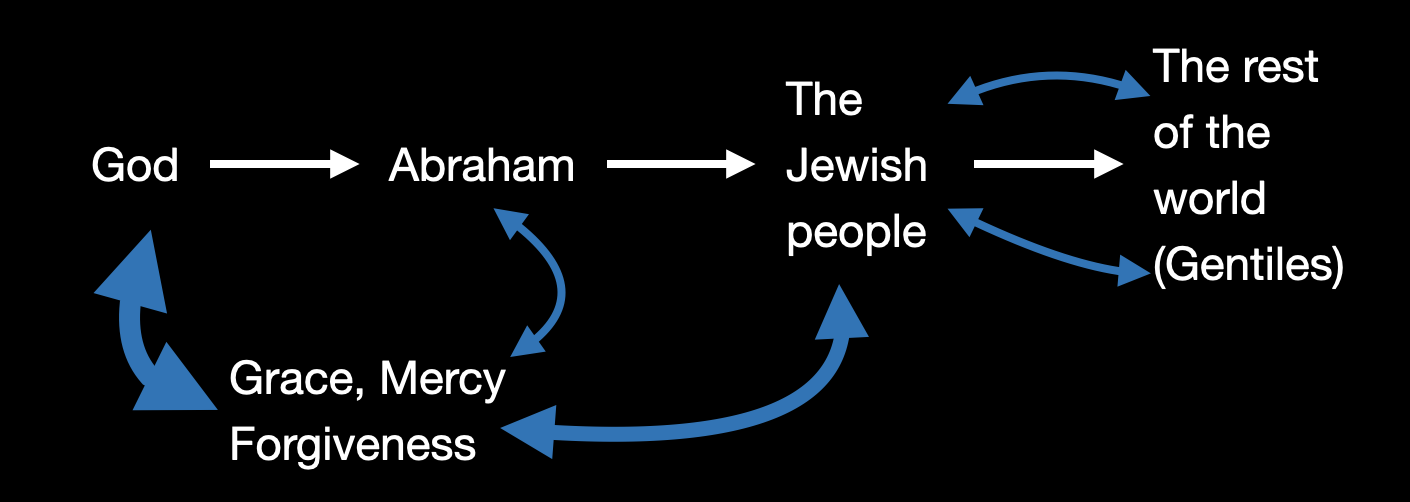
God reaches out to Abraham and establishes a covenant with him out of his grace, mercy, and forgiveness.  Then Abraham’s descendants, the Jewish people, are able to join in this Abrahamic covenant with God.  Then they are to reach out to the rest of the world – the Gentiles.  The Gentiles must then join the Jewish people to take part in that covenantal relationship with God.   This had been the understanding of God’s plan that Peter was taught as a child.

But what did God actually intend? 

God reaches out to Abraham and establishes a covenant with him out of his grace, mercy, and forgiveness.  Then Abraham’s descendants, the Jewish people, are able to join in this Abrahamic covenant with God.  (All this is just as before.) But then the Jewish people are to reach out to the rest of the world – the Gentiles.  The Gentiles can join in a covenant with God of mercy, grace, and forgiveness just as the Jews can.  They don’t have to become Jewish to be in covenant with God.  But now God’s Grace, Mercy, and Forgiveness have a name.  And that name is Jesus.

What Peter and these in Acts 3 understood was this: “To come to God, you must come through us; you must become one of us.”  But Jesus had said this: “No one comes to the Father except through me.  I am the way, and the truth, and the life.”  (John 14:6)

Jesus had tried to show them this even early in his ministry. Just after the Sermon on the Mount, he encounters a Roman Centurion who asks him to heal his servant.  And Jesus says of this gentile: 

Matthew 8:10   Truly, I tell you, with no one in Israel have I found such faith. 

I have not seen any Jew with as much faith as this Gentile.   And Jesus continues:

Matthew 8:11-12   I tell you, many will come from the east and the west and recline at the table with Abraham, Isaac, and Jacob in the kingdom of heaven, while the sons of the kingdom will be thrown into the outer darkness. In that place, there will be weeping and gnashing of teeth.

Many will come from the east and west… These other nations will celebrate with the Father in heaven, while some Jews will not be allowed in.  This is radical talk for a people that always assumed you had to become Jewish to come to God.

And Jesus tries to show them this truth as he ministers to other Gentiles and Samaritans.  You can see a gradual movement of Jesus in his year with the disciples toward ministry to the Gentiles that culminates in his Great Commission to go and disciple all nations. He says this in his final words:

Acts 1:8   But you will receive power when the Holy Spirit has come upon you, and you will be my witnesses in Jerusalem and in all Judea and Samaria, and to the end of the earth.

But God’s people had never fully understood God’s plan that God came to the Jews first so that they could be the conduit to spread his gospel to the nations.  And instead of inviting others in, they have been building walls to keep them out.

Every Resurrection Day, we talk about the veil of the temple that was torn from top to bottom when Jesus was crucified.  The heavy curtain that separated the holy place in the Temple from the Holiest place where God’s spirit would rest on the mercy seat in the previous temple.  The veil was there to keep people from entering into God’s presence.  Only the high priest could go through there, and he could only do so once a year.   

Every year, we talk about how the tearing of that veil opened up the way for people to have access to the Father through Jesus.  But that was not the only separation in the Temple that needed to come down.  I showed you the picture last week of the model of Herod’s Temple.  We talked about these massive 30-foot-tall brass doors that it took 20 men to open.  They set aside this area of the temple as the women’s court.  Females could go no further.  

Was that God’s plan or man’s plan?  God never gave any instructions for a woman’s court.   You do not find a woman’s court in the plans for the Tabernacle that Moses received on the mountain.  Women and men were both allowed to access the common area of the tabernacle.  There is no mention of a woman’s court in Solomon’s temple or in the temple rebuilt after returning from Babylon.  It was added when Herod began rebuilding the temple in 20 BC.  Why was that boundary added?  It was man’s idea, not God’s.  

Then there was a 15-foot area around the temple enclosed by a 4.5-foot-tall wall called the Soreg.  This is the barrier that the Gentiles could not pass under penalty of death.  Again, there was no mandate from God to build this wall.  It is the invention of the temple leadership to keep certain people away from God.  Originally, Gentiles were able to bring sacrifices to the tabernacle (see Numbers 15:14-16).  And Solomon invited Gentiles to pray in the common areas of the temple.  But in the 2nd century BC, Gentiles began to be excluded.  

And in Jesus’ day, Gentiles getting too close to the temple faced death.  All of Jesus’ followers had grown up their whole life being taught that this wall was necessary.  It was important.  This is a rule you don’t break.  If you do, then you will die.  God is only for the Jews.  And in Acts 3, Peter is preaching just outside this wall and calling people to repentance, but he is only calling Jews to repentance.  He doesn’t understand yet.

When Jesus was crucified, the veil was torn; the separation that symbolized the isolation of God’s presence was removed.  Because of Jesus’ work on the cross, God can truly dwell with people.  But Jesus was not satisfied with just tearing down the veil of the temple.  These other walls must come down.  These walls that people built to keep others from God, to keep the women out, to keep the Gentiles out.  God never intended this, and they must fall.  But the only way to tear down these walls would be to tear down the temple block by block, as Jesus said in Mark 13:

Mark 13:1-2   And as he came out of the temple, one of his disciples said to him, “Look, Teacher, what wonderful stones and what wonderful buildings!” And Jesus said to him, “Do you see these great buildings? There will not be left here one stone upon another that will not be thrown down.”

And so it was.  Just 40 years later, in 70 AD, the temple was dismantled stone by stone, with Roman soldiers using pry bars to lever the huge stones off the temple mount.  You can see these stones still lying where they fell almost 2000 years ago.

And Paul addresses some Gentiles in Ephesus:  

Ephesians 2:11-16. Therefore, remember that at one time you Gentiles in the flesh…remember that you were at that time separated from Christ, alienated from the commonwealth of Israel and strangers to the covenants of promise, having no hope and without God in the world. But now in Christ Jesus, you who once were far off have been brought near by the blood of Christ. For he himself is our peace, who has made us both one and has broken down in his flesh the dividing wall of hostility that he might create in himself one new man in place of the two, so making peace, and might reconcile us both to God in one body through the cross.

It took drastic measures for God to defeat sin and death.  It took Jesus dying on a cross and being resurrected.  It took drastic measures for God to set his people back on the right path of worship, obedience, and compassion.  It took the destruction of the Temple that bore His name, built in the place where He said He would place His name forever.  It took the formation of a new Temple, but not one of stone.  His followers would become His temple.  He would dwell with them.

But in Acts 3, Peter is still blind to God’s truth about the Gentiles.   And so was the rabbi called Saul, until he met Jesus on the road to Damascus.  Paul says that on that road, Jesus came to him to let him know he was sending him to the Gentiles “to open their eyes, so that they may turn from darkness to light and from the power of Satan to God, that they may receive forgiveness of sins and a place among those who are sanctified by faith in me.” (Acts 26:17-18).  

So Paul understood.  He said in Romans 1:16 that the Gospel is “the power of God for salvation to everyone who believes, to the Jew first and also to the Gentile.”  This is the story of salvation in the Bible.  God chose Abraham to establish a family that would serve as priests, bringing God’s blessing to the world. However, they continually failed in this mission. They distorted his teachings and became a religion that was inward-focused, caring only for themselves and not spreading the good news of God to the nations. So God sent his Son to be the Jew that would reboot this mission, get them back on the right track as a kingdom of priests to the nations.

But at this point, Peter, John, and the early followers of Jesus are busy trying to persuade just the Jewish people to accept the fact that the Messiah has come.  That Jesus is the one they have long awaited.  So Peter tells the Jews in his sermon:

Acts 3:19-26   Repent therefore, and turn back, that your sins may be blotted out, that times of refreshing may come from the presence of the Lord, and that he may send the Christ appointed for you, Jesus, whom heaven must receive until the time for restoring all the things about which God spoke by the mouth of his holy prophets long ago. Moses said, ‘The Lord God will raise up for you a prophet like me from your brothers. You shall listen to him in whatever he tells you. And it shall be that every soul who does not listen to that prophet shall be destroyed from the people.’

Compare Acts 3:19 in the King James Version and the English Standard Version:

Acts 3:19 (KJV)  Repent ye therefore, and be converted, that your sins may be blotted out…
Acts 3:19 (ESV)  Repent therefore, and turn back, that your sins may be blotted out…

(The KJV and the NKJV are pretty much the only versions that use the word ‘converted.’)  The way we understand the word “convert” in the KJV has led to some misunderstandings. We define ‘convert’ as either (1) to change from one form to another, or  (2) to change one’s religion or other beliefs.

We read this in the King James Version and get the idea that Peter is trying to convince these Jews to convert from Judaism to Christianity, to change religions.  But if you asked Peter if he had changed religions, he would think you were very confused.  He would say, “Of course I haven’t changed religions.  I am still very much Jewish.  The difference for me is that I have found the Messiah that my people have prayed for for hundreds of years.”  As we noted earlier, Peter is still attending Temple services, praying Jewish prayers, and following Jewish cultural laws.  He is now following these laws as interpreted by the one he considers the ultimate Jewish rabbi, Jesus.  

So, I think ‘converted’ is a poor translation of the Greek word ‘epistrepho’, which means to turn towards, to turn about, to turn back, or return.   It is about changing direction, and its counterpart, the Hebrew word shuv, is frequently used in the Old Testament as turning away from sin and turning towards God. But there is a conversion that must occur when one comes to accept Jesus.  There is a change that must take place when we turn from sin and turn to God.  

2 Corinthians 5:17   Therefore, if anyone is in Christ, he is a new creation. The old has passed away; behold, the new has come.  

Paul says the ‘old man’ must die. 

Galatians 2:20   I have been crucified with Christ. It is no longer I who live, but Christ who lives in me.

Our old self, who was motivated by self-interest, who made our own decisions, and who lived by our rules, must be symbolically crucified and buried with Christ so that the new life that proclaims Jesus as Lord, that submits our will to his, that lives by his rules and in his interest.  Gentiles do not convert to Judaism, and Jews do not need to abandon their heritage.  They both need to recognize Jesus as the Messiah who came as the Old Testament predicted.  

Peter and the other followers of Jesus in Acts 3 see themselves as Jews.  They view themselves as a sect of Judaism that followed Jesus as the Messiah.  And followers of Jesus continued to be viewed as a sect of Judaism throughout most of the first century at least.   One day, we will discuss when what the New Testament called “followers of the Way” ceased to be viewed as a Jewish sect and began to be viewed as a separate religion.  

But we must not forget, as Paul notes in Romans 11, we are part of God’s family because we have been grafted into the Jewish root.  We do not become Jewish, but the root of our faith and life is the Jewish heritage that supports us, from Abraham to Jesus.  Abraham is our Father.  The Old Testament is our story, and we need to read the Bible as one unified story about the creation and redemption of God’s people and God’s world. 

One day, Peter will learn that Gentiles are part of this story, but it will take a dramatic lesson involving a vision from God and a devout Gentile centurion that we will see in Acts 10.  But one more lesson for us now.  Even though Peter, at this point, is dead wrong on his theology about Gentiles, it does not stop God from doing great things through him.  Peter is in on many miracles in these early chapters of Acts.  The church is growing amazingly fast.  Thousands are being added.  

Perhaps we can learn from this that God can do much through us, even if we don’t understand everything. Even if we have some theology completely wrong, God can use us for his kingdom.  And perhaps we can show more grace to our brothers and sisters in Christ, who we feel don’t have everything right.  I confess I have at times been too judgmental of others’ theology.  I need to learn to show grace like Jesus shows grace, while also realizing that I could be the one who doesn’t have it just right.  But even if we get some things wrong, Jesus can do great things through us.   Having everything theologically correct is important.  We should study the scriptures for ourselves intently.  But that is not the most important thing. After all, what does Jesus really want from us?  Obedience and Compassion to others. 

December 4, 27 A.D.  –  The Good Shepherd—   The Year of the Lord’s Favor #62

Week 42 ——— The Good Shepherd
John 10:1–23 

Last week, we discussed how the Pharisees had made following God hard for the people.  They didn’t like the kind of Messiah Jesus was turning out to be.  Jesus called them idolaters.  He said they were worshiping idols.  And what is an idol?  It is a god that you make up and pretend to be real.  The Pharisees read the scriptures, but instead of worshipping the God of the Bible, they designed their own imaginary god that fit their purposes quite well.   They remade God in their image.  The god they worshiped bore little resemblance to the God of the Bible.  The god they worshiped cared more about laws than people, rituals than righteousness, and tithing spices than the poor.  

You can read the right scriptures but worship the wrong god. 

Let me set the scene of our scripture in John 10, where Jesus continues criticizing the religious leaders of his day. The 70 disciples he sent out have returned with stories of their mission’s success. It is festival time, and despite the danger of being in Jerusalem, where the Pharisees want to kill him, Jesus goes to celebrate.

John 10:22-23   At that time the Feast of Dedication took place at Jerusalem. It was winter, and Jesus was walking in the temple, in the colonnade of Solomon.

I cannot understand why the translators of the Bible go to great lengths to try to hide the fact that this ‘feast’ is Hanukkah.  While very few Christians know what the “Feast of Dedication” is, most everyone knows that Hanukkah is a Jewish holiday.  The word in the gospel of John in Greek is ‘egkania’ which is the word used in Ancient Greek for Hanukkah.  It is a festival celebrating the dedication of the temple, but  only one major version of the Bible translates it clearly  (New Living Translation.)   For many years, the institutional church was antisemitic and tried to divorce itself from its Jewish roots.  But Yehovah, the God of the Bible, chose the Jews to be the conduit of his message.  Our lord and savior, Jesus, was Jewish, and he celebrated Hanukkah.  Next week, we will discuss the history of this holiday and how Jesus used the festival theme to teach a great truth.  So, the teaching we discuss today and next week occurs during this Jewish festival.  It is winter, and Jerusalem can get quite cold.  We saw it snow in Jerusalem on our first trip.  Jesus is teaching in Solomon’s colonnade; it was a roofed outdoor section of the temple grounds, so it was somewhat protected from the elements.  It was huge, about 45 feet wide and 800 feet long.  A common place for public meetings, the early church met here.  

John 10:1-6 “Truly, truly, I say to you, he who does not enter the sheepfold by the door but climbs in by another way, that man is a thief and a robber.   But he who enters by the door is the shepherd of the sheep.   To him the gatekeeper opens. The sheep hear his voice, and he calls his own sheep by name and leads them out.   When he has brought out all his own, he goes before them, and the sheep follow him, for they know his voice.  A stranger they will not follow, but they will flee from him, for they do not know the voice of strangers.”   This figure of speech Jesus used with them, but they did not understand what he was saying to them.

Jesus gives this story about the sheep and the shepherd and the disciple are confused.  Now, we have the benefit of having heard the explanation Jesus gives in the following 11 verses, so we know where Jesus is going.  But the disciples needed clarification.  They shouldn’t have been.  Jesus is calling to mind a familiar metaphor from the scriptures.  Several Old Testament prophets denounced the religious leaders of their day, calling them bad shepherds of the people.  So when Jesus introduced the idea of himself as the good shepherd, they should have gotten it.  They must have missed the class on Ezekiel 34.   That is the background for this teaching of Jesus.  If you, like the disciples, have forgotten that passage, let’s take a look at it.

Ezekiel 34:1-6   The word of Yehovah came to me:  “Son of man, prophesy against the shepherds of Israel; prophesy, and say to them, even to the shepherds, Thus says Yehovah elohim:  Ah, shepherds of Israel who have been feeding yourselves!  Should not shepherds feed the sheep?  You eat the fat, you clothe yourselves with the wool, you slaughter the fat ones, but you do not feed the sheep.  The weak you have not strengthened, the sick you have not healed, the injured you have not bound up, the strayed you have not brought back, the lost you have not sought, and with force and harshness you have ruled them.  So they were scattered, because there was no shepherd, and they became food for all the wild beasts. My sheep were scattered;  they wandered over all the mountains and on every high hill. My sheep were scattered over all the face of the earth, with none to search or seek for them.

A shepherd’s job was to care for the sheep.  These shepherds were just using the sheep.  If they were hungry they would just kill one.  If they needed a sweater they took the wool.  But they didn’t make sure the herd was healthy. They didn’t supply them with green pastures for food.  They didn’t care for the injured.  They just let them wander and become lost.  That’s what sheep do without a shepherd.  They follow another sheep head down, munching on the next clump of grass until they end up miles from the herd.  Sheep need a shepherd.  But Ezekiel said these shepherds of the people were bad shepherds, only caring for themselves.  So what did Ezekiel say God would do?  

Ezekiel 34:11-16   “For thus says Yehovah elohim: Behold, I, I myself will search for my sheep and will seek them out.   As a shepherd seeks out his flock when he is among his sheep that have been scattered, so will I seek out my sheep, and I will rescue them from all places where they have been scattered on a day of clouds and thick darkness.  And I will bring them out from the peoples and gather them from the countries, and will bring them into their own land. And I will feed them on the mountains of Israel, by the ravines, and in all the inhabited places of the country.   I will feed them with good pasture, and on the mountain heights of Israel shall be their grazing land.  There they shall lie down in good grazing land, and on rich pasture they shall feed on the mountains of Israel.    I myself will be the shepherd of my sheep, and I myself will make them lie down, declares the Lord GOD.   I will seek the lost, and I will bring back the strayed, and I will bind up the injured, and I will strengthen the weak, and the fat and the strong I will destroy.1 I will feed them in justice.

Did you see that?  This is the message of Christmas!  These shepherds have failed to care for the people.  So God himself will come and seek them out and rescue them.  What did Jesus tell Zacchaeus? 

Luke 19:10  For the Son of Man is come to seek and to save that which was lost.

David wrote a psalm about what God, as a shepherd, would do for us. You know it.  It  begins,” The Lord is my shepherd…”

Yehovah is my shepherd; I shall not want for anything.
He makes me lie down in green pastures; he restores my soul.

This picture of Yehovah as our shepherd runs throughout the Bible.  And the people of the Bible understood all about shepherding.  From Abraham on, they kept flocks. There was a special bond between a shepherd and his sheep.  The Hebrew term for shepherd of sheep is “ro-eh tzon”.    Tzon is the word for sheep.  Ro’eh is the Hebrew root we translate as shepherd, but that root is used for one who cares for another or is a close friend or companion.   So, a shepherd cares for his sheep as he would love a close friend.  Some of you have pets with whom you share this special bond.  In Leviticus 19:18  “Love your neighbor as yourself,” we see that same root for the neighbor that we are to care for.   The idea is that we should shepherd our neighbors and make sure they have food and shelter and are cared for with love.

Ohad Cohen at the Institute of Biblical Studies says, “The Hebrew context teaches us that a shepherd was not just a responsible overseer, but a caring father figure, tending to his flock out of a deep sense of love. The prophet Isaiah tells us that the shepherd “gathers the lambs in his arms and carries them close to his heart” (Isaiah 40:11). The bond between a shepherd and his animals has all the qualities of a true family.” 

Jesus’ disciples could identify with this shepherd analogy.  But I’m a city boy.   The closest I ever got to caring for sheep was a wool sweater.  I had the chance one day to get up close and personal with a herd of sheep and take a crash course in shepherding.  I was in the Middle East in 2016; we were on a bus driving near Bethlehem, and several shepherds had their flocks near the roadside, so we stopped to visit with them.  We got to hold the little lambs and watch the sheep.

We learned that shepherds kept sheep in some type of enclosure at night.  This could be a low rock wall enclosure in a field, but this is winter, so most shepherds keep their sheep in caves, which are numerous on the hills of Israel.  This provides warmth and safety from predators at night.  That makes you wonder a bit about this verse:

Luke 2:8   And in the same region there were shepherds out in the field, keeping watch over their flock by night.

Why are shepherds out in the field at night instead of safely in a cave or enclosure?  I think it is because these particular shepherds had loaned their cave out to a poor man and his pregnant wife that night.  So when the angels announce the birth of the Messiah to the shepherds, they don’t tell them where to find the baby, but just that the baby will be lying in a feeding trough.  They didn’t need directions if it was their cave….

But usually, sheep were in an enclosure, and the shepherd would sleep in the opening of the cave so the sheep wouldn’t wander off at night and predators would not attack them.    Most caves have multiple openings, so the shepherds would stack rocks to close off all but the one they would guard.  This is where the idea of counting sheep to sleep comes from.  They would call the sheep into the cave, and once all were in, they would lay down to seal the opening with their bodies.  Having counted their sheep as they entered the cave, knowing they were all safe, they were ready for sleep.

If you wanted to hurt a shepherd, you would open their enclosure and let the sheep wander off at night.   If one left, there was a good chance that others would follow.  That’s what sheep do.  The herd would wander off, and a thief could follow and steal the herd.   Otherwise, if you just broke in and tried to grab some, you could only steal what you could carry, so you might cause them to lose a few sheep.  They would not follow the thief. They would only follow the voice of their shepherd.

During our roadside visit with the shepherds,  If any wandered off, the shepherd would make a sound, and they would return.  The sheep were pretty skittish, so I tried to imitate the sound to get one to come close.  I apparently failed because that sheep just gave me the side eye and kept going.  But when the shepherd called out, they turned right around.  Our visit was cut short as it was late afternoon, and the shepherds said it was time to take their flocks home.  We turned to go, but our teacher said to stop and watch.  As the two groups of shepherds headed in different directions, they made their particular call sound, and the flock separated as they followed their own shepherd home.  And several Bible passages came alive for me.  Let’s return to John 10 and Jesus’ explanation.

John 10:7-16   So Jesus again said to them, “Truly, truly, I say to you, I am the door of the sheep. All who came before me are thieves and robbers, but the sheep did not listen to them.   I am the door. If anyone enters by me, he will be saved and will go in and out and find pasture.   The thief comes only to steal and kill and destroy. I came that they may have life and have it abundantly.   I am the good shepherd. The good shepherd lays down his life for the sheep.   He who is a hired hand and not a shepherd, who does not own the sheep, sees the wolf coming and leaves the sheep and flees, and the wolf snatches them and scatters them.   He flees because he is a hired hand and cares nothing for the sheep.  I am the good shepherd.  I know my own and my own know me, just as the Father knows me and I know the Father; and I lay down my life for the sheep.   And I have other sheep that are not of this fold.   I must bring them also, and they will listen to my voice. So there will be one flock, one shepherd.

Who are those who came before him?  It is the current religious elite of Israel —the Pharisees, Sadducees, and scribes.  They claimed they were the door.  If anyone wanted to worship God, they had to go through them.  They had to do it their way.  If they didn’t, then they would be turned aside and not allowed to enter the temple.  The blind man that Jesus will heal this very week will be kicked out of the Temple and excommunicated from their religion because he witnessed to others that Jesus healed him.  It was their way or the highway.  But Jesus says they are not the way.  He is the way, the truth, and the life.  No one comes to the Father except through him.  If anyone tells you there are things you must do, requirements not given by Jesus, do not listen.  He is the way, the only way.

Who are the “other sheep not of this fold”?  Jesus is saying, “It is not just about you, Jews.  You have made it that way, but that is never what God intended.  You were to be a kingdom of priest to the nations.  But you never reached out.  You insisted they become Jewish to worship me.  But I will bring them in.  I will bring in the lost tribes of Israel that were dispersed in 700 BC, I will bring in all the Gentile nations – and they will listen to me and answer when I call.  So, there will be one flock with no divisions.  No Jew and Gentile, no slave and free, one flock.”

What would Jesus say to us today?  When we see many people argue about minor points in the way we worship or, the way we stay pure or, the way we baptize, or the way we reach out.  We embrace our divisions and work to better our individual churches and denominations while God is begging us not to see our denominations as the kingdom but to work toward the good of the Kingdom of God: one flock, one shepherd.  

“And they will listen to my voice.”….. There are so many voices to listen to.  Do you hear his voice?  Do you hear the good shepherd calling out to you?  How do you distinguish the voice of God from all the other voices calling out to you?  I often run into this when talking to people about how they practice their faith.  People aren’t sure if they can hear the voice of God or how they can hear the voice of God.  If you hang around the shepherd long enough, and if you listen, you will learn to recognize the shepherd’s voice.  It takes time to learn the shepherd’s voice.  

The first thing you need to do is to turn off the noise.  We are bombarded by voices constantly throughout the day.  The television may be on 24/7, the radio always on in the car, and now there is the constant ping of your cellphone with an alert of yet another voice clamoring for your attention via text, email, or phone call.  You can’t hear the shepherd if you aren’t listening, and you need to find a time of silence to practice listening.  For many people, God can’t get a word in edgewise.  I don’t believe God is giving any believer the silent treatment.  He wants to call out to us, but I imagine he feels like me when I was in the office trying to talk to a teenager and then realizing he couldn’t hear me because he had his AirPods in his ears listening to music.  He couldn’t hear anyone else because he had the music turned up so loud. 

God wants to call out to us when we wander away, but we aren’t listening.  Take your headphones off.  Turn off the world for a few minutes and talk to and listen to God.   Every believer can hear the voice of God, but very few listen.  Spend time in prayer.  And prayer is not a monologue but a dialog.  Spend time listening and meditating. Begin with just a few minutes a day.  

How do you know it is God’s voice?  You can’t be sure if you don’t know the scriptures. We have these scriptures with the very words of our shepherd recorded in them.  Study and learn them; this is the shepherd’s voice spoken to so many others over the years.  He is the same God as the one who spoke long ago.  He will not contradict himself.  But you have to study the scriptures to have this awareness. 

If you want to read material to help you start your journey to hear the voice of your shepherd, here are three helpful books. Brother Lawrence, a monk in France in the 1600s, wrote the Practice of the Presence of God, a classic. Dallas Willard’s Hearing God was written about 25 years ago, and Mark Batterson’s Whisper is only a few years old.  

But remember the Pharisees in our passage today.  They had studied the right scriptures but worshiped the wrong god.  You can’t just interpret the scriptures any old way you want to.  You can’t read them trying to find something you agree with.  You must be honest with the scriptures, look at the context, and compare what you read to other scriptures.  Discuss them in community, not just by yourself. d We have to be students of the word to be the people of God.

As we pray, study, and listen, the Holy Spirit will begin to speak God’s word.

January 28, 27 A.D.  –  What About The Lost? —   The Year of the Lord’s Favor #69

Week 50 — What About The Lost?
Luke 15:1-32

Have you ever lost something that was very important to you?  So crucial that you dropped anything else you were doing to search for it?  So important that you would tear the house apart if that were required to find it?

Jesus continues to teach in the area east of Jordan, and today, we will discuss a set of three parables that Jesus tells of lost things: the lost sheep, the lost coin, and the lost son.   The last one, often called the “parable of the prodigal son,” is one of Jesus’ best-known parables.  But first, the parable of the lost coin.

Luke 15:3  So he told them this parable: “What man of you, having a hundred sheep…

Stop.  Luke says, “So he told them this parable…”  Luke gave us the reason for Jesus’ story.  We must back up a few verses to see why he told these stories together.  What is the context of these parables?  If you ignore the context, you may make some false assumptions about Jesus’ primary purpose.  And we can’t ignore the context here because Luke makes it obvious.

Luke 15:1-2   Now the tax collectors and sinners were all drawing near to hear him.  And the Pharisees and the scribes grumbled, saying, “This man receives sinners and eats with them.”

This is a familiar setting.  The Scribes and Pharisees are grumbling because Jesus is hanging around the ‘wrong people.’  As we discussed a few weeks ago, it mattered who you ate with.  As we said then, dinner invitations were a social investment.  But Jesus just ignored the usual social rules about this.  When he called Matthew, he threw a big party for all the tax collectors.  The religious leaders would never set foot in such a sinner’s house.  Jesus didn’t seem to understand social boundaries.

The Scribes and Pharisees are grumbling.  What does the Bible mean by grumbling?   Read the words.  The words are important.

The root for grumble, ‘gonguzo,’ means murmuring to yourself or muttering.  It is an expression of disagreement, but not out loud, just under your breath.  Let’s see that in a Bible passage:  

John 6:41-43   So the Jewish leaders grumbled about him, because he said, “I am the bread that came down from heaven.”   They said, “Is not this Jesus, the son of Joseph, whose father and mother we know? How does he now say, ‘I have come down from heaven’?”   Jesus answered them, “Do not grumble among yourselves.”

But in our verse today, Luke uses a different form of the word ‘grumbled,’ in Greek, ‘diagongguzo’.  Whereas ‘gonguzo’ is private muttering or grumbling to yourself, ’diagongguzo’ means a crowd of people all grumbling out loud.   They are shouting out their murmurs.

This word appears only twice in the New Testament. The other instance is when Jesus eats at the house of the tax collector Zacchaeus.

Luke 19:7  And when they saw it, they all grumbled, “He has gone in to be the guest of a man who is a sinner.”

Notice that this word is used both times to protest Jesus’ spending time with the ‘wrong people.’   It is also used several times in the Greek Old Testament (the LXX) when the children of Israel grumbled against Moses.  

Exodus 15:24 And the people grumbled against Moses, saying, “What shall we drink?”

They just left the Red Sea and have traveled 3 days out into the desert.  The water there was bitter, and they could not drink it.  So they grumble.  But just 3 days before this, God took an entire body of water and split it open so the whole nation could walk across not on mud but on dry ground.  Then God waited until the Egyptians were in the middle and let the waters collapse on them and drown them.  Just 3 days ago, they saw one of the most incredible miracles in the history of the world.  And now they grumble because they have nothing to drink.  Somehow, they don’t think the God who can split a whole body of water at will could ever control the small amount of water they need to drink. Seriously?  That is the idea of grumbling.  You grumble when you don’t have the faith to believe in God’s ability to deliver.

Luke uses the same word, ‘grumble,’ for the Scribes and Pharisees. This is important. It is the whole reason Jesus tells these three parables. And every time this word is used in the Bible, it is used in the same situation.

Just as in the example of the bitter water, people who grumble like this don’t have the faith to believe that God can deliver, that God can save.  The children of Israel should have immediately thought: “Well, no drinkable water, not a problem for our God.  We know he can provide. He just demonstrated his power over water 3 days ago.  But they had no faith.  

The Pharisees lack faith in God’s ability to deliver the tax collectors and sinners. They ignore ‘those people’ because they feel they are beyond hope. In their minds, saving them is beyond what God can do. That is why Jesus tells these three parables.

Luke 15:3-7   So he told them this parable: “What man of you, having a hundred sheep, if he has lost one of them, does not leave the ninety-nine in the open country, and go after the one that is lost, until he finds it?   And when he has found it, he lays it on his shoulders, rejoicing.  And when he comes home, he calls together his friends and his neighbors, saying to them, ‘Rejoice with me, for I have found my sheep that was lost.’  Just so, I tell you, there will be more joy in heaven over one sinner who repents than over ninety-nine righteous persons who need no repentance.

If you know your Bible, you realize Jesus is stomping on the toes of the religious leaders here.  Suppose one of you religious leaders had a lost sheep.  Wouldn’t you go after it and seek until you found it?

Jesus has preached this sermon before.  Remember back in mid-December when we discussed Jesus calling himself the good shepherd?  That sermon was based on Ezekiel 34, where the prophet was speaking against the religious leaders of his day, calling them bad shepherds who didn’t even really care for the sheep but just used them.  Here is Ezekiel’s accusation of the religious leaders of his day:

Ezekiel 34:4  The weak you have not strengthened, the sick you have not healed, the injured you have not bound up, the strayed you have not brought back, the lost you have not sought, and with force and harshness you have ruled them. 

And Jesus asks in the parable, “Suppose one of you religious leaders lost one of your sheep.  Wouldn’t you go after it to bring it back?  That is Jesus’ point.  It was their job as religious leaders to care for the sheep.  But like those of Ezekiel’s day, these leaders were not good shepherds either.  No, they would not seek out the lost.  If people chose to live lives of sin, the leaders just took their names off the flock’s membership role.  They don’t belong.  These shepherds didn’t seek them out; they purposely avoided them.  There was no grace; there was no mercy.  It is as we discussed last week.  You don’t take away a fruitless branch from a vine; you lift it up.  These people are bad shepherds, and it made Jesus sad.

Matthew 9:36  When he saw the crowds, he had compassion for them, because they were harassed and helpless, like sheep without a shepherd.

And Ezekiel tells us that because the shepherds didn’t care for the sheep and seek out the lost, one day, God himself would come and seek them out. 

Ezekiel 34:11-12   “For thus says Yehovah elohim: Behold, I, I myself will search for my sheep and will seek them out.   As a shepherd seeks out his flock when he is among his sheep that have been scattered, so will I seek out my sheep, and I will rescue them from all places where they have been scattered on a day of clouds and thick darkness.

 And here is Jesus in the first century, doing just that, seeking out the lost sheep that the current shepherds in Israel have ignored and abandoned.

You know that Jesus said, “For the Son of Man is come to seek and to save that which was  lost.”  Do you know when Jesus said this?  It is in Luke 19:10 at the house of the tax collector, Zacchaeus.  Yes, the one that the religious leaders grumbled about Jesus’ going to.  They said, “That tax collector is hopeless; God can not save him.”   Jesus has dinner with him, and Zacchaeus says he will return all the funds he took dishonestly from people and then give away half of everything he owns.  Zacchaeus repents, begins to bear fruit, and has entered the kingdom of God.  He was written off as a hopeless sinner by the religious leaders of the day, but God himself, Jesus, came down to seek out the lost sheep. 

So the good shepherd in Jesus’ parable sought earnestly for the lost sheep and carried it home.  Then the shepherd went around the whole town to invite them over for a massive party with lots of food for the entire village to celebrate.  

Oh, we could stop there, but we have two more parables.  So we’ll fly through this second one to have time for the last one.  Jesus follows with a story about a lost coin.

Luke 15:8   “Or what woman, having ten silver coins, if she loses one coin, does not light a lamp and sweep the house and seek diligently until she finds it?  And when she has found it, she calls together her friends and neighbors, saying, ‘Rejoice with me, for I have found the coin that I had lost.’  Just so I tell you, there is joy before the angels of God over one sinner who repents.”

So this woman had ten drachmas (about 10 days’ wages).  Realize that in Jesus’ day, most purchases were done through bartering.  Not many people kept coins.  This would be a family’s emergency fund.  And she has lost not one out of a hundred, like the sheep, but one out of 10, making the search more urgent.   And she seeks diligently, and after finding it, she prepares a big celebration also.

Luke 15:11   And he said, “There was a man who had two sons.

(Note that we have moved from one sheep out of a hundred to one coin out of ten and now two sons.)

 And the younger of them said to his father, ‘Father, give me the share of property that is coming to me.’ And he divided his property between them.   

We need some context here to understand what a crazy request this is.  We are not nearly as shocked by this as Jesus intended.  The father would not grant his children his property until his death or immediately before it.  The older brother, the firstborn, would typically receive a double share, so the older would get 2/3 and the younger 1/3.  But what this son does is beyond shameful.  He is basically telling his father that he wants him to die.  He cares nothing for his father and the family.  He wants his portion of the inheritance now.

This is evident in the Greek, where it says, “And he divided his property between them.” The Greek is literally “he divided his ‘bios’ between them.”   ‘Bios’ is the Greek word from which  we get our word ‘biology.’  Bios is not property; bios is life.  “He divided his life between them.” Everything the father had worked for all his life —all his property, even his authority over the family, his good name.  It is like he has died.  (Note that the older son does not object but willingly receives his 2/3 portion divided between them.)  The older son has now become the ruler of the household.

Not many days later, the younger son gathered all he had and took a journey into a far country.

So the younger son sells his third of the land and animals that his father worked his life to produce. He takes the money and goes to ‘a far country.’  We are supposed to realize that he has gone to Decapolis, the land east of the Sea of Galilee ruled by Gentiles—a pagan land.  

And there he spent everything on reckless living….  

We aren’t told exactly what “reckless living” means here, but the Greek word for it is the same one used in I Peter, which is translated as “debauchery.”

1 Peter 4:3-4   For the time that is past suffices for doing what the Gentiles want to do, living in sensuality, passions, drunkenness, orgies, drinking parties, and lawless idolatry.   With respect to this they are surprised when you do not join them in the same flood of debauchery, and they malign you; 

Apparently, the older brother was aware of his younger brother’s actions, later telling his father that his brother “has devoured your property with prostitutes.”   

And when he had spent everything, a severe famine arose in that country, and he began to be in need.   So he went and hired himself out to one of the citizens of that country, who sent him into his fields to feed pigs. And he was longing to be fed with the pods that the pigs ate, and no one gave him anything.

This young man hit rock bottom, so hungry that he wanted to eat the pig’s slop.  Then verse 17 tells us, “he came to his senses.”  Some people have to hit rock bottom to come to their senses.  Notice that, unlike the parable of the lost sheep or the lost coin, the father doesn’t seek out the young man.  He lets him leave and lets him hit rock bottom.

This is hard.  Some of you know how difficult it is to watch someone destroy themself.  And we, of course, try to rescue them.   I have seen families rescue the same child over and over, intervening to keep them out of jail and not let them suffer for their poor decisions.  We know a man who lost everything he owned and became homeless, trying to pay off his children’s debts from a drug habit.  Oh, the pain of parents placed in this situation, finally having to choose to let them go.  How many times have we seen that it is only when they hit bottom that they come to their senses?  We have gotten phone calls from people begging to help them get out of jail, and then we had to decide that they were where they needed to be until they decided to change their lives.  How many people have we met who have finally gotten straight with God only after some time in a dismal jail cell or a mandated drug program?   

This father didn’t lose his son when he walked off the property with 1/3 of everything.  That son was lost long before that, having no regard for his father, his family, or his God.  The father didn’t give up on him; the father let him go so he could wait for him to return, having faith that God, who loves his son even more than he did, would bring him home.  The father didn’t grumble, but he had the faith to believe God could deliver even this prodigal son.

But he comes to his senses and decides he would be better off being a slave in his father’s household than where he is now.  So he prepares what he will say, hoping his father will take him in as just a slave.  And as he approaches his old home.  He sees his father running down the road.  The commentaries tell us that adult men in this day never ran.  It was too undignified.  But what will make a man run?  Love for your child will make you run.  Grace will make you run. It was mercy running down that road.  And the son starts his prepared speech, 

‘Father, I have sinned against heaven and before you. I am no longer worthy to be called your son.’

But he didn’t get to finish because the father heard all he needed to hear.  His son was not just physically back home, but he was not lost anymore.  And, like the previous two stories, it’s party time.  Kill the fatted calf— enough food for everyone to celebrate with us.  But Jesus isn’t through with the story.  He is finally just getting to the part that matters to him.

The party is already in full swing when the older son arrives from the field.   He hears the music and the dancing and asks a servant what the celebration is about.  And then he is enraged.  He never got a fatted calf party.  And he was the good son.  He was the leader of the family.  (And since he already has his inheritance, it was technically his fatted calf anyway.)  

The older brother had written off his brother. He couldn’t even call him his brother (he says to his father, “That son of yours.”)  This is important. The older son was responsible for seeking his brother, but he had written him off as a hopeless cause beyond repentance.

He was entitled, angry, jealous, and judgmental.  

Who is the main character of this story? Not the prodigal, the younger brother.  Not the father.  The main character is the older brother.  Why is Jesus telling this story?  Because the Pharisees were grumbling –  they did not believe God had the power to save the sinners they had written off.  They were the entitled religious elite, and they were angry that Jesus would waste time on the sinners.  They were judgmental and jealous that this riff-raff was seeing all of Jesus’ miracles.

He is the Pharisee in the story.  

It is not the story of the Prodigal son, but it is the story of the lost son.   And the lost son is not the one who wandered away; he is found.  The lost son is the one who stayed.  As Tim Keller said in “The Prodigal God,”

“Neither son loved the father for himself. They both were using the father for their own self-centered ends rather than loving, enjoying, and serving him for his own sake. This means that you can rebel against God and be alienated from him either by breaking his rules or by keeping all of them diligently. It’s a shocking message: Careful obedience to God’s law may serve as a strategy for rebelling against God.” … “The targets of this story are not “wayward sinners” but religious people who do everything the Bible requires. Jesus is pleading not so much with immoral outsiders as with moral insiders. He wants to show them their blindness, narrowness, and self-righteousness and how these things are destroying both their own souls and the lives of the people around them.”

The minute we look at a group of people and start judging them as undeserving of mercy, of beyond hope, of beyond God’s grace and forgiveness, we have become the older brother; we have become the Pharisees.  Just as it was the older brother’s responsibility to seek out his brother, just as it was the religious leaders’ responsibility to seek out the lost sheep, it is our responsibility to seek out the lost sheep of our day.  

I will leave it to you to figure out who the “tax collectors and sinners” are today.  Who is that group of people that some people in the name of religion have decided are beyond hope, beyond grace, beyond mercy?  And instead of demonizing those who seek hope and compassion for these groups of people, we ought to applaud them.

But listen carefully because this is where so many have gone horribly wrong in the past 25 years. Jesus never compromised on sin.  The younger son had to repent.  Simon the Zealot had to leave his anger and merciless ways behind to become a disciple of Jesus.  The tax collectors, Matthew and Zacchaeus, had to leave their dishonest dealings behind to become disciples.  The prostitutes and all the other sinners had to repent and leave their lives of sin behind to become disciples of Jesus.  It is the first word of Jesus’ primary message, “Repent, for the kingdom of heaven is at hand.”  Repentance is a requirement for entering the kingdom.  We aren’t supposed to rewrite the Bible and leave out a section to allow someone to become a disciple of Jesus.  The Bible doesn’t need to change – people do.

But just as important, Jesus had no such requirements for his social invitations.  In fact, he went very much out of his way to spend most of his time with “those” people.  When we restrict our social circle to only those “acceptable people,” then welcome to the world of Pharisees and older brothers.  We are called to imitate Jesus.  Our goal is to become more like him.  Unfortunately, we often find it’s easier to imitate the Pharisees.  Jesus is trying to tell the Pharisees that no group of people is beyond salvation.

So ignore the grumblers out there who don’t have the faith to believe God can save, put your feet where your faith is, and go out and do some seeking.  Demonstrate mercy and kindness in love.  Have lunch with a homeless person.  Invite a marginalized person over to your home to eat.  Develop a friendship with someone who would never show up in church.  Be like Jesus.