
Week 63 — Jesus rides in a parade, rearranges furniture, and kills a tree.
Matthew 21:18-19
As we follow Jesus’ ministry day by day, in 28 AD, this is the week of Passover, the week between Palm Sunday and the Resurrection. At times over the past year, I had only had one short scripture passage to cover the events of that week in Jesus’ ministry. But the week between the triumphal entry and the resurrection is so important to the story of Jesus that there is a lot of material: Seven chapters of Matthew, five chapters of Mark and Luke, and eight chapters of John. Almost one-fourth of the material in the four gospels is about this final week.
There is no way to cover the material in those 20 chapters. So I want to step back this week and get one aspect of the big picture of what is going on in the story of the Bible in that week. The Bible is one cohesive story of how God is working to reestablish his relationship with his creation, and the key to that plan is what happens in this week and 50 days later. Jesus does three symbolic acts at the beginning of that week. We have already discussed two of them, so today, we will look at the third one and see how these fit into that big picture.
Matthew 21:18-19 In the morning, as he was returning to the city, he became hungry. And seeing a fig tree by the wayside, he went to it and found nothing on it but only leaves. And he said to it, “May no fruit ever come from you again!” And the fig tree withered at once.
I know what you’re thinking. “So, out of 20 chapters of Gospel Material from Jesus’ final week, this is what you pick as a focal passage? And why is Jesus hating on a fig tree? “
At the beginning of Jesus’ passion week, he performs three significant symbolic acts, which carry a lot of meaning to his followers who are familiar with the scriptures. He rides a donkey into the city (the Palm Sunday triumphal entry that we discussed two weeks ago). He drives the money changers and animal salespeople out of the temple area (which we discussed last year), and then he curses a fig tree.
These may seem out of character for the Jesus we have seen this past year—that meek and mild Jesus who told people not to talk about his miracles, who was leaving town when he gathered crowds to try to fly under the radar, and who mostly avoided confrontation. Here, we see him in a big parade entering the capital city, jumping into the middle of a confrontation in the temple, and then performing a miracle of destruction. What has changed? Let’s look at these events.
The cleansing of the Temple happens twice in Jesus’ ministry. Both at the same time of the year, just before Passover.. Every Jewish person at that same time every year would, in preparation for the feast of Unleavened Bread, go to great lengths to remove every bit of yeast from their homes. This is to commemorate the exodus from Egypt when they left after Passover and ate only unleavened bread, because they didn’t have time to let the bread rise as they hurried out of Egypt. Yeast came to represent sin and corruption. So every home would be cleansed to remove any traces of yeast every year. Walls would be scrubbed, and cooking utensils boiled in water. This still happens in Orthodox Jewish homes today. Jesus enters the Temple and sees that the House of God is full of corruption and takes it upon himself to do some spring cleaning in preparation for the festival. This has great symbolic meaning to the people of Jesus’ day. (You can go back to my blog entry of April 10 last year to review.)
Then there is this episode about the fig tree, which seems odd to us. Again, these are very symbolic acts. To understand what is really going on in these events, you have to have a good working knowledge of the first 2/3 of the Bible. But most people don’t spend much time in the ‘First Testament.’ We call it the ‘Old Testament.’ Why study something old when you have something newer? I really don’t like the ‘old/new’ nomenclature. Jesus just called the Old Testament ‘the Scriptures.’ The only Bible that Jesus and the disciples ever read is the one that very few people now ever read.
But the Old Testament is the context for the New Testament. Jesus assumes you have a working knowledge of the Scriptures when he talks. Ten percent of his teachings are quotes from the Old Testament. If you don’t understand his quotes, then you misunderstand what Jesus is saying. These acts are a good example. We miss what God is communicating if we are ignorant of the context and connection to the Scriptures. So bear with me while I go way back to give you the big picture you need to understand the fig tree.
The key to these incidents is found in Malachi, the last book of the Old Testament.
Malachi 3:1-2a “And the Lord whom you seek will suddenly come to his temple; and the messenger of the covenant in whom you delight, behold, he is coming, says Yehovah Tzavaot. But who can endure the day of his coming, and who can stand when he appears?”
Let me put this verse in its historical context for you. The Jews were conquered by Babylon in 586 BC. The Babylonians destroyed the city and the temple. Most of the Jews were taken to Babylon, where they lived in exile for 70 years. When they finally returned, they rebuilt the wall around the city and the temple. But they didn’t have the riches of Solomon to build the temple this time, and this temple they built was a sad imitation of the grand structure that had been. The people came back from Babylon expecting to have all the promises of the prophets come true, that the Messiah would come and set up God’s kingdom over Israel and restore the nation with a time of prosperity, justice, and peace.
But the people don’t see that, so in Malachi, they complain to God,
“Hey God, things are going very well.”
And God could answer,
“You’re telling me, I allowed your country to be conquered because of your sins, hoping that the time of exile would lead to repentance and that you would come back ready to truly follow me and my commandments and abandon your idols. But you have not repented. You are committing the same sins as your ancestors did, which got them exiled.”
The people keep complaining to God. (The book has six disputes between the people and God), And he says,
“You are on my last nerve with all this griping and complaining and bad behavior.”
(Or maybe that was my wife talking to one of my sons in the backseat of the car one day.) But Malachi says it this way:
Malachi 2:17 “You have wearied Yehovah with your words.” [He is tired of your griping.]
They are asking, “Where are you, God?” Why are they asking this? They have been back in the land for almost 100 years. They had rebuilt the temple, and everyone came to the grand opening except God. He didn’t show up. To understand this, we have to go back even further.
Remember when Israel first encountered Yehovah in the wilderness of Sinai. They had escaped from Egypt, and 50 days later came to Mt Sinai. God invited them to come up on the mountain with him, but on that day, God came on the mountain with a great cloud of smoke, and with fire and the sound of a loud shofar, like a roaring wind. And it scared the people so that they would not go up on the mountain to meet God. So Moses goes for them, and while up on Mount Sinai, God gives him instructions to build a tabernacle, a tent of meeting. God told Moses,
Exodus 25:8 “Have them build me a tabernacle, a holy place so that I might dwell with them.”
God wants to dwell with his people. He wants to walk with us like he did with Adam and Eve in the Garden. Sin destroyed the fellowship between humans and God in the Garden, and the whole story of the Bible is God working a way to restore that fellowship so that he may dwell with his people again.
So they built the tabernacle, and when they dedicated it:
Exodus 40:34-38 Then the cloud covered the tent of meeting, and the glory of Yehovah filled the tabernacle. And Moses was not able to enter the tent of meeting because the cloud settled on it, and the glory of Yehovah filled the tabernacle.
Leviticus 9:23-24 And Moses and Aaron went into the tent of meeting, and when they came out, they blessed the people, and the glory of Yehovah appeared to all the people. And fire came out from before Yehovah and consumed the burnt offering and the pieces of fat on the altar, and when all the people saw it, they shouted and fell on their faces.
Just like on Mount Sinai, God comes in a cloud with fire. Since they wouldn’t come up on the mountain, God comes to dwell with them in the cloud and fire and leads them with a pillar of cloud by day and a pillar of fire by night.
And 400 years later, Solomon builds a more permanent structure. And the nation of Israel was at the pinnacle of its wealth. So this temple was very impressive. And when it is time to dedicate the temple:
2 Chronicles 7:1-3 As soon as Solomon finished his prayer, fire came down from heaven and consumed the burnt offering and the sacrifices, and the glory of Yehovah filled the temple. And the priests could not enter the house of Yehovah, because the glory of Yehovah filled Yehovah’s house. When all the people of Israel saw the fire come down and the glory of the Yehovah on the temple, they bowed down with their faces to the ground on the pavement and worshiped and gave thanks to Yehovah, saying, “For he is good, for his steadfast love endures forever.”
First at Sinai, then at the tabernacle, and now at Solomon’s temple, God’s presence comes in mighty fashion. Have you ever been in a church service where you wondered if God was present? No one left these dedication services wondering if God showed up.
But things go downhill in Israel, and God punishes the Northern and Southern Kingdoms by allowing them to be conquered by a foreign nation. Four hundred years after Solomon’s Temple was built, the Jews were conquered by Babylon in 586 BC. The Babylonians destroyed the city and this wonderful Temple. Most of the Jews were taken to Babylon, where they lived in exile for 70 years. And that horrible day of destruction is still mourned by Israel today on their calendar on the ninth day of their month of Av.
But the worst part of this tragedy is seen in a vision by the prophet Ezekiel. Now, most people reading the Bible miss this because Ezekiel is not exactly an easy book to read. In his vision in Ezekiel 10, he sees God on His throne leave the temple in Jerusalem. This is that odd vision of the throne chariot with the cherubim and the ‘wheels within wheels.’ God abandoned his temple and allowed the temple to be destroyed.
Ezekiel 11:23. And the glory of Yehovah went up from the midst of the city and stood on the mountain that is on the east side of the city.
(What mountain is on the east? The Mount of Olives.)
But in Ezekiel, there is hope. God abandoned the temple, but he didn’t abandon his people, and Ezekiel talked about God preserving a remnant and that God will one day take away the heart of stone and give them a new heart. And in Ezekiel, we have the vision of the restoration, the valley of dry bones brought back to life. And finally, in Ezekiel, there is a vision of God’s presence returning to the temple. Ezekiel sees God coming back from the East
Ezekiel 43:1-2 Then he led me to the gate, the gate facing east. And behold, the glory of the God of Israel was coming from the east.
And 70 years later, Ezekiel’s prophecies started coming true. A remnant of the people returned from Babylon to Jerusalem and rebuilt the city and the temple, though as I said, it was nowhere near as grand a structure. And as before, they held a dedication service:
Ezra 6:16-18 And the people of Israel, the priests and the Levites, and the rest of the returned exiles, celebrated the dedication of this house of God with joy. They offered at the dedication of this house of God 100 bulls, 200 rams, 400 lambs, and as a sin offering for all Israel 12 male goats, according to the number of the tribes of Israel. And they set the priests in their divisions and the Levites in their divisions, for the service of God at Jerusalem, as it is written in the Book of Moses.
It was a grand service, and huge numbers of people crowded in to see the spectacle. But something was missing. God was missing. There is no great storm of wind, thunder, clouds, and fire that shows God’s presence in the temple. They set up the altar, but this time, fire didn’t come from heaven to consume the sacrifice. They have to light the fire themselves, because God doesn’t show up.
That is why the people of Malachi’s day asked, “Where is God? We rebuilt the temple, but he didn’t show up.”
They knew Zechariah had prophesied of the time when God would return.
Zechariah 8:3 Thus says Yehovah: I have returned to Zion and will dwell in the midst of Jerusalem, and Jerusalem shall be called the faithful city, and the mountain of the Yehovah Tzavaot, the holy mountain.
So we see in Malachi that they complain that God has not returned as he promised. They had conveniently forgotten the first part of Zechariah, which made it clear to them that this was a conditional promise.
Zechariah 1:3 Therefore, say to them, Thus declares Yehovah Tzavaot: Return to me, and I will return to you, says Yehovah Tzavaot.
But God explains, “You returned to the land, you returned to the city, but you didn’t return to me. You haven’t repented. You are still committing the same sins your fathers did that got them exiled. So I have not returned to you.
But when the people complain, Malachi answers, “Oh, God is going to come back to his Temple…”
Malachi 3:1 “Behold, I send my messenger, and he will prepare the way before me. And the Lord whom you seek will suddenly come to his temple; and the messenger of the covenant in whom you delight, behold, he is coming, says the Yehovah Tzavaot.”
Malachi says that a messenger of the covenant will come, and then God is coming back to his temple, but he may not come exactly like you want him to come. The next verse, Malachi 3:2a
“But who can endure the day of his coming and who can stand when he appears?”
Uh-oh… he is coming in judgment. Malachi is the last prophet in the Old Testament. There would be 400 years of waiting until another prophet comes, until the time Malachi predicted. And the Gospels tell us the messenger did come, John the Baptist, preaching repentance, and after that, God returns to the temple
So in his final week, Jesus is again staying at the home of Lazarus, Martha, and Mary in Bethany. He has his disciples get a donkey from the nearby town of Bethphage. And Jesus rides into Jerusalem on the colt of a donkey, with people shouting praise and proclaiming him as king, and he enters the temple. This is the first of those three symbolic acts Jesus did this past week. People of his time easily recognized the symbol of the king being coronated and triumphantly entering the city just as David and Solomon did. But more than that, God, in the form of Jesus, is coming back to the temple as Zechariah and Malachi prophesied. And he is coming just as Ezekiel predicted, from the east, from the Mount of Olives.
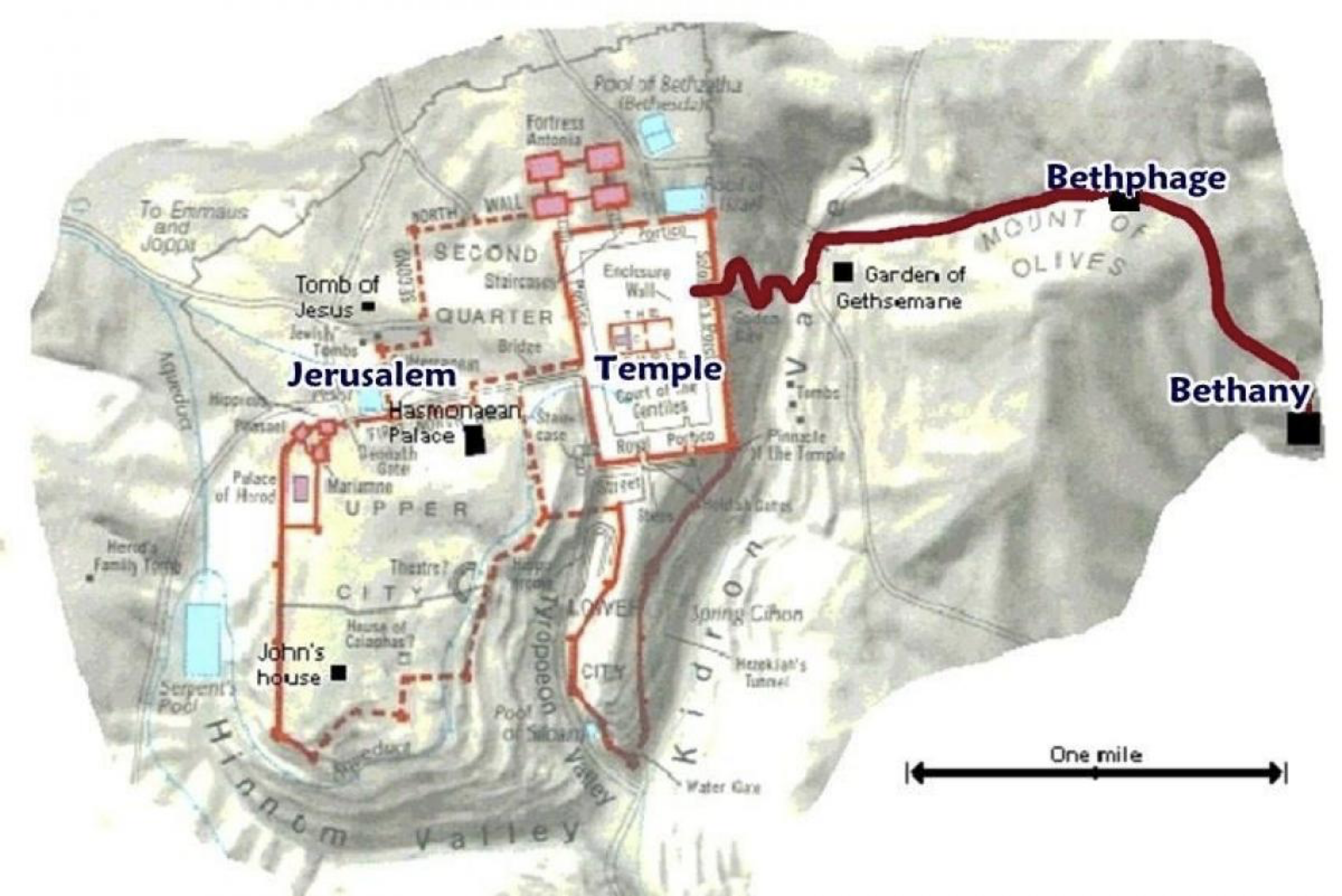
Ezekiel said, “Behold, the glory of the God of Israel was coming from the east.” The Triumphal Procession on Palm Sunday – God returning to his temple.
And how does Jesus enter the temple? As Malachi said, He comes not in peace but in judgment. God’s presence will eventually come, never to depart again. And it will come with a great sound of rushing and with fire. But first, God has to deal with the problem of sin. There has to be a cleansing of the temple first. Jesus enters the Temple and sees that the House of God is full of corruption, and begins the process of cleaning it out.
Matthew 21:12-13 And Jesus entered the temple and drove out all who sold and bought in the temple, and he overturned the tables of the money-changers and the seats of those who sold pigeons. He said to them, “It is written, ‘My house shall be called a house of prayer,’ but you make it a den of robbers.”
He drives out the money changers who are charging exorbitant fees for the special coin that could be used to pay the temple tax. Then he turns over the seats of those selling animals and taking advantage of people who have to purchase animals to sacrifice. And which animals does Matthew specifically note? The pigeons. They were the sacrifices of the poor who could not afford a sheep or goat. Religion for profit, stealing money from the poor.
He is coming to judge. As Malachi asked, “Who can endure the day of his coming, and who can stand when he appears?” But Jesus is just getting started with the cleansing. Every time he comes back into the temple, the next week he is coming with his gloves off, he speaks in judgment, especially of the Scribes and Pharisees. Matthew chapter 23 has 7 statements of woe on these leaders because they are ‘hypocrites,’ ‘false teachers,’ ‘blind guides,’ ‘all show and no substance,’ ‘dead on the inside,’ ‘sons of snakes,’ ‘people who will not enter the kingdom of God.’
This is the same Judgment God had passed on Israel in the past. Look at the similarities from the prophet Jeremiah:
Jeremiah 7:2-11 Hear the word of Yehovah, all you people of Judah who come through these gates to worship Yehovah. This is what the Yehovah Almighty, the God of Israel, says: Reform your ways and your actions, and I will let you live in this place. Do not trust in deceptive words and say, “This is the temple of the LORD, the temple of the LORD, the temple of the LORD!” If you really change your ways and your actions and deal with each other justly, if you do not oppress the foreigner, the fatherless or the widow and do not shed innocent blood in this place, and if you do not follow other gods to your own harm, then I will let you live in this place, in the land I gave your ancestors for ever and ever.
But look, you are trusting in deceptive words that are worthless. Will you steal and murder, commit adultery and perjury, burn incense to Baal and follow other gods you have not known, and then come and stand before me in this house, which bears my Name, and say, “We are safe”—safe to do all these detestable things? Has this house, which bears my Name, become a den of robbers to you? But I have been watching! declares Yehovah.”
And the third symbolic act we find in Matthew 21:
Matthew 21:18-19 In the morning, as he was returning to the city, he became hungry. And seeing a fig tree by the wayside, he went to it and found nothing on it but only leaves. And he said to it, “May no fruit ever come from you again!” And the fig tree withered at once.
He sees this fig tree full of leaves. And these fig trees produce an early fruit that comes when the leaves appear. It is not as big as the later harvest of figs in the summer. This fruit is not as good or mature, but these early figs bring the promise of more mature fruit later. Early figs in Hebrew are ‘phage.’ And this happened in a town called Bethphage, which is in Hebrew, the house of early figs.
If you know the scriptures (the Old Testament), you know the prophets frequently used this symbol of early figs. I could give a bunch of examples, but we only have time for one.
Micah 3:9-12 Hear this, you leaders of Jacob, you rulers of Israel, who despise justice and distort all that is right; who build Zion with bloodshed, and Jerusalem with wickedness. Her leaders judge for a bribe, her priests teach for a price, and her prophets tell fortunes for money.
Yet they look for Yehovah’s support and say, “Is not Yehovah among us? No disaster will come upon us.” Therefore, because of you, Zion will be plowed like a field, Jerusalem will become a heap of rubble, the temple hill a mound overgrown with thickets.
Micah 7:1-4 What misery is mine! There is no cluster of grapes to eat, none of the early figs that I crave. The faithful have been swept from the land; not one upright person remains.…
Now is the time of your judgment.
You are wicked and producing no fruit. You will be judged.
So, as Malachi predicted, God would come back to his Temple, but in judgment. This condemnation of this fruit tree that was all leaves and no fruit is a symbol of Jerusalem. Its leadership is all leaves and no fruit, all show and no substance.
You have to bear fruit. This is the message of the messenger that Malachi predicted would come before God came back to the temple. That messenger was John the Baptist, and he had a 2-part message.
First, “Repent for the kingdom of heaven is at hand.” — Clean your house, God is coming back. So all these people were coming to repent, and John said, “Hey, that’s great that you want to repent, but you can’t just say ‘I repent ‘ and then get baptized. Your life has to change.
Repentance is not something you say; it is something you do.
So the second part of the message is “You have to bring fruits worthy of repentance.” You have to perform acts that are consistent with the life you have decided to live. Don’t tell God you are going to change — show God how you have changed. Then he warns them that a time of judgment is coming— either bear fruit or perish. And Jesus shows that symbolically with the fig tree.
Remember the reason God didn’t come back to the Temple they built in Malachi’s day? They didn’t repent. There is a reason Malachi saw the messenger coming before God came back to his Temple. There is a reason John comes before Jesus. The Messenger has to preach repentance before God returns.
And John told them it is judgment time, either bear fruit or perish. Because the Kingdom of God is near. God it about to return to his temple. And we are in week 63 of this 70-week study. You don’t want to miss week 70. Because that is when God returns in power to his temple, as he did before with fire and the sound of a rushing windstorm. But first, the temple must be cleansed. First, there must be repentance.
Repentance is the necessary step everyone must take before establishing a relationship with God, and it is a step we must all continue to take as we walk with Jesus. The old man dies hard. We want to make our own rules. We want to go the way that seems right to us, even though we are warned it leads to destruction.
Don’t miss the story of the fig tree. But I can’t finish this morning without looking at Jesus’ other story of the fig tree Jesus tells in Luke:
Luke 13:6-9 And he told this parable: “A man had a fig tree planted in his vineyard, and he came seeking fruit on it and found none. And he said to the vinedresser, ‘Look, for three years now I have come seeking fruit on this fig tree, and I find none. Cut it down. Why should it use up the ground?’ And he answered him, ‘Sir, let it alone this year also, until I dig around it and put on manure. Then if it should bear fruit next year, well and good; but if not, you can cut it down.’”
Why does this tree get a second chance when the other fig tree is condemned immediately? This Fig tree has been barren for years. It is just taking up space in the vineyard. How do we reconcile these two stories? What is the difference?
This tree has an advocate—a vinedresser who intervenes and asks for mercy on its behalf. Someone who will show this tree more care and love in an effort to encourage it to produce fruit. Thanks be to God that we have an advocate.
Romans 8:34. Christ Jesus is the one who died—more than that, who was raised—who is at the right hand of God, who indeed is interceding for us.
1 John 2:1 We have an advocate with the Father—Jesus Christ, the Righteous One.
We have a loving, merciful Father who remembers his children not for the day of their trouble, but the day of their salvation. He remembers us not for our worst day but for our best day.
And Jesus and the Spirit within us are interceding for us. And we can intercede for each other. We can go before the Father asking God to be merciful just as this vinedresser interceded for this tree. We can then, as the vinedresser did for the tree, show these people love and encourage them to produce more fruit.
Time is short. Spend time in prayer before the Father on behalf of your friends and family. And each day, seize the opportunity to produce fruit.
 Swallow No Camels