November 6, 2025 –  Temples, Monuments, and Churches— Acts #19

November 6, 2025 –  Temples, Monuments, and Churches— Acts #19
Acts 6:12 – 7:1

We continue with the story of Stephen.  He was chosen to be one of seven to oversee the distribution of resources in the growing church.  He was obedient to this and more.  The Holy Spirit began to do miracles through him.  Then some rose up against him and made accusations to the court of priests.  That’s where we pick up the story in Acts.

Acts 6:12-7:1   And they stirred up the people and the elders and the scribes, and they came upon him and seized him and brought him before the council, and they set up false witnesses who said, “This man never ceases to speak words against this holy place and the law, for we have heard him say that this Jesus of Nazareth will destroy this place and will change the customs that Moses delivered to us.” And gazing at him, all who sat in the council saw that his face was like the face of an angel.
And the high priest said, “Are these things so?”

Stephen then gives them a long lesson.  52 verses.  I won’t print it all here, but you should read it now, Acts 7:2-53.  Stephen recounts Israel’s history, but he focuses on two main themes. The first one is that God has, throughout history, raised up deliverers for the people, but they have been rejected. And just as they rejected the prophets, they rejected Jesus.   And the second one that I would like to look at primarily here is that God gave them the tabernacle and the temple as places where they may dwell with him, but they made the mistake of thinking that God actually dwelt in the temple.  They put too much emphasis on the temple and its liturgy.   By the time of Jesus, the temple had essentially lost its true function and was more of a monument than a Temple. An excellent piece of architecture —a grand building —but not a place for God.

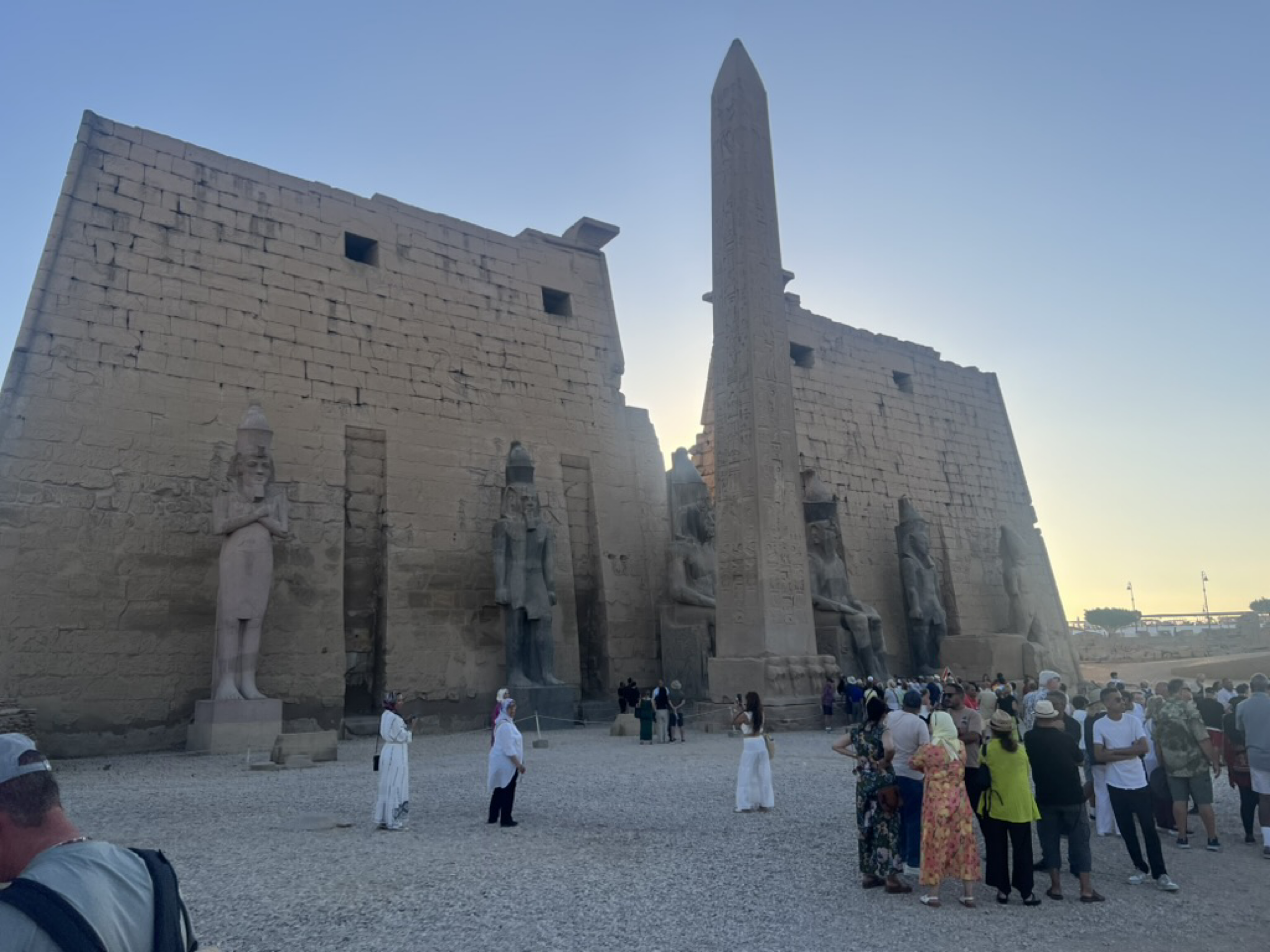
While we were in Egypt a month ago, we saw temple after temple.  But no one worships at any of these temples any longer.  They no longer function as temples, but just monuments to long-lost Pharaohs.  And Stephen, in his speech to the Chief Priests, will tell them that they have lost the purpose of their Jerusalem temple.  It was a place to meet God in worship, but they have used it to make money and gain power for themselves.  And they revere the temple more than they revere the God they should worship there.  Their temple has become an idol.

And the question we need to ask ourselves this morning, as we consider this passage of scripture, is: do we make the same mistake?  Have we placed too much emphasis on our individual church, on this church, or on a particular denomination, or church service itself, and forgotten that it is all about God, that the church is not the style of worship we use or the church rules we follow or the denomination we belong to, or the building we worship in?  Are we in danger of making the same mistake as these religious leaders in Acts 7?  

Just over 20 years ago, our church in Alabama was having its sanctuary remodeled.  Overnight, some cleaning rags spontaneously combusted, and the sanctuary was destroyed by fire.  It was a difficult time.  Many mourned the loss of that building, as they had very fond memories of their time there.  Babies had been dedicated there, children baptized there, couples married there, and some saints’ funerals held there.  There were mothers of young girls who dreamed of their daughters being married in that sanctuary.  But it was beyond repair. 

I remember standing outside looking at the charred building and saying to the pastor, “It’s only a building.”  That may have sounded a little callous then, because it really wasn’t just any old building, like a warehouse or a store.  But it really was just a building.  There were some holy moments in that place, but it was the moments that were holy, not the place.  It’s just a building.

But sadly, there are many stories of churches that have had bitter controversies over building decisions, whether to build a new building or remodel.   At least one church split over the color of the carpet in the new sanctuary.  Half wanted blue, half wanted red. The argument became so heated that people stopped speaking to each other. Some even left.  Months later, when the church finally installed the new carpet, they had lost far more than members—they had lost their witness. 

Now perhaps one group was right.  Maybe there were experts on interior decorating and on church decor who could state as a fact that one color was better for that circumstance.  But that doesn’t matter.  Choosing to be right is not more important than choosing to be in relationship.  A church splitting over carpet color may sound ridiculous… until we realize that we all have our “carpet issues.”

As a Christian Counselor, my wife often faces this same situation in marriage counseling. Usually, the most significant conflict in marriage is over things that don’t really matter, like carpet color.  She frequently asks couples who can’t seem to agree on a particular situation this:  “Would you rather be right, or would you rather be in a good relationship with your spouse?”  This is not only an essential principle for marriage, but a fundamental part of our understanding of God.  God is always right.  He is never wrong.  But he is willing to love us despite our wrongs and to seek a relationship with us.  He is willing to suffer himself to atone for the wrongs we have done, so that he can have that relationship.  And he wants us to show that same mercy and grace to others.  

But we all fight carpet color issues at some point.  Small things are blown out of proportion, causing division.  Every church has them.  Every denomination has them.  Every heart has them.  We all have the temptation to make something secondary into something sacred.  And this time, in Acts 6 and 7, the fight was over the temple itself.  And Stephen stood before the religious leaders of Israel and dared to challenge their obsession with one sacred thing: the Temple.

The charge against Stephen was simple. 

Acts 6:13-14   They set up false witnesses who said, “This man never ceases to speak words against this holy place and the law, for we have heard him say that this Jesus of Nazareth will destroy this place and will change the customs that Moses delivered to us.

They produced false witnesses who said,  He wants to tear down our temple and the way we worship here.  He wants to demolish the center of our faith.  But Stephen’s response in Acts 7 would reveal that their love for the Temple had actually blinded them to the true center of their faith—not a building and the sacrifices offered there, but the presence of God.

When Stephen begins his 52-verse defense, he doesn’t start with the accusations against him. He begins with a history lesson.  He tells the story of Abraham, Joseph, and Moses—men who met God outside of any temple or holy site.  He wants to show them that God doesn’t have to have a Temple made with human hands to meet people.

Long before there was a temple, before there was a promised land, before there was a chosen people, God first appeared to Abraham not in this place but in a pagan land.  Stephen is saying, “You think God only works in Jerusalem? He met our father Abraham in Babylon!”

And where did God first meet Moses? In the wilderness.  God spoke to Moses from a burning bush—not in a temple, but on dusty ground on Mount Sinai.  Stephen quoted God’s words:  

Acts 7:33. “Take off your sandals, for the place where you are standing is holy ground.” 

I have been on that mountain twice. I’ve hiked up and down that mountain, and there is no place with a sign that says this is holy ground.  That was Stephen’s point: Wherever God is present, it becomes sacred ground.  Let me tell you that on that sunrise at the top of Sinai, I found holy ground.  I had a sacred moment with God up there. Because it was never the ground that was holy, it was the presence of God that was holy.  It’s not about the location—it’s about His presence.   

Then Stephen speaks of how God moved with the children of Israel on their journey.  After God delivered them from Egypt, they returned to the same mountain where God had met Moses before.   And there God told Moses, “Make me a tabernacle that I may be worshipped in it.”  No, that is not what he said.  God said:

Exodus 25:8  “Let them make me a tabernacle, that I may dwell in their midst.   

That is what God wanted.  That is what he did in creation: he built a world and made a garden there so he could dwell with us.  And ever since Adam and Eve messed up God’s perfect plan to live with us, ever since Man brought sin and death into the world to drive a wedge between us and God, ever since that moment, God has been working to make a way to reunite himself with his creation.  So that is why they built the Tabernacle so that he could move with his people on their journey, and the tent was placed right in the middle of them. 

For all of the years in the wilderness and for hundreds of years after coming into the land, God met them in a tent—the Tabernacle—because His presence moved with His people. Only later, when Israel had settled in the land, did Solomon build the Temple, and even then, Stephen told them:

Acts 7:47-50 “But it was Solomon who built a house for him.  Yet the Most High does not dwell in houses made by hands, as the prophet says,
“‘Heaven is my throne, and the earth is my footstool. What kind of house will you build for me, says the Lord, or what is the place of my rest?  Did not my hand make all these things?’”

Stephen reminds the Sanhedrin that even when Solomon built the Temple that God designed, it was not to be His house.  God made it clear then that He cannot be contained in any man-made structure.

And yet the Temple had become their idol.  The Temple was not a bad thing, nor was the Tabernacle.  They were both good.  God gave the plans for the Tabernacle to Moses and the plans for the Temple to David.  God gave these structures to be a symbol of His desire to dwell among His people.  But symbols can become substitutes.  

Remember the bronze serpent on the pole that Moses made?  The people were dying from poisonous snake bites, and God instructed Moses to make a bronze (or more likely, copper) serpent on a pole.  The people would look to it and be healed.  (Jesus mentions it in His discussion with Nicodemus in John 4.)  Did you know that this copper snake that Moses made was still around in Israel 1000 years after Moses made it?   2 Kings 18 tells us that when the good king Hezekiah was trying to destroy all the idols in Israel:

2 Kings 18:4   And he [Hezekiah] broke in pieces the bronze serpent that Moses had made, for until those days the people of Israel had made offerings to it (it was called Nehushtan).

The people had taken something good that God designed for a good purpose and turned it into an idol.  And idols must be destroyed.  This is not a new idea.  God made all the animals and all the heavenly bodies, and many false religions have turned them into idols.  And now Stephen is telling these priests that they have taken the idea of the Temple as the place where God meets men and turned it into an idol.

And for these Jewish leaders, the Temple was a status symbol: proof of their national pride.  It was a security blanket: “As long as we have the Temple, God is with us.”  And it was a source of control: it gave the priests and leaders power over who could approach God.  They believed that questioning the Temple was questioning God Himself.   But in truth, their loyalty had shifted—from the Lord to the location.  This is not a new problem.  It was the same 600 years earlier in Jeremiah’s day.

Jeremiah 7:3-4  “Thus says Yehovah of hosts, the God of Israel: Amend your ways and your deeds, and I will let you dwell in this place. Do not trust in these deceptive words: ‘This is the temple of the LORD, the temple of the LORD, the temple of the LORD.’

They had made a mantra of their claims that because the temple was there, they could not be defeated.  The Babylonians can not take our city, for the Temple of God stands here.   But Jeremiah warned them that the Temple was no protection from the punishment for abandoning their obedience to God.  And so this prophecy came true on the ninth day of the month of Av, 586 BC, the Babylonians sacked Jerusalem and destroyed the temple.

And now Stephen tells them, as Jeremiah did their predecessors, that the Temple is not God, and they have left God no choice but to destroy the object of their idolatry. Idols must be destroyed.

So again, God called up a foreign oppressor nation to do that.  And in 70 AD, Roman troops breached the city’s walls and destroyed the temple.  And it happened on the same day of the year as before, on the ninth of the month of Av.  God is trying to teach this vital lesson.  Do not take something good I have given you and make it into an idol.

It is easy to read the story and see how these priests had been deceived into thinking they were doing a great job handling religion, when all the time they were like shepherds leading their sheep to destruction, to see how they had substituted their Temple and their religious practice for God.   But now let’s bring this forward 2,000 years.   

The problem Stephen exposed still exists—the temptation is still there, just in different clothes.  There is a temptation today to take something wonderful that God has given us and turn it into an idol.  And there is a temptation to see the local church as the new Temple.  It’s easy for a congregation to fall in love with itself.   There’s nothing wrong with loving your church!  But some churches, over time, like the Temple, turn inward on themselves.  They see themselves like these priests in Stephen’s day see the Temple, as the “House of God”.

J D Greear wrote a book in 2015 called “Gaining by Losing,” in which he described the modern-day church as a cruise ship.  Initially, there were ocean liners, built to ferry people across the Atlantic.  Now, don’t be fooled by the movie about the Titanic.  For all but a few people, these were not luxury trips at all but were filled with poor immigrants or refugees seeking a new life in America.  These were destination-based trips.  You tolerated the journey to reach the destination.  That is why they were called ocean liners. They were designed to get you from point A to point B on a regular route or line, like a bus or train.

With the advent of larger airplanes, the need for ocean liners as primary transportation diminished.  And then we saw the rise of cruise ships that did go places but, over time, really became destinations in themselves, with top entertainment, restaurants, water slides, ice rinks, etc.   They mostly went in circles, delivering you back where you started.

Before the 1960s, most churches were small and community-based. They had a sanctuary, a few offices, and classrooms. The church was destination-based; a means to get you to the throne of God.  Then churches began following the cruise ship model, Greear notes, offering more and more amenities to attract members to their particular brand.  We saw churches build sports complexes, coffee shops, and bookstores, and, of course, better-decorated sanctuaries with the latest stage sound, lighting, and special effects, and padded pews for the comfort of the members: more charismatic pastors, video backdrops. 

All of this catering to a membership that chooses which church to attend based on what that church can do for me or how it meets my perceived needs.  I have heard friends say, “Well, this church has better programs,” or “that pastor didn’t meet my needs,” or “that is not my favorite kind of music.” “I didn’t enjoy the worship service.”   It is all about me and what I need.  They go somewhere, but they don’t get you to the throne of God.

Therein is the problem.   The gathering of believers is not for the purpose of getting something but giving something — giving praise to God, giving a part of your income, and giving service to others to spread the gospel.  We are there to serve, not to be served.  To give, not to get.   

You should never make your decision about church attendance based on what you get out of it.

There is the danger that the destination is our enjoyment of the worship service. Not us meeting God at his throne.  Do you see how ridiculous that sounds?   You can lose the church’s very purpose by making it all about yourself.  Then you are no longer worshipping God, but you are worshipping an idol, either the church or yourself.

The priests in Acts 7 got a lot out of the Temple.  They got power, prestige, and money.  It was not about God; it was all about them.  The temple had become their cruise ship.  We, too, must be careful not to obsess over our own institutions, for if we do, we stop moving outward and start looking inward.

Temple-thinking says: “If people want God, they’ll come to us.”  The gospel says: “Go into all the world.”  Our focus must be broader than our little corner of the world.  We need to be kingdom-minded.  Just because we have the resources to make our sanctuaries bigger or better doesn’t mean we should.  We have to consider the needs of God’s kingdom.  It is not all about us.

The religious leaders thought they were guarding holiness, but in truth, they were rejecting the Holy One Himself.  Jesus stood right before them—and they didn’t recognize Him.  Stephen’s accusation still echoes:  “You’re worshiping the symbol of God’s presence, not God’s actual presence.”

Jesus came to make a radical change in the structure of the Temple in God’s world.  The days of a physical temple as a symbol of God’s dwelling among people are no longer needed. God was never contained in a building, he told Solomon that.  It was always God’s wish to dwell with us intimately in our hearts.  But the problem was sin.  So Jesus came to bring about the final defeat of sin, so that God could take up residence in our hearts.  And 50 days after Jesus defeated sin, the Holy Spirit came in power on Pentecost.  And from that day on, the Temple building in Jerusalem lost its purpose.  Oh, they had polluted and defiled it so severely that it was no longer serving the purpose God intended anyway.  So it is no more.

  Paul said this:  

1 Corinthians 3:16  Do you not know that you are God’s temple and that God’s Spirit dwells in you?

And Paul isn’t using the generic Greek word for ‘temple’ there.  He is using the Greek ‘naos’ for the Temple.  Naos is the word for the most holy place, the holy of holies, the very place where God’s spirit dwells.  When Jesus cleanses us of sin, we become together the holy of holies.  God has accomplished his goal of communion with us again.  We are the temple.

And Stephen got a glimpse of that.  They become so angry at Stephen that they take him outside the city and stone him to death.  And as the stones began to fly, Stephen looked up and said: 

Acts 7:56   Look, I see heaven open and the Son of Man standing at the right hand of God!”

Think about that. They accused him of disrespecting the Temple—but Stephen saw the real Temple—the presence of God in heaven, with Jesus standing beside the Father.   What they were defending was a shadow.  What Stephen saw was the reality.   Through Christ, we have become God’s temple.  That means that God’s presence is not limited to one church building.   God’s Spirit is not confined to one denomination. God’s glory is not dependent on our brand.   The actual temple is wherever the people of God live, love, and carry His presence into the world.

I showed you monuments that the pharaohs in Egypt built 1000s of years ago.  Monuments to a past that is gone.  That is what man has always built – monuments.   We do that in our country also. 
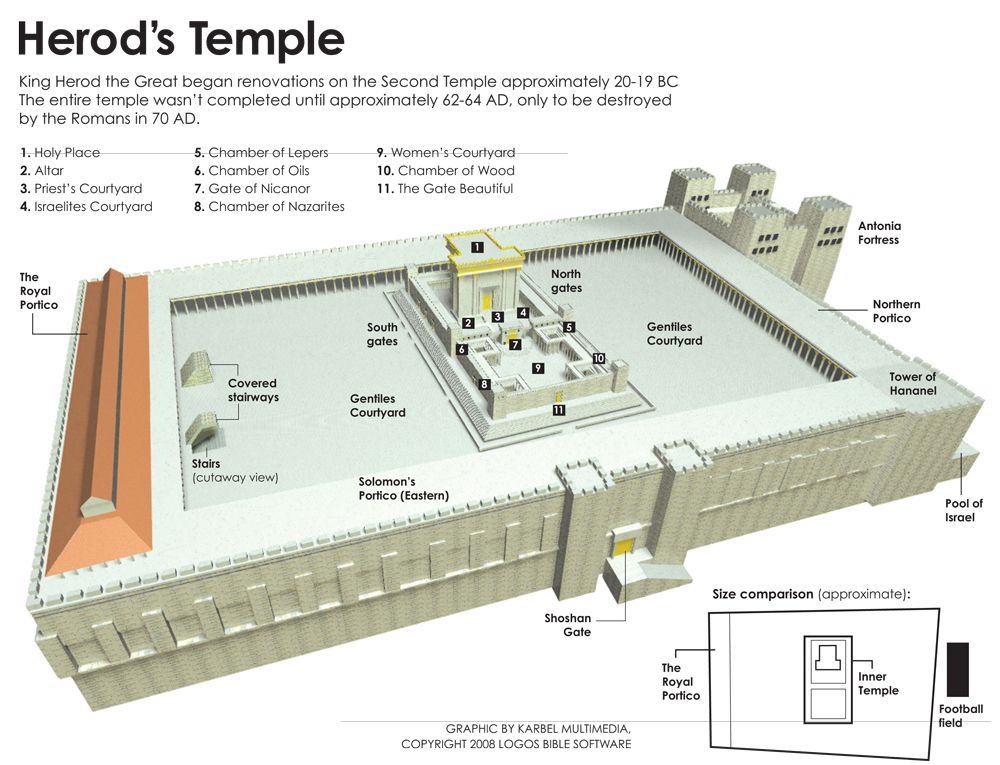
And the Temple in Jerusalem had become a monument.  It was initially built to be a place where God met people.  Where worship was centered.  But over the years, it became just a monument.  A structure that commemorates a past event.  Not only did it no longer function as God intended, but it had become an idol.  And idols must be destroyed.

God doesn’t build buildings and monuments; God builds people.

So we must not put too much importance on buildings.   Don’t call this the house of God.  God doesn’t live here.  He can’t be contained.   Don’t call it the church house either.  We don’t live here; we just meet here to worship.  I don’t even like the phrase ‘house of worship’. One, because it is not a house, and 2, because worship is something we do all day, every day, everywhere. 

We should look at our buildings as mission outposts.   A mission outpost is a small, localized base, often focused on outreach, service, and fellowship. These outposts can serve as places for evangelism and discipleship, hubs for community support — like food and clothing —or spaces for believers to be recharged and connected to go back out into the world.  I believe the current military term is Forward Operating Base or FOB.  This is a staging area to send people out to do the mission.

As Greear noted, we as a local church should not function like a cruise ship.  We are not here to serve ourselves.   Greear said we should be more like aircraft carriers.  Aircraft Carriers equip planes to go off and complete missions.  The church is not the mission. It is a staging ground for the mission of carrying the light of the gospel to the places in the world where there is darkness.  We meet here to worship God and to get our mission assignment.  Every time we walk out those doors, we should know what our specific mission is for that week.  Do you know your mission?
June 15  – Shavuot (Pentecost) — Acts #2

Acts #2 — Shavuot (Pentecost)
Acts 2:1-13
(Cross-posted in the 70 weeks with Jesus section.)

We have reached week 70 in our study. We began in January, looking at John the Baptist as the forerunner to Jesus. The 70-week study of Jesus’ ministry started on February 16th, with Jesus’ baptism. We have followed Jesus week by week as he traveled about, teaching, healing, and discipling his small group. 

As I was looking back this week, I asked many people this question: “What is the climax of Jesus’ ministry?”  Most said the climax was the crucifixion or the resurrection, which are good answers.  But to decide on the climax of the story, let’s review the plot, the story of the Bible, which is all about Jesus.

God created a world and people and said it was good.  And God and his people lived together in the same space we call the Garden of Eden.  But sin came in Genesis 3 and broke the fellowship between God and his people.  Sin and death entered the world.  And the rest of the Bible is the story of how God is working to restore his relationship with his people, to reunite heaven and earth.   

In Exodus, God tells Moses to build a tabernacle, “So I can dwell with them.” God establishes his presence in this small people group, leading them with a pillar of fire and cloud.  Later, Temples were built as places where God’s and man’s space could overlap. But even with constant sacrifice, sin is not completely dealt with. People continue to be rebellious.  

So Jesus comes, Emmanuel, God with us.  And for a short time, God is present with us in the person of Jesus.  Through Jesus’ crucifixion and resurrection, sin and death are defeated so that we have the possibility of eternal life with God.  And then in his ascension to the Father and his enthronement at the Father’s right hand, He serves as our High Priest and from there sends us the blessing of the Father, which is God’s presence with all of us.  In Jesus, God is fulfilling his goal of communion with us by sending the Holy Spirit to live in us.  And we have become temples, filled with God’s presence, where God’s space and man’s space overlap.   Is this the climax?

God is not finished, because the day is coming when Jesus will return to complete his work.  He is coming again to bring a complete end to sin and death and to restore God’s kingdom over all, and heaven and earth will be one again.  That is the day that the prayer you constantly pray will be answered.   “Thy kingdom come. Thy will be done on earth as it is in heaven.”  This is the climax of Jesus’ ministry – when he returns and God has completed his redemption of the world.

But today we are talking about the arrival of the Holy Spirit.  Just before he ascended, Jesus told the disciples the Holy Spirit was coming in a few days.  They were to wait in Jerusalem until then.  And what did they do while they were waiting?

Luke 24:50-53   While he blessed them, he parted from them and was carried up into heaven. And they worshiped him and returned to Jerusalem with great joy, and were continually in the temple blessing God.”

First, they worshipped right there.  Then they returned to Jerusalem.   And how did they spend their time there?  They were continually blessing God.  And where were they meeting to bless God?  The Jewish Temple.   What does it mean to bless God?   Blessing is from the root word to ‘bend the knee.’   We praise and thank God for who he is and what he has done.  And Jesus, as a young boy, was taught the traditional Jewish blessings.  It seemed that there was a blessing for everything. 100 blessings a day.

When we wake up: “Blessed are you, O Lord our God, King of the Universe, who has given me today the breath of life.” When we have food: “Blessed are you, O Lord our God, King of the Universe, who brings forth bread from the earth.” And when we go to bed:  “Blessed is He who brings sleep to my eyes and slumber to my eyelids.”

Blessing God — this is how we worship God every day, everywhere.

Worshipping While Waiting.  Do you like to wait?  I have to confess that I am not good at waiting. I can, at times, be annoyingly impatient, especially when driving. The light turns green, and suddenly, the three seconds it takes the car in front of me to go seem an eternity.  Am I the only one like this?  The disciples took advantage of this time of waiting to bless God.

So, this past week, I experimented with finding reasons to thank or bless God anytime I found myself waiting, worshiping in waiting. At 5:45 a.m. on Tuesday morning, driving from Georgia to Alabama, at the four red lights in a row (with no other cars present), I am blessing God.  “Blessed are you, our Lord, King of the universe, who has made such a beautiful day.  Blessed are you, Yehovah, who has created coffee so I can be fully awake.”

Later that trip, I got behind a large truck doing 15 mph up the mountain in Crossville. (This happens almost every time.) But this time, instead of complaining to myself about the delay, I am blessing God.  “Blessed are you, our Lord, king of the Universe, who has given me a chance to see this amazing view off the mountain.”  Let me tell you, it was a much better drive.

The disciples didn’t know exactly when the Spirit would come.  Jesus told them the Father’s timing was not for them to know.  

Why is God waiting 10 days?  What is He waiting for?  When you study the scriptures, you find God is very intentional with his timing.  The Old Testament often speaks of the “fullness of time.”  Jesus says over and over in his Gospels, “My hour has not yet come,” until he prays in Gethsemane, and then says, “The hour has come.”  God makes sure that Jesus is crucified as the Passover lambs are being slain, and he is resurrected on the day of the Feast of FirstFruits.  So it should not come as a surprise that God is setting up the coming of the blessing of the Holy Spirit at a special time.

Pentecost is from the Greek pentekostos, meaning “50″, because it is 50 days from Passover.  By the time of Jesus, the Jews had been celebrating that day for over a thousand years.  In the Hebrew Scriptures, it is called Shavuot, which translates into ‘sevens’ or ‘weeks.’   Leviticus 23 commanded them to count seven ‘sevens’ or seven weeks and then one day.  Then there was a special offering with grain and animals, as well as a special reading and convocation.  (Leviticus 23:15-21).   This was one of the three feasts that the scripture required all males to attend and make an offering.  (Deuteronomy 16:16).  So, as in Passover, the city is packed with over a hundred thousand Jews from all over the known world who have made their way to Jerusalem for this special day, bringing offerings of thanksgiving for God’s blessings.  

Isn’t it interesting that God tells them to count up 50 days?   The scriptures specify the day that the Passover falls as the 14th day of the 1st month.  But the Bible never says that Shavuot is on the 6th day of the third month.  It simply says to count the days.  For 50 days, they have a special grain offering in the Temple and would make a ceremony of counting the days.  It is all about anticipation.  Something great is coming.  

Shavuot is a harvest celebration.  As Passover and Firstfruits celebrate the barley harvest, Shavuot, 50 days later, celebrates the wheat harvest. But they are both more than harvest celebrations.  Passover celebrates the night they were spared the death of the firstborn, and they escaped bondage in Egypt.   Shavuot also commemorates the giving of the law on Mt Sinai, which Exodus tells us happened 50 days after the first Passover.

We talked about how seven is the number of completeness throughout the Bible.  If seven is completeness, the eighth in the series is the beginning of something new.  In Genesis, God set up the week of seven days; the eighth day is the start of a new week.  We have seen many examples of sevens in the Gospel of John.  Jesus has seven table meals in John’s Gospel with people; the eighth is after the resurrection.  There are seven confessions people make about Jesus, and then the eighth one, after the resurrection, is the one that is new and different.  For the first time, He is recognized as God.  The eighth of something is new.  So we count 7 weeks, seven sevens — complete completeness, then the next day is something radically new —Pentecost.  God is doing a new thing.   To the Jews in Jesus’ day, the new thing was the giving of the law.

And that encounter with God at Mount Sinai was dramatic and powerful.  The mountain is filled with fire and smoke and noise, with the whole mountain shaking violently.  The people were filled with fear and refused to go up the mountain as God had invited them, so they sent Moses for them.   We have discussed this powerful manifestation of God seen here, and how it is repeated at the dedication of the tabernacle with the cloud and fire consuming the sacrifice and God’s glory filling the space. 

This same overwhelming presence of God was seen again at the dedication of Solomon’s temple.  Again, fire came down from heaven, consuming the sacrifice, and again, God’s glory filled the Temple. But the people continued to rebel, and you remember that God punished his people for their sin by allowing the foreign nation of Babylon to conquer them.  

Ezekiel, the prophet, saw in a vision the presence of God leaving Solomon’s Temple.  Then the temple and the city of Jerusalem were destroyed, and all the people taken captive.  Seventy years later, when they returned to the land of Israel, they rebuilt the temple and had this grand dedication service.  But unlike the dedication of the tabernacle, unlike the dedication of Solomon’s temple, this time, God did not show up.  There was no fire, no wind, no cloud, and no sound.  God did not return because the sins that led to their exile still remained.  They had not repented.

But God revealed to Ezekiel that though God had abandoned this Temple, He had not abandoned His people.  One day, he would return to His temple.   And all the prophets in the Old Testament looked forward to this time when God would return.  As the final prophet in the Old Testament, Malachi said:

Malachi 3:1    Behold, I send my messenger, and he will prepare the way before me. And the Lord whom you seek will suddenly return to his temple;

And they waited, and they waited… 400 years they waited.   Until that messenger that Malachi spoke of came… John the Baptist – the one crying in the wilderness to prepare the way of the Lord.  And then, about 16 months later, God finally returns to the temple.

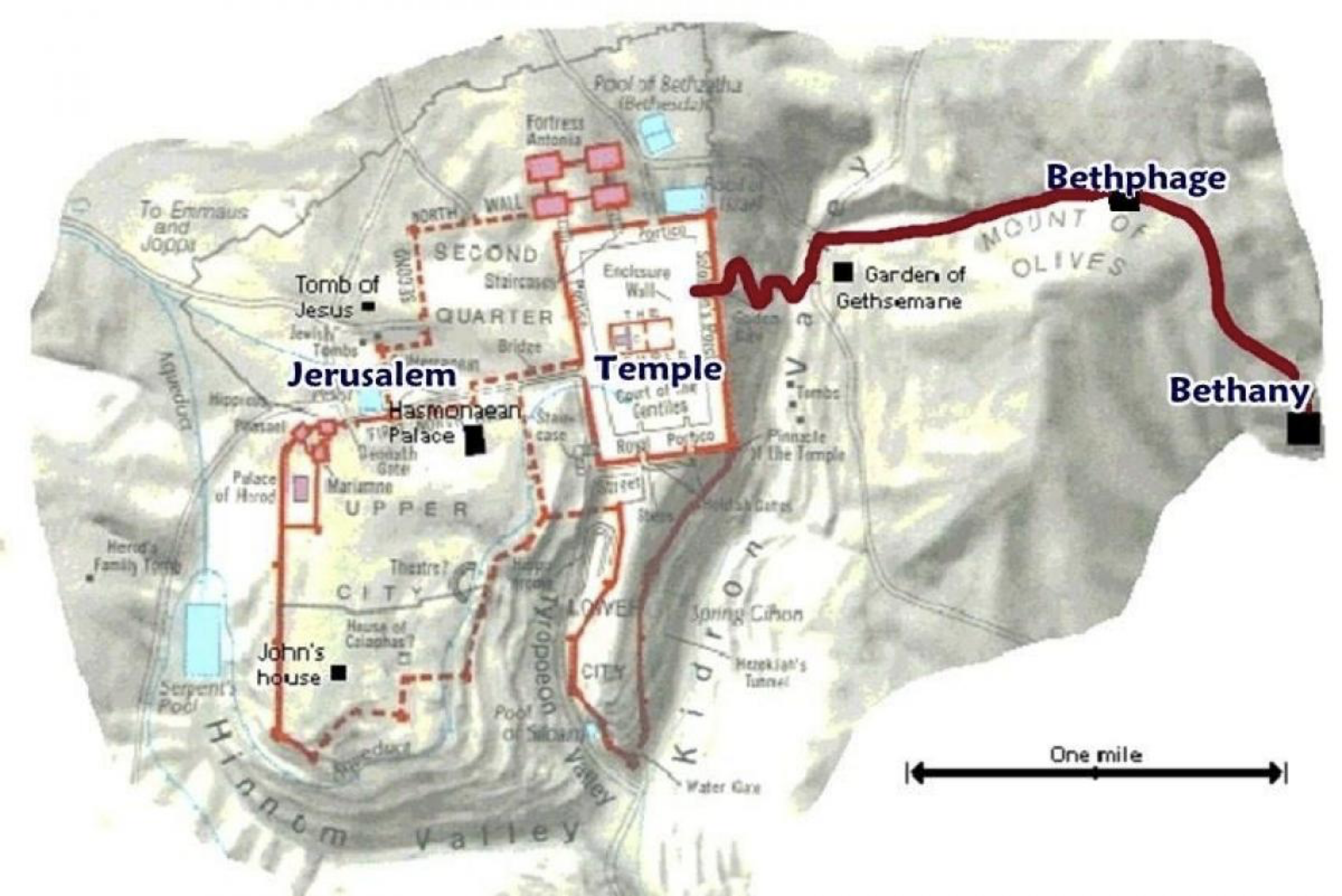
God comes to the temple in the form of Jesus.  He comes riding on a donkey as King David and Solomon did.  And he enters the temple on that Palm Sunday.  But he comes not to be praised, but to judge.  That is when he overturns the tables of the crooked money changers and drives out the corrupt animal salesmen.  He comes with harsh words of judgment for the religious leaders of the day.  And they kill him.  And he is resurrected, but he does not return to the temple again.  He is coming back to the temple just as Ezekiel and the other Old Testament prophets foresaw, but not yet.  Just look at the picture God is painting in history:

For 400 years, the children of Israel were held in slavery in Egypt.  400 years of waiting for redemption.  And Passover comes, and they are delivered from slavery, passing through the sea and traveling 50 days to Mount Sinai, where God’s presence shows up in mighty form.  Then you skip forward in history, and after the last prophet spoke in the Old Testament, for 400 years, they waited for God to return to His Temple. For 400 years, they waited for redemption. And Passover comes again, and through the death of Jesus on the cross, deliverance comes from slavery to sin. And then 50 days later, God’s presence comes in a mighty way to his temple. It is Pentecost. Could God make this any clearer?  He is about to intervene in history again, like he did at Sinai.

Let’s see what happened when God’s presence came on that first day of Shavuot, when God came on Sinai. But first, we have to realize that things of God are hard for the writers of the Bible to describe.  They are trying to represent in words something we don’t have the words to explain or the context to understand.   When Ezekiel sees God leaving the temple, he tries to give us a picture of what he is seeing, God’s throne chariot, but it is indescribable.  So he talks about wheels inside wheels that move in any direction, made of jewels, and multi-faced animals, and well, it is nothing I can picture.  

God is so much greater, so different that we cannot adequately describe his appearance.  So descriptions of God’s appearance or the descriptions of Heaven (God’s space) in Revelation are … well… just bizarre.  The Bible writers do the best they can, but it is like trying to explain a rocket ship to a caveman, or to explain colors to someone who has been blind from birth.  With that in mind, let’s look at how God’s presence at Sinai is described.  

Exodus 20:18   Now, when all the people saw the thunder and the flashes of lightning and the sound of the trumpet and the mountain smoking, the people were afraid and trembled.

Our translators are trying to translate what it says in Hebrew, but they are having problems. Did they ” see” the thunder?  In Hebrew, it actually says,  “When all people saw the voice.” That Hebrew word appears over 500 times in the Bible and is almost always translated as voice, except in Exodus. They use “thunder” to try to describe God’s voice.

Look what Job says about God’s voice:

Job 37:2-4   Listen! Listen to the roar of his voice, to the rumbling that comes from his mouth.
He unleashes his lightning beneath the whole heaven and sends it to the ends of the earth.
After that comes the sound of his roar; He thunders with his majestic voice.
When his voice resounds, He holds nothing back.

So the people “saw the voice of God” and  then “flashes of lightning.”  “Flashes of lightning” is one Hebrew word, “lappidim,” which is always translated as “torches” except in this verse.    This is not lightning.  There is another Hebrew word for lighting (barak) used 21 times in the Bible.  These are pieces of fire that are moving or, as the modern Tyndale commentary says, “fireballs”, like in Abraham’s vision of God.1  Or as Jerry Lee Lewis would say, “Great balls of fire.”2

Many times in the Bible, the voice of God is visualized as flames of fire.  Here is one example in the Psalms

Psalm 29:7   The voice of the LORD flashes forth flames of fire.
  The voice of the LORD shakes the wilderness.

So when God’s mighty presence comes at Mount Sinai, it is hard to describe, but the people see the voice of God like fireballs, and it thunders and roars. Over 1000 years later, on the same day of the year, at the celebration of that Sinai moment, God’s presence comes again on the Temple Mount.  And how does Luke describe it?

Acts 2:1-3 “When the day of Pentecost arrived, they were all together in one place. And suddenly there came from heaven a sound like a mighty rushing wind, and it filled the entire house where they were sitting. And divided tongues as of fire appeared to them and rested on each one of them.”

Notice he doesn’t feel the wind but hears the sound of a “mighty rushing wind”.  In Greek, a “violent” wind.  Have you ever been close to a tornado?  One day, my family huddled in our hall when one passed by.  The sound has been described as a freight train, a thundering, rumbling, howling sound.  It is a frightening sound.

A flame comes and divides itself into tongues of fire.  Tongue in Greek can mean the actual muscle in your mouth or, more commonly, ‘tongue’ is a language.  (We still use the term, “native tongue.”). A few verses later, when it says the disciples speak in “other tongues,” it is, of course, not saying they had different muscles in their mouth, but they spoke different languages.3  As in Sinai, fire divides into pieces, ‘tongues’ or ‘balls’ of fire.  God’s presence is being manifested in much the same way as it was at Sinai. 4 Again, Luke is trying to describe God’s presence, and like the writer of Exodus, he does the best he can.

What we can see is that the day the Old Testament prophets had looked forward to has arrived. God’s presence has finally returned to the Temple after over 400 years of waiting. But where do the flames come from to rest? Not on the Temple building, as when God came to the Tabernacle and Solomon’s temple, but on the disciples’ heads.  The temple that God returned to was not the physical building there, not Herod’s Temple.  They waited over 400 years for God to return to His Temple, and he has.  But the temple is us. 

1 Corinthians 3:16   Do you not know that you are God’s temple and that God’s Spirit dwells in you? 

Jeremiah had seen this coming. 

Jeremiah 31:33   For this is the covenant that I will make with the house of Israel after those days, declares the LORD: I will put my law within them, and I will write it on their hearts.  And I will be their God, and they shall be my people.

Who is there in the temple on that Pentecost?   Jews from all over the world gathered for the required feast—the whole house of Israel.  At the first Shavuot, God gave them the law on stone tablets.  But Jeremiah saw the day coming, a new Shavuot with a new covenant: “I will put my law within them.”  The word they translate as “law” is the Hebrew word ‘Torah.’  And Torah can mean law, or the first five books of the Bible, but it literally means “God’s instructions for living.”   If we listen to and follow the Holy Spirit, God’s Spirit within us will teach us how to live.

Ezekiel 36:26-27 “And I will give you a new heart, and a new spirit I will put within you. And I will remove the heart of stone from your flesh and give you a heart of flesh. And I will put my Spirit within you, and cause you to walk in my statutes and be careful to obey my rules.”

Again, the Holy Spirit within us will “cause us to follow God’s instructions”.   The Spirit will show us how to live and follow God’s rules.  And just after this passage is the vision God gave Ezekiel of the spirit coming.  There was a valley full of dried-up bones.  And God asked Ezekiel, “Can these bones come back to life?”  It sure didn’t look like it.  They were dead and dried up and lying in the sand.  But God said, “I will cause breath to enter you and you shall live.”   And the breath came into them, and they stood and came to life.   

And God tells Ezekiel the meaning of the vision.  The bones are the house of Israel, which is dried up without hope.  But God is going to breathe life into them.  Remember that the Hebrew word for breath is Ruach, the same word for wind or spirit.  In Genesis 1, the Spirit is hovering over the face of the waters.   Then God takes the dust and breathes life into the dust.  God places his breath, his spirit, in us.   Breath is life. 

When a baby is born, it appears lifeless at first, which can be scary. Then, it is stimulated and takes its first breath, and with that first breath come signs of life: movement and crying.  If you have ever witnessed a death, there is that last breath, a final exhale of breath from their lungs.  You can see how long ago people understood breath as life. Breath enters, and there is life; breath leaves, and there is death.  That is why they used the same word for breath, wind, and spirit (in Hebrew ‘ruach’ and in Greek ‘pneuma’). God tells us it is His Spirit, His Ruach, that gives us life.

People look at the Church in the world and see decreasing attendance in worship and decreasing membership, and they say the Church is dying.  I don’t believe that.  Because life is not measured in numbers, numerical growth does not determine life.  It is the spirit that gives life.  If we can learn to accept the presence of the Holy Spirit of God in our lives, then we live.  But so many don’t even consider the presence of God’s spirit in them.

Paul tells his apprentice Timothy:

2 Timothy 1:6   Fan into flame the gift of God, which is in you through the laying on of my hands,”

We need to be fanning the flame in ourselves.  When you invite God into your life, He comes as the Holy Spirit, that fireball from God.  We need to feed that fire by listening to the Spirit, agreeing with the Spirit, and following the Spirit.

Paul repeatedly tells us not to ignore God’s Spirit in our lives.

1 Thessalonians 5:19  Do not quench the Spirit.”
Ephesians 4:30   Do not grieve the Holy Spirit of God.

The Holy Spirit is within us to instruct us, lead us, and make our character more like Jesus so that we will look like him.  The spirit within us causes us to produce this fruit.

Galatians 5:22-23 “But the fruit of the Spirit is love, joy, peace, patience, kindness, goodness, faithfulness, gentleness, self-control;”

This is what a disciple of Jesus looks like.  This is the effect of God’s Holy Spirit in a person.  

Maybe, like me, you look at this list of nine attributes and realize you aren’t listening to the Spirit as much as you should.  Today is a good day to begin being a better listener and follower.

Let me add one more connection between that first Pentecost, that first Shavuot at Mount Sinai, and the Pentecost in Acts 2.  Do you remember when Moses was up on the mountain receiving the Ten Commandments from God? What was going on with the people of Israel?   They have given up on Moses and made a golden calf to worship.   And God sent a plague on the people, and those who were guilty were affected and were then slain by the Levites.  And 3000 died that day (Exodus 32:28).

After the Holy Spirit comes on Pentecost, Peter preaches a sermon. Many decide to follow Jesus and are baptized. How many?

Acts 2:41 “So those who received his word were baptized, and there were added that day about three thousand souls.”

God is redeeming here what was lost before.  God is still in the business of redeeming that which was lost.  And those 3000 Jews from all over the known world who just got baptized will head back to their home countries the next day.   Do you see what God just did there?  3000 missionaries spreading the Gospel to the world, all sent in one day.

And there is a world beyond our doors that is broken and lost.  And God, through His Holy Spirit in us, desires that no one perish, but all come to repentance.  Remember Jesus telling his disciples (John 14.12) that they would do greater works than he did because he was going to the Father? Jesus goes to the Father so he can send us the blessing of the Holy Spirit.  The Spirit of Christ lives in us.  We need to be doing great things.

  1. Cole, R. Alan.  Tyndale Complete Commentary, Exodus.  
  2. The phrase “Great Balls of Fire!” became popular in the southern United States in the mid-1800s, according to “Phrase Finder” (internet website) based on the references in Exodus, as the presence of God indicated by fire.  The phrase became more popular in the South after being quoted multiple times by Scarlett O’Hara in “Gone with the Wind” (1939).  But the best-known use of the phrase was in the song popularized by Jerry Lee Lewis in 1957, “Great Balls of Fire.” Lyrics and music by Otis Blackwell and Earl Burroughs.
  3. Notice that what happens at Pentecost, with all of the people able to understand each other as if they all had the same language, is the reversal of what happened at the Tower of Babel in Genesis.  Those people were arrogantly trying to build their own way to heaven.  At Pentecost, God is making a way for heaven to come to people.
  4. Where did this happen?  Tradition from the 5th century says it was at the Upper Room, where they also had the Last Supper.  But a look at the Scripture makes that less likely.   It is happening on the day of the Feastival of Shavuot, a one-day festival.   The scripture tells us they were in the Temple “continually.”  Peter mentions the time in his sermon after the Spirit comes as 9:00 am.  The temple services typically began with the first Tamid offering at 9 am.  And this service is one of the three times that the Scriptures say is required attendance. They would not have missed the service that is the highlight of the one-day celebration.  And the Scriptures mention that 3000 responded to Peter’s sermon and were baptized.  This had to happen in or near the temple grounds to have a place large enough for a crowd this large to hear them speak, and then to have a place to baptize that many.  There were over 50 mikveh near the Temple Mount, for people to immerse themselves in before entry into the Temple.

June 15, 28 A.D.  – Shavuot (Pentecost) — The Year of the Lord’s Favor #87

Week 70 — Shavuot (Pentecost)
Acts 2:1-13

We have reached week 70 in our study. We began in January, looking at John the Baptist as the forerunner to Jesus. The 70-week study of Jesus’ ministry started on February 16th, with Jesus’ baptism. We have followed Jesus week by week as he traveled about, teaching, healing, and discipling his small group. 

As I was looking back this week, I asked many people this question: “What is the climax of Jesus’ ministry?”  Most said the climax was the crucifixion or the resurrection, which are good answers.  But to decide on the climax of the story, let’s review the plot, the story of the Bible, which is all about Jesus.

God created a world and people and said it was good.  And God and his people lived together in the same space we call the Garden of Eden.  But sin came in Genesis 3 and broke the fellowship between God and his people.  Sin and death entered the world.  And the rest of the Bible is the story of how God is working to restore his relationship with his people, to reunite heaven and earth.   

In Exodus, God tells Moses to build a tabernacle, “So I can dwell with them.” God establishes his presence in this small people group, leading them with a pillar of fire and cloud.  Later, Temples were built as places where God’s and man’s space could overlap. But even with constant sacrifice, sin is not completely dealt with. People continue to be rebellious.  

So Jesus comes, Emmanuel, God with us.  And for a short time, God is present with us in the person of Jesus.  Through Jesus’ crucifixion and resurrection, sin and death are defeated so that we have the possibility of eternal life with God.  And then in his ascension to the Father and his enthronement at the Father’s right hand, He serves as our High Priest and from there sends us the blessing of the Father, which is God’s presence with all of us.  In Jesus, God is fulfilling his goal of communion with us by sending the Holy Spirit to live in us.  And we have become temples, filled with God’s presence, where God’s space and man’s space overlap.   Is this the climax?

God is not finished, because the day is coming when Jesus will return to complete his work.  He is coming again to bring a complete end to sin and death and to restore God’s kingdom over all, and heaven and earth will be one again.  That is the day that the prayer you constantly pray will be answered.   “Thy kingdom come. Thy will be done on earth as it is in heaven.”  This is the climax of Jesus’ ministry – when he returns and God has completed his redemption of the world.

But today we are talking about the arrival of the Holy Spirit.  Just before he ascended, Jesus told the disciples the Holy Spirit was coming in a few days.  They were to wait in Jerusalem until then.  And what did they do while they were waiting?

Luke 24:50-53   While he blessed them, he parted from them and was carried up into heaven. And they worshiped him and returned to Jerusalem with great joy, and were continually in the temple blessing God.”

First, they worshipped right there.  Then they returned to Jerusalem.   And how did they spend their time there?  They were continually blessing God.  And where were they meeting to bless God?  The Jewish Temple.   What does it mean to bless God?   Blessing is from the root word to ‘bend the knee.’   We praise and thank God for who he is and what he has done.  And Jesus, as a young boy, was taught the traditional Jewish blessings.  It seemed that there was a blessing for everything. 100 blessings a day.

When we wake up: “Blessed are you, O Lord our God, King of the Universe, who has given me today the breath of life.” When we have food: “Blessed are you, O Lord our God, King of the Universe, who brings forth bread from the earth.” And when we go to bed:  “Blessed is He who brings sleep to my eyes and slumber to my eyelids.”

Blessing God — this is how we worship God every day, everywhere.

Worshipping While Waiting.  Do you like to wait?  I have to confess that I am not good at waiting. I can, at times, be annoyingly impatient, especially when driving. The light turns green, and suddenly, the three seconds it takes the car in front of me to go seem an eternity.  Am I the only one like this?  The disciples took advantage of this time of waiting to bless God.

So, this past week, I experimented with finding reasons to thank or bless God anytime I found myself waiting, worshiping in waiting. At 5:45 a.m. on Tuesday morning, driving from Georgia to Alabama, at the four red lights in a row (with no other cars present), I am blessing God.  “Blessed are you, our Lord, King of the universe, who has made such a beautiful day.  Blessed are you, Yehovah, who has created coffee so I can be fully awake.”

Later that trip, I got behind a large truck doing 15 mph up the mountain in Crossville. (This happens almost every time.) But this time, instead of complaining to myself about the delay, I am blessing God.  “Blessed are you, our Lord, king of the Universe, who has given me a chance to see this amazing view off the mountain.”  Let me tell you, it was a much better drive.

The disciples didn’t know exactly when the Spirit would come.  Jesus told them the Father’s timing was not for them to know.  

Why is God waiting 10 days?  What is He waiting for?  When you study the scriptures, you find God is very intentional with his timing.  The Old Testament often speaks of the “fullness of time.”  Jesus says over and over in his Gospels, “My hour has not yet come,” until he prays in Gethsemane, and then says, “The hour has come.”  God makes sure that Jesus is crucified as the Passover lambs are being slain, and he is resurrected on the day of the Feast of FirstFruits.  So it should not come as a surprise that God is setting up the coming of the blessing of the Holy Spirit at a special time.

Pentecost is from the Greek pentekostos, meaning “50″, because it is 50 days from Passover.  By the time of Jesus, the Jews had been celebrating that day for over a thousand years.  In the Hebrew Scriptures, it is called Shavuot, which translates into ‘sevens’ or ‘weeks.’   Leviticus 23 commanded them to count seven ‘sevens’ or seven weeks and then one day.  Then there was a special offering with grain and animals, as well as a special reading and convocation.  (Leviticus 23:15-21).   This was one of the three feasts that the scripture required all males to attend and make an offering.  (Deuteronomy 16:16).  So, as in Passover, the city is packed with over a hundred thousand Jews from all over the known world who have made their way to Jerusalem for this special day, bringing offerings of thanksgiving for God’s blessings.  

Isn’t it interesting that God tells them to count up 50 days?   The scriptures specify the day that the Passover falls as the 14th day of the 1st month.  But the Bible never says that Shavuot is on the 6th day of the third month.  It simply says to count the days.  For 50 days, they have a special grain offering in the Temple and would make a ceremony of counting the days.  It is all about anticipation.  Something great is coming.  

Shavuot is a harvest celebration.  As Passover and Firstfruits celebrate the barley harvest, Shavuot, 50 days later, celebrates the wheat harvest. But they are both more than harvest celebrations.  Passover celebrates the night they were spared the death of the firstborn, and they escaped bondage in Egypt.   Shavuot also commemorates the giving of the law on Mt Sinai, which Exodus tells us happened 50 days after the first Passover.

We talked about how seven is the number of completeness throughout the Bible.  If seven is completeness, the eighth in the series is the beginning of something new.  In Genesis, God set up the week of seven days; the eighth day is the start of a new week.  We have seen many examples of sevens in the Gospel of John.  Jesus has seven table meals in John’s Gospel with people; the eighth is after the resurrection.  There are seven confessions people make about Jesus, and then the eighth one, after the resurrection, is the one that is new and different.  For the first time, He is recognized as God.  The eighth of something is new.  So we count 7 weeks, seven sevens — complete completeness, then the next day is something radically new —Pentecost.  God is doing a new thing.   To the Jews in Jesus’ day, the new thing was the giving of the law.

And that encounter with God at Mount Sinai was dramatic and powerful.  The mountain is filled with fire and smoke and noise, with the whole mountain shaking violently.  The people were filled with fear and refused to go up the mountain as God had invited them, so they sent Moses for them.   We have discussed this powerful manifestation of God seen here, and how it is repeated at the dedication of the tabernacle with the cloud and fire consuming the sacrifice and God’s glory filling the space. 

This same overwhelming presence of God was seen again at the dedication of Solomon’s temple.  Again, fire came down from heaven, consuming the sacrifice, and again, God’s glory filled the Temple. But the people continued to rebel, and you remember that God punished his people for their sin by allowing the foreign nation of Babylon to conquer them.  

Ezekiel, the prophet, saw in a vision the presence of God leaving Solomon’s Temple.  Then the temple and the city of Jerusalem were destroyed, and all the people taken captive.  Seventy years later, when they returned to the land of Israel, they rebuilt the temple and had this grand dedication service.  But unlike the dedication of the tabernacle, unlike the dedication of Solomon’s temple, this time, God did not show up.  There was no fire, no wind, no cloud, and no sound.  God did not return because the sins that led to their exile still remained.  They had not repented.

But God revealed to Ezekiel that though God had abandoned this Temple, He had not abandoned His people.  One day, he would return to His temple.   And all the prophets in the Old Testament looked forward to this time when God would return.  As the final prophet in the Old Testament, Malachi said:

Malachi 3:1    Behold, I send my messenger, and he will prepare the way before me. And the Lord whom you seek will suddenly return to his temple;

And they waited, and they waited… 400 years they waited.   Until that messenger that Malachi spoke of came… John the Baptist – the one crying in the wilderness to prepare the way of the Lord.  And then, about 16 months later, God finally returns to the temple.

God comes to the temple in the form of Jesus.  He comes riding on a donkey as King David and Solomon did.  And he enters the temple on that Palm Sunday.  But he comes not to be praised, but to judge.  That is when he overturns the tables of the crooked money changers and drives out the corrupt animal salesmen.  He comes with harsh words of judgment for the religious leaders of the day.  And they kill him.  And he is resurrected, but he does not return to the temple again.  He is coming back to the temple just as Ezekiel and the other Old Testament prophets foresaw, but not yet.  Just look at the picture God is painting in history:

For 400 years, the children of Israel were held in slavery in Egypt.  400 years of waiting for redemption.  And Passover comes, and they are delivered from slavery, passing through the sea and traveling 50 days to Mount Sinai, where God’s presence shows up in mighty form.  Then you skip forward in history, and after the last prophet spoke in the Old Testament, for 400 years, they waited for God to return to His Temple. For 400 years, they waited for redemption. And Passover comes again, and through the death of Jesus on the cross, deliverance comes from slavery to sin. And then 50 days later, God’s presence comes in a mighty way to his temple. It is Pentecost. Could God make this any clearer?  He is about to intervene in history again, like he did at Sinai.

Let’s see what happened when God’s presence came on that first day of Shavuot, when God came on Sinai. But first, we have to realize that things of God are hard for the writers of the Bible to describe.  They are trying to represent in words something we don’t have the words to explain or the context to understand.   When Ezekiel sees God leaving the temple, he tries to give us a picture of what he is seeing, God’s throne chariot, but it is indescribable.  So he talks about wheels inside wheels that move in any direction, made of jewels, and multi-faced animals, and well, it is nothing I can picture.  

God is so much greater, so different that we cannot adequately describe his appearance.  So descriptions of God’s appearance or the descriptions of Heaven (God’s space) in Revelation are … well… just bizarre.  The Bible writers do the best they can, but it is like trying to explain a rocket ship to a caveman, or to explain colors to someone who has been blind from birth.  With that in mind, let’s look at how God’s presence at Sinai is described.  

Exodus 20:18   Now, when all the people saw the thunder and the flashes of lightning and the sound of the trumpet and the mountain smoking, the people were afraid and trembled.

Our translators are trying to translate what it says in Hebrew, but they are having problems. Did they ” see” the thunder?  In Hebrew, it actually says,  “When all people saw the voice.” That Hebrew word appears over 500 times in the Bible and is almost always translated as voice, except in Exodus. They use “thunder” to try to describe God’s voice.

Look what Job says about God’s voice:

Job 37:2-4   Listen! Listen to the roar of his voice, to the rumbling that comes from his mouth.
He unleashes his lightning beneath the whole heaven and sends it to the ends of the earth.
After that comes the sound of his roar; He thunders with his majestic voice.
When his voice resounds, He holds nothing back.

So the people “saw the voice of God” and  then “flashes of lightning.”  “Flashes of lightning” is one Hebrew word, “lappidim,” which is always translated as “torches” except in this verse.    This is not lightning.  There is another Hebrew word for lighting (barak) used 21 times in the Bible.  These are pieces of fire that are moving or, as the modern Tyndale commentary says, “fireballs”, like in Abraham’s vision of God.1  Or as Jerry Lee Lewis would say, “Great balls of fire.”2

Many times in the Bible, the voice of God is visualized as flames of fire.  Here is one example in the Psalms

Psalm 29:7   The voice of the LORD flashes forth flames of fire.
  The voice of the LORD shakes the wilderness.

So when God’s mighty presence comes at Mount Sinai, it is hard to describe, but the people see the voice of God like fireballs, and it thunders and roars. Over 1000 years later, on the same day of the year, at the celebration of that Sinai moment, God’s presence comes again on the Temple Mount.  And how does Luke describe it?

Acts 2:1-3 “When the day of Pentecost arrived, they were all together in one place. And suddenly there came from heaven a sound like a mighty rushing wind, and it filled the entire house where they were sitting. And divided tongues as of fire appeared to them and rested on each one of them.”

Notice he doesn’t feel the wind but hears the sound of a “mighty rushing wind”.  In Greek, a “violent” wind.  Have you ever been close to a tornado?  One day, my family huddled in our hall when one passed by.  The sound has been described as a freight train, a thundering, rumbling, howling sound.  It is a frightening sound.

A flame comes and divides itself into tongues of fire.  Tongue in Greek can mean the actual muscle in your mouth or, more commonly, ‘tongue’ is a language.  (We still use the term, “native tongue.”). A few verses later, when it says the disciples speak in “other tongues,” it is, of course, not saying they had different muscles in their mouth, but they spoke different languages.3  As in Sinai, fire divides into pieces, ‘tongues’ or ‘balls’ of fire.  God’s presence is being manifested in much the same way as it was at Sinai. 4 Again, Luke is trying to describe God’s presence, and like the writer of Exodus, he does the best he can.

What we can see is that the day the Old Testament prophets had looked forward to has arrived. God’s presence has finally returned to the Temple after over 400 years of waiting. But where do the flames come from to rest? Not on the Temple building, as when God came to the Tabernacle and Solomon’s temple, but on the disciples’ heads.  The temple that God returned to was not the physical building there, not Herod’s Temple.  They waited over 400 years for God to return to His Temple, and he has.  But the temple is us. 

1 Corinthians 3:16   Do you not know that you are God’s temple and that God’s Spirit dwells in you? 

Jeremiah had seen this coming. 

Jeremiah 31:33   For this is the covenant that I will make with the house of Israel after those days, declares the LORD: I will put my law within them, and I will write it on their hearts.  And I will be their God, and they shall be my people.

Who is there in the temple on that Pentecost?   Jews from all over the world gathered for the required feast—the whole house of Israel.  At the first Shavuot, God gave them the law on stone tablets.  But Jeremiah saw the day coming, a new Shavuot with a new covenant: “I will put my law within them.”  The word they translate as “law” is the Hebrew word ‘Torah.’  And Torah can mean law, or the first five books of the Bible, but it literally means “God’s instructions for living.”   If we listen to and follow the Holy Spirit, God’s Spirit within us will teach us how to live.

Ezekiel 36:26-27 “And I will give you a new heart, and a new spirit I will put within you. And I will remove the heart of stone from your flesh and give you a heart of flesh. And I will put my Spirit within you, and cause you to walk in my statutes and be careful to obey my rules.”

Again, the Holy Spirit within us will “cause us to follow God’s instructions”.   The Spirit will show us how to live and follow God’s rules.  And just after this passage is the vision God gave Ezekiel of the spirit coming.  There was a valley full of dried-up bones.  And God asked Ezekiel, “Can these bones come back to life?”  It sure didn’t look like it.  They were dead and dried up and lying in the sand.  But God said, “I will cause breath to enter you and you shall live.”   And the breath came into them, and they stood and came to life.   

And God tells Ezekiel the meaning of the vision.  The bones are the house of Israel, which is dried up without hope.  But God is going to breathe life into them.  Remember that the Hebrew word for breath is Ruach, the same word for wind or spirit.  In Genesis 1, the Spirit is hovering over the face of the waters.   Then God takes the dust and breathes life into the dust.  God places his breath, his spirit, in us.   Breath is life. 

When a baby is born, it appears lifeless at first, which can be scary. Then, it is stimulated and takes its first breath, and with that first breath come signs of life: movement and crying.  If you have ever witnessed a death, there is that last breath, a final exhale of breath from their lungs.  You can see how long ago people understood breath as life. Breath enters, and there is life; breath leaves, and there is death.  That is why they used the same word for breath, wind, and spirit (in Hebrew ‘ruach’ and in Greek ‘pneuma’). God tells us it is His Spirit, His Ruach, that gives us life.

People look at the Church in the world and see decreasing attendance in worship and decreasing membership, and they say the Church is dying.  I don’t believe that.  Because life is not measured in numbers, numerical growth does not determine life.  It is the spirit that gives life.  If we can learn to accept the presence of the Holy Spirit of God in our lives, then we live.  But so many don’t even consider the presence of God’s spirit in them.

Paul tells his apprentice Timothy:

2 Timothy 1:6   Fan into flame the gift of God, which is in you through the laying on of my hands,”

We need to be fanning the flame in ourselves.  When you invite God into your life, He comes as the Holy Spirit, that fireball from God.  We need to feed that fire by listening to the Spirit, agreeing with the Spirit, and following the Spirit.

Paul repeatedly tells us not to ignore God’s Spirit in our lives.

1 Thessalonians 5:19  Do not quench the Spirit.”
Ephesians 4:30   Do not grieve the Holy Spirit of God.

The Holy Spirit is within us to instruct us, lead us, and make our character more like Jesus so that we will look like him.  The spirit within us causes us to produce this fruit.

Galatians 5:22-23 “But the fruit of the Spirit is love, joy, peace, patience, kindness, goodness, faithfulness, gentleness, self-control;”

This is what a disciple of Jesus looks like.  This is the effect of God’s Holy Spirit in a person.  

Maybe, like me, you look at this list of nine attributes and realize you aren’t listening to the Spirit as much as you should.  Today is a good day to begin being a better listener and follower.

Let me add one more connection between that first Pentecost, that first Shavuot at Mount Sinai, and the Pentecost in Acts 2.  Do you remember when Moses was up on the mountain receiving the Ten Commandments from God? What was going on with the people of Israel?   They have given up on Moses and made a golden calf to worship.   And God sent a plague on the people, and those who were guilty were affected and were then slain by the Levites.  And 3000 died that day (Exodus 32:28).

After the Holy Spirit comes on Pentecost, Peter preaches a sermon. Many decide to follow Jesus and are baptized. How many?

Acts 2:41 “So those who received his word were baptized, and there were added that day about three thousand souls.”

God is redeeming here what was lost before.  God is still in the business of redeeming that which was lost.  And those 3000 Jews from all over the known world who just got baptized will head back to their home countries the next day.   Do you see what God just did there?  3000 missionaries spreading the Gospel to the world, all sent in one day.

And there is a world beyond our doors that is broken and lost.  And God, through His Holy Spirit in us, desires that no one perish, but all come to repentance.  Remember Jesus telling his disciples (John 14.12) that they would do greater works than he did because he was going to the Father? Jesus goes to the Father so he can send us the blessing of the Holy Spirit.  The Spirit of Christ lives in us.  We need to be doing great things.

  1. Cole, R. Alan.  Tyndale Complete Commentary, Exodus.  
  2. The phrase “Great Balls of Fire!” became popular in the southern United States in the mid-1800s, according to “Phrase Finder” (internet website) based on the references in Exodus, as the presence of God indicated by fire.  The phrase became more popular in the South after being quoted multiple times by Scarlett O’Hara in “Gone with the Wind” (1939).  But the best-known use of the phrase was in the song popularized by Jerry Lee Lewis in 1957, “Great Balls of Fire.” Lyrics and music by Otis Blackwell and Earl Burroughs.
  3. Notice that what happens at Pentecost, with all of the people able to understand each other as if they all had the same language, is the reversal of what happened at the Tower of Babel in Genesis.  Those people were arrogantly trying to build their own way to heaven.  At Pentecost, God is making a way for heaven to come to people.
  4. Where did this happen?  Tradition from the 5th century says it was at the Upper Room, where they also had the Last Supper.  But a look at the Scripture makes that less likely.   It is happening on the day of the Feastival of Shavuot, a one-day festival.   The scripture tells us they were in the Temple “continually.”  Peter mentions the time in his sermon after the Spirit comes as 9:00 am.  The temple services typically began with the first Tamid offering at 9 am.  And this service is one of the three times that the Scriptures say is required attendance. They would not have missed the service that is the highlight of the one-day celebration.  And the Scriptures mention that 3000 responded to Peter’s sermon and were baptized.  This had to happen in or near the temple grounds to have a place large enough for a crowd this large to hear them speak, and then to have a place to baptize that many.  There were over 50 mikveh near the Temple Mount, for people to immerse themselves in before entry into the Temple.

April 27, 28 A.D.  – Jesus rides in a parade, rearranges furniture, and kills a tree.— The Year of the Lord’s Favor #80

Week 63 — Jesus rides in a parade, rearranges furniture, and kills a tree.
Matthew 21:18-19

As we follow Jesus’ ministry day by day, in 28 AD, this is the week of Passover, the week between Palm Sunday and the Resurrection.  At times over the past year, I had only had one short scripture passage to cover the events of that week in Jesus’ ministry.  But the week between the triumphal entry and the resurrection is so important to the story of Jesus that there is a lot of material: Seven chapters of Matthew, five chapters of Mark and Luke, and eight chapters of John.   Almost one-fourth of the material in the four gospels is about this final week.

There is no way to cover the material in those 20 chapters.   So I want to step back this week and get one aspect of the big picture of what is going on in the story of the Bible in that week.  The Bible is one cohesive story of how God is working to reestablish his relationship with his creation, and the key to that plan is what happens in this week and 50 days later.  Jesus does three symbolic acts at the beginning of that week.  We have already discussed two of them, so today, we will look at the third one and see how these fit into that big picture.

Matthew 21:18-19   In the morning, as he was returning to the city, he became hungry.  And seeing a fig tree by the wayside, he went to it and found nothing on it but only leaves. And he said to it, “May no fruit ever come from you again!” And the fig tree withered at once.  

I know what you’re thinking.  “So, out of 20 chapters of Gospel Material from Jesus’ final week, this is what you pick as a focal passage?  And why is Jesus hating on a fig tree? “

At the beginning of Jesus’ passion week, he performs three significant symbolic acts, which carry a lot of meaning to his followers who are familiar with the scriptures. He rides a donkey into the city (the Palm Sunday triumphal entry that we discussed two weeks ago). He drives the money changers and animal salespeople out of the temple area (which we discussed last year), and then he curses a fig tree.

These may seem out of character for the Jesus we have seen this past year—that meek and mild Jesus who told people not to talk about his miracles, who was leaving town when he gathered crowds to try to fly under the radar, and who mostly avoided confrontation. Here, we see him in a big parade entering the capital city, jumping into the middle of a confrontation in the temple, and then performing a miracle of destruction. What has changed? Let’s look at these events.

The cleansing of the Temple happens twice in Jesus’ ministry.  Both at the same time of the year, just before Passover..  Every Jewish person at that same time every year would, in preparation for the feast of Unleavened Bread, go to great lengths to remove every bit of yeast from their homes.  This is to commemorate the exodus from Egypt when they left after Passover and ate only unleavened bread, because they didn’t have time to let the bread rise as they hurried out of Egypt.  Yeast came to represent sin and corruption.  So every home would be cleansed to remove any traces of yeast every year.  Walls would be scrubbed, and cooking utensils boiled in water.  This still happens in Orthodox Jewish homes today.  Jesus enters the Temple and sees that the House of God is full of corruption and takes it upon himself to do some spring cleaning in preparation for the festival.  This has great symbolic meaning to the people of Jesus’ day.  (You can go back to my blog entry of April 10 last year to review.)

Then there is this episode about the fig tree, which seems odd to us.  Again, these are very symbolic acts.  To understand what is really going on in these events, you have to have a good working knowledge of the first 2/3 of the Bible.  But most people don’t spend much time in the ‘First Testament.’  We call it the ‘Old Testament.’   Why study something old when you have something newer?   I really don’t like the ‘old/new’ nomenclature.  Jesus just called the Old Testament ‘the Scriptures.’  The only Bible that Jesus and the disciples ever read is the one that very few people now ever read.

But the Old Testament is the context for the New Testament. Jesus assumes you have a working knowledge of the Scriptures when he talks. Ten percent of his teachings are quotes from the Old Testament.  If you don’t understand his quotes, then you misunderstand what Jesus is saying.  These acts are a good example.  We miss what God is communicating if we are ignorant of the context and connection to the Scriptures.  So bear with me while I go way back to give you the big picture you need to understand the fig tree.

The key to these incidents is found in Malachi, the last book of the Old Testament.  

Malachi 3:1-2a “And the Lord whom you seek will suddenly come to his temple; and the messenger of the covenant in whom you delight, behold, he is coming, says Yehovah Tzavaot. But who can endure the day of his coming, and who can stand when he appears?”

Let me put this verse in its historical context for you.  The Jews were conquered by Babylon in 586 BC.  The Babylonians destroyed the city and the temple. Most of the Jews were taken to Babylon, where they lived in exile for 70 years.  When they finally returned, they rebuilt the wall around the city and the temple.  But they didn’t have the riches of Solomon to build the temple this time, and this temple they built was a sad imitation of the grand structure that had been.  The people came back from Babylon expecting to have all the promises of the prophets come true, that the Messiah would come and set up God’s kingdom over Israel and restore the nation with a time of prosperity, justice, and peace.

But the people don’t see that, so in Malachi, they complain to God, 

“Hey God, things are going very well.”  

And God could answer, 

“You’re telling me, I allowed your country to be conquered because of your sins, hoping that the time of exile would lead to repentance and that you would come back ready to truly follow me and my commandments and abandon your idols.  But you have not repented.  You are committing the same sins as your ancestors did, which got them exiled.”

The people keep complaining to God. (The book has six disputes between the people and God), And he says, 

“You are on my last nerve with all this griping and complaining and bad behavior.”  

(Or maybe that was my wife talking to one of my sons in the backseat of the car one day.)  But Malachi says it this way:

Malachi 2:17  “You have wearied Yehovah with your words.”    [He is tired of your griping.]

They are asking, “Where are you, God?”   Why are they asking this?  They have been back in the land for almost 100 years.  They had rebuilt the temple, and everyone came to the grand opening except God.   He didn’t show up.  To understand this, we have to go back even further.

Remember when Israel first encountered Yehovah in the wilderness of Sinai.  They had escaped from Egypt, and 50 days later came to Mt Sinai.  God invited them to come up on the mountain with him, but on that day, God came on the mountain with a great cloud of smoke, and with fire and the sound of a loud shofar, like a roaring wind.  And it scared the people so that they would not go up on the mountain to meet God.   So Moses goes for them, and while up on Mount Sinai, God gives him instructions to build a tabernacle, a tent of meeting.  God told Moses, 

Exodus 25:8  “Have them build me a tabernacle, a holy place so that I might dwell with them.”

God wants to dwell with his people.  He wants to walk with us like he did with Adam and Eve in the Garden.  Sin destroyed the fellowship between humans and God in the Garden, and the whole story of the Bible is God working a way to restore that fellowship so that he may dwell with his people again.

So they built the tabernacle, and when they dedicated it:

Exodus 40:34-38   Then the cloud covered the tent of meeting, and the glory of Yehovah filled the tabernacle. And Moses was not able to enter the tent of meeting because the cloud settled on it, and the glory of Yehovah filled the tabernacle.

Leviticus 9:23-24  And Moses and Aaron went into the tent of meeting, and when they came out, they blessed the people, and the glory of Yehovah appeared to all the people. And fire came out from before Yehovah and consumed the burnt offering and the pieces of fat on the altar, and when all the people saw it, they shouted and fell on their faces.

Just like on Mount Sinai, God comes in a cloud with fire.  Since they wouldn’t come up on the mountain, God comes to dwell with them in the cloud and fire and leads them with a pillar of cloud by day and a pillar of fire by night.

 And 400 years later, Solomon builds a more permanent structure. And the nation of Israel was at the pinnacle of its wealth.  So this temple was very impressive.  And when it is time to dedicate the temple:

2 Chronicles 7:1-3    As soon as Solomon finished his prayer, fire came down from heaven and consumed the burnt offering and the sacrifices, and the glory of Yehovah filled the temple. And the priests could not enter the house of Yehovah, because the glory of Yehovah filled Yehovah’s house. When all the people of Israel saw the fire come down and the glory of the Yehovah on the temple, they bowed down with their faces to the ground on the pavement and worshiped and gave thanks to Yehovah, saying, “For he is good, for his steadfast love endures forever.”

First at Sinai, then at the tabernacle, and now at Solomon’s temple, God’s presence comes in mighty fashion.  Have you ever been in a church service where you wondered if God was present?  No one left these dedication services wondering if God showed up.  

But things go downhill in Israel, and God punishes the Northern and Southern Kingdoms by allowing them to be conquered by a foreign nation.  Four hundred years after Solomon’s Temple was built, the Jews were conquered by Babylon in 586 BC.  The Babylonians destroyed the city and this wonderful Temple. Most of the Jews were taken to Babylon, where they lived in exile for 70 years.  And that horrible day of destruction is still mourned by Israel today on their calendar on the ninth day of their month of Av.

But the worst part of this tragedy is seen in a vision by the prophet Ezekiel.  Now, most people reading the Bible miss this because Ezekiel is not exactly an easy book to read.  In his vision in Ezekiel 10, he sees God on His throne leave the temple in Jerusalem.  This is that odd vision of the throne chariot with the cherubim and the ‘wheels within wheels.’  God abandoned his temple and allowed the temple to be destroyed.  

Ezekiel 11:23. And the glory of Yehovah went up from the midst of the city and stood on the mountain that is on the east side of the city.   

(What mountain is on the east?  The Mount of Olives.)

But in Ezekiel, there is hope.  God abandoned the temple, but he didn’t abandon his people, and Ezekiel talked about God preserving a remnant and that God will one day take away the heart of stone and give them a new heart.   And in Ezekiel, we have the vision of the restoration, the valley of dry bones brought back to life.  And finally, in Ezekiel, there is a vision of God’s presence returning to the temple. Ezekiel sees God coming back from the East

Ezekiel 43:1-2   Then he led me to the gate, the gate facing east.  And behold, the glory of the God of Israel was coming from the east. 

And 70 years later, Ezekiel’s prophecies started coming true.  A remnant of the people returned from Babylon to Jerusalem and rebuilt the city and the temple, though as I said, it was nowhere near as grand a structure.  And as before, they held a dedication service:

Ezra 6:16-18   And the people of Israel, the priests and the Levites, and the rest of the returned exiles, celebrated the dedication of this house of God with joy.  They offered at the dedication of this house of God 100 bulls, 200 rams, 400 lambs, and as a sin offering for all Israel 12 male goats, according to the number of the tribes of Israel. And they set the priests in their divisions and the Levites in their divisions, for the service of God at Jerusalem, as it is written in the Book of Moses.

It was a grand service, and huge numbers of people crowded in to see the spectacle. But something was missing.  God was missing.  There is no great storm of wind, thunder, clouds, and fire that shows God’s presence in the temple.  They set up the altar, but this time, fire didn’t come from heaven to consume the sacrifice.  They have to light the fire themselves, because God doesn’t show up.

That is why the people of Malachi’s day asked, “Where is God? We rebuilt the temple, but he didn’t show up.”

They knew Zechariah had prophesied of the time when God would return.

Zechariah 8:3  Thus says Yehovah: I have returned to Zion and will dwell in the midst of Jerusalem, and Jerusalem shall be called the faithful city, and the mountain of the Yehovah Tzavaot, the holy mountain.

So we see in Malachi that they complain that God has not returned as he promised. They had conveniently forgotten the first part of Zechariah, which made it clear to them that this was a conditional promise.  

Zechariah 1:3  Therefore, say to them, Thus declares Yehovah Tzavaot: Return to me, and I will return to you, says Yehovah Tzavaot.

But God explains, “You returned to the land, you returned to the city, but you didn’t return to me.  You haven’t repented.   You are still committing the same sins your fathers did that got them exiled.  So I have not returned to you. 

But when the people complain, Malachi answers, “Oh, God is going to come back to his Temple…”

Malachi 3:1 “Behold, I send my messenger, and he will prepare the way before me. And the Lord whom you seek will suddenly come to his temple; and the messenger of the covenant in whom you delight, behold, he is coming, says the Yehovah Tzavaot.”

Malachi says that a messenger of the covenant will come, and then God is coming back to his temple, but he may not come exactly like you want him to come.  The next verse, Malachi 3:2a

“But who can endure the day of his coming and who can stand when he appears?”   

Uh-oh… he is coming in judgment.  Malachi is the last prophet in the Old Testament. There would be 400 years of waiting until another prophet comes, until the time Malachi predicted.  And the Gospels tell us the messenger did come, John the Baptist, preaching repentance, and after that, God returns to the temple 

So in his final week, Jesus is again staying at the home of Lazarus, Martha, and Mary in Bethany.  He has his disciples get a donkey from the nearby town of Bethphage.  And Jesus rides into Jerusalem on the colt of a donkey, with people shouting praise and proclaiming him as king, and he enters the temple. This is the first of those three symbolic acts Jesus did this past week. People of his time easily recognized the symbol of the king being coronated and triumphantly entering the city just as David and Solomon did.  But more than that, God, in the form of Jesus, is coming back to the temple as Zechariah and Malachi prophesied.  And he is coming just as Ezekiel predicted, from the east, from the Mount of Olives.

Ezekiel said, “Behold, the glory of the God of Israel was coming from the east.”  The Triumphal Procession on Palm Sunday – God returning to his temple.

And how does Jesus enter the temple?  As Malachi said, He comes not in peace but in judgment.  God’s presence will eventually come, never to depart again.  And it will come with a great sound of rushing and with fire.  But first, God has to deal with the problem of sin.  There has to be a cleansing of the temple first.  Jesus enters the Temple and sees that the House of God is full of corruption, and begins the process of cleaning it out.

Matthew 21:12-13   And Jesus entered the temple and drove out all who sold and bought in the temple, and he overturned the tables of the money-changers and the seats of those who sold pigeons.   He said to them, “It is written, ‘My house shall be called a house of prayer,’ but you make it a den of robbers.”

He drives out the money changers who are charging exorbitant fees for the special coin that could be used to pay the temple tax. Then he turns over the seats of those selling animals and taking advantage of people who have to purchase animals to sacrifice.  And which animals does Matthew specifically note? The pigeons. They were the sacrifices of the poor who could not afford a sheep or goat.  Religion for profit, stealing money from the poor.

He is coming to judge.  As Malachi asked, “Who can endure the day of his coming, and who can stand when he appears?”  But Jesus is just getting started with the cleansing.  Every time he comes back into the temple, the next week he is coming with his gloves off, he speaks in judgment, especially of the Scribes and Pharisees.  Matthew chapter 23 has 7 statements of woe on these leaders because they are ‘hypocrites,’ ‘false teachers,’ ‘blind guides,’ ‘all show and no substance,’ ‘dead on the inside,’ ‘sons of snakes,’ ‘people who will not enter the kingdom of God.’

This is the same Judgment God had passed on Israel in the past.  Look at the similarities from the prophet Jeremiah:

Jeremiah 7:2-11   Hear the word of Yehovah, all you people of Judah who come through these gates to worship Yehovah.  This is what the Yehovah Almighty, the God of Israel, says: Reform your ways and your actions, and I will let you live in this place.  Do not trust in deceptive words and say, “This is the temple of the LORD, the temple of the LORD, the temple of the LORD!”   If you really change your ways and your actions and deal with each other justly, if you do not oppress the foreigner, the fatherless or the widow and do not shed innocent blood in this place, and if you do not follow other gods to your own harm, then I will let you live in this place, in the land I gave your ancestors for ever and ever.

But look, you are trusting in deceptive words that are worthless.  Will you steal and murder, commit adultery and perjury, burn incense to Baal and follow other gods you have not known, and then come and stand before me in this house, which bears my Name, and say, “We are safe”—safe to do all these detestable things?   Has this house, which bears my Name, become a den of robbers to you?  But I have been watching! declares Yehovah.”

And the third symbolic act we find in Matthew 21:

Matthew 21:18-19   In the morning, as he was returning to the city, he became hungry.  And seeing a fig tree by the wayside, he went to it and found nothing on it but only leaves. And he said to it, “May no fruit ever come from you again!” And the fig tree withered at once.  

He sees this fig tree full of leaves.  And these fig trees produce an early fruit that comes when the leaves appear.  It is not as big as the later harvest of figs in the summer.  This fruit is not as good or mature, but these early figs bring the promise of more mature fruit later.   Early figs in Hebrew are ‘phage.’  And this happened in a town called Bethphage, which is in Hebrew, the house of early figs.

If you know the scriptures (the Old Testament), you know the prophets frequently used this symbol of early figs. I could give a bunch of examples, but we only have time for one.

Micah 3:9-12   Hear this, you leaders of Jacob, you rulers of Israel, who despise justice and distort all that is right; who build Zion with bloodshed, and Jerusalem with wickedness.  Her leaders judge for a bribe, her priests teach for a price, and her prophets tell fortunes for money.

Yet they look for Yehovah’s support and say, “Is not Yehovah among us? No disaster will come upon us.”  Therefore, because of you, Zion will be plowed like a field, Jerusalem will become a heap of rubble, the temple hill a mound overgrown with thickets.

Micah 7:1-4  What misery is mine!  There is no cluster of grapes to eat, none of the early figs that I crave.  The faithful have been swept from the land;  not one upright person remains.…

Now is the time of your judgment.

You are wicked and producing no fruit.  You will be judged.

So, as Malachi predicted, God would come back to his Temple, but in judgment. This condemnation of this fruit tree that was all leaves and no fruit is a symbol of Jerusalem. Its leadership is all leaves and no fruit, all show and no substance.  

You have to bear fruit.  This is the message of the messenger that Malachi predicted would come before God came back to the temple.  That messenger was John the Baptist, and he had a 2-part message.

First, “Repent for the kingdom of heaven is at hand.”  — Clean your house, God is coming back.  So all these people were coming to repent, and John said, “Hey, that’s great that you want to repent, but you can’t just say ‘I repent ‘ and then get baptized.  Your life has to change.  

Repentance is not something you say; it is something you do.

So the second part of the message is “You have to bring fruits worthy of repentance.”  You have to perform acts that are consistent with the life you have decided to live.  Don’t tell God you are going to change — show God how you have changed.  Then he warns them that a time of judgment is coming— either bear fruit or perish. And Jesus shows that symbolically with the fig tree.

Remember the reason God didn’t come back to the Temple they built in Malachi’s day?  They didn’t repent.  There is a reason Malachi saw the messenger coming before God came back to his Temple.  There is a reason John comes before Jesus.  The Messenger has to preach repentance before God returns. 

 And John told them it is judgment time, either bear fruit or perish.  Because the Kingdom of God is near.  God it about to return to his temple.  And we are in week 63 of this 70-week study.  You don’t want to miss week 70.  Because that is when God returns in power to his temple, as he did before with fire and the sound of a rushing windstorm.  But first, the temple must be cleansed.   First, there must be repentance.

Repentance is the necessary step everyone must take before establishing a relationship with God, and it is a step we must all continue to take as we walk with Jesus.  The old man dies hard.  We want to make our own rules.  We want to go the way that seems right to us, even though we are warned it leads to destruction.

Don’t miss the story of the fig tree.   But I can’t finish this morning without looking at Jesus’ other story of the fig tree Jesus tells in Luke:

Luke 13:6-9   And he told this parable: “A man had a fig tree planted in his vineyard, and he came seeking fruit on it and found none.  And he said to the vinedresser, ‘Look, for three years now I have come seeking fruit on this fig tree, and I find none. Cut it down. Why should it use up the ground?’  And he answered him, ‘Sir, let it alone this year also, until I dig around it and put on manure.  Then if it should bear fruit next year, well and good; but if not, you can cut it down.’”

Why does this tree get a second chance when the other fig tree is condemned immediately? This Fig tree has been barren for years.  It is just taking up space in the vineyard.  How do we reconcile these two stories?   What is the difference?

This tree has an advocate—a vinedresser who intervenes and asks for mercy on its behalf. Someone who will show this tree more care and love in an effort to encourage it to produce fruit.  Thanks be to God that we have an advocate.

Romans 8:34. Christ Jesus is the one who died—more than that, who was raised—who is at the right hand of God, who indeed is interceding for us.

1 John 2:1  We have an advocate with the Father—Jesus Christ, the Righteous One.

We have a loving, merciful Father who remembers his children not for the day of their trouble, but the day of their salvation.  He remembers us not for our worst day but for our best day.

And Jesus and the Spirit within us are interceding for us.   And we can intercede for each other.  We can go before the Father asking God to be merciful just as this vinedresser interceded for this tree.  We can then, as the vinedresser did for the tree, show these people love and encourage them to produce more fruit.

Time is short.  Spend time in prayer before the Father on behalf of your friends and family.  And each day, seize the opportunity to produce fruit.

April 10, 27 A.D.  Jesus Cleanses the Temple – The Year of the Lord’s Favor #25

Week 8 ———  Jesus Cleanses the Temple

John 2:14-22

Jesus and those traveling with him have just completed a 5-day walk covering 94 miles from Capernaum to Jerusalem.  The last part of the journey is all uphill, going up in altitude from near the earth’s lowest point (the Dead Sea) in the Rift Valley to the mountains of Jerusalem, a gain of over 3700 feet.  The goal of the pilgrimage was the Temple, and in Jesus’ day, the rebuilding of the second temple under Herod was grand.1 This massive marble structure gilded with gold must have been a sight, especially for those living in the ‘back country’ of Galilee.  

Jesus entered the temple area on this day, 1997 years ago. However, his attention is not focused on the massive structure in the center of the courts but on the commotion in the outer courts.   

This would happen in the “Gentiles Courtyard.”  Note the size of the footprint of the Temple Mount complex (about 37 acres) in comparison to a modern football field.  

Again, Jesus is arriving for the Passover and the Feast of Unleavened Bread, as commanded several times in the Bible.

Lev. 23:4-8  These are the appointed feasts of Yehovah, the holy convocations, which you shall proclaim at the time appointed for them.  In the first month, on the fourteenth day of the month at twilight, is Yehovah’s Passover.  And on the fifteenth day of the same month is the Feast of Unleavened Bread to Yehovah; for seven days you shall eat unleavened bread.  On the first day you shall have a holy convocation; you shall not do any ordinary work.  But you shall present a food offering to Yehovah for seven days. On the seventh day is a holy convocation; you shall not do any ordinary work.”2

Unleavened bread, in Hebrew, ‘matzah,’ means bread not made with yeast.  This is to remember when the children of Israel left Egypt in a hurry and did not have time to make bread that would rise. 

Exodus 12:34    So the people took their dough before it was leavened, their kneading bowls being bound up in their cloaks on their shoulders.

Typically, they would keep a small amount of their old yeast bread (their ‘starter’) and mix a small portion in with the new dough.  The yeast would spread throughout the entire dough. As the yeast feeds on the sugars in the dough, it creates gas bubbles that cause the dough to rise.  Yeast (leaven) is often used in the Bible as a metaphor for sin or corruption.  (It is also used in Hellenistic literature as a metaphor for corruption.)  

Matthew 16:6-12 “Beware of the leaven [teaching] of the Pharisees.”  

Exodus 13:7  Unleavened bread shall be eaten for seven days; no leavened bread shall be seen with you, and no leaven shall be seen with you in all your territory.  

Based on this scripture, before the Feast, there was a great effort to remove any trace of leaven from their homes.  This was a very serious spring housecleaning.  Everything and every surface of the walls and floors were scrubbed.  Cooking pots and utensils were boiled in water.  This still goes on in modern Israel in Orthodox Jewish homes today.  It has become more challenging to rid modern businesses of all the leaven.  For example, grocery stores and factories that produce leavened products like bread or beer can’t just destroy their stock and shut down and clean their equipment.  So, what they currently do is use an interesting legal loophole. For the past 25 years, the State of Israel has sold the entire stock of food items and related goods to one Muslim man, Hussein Jabar.  He pays ~$14,000 to Israel as a down payment.  The contract says he owns the products and has ten days to pay the remainder (~300 million dollars) to complete the transaction. This way no Jewish people would own any yeast products. He is also given the keys to the premises.  Every year, he fails to pay the remainder by the end of the Feast so he ‘returns’ all the property and receives his down payment back.3

So, every house in Jesus’ day was thoroughly cleaned—all but one.  Jesus enters the temple and sees God’s house is full of corruption.  So Jesus takes it upon himself to do a little house cleaning.  Did you realize that Jesus drives out the money changers and the people selling animals twice in the scriptures?  Did you know that the two events are the exact same time of year?  Both times are immediately before Passover and the Feast of Unleavened Bread.  Jesus is symbolically cleansing the leaven from the temple.

John 2:14-17  “In the temple he found those who were selling oxen and sheep and pigeons, and the money-changers sitting there. And making a whip of cords, he drove them all out of the temple, with the sheep and oxen. And he poured out the coins of the money-changers and overturned their tables. And he told those who sold the pigeons, “Take these things away; do not make my Father’s house a house of trade.” His disciples remembered that it was written, “Zeal for your house will consume me.”

Why are money changers in the temple? The annual Temple Tax began as an offering for atonement, a ransom of the firstborn (all of Israel is God’s firstborn). A census was taken of the people ransomed from Egypt. (The census is where we get our names for the Book of Numbers.)

Exodus 30:12 -15  “When you take the census of the people of Israel, then each shall give a ransom for his life to Yehovah when you number them, that there be no plague among them when you number them. Each one who is numbered in the census shall give this: half a shekel according to the shekel of the sanctuary (the shekel is twenty gerahs), half a shekel as an offering to Yehovah. Everyone who is numbered in the census, from twenty years old and upward, shall give Yehovah’s offering. The rich shall not give more, and the poor shall not give less, than the half shekel, when you give Yehovah’s offering to make atonement for your lives. 

It became an annual offering, as seen in 2 Kings 12:5-17 and Nehemiah 10:32-33.

The offering had to be paid in a specific monetary unit: shekels from Tyre.  Some have said that was because other coins had ‘graven images,’ but the Tyrian shekel had the image of a god.  The real reason was that the Tyrian Shekels were more pure silver.   (Roman coinage was only 80% silver, and Tyrian coins were 94% or more.)  The money changers referenced in the New Testament Gospels (Matt. 21:12 and parallels) provided Tyrian shekels in exchange for Roman currency, at a cost, of course.  The current value of this amount of silver is about 27 dollars.

Then, there were those selling animals for sacrifices.  The original reason is that people traveling to Jerusalem would not have to carry the animals long distances but could purchase them after arrival.  There was a place originally designated for these purposes outside the temple proper at what is now the Western Wall.  Presumably, these businesses were moved inside the temple by Annas (the High Priest before Caiphas) so he could keep an eye on them and ensure he got his cut of the profits.  Of course, the animal you brought would not be deemed “without blemish” when inspected, so you would have to purchase another that was deemed ‘perfect’ at a premium cost.  The ‘imperfect’ animal would be taken in trade and presumably recycled later as newly deemed ‘perfect.’  It was quite the business model.

John quotes Jesus as saying “Do not make my Father’s house a house of trade.”  In the passages in the other gospels, when Jesus replays the driving out of these traders, he quotes Isaiah and Jeremiah,  “Is it not written, ‘My house shall be called a house of prayer for all the nations’? But you have made it a den of robbers.” Mark 11:17, quoting from Isaiah 56:7 and Jeremiah 7:11.

The Greek word for ‘robbers’ is ‘lēstai,’ which can mean ‘robber, bandit, or insurrectionist.’  It is the same word used in Matthew 27:38 “Then two robbers were crucified with him, one on the right and one on the left.”  But Rome did not use the punishment of crucifixion for robbers or bandits.  Primarily, crucifixion was used for Romans who committed treason or non-citizens who committed rebellion or insurrection.  Indeed, the charge Pilate gives Jesus is insurrection.  So those two beside Jesus at his crucifixion are not robbers but lēstai, insurrectionists.   Then, overturning the tables in the temple courtyard is not about robbery but about those rising up against an authority.  Then, who is the authority that the guilty is attempting to overthrow?  The authority Jesus is defending is God himself, and the rebels are those attempting to usurp God’s authority, the priests and temple rulers.

In 2024, Passover and the Feast of Unleavened Bread begin in less than two weeks.  If yeast represents sin, it may be time for all of us to do a little spring cleaning. God’s temple must be kept clean.   “Do you not know that you are God’s temple and that God’s Spirit dwells in you?” (1 Cor. 3:16.)  Ask Yehovah to look deep into your life, in all the corners and crevices, and remove all that hinders us from being worthy vessels for his service.  And if you have given Jesus authority over you, let us pray we never are insurrectionists, attempting to regain that authority over ourselves.

  1. Some sections of the temple were still under construction and were officially completed between 64 and 66 A.D. The Romans destroyed the Temple just a few years later, in 70 A.D.
  2. Note that the first day of the Feast of Unleavened Bread and the last day are special Sabbaths.  In a week when the first day falls on a day other than the seventh day of the week, there can be three Sabbaths in that week.  This will become important next year when we consider the Sabbaths in the week that Jesus is crucified.
  3. https://www.timesofisrael.com/meet-the-arab-israeli-who-buys-all-of-israels-hametz/