
Week 7 ——— The Wedding at Cana
John 2:1-11
John 2:1-11 “On the third day, there was a wedding at Cana in Galilee, and the mother of Jesus was there. Jesus also was invited to the wedding with his disciples. When the wine ran out, the mother of Jesus said to him, “They have no wine.” And Jesus said to her, “Woman, what does this have to do with me? My hour has not yet come.” His mother said to the servants, “Do whatever he tells you.”
Now there were six stone water jars there for the Jewish rites of purification, each holding twenty or thirty gallons. Jesus said to the servants, “Fill the jars with water.” And they filled them up to the brim. And he said to them, “Now draw some out and take it to the master of the feast.” So they took it. When the master of the feast tasted the water now become wine and did not know where it came from (though the servants who had drawn the water knew), the master of the feast called the bridegroom and said to him, “Everyone serves the good wine first, and when people have drunk freely, then the poor wine. But you have kept the good wine until now.” This, the first of his signs, Jesus did at Cana in Galilee and manifested his glory. And his disciples believed in him.”
“And the third day” is a puzzling phrase unless you understand how the Israelites named the days of the week. Only the 7th day got a name, ‘Shabbat’ (Sabbath), which means “come to a stop, cease, rest.” The other days of the week are just named after their order. The first day is our Sunday; the second day is Monday. So the “third day” is Tuesday. According to Jewish tradition, Tuesday is the best day for a wedding. The reason is that Tuesday is ‘doubly blest’ — the only day of creation in which the Bible states “and God saw that it was good” twice. (Seriously, that is the reason.) So we know the wedding was most likely on a Monday night. Wait a minute,” you say, “didn’t you just say the third day was Tuesday?” Ah, but this is a Jewish marriage. And Jewish culture counts the days beginning at sunset, so our Monday night is the beginning of their third day. Why do they count the day starting at sunset? It all goes back to Genesis (doesn’t most everything?). “And there was evening and there was morning, the first day” (Genesis 1:5). So Jesus is there for the Monday night wedding. Wedding celebrations usually lasted seven days, but Jesus didn’t hang around for the entire celebration.
How long did he stay? Long enough for them to run out of wine. Jesus departs the wedding with his family (mother and brothers) sometime between Tuesday morning and Thursday morning. It is about 32 miles from Cana to Capernaum and “down” to Capernaum, a drop of about 700 feet. The journey would take two days, and they would want to arrive in Capernaum early enough on Friday to have time to prepare for the Sabbath. They are returning to Jesus’ home base of Capernaum (likely staying at Peter’s house [or Peter’s mother-in-law’s house]) before they undertake the long journey to Jerusalem for Passover on the day after Shabbat. So they likely left Cana either Tuesday or Wednesday morning.
Running out of wine at a wedding celebration is a major social faux pas by the bride’s family. People will be coming and going for the seven-day celebration, and in this culture, you do not have a joyful celebration without wine. We can only guess why Mary relates this information to Jesus. Has he been in a habit of performing miracles for social reasons before? I doubt it. Is Jesus’ family part of hosting this wedding? Possibly. We just don’t know. But Jesus’ response to Mary makes it clear he feels like she has asked for his help. In English, Jesus’ reply to Mary sounds harsh, but it is not. He uses the same term when he tells Mary, “Woman, behold your son,” about John at the crucifixion.
Jesus says, “My hour has not yet come.” You will see this phrase several more times in John’s Gospel. (John 7:6, 7:30, and 8:20). when the time has come for Jesus to go to the cross, Jesus says, “The hour has come for the Son of Man to be glorified.” Jesus is on a schedule. He has tasks to complete before he allows the Jewish authorities to put him to death. There is a plan, and it is the Father’s plan.
As I have said before, whenever the Bible gives you an unexpected detail, it is almost always very important to the message. Why do we get so much information about the water jars? They were the expensive kind, stone, not clay. Stone has to be carved from a solid piece of rock. And they were big and heavy. These are not jars you carry around with you. They would have been 26-32 inches high and 16-20 inches in diameter. Stone jars were used for ritual purification as they were non-porous and could be cleaned well. A clay vessel that became contaminated (unclean) would be shattered and thrown away. Why would one home have so many of these jars? Some have suggested that it could be the home of a priest or pharisee, who would be more interested in ritual purification. We do know that some priestly families lived in Cana.
Some people make a lot about the number of jars. Six can be a significant number. As seven is seen as the number of completion, six can be seen as the number of incompletion or imperfectness.1 If that were the case when Jesus performed his miracle, it wouldn’t have remained six. Sometimes, the number is six because there were six stone jars. And we presume John is present here as an eye-witness. (We are told that disciples were present. Andrew, John, and Peter have been with Jesus for a few days, though he won’t officially call them as disciples for a while. Perhaps Philip and Nathaniel are also here, but none are mentioned by name.) Exactly six stone jars of this size were found in the remains of the kitchen of a first-century house in the Jewish quarter of Jerusalem that was excavated in 1970. The house was burned in the fire started by the Romans during the siege of Jerusalem in 70 A.D. It was located in the section of Jerusalem where the priests lived. It is now a museum called ‘The Burnt House Museum’ (pictures below.)
So what is the significance of Jesus using water jars that were for ritual purification? These would be for ‘netilat yadayim’ or ‘washing hands with a cup.’2 Halakha required hand washing before and after meals, before prayers, upon waking in the morning, and after using the toilet. Note that this was for ritual purity (though there was obviously some benefit we now realize for germ control.) As we move through the gospel, Jesus will have much to say about ritual purity. He will also demonstrate his ability to overcome ritual impurity through his contagious holiness. Two types of impurity are discussed in the Bible: ritual and moral. We understand moral impurity, which is sin. Ritual impurity was unavoidable and was not sinful (unless you came into the tabernacle/temple without going through the purity procedures.) Jesus will show that he is the answer for both ritual impurity and moral impurity. Here, he replaces the waters of ritual purification with wine. In his last supper, he reveals that his wine represents his blood. He is foreshadowing a new method for complete purification through his blood. Revelation 7:14 says, “They have washed their robes and made them white in the blood of the Lamb.”
The author says in 2:11 that “this is the first of his signs.” This gospel has seven signs that climax in the raising of Lazarus from the dead.3 The purpose of the signs is to reveal his glory, which is in keeping with the prologue to the gospel in chapter 1:14
“And the Word became flesh and dwelt among us, and we have seen his glory, glory as of the only Son from the Father, full of grace and truth.”
May we seek this day to glorify our God. There are a lot of empty jars out there.
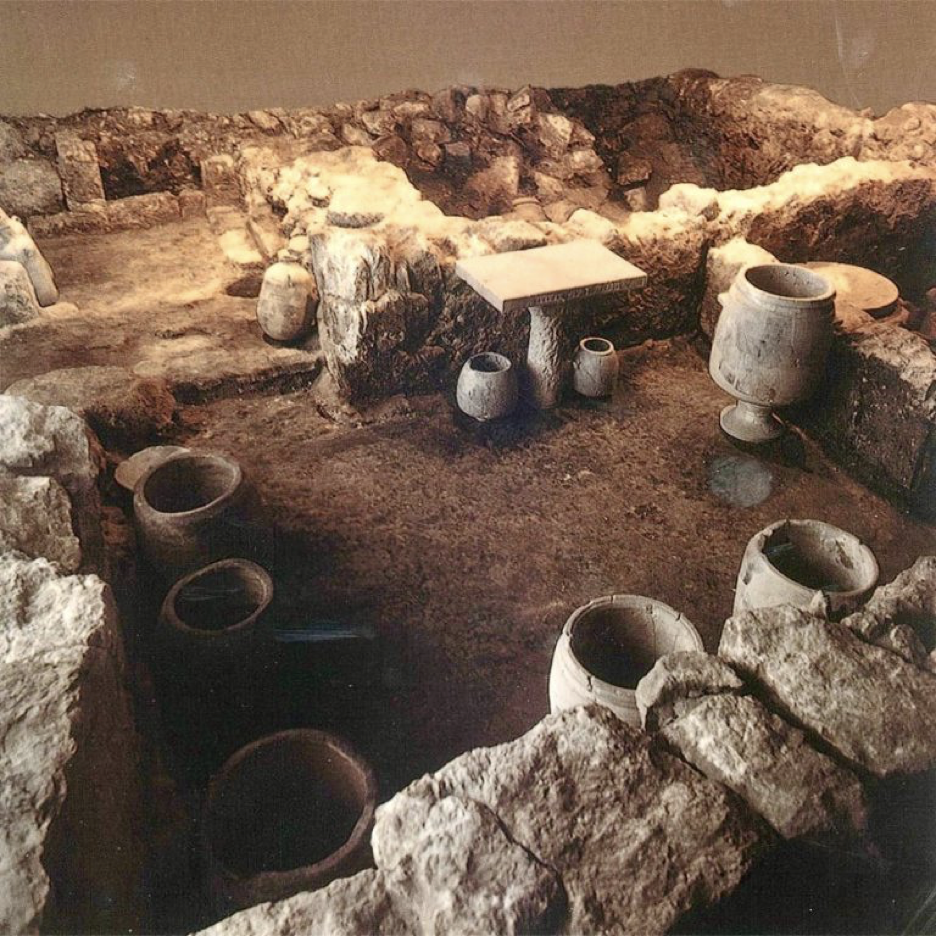
Six stone jars as used for purification (and two smaller jars), as found in first century house of a priest (from the “Burnt House Museum” Jerusalem).
- Saint Augustine of Hippo (354-430 A.D.), who was never known to miss a chance to see ‘deeper meanings,’ said the six jars represented the six ages. (From Augustine’s “Tractates on John (9.6)”) If I were to go down a rabbit hole on this (and yes, I have been known to do just this), I would say there were six disciples there (though I am not sure who the sixth would be) and that filling the six vessels with Jesus’ new wine would be symbolic of filling the disciples with the new wine of the gospel. I would contrast that to Jeremiah 13:12-14, where people are visualized as jars being filled with wine and sentenced to destruction. Jesus is filling the disciples with his gospel of the kingdom that, instead of destruction, leads to blessing. But I will resist the urge to go down that rabbit hole, so pretend you didn’t just read this (But do read the Jeremiah passage and tell me what you think.)
- The other form of ritual washing is ‘tevilah,’ which is total body immersion in a mikvah.
- Here are the seven signs in John: water into wine (John 2:1–11), healing a royal official’s son (John 4:46–54), healing a disabled man (John 5:1–15), feeding 5,000 (John 6:1–14), walking on water (John 6:16–21), healing a man born blind (John 9:1–12), and raising Lazarus from the dead (John 11:1–43).


 Swallow No Camels
Leave a comment