
March 19, 2026 – The Other Gift the Gentiles Receive — Acts #34

March 19, 2026 – The Other Gift the Gentiles Receive — Acts #34
Acts 10:9-43

Last week, we continued our discussion of the story of the centurion Cornelius and Peter, their two visions, and how God chose this moment to finally get Peter to understand the lesson he had been trying to teach His people for over a thousand years.   And the lesson that was so hard for them to grasp was this:  “God’s message of love and grace is for all people, Jew and Gentile, and He seeks to establish a covenant with all people who are willing.  

When God created people, he did not intend any divisions.  People were to be one, united in Him.  God told them to be fruitful and fill the earth, but they congregated in one city to make a name for themselves.  God wanted them to live in unity in Him, but they sought their unity in themselves.  They built a tower in Babel.  And because of their sin, God had to divide their languages to force them to scatter so that they would fill the earth as He intended.

And each of these people groups created idols for themselves, false gods that they worshiped.  Each nation had its own gods to worship.  You are familiar with the gods of Egypt (they had over 1000).  We know from scripture that the Canaanites worshipped Baal, the Moabites worshipped Chemosh, the Ammonites worshipped Milkom or Molech, and the Sidonians worshipped Ashtoreth (Numbers 21:29, 1 Kings 11:5-7).

Most nations other than the Jews worshipped a pantheon of gods, each performing different functions.  One was responsible for the sunshine, another for the rain, one for war, another for the crops.  

So in Acts 10, Peter finally realizes that Yehovah is not only the God of the Jews but also accepts all other people.  It is hard for us to understand just how radical an idea this is.  The idea of a single god over all things and over all people was unthinkable.  So when word gets back to Jerusalem of what happened with Peter, they need some explanation.  And the first part of Acts 11 provides a good summary for us of our past 3 weeks.

Acts 11:1-9. Now the apostles and the brothers who were throughout Judea heard that the Gentiles also had received the word of God. So when Peter went up to Jerusalem, the circumcision party criticized him, saying, “You went to uncircumcised men and ate with them.” But Peter began and explained it to them in order: “I was in the city of Joppa praying, and in a trance I saw a vision, something like a great sheet descending, being let down from heaven by its four corners, and it came down to me. Looking at it closely, I observed animals and beasts of prey and reptiles and birds of the air. And I heard a voice saying to me, ‘Rise, Peter; kill and eat.’ But I said, ‘By no means, Lord; for nothing common or unclean has ever entered my mouth.’ But the voice answered a second time from heaven, ‘What God has made clean, do not call common.’

Acts 11:10-18  This happened three times, and all was drawn up again into heaven. And behold, at that very moment three men arrived at the house in which we were, sent to me from Caesarea. And the Spirit told me to go with them, making no distinction. These six brothers also accompanied me, and we entered the man’s house. And he told us how he had seen the angel stand in his house and say, ‘Send to Joppa and bring Simon who is called Peter; he will declare to you a message by which you will be saved, you and all your household.’ As I began to speak, the Holy Spirit fell on them just as on us at the beginning. And I remembered the word of the Lord, how he said, ‘John baptized with water, but you will be baptized with the Holy Spirit.’ If then God gave the same gift to them as he gave to us when we believed in the Lord Jesus Christ, who was I that I could stand in God’s way?” When they heard these things they fell silent. And they glorified God, saying, “Then to the Gentiles also God has granted repentance that leads to life.”

Don’t miss that, when the passage begins, they’re upset with Peter.  “What was he thinking, going to the house of a Gentile?  And preaching to the Gentiles?  He is just wasting his time.”But then Peter tells his story of the remarkable visions and what happened at Cornelius’ house, how they had a similar experience to the disciples’ at Pentecost. So Peter tells them, “If then God gave the same gift to them as he gave to us when we believed in the Lord Jesus Christ, who was I that I could stand in God’s way?”

 And the Jerusalem leaders’ reaction when they found out that these Gentiles had received the Holy Spirit?

Acts 11:18a   When they heard these things they fell silent…

They were shocked.  Something they thought unthinkable had just happened.  The God of the Jews, the God of Abraham, Isaac, and Jacob, the God who brought their forefathers out of Egypt,  the God of Moses and David — their God, Yehovah, was God of the Gentiles also.  One God for all people.  All people united under one God.  They were speechless.  And after having a moment to process all of this:

Acts 11:18b  …and they glorified God, saying, “Then to the Gentiles also God has granted repentance that leads to life.”

Now, note that Peter’s review of the events in Acts 11:1-18 mentions two gifts that are given to the Gentiles in Cornelius’ home.  First, there was the gift of the Holy Spirit that we talked about last week.  Did you notice the second gift?

“God has granted repentance that leads to life.”  God has given the gift of repentance.  Does that sound odd to you, that God gifted them with repentance?  You might expect that to say “God freely gave them forgiveness”.  Because we often talk about repenting as if it is something we do ourselves.  We repent, and God gives forgiveness.   But let’s look at how the Bible talks about repentance.

I remember once seeing a preacher demonstrate the concept of repentance by walking one direction that he called “the path of sin”, and then stopping and turning around to walk back the other way “towards God”.  He said that this is repentance.  It is not just stopping on the road to sin, but turning around and walking back towards God.   It is that moment of stopping and then turning around and taking that first step back to God that I want to look at.

The Greek word for repentance is metanoeo.  The word is composed of meta (meaning “after” or “beyond”, implying change) and noieō (meaning “to perceive” or “think”).  To repent is to change your thinking and change your direction.  And what the pastor’s physical example of turning around really doesn’t communicate well is what happens in the moment before he turns.  What happens to cause the stop and change of direction?  

Last week, we read a portion of the prophecy of Joel in the second chapter that told of the pouring out of the Holy Spirit on all flesh.  Let me read a few earlier verses in that chapter.

Joel 2:12-13  “Yet even now,” declares Yehovah, “return to me with all your heart, with fasting, with weeping, and with mourning; and rend your hearts and not your garments.” Return to Yehovah your God, for he is gracious and merciful, slow to anger, and abounding in steadfast love; and he relents over disaster.”

This word ‘return’ here is the Hebrew “shuv”, which is repentance, turning around and turning back towards God.  In Joel’s day, people would express their grief by tearing their clothes, putting on sackcloth, and sitting in ashes.  But here, God is asking them not just to show signs of their grief, but to have true weeping and mourning, being grieved over the sins they committed.  Grief and remorse over sin is the first step in repentance.  David expresses this in his psalm of repentance following his sin with Bathsheba:

Psalm 51:16-17   For you will not delight in sacrifice, or I would give it; you will not be pleased with a burnt offering. The sacrifices of God are a broken spirit; a broken and contrite heart, O God, you will not despise.

David knew that what God wanted from him as a response to his sin was not simply another animal sacrifice.  What was necessary was for David to be heartbroken over his own sin.  This is much more than regret. This is brokenness before God over his sin. 

We should grieve our sin.  Far too often, what I see happening is people grieving another person’s sin.  Oh, I have done it too.  Perhaps you’ve said something like this:  “I can’t believe he could be so heartless.”  “How can people be so mean?”  “How could they ever think that God would approve of that behavior?” 

I caught myself saying this next one not too long ago, after seeing yet another example of someone trying to scam a friend out of money.  I said,  “God must have a special place for people who deceive older people and steal their money.”   Have you ever said that? 

Well, God does have a special place for those people.  It is the same place he has for you when you sin. It is the same special place he has for me when I sin.  It is a special place in the heart of God where he wants all of us to come to terms with our own sin, not the sins of others.  God desperately wants us to understand what we have done wrong so that we can turn around and not do it anymore.  He wants us to be true followers of His, walking on His path.  

So repentance is coming to the moment when we stop and consider our own sin, and then truly grieve it to the point that we never want to commit it again. We are heartbroken over our sin.  So we then turn around.  How do you get to that point?

The Scriptures tell us the answer.  Repentance is a gift from God.  That is what the people in Jerusalem were saying:

Acts 11:18b And they glorified God, saying, “Then to the Gentiles also God has granted repentance that leads to life.”

God has given the gift of repentance to the Gentiles also.  Perhaps this idea that repentance is a gift is best seen in this passage in 2 Timothy:

2 Timothy 2:24-26   And the Lord’s servant must not be quarrelsome but kind to everyone, able to teach, patiently enduring evil, correcting his opponents with gentleness. God may perhaps grant them repentance leading to a knowledge of the truth, and they may come to their senses and escape from the snare of the devil, after being captured by him to do his will.

We are to pray for our evil opponents, that “God may perhaps grant them repentance.”  Paul instructs Timothy to ask God to give the gift of repentance to these evil people who oppose him.  (By the way, if you have someone oppressing you, this passage is a great prayer.) 

Someone who sins must first reach the critical point where they stop what they are doing and change their mind, realizing how wrong their rebellion against God is.  Then they must grieve their sin, mourn their mistakes, and turn around, desiring never to walk that way again.  We can’t get to that point on our own. We need God to lead us to that point.  That is the gift of repentance. 

So we must pray that God will lead us to repentance.  We must ask God to soften our hearts to the hardness of our sin.  We need to ask God to break our hearts for the things that break His heart. And let me tell you, the first thing He will do is break your heart about your own sins. 

And I can’t leave this passage without quickly pointing out another important point.

Acts 11:18b  …and they glorified God, saying, “Then to the Gentiles also God has granted repentance that leads to life.”

We are part of the “also.”  Most of us were not born of the chosen people of God.  We are not Jewish.  We can’t trace our family tree back to Jacob, Isaac, and Abraham.  God chose the people of Abraham as His chosen ones, the ones to carry His message to the world.  We were not born into that family.  As Peter told the Gentile believers in Jesus in Mesopotamia:

1 Peter 2:10   Once you were not a people, but now you are God’s people; once you had not received mercy, but now you have received mercy.

Once we were excluded, but now we are included.  We weren’t born into this group of chosen people, but, as Paul says in Romans 11, we have been grafted in.  We have been adopted into God’s chosen people.  We are the “also” who are now the chosen, as Peter tells these Gentiles:

1 Peter 2:9-10    But you are a chosen race, a royal priesthood, a holy nation, a people for his own possession, that you may proclaim the excellencies of him who called you out of darkness into his marvelous light. Once you were not a people, but now you are God’s people; once you had not received mercy, but now you have received mercy.

God is the giver of all good gifts. He gives us life, he gives us grace, He gives us love and acceptance.  He gives us forgiveness through the gift of His Son dying in our place, and this through the gift of repentance.  It is God’s gift to us to bring us into His way of thinking, to a brokenness over our sin. Repentance requires mourning over our sin.

This is the season of Lent.  It is a time of reflection as we prepare to celebrate the greatest gift: our savior, Jesus, going to the cross in our place and rising from the dead, so that we may follow him in how we live and how we are raised to life.  The ashes we receive on Ash Wednesday remind us of the people of the Old Testament, who showed their grief by tearing their clothes and sitting in ashes.  It is about repentance.  Have you ever reached the point of brokenness for your sins?  Let us all pray to our Father and ask Him to break our hearts for our sin that breaks his heart. Then we can put that sin behind us as we turn and walk with our Father in His path.
March 7, 2026 –  God Seals the Deal — Acts #33

March 7, 2026 –  God Seals the Deal — Acts #33
Acts 10:34-43

For several weeks, we have been looking at the story of Cornelius, the centurion, and Peter in Acts 10.  It is a huge moment in God’s plan to redeem the world.

First, we looked back at Jesus’ first attempt to teach this to his disciples, with the first centurion in Matthew 8, and at how he tried to teach it again in his final words before ascending to heaven.  Then, 10 years later, God sends Cornelius a vision to send for Peter, who had a message for him.  So Cornelius gathered friends and family to hear Peter’s message.

Meanwhile, God uses another dramatic vision to finally convince Peter to abandon the idea that Gentiles were unclean and had to convert to Judaism to be accepted by God.  And Peter does come to Cornelius’ home, and here is the message he has for them:

Acts 10:34   “Truly I understand that God shows no partiality, but in every nation anyone who fears him and does what is right is acceptable to him.”

And as I said last week, I can almost hear God speak, “Well, it’s about time, Peter!” God called Israel His chosen nation for a purpose that He revealed at Mount Sinai more than a thousand years before Jesus came.  The purpose was to be priests to the world.  But they kept God to themselves and said you must become like us to worship God. So part of Jesus’ reason for coming was to correct this misconception.  But they were still unable to abandon their prejudice and fulfill their mission for the rest of the world.  That is why God is doing all this in Acts 10.  And when Peter arrives at Cornelius’ house and finds the house full of Gentiles waiting to hear his message, here is what he says:

Acts 10:34-43   So Peter opened his mouth and said: “Truly I understand that God shows no partiality, but in every nation anyone who fears him and does what is right is acceptable to him. As for the word that he sent to Israel, preaching good news of peace through Jesus Christ (he is Lord of all), you yourselves know what happened throughout all Judea, beginning from Galilee after the baptism that John proclaimed: how God anointed Jesus of Nazareth with the Holy Spirit and with power. He went about doing good and healing all who were oppressed by the devil, for God was with him. And we are witnesses of all that he did both in the country of the Jews and in Jerusalem. 
They put him to death by hanging him on a tree, but God raised him on the third day and made him to appear, not to all the people but to us who had been chosen by God as witnesses, who ate and drank with him after he rose from the dead. And he commanded us to preach to the people and to testify that he is the one appointed by God to be judge of the living and the dead. To him all the prophets bear witness that everyone who believes in him receives forgiveness of sins through his name.

Peter makes 4 important points here:

  1. Jesus was anointed by the Holy Spirit and power.
  2. He did many good things and healed many who were oppressed by evil.
  3. They killed him, but God raised him from the dead (and we saw him)
  4. Jesus commanded us to preach to the people.

This is Peter’s testimony, giving witness to what he saw himself.  Now, when we give our testimony, we usually talk about the good things Jesus did, and we always talk about his crucifixion and ascension.   And we may even talk about his command to us to spread the word.  But I wonder how many times we include that first point Peter made, that Jesus was anointed by the Holy Spirit? 

We know that happened, but I don’t think we understand the importance as much as Peter did. Peter has not only seen Jesus anointed by the Holy Spirit at Jesus’ baptism in the Jordan River, but Peter was also anointed by the Holy Spirit.  At Pentecost, God poured out his Spirit on those disciples.  And we talked about that turning point in their lives.  The difference it made, taking these scared young men hiding in a room and making them bold witnesses for Jesus, publicly preaching and healing.  That is the difference the Holy Spirit makes.  So to Peter, this anointing of Jesus was an important fact.

And that fourth point, “Jesus commanded us to preach to the people,” is what this section of Acts is all about.  To whom, Peter, were you commanded to preach?

Matthew 28:19-20 “Therefore go and make disciples of all nations, baptizing them in the name of the Father and of the Son and of the Holy Spirit, and teaching them to obey everything I have commanded you.”

Well, here is the Great Commission, the command Jesus gave before ascending to heaven. And it is a command, not a suggestion.  Which people does the command say?  Just the Jews?  No, it says all nations.  All people.  That is the lesson Peter finally understood 10 years later in Acts 10.  The lesson that Israel didn’t understand for 1400 years.  

But look what happens next.   Peter’s sermon gets interrupted after his fourth point.  We will never know what Peter was going to say next.  And it is God who interrupts Peter’s sermon.  God doesn’t wait for Peter to finish his outline.  (By the way, anytime God, if you want to interrupt me, that is perfectly okay with me.)  And here, God interrupts in a very dramatic fashion. 

Acts 10:44-46   While Peter was still saying these things, the Holy Spirit fell on all who heard the word. And the believers from among the circumcised who had come with Peter were amazed, because the gift of the Holy Spirit was poured out even on the Gentiles. For they were hearing them speaking in tongues and extolling God. 

So look at the scene here.  Suddenly, these people listening to Peter became filled with God’s Holy Spirit.  And they start speaking in different languages.    Do you see what God is doing?  He is showing Peter the day of Pentecost happening again.   The Holy Spirit comes and is evidenced by these tongues, just as on Pentecost in Jerusalem.  But there is one big difference.  These people are Gentiles. 

The greatest day of the manifestation of God’s Spirit on humanity is happening again.   Except this time it is with people who would have been arrested if they had entered into the temple area on the last Pentecost.  As we have discussed before, the Jews said Gentiles were forbidden to approach the place of God, under penalty of death.

Here is one of the actual notices placed on the wall, the 4.5-foot barrier that kept Gentiles out of the temple.   It was discovered by archeologists in 1871 and is now on display in a museum in Istanbul.  It says, “No foreigner is to enter within this wall around the temple and enclosure.  Whoever is caught will be responsible for his ensuing death.”

They said Gentiles can not approach God.  But here in Acts 10, God has the last word.  He says, yes, they can be accepted by me, even if not by you.  God says, “You won’t let them approach my temple, but I will approach them myself, and I will make them my temple.” This pouring out of God’s Spirit on Gentiles is an undeniable proof of God’s acceptance. 

Can you imagine it from Peter’s point of view?   Why does God pour out his Holy Spirit with tongues just as he did at Pentecost?  Because he doesn’t want Peter or anyone else to miss it.  It is the same thing, the same experience. Gentiles who seek God are no different than Jews who seek God.  

And again, this is not late-breaking news.  God didn’t change his mind about Gentiles on this day.  This was his plan all along.  It was clearly prophesied in Joel:

Joel 2:28-29   And it shall come to pass afterward, that I will pour out my Spirit on all flesh; your sons and your daughters shall prophesy, your old men shall dream dreams, and your young men shall see visions.
 Even on the male and female servants in those days I will pour out my Spirit.

Who will he pour His Spirit out on?  God said he would pour out his Spirit on all flesh.  On everyone!  Peter even quoted this same passage from Joel in his sermon on the day of Pentecost.  But when he quoted it then, he assumed that everyone meant ‘everyone of the Jews.’  That is the way it had been understood for 800 years.  But God is putting the finishing touches on this lesson.  Everyone means everyone.  Even the servants.  Even the women. Even the Gentiles.  On all people.  Joel said this 800 years before Peter was born.  But the understanding does not come until here in Acts 10.  And how does Peter respond?

Acts 10:44-48   Then Peter declared, “Can anyone withhold water for baptizing these people, who have received the Holy Spirit just as we have?” And he commanded them to be baptized in the name of Jesus Christ. Then they asked him to remain for some days.

Peter says, “I can’t argue with God.  If these people are receiving the Holy Spirit in the same way that the other disciples and I did on Pentecost, then obviously God has proven his point.”  The work of the Holy Spirit before him is the evidence of God’s approval. They are ready for that next step, baptism.  The same next step in Act 2 at Pentecost.  Here is what Peter said in Acts 2 when the Spirit came on Pentecost:

Acts 2:38-39   And Peter said to them, “Repent and be baptized every one of you in the name of Jesus Christ for the forgiveness of your sins, and you will receive the gift of the Holy Spirit. For the promise is for you and for your children and for all who are far off, everyone whom the Lord our God calls to himself.”

Repent and be baptized, and you will receive the gift of the Holy Spirit.  It was true for the 3000 Jews who were baptized on that day in Acts 2, and it is true for all of the Gentiles gathered in Cornelius’ home here in Acts 10.  And it is true for us today.  If you read the New Testament closely, you will notice that the order is not consistent, but it always follows the same 3 steps: repentance, baptism, and receiving the Holy Spirit.   Those in Acts 2 were baptized and then received the Spirit. These, in Acts 10, received the Spirit and were then baptized.  The order does not matter, but it is a package deal.

When you repent and accept Jesus as your Lord and the King of your life, as your savior, then you receive the Spirit.  You can call it a baptism of the Spirit if you want, like the picture of the Spirit being poured out on everyone that Joel uses, or you can say the gift of the Spirit, as we see in the New Testament many times.  But it is the same.  Because when you receive Jesus, you receive the Spirit.   It is an initial blessing and a universal blessing for all who believe.  Paul says it this way:

Colossians 2:9-10  “For in him [Jesus] the whole fullness of deity dwells bodily, and you have been filled in him, who is the head of all rule and authority.

When you receive Jesus, since the fullness of deity dwells in Jesus, you are filled with His Spirit.  And if Christ dwells within us by his Spirit, then what more can God add to that?   If you are in Christ, the Holy Spirit already dwells in you. The question is: do we follow the Spirit? Do we listen to Him?  Or does He dwell in some small closet of ours, locked away and ignored?  

We all have the spirit, but not all of us are filled with the spirit.  We fill our lives with other things that take priority over the Spirit of God within us.  We pay attention to other voices.  We follow other paths.  Receiving the Spirit is a one-time event when you repent and commit to Jesus.  Being filled with the Spirit is a continual process of letting the Holy Spirit have His way in our lives, filling every corner of our lives, and changing the way we live.

That is why you see commands in the Bible to be filled with the Spirit.  But there are no New Testament commands to be baptized by the Spirit, for again, if you are in Christ, his Spirit is with you.  We are all baptized in the Spirit, but we are only filled with the Spirit as we allow the Spirit to have his way with us. 

Paul says in Ephesians 4 that we can grieve the Holy Spirit when we sin, by how we talk or how we act.  Our response to that is to seek to be filled more with the Spirit through repentance and a renewed effort to listen to and follow the Spirit.

The church in Corinth provides a good example of this.   Paul is clear that they had all received the Holy Spirit.

1 Corinthians 12:13  For in one Spirit we were all baptized into one body—Jews or Greeks, slaves or free—and all were made to drink of one Spirit.

He then describes that they had been enriched by all spiritual gifts.  Yet in that first letter, Paul rebukes them for being unspiritual, that is, not being filled with the Spirit.  In that letter, he shows them that the evidence of being filled with the Spirit is not the exercise of gifts (which they had in abundance) but the fruit of the Spirit (in which they were found lacking).  They had been baptized and gifted by the Spirit but were not filled by the Spirit.

So if you are in Christ, you have received the Holy Spirit.  But the important question is: “Are you filled with the Spirit?”   (Warning: personal opinion here — as usual, feel free to disagree with me — I have friends who differ with me here and we love each other.)  Now, some believe that if you have not spoken in tongues, then you have not received nor been filled with the Spirit.  But in all of the book of Acts, only 3 groups who received the Spirit spoke in Tongues.   (Acts 2 at Pentecost, here in Acts 10, and a group in Acts 19.)    Speaking in tongues is but one of many gifts mentioned in Corinthians 12, and nowhere does the Scripture call it an indispensable sign of the Spirit. 

So what is the evidence of the fullness of the Spirit within you?  How do you know you are spirit-filled?  The evidence is not the gifts of the spirit but the fruit of the spirit. The only passage in Scripture in which Paul describes the consequences of being filled with the Spirit is Ephesians 5:18-21.

Ephesians 5:18-21  And do not get drunk with wine, for that is debauchery, but be filled with the Spirit, addressing one another in psalms and hymns and spiritual songs, singing and making melody to the Lord with your heart, giving thanks always and for everything to God the Father in the name of our Lord Jesus Christ, submitting to one another out of reverence for Christ.

Paul says the consequences of being filled with the Spirit are not gifts like tongues or prophecy, but are all moral qualities — how you behave.

Why does he mention being drunk with alcohol as a contrast to being Spirit-filled?   It is all about what you cede control of your life to.  We all know the effect alcohol has.  In sufficient quantities, you lose your inhibitions. You lose emotional control, and if you continue, you lose control of your motor abilities (you can’t walk straight), and then finally lose control of your consciousness.

Paul is saying, ” Don’t give up your control of yourself to alcohol; give up control of yourself to the Spirit.”  When we follow the path the Spirit leads, then we act like the person described here.   We could spend hours discussing the 4 individual behavioral results Paul sees as evidence of being spirit-filled: how we speak to one another, how we sing to the Lord, how we give thanks for everything, and how we submit to one another.  

The other list Paul gives is the fruit of the Spirit.  In other words, what is the result of the spirit living in you?   The result you get if you plant apple trees is apples.  The fruit you get from a stalk of corn is corn. What fruit does a person filled with the Spirit bear? 

Galatians 5:22-23  But the fruit of the Spirit is love, joy, peace, patience, kindness, goodness, faithfulness, gentleness, self-control.”

Again, this is how we can tell we are filled with God’s Spirit: this is what someone who is filled with the Holy Spirit looks like.  

We all need to seek to be filled to overflowing with God’s Holy Spirit.  And we do that by listening to the Spirit, then following Him, and letting Him change the way we talk, the way we treat each other, our attitudes about life, and our relationship with the Father.  Let me share what John Stott said in his book, “Baptism and Fullness: The Work of the Holy Spirit Today”.

“But disobedience and our unbelief have robbed many of us of our full inheritance. It is still ours by right, because we are Christ’s, but we have failed to enter into it. We are like the Israelites when they had been given the Promised Land but had not yet taken possession of it. We need to repent and to return to God. We have indeed been baptized with the Spirit, but we continue to live on a level lower than our Spirit-baptism has made possible, because we do not remain filled with the Spirit.”

You can call it being filled by the Spirit, being led by the Spirit, or walking by the Spirit.  They are all ways of saying the same thing.  God’s Holy Spirit is in you.  He placed it there when you repented of your sins and accepted Jesus.  What have you done with the Holy Spirit within you?  Does the Spirit guide you in how you speak and how you act, or have you ignored the voice of the Spirit for so long that you no longer hear it?  If that is you, then today you need to repent of grieving the holy Spirit.  You need to commit to learning to listen to that Spirit within you and following Him.  Then you will bear the fruit that God designed you to bear: love, joy, peace, patience, kindness, goodness, faithfulness, gentleness, self-control.”

1.  Stott, John. Baptism and Fullness: The Work of the Holy Spirit Today (p. 85). Kindle Edition.

March 1, 2026 –  Double Visions — Acts #32

March 1, 2026 –  Double Visions — Acts #32
Acts 10:9-43

Last week, we started looking at the story in Acts 10 of a centurion.  And we came to understand that this centurion is the second half of a duo of centurions that God uses to teach a very important lesson.

 So we looked at the first centurion that Jesus encountered in Matthew 8 and discussed Jesus attempt to teach his followers that Gentiles are accepted into His kingdom.  It is a message they should have learned from the Old Testament, but they chose to cling to their prejudice rather than scripture.  Jesus offers to go to this centurion’s home, something the Jews would have seen as impossible.  Then Jesus shocks his listeners further by telling them that this centurion’s faith is greater than that of any Jew he has ever met.  And then he tells them that many people from all over the world will join with Abraham, Isaac, and Jacob in that great banquet with God.  But they didn’t understand.

Jesus told them in the Great Commission to make disciples of all nations.  But they still did not understand, and now ten years later, in Acts 10, they are spreading the Gospel to primarily Jews, with the idea that you must become Jewish to follow Jesus.  So God chooses to use a second centurion to convince Peter that Gentiles are acceptable to Him.  

And while this centurion, Cornelius, is praying, God sends a messenger in a vision.  The messenger tells him that God has heard his prayers and seen his good deeds to the poor. and that God has accepted his prayers and deeds just as He would accept a burnt offering.  God tells this Roman Centurion, this Gentile, that even though his Jewish followers do not accept him, he has found acceptance by God.  Cornelius is to send for Peter to come to his house.  And Cornelius is wondering if Peter would actually come.  None of the Jews in his town would be caught dead in his house.  Would Peter be willing to come to the house of a Roman soldier?

God knew very well that Peter would not go with them to a Gentile’s home.  So while Cornelius’ delegation is on the way to Joppa, God has to do something drastic to change Peter’s thinking.  His attempts to teach Peter with the first centurion, other teachings, and then finally with the Great Commission just before he ascended to heaven didn’t work.  Peter and the others stubbornly clung to their prejudices.  God knew it would take something dramatic.  And let me tell you, God is awesome at drama when He needs to be.  

So to make this lesson finally stick with Peter, God produces 2 visions.  One to Cornelius the centurion we talked about last week, and now this second very dramatic vision to Peter.  Our scripture is Acts 10, starting in verse 9.

Acts 10:9-16   The next day, as they were on their journey and approaching the city, Peter went up on the housetop about the sixth hour to pray. And he became hungry and wanted something to eat, but while they were preparing it, he fell into a trance and saw the heavens opened …

So it is noon, and Peter goes to a place by himself to pray.   And Peter is hungry.  Perhaps he missed breakfast.  Noon was not a typical Jewish mealtime.  They usually had a light breakfast and a more substantial meal in the late afternoon.  But while someone is preparing some food for Peter, God comes in a vision.  

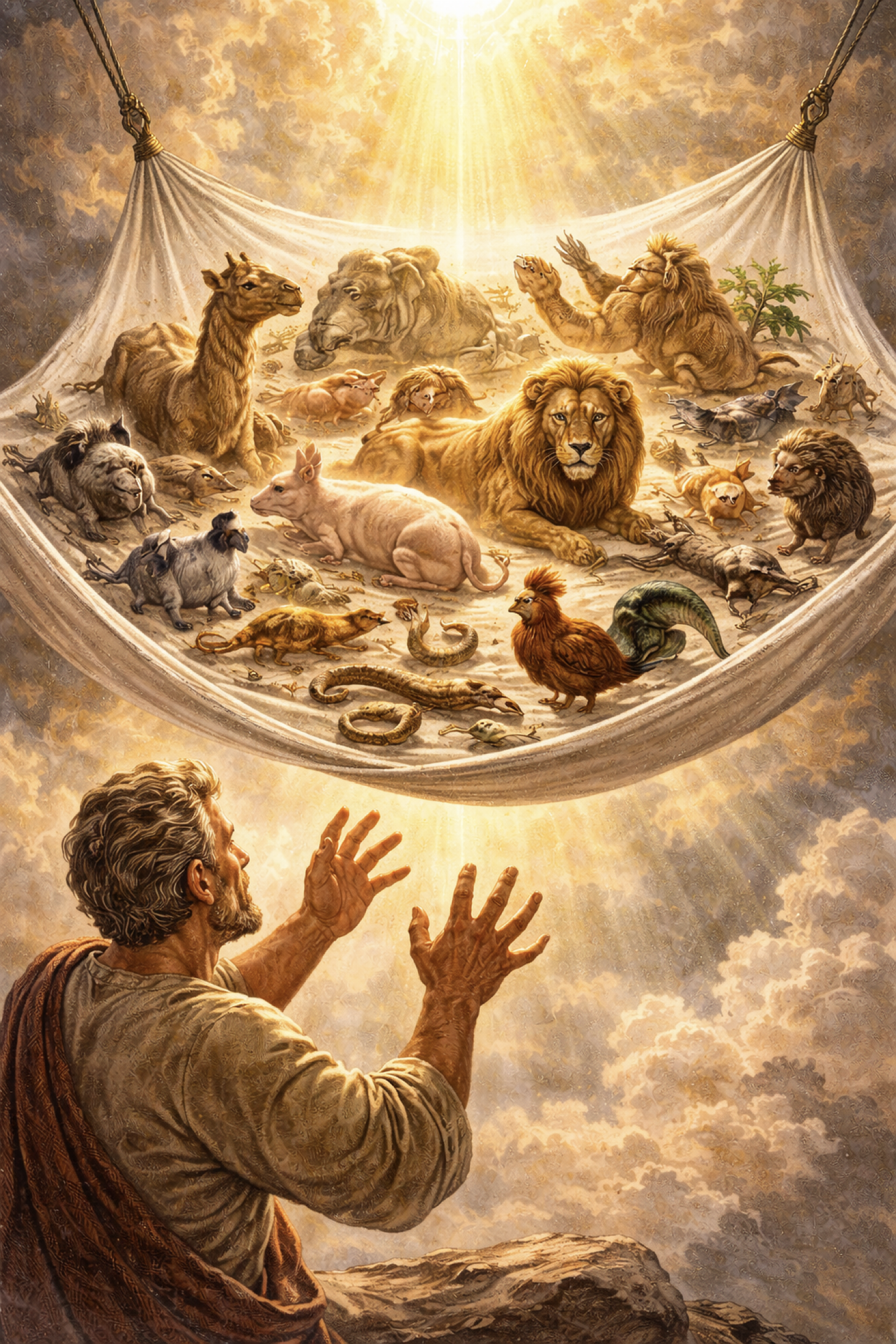
Acts 10:10-16  …he fell into a trance and saw the heavens opened and something like a great sheet descending, being let down by its four corners upon the earth.  In it were all kinds of animals and reptiles and birds of the air. And there came a voice to him: “Rise, Peter; kill and eat.” But Peter said, “By no means, Lord; for I have never eaten anything that is common or unclean.” And the voice came to him again a second time, “What God has made clean, do not call common.” This happened three times, and the thing was taken up at once to heaven.  

Close your eyes for a minute and try to imagine what Peter saw.  I asked ChatGPT to draw a picture of what Peter saw, and here it is:

(Hey ChatGPT, those are some really bizarre animals.)

So if you are Peter, up on the roof, how do you interpret this vision?  What is God trying to tell Peter?   Here is what it says in the Tyndale Commentary on the Book of Acts:

“The effect of the vision was thus to announce to Peter that the distinction made in the Old Testament between foods that were ‘clean’, and therefore fit for human consumption, and those that were unclean, was now cancelled, so that in future Jewish Christians could eat any food without fear of defilement.”   (I. Howard Marshall, The Tyndale Commentary)

The Biblical laws that define food are spelled out primarily in Leviticus 11 and Deuteronomy 14.    Land animals must have divided hooves and must chew their cud (cattle, sheep, goats, deer, etc.) In contrast, pigs, camels, and rabbits, for example, are not food.    Swimming creatures that are food must have fins and scales, so shrimp, lobster, octopus, catfish, etc., are excluded.   Birds that were not defined as food were primarily birds of prey or scavengers, such as hawks, eagles, and vultures.  Chicken and turkey were allowed.  Let’s continue with the scripture.

Acts 10:17   So Peter understood from the vision that God changed the Torah rules about food, and he immediately called downstairs and changed his lunch order to bacon-wrapped scallops. 

No, that’s not quite right.

Acts 10:17   Now while Peter was inwardly perplexed as to what the vision that he had seen might mean…

Wait a minute.  How is it that Peter is “inwardly perplexed” about the vision?  He must not have had his copy of the Tyndale Commentary handy.  They seem pretty clear about it.  But Peter is utterly at a loss to explain what this means.   He knows God isn’t just rewriting his law book that has been in place for over 1000 years.  So the vision confuses him.  While he is thinking, Cornelius’s men arrive.

Acts 10:17-18   Now, while Peter was inwardly perplexed as to what the vision that he had seen might mean, behold, the men who were sent by Cornelius, having made inquiry for Simon’s house, stood at the gate and called out to ask whether Simon, who was called Peter, was lodging there.

While they are approaching the house, this is happening upstairs with Peter:

Acts 10:19-20   And while Peter was pondering the vision, the Spirit said to him, “Behold, three men are looking for you. Rise and go down and accompany them without hesitation, for I have sent them.

The Holy Spirit tells him to accompany these strangers wherever they are going.  He is to go “without hesitation.”  Let’s look at this in a few other translations:

Acts 10:20 (ESV)   Rise and go down and accompany them without hesitation, for I have sent them.
Acts 10:20  (KJV)  Arise therefore, go down and go with them, doubting nothing; for I have sent them.
Acts 10:20  (NASB)  But get up, go downstairs and accompany them without misgivings, for I have sent them Myself.

These are all ways of translating the Greek into English.  Have you considered the idea of doubt as hesitation?  That is a very Hebrew way of thinking.

In fact, there is no word in Biblical Hebrew like our word for doubt.  The idea of mental indecision leading to uncertainty is foreign to the Hebrew mindset.  In their worldview, God is king.  He is the ultimate decision maker.  Whatever God determines is law.  You don’t have to think about it and consider the options.  You don’t have to consider the good and the bad.  You don’t vote on it.  God says something, and whatever God says is good.  God gives instructions for living, and you obey them.

The Hebrew Bible (the Old Testament). does have a word for people stopping to consider what to do, what action to take.  You see it in Genesis 3.  Adam and Eve stop to think whether they should eat the fruit or not.  Does it look good to me?  The word for that kind of thinking is sin.  It is a sin to refuse to accept God’s determination of right and wrong.  It is a sin to think you can make those decisions for yourself.

In 1 Kings, when the people in Elijah’s day are wavering between worshipping God and worshipping the false deity Baal, Elijah holds the contest on Mt Carmel.  He does not ask the people, “How long are you going to doubt God? He doesn’t have a word in his language to express that, so he says,

1 Kings 18:21  How long will you go limping between two different opinions?

Elijah uses a picture of a man hobbling at a crossroads, trying to take both directions at once and effectively going nowhere. This is the only way he can discuss the ridiculousness of not being obedient to God.

Elijah would not call this doubt; he would call it disobedience.  Let me give you one more illustration: I have used it before, but it is worth repeating.  When Jesus is walking on the water in the storm, Peter sees him and says an interesting thing:

Matthew 14:28   Lord, if it’s you,” Peter replied, “Command me to come to you on the water.”

And Jesus does.  But why does Peter ask Jesus to command him to walk on the water?  Because if Jesus wills for Peter to walk on water, then Peter has no choice but to follow his Lord and King.  And if Jesus wills for Peter to walk on water, then Peter knows that Jesus will certainly give him the ability to follow through. And Peter is initially successful, but then he looks at the wind and becomes afraid.  He takes his focus off the power of Jesus and looks at the power of the wind.  

And when Peter stops walking, he starts sinking.  As long as he is being obedient to Jesus command, Jesus is empowering him to do the task. But Peter stops walking and then starts sinking.  And when Peter is sinking, first Jesus reaches out to pull him back up, but then he says, 

Matthew 14:31   “Oh, you of little faith, why did you doubt?”

This is the ESV rendering, but that is not exactly what Jesus said.  Jesus was a Jew.  Like Elijah, He did not have that word or concept of doubt that we had.  The Greek word there is distazo, which isn’t about mental confusion but about a lack of action or hesitation.  Jesus wasn’t asking why Peter was thinking wrong.  He was asking, “Why did you stop walking?”  Peter hesitated; he stopped walking; he stopped being obedient.  So Jesus really said, 

Matthew 14:31   “Oh, you of little faith, why did you stop being obedient?”

And now, 10-11 years later, this same Peter is faced with another problem in Acts 10.  He gets a clear word from the Holy Spirit to 

Acts 10:20    Rise and go down and accompany them without hesitation, for I have sent them.

So, like the command to come to Jesus on the water, Peter gets another direct command from God to go with these men.  And the Spirit throws in there, “And this time don’t hesitate!” So Peter heads downstairs.

Acts 10:21-23   And Peter went down to the men and said, “I am the one you are looking for. What is the reason for your coming?” And they said, “Cornelius, a centurion, an upright and God-fearing man, who is well spoken of by the whole Jewish nation, was directed by a holy angel to send for you to come to his house and to hear what you have to say.” So he invited them in to be his guests.”

Peter invites them in.  (It is ok for a Jew to have a Gentile into their house.)  But now Peter has another problem.  Not only is he still puzzled about that crazy vision, but these men are Gentiles.  And just like the command from Jesus to Peter to come to him on the water, Peter now has a command to do something that seems more impossible than walking on water.  God has commanded him to go to the house of a Gentile, a Roman Centurion.  This goes against everything he learned as a Jewish boy growing up.  You don’t go to the house of a Gentile.  They are unclean. 

But Peter remembers the last time he disobeyed a direct order.  He thought he was going to drown.  He has learned to be obedient.  He doesn’t understand why God wants him to do this, but he goes.

Acts 10:23-24  The next day he rose and went away with them, and some of the brothers from Joppa accompanied him. And on the following day, they entered Caesarea. Cornelius was expecting them and had called together his relatives and close friends.

So picture this:  Cornelius is excited.   God has a message for him through this disciple, and he is anxiously awaiting to hear what Peter will say.  He has called everyone over, and the house is full of friends and family.  Meanwhile, Peter left on this journey thinking, “What am I doing?  Why am I going to a Gentile’s house and breaking every rule my mother taught me?”   But on the way there, Peter figures it out.

Acts 10:25-29   When Peter entered, Cornelius met him and fell down at his feet and worshiped him. But Peter lifted him up, saying, “Stand up; I too am a man.” And as he talked with him, he went in and found many persons gathered. And he said to them, “You yourselves know how unlawful it is for a Jew to associate with or to visit anyone of another nation, but God has shown me that I should not call any person common or unclean. So when I was sent for, I came without objection. I ask then why you sent for me.

Peter apparently now knows that the vision he saw on the roof with all the animals wasn’t about food at all.  It was about people.  If God says they are acceptable, then Peter has no right to say they are not.  Apparently, the people who wrote the Tyndale Commentary missed Peter’s explanation in verse 28.  Oh, Mr. Marshall, you also missed it in verse 34:

Acts 10:34-35   So Peter opened his mouth and said: “Truly I understand that God shows no partiality, but in every nation anyone who fears him and does what is right is acceptable to him.

And I can almost hear God in heaven saying, “Well, it’s about time. I have been trying to teach Peter this lesson for over 10 years.”And just in case you are still confused about the vision, I can tell you that Peter didn’t hit the Red Lobster when he returned to Jerusalem and partake in the Crab fest.  In fact, if you read the rest of the New Testament, it is apparent that none of these Jews changed their dietary habits.  There is ample evidence that the Jews who are following Jesus continue to observe the Torah that God gave them in Leviticus and Deuteronomy throughout the NT, including circumcision, Nazarite vows, dietary laws, required prayer times, and the appointed times of the Jewish calendar.  

This is completely consistent with what Jesus said in the Sermon on the Mount:

Matthew 5:17-18   Do not think that I have come to abolish the Law or the Prophets; I have not come to abolish them but to fulfill them. For truly I tell you, until heaven and earth disappear, not the smallest letter, not the least stroke of a pen, will by any means disappear from the Law until everything is accomplished.”

Jesus didn’t come to erase the laws in Deuteronomy and Leviticus; he came to show people how to live them correctly.  He fulfilled them all and erased not a single letter.  Just because the Jews have now met their promised Messiah, doesn’t mean they can throw out all the things God said before.  None of those commandments is going away for them until heaven and earth disappear.  And last time I looked, the earth and the sky are both still present.

So if you are Jewish, and you find your promised mesiah in Jesus, you continue to follow the laws as before.  What Jesus corrects in the Gospels and here in Acts 10 are not God’s laws but man-made ones.  That stuff about Gentiles being unclean and not entering their houses.  That wasn’t God’s law; man made it up.  And Jesus spent much of his ministry correcting what man got wrong about his laws.

What is the lesson we are to learn from Peter’s vision, now that we know it was not about what food to eat?  If God has called someone clean, we should not consider them otherwise.   God makes the rules, and we follow them without question and without hesitation.  If you find yourself wanting to make your own rules or argue with God about the rules, then ask Adam and Eve how that turned out.

No group of people is beyond God’s grace and mercy; the gospel is for all.  It is for all of your friends and all of your enemies.  It is for people who like you and hate you.  It is for people who agree with you and people who don’t.   It is for the rich and the poor, the person with the nice home and the homeless.  It is for your best friend and the beggar on the street.  God calls them all.  And if God approves them, we have no right to dismiss them as unacceptable.  

But I want to look at one more aspect of this lesson that we often miss.  God sent his son, Jesus, to solve our sin problem.  He suffered and died for our sins and removed the penalty of death for the sins that we committed, the penalty we deserved.  When we turn over our lives to Jesus and make him King of our lives, accepting his sacrifice for the remission of our sins, then God pronounces us clean.

But have you ever just dwelt on your sins and felt that you were unworthy?  Have you ever looked at yourself and decided that you couldn’t speak up for Jesus, because you know your friends have seen your own shortcomings?  How can you pretend to be righteous in front of them?  How many times have you refrained from doing some work for God because you felt you weren’t good enough?  How many times have you sat by yourself feeling guilty for all the wrongs you have done in your life?  Is there some sin from your past that hangs over you that you can’t seem to get beyond?   Have you ever felt like you didn’t belong in the family of God?

There are too many of God’s people paralyzed in their Christian walk because they keep recalling past sins and just can’t let go.  If you still think about your past sins that you have confessed and repented of, and if you still carry guilt for these things, then I have something to say to you that you need to hear. It is what Peter would say if he were here this morning, because it is the message God sent him in Acts 10.

How dare you call someone unclean that God has cleansed? 

God has cleansed you.  You have no right to say otherwise.  His blood has washed you whiter than snow.  Don’t wallow in your guilt.  God is faithful and just.  Jesus took on your sin; he suffered the penalty for sin.  If you want to keep remembering it or want to punish yourself, then you are saying that Jesus didn’t do what he said he would do.  God is no liar.  

God does not want you to live in the shadow of your past sins.  Look at what God says:

Jeremiah 31:34   For I will forgive their iniquity, and I will remember their sin no more.

And in case you missed it in Jeremiah, here it is in the second testament.

Hebrews 8:12   For I will be merciful toward their iniquities, and I will remember their sins no more.

If God has forgotten your sin, then why do you keep thinking about it?  Those thoughts come from the adversary himself, the father of lies.  Any time those memories pop up, then you should rebuke them in the name of Jesus.  

We must learn the lesson that was so hard for Peter to learn. What God has cleansed, I cannot call unclean.  You can walk out this door today knowing that the blood of Jesus has cleansed you.  You are righteous in God’s eyes.  And share this incredibly good news with everyone you know.

John 8:36   So if the Son sets you free, you will be free indeed.

February 26, 2026 –  Double Vision – Two Centurions — Acts #31

February 26, 2026 –  Double Vision – Two Centurions — Acts #31
Acts 10:1-8

Double vision is an odd thing.  I only experienced it once after a car accident when my jeep rolled several times and ended up upside down on the road.  I had a bit of a concussion and was hanging upside down by the seatbelt.  By the way, if that ever happens, do not release the seatbelt without bracing for the fall on your head.   But I was disoriented for a bit and saw double for just a few minutes.  It is an odd feeling.  

This morning, as we continue in Acts 10, we have a story about a Roman centurion.   But I see not one but two centurions here.  Because this story is tied to another centurion’s story in scripture, and the story of the first centurion is found in Matthew 8.

Matthew 8:5-9 (NIV)  When Jesus had entered Capernaum, a centurion came to him, asking for help. “Lord,” he said, “my servant lies at home paralyzed, suffering terribly.”
Jesus said to him, “Shall I come and heal him?”
The centurion replied, “Lord, I do not deserve to have you come under my roof. But just say the word, and my servant will be healed. For I myself am a man under authority, with soldiers under me. I tell this one, ‘Go,’ and he goes; and that one, ‘Come,’ and he comes. I say to my servant, ‘Do this,’ and he does it.

Centurions were the backbone of the Roman army, the equivalent of our highest-ranking non-commissioned officers, commanding 80 men.  (It originally was 100 men, thus the name (century =100), but the Romans later reduced the squad to 80 for efficiency.  And what makes this centurion unique is that he recognized Jesus’ authority.  This happens right after the Sermon on the Mount.  And remember that one of the things that most impressed people in Jesus’ sermon was this:

Matthew 7:28-29  And when Jesus finished these sayings, the crowds were astonished at his teaching, for he was teaching them as one who had authority, and not as their scribes.

Jesus said many good things in the Sermon on the Mount, but what most impressed people was the manner in which he spoke, for he spoke with authority.  He didn’t sound like a commentator or a teacher giving an opinion; he sounded like the author.  

Jesus speaks with authority about the scriptures because they are his scriptures.  And he is trying to correct their misinterpretations of His scriptures.  Several times in the Sermon on the Mount, he says, “You have heard it said, but I say unto you.”  What He is doing is telling them that they need a correct understanding.   And he has the authority to give the interpretation.  Jesus has come to correct what people got wrong about His word.

Then what is the first thing that happens when Jesus walks down the mountain after the sermon?

Matthew 8:1-4 “When Jesus came down from the mountainside, large crowds followed him. A man with leprosy came and knelt before him and said, “Lord, if you are willing, you can make me clean.”

Jesus reached out his hand and touched the man. “I am willing,” he said. “Be clean!” Immediately he was cleansed of his leprosy. Then Jesus said to him, “See that you don’t tell anyone. But go, show yourself to the priest and offer the gift Moses commanded, as a testimony to them.””

He has just astounded them by his authority over scripture.  And now he shows them he has authority over disease.  He will later show his disciples that he has authority over the wind and waves by calming the sea.  Just as Jesus had authority over the scriptures because they are his, he has authority over the world because it is his as well.  He created it.

So this centurion comes to Jesus and recognizes his authority. Then Jesus volunteers to go to the centurion’s home. Most translations have this as a statement by Jesus: “I will come and heal him.”  But the NIV has Jesus asking, “Shall I come and heal him?”  Greek scholars agree that this indeed should be a question, and it is worded in such a way as to emphasize the “I” — Shall I come?  Because this would be very surprising.  Jews in Jesus’ day did not go into the home of a Gentile, much less a Roman soldier.  The original idea behind this was to avoid ritual impurity from food or utensils, but it had morphed into more of a racial prejudice.  They were the enemy, and they were unclean.  No one would enter his home, certainly not a prophet or holy man. 

Then the centurion reveals his belief in Jesus’ authority.  He is convinced that Jesus is the owner of this world and all that is in it.  He can will for something to happen, and it will happen. But let’s look at Jesus’ response:

Matthew 8:10  When Jesus heard this, he was amazed…

First of all, Jesus was amazed.  Matthew uses this Greek word many times to explain how people, again and again, were amazed by what Jesus did or said.  But this is the only time he uses it to show that Jesus is amazed by somebody.  What left Jesus amazed?

Matthew 8:10-12   When Jesus heard this, he was amazed and said to those following him, “Truly I tell you, I have not found anyone in Israel with such great faith. I say to you that many will come from the east and the west, and will take their places at the feast with Abraham, Isaac and Jacob in the kingdom of heaven. But the subjects of the kingdom will be thrown outside, into the darkness, where there will be weeping and gnashing of teeth.

Jesus is amazed by the centurion’s faith.  This man is convinced beyond any doubt that Jesus has authority over everything, including sickness.  Jesus recognizes that this centurion’s faith is on a completely different level from that of his disciples or any Jewish person he has met.  This didn’t sit well with the crowd.  Jesus points out this Gentile, this Roman soldier of all people, he has more faith than any Jew?   Why, Jesus, he is not Jewish!  He can’t even be part of the faithful!  He is an unclean Gentile!  How can you say that?  But Jesus doesn’t stop there.

Jesus speaks of something his listeners knew well, the great Messianic banquet, when God gathers all his faithful together in the last days for a great feast.  The true faithful are invited, and others are left out.    And every Jewish person there believed the same thing.  The Jews would be invited, but the Gentiles would be left out. They will all dine with God and their forefathers, Abraham, Isaac, and Jacob.   And here is Jesus saying that foreigners will come from all over (the east and the west) to sit at the table, many of them.  This is a radical statement.

Peter and the others are standing here listening to this.  Do they understand what he is saying?  No, and this is very important, they didn’t get it at all at this point.  Jesus is not speaking in riddles.  It is stated very clearly.  Still, they did not comprehend.   Because this is counter to everything they have been taught their whole life about these unclean Gentiles.    

Jesus tried to tell them.  And he tries to tell them later.  It is in his Great Commission.  And you all know the Great Commission.  But do you remember how it begins?

Matthew 28:18-20   Then Jesus came to them and said, “All authority in heaven and on earth has been given to me…

Oh, did you see that…. all authority has been given to me.   He is trying to get them to see what the centurion in Capernaum in Matthew 8 knew.  I have all authority.  I created the world, I am the Torah. I am the Word of God. I am the Son of God.   Keep reading….

Matthew 28:18-20   Then Jesus came to them and said, “All authority in heaven and on earth has been given to me.  Therefore, go and make disciples of all of the Jews, baptizing them in the name of the Father and of the Son and of the Holy Spirit….

No, that is not what he said. But listen, that was still what they thought.  Even after Jesus’ encounter with the first centurion, they still think God is only for the Jews.  But Jesus said this:

Matthew 28:18-20   Then Jesus came to them and said, “All authority in heaven and on earth has been given to me.   
Therefore, go and make disciples of all nations, baptizing them in the name of the Father and of the Son and of the Holy Spirit, and teaching them to obey everything I have commanded you. And surely I am with you always, to the very end of the age.”

Go and make disciples of all nations.   Jews and Gentiles.  Greeks and Romans.  Americans and Iraqis.  No one is off limits.  The Gospel is for everyone.  There is no one so unclean that they can not be my disciple.  But they still didn’t get it…

So this encounter with the centurion is the first time Jesus shows that He is here for all people.   Jesus will concentrate his time on earth with the Jews as predicted in the scriptures, but he is very clear that it is not the end but the beginning.  As Paul stated it:  

Romans 1:16  “For I am not ashamed of the gospel, for it is the power of God for salvation to everyone who believes, to the Jew first and also to the Greek.”

There is salvation for everyone who believes.  “Jews first and then Gentiles.”  But again, at the time Jesus gives the Great Commission and then ascends to heaven, and even 10 years later in Acts 10, Peter and the other disciples don’t get it.   They are still thinking “Jew only, not Gentile.”

How will God pierce their prejudice and finally teach them this lesson?

That is why we have the story of the other centurion.  So we return to Acts 10.  Last week, we discussed Peter’s travels along the coast and through the plain of Sharon, including the towns of Lydda and Joppa.   The action in today’s story takes place in Caesarea.

Many cities in the times of Roman Emperors were named “Caesarea” as a way to honor the emperor, Caesar.   If you want to get in good with the new emperor, build a big city and put his name on it.   There were two major cities in Israel with that name.  Caesarea Philippi was located north of the Sea of Galilee, and was where Jesus asked his disciples, “Who do you say that I am?” and Peter answered, “You are the Messiah, the Son of the living God.”  But we are speaking today of Caesarea Maritima, or Caesarea “by the sea.”  This city was built by Herod the (not-so) Great between 22 and 19 BC, and he named it after Caesar Augustus.   It became the administrative and military capital of the Roman province of Judea.   This is where Pilate and other Roman officials stayed.

Acts 10:1-8   At Caesarea, there was a man named Cornelius, a centurion of what was known as the Italian Cohort, a devout man who feared God with all his household, gave alms generously to the people, and prayed continually to God.

Cornelius is described as a “devout man.”  He and all of his household are worshipping Yehovah, the God of Israel, but they have not converted to Judaism.  The common name for people who worship but don’t convert to Judaism is “God-fearer.”  He was generous to the poor and prayed continually, meaning he kept the Jewish order of prayer throughout the day, reciting the Shema 2-3 times a day and maintaining regular prayer times.  Two of the regular prayer times coincided with the Tamid offering in the Temple at 9 am and 3 pm, and then there was an evening prayer time, typically after sundown.  But he had not become a full proselyte, which required formal questioning and circumcision.  So the Jews in Jerusalem would have considered him pagan.  Like the centurion in Matthew 8, no Jew would ever enter his home.

But that attitude didn’t stop Jesus from entering the centurion’s home in Matthew 8.  And it didn’t stop God from being willing to send a messenger from his throne room to Cornelius’ home.

Acts 10:3 About the ninth hour of the day he saw clearly in a vision an angel of God come in and say to him, “Cornelius.”

It was the 9th hour of the day, that is, 9 hours from daybreak, so about 3 pm.  And Cornelius is in his regular prayer time, the same time all devout Jews gathered to pray.  And God sends him a message in the form of a vision.  An angel who calls his name.  And he reacts the same way everyone reacts to one of God’s messengers.

Acts 10:4  “And he stared at him in terror and said, “What is it, Lord?” And he said to him, “Your prayers and your alms have ascended as a memorial before God.

The language the messenger uses to address Cornelius speaks of his donations to the poor and his prayers, as if they were the smoke of a burnt offering ascending to God. Have you thought about this?  We bring offerings in the form of money to God, but have you stopped to consider that our prayers, devotion, praise, and good deeds are also offerings to the Father?

After the Jerusalem temple was destroyed and they could no longer do animal sacrifices, Jews today consider their prayers, their giving of alms, and their praise as acceptable sacrifices instead. This thought is seen throughout the Bible, in both the Old and the New Testaments.

Psalm 50:23 “The one who offers thanksgiving as his sacrifice glorifies me;
Hebrews 13:15 “Through him then let us continually offer up a sacrifice of praise to God, that is, the fruit of lips that acknowledge his name.”

Paul said it this way:

Romans 12:1  “I appeal to you therefore, brothers, by the mercies of God, to present your bodies as a living sacrifice, holy and acceptable to God, which is your spiritual worship.

Our devotion to God, what we say, what we do, our whole life is a living sacrifice.

So the messenger tells Cornelius that God sees his devotion as an acceptable sacrifice.  Can you imagine how Cornelius felt?  He has been worshipping the God of the Jews for some time, but the Jews who claim this God do not in any way see Cornelius as acceptable.  The Jews do not accept him, but God does accept him.  This is good news!

And then the messenger says:

Acts 10:5-8 “And now send men to Joppa and bring one Simon who is called Peter.   He is lodging with one Simon, a tanner, whose house is by the sea.  ” When the angel who spoke to him had departed, he called two of his servants and a devout soldier from among those who attended him, and having related everything to them, he sent them to Joppa.”

Cornelius is to send for Simon Peter to come to his house.  He has heard of Peter.  He is a Jew.  And he was also one of Jesus’ 12 disciples.   What could this mean?   Will Peter come to the house of a Gentile?  Even if God has accepted Cornelius, does that mean Peter will?  And if God’s messenger asked him to send for one of Jesus’ disciples, does that mean that Jesus is the Jewish Messiah, as some people say?

What do you think?  Will Peter ignore the Jewish ban on entering a Gentile’s home?  Will Peter accept an unclean Gentile Roman Soldier?  We will discuss this next week, but I am going to let you know now.   Peter will end up coming.  But it is going to take something really big for God to convince Peter that it is okay to visit Cornelius.  God is going to have to do something dramatic to change Peter’s prejudice against the Gentile world.  It will take something big to end Peter’s racism.   You see, the prejudices that you were raised with die hard, because you don’t even realize those things you learned were racist.  You were just told that is how it was.  And you accepted it.  Many of us here were raised in an area of the country that embraced racism for many years.  And it took a lot to break us out of thought patterns that were embedded deep within us.  

Peter was taught all his life that Gentiles were ceremonially unclean.  There was no hope for them unless they converted to Judaism.  They ate unclean food and did unclean things.  And if you went around them, you would also be unclean.  But that wasn’t God’s teaching.  That was man’s perversion of God’s teaching.   God never said an entire people group was unclean.  But Peter learned these things as part of the tradition of his faith.  Not scripture, but tradition.  Jesus told the Pharisees:

Mark 7:8 “You leave the commandment of God and hold to the tradition of men.

We cannot accept things just because tradition says so.  We have to put everything to the test of scripture.  I am reminded of a discussion I had with a friend back in 2015.  We had been discussing the doctrine of Original Sin in our Bible Study, and it turned into a several-month-long email discussion with others.  

So we exchanged emails for months discussing scripture as it pertains to this doctrine, and I learned a lot from our discussions.  But at one point, one of my friends in the discussion said to me, “You just frighten me because you’re really smart and apparently read everything ever published. But you’re also a bit of an iconoclast, which makes me nervous.”   While I appreciated his compliment, I have to admit I had to look up the word ‘iconoclast’ to make sure I understood what he meant.  

According to Google, an iconoclast is “a person who attacks or challenges cherished beliefs, traditional institutions, or widely accepted practices, often viewing them as superstitious or erroneous. The term originates from the Greek words for “image” and “breaker,” historically referring to those who destroyed religious icons.  A sacred image breaker, challenging cherished traditional beliefs.”

Well, once I knew what it meant, I thanked my friend for the compliment.  Yes, I told him, I feel the responsibility to challenge all traditional beliefs in light of the scripture God gave us.  I told him that the best compliment I had ever received was that it was exactly what I saw Jesus doing with the religious leaders of His day, challenging all their traditions in light of scripture.  

When I was young, I read a tract that someone left in our mailbox from the KKK that used scripture to say how people of dark skin color were cursed by God.   I bet some of you saw it too.  God, please forgive them for this perversion of your word.  Racism runs deep in my part of the country.  Who is acceptable and who is not.  That is what is at stake here in Acts 10.   Do you have to be Jewish to worship God?  Do you have to be Jewish to encounter Jesus?

Peter’s answer on the day that Cornelius got his vision would have been, “Yes, you do.”   But God will deal with Peter, and next week we will talk about Peter’s vision and why it is so critical to Jesus’ movement in Acts.   But for now, consider these two centurions.  They are not random characters. 

The centurion in Matthew 8 is a prophecy.  Cornelius in Acts 10 is the reality, the fulfillment of that prophecy.  The first shows that Gentiles can have faith.  The second shows that Gentiles are fully welcomed into the family of God.  God did not change His plan; He revealed it progressively. Together, these two centurions reveal that from the beginning, God’s plan was never limited to one nation.  The gospel was always meant for the world.   As God told the children of Israel after they passed through the Sea, 

Exodus 19:4-6   You yourselves have seen what I did to the Egyptians, and how I bore you on eagles’ wings and brought you to myself. Now therefore, if you will indeed obey my voice and keep my covenant, you shall be my treasured possession among all peoples, for all the earth is mine; and you shall be to me a kingdom of priests and a holy nation.’ These are the words that you shall speak to the people of Israel.

A kingdom of priests to take the message of the one true God to all the nations.  But they held the gospel too close.  They kept it to themselves.  They said, ” You must become like us to share in our God.  You must become Jewish.”  It is no different than the mistake made by early missionaries to the Native Americans here, who forced them to become like us to worship our God.  You must wear our clothes, follow our customs and traditions, and sing our hymns to worship our God.   

God does not want us to become like someone else.
He wants us to become like Him.

But the nation of Israel never accepted the role of priests to the world.  They were priests only to each other.  So God comes in the form of a Jew who is not bound by the tradition of isolationism.  Jesus comes as a son of Abraham who will be the priest to the nations, and lead a group of his brother Jews to become priests to the nations.

Oh, they came reluctantly, but they came.  It took many years to convince them.  God has to shock Peter; he has to basically hit him on the head to wake him up to the truth that he tried to explain way back in Matthew 8 with the first centurion.  And don’t think Peter totally understands it yet in Acts 10.  We will see how he still does not completely buy in.  But he eventually does.  And when Peter finally understands, he goes 100%

For it is Peter, just another Jew who hated the Romans; Peter, who at one time would not dare consider entering a Roman house; who at one time felt they were not worthy to worship his God.  It is Peter who ends up going to Rome to lead as many Romans as he can to Jesus.  And from Rome, he writes a letter to the Gentile church in Asia Minor.  And he gives them the same charge that God gave his ancestors thousands of years ago:

1 Peter 2:9-10    But you are a chosen race, a royal priesthood, a holy nation, a people for his own possession, that you may proclaim the excellencies of him who called you out of darkness into his marvelous light. Once you were not a people, but now you are God’s people; once you had not received mercy, but now you have received mercy.

Peter has finally understood what God said back in Exodus.  And now he preaches that same message to the Gentile followers of Jesus in Asia Minor.   Once you were not a chosen people of God, but now you are the chosen people; in fact, all people are chosen by God, and we are a nation of priests whose job it is to spread the name of Yehovah to everyone, for no one is unclean.