
March 1, 2026 –  Double Visions — Acts #32

March 1, 2026 –  Double Visions — Acts #32
Acts 10:9-43

Last week, we started looking at the story in Acts 10 of a centurion.  And we came to understand that this centurion is the second half of a duo of centurions that God uses to teach a very important lesson.

 So we looked at the first centurion that Jesus encountered in Matthew 8 and discussed Jesus attempt to teach his followers that Gentiles are accepted into His kingdom.  It is a message they should have learned from the Old Testament, but they chose to cling to their prejudice rather than scripture.  Jesus offers to go to this centurion’s home, something the Jews would have seen as impossible.  Then Jesus shocks his listeners further by telling them that this centurion’s faith is greater than that of any Jew he has ever met.  And then he tells them that many people from all over the world will join with Abraham, Isaac, and Jacob in that great banquet with God.  But they didn’t understand.

Jesus told them in the Great Commission to make disciples of all nations.  But they still did not understand, and now ten years later, in Acts 10, they are spreading the Gospel to primarily Jews, with the idea that you must become Jewish to follow Jesus.  So God chooses to use a second centurion to convince Peter that Gentiles are acceptable to Him.  

And while this centurion, Cornelius, is praying, God sends a messenger in a vision.  The messenger tells him that God has heard his prayers and seen his good deeds to the poor. and that God has accepted his prayers and deeds just as He would accept a burnt offering.  God tells this Roman Centurion, this Gentile, that even though his Jewish followers do not accept him, he has found acceptance by God.  Cornelius is to send for Peter to come to his house.  And Cornelius is wondering if Peter would actually come.  None of the Jews in his town would be caught dead in his house.  Would Peter be willing to come to the house of a Roman soldier?

God knew very well that Peter would not go with them to a Gentile’s home.  So while Cornelius’ delegation is on the way to Joppa, God has to do something drastic to change Peter’s thinking.  His attempts to teach Peter with the first centurion, other teachings, and then finally with the Great Commission just before he ascended to heaven didn’t work.  Peter and the others stubbornly clung to their prejudices.  God knew it would take something dramatic.  And let me tell you, God is awesome at drama when He needs to be.  

So to make this lesson finally stick with Peter, God produces 2 visions.  One to Cornelius the centurion we talked about last week, and now this second very dramatic vision to Peter.  Our scripture is Acts 10, starting in verse 9.

Acts 10:9-16   The next day, as they were on their journey and approaching the city, Peter went up on the housetop about the sixth hour to pray. And he became hungry and wanted something to eat, but while they were preparing it, he fell into a trance and saw the heavens opened …

So it is noon, and Peter goes to a place by himself to pray.   And Peter is hungry.  Perhaps he missed breakfast.  Noon was not a typical Jewish mealtime.  They usually had a light breakfast and a more substantial meal in the late afternoon.  But while someone is preparing some food for Peter, God comes in a vision.  

Acts 10:10-16  …he fell into a trance and saw the heavens opened and something like a great sheet descending, being let down by its four corners upon the earth.  In it were all kinds of animals and reptiles and birds of the air. And there came a voice to him: “Rise, Peter; kill and eat.” But Peter said, “By no means, Lord; for I have never eaten anything that is common or unclean.” And the voice came to him again a second time, “What God has made clean, do not call common.” This happened three times, and the thing was taken up at once to heaven.  

Close your eyes for a minute and try to imagine what Peter saw.  I asked ChatGPT to draw a picture of what Peter saw, and here it is:
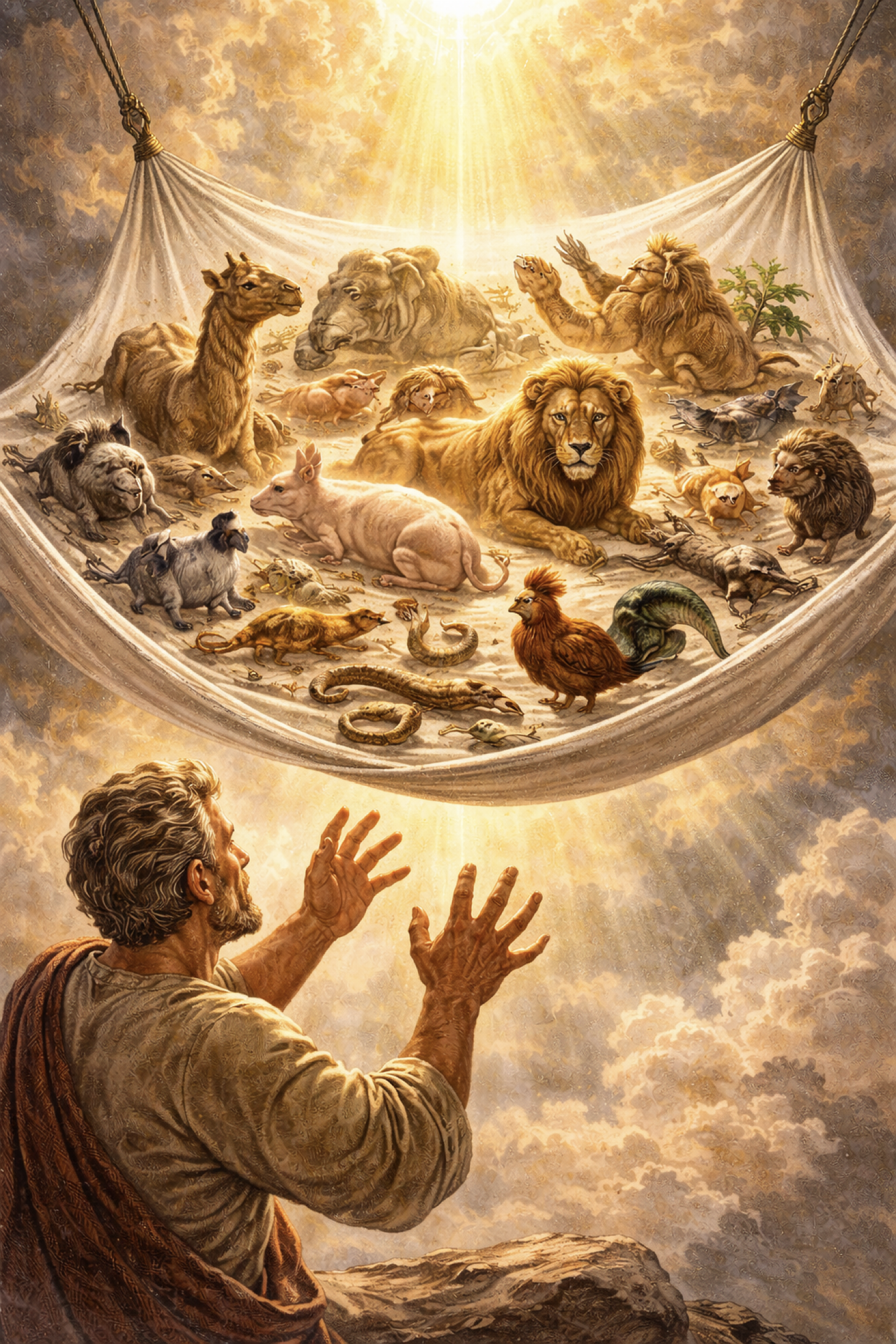
(Hey ChatGPT, those are some really bizarre animals.)

So if you are Peter, up on the roof, how do you interpret this vision?  What is God trying to tell Peter?   Here is what it says in the Tyndale Commentary on the Book of Acts:

“The effect of the vision was thus to announce to Peter that the distinction made in the Old Testament between foods that were ‘clean’, and therefore fit for human consumption, and those that were unclean, was now cancelled, so that in future Jewish Christians could eat any food without fear of defilement.”   (I. Howard Marshall, The Tyndale Commentary)

The Biblical laws that define food are spelled out primarily in Leviticus 11 and Deuteronomy 14.    Land animals must have divided hooves and must chew their cud (cattle, sheep, goats, deer, etc.) In contrast, pigs, camels, and rabbits, for example, are not food.    Swimming creatures that are food must have fins and scales, so shrimp, lobster, octopus, catfish, etc., are excluded.   Birds that were not defined as food were primarily birds of prey or scavengers, such as hawks, eagles, and vultures.  Chicken and turkey were allowed.  Let’s continue with the scripture.

Acts 10:17   So Peter understood from the vision that God changed the Torah rules about food, and he immediately called downstairs and changed his lunch order to bacon-wrapped scallops. 

No, that’s not quite right.

Acts 10:17   Now while Peter was inwardly perplexed as to what the vision that he had seen might mean…

Wait a minute.  How is it that Peter is “inwardly perplexed” about the vision?  He must not have had his copy of the Tyndale Commentary handy.  They seem pretty clear about it.  But Peter is utterly at a loss to explain what this means.   He knows God isn’t just rewriting his law book that has been in place for over 1000 years.  So the vision confuses him.  While he is thinking, Cornelius’s men arrive.

Acts 10:17-18   Now, while Peter was inwardly perplexed as to what the vision that he had seen might mean, behold, the men who were sent by Cornelius, having made inquiry for Simon’s house, stood at the gate and called out to ask whether Simon, who was called Peter, was lodging there.

While they are approaching the house, this is happening upstairs with Peter:

Acts 10:19-20   And while Peter was pondering the vision, the Spirit said to him, “Behold, three men are looking for you. Rise and go down and accompany them without hesitation, for I have sent them.

The Holy Spirit tells him to accompany these strangers wherever they are going.  He is to go “without hesitation.”  Let’s look at this in a few other translations:

Acts 10:20 (ESV)   Rise and go down and accompany them without hesitation, for I have sent them.
Acts 10:20  (KJV)  Arise therefore, go down and go with them, doubting nothing; for I have sent them.
Acts 10:20  (NASB)  But get up, go downstairs and accompany them without misgivings, for I have sent them Myself.

These are all ways of translating the Greek into English.  Have you considered the idea of doubt as hesitation?  That is a very Hebrew way of thinking.

In fact, there is no word in Biblical Hebrew like our word for doubt.  The idea of mental indecision leading to uncertainty is foreign to the Hebrew mindset.  In their worldview, God is king.  He is the ultimate decision maker.  Whatever God determines is law.  You don’t have to think about it and consider the options.  You don’t have to consider the good and the bad.  You don’t vote on it.  God says something, and whatever God says is good.  God gives instructions for living, and you obey them.

The Hebrew Bible (the Old Testament). does have a word for people stopping to consider what to do, what action to take.  You see it in Genesis 3.  Adam and Eve stop to think whether they should eat the fruit or not.  Does it look good to me?  The word for that kind of thinking is sin.  It is a sin to refuse to accept God’s determination of right and wrong.  It is a sin to think you can make those decisions for yourself.

In 1 Kings, when the people in Elijah’s day are wavering between worshipping God and worshipping the false deity Baal, Elijah holds the contest on Mt Carmel.  He does not ask the people, “How long are you going to doubt God? He doesn’t have a word in his language to express that, so he says,

1 Kings 18:21  How long will you go limping between two different opinions?

Elijah uses a picture of a man hobbling at a crossroads, trying to take both directions at once and effectively going nowhere. This is the only way he can discuss the ridiculousness of not being obedient to God.

Elijah would not call this doubt; he would call it disobedience.  Let me give you one more illustration: I have used it before, but it is worth repeating.  When Jesus is walking on the water in the storm, Peter sees him and says an interesting thing:

Matthew 14:28   Lord, if it’s you,” Peter replied, “Command me to come to you on the water.”

And Jesus does.  But why does Peter ask Jesus to command him to walk on the water?  Because if Jesus wills for Peter to walk on water, then Peter has no choice but to follow his Lord and King.  And if Jesus wills for Peter to walk on water, then Peter knows that Jesus will certainly give him the ability to follow through. And Peter is initially successful, but then he looks at the wind and becomes afraid.  He takes his focus off the power of Jesus and looks at the power of the wind.  

And when Peter stops walking, he starts sinking.  As long as he is being obedient to Jesus command, Jesus is empowering him to do the task. But Peter stops walking and then starts sinking.  And when Peter is sinking, first Jesus reaches out to pull him back up, but then he says, 

Matthew 14:31   “Oh, you of little faith, why did you doubt?”

This is the ESV rendering, but that is not exactly what Jesus said.  Jesus was a Jew.  Like Elijah, He did not have that word or concept of doubt that we had.  The Greek word there is distazo, which isn’t about mental confusion but about a lack of action or hesitation.  Jesus wasn’t asking why Peter was thinking wrong.  He was asking, “Why did you stop walking?”  Peter hesitated; he stopped walking; he stopped being obedient.  So Jesus really said, 

Matthew 14:31   “Oh, you of little faith, why did you stop being obedient?”

And now, 10-11 years later, this same Peter is faced with another problem in Acts 10.  He gets a clear word from the Holy Spirit to 

Acts 10:20    Rise and go down and accompany them without hesitation, for I have sent them.

So, like the command to come to Jesus on the water, Peter gets another direct command from God to go with these men.  And the Spirit throws in there, “And this time don’t hesitate!” So Peter heads downstairs.

Acts 10:21-23   And Peter went down to the men and said, “I am the one you are looking for. What is the reason for your coming?” And they said, “Cornelius, a centurion, an upright and God-fearing man, who is well spoken of by the whole Jewish nation, was directed by a holy angel to send for you to come to his house and to hear what you have to say.” So he invited them in to be his guests.”

Peter invites them in.  (It is ok for a Jew to have a Gentile into their house.)  But now Peter has another problem.  Not only is he still puzzled about that crazy vision, but these men are Gentiles.  And just like the command from Jesus to Peter to come to him on the water, Peter now has a command to do something that seems more impossible than walking on water.  God has commanded him to go to the house of a Gentile, a Roman Centurion.  This goes against everything he learned as a Jewish boy growing up.  You don’t go to the house of a Gentile.  They are unclean. 

But Peter remembers the last time he disobeyed a direct order.  He thought he was going to drown.  He has learned to be obedient.  He doesn’t understand why God wants him to do this, but he goes.

Acts 10:23-24  The next day he rose and went away with them, and some of the brothers from Joppa accompanied him. And on the following day, they entered Caesarea. Cornelius was expecting them and had called together his relatives and close friends.

So picture this:  Cornelius is excited.   God has a message for him through this disciple, and he is anxiously awaiting to hear what Peter will say.  He has called everyone over, and the house is full of friends and family.  Meanwhile, Peter left on this journey thinking, “What am I doing?  Why am I going to a Gentile’s house and breaking every rule my mother taught me?”   But on the way there, Peter figures it out.

Acts 10:25-29   When Peter entered, Cornelius met him and fell down at his feet and worshiped him. But Peter lifted him up, saying, “Stand up; I too am a man.” And as he talked with him, he went in and found many persons gathered. And he said to them, “You yourselves know how unlawful it is for a Jew to associate with or to visit anyone of another nation, but God has shown me that I should not call any person common or unclean. So when I was sent for, I came without objection. I ask then why you sent for me.

Peter apparently now knows that the vision he saw on the roof with all the animals wasn’t about food at all.  It was about people.  If God says they are acceptable, then Peter has no right to say they are not.  Apparently, the people who wrote the Tyndale Commentary missed Peter’s explanation in verse 28.  Oh, Mr. Marshall, you also missed it in verse 34:

Acts 10:34-35   So Peter opened his mouth and said: “Truly I understand that God shows no partiality, but in every nation anyone who fears him and does what is right is acceptable to him.

And I can almost hear God in heaven saying, “Well, it’s about time. I have been trying to teach Peter this lesson for over 10 years.”And just in case you are still confused about the vision, I can tell you that Peter didn’t hit the Red Lobster when he returned to Jerusalem and partake in the Crab fest.  In fact, if you read the rest of the New Testament, it is apparent that none of these Jews changed their dietary habits.  There is ample evidence that the Jews who are following Jesus continue to observe the Torah that God gave them in Leviticus and Deuteronomy throughout the NT, including circumcision, Nazarite vows, dietary laws, required prayer times, and the appointed times of the Jewish calendar.  

This is completely consistent with what Jesus said in the Sermon on the Mount:

Matthew 5:17-18   Do not think that I have come to abolish the Law or the Prophets; I have not come to abolish them but to fulfill them. For truly I tell you, until heaven and earth disappear, not the smallest letter, not the least stroke of a pen, will by any means disappear from the Law until everything is accomplished.”

Jesus didn’t come to erase the laws in Deuteronomy and Leviticus; he came to show people how to live them correctly.  He fulfilled them all and erased not a single letter.  Just because the Jews have now met their promised Messiah, doesn’t mean they can throw out all the things God said before.  None of those commandments is going away for them until heaven and earth disappear.  And last time I looked, the earth and the sky are both still present.

So if you are Jewish, and you find your promised mesiah in Jesus, you continue to follow the laws as before.  What Jesus corrects in the Gospels and here in Acts 10 are not God’s laws but man-made ones.  That stuff about Gentiles being unclean and not entering their houses.  That wasn’t God’s law; man made it up.  And Jesus spent much of his ministry correcting what man got wrong about his laws.

What is the lesson we are to learn from Peter’s vision, now that we know it was not about what food to eat?  If God has called someone clean, we should not consider them otherwise.   God makes the rules, and we follow them without question and without hesitation.  If you find yourself wanting to make your own rules or argue with God about the rules, then ask Adam and Eve how that turned out.

No group of people is beyond God’s grace and mercy; the gospel is for all.  It is for all of your friends and all of your enemies.  It is for people who like you and hate you.  It is for people who agree with you and people who don’t.   It is for the rich and the poor, the person with the nice home and the homeless.  It is for your best friend and the beggar on the street.  God calls them all.  And if God approves them, we have no right to dismiss them as unacceptable.  

But I want to look at one more aspect of this lesson that we often miss.  God sent his son, Jesus, to solve our sin problem.  He suffered and died for our sins and removed the penalty of death for the sins that we committed, the penalty we deserved.  When we turn over our lives to Jesus and make him King of our lives, accepting his sacrifice for the remission of our sins, then God pronounces us clean.

But have you ever just dwelt on your sins and felt that you were unworthy?  Have you ever looked at yourself and decided that you couldn’t speak up for Jesus, because you know your friends have seen your own shortcomings?  How can you pretend to be righteous in front of them?  How many times have you refrained from doing some work for God because you felt you weren’t good enough?  How many times have you sat by yourself feeling guilty for all the wrongs you have done in your life?  Is there some sin from your past that hangs over you that you can’t seem to get beyond?   Have you ever felt like you didn’t belong in the family of God?

There are too many of God’s people paralyzed in their Christian walk because they keep recalling past sins and just can’t let go.  If you still think about your past sins that you have confessed and repented of, and if you still carry guilt for these things, then I have something to say to you that you need to hear. It is what Peter would say if he were here this morning, because it is the message God sent him in Acts 10.

How dare you call someone unclean that God has cleansed? 

God has cleansed you.  You have no right to say otherwise.  His blood has washed you whiter than snow.  Don’t wallow in your guilt.  God is faithful and just.  Jesus took on your sin; he suffered the penalty for sin.  If you want to keep remembering it or want to punish yourself, then you are saying that Jesus didn’t do what he said he would do.  God is no liar.  

God does not want you to live in the shadow of your past sins.  Look at what God says:

Jeremiah 31:34   For I will forgive their iniquity, and I will remember their sin no more.

And in case you missed it in Jeremiah, here it is in the second testament.

Hebrews 8:12   For I will be merciful toward their iniquities, and I will remember their sins no more.

If God has forgotten your sin, then why do you keep thinking about it?  Those thoughts come from the adversary himself, the father of lies.  Any time those memories pop up, then you should rebuke them in the name of Jesus.  

We must learn the lesson that was so hard for Peter to learn. What God has cleansed, I cannot call unclean.  You can walk out this door today knowing that the blood of Jesus has cleansed you.  You are righteous in God’s eyes.  And share this incredibly good news with everyone you know.

John 8:36   So if the Son sets you free, you will be free indeed.

May 19, 28 A.D.  – “Doubting Thomas” — The Year of the Lord’s Favor #83

Week 66 — “Doubting Thomas”
John 20:24-29

John 20:24-29   Now Thomas, one of the twelve, called the Twin, was not with them when Jesus came. So the other disciples told him, “We have seen the Lord.” But he said to them, “Unless I see in his hands the mark of the nails, and place my finger into the mark of the nails, and place my hand into his side, I will never believe.”
Eight days later, his disciples were inside again, and Thomas was with them. Although the doors were locked, Jesus came and stood among them and said, “Peace be with you.”  Then he said to Thomas, “Put your finger here, and see my hands; and put out your hand, and place it in my side. Do not disbelieve, but believe.”  Thomas answered him, “My Lord and my God!”   Jesus said to him, “Have you believed because you have seen me? Blessed are those who have not seen and yet have believed.”

Poor Thomas, so famously known for one moment in his life.  This is how we often perceive people.  We tend to reduce them to that one moment that we remember.   And sadly, like Thomas, it may be a moment we view negatively.  Thomas is not the only person who, unfortunately, becomes known for one moment in their life.

If you are a baseball fan, there is one name that comes to your mind.  Bill Buckner.  It is Game 6 of the 1986 World Series.  The Red Sox lead the Mets in the series, three games to 2.  A win in this game will mean Boston will have their first World Series Championship since 1918.  Boston was leading this game, but the Mets tied it up, and the game went into extra innings.  In the top of the 10th inning, Boston scored two runs to go ahead again, 5-3.  In the bottom of the 10th, the Mets scored twice to tie the game again at 5-5.  The Mets had a man on second, but there were two outs, and they were down to their last strike.  One more strike and the game goes to the 11th inning.

Mookie Wilson hits a slow roller down the first baseline.  Bill Buckner is there to field the ball, but it goes between his legs and rolls into right field.  The runner scores and the Mets win.  The Mets go on to win the World Series, denying Boston yet again.  The term ‘Buckner Play’ became synonymous with a costly sports blunder.

Bill Buckner played Major League Baseball for 21 years. He ended his career with over 2,700 hits and almost 500 doubles, having batted over .300 seven times. He retired as one of the most effective first basemen in major league history, but is still remembered for one error.

“Doubting Thomas.”  Does he deserve this title?  Should he be known for this one event?  We don’t have as much written in the Gospel accounts about Thomas as we do Peter or John, but there is more to him than this one story.  Thomas was a bold, dedicated follower of Jesus.  When Jesus says he is going back to Jerusalem, and the disciples say, “Wait, you know they are looking to kill you there?”  It is Thomas who steps up and says, “Let us also go, that we may die with him.”

Another time, Jesus tells the disciples:

“And if I go and prepare a place for you, I will come again and will take you to myself, that where I am, you may be also.   And you know the way to where I am going.”

But none of them understood, and they were scared to admit it.   Only Thomas has the courage to speak up.”

“Lord, we do not know where you are going. How can we know the way?”     

And because Thomas was bold enough to ask, we get this from Jesus:

Jesus said to him, “I am the way, and the truth, and the life. No one comes to the Father except through me.”

The reason we have this verse is that Thomas was bold enough to ask the question that the others were scared to ask.  But what do we remember about Thomas?  He was the doubter.    And is doubt really that bad of a thing?  Do we even understand what doubt means in the Bible?

According to modern dictionaries, doubt is “a feeling of uncertainty or a lack of conviction”. If that is what doubt means, then we might think of the opposite of doubt as faith, which is defined as “complete trust or confidence in someone or something.”  These would seem to be near opposites.  But these modern-day dictionary definitions don’t fit with the way the Bible uses these words.  You see, this is the Greek view, not the Biblical view.

Our thinking is significantly influenced by the ideas of Greek thinkers.  We tend to want proof with absolute certainty before we ‘believe’ something. In fact, the very idea of proving something is Greek.  It comes from the Greek mathematicians Euclid and Thales, who devised a method of proof for mathematical theorems.  (I am suddenly having flashbacks of writing proofs in Geometry in High School.  Anyone else nauseous?)

 However, in life, absolute certainty is rare.  So, then it takes a leap of faith.  You finally have to be convinced enough to accept something.  So the Greek idea of faith is what you mentally agree with.  If you have Greek faith, then you are mentally convinced, your mind is made up. 

However, the Biblical notion of faith is not from the Greek mindset but from the Hebrew.  Faith in Hebrew is ‘emet’ (from which we get our word ‘Amen’); it is about reliability, trustworthiness, and consistency of actions.  God is always consistent.  He always keeps his promises.  He is faithful.  Faith is about actions, not thoughts.  It is what you do, not what you think.  (It helps us to read “faith” as “faithfulness” as it is an action, not a thought.)

So, biblical faith is not just accepting God and His word, but acting in obedience to His word.  But if Biblical faith is about action, then what is doubt in the Bible?  The Biblical Hebrew word for Doubt is — wait, there is no Biblical Hebrew word for doubt.   Does that surprise you?  There is a word for doubt in modern spoken Hebrew (safek), but you won’t find that word in the Bible.  While we view doubt or mental uncertainty as a negative thing, the Old Testament doesn’t even assign a word to it.

You do see people in a time of mental uncertainties in the Bible, but it is not called doubt.  Abraham and Sarah both laughed when God told them they would have a child in their old age.  And while God corrects them, he does not rebuke them.  Twice, Gideon seeks confirmation of God’s plan before he acts because he is unsure.  Similarly, Moses needs assurance from God because he is uncertain that he is the right man for the job.

God doesn’t rebuke any of these people for having some mental uncertainty.  He helps them through it.  Jesus does the same with Thomas, yet you don’t hear “doubting Abraham” or “doubting Sarah.”  Instead, you see the author of Hebrews put all of these people who had uncertainties in the Hall of Fame for faith in Hebrews 11.  And for all of the “heroes of faith,” in that ‘roll call of faith, ’ you read not what they believed, but what they did.  Their faith is not what they thought about God, but their actions.  (Abraham offered up Isaac, Noah built an ark, Moses kept the passover, sacrificed the lamb, walked through the sea, etc.)

While there is no word for doubt in the Old Testament, you do see the word doubt in the New Testament a few times.  There are 2 Greek words that are translated as ‘doubt’:
Diakrino, which means to distinguish between two things, is occasionally translated as ‘doubt.’
Distazo, which means to waver, hesitate, or delay, is translated as ‘doubt’ twice.  However, it is clear that neither word accurately captures our modern understanding of doubt. The best example of how these words are used is the story of Jesus walking on water.  We reviewed this back in the fall, but let’s revisit it here to see what Jesus says that gets translated as ‘doubt.’

The disciples are in a boat in a storm.  Jesus is casually walking on the water by them.  Peter says, “Lord, if it is you, command me to come to you on the water.”  Jesus replies, “Come.”  Peter hops out of the boat and begins walking on the water. 

Matthew 14:30-31   But when he saw the wind, he was afraid…    

Wait a minute.  Can you see the wind? No, you can only see the results of the action of the wind.  Hang on to that thought for a minute.

Matthew 14:30-31   But when he saw the wind, he was afraid, and beginning to sink, he cried out, “Lord, save me.”

What is going on? Why is Peter sinking?  Peter is wavering between two thoughts:
1. Jesus told me to walk on water, so I should be obedient.
2. It is impossible to walk on water (do you see those waves?)
And Peter is stuck.  He stops walking and becomes stuck in his thoughts, pondering between these two ideas.  This is similar to our concept of doubt.

Some call this Analysis Paralysis – His mental confusion led to an inability to do what Jesus commanded.  His mental uncertainty causes him to stop obeying Jesus’ command to come.  So, how does Jesus respond to Peter?

Matthew 14:31     Jesus immediately reached out his hand and took hold of him. “Lord, save me.”

This is important.  Jesus does not punish Peter for having mental confusion; he reaches out his hand to pull him up, and says, 

“Oh, you of little faith, why did you doubt?”

Why does Jesus say Peter has “little faith”?  First, remember that Jesus said if you have faith as small as a mustard seed, you could move mountains.  A mustard seed was the smallest item he could show them, smaller than a grain of sand.  So the point is any faith at all is sufficient, even the smallest amount, because the outcome is not dependent on the amount of faith you have, but the amount of power God has.  “Little faith” really means no faith.

Why does Jesus say Peter has no faith?  Faith is like the wind.  You can’t see it, but you can see the result of it.  Remember when the paralyzed man’s friends let him down through the roof to Jesus?  The Bible says, “Jesus saw their faith.”   You can see faith because faith is an action.  Biblical faith is characterized by reliability, trustworthiness, and consistency of action.  Peter stops walking.  He is inconsistent in his actions. Therefore, he has no faith.

“Oh, you of little faithfulness, why did you doubt?”  Jesus isn’t asking Peter if he is theologically confused or has doctrinal issues.  He is asking Peter why he stopped walking.

This Greek word doesn’t mean ‘doubt’ as we think, but instead has the meaning of hesitating and/or delaying.  To Jesus, the problem is not mental questioning or uncertainty; the problem is his hesitation or refusal to do what he called Peter to do.  To Jesus, the issue with doubt is the lack of obedience.

The Bible doesn’t call us to be certain in our minds.  (It is not Greek.). Proofs are not necessary.  The Bible leaves room for uncertainty.  But it does not leave room for disobedience.

Jesus never said, “Understand everything I say and don’t ask questions.”  He said, “Follow me.”  It’s all about the action, all about obedience.  Jesus is fine with your questions.  He has no problem with your consideration as long as it does not lead to disobedience.

We see that with Thomas.  Thomas was an eyewitness to Jesus’ life; he knew Jesus had died.  If Jesus were alive again, Thomas would need to see Him again.  Jesus doesn’t fuss at him. He gives him exactly what he needs.  You need to see my hands and side.  Here they are..  Jesus solves his uncertainty.  Mental uncertainty is fine, as long as you remain obedient.

But there can be a huge potential problem with resolving mental uncertainty.  We need to go back to Genesis. There is a tree in the garden.  Eve says, “That fruit looks delicious!  It looks so good to me, but God said, ‘Don’t eat it.’”  So, where does Eve go when she has uncertainty?  Where does Eve go when she is confused?  She goes to the serpent and listens to what he has to say.  Then she reasons within herself.  Her mental uncertainty led to disobedience, as she sought advice from the snake and then decided that she was more capable of making decisions than God.

If Adam and Eve had some mental uncertainty or questions about the tree of knowledge of good and evil, then they should have asked God about it on their next walk in the Garden, not the snake.  The answers we need are not going to come from our reasoning, and certainly not from the snake and the world he controls.

Proverbs 3:5-6.  (Message)  “Trust God from the bottom of your heart; don’t try to figure out everything on your own. Listen for God’s voice in everything you do, everywhere you go; He’s the one who will keep you on track.”

If you find yourself confused or questioning, don’t go to the serpent for advice. Don’t go to the world that he currently runs.  And then don’t think you can decide better than God.   The next verse in Proverbs says, “Don’t be wise in your own eyes.

Luke tells us this also.  In the book of Acts, Luke writes about Paul’s ministry and says:

Acts 17:11. Now these Jews were more noble than those in Thessalonica; they received the word with all eagerness, examining the Scriptures daily to see if these things were so. 

Paul was saying some things they had trouble understanding.  You may not have noticed this, but Paul can be difficult to understand. (See 2 Peter 3:16 for Peter’s opinion on this.)   So what do you do?  You don’t go asking a snake about it.  And you don’t just sit around thinking you can reason it out in your own mind.

I frequently see this in Bible studies.   People ask, “What do you think the scripture is saying? What makes sense to you?”  I apologize, but that is not the correct way to interpret scripture. That’s what got Adam and Eve in trouble.  “The fruit looks good.  It makes sense to me to eat it!”  Use the Bible, God’s Word, to interpret the Bible, not your own understanding.  Don’t make the same mistake Adam and Eve made.  Ask questions about it, but go to the right place for answers.  Listen, if we spend hours in front of a television and never find time to study God’s word, it is no wonder we are confused.  Search the scriptures and ask God to help you understand them.

So it is all about action.   Christianity’s leap of faith is not a mental leap but a leap of action.

Remember the story of Naaman the leper?  He came to the prophet Elisha seeking healing.  He was expecting some grand gesture from the prophet, but Elisha sent a servant to instruct Naaman to wash in the Jordan.  Naaman was angry that Elisha didn’t even bother to speak to him personally, and he was mad that all he offered him was to bathe in a river.  What would that do?  But Naaman’s servant said, You’ve come all this way, what could it hurt to try the river that the prophet said?   So Naaman goes and washes 7 times in the Jordan.

Did Naaman, after his healing, understand how the water would heal him?  Did he solve his uncertainty about the prophet’s command?  No, but he was obedient, and he was healed, and his obedience led to faith. He goes back to the prophet and says, “Behold, I know that there is no God in all the earth but in Israel” (2 Kings 5:15). His obedience preceded his belief, and his obedience led to his belief.  Understanding is not a prerequisite to obedience.

Faith comes by obedience.  Let me ask you, “When has your faith grown?”  I have been in some beautiful church buildings and heard some fantastic music, and I enjoyed the time of worship, but that did not deepen my faith.  I have listened to some incredible preachers deliver great sermons, and I have learned a lot, but that hasn’t deepened my faith.    I have heard some amazing testimonies from others, but that alone didn’t make my faith grow.  However, all of these things contributed to inspiring me to do the one thing that ultimately led to my faith growing: walking out of the building and being obedient to what God led me to do.

It was when I followed God in obedience and stepped out to do something that my faith grew.  And often they were things that I didn’t really want to do or things I felt inadequate to do.   But as I stepped out, like Peter, God empowered me to do what I thought I couldn’t do.  And in obedience, faith grows.

Again, faith is not about mental agreement; it is about action.  Read the book of James.  James says faith without action is worthless.  It is dead.  It only exists if there is action with it.

Have you ever been rappelling?   Essentially, you attach a rope to the top of a cliff, hook into the rope with a harness, then lean back off the side of the cliff and walk backward down the cliff wall.  There is a big difference between believing that the rope is strong enough to support your weight and then stepping off the side of the cliff and depending on the rope.   Faith is not “believing that the rope will hold you”; it is leaning back off the side of the cliff on that rope.

James 1:6 But let him ask in faith, with no doubting, for the one who doubts is like a wave of the sea that is driven and tossed by the wind.

James is clearly thinking of Peter on the water here.  Doubt (wavering between two things) is like the back-and-forth waves in the sea, just being tossed around.  “Let him ask in faith.”  Don’t be like Peter, who stopped being obedient while he considered the physics of water-walking.

We must also guard against analysis paralysis. I don’t know about you, but I like to stop and think about things first – I’m not Peter, just quickly jumping out of the boat.  I want to follow Jesus, but sometimes I’m not quite sure it’s His voice I’m hearing.  It is okay to be sure, but it is not okay to use that as an excuse for delaying obedience.

How often have I been prompted to do something – give something away, visit someone, whatever – and I have not done it because I second-guessed myself, not believing the prompting was from God. A wise friend told me that if it were an act of kindness that could not harm anyone, then don’t hesitate.  It would certainly be tragic to miss a command from God because I was questioning my motivations.  Remember, Jesus is fine with our questioning, but not with our delay and hesitation in obedience.

So “Doubting Thomas”?  No.  Thomas was no different than any of the other disciples.  None of them believed Mary or the disciples from Emmaus when they came and told them about Jesus’ resurrection.  They had all seen him alive and seen him die.  They all needed to see him alive again.  Let’s look at the end of the story again.

John 20:26-29   Eight days later, his disciples were inside again, and Thomas was with them. Although the doors were locked, Jesus came and stood among them and said, “Peace be with you.”  Then he said to Thomas, “Put your finger here, and see my hands; and put out your hand, and place it in my side. Do not disbelieve, but believe.”  Thomas answered him, “My Lord and my God!”   Jesus said to him, “Have you believed because you have seen me? Blessed are those who have not seen and yet have believed.”

“My Lord and my God!”   The clearest confession of Jesus’ divinity in the Gospels.1  Many called Jesus ‘Lord’, but that was a title of reverence and used as a standard greeting, as we say ‘sir’ or ‘mister’.  Some called him the ‘Son of God,’ but this term is used frequently in the Bible to refer to angels, the nation of Israel as a whole, and some kings, not specifically to a divine being. ‘Son of Man’ can be used as a reference to human beings or as a special reference to the Daniel 7 exalted figure called the ‘Son of Man.’

John began his Gospel, “In the beginning was the word, and the word was with God and the word was God.”  This is a statement about the divinity of Jesus.  And now John is ending his Gospel with the same statement.  How ironic that this most bold statement of faith comes from the man we call “Doubting Thomas.”

How does Thomas’ story end?  The Bible doesn’t say, but history tells us Thomas, the disciple who stated his willingness to follow Jesus to death, traveled further than any other apostle to spread the Gospel.  He traveled the trade routes east, outside the Roman Empire, through Persia to India, likely arriving there by 49 AD.  He started numerous churches and was later martyred there.  The man known for doubting followed Jesus further than anyone.

So what is our take-home message?

  1. It is ok to question God.  He can handle our questions.  If you are drowning in uncertainties, Jesus will reach out his hand to help you.
  2. If you are uncertain or questioning, do not go to the world and do not go to the serpent, and do not think you can reason it out on your own.  Go to God’s Word and God in prayer.  Don’t make the Adam and Eve mistake.
  3. Faith is something you can see.  It is not a creed, a list of things we believe.  It is the actions of a life that is based on that creed.  It is what you do, not what you think.
  4. If God calls you to do something, do not delay or hesitate; act promptly.  Be consistent in your obedience.

God brought us into his kingdom to do the work of the kingdom.  He gave us talents to use them.  There is nothing I can say to help you grow your faith.  I hope to inspire you to walk into God’s world and do what God leads you to do.   I truly believe God is calling each of us to do something for the kingdom this week.  And as we do, our faith grows.

  1. Last week, I mentioned that the Last Supper was the seventh meal Jesus had at the table in John.  Seven is the number of completion.  And then the next meal in Emmaus was a kind of ‘first supper,’ marking the beginning of a new era in the world following Jesus’ resurrection.  There are many ‘sevens’ in John.  There are seven miracles, and the eighth one, marking a newness of life in the world, is the resurrection of Jesus.  There are seven “I am” statements by Jesus.  There are seven statements by seven witnesses that Jesus is the Messiah, followed by the eighth one after the resurrection, the climactic witness that Jesus is divine.

September 18, 27 A.D.  Jesus Walks on the Water #51

Week 31 ———  Jesus Walks on the Water
Matthew 14:22-33 — Mark 6:45–52 — John 6:16-21

Jesus got the bad news about John’s death.  He wanted to go off by himself to grieve but ended up healing and teaching a large crowd and then performing a miracle to feed them.  

Matthew 14:22-23  Immediately, he made the disciples get into the boat and go before him to the other side, while he dismissed the crowds.  And after he had dismissed the crowds, he went up on the mountain by himself to pray. When evening came, he was there alone.

Jesus made (not asked)1 the disciples get in a boat to go to the other side of the lake.  He finally gets some time alone and goes to the mountain to pray.

Matthew 14:24-25  …but the boat by this time was a long way from the land, beaten by the waves, for the wind was against them.  And in the fourth watch of the night…

You remember the last time the disciples made a night trip in a boat a few weeks ago.  The storm was so bad they thought they would die, but Jesus was in the boat with them, and he calmed the storm.  Well, the wind was against them again, and this trip should have only taken a few hours in the boat, but now it is the fourth watch (between 3-6 am).  They have been rowing a boat against the wind for 6 hours.  They are exhausted and getting nowhere.  Matthew tells us they are “many stadion.” (A stadia is about 600 feet2)   The sea is beating them down, and Jesus is not in the boat with them this time.  They are on their own.  During the last storm, Jesus said they had no faith, zero faith.  Jesus is now testing their faith.  Have they learned anything from the previous storm, from the last few weeks of teaching and miracles?   

Matthew is telling these stories to let us know how Jesus taught them what it means to be a disciple — a disciple of one who controls the wind and waves, one who always acts out of compassion, one who fills the needs of people when there aren’t resources.  A disciple must have the faith to do what is asked despite any circumstances.   So he made them get back in the boat and gave them another storm.  And the Bible doesn’t say they are scared to death- good, maybe they have faith now.  But the test is not over.

Matthew 14:26   But when the disciples saw him walking on the sea, they were terrified and said, “It is a ghost!” and they cried out in fear.

So the wind and waves don’t scare them. But they see this figure walking on top of the water (this same water that is so churned up they can’t get anywhere).  And they are terrified again.

Mark 6:48-50   And about the fourth watch of the night he came to them, walking on the sea. He meant to pass by them, but when they saw him walking on the sea, they thought it was a ghost and cried out, for they all saw him and were terrified.  But immediately, he spoke to them and said, “Take heart; it is I. Do not be afraid.” 

He meant to pass by them.  (Thanks for the smile, Mark.) In the last storm, Jesus was sleeping; this time, he was just out for a stroll.  What’s the message?  Don’t be afraid of storms.  Don’t be scared of ghosts.  What is the most common command in the Bible?  Do not fear!   

Matthew 14:28  And Peter answered him, “Lord, if it is you, command me to come to you on the water.” He said, “Come.” So Peter got out of the boat, walked on the water, and came to Jesus.

Peter wanted to be a disciple.  Again, the goal of a disciple is not to know what the rabbi knows; it is to be who the rabbi is.  To do what he does.  To follow.  And this is not Peter’s brashness talking.  He wouldn’t step out of the boat unless Jesus told him to.  At this point, we would all say of Peter, “Wow! he sure has a lot of faith!”   I don’t see the other 11 disciples stepping out.  But keep reading…

Matthew 14:30-31   But when he saw the wind, he was afraid, and beginning to sink he cried out, “Lord, save me.”  Jesus immediately reached out his hand and took hold of him, saying to him, “O you of little faith, why did you doubt?”

What happened?  Jesus says Peter has no faith.  We talked last week about how Jesus defines “little faith.”  It is less faith than the smallest thing in their world, a mustard seed.  It is zero faith.  Jesus seems to say that you either have faith or don’t.  It is not a measurable commodity.  And here, Jesus says Peter does not have faith.  But let’s look at that scripture:

Luke 17:5-6   The apostles said to the Lord, “Increase our faith!”   And the Lord said, “If you had faith like a grain of mustard seed, you could say to this mulberry tree, ‘Be uprooted and planted in the sea,’ and it would obey you. 

The disciples thought faith was measurable and that you could get more of it. We know this because they asked Jesus for more faith. Then Jesus tells this parable that, at first, looks odd.

Luke 17:7-10  “Will any one of you who has a servant plowing or keeping sheep say to him when he has come in from the field, ‘Come at once and recline at table’?  Will he not rather say to him, ‘Prepare supper for me, and dress properly, and serve me while I eat and drink, and afterward you will eat and drink’?  Does he thank the servant because he did what was commanded?   So you also, when you have done all that you were commanded, say, ‘We are unworthy servants; we have only done what was our duty.’”

The story’s point is that the slave is just doing what he is supposed to do.  His position is to be obedient to his master.  And when he is obedient, he is not greatly rewarded for his obedience.  He is not invited to the table to eat but is expected to serve the meal. The master does not lavish honor and thanks on the servant; he is just doing what he is supposed to do.  And when the slave has completed his tasks he says: “I don’t deserve a reward; I have done only what was expected of me.”

What a strange answer to a request for more faith!  But wait, maybe it isn’t so strange.  What it tells us is that faith is not something I am given as a reward.  It is not something given as a sign of privilege.  Faith comes by obedience – and obedience is expected!  We are not obedient to God to earn a reward or honor.  We are obedient because it is our position to be obedient.  He is God.  We are not.  And God does not owe us anything for our obedience.  What God gives us, especially salvation, is not due to our obedience but out of his love, mercy, and grace.  

If you ask for more faith, God will not just go to his cabinet, get out a bottle of faith, and pour more on you.  He will simply give you more to do.  If you obey Him, you will discover that your obedience is the faith you desire.  To request an increase in faith is to ask for the opportunity to be more obedient.  The times in my life that I have felt my faith was the strongest was after I had been obedient to some difficult things.

You don’t need more faith; you just need to continue being obedient. The power to fling mulberry trees or mountains around is not dependent on the measure of our faith but on the measure of God’s power, which is limitless.  

Paul said that faith comes through obedience, in a much-misunderstood verse.  

Romans 10:17   So faith comes from hearing, and hearing through the word of God.

Paul is not saying that you get faith by reading the Bible.  This verse is only valid if you remember that Paul is a Jewish Rabbi.  To Paul, hearing is not just listening but obedience. Shema (Hebrew for ‘to hear’) means to hear AND obey.  So, in this verse, Paul says, “Faith is a result of hearing the word of God and doing it.  Faith is not the prerequisite for obedience but the result of obedience.  First, I am obedient to what God calls me to do, and by doing so, I discover that I can stand on his word.  That is faith.  Faith is impossible without obedience. If you do not obey God, you have no faith.

Peter steps out and stands on the water, but he ‘sees the wind’ and then starts sinking.  Of course, you can’t see the wind; you can only see the results of the action of the wind.  You can’t see faith either; you can only see the actions of faith  – because faith is obedience.)  What did Peter doubt?  He didn’t doubt Jesus; Jesus seemed to be just fine standing on the water waiting for him.

What is doubt?  There is no Hebrew word for doubt.  Why not?  The answer is in Genesis 3.

The serpent asks, “Did God really say that?  You won’t really die.  You will be like God, able to make your own decisions and decide for yourself.”  So Eve looks at the fruit, and to her, it looks good, so she weighs that against what God said, decides for herself, and is disobedient.  It is what makes sense to her.  She didn’t doubt God; she just decided that she was a better judge of what was best for her.  

The Greek word for doubt is ‘distazo.’  It comes from a root meaning ‘two.’  Peter looks at the wind and waves and how crazy this is. Like Eve, he weighs that against what Jesus has shown him and decides for himself.  He should have kept walking but stopped and considered the two options.  Is God right, or is my understanding of physics right?  He hesitates to walk any further while he tries to decide between the two viewpoints.  And he sinks.  

It is okay to ask God ‘why’.  It is not okay to wonder if God is telling the truth, if God means what he says, or if God is God.  What kind of arrogance does it take for someone to think they are smart enough to decide if God is right or wrong?  It takes Adam’s and Eve’s kind of arrogance, yours, and my kind of arrogance. This is the opposite of faith, and it is sinful.  When Jesus asks Peter why he doubted, he is asking why he stopped walking.  Doubt is hesitation; it is stopping your obedience to consider if God is right.  James said it this way:

James 1:6-8  But let him ask in faith, with no doubting, for the one who doubts is like a wave of the sea that is driven and tossed by the wind.  For that person must not suppose that he will receive anything from the Lord; he is a double-minded man, unstable in all his ways.

I have to think James is thinking about the story of Peter on the water, comparing doubt to a wave in the sea.  Doubt is being double-minded, wavering between two worldviews.  

Let’s tie this all together.  Jesus is trying to teach these young men what it means to be a disciple.  Look at the world and have compassion for the people.  Don’t walk through the world with blinders on.  We pass by people who are hungry and homeless and depressed and sick and tired and hopeless without Jesus every day.  See the needs around you.  Then, take it to Jesus.  Pray to Jesus:  these people need help!  And Jesus will smile at you and say, “Good, you go help them.”  And then bring whatever you have to Jesus to solve the problem.  Even though there is no way your little can begin to solve a huge problem.  Bring it to Jesus; be willing to bring your all.  And Jesus will multiply it and give it back to you to hand out.  Don’t waver.  Don’t be double-minded.  Don’t hesitate on your obedience by stopping to consider how it doesn’t make sense.

It doesn’t make sense that you can feed thousands of people with five loaves and two fish; it doesn’t make sense that you can treat a hundred children with four antibiotics.  It doesn’t make sense that you can walk on water.  It doesn’t make sense that God would love us, despite our rebellion, that he would send his Son to suffer and die for our sins.   And the issue is not how strong your faith is but how strong the object of your faith is.  It is not the power of your faith but how powerful God is.  We don’t need faith in our faith, but faith in Jesus.  And faith comes by obedience.  

  1. The Greek verb for ‘made’ (the disciples get into the boat) is ‘anagkazo’, a very forceful verb, elsewhere in the New Testament translated as ‘compelled’ or ‘forced’.  It makes you wonder if the disciples might have hesitated to get back in a boat in the evening after their most recent evening trip that ended in a storm that scared them to death.
  2. The Greek stadia was a measure of length equal to 1/8 of a Roman mile or about 600 feet (or about 1 furlong for horse racing fans). This is the distance of two 100-yard football fields. Interestingly, the plural ‘stadion’ came to refer to the race track itself. The track at Olympia was 192 meters or one stadia. From this, we get the word ‘stadium’ to refer to the facility with the running track and then to any sports event.