
April 1, 2026 – What About Herod? — Acts #38
Acts. 12:1-5
Acts 12:1-5 About that time, Herod the king laid violent hands on some who belonged to the church. He killed James the brother of John with the sword, and when he saw that it pleased the Jews, he proceeded to arrest Peter also. This was during the days of Unleavened Bread. And when he had seized him, he put him in prison, delivering him over to four squads of soldiers to guard him, intending after the Passover to bring him out to the people. So Peter was kept in prison, but earnest prayer for him was made to God by the church.
This Herod is Herod Agrippa I, the grandson of Herod the not-so-Great. So he came from a family of rulers. Herod the Great ruled Israel under the Romans until 4 BC. When he died, 3 of his sons, Herod Antipas, Herod Archelaus, and Philip, divided up the territory. Herod Antipas ruled Galilee and Perea. He is the one who killed John the Baptist and also saw Jesus on the day of his trial and sent him to Pilate. Archelaus ruled Judea and Samaria until Rome removed him from office and banished him to Gaul for his incompetence and cruelty. Philip was the only good leader in the family and ruled until he died in 34 AD.
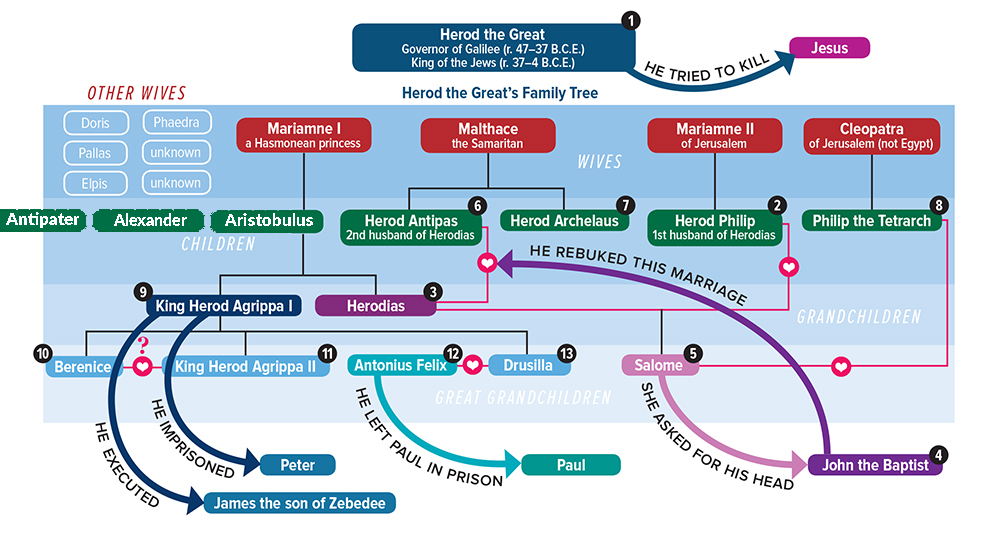
But Herod the not-so-Great was ruthless and paranoid, always thinking his family was trying to take his throne. So he killed his wife Mariamne, and three of his sons, Aristobulus, Alexander, and Antipater. He also killed his grandfather, his mother-in-law, and two brothers-in-law. And of course, Herod commanded the murder of all children under 2 years of age in Bethlehem in an attempt to kill Jesus.
But the Herod we are talking about this morning is Herod Agrippa I. So, after his grandfather Herod the not-so-great killed his grandmother, his father, and two of his uncles, he shipped Agrippa to Rome to be raised. Agrippa gets on good terms with the Emperor and is appointed ruler of Judea after Pilate is fired.
And here is Acts 12, we see him ruling the same area as Herod the not-so-great and being just as murderous. He is trying to earn favor with the Sanhedrin and other Jewish leaders, and so he does them a favor and murders James, the brother of John. And when he sees how much he is appreciated for this, then he finds another leader of the Jesus followers, Peter. And he would have killed him right away, but it is the time for Passover and Unleavened Bread, so he puts Peter in prison until after the holy days are over.
How awful can a person be? Committing multiple murders just to gain political approval. He is a chip off the old Herod block. How would you feel about Herod if he killed your brother or a good friend for such a reason? Now we usually just speed past this when we are reading the Bible and move quickly to the great story of Peter’s miraculous prison escape. But I want to slow down for a minute. Because I think we have something to learn from Herod.
He is a ruthless murderer, willing to kill to move ahead politically. If you were one of the followers of Jesus in Jerusalem in the first century, how would you feel about Herod Agrippa? If he killed the number one religious leader of the day? It would be like if 30 years ago, some political leader murdered Billy Graham to win some votes from certain people. You would be outraged, you would want them brought to justice, you would want the death penalty for them.
But let me ask you this. Could you ever forgive them? If someone commits a horrible crime and then later truly repents, can you forgive them? If someone abused or killed your friend or even your child, could you ever forgive them? If you were a Jew in a Nazi death camp, is there any way you could forgive one of the German soldiers who murdered and tortured your people?
I read two books in the past weeks that really made me think about this. The first is The Sunflower, by Simon Wiesenthal, and the second is a book by Brian Zahnd, “Unconditional?: The call of Jesus to radical forgiveness.” Let me share with you Zahnd’s summary of Wiesenthal’s story:
Simon Wiesenthal was an Austrian Jew imprisoned in a Nazi concentration camp during World War II. Wiesenthal is part of a work detail being taken from the concentration camp to do cleanup work in a makeshift field hospital near the Eastern Front. As they are marched from the prison camp to the hospital, they come across a cemetery for German soldiers. On each grave is a sunflower. Wiesenthal writes: “I envied the dead soldiers. Each had a sunflower to connect him with the living world, and butterflies to visit his grave. For me there would be no sunflower. I would be buried in a mass grave, where corpses would be piled on top of me. No sunflower would ever bring light into my darkness, and no butterflies would dance above my dreadful tomb.”1
While working at the field hospital, a German nurse orders Wiesenthal to follow her. He is taken into a room where a lone German SS soldier lies dying. The SS soldier is a twenty-one-year-old German from Stuttgart named Karl Seidl. Karl has asked the nurse to “bring him a Jew.” Karl has been mortally wounded in battle and now wants to make his dying confession—and he wants to make it to a Jew. The SS man is wrapped in bandages covering his entire face, with only holes for his mouth, nose, and ears. For the next several hours, Simon sits alone in silence with Karl as the dying SS soldier tells his story. Karl was an only child from a Christian home. His parents had raised him in the church and had not been supporters of the Nazi party and Hitler’s rise to power. But at fifteen, against his parents’ wishes, Karl joined the Hitler Youth. At eighteen Karl joined the infamous SS troops. Now as Karl is dying, he wants to confess the atrocities he has witnessed and in which he, as a Nazi SS soldier, has participated. Most horrifying is his account of being part of a group of SS soldiers sent to round up Jews in the city of Dnepropetrovsk. Three hundred Jews—men, women, children, and infants—were gathered and driven with whips into a small three-story house. The house was set on fire, and Karl tells Simon what happened:
“We heard screams and saw the flames eat their way from floor to floor. . . . We had our rifles ready to shoot down anyone who tried to escape from that blazing hell. . . . The screams from that house were horrible. . . . Behind the windows of the second floor, I saw a man with a small child in his arms. His clothes were alight. By his side stood a woman, doubtless the mother of the child. With his free hand the man covered the child’s eyes . . . then he jumped into the street. Seconds later the mother followed. Then from the other windows fell burning bodies . . . We shot . . . Oh God!”
During the several hours that Simon the Jew sat with Karl the Nazi, Simon never spoke. At Karl’s request, Simon held the dying man’s hand. Simon brushed away the flies and gave Karl a drink of water, but he never spoke. During the long ordeal, Simon never doubted Karl’s sincerity or that he was truly sorry for his crimes. Simon said that the way Karl spoke was proof enough of his repentance. At last Karl said: “I am left here with my guilt. In the last hours of my life you are here with me. I do not know who you are, I only know that you are a Jew and that is enough. . . . I know that what I have told you is terrible. In the long nights while I have been waiting for death, time and time again I have longed to talk about it to a Jew and beg forgiveness from him. Only I didn’t know if there were any Jews left. . . . I know that what I am asking is almost too much for you, but without your answer I cannot die in peace.”3
With that, Simon Wiesenthal made up his mind and left the room in silence. He was there for hours but never said a word. That night Karl Seidl died. Against all odds, Simon Wiesenthal survived the Holocaust. Eighty-nine members of his family did not. But Simon Wiesenthal could not forget Karl Seidl. After the war, Simon visited Karl’s mother to check out Karl’s story. It was just as Karl had said. Karl’s mother assured Simon that her son was “a good boy” and could never have done anything bad. Simon remained silent again, this time out of kindness. Simon believed that in his boyhood, Karl might indeed have been “a good boy.” But Simon also concluded that a graceless period of his life had turned him into a murderer. Simon Wiesenthal concludes his riveting and haunting story with an equally riveting and haunting question addressed to the reader. Should I have forgiven him? . . . Was my silence at the bedside of the dying Nazi right or wrong? This is a profound moral question that challenges the conscience of the reader of this episode, just as much as it once challenged my heart and mind. . . . The crux of the matter is, of course, the question of forgiveness. Forgetting is something that time alone takes care of, but forgiveness is an act of volition, and only the sufferer is qualified to make the decision. You, who have just read this sad and tragic episode in my life, can mentally change places with me and ask yourself the crucial question, “What would I have done?” 1
Let me first say I am not in a position to judge Simon Wiesenthal’s actions. It was the Lutheran theologian Martin Marty who said, “Non-Jews and perhaps especially Christians should not give advice about the Holocaust experience to its heirs for the next two thousand years.” But I do want to talk about forgiveness, for it is a topic so central to the faith that we share. It is part of the creed that many protestant churches recite regularly.
I believe in God, the Father Almighty, maker of heaven and earth; And in Jesus Christ his only Son, our Lord; who was conceived by the Holy Spirit, born of the Virgin Mary, suffered under Pontius Pilate, was crucified, dead, and buried; the third day he rose from the dead; he ascended into heaven, and sitteth at the right hand of God the Father Almighty; from thence he shall come to judge the quick and the dead. I believe in the Holy Spirit, the holy catholic** church, the communion of saints, the forgiveness of sins, the resurrection of the body, and the life everlasting. Amen.
One of the statements we recite is that “we believe in the forgiveness of sins.” It is, in fact, central to what we believe. The Bible teaches us that there is a great problem in the world. The problem is sin. The Bible tells us in Romans 3:23: “All have sinned and fall short of the glory of God.” All have sinned. This is not breaking news. This is not the news we need to tell the world. Everyone knows they have done wrong. I haven’t met anyone yet who would honestly say they have never done anything wrong. And if we had time this morning, it would not take you long to make a list of things you have done wrong, mistakes you have made in the past, people you have let down, people you have lost your temper with, and things you should have done but did not. If you are like me, your list would be long.
The problem with sin is the results of sin. Romans 6:23 “The wages of sin is death.” When you wrong someone, the relationship is broken. There are people you know who refuse to even speak to someone because of a wrong that was done and remains unresolved. Death is the ultimate break in a relationship. That is what we mourn at funerals, a broken relationship. Unresolved sin destroys relationships with other people and with God. And a broken relationship with God is spiritual death. But the Bible is the Gospel. It is very good news about a very bad problem. Both of these verses present the problem and then the solution.
Romans 3:23-25 For all have sinned and fall short of the glory of God, and are justified by his grace as a gift, through the redemption that is in Christ Jesus, whom God put forward as a propitiation by his blood, to be received by faith.
Romans 6:23 For the wages of sin is death, but the free gift of God is eternal life in Christ Jesus our Lord.
You see, the problem is sin. But the answer is forgiveness. People spend their entire lives bitter over a past wrong done to them—people consumed with hate, or anger, or a desire for revenge. The problem is sin. People are living under a burden of great guilt because of something they did in the past that they cannot undo. People who are living with the pain of broken relationships can’t take the necessary steps to be reconciled. The problem is sin. The answer is forgiveness.
The theme of the Bible is forgiveness. We sinned and broke the relationship with God, and the Bible tells the story of how God is making a path for reconciliation by forgiving us and through Jesus paying the debt that we owe. And as people who have been forgiven and reconciled with God, we are to imitate our heavenly Father and live lives of forgiveness and reconciliation.
Genesis tells us that we were created in the image of God. We are his image bearers in this world. People cannot see God, but we are created to live lives that reflect his image so that they may see God in us. And last week, we looked at God’s self-description in Exodus 34. And one of the ways we can best reflect the image of our God is by living lives of compassion for others, being slow to anger, and forgiving others.
We are disciples of Jesus. Remember that to be a disciple is to be an apprentice. If you are an apprentice electrician, we expect you to learn now to do wiring and handle electricity correctly. If you are a disciple of a great sculptor, then you are expected to learn to handle the tools to create great pieces of art.
If you are a disciple of Jesus, you should be learning to live as Jesus did. And you can’t look at the life of Jesus without seeing great forgiveness. Not just ordinary forgiveness. Conventional forgiveness is what most rational people easily do. If someone bumps into you in a crowded lunchroom, they say “excuse me” or “pardon”. They are asking forgiveness, and of course, you forgive them. If a server spills a drink on you and apologizes, you forgive her. That is just ordinary, conventional forgiveness. It is not hard. But Jesus calls us to radical forgiveness. It is an unreasonable forgiveness, a reckless forgiveness, a seemingly impossible forgiveness. It is the kind of forgiveness that leads Jesus to pray:
Luke 23:34 “Father, forgive them, for they know not what they do.”
He has been beaten, mocked, and abused. He was stripped naked, and they nailed his hands and feet to a cross. He is dying a death of great pain and torture. And in the midst of this, he prays for those who are murdering him, “Forgive them.” This is radical forgiveness. But that’s Jesus. Come on, does he really expect that of us? Yes, he does. Disciples imitate their rabbis.
In Matthew 18, Jesus is talking to the disciples about forgiveness. Peter comes to Jesus and asks for some clarification.
Matthew 18:21-22 Then Peter came up and said to him, “Lord, how often will my brother sin against me, and I forgive him? As many as seven times?” Jesus said to him, “I do not say to you seven times, but seventy-seven times.”
You see, the Jewish religious authorities had said there was a limit on how many times you should forgive. Three times was enough. And Peter has listened to Jesus’ discussion on forgiveness and already understood that Jesus’ style of forgiveness was much more than that, so he suggests 7 times instead of 3. But Jesus says that our forgiveness should go way beyond even what you imagine. He answers with a number that is seen only 1 other place in the Bible. Jesus wanted Peter to think about the story of Lamech.
Genesis 4:23-24 Lamech said to his wives:
“Adah and Zillah, hear my voice; you wives of Lamech, listen to what I say: I have killed a man for wounding me, a young man for striking me. If Cain’s revenge is sevenfold, then Lamech’s is seventy-sevenfold.”
Lamech is the biblical poster child for revenge and retaliation. He certainly did not abide by the “eye for eye” idea. You hit me, I’ll kill you. I take revenge to the extreme. Jesus’ point is to forgive to the extreme, as Lamech avenged to the extreme. Jesus said our forgiveness should be way out of proportion to someone’s actions against us. Jesus’ followers should be known for their extravagant forgiveness.
As a disciple of the great forgiver, we must practice his type of forgiveness every day. If we work at it, we will get better at forgiving. This is one of the reasons we get married, so we can practice forgiving others. I try to do at least one stupid thing every day so that Shirley has an opportunity to practice forgiving. I actually don’t have to try. Doing dumb things comes easily to me. We’ve been married about 47 years, and I can tell you that my beautiful wife has become an expert in forgiveness, thanks to me. One reason marriages don’t last is a lack of forgiveness, which leads to broken relationships.
Everyone is going to fail you sometimes. Your friends will say things they shouldn’t. They will forget things that are important to you. Your family will do the same. If you don’t become good at forgiving, then you will be a very lonely person. How important is it to Jesus that we follow his example of extravagant forgiveness? From the Sermon on the Mount:
Matthew 5:23-24 So if you are offering your gift at the altar and there remember that your brother has something against you, leave your gift there before the altar and go. First be reconciled to your brother, and then come and offer your gift.
Jesus said, ” Look, if you have done something to offend someone, or if they have done something to offend you, and you haven’t reconciled, you haven’t forgiven each other, and you are about to give an offering at the altar, then stop. Leave the offering there and be reconciled with your brother first. If you are coming to church on Sunday morning, and you need to set things right with someone. Don’t come to church. Don’t put money in the offering plate. Don’t try to worship God while you are holding a grudge against one of his kids.
Now, if you understand the geography of the Bible, then Jesus’ statement is even more radical. He is speaking in Galilee, just north of the Sea of Galilee. The only place where there is an altar to offer gifts is in Jerusalem. Jesus says that if you traveled to Jerusalem to make an offering at the altar and suddenly remembered that you need to forgive someone and restore a relationship, then leave your offering there and travel 80-90 miles back to take care of your broken relationship (typically a 5-7-day journey). Then travel the 80 miles back and offer your gift. It is very important to Jesus that we do all we can to maintain good relationships with others.
In Paul’s letter to the followers of Jesus in Rome, he talks about Jesus radical ideas on our relationships with others:
Romans 12:14-21 Bless those who persecute you; bless and do not curse them. Rejoice with those who rejoice, weep with those who weep. Live in harmony with one another. Do not be haughty, but associate with the lowly. Never be wise in your own sight. Repay no one evil for evil, but give thought to do what is honorable in the sight of all. If possible, so far as it depends on you, live peaceably with all. Beloved, never avenge yourselves, but leave it to the wrath of God, for it is written, “Vengeance is mine, I will repay, says the Lord.” To the contrary, “if your enemy is hungry, feed him; if he is thirsty, give him something to drink; for by so doing you will heap burning coals on his head.” Do not be overcome by evil, but overcome evil with good.
If possible, so far as it depends on you, live peaceably with all. Sometimes forgiveness can be given, and there is peace, but the relationship cannot be fully restored. Sometimes, distance in relationships must be maintained. But we are required to do all we can to forgive and restore relationships. And in the prayer Jesus taught his disciples, the prayer we prayed this morning together, we ask God to forgive us in the same way that we forgive others.
Matthew 6:12 …and forgive us our debts, as we also have forgiven our debtors.
\That is a dangerous prayer if you aren’t a forgiving person. Do you really want to ask God to forgive you in the same way you forgive others? And if you didn’t catch that, Jesus makes it very clear in the following statement found just after the Lord’s Prayer:
Matthew 6:14-15 “For if you forgive others their trespasses, your heavenly Father will also forgive you, but if you do not forgive others their trespasses, neither will your Father forgive your trespasses.
Forgiveness is not optional. God expects us to forgive as he does. We should be like him, full of compassion, slow to anger, and full of grace, mercy, and forgiveness. Brian Zahnd sums it up in his book “Unconditional?”
So, ultimately, for the committed Christ follower, the question of forgiveness is not whether forgiveness is possible, but how we can find the grace to offer it. We may discover that we offer forgiveness to transgressors and offenders the same way that Jesus did—amidst great suffering. In our feelings-oriented culture, it’s easy to equate forgiveness with having certain feelings. Forgiveness is not a feeling. Forgiveness is a choice to end the cycle of revenge and leave justice in God’s hands.2
Forgiveness is not about feelings. It is about a choice to be obedient to God, a choice to forgive others as he forgives us. How can we who have been forgiven so much choose any other way? How do we find the grace to forgive?
You know of Corrie ten Boom. She was a Dutch Christian whose family was involved in hiding and rescuing Dutch Jews during the holocaust and German occupation of the Netherlands. Her family’s actions were discovered, and they were arrested. Her father died in prison shortly after the arrest, and Corrie and her sister were taken to a concentration camp in Ravensbrück, where they were tortured and nearly starved to death. Her sister died in that camp, but Corrie survived and, after the war, gained international recognition for her writing and charitable work. She was speaking at a church in Munich, Germany, in 1947, and came face to face with one of the cruelest guards who abused her.
This is from her book Tramp for the Lord (the sequel to her first book, “The Hiding Place”
The place was Ravensbrück and the man who was making his way forward had been a guard—one of the most cruel guards. Now he was in front of me, hand thrust out: “A fine message, Fraulein! How good it is to know that, as you say, all our sins are at the bottom of the sea!” And I, who had spoken so glibly of forgiveness, fumbled in my pocketbook rather than take that hand. He would not remember me, of course—how could he remember one prisoner among those thousands of women? But I remembered him and the leather crop swinging from his belt. I was face-to-face with one of my captors, and my blood seemed to freeze. “You mentioned Ravensbrück in your talk,” he was saying. “I was a guard there.” No, he did not remember me. “But since that time,” he went on, “I have become a Christian. I know that God has forgiven me for the cruel things I did there, but I would like to hear it from your lips as well. Fraulein,”—again the hand came out—“ will you forgive me?” And I stood there—I whose sins had again and again to be forgiven—and could not forgive. Betsie had died in that place—could he erase her slow terrible death simply for the asking? It could not have been many seconds that he stood there—hand held out—but to me it seemed hours as I wrestled with the most difficult thing I had ever had to do. For I had to do it—I knew that. The message that God forgives has a prior condition: that we forgive those who have injured us. “If you do not forgive men their trespasses,” Jesus says, “neither will your Father in heaven forgive your trespasses.” I knew it not only as a commandment of God, but as a daily experience. Since the end of the war I had had a home in Holland for victims of Nazi brutality. Those who were able to forgive their former enemies were able also to return to the outside world and rebuild their lives, no matter what the physical scars. Those who nursed their bitterness remained invalids. It was as simple and as horrible as that. And still I stood there with the coldness clutching my heart. But forgiveness is not an emotion—I knew that too. Forgiveness is an act of the will, and the will can function regardless of the temperature of the heart. “Jesus, help me!” I prayed silently. “I can lift my hand. I can do that much. You supply the feeling.” And so woodenly, mechanically, I thrust my hand into the one stretched out to me. And as I did, an incredible thing took place. The current started in my shoulder, raced down my arm, sprang into our joined hands. And then this healing warmth seemed to flood my whole being, bringing tears to my eyes. “I forgive you, brother!” I cried. “With all my heart.” For a long moment we grasped each other’s hands, the former guard and the former prisoner. I had never known God’s love so intensely as I did then. But even so, I realized it was not my love. I had tried, and did not have the power. It was the power of the Holy Spirit as recorded in Romans 5: 5, “ . . . because the love of God is shed abroad in our hearts by the Holy Ghost which is given to us.” 3
How do you forgive extravagantly? How do you forgive like Jesus? Only through the power of His Holy Spirit living in us. Maybe this is a good time for you to take an inventory of your forgiveness this morning.
- Simon Wiesenthal, The Sunflower (New York: Schocken, 1997), 14–15.
- Zahnd, Brian. Unconditional?: The call of Jesus to radical forgiveness (p. 20). Kindle Edition.
- Zahnd, Brian. Unconditional?: The call of Jesus to radical forgiveness (p. 32-34 ). Kindle Edition.
 Swallow No Camels