June 17, 28 A.D.  –  The Decision to Replace Judas — The Year of the Lord’s Favor #88

Week 69 — The Decision to Replace Judas
Acts 1:15-26

Last week, we completed our 70-week study of Jesus’ ministry.  We will continue the Bible’s story with the Book of Acts, Luke’s second volume.  We have already covered the ascension and the coming of the Holy Spirit at Pentecost in Acts chapters 1 and 2.   There is one other story in Acts 1 that we will cover today, and it happens just before Pentecost.  

One thing I don’t want you to miss as we study the book of Acts is that the coming of the Holy Spirit is a turning point in the Bible and the history of the world.  Part of what we will concentrate on is the significant difference the Holy Spirit makes in God’s people.  The Holy Spirit is essential to living the abundant life Jesus discussed.  After that Pentecost, God’s Spirit is now not just in one person, Jesus, but in over 3000 people who are scattering throughout the known world.  And the number of people carrying God’s Holy Spirit continues to multiply today.  

Jesus said: 

John 14:12   “Truly, truly, I say to you, whoever believes in me will also do the works that I do; and greater works than these will he do, because I am going to the Father. 

You are going to hear this verse a lot.  It confuses many people because they first wonder how anyone could do anything greater than Jesus did.  Secondly, they don’t see how Jesus going to the Father has anything to do with his disciples doing greater works.  But remember our discussion of Jesus’ ascension.  Jesus performs the duties of our high priest.  He enters the holy place and offers the sacrifice for our sins to the Father, and then he gives the blessing from the Father – God’s very presence in the form of the Holy Spirit. Greater works than these will be done because God’s presence in our world has been multiplied. This is the difference the Holy Spirit makes.

Before this, in the time of history after the fall and before Jesus, the manifestation of God’s presence to His people was very limited.  He appeared to Noah.  He appeared to Abraham and his descendants at times.   He appeared to all of Israel at Mount Sinai and on several occasions. The Old Testament contains the stories of how God occasionally clothed people with the Holy Spirit.   But these visitations of God’s presence were very few, with at times hundreds of years between.

Moses expressed the desire that all people have God’s Holy Spirit. 

Numbers 11:29    Would that all the Yehovah’s people were prophets, that Yehovah would put his Spirit on them!

And then Jesus came, God in flesh.  And Jesus appeared to many thousands at one time on several occasions.  But think throughout history, how many people living in the world never had the opportunity to witness firsthand a specific manifestation of God.  Jesus came to change that.   Because the Holy Spirit was sent in Jesus’ name, all who believe and follow Jesus will have an encounter with God personally.  And now God’s power is available to work in every follower.  This is the difference the Holy Spirit in us makes.

But just before the Holy Spirit comes, we have this story in Acts 1:

Acts 1:15, 21-26   In those days Peter stood up among the brothers (the company of persons was in all about 120) and said, “Brothers, the Scripture had to be fulfilled, which the Holy Spirit spoke beforehand by the mouth of David concerning Judas…    
So one of the men who have accompanied us during all the time that the Lord Jesus went in and out among us, beginning from the baptism of John until the day when he was taken up from us—one of these men must become with us a witness to his resurrection.”
And they put forward two, Joseph called Barsabbas, who was also called Justus, and Matthias. And they prayed and said, “You, Lord, who know the hearts of all, show which one of these two you have chosen to take the place in this ministry and apostleship from which Judas turned aside to go to his own place.” And they cast lots for them, and the lot fell on Matthias, and he was numbered with the eleven apostles.

Why must there be a replacement for Judas?  Are eleven apostles not enough?  Jesus chose twelve disciples and told them: 

Matthew 19:28  “Truly, I say to you, in the new world, when the Son of Man will sit on his glorious throne, you who have followed me will also sit on twelve thrones, judging the twelve tribes of Israel.”

Twelve thrones must be filled.  In his complete rebellion, Judas has disqualified himself.  So, a replacement must be chosen. Note that later, when James, the son of Zebedee, is martyred by Herod Agrippa in Acts 12, there is no need to replace him.  We will see James on that throne later.  But they must replace Judas.

So this is a monumental decision.  And how do they choose the person to take this position?  First, they discussed the qualifications.  They must have been there for the entire ministry of Jesus, from his baptism in the Jordan to his resurrection.  They wanted an eyewitness.   So they narrowed it down to two individuals, and they “cast lots.”  Did they draw straws, flip a coin, or roll the dice?  We don’t know, but it was something along those lines.  Does it bother you that the decision of who will sit on a throne of judgment in Heaven was left to something like a coin toss?

Let’s say that one day you decide to hire a financial investor to help you handle your money.  You interview several people and you ask them about their investment strategies.  How will you choose where to invest my money?   One of them says, “When deciding how to invest other people’s money, I usually just flip a coin to choose which investment to take.  Sometimes I roll the dice and sometimes just close my eyes and point.”  I am going to guess that this guy would not be your first choice.  After all, no reasonable person would ever make a major life decision by flipping a coin or rolling the dice.  That is ridiculous… isn’t it?  

Yet in Acts 1, the disciples choose someone to sit on a throne and be a judge in the New World by casting lots.  Casting lots to make big decisions was standard practice in many of the cultures seen in the Old Testament.  When Jonah was running from God and the ship was in a storm, the pagan sailors cast lots to see whose God was angry at whom. 

Jonah 1:7   “And they said to one another, ‘Come, let us cast lots, that we may know on whose account this evil has come upon us.” So they cast lots, and the lot fell on Jonah.”

This was standard practice for many religions in the day. But it wasn’t just in the pagan cultures.   In Israel, when they decided to divide the promised land and determine which tribe got which property, they did it by casting lots. On the Day of Atonement each year, the High Priest would cast lots to see which of the two goats would become the scapegoat and which would be sacrificed.  The Book of Exodus gives instructions for two stones, named the Urim and Thumim, to be worn in a pouch in the High Priest’s breastplate.  They were often used to cast lots as a way to determine God’s will.

Once, in Samuel, the Israelites were at war with the Philistines, and Saul determined to attack them.  The people followed his decision, but the High Priest said they should ask God.  This was a life-or-death decision.   So they asked God, but He did not answer.  They reasoned that God refused to answer because someone in the camp had sinned.  To determine who had sinned, they again consulted the Urim and the Thumin, the High Priest’s “holy dice.”  

Here is the story:

1 Samuel 14:36-42  Then Saul said, “Let us go down after the Philistines by night and plunder them until the morning light; let us not leave a man of them.” And they said, “Do whatever seems good to you.” But the priest said, “Let us draw near to God here.” And Saul inquired of God, “Shall I go down after the Philistines? Will you give them into the hand of Israel?” But he did not answer him that day. And Saul said, “Come here, all you leaders of the people, and know and see how this sin has arisen today. For as the LORD lives who saves Israel, though it be in Jonathan my son, he shall surely die.” But there was not a man among all the people who answered him.
Then he said to all Israel, “You shall be on one side, and I and Jonathan my son will be on the other side.” And the people said to Saul, “Do what seems good to you.” Therefore Saul said, “O LORD God of Israel, why have you not answered your servant this day? If this guilt is in me or in Jonathan my son, O LORD, God of Israel, give Urim. But if this guilt is in your people Israel, give Thummim.” And Jonathan and Saul were taken, but the people escaped. Then Saul said, “Cast the lot between me and my son Jonathan.” And Jonathan was taken.”

So God answered them through the holy dice, the Urim and the Thumim, and revealed that Jonathan sinned by breaking their fast.  Again, it may seem strange to you that these life or death situations are left to the roll of two stones.  You might want to stop Saul and say, “But rolling the dice is random! That is no way to decide!”  And everyone there would think you were the heretic.  Casting lots is only odd if you think the result of tossing the stones is left to chance.  And no one in Israel thought the answer was left to chance.  God would control the result to give His answer.  This is stated very clearly in Proverbs:

Proverbs 16:33  The lot is cast into the lap, but its every decision is from the LORD.

This proverb says the dice are rolled in your lap, but the result is not random.  God intervenes and controls the result.  We still use this idea when we say “your lot in life.”   And perhaps you’ve heard of the “lottery.” But our view is that the lottery is just random, a one-in-a-million chance to win.  But this is different.  

The writer of this proverb and all those who cast lots had a very high view of God’s sovereignty — God’s control over the world.   We can all agree that God has control over His creation.  He is not some cosmic watchmaker who created the world, wound it as one would wind a watch, and then left it to run on its own.  We can all agree that we see God intervening in the world in the Bible.  But how much control does God maintain over this world and your life?  

This is a highly complex question, and many theologians, much smarter than I, reach different conclusions and use scripture to support their positions. 

My Calvinist friends believe God is completely sovereign over every aspect of life.  Not a leaf falls to the ground nor an airplane falls out of the sky that is not determined by His will.  Moreover, they maintain that God has willed (predestined) that some individuals will be saved and some will not.  And those individuals do not have a choice.  They say Judas was destined by God to betray Jesus.  God determined that Judas would do this.  Nothing else could happen.  There is no other way Judas’ story could end.   

That is not what I see in the scriptures.  I certainly believe that God is sovereign, but that he created people with free will.  People have the option to make decisions contrary to God’s will.  Even though God wants everyone to be saved, people can freely choose to reject God. 

1 Timothy 2:4   [God] desires all people to be saved and to come to the knowledge of the truth.”

Judas had a choice.  He didn’t have to betray Jesus.  They were going to arrest Jesus anyway.  Judas just made it easier.  Everyone has a choice.  God can make his plan happen without forcing people to sin.  God is so good that He can accomplish his will despite some people’s choices.  God often intervenes in the world to cause everything to work toward good.  When people choose evil and cause harm to come to others, God is in the business of taking that bad situation and causing it to work for good.   But God’s perfect will is not done on earth now due to humanity’s bad choices.  

One day, God’s will is going to be completely done on earth as it is now being done in heaven.  That is what we pray for in the Lord’s Prayer:  “Thy Kingdom come.  Thy will be done on earth as it is in heaven.”

These two ways of approaching the idea of sovereignty are much more complex than this.  So please search the scriptures for yourself and seek the guidance of the Holy Spirit.  I believe God loves us and does everything He can to encourage us to make the best decisions.  I think that applies to all people, as the Bible says.   I believe God wanted Judas to be saved.  When I read the Bible, I see God constantly intervening in people’s lives to lead them to where he would have them to be.   I don’t think our lives are random any more than the result of casting lots was random. 

But the Bible clearly says that prayerfully casting lots presumed that God determined the result.  It was His will, not just random chance.  So why are we not doing that today?  Is it because we believe God no longer has the power to control the roll of the dice?  Is it because we don’t think God cares enough about our decisions to give us the correct answer?  Is it because we are enlightened in our modern world and believe we are so intelligent that we don’t need God’s help to make good decisions?  

Though we see many instances of casting lots throughout the Old Testament and again here after Jesus’ ascension, there is not one example of casting lots in the Bible after this point in Acts chapter 1.2  Why? There are many times in the New Testament stories about the apostles making difficult and sometimes life-or-death decisions, but never after this episode in Acts 1 do we see them consulting God’s answer by casting lots.  

Why?  Because the next event in the Bible is the coming of the holy spirit.  This is what Jesus’ ministry was leading up to: victory over sin and death and the blessing of the Holy Spirit. These things are part of God’s plan to dwell with his people again.  And now that the Holy Spirit is within us, there is no need to cast lots again.  So, how does the church in Acts make decisions?

Acts 13:2   While they were worshiping the Lord and fasting, the Holy Spirit said, “Set apart for me Barnabas and Saul for the work to which I have called them.”

God speaks to them through the Holy Spirit.  “The Holy Spirit spoke while they were worshiping and fasting. Do you want to hear from the Holy Spirit?  Here is your first clue: worship and fast.   We do not hear because we don’t listen.  We have not trained ourselves to listen to God. We are too busy doing other things. Can you hear from the Holy Spirit while watching TV or surfing the internet? Absolutely. God can speak at any time. However, while you are watching TV or surfing the internet, when the Spirit speaks, His message to you might be, “Stop watching TV!” or “Get off the internet!”  But if you really want to hear God’s Spirit, you should follow his direction to worship, fast, and pray. Remember, Paul told Timothy:

2 Timothy 1:6   Fan into flame the gift of God, which is in you through the laying on of my hands,”

Fan the flame.  Encourage the Spirit by being obedient.  Cultivate a relationship with the Spirit within you. You won’t hear from the Spirit if you are constantly dumping buckets of water on the fire.  Here is another example of the Spirit’s direction:

Acts 16:6   And they went through the region of Phrygia and Galatia, having been forbidden by the Holy Spirit to speak the word in Asia.

Paul thought heading west to Ephesus was the right move, but the Spirit said NO! You can’t go there now.    “There is a way that seems right to a man”….. “Lean not on your own understanding.  In all your ways acknowledge him, and he will direct your paths.“

And we know the Holy Spirit sometimes speaks through visions:

Acts 16:9-10   And a vision appeared to Paul in the night: a man of Macedonia was standing there, urging him and saying, “Come over to Macedonia and help us.” And when Paul had seen the vision, immediately we sought to go on into Macedonia, concluding that God had called us to preach the gospel to them.”

And in Acts 15, the apostles met in Jerusalem to solve the church’s most significant question in the first century.  What about Gentiles who want to follow the Jewish Messiah?  Must they become Jewish first?   Must they be circumcised?  Must they stop eating shrimp?  

They came to that meeting with very different opinions on the matter.  And they meet and discuss this, and then they come to an agreement.  How did they decide?  Here is their report:

Acts 15:28   For it has seemed good to the Holy Spirit and to us to lay on you no greater burden than these requirements…

“It seemed good to the Holy Spirit and to us.”  The voice of the Holy Spirit came to them, and they agreed with the Spirit.   Now let me ask you, “Is this how you make decisions?”  

God loves you and wants the best for you, and he has placed His Spirit within you to guide you.  Oh, that we would listen.

The Holy Spirit is speaking to your heart, to lead you in the path God wants you to take. God is not just sitting back watching.  He is bringing people into our lives for a reason.  He is challenging you so you can grow and comforting you so that you may know peace in the storm.  If we can only open our eyes to the work of God in this world, then we will see all the times that God intervenes and directs our path, all of those bad situations we avoided, and all of the accidents we didn’t have.  We would see that really few things in our lives are coincidences, and very little is left to chance.

I recently reenrolled in Hebrew classes.  I started 10 years ago and had to stop after a few years because my Pediatric practice was leaving me with too little time.  In the past 2 weeks, I have been reviewing vocabulary words and came across this Hebrew word, miqreh, which means “chance or accident.”  I remember coming across this word years ago, and knowing the Scripture’s high view of God’s sovereignty, I wondered where it was found in the Bible and how it was used.  But I never found the time to look it up then.  But now I had the time. You only see this word 10 times in the whole Hebrew Bible.  Here is one verse:

Ruth 2:3   So she set out and went and gleaned in the field after the reapers, and she happened to come to the part of the field belonging to Boaz, who was of the clan of Elimelech.

The Book of Ruth is short, but it is packed full of wisdom. The story occurs during the period of the Judges, a bleak time of Israel’s failure and rebellion.   A famine forces Naomi, her husband, and her two sons to leave Israel and live in Moab.  Her husband dies there, and Naomi’s two sons marry women from Moab.  One of those women is Ruth.  Later, both sons die, and Naomi is left with her two daughters-in-law. Three widows left together.   Naomi returns to her country, Israel, and Ruth agrees to go, even though it means leaving her homeland.  Life is hard for the two widows.  They live in poverty, gathering the remnants of the grain harvest left in the field. 

Ruth just “happened” to come, of all the fields around Bethlehem, to the one who belonged to a relative of Naomi.  However, how the writer of Ruth has crafted the story makes it evident that this is no accident.  The writer emphasizes God’s involvement in the story all along.  God takes the horrible circumstance of the death of the three men and works the story for the good.   Ruth thought she ended up at Boaz’s field by accident.  Too often, we are like Ruth and chalk up the work of God to good luck.   Boaz becomes the kinsman-redeemer who rescues Naomi and Ruth from poverty.  Boaz and Ruth have a son, Obed, who becomes the grandfather of David and the ancestor of Jesus.  God has taken something bad and made good out of it.  And it was not an accident or coincidence.

God is just as active in our lives as he was in Ruth’s.  There are many fewer coincidences in life than we might realize.  I love how Oswald Chambers says it in his devotional, “My Utmost for His Highest”:

“God engineers our circumstances as He did those of His Son; all we have to do is to follow where He places us. The majority of us are busy trying to place ourselves.”3  

God is intimately involved and moving in our lives on a daily basis.  Just yesterday, Shirley shared with a friend at lunch about one such incident. 

We were leaving New York City, where we had been for a week.  Meriel had won a drama competition and was invited to participate in a trial run of a new Dreamworks play that they were demonstrating for some Disney executives.  We were at the airport past security when Shirley realized her purse was left at the hotel.  The purse that had our car keys for the car parked in Atlanta.  We decided it was worth the trip back, and Shirley insisted that Meriel and I take the flight that was leaving soon. She changed her flight to the next one and then took a taxi back to pick up her purse.  

She got on the plane, and a woman sat down beside her.  God ordained this meeting.  This woman was going through a terrible situation, and she needed help.  She needed some godly counseling.  And she “happened” to sit by my wife, a pastoral counselor, for a several-hour flight.   God went to a lot of trouble to set this up.  This was no more an accident than Ruth gleaning wheat in Boaz’s field.  And I could tell you many stories where God moved us and our circumstances for the cause of Christ.  God is active in our world and is working good all around us.

God is powerfully sovereign, constantly moving in the world he created.  Despite the popular Christian song, I don’t think God has to tell the sun to rise every morning.  He designed a beautiful universe where gravity and other forces keep the sun and the moon in their orbits for billions of years with no need to make adjustments.  God can intervene in the sun’s orbit if he desires it (see Job 9:7 and Joshua 10).  But he initially set things up so well that it doesn’t need regular adjustment.   He doesn’t need to push each leaf off the trees in the fall.  In his design for this world, leaves fall when it is their season.  And the sun and the leaves are obedient to the laws God set up for them in the beginning.  But people are not leaves or planets.  We have free will.  We are not always obedient.  We are capable of making decisions that run counter to God’s will.   So unlike the sun’s rising, God must constantly intervene in our lives to work things for good.  If we sin and choose a wrong path, God, out of his love, mercy, and grace, intervenes to urge us back on track.   He brings people into our lives to encourage us to return.  God’s love for us is so great that he continually adjusts our world to help us do the next right thing.

God promised that this time would come: 

Isaiah 42:16   And I will lead the blind in a way that they do not know, in paths that they have not known I will guide them.  I will turn the darkness before them into light, the rough places into level ground.  These are the things I do,  And I do not forsake them.

This is what God does.  His Holy Spirit constantly goes before us, leveling the ground in ways we do not see.  

We are often blind to God working in our lives.  Think about your past week.   Like Ruth, you might see something that happened as a chance encounter or an accidental meeting, but it was God-directed and meant for your good.  We need to have the attitude of the lot casters who said…

Proverbs 16:33  The lot is cast into the lap, but its every decision is from the LORD.

Here is the attitude we need:

Proverbs 16:9   The heart of man plans his way, but Yehovah establishes his steps.

When you walk out your door today or when you wake up tomorrow morning, you may have plans for your journey, but expect the Holy Spirit to intervene.  Remember when we discussed the Great Commission and Jesus said:   “As you go about living life, disciple people.”

Let me encourage you again to view every person that comes into your life, every “chance encounter”, as if God has purposely brought you together.  What would you say to someone, and how would you act differently if you knew God had specifically arranged for them to meet you that day?  I believe God directs our lives, so we have many daily opportunities to influence people for God’s Kingdom. This is how we fulfill the Great Commission.  Much more good is done for God’s kingdom through the encounters of his people just doing life than all the preachers and missionaries put together.   We need to be more aware that God is placing people in our path and looking for opportunities to display Jesus.

So you can get rid of your ‘Holy Dice.’  You don’t need them.  We have the Holy Spirit within us.  We must live lives of worship, prayer, and fasting, fanning the flame of God’s spirit in us.  As we go through the book of Acts in the following months, we will see how the Holy Spirit made a difference in the lives of the early church.  Let us decide to imitate their response to the coming of the Holy Spirit.  Ask God to open your eyes to see Him working all around you. Ask God to give you ears to hear.  God is speaking.  Are you listening?

  1. This is where our word comes from for the land we own.  Our “building lot” is 1.3 acres.  
  2. It is interesting that Luke begins his Gospel and the Book of Acts with a casting of lots. In Luke 1:9, we learn that Zechariah was chosen by lot to offer incense in the Temple when the angel came to announce he would have a son.
  3. Chambers, Oswald.  My Utmost for His Highest. 1924.
June 15, 28 A.D.  – Shavuot (Pentecost) — The Year of the Lord’s Favor #87

Week 70 — Shavuot (Pentecost)
Acts 2:1-13

We have reached week 70 in our study. We began in January, looking at John the Baptist as the forerunner to Jesus. The 70-week study of Jesus’ ministry started on February 16th, with Jesus’ baptism. We have followed Jesus week by week as he traveled about, teaching, healing, and discipling his small group. 

As I was looking back this week, I asked many people this question: “What is the climax of Jesus’ ministry?”  Most said the climax was the crucifixion or the resurrection, which are good answers.  But to decide on the climax of the story, let’s review the plot, the story of the Bible, which is all about Jesus.

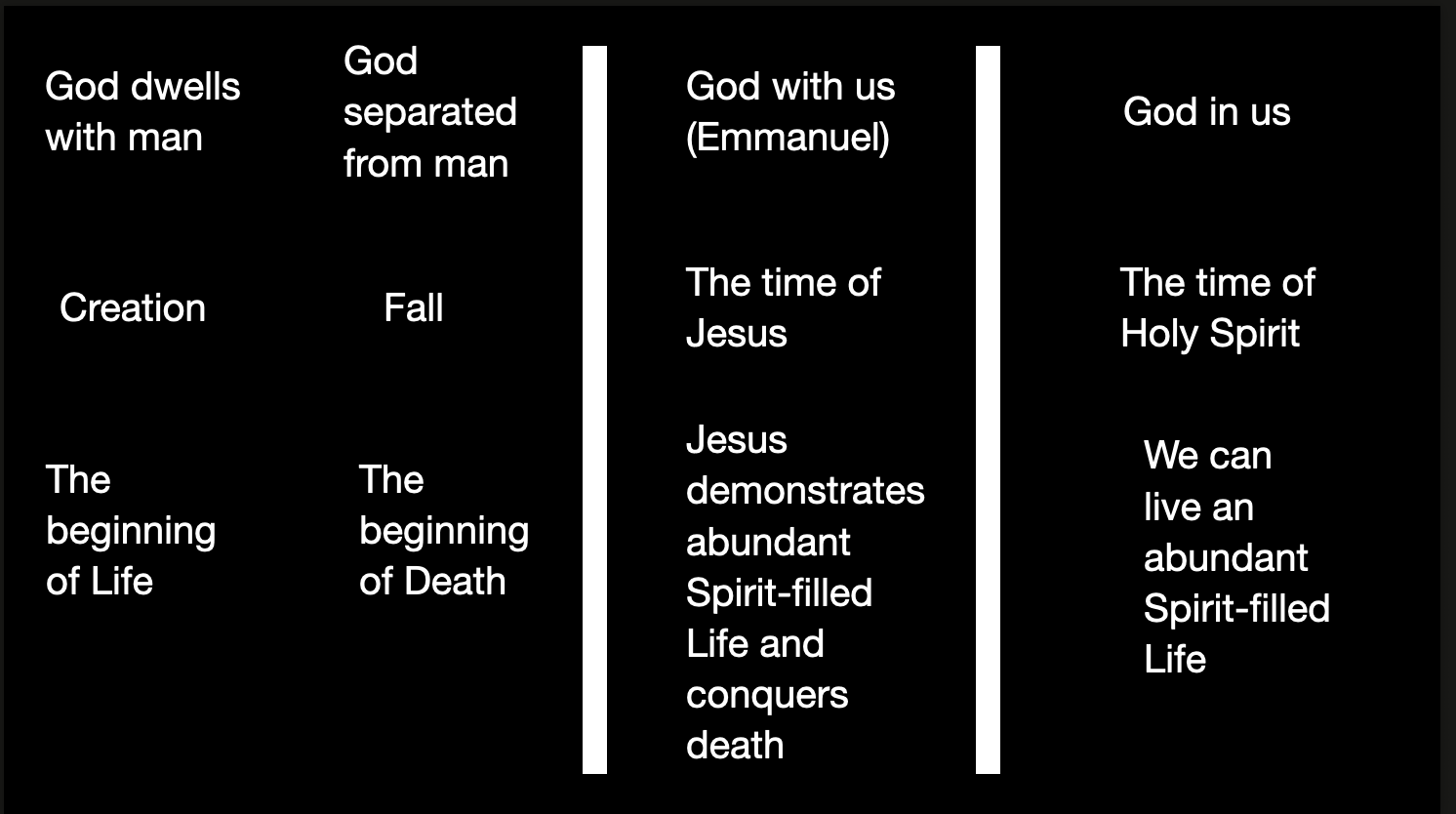
God created a world and people and said it was good.  And God and his people lived together in the same space we call the Garden of Eden.  But sin came in Genesis 3 and broke the fellowship between God and his people.  Sin and death entered the world.  And the rest of the Bible is the story of how God is working to restore his relationship with his people, to reunite heaven and earth.   

In Exodus, God tells Moses to build a tabernacle, “So I can dwell with them.” God establishes his presence in this small people group, leading them with a pillar of fire and cloud.  Later, Temples were built as places where God’s and man’s space could overlap. But even with constant sacrifice, sin is not completely dealt with. People continue to be rebellious.  

So Jesus comes, Emmanuel, God with us.  And for a short time, God is present with us in the person of Jesus.  Through Jesus’ crucifixion and resurrection, sin and death are defeated so that we have the possibility of eternal life with God.  And then in his ascension to the Father and his enthronement at the Father’s right hand, He serves as our High Priest and from there sends us the blessing of the Father, which is God’s presence with all of us.  In Jesus, God is fulfilling his goal of communion with us by sending the Holy Spirit to live in us.  And we have become temples, filled with God’s presence, where God’s space and man’s space overlap.   Is this the climax?

God is not finished, because the day is coming when Jesus will return to complete his work.  He is coming again to bring a complete end to sin and death and to restore God’s kingdom over all, and heaven and earth will be one again.  That is the day that the prayer you constantly pray will be answered.   “Thy kingdom come. Thy will be done on earth as it is in heaven.”  This is the climax of Jesus’ ministry – when he returns and God has completed his redemption of the world.

But today we are talking about the arrival of the Holy Spirit.  Just before he ascended, Jesus told the disciples the Holy Spirit was coming in a few days.  They were to wait in Jerusalem until then.  And what did they do while they were waiting?

Luke 24:50-53   While he blessed them, he parted from them and was carried up into heaven. And they worshiped him and returned to Jerusalem with great joy, and were continually in the temple blessing God.”

First, they worshipped right there.  Then they returned to Jerusalem.   And how did they spend their time there?  They were continually blessing God.  And where were they meeting to bless God?  The Jewish Temple.   What does it mean to bless God?   Blessing is from the root word to ‘bend the knee.’   We praise and thank God for who he is and what he has done.  And Jesus, as a young boy, was taught the traditional Jewish blessings.  It seemed that there was a blessing for everything. 100 blessings a day.

When we wake up: “Blessed are you, O Lord our God, King of the Universe, who has given me today the breath of life.” When we have food: “Blessed are you, O Lord our God, King of the Universe, who brings forth bread from the earth.” And when we go to bed:  “Blessed is He who brings sleep to my eyes and slumber to my eyelids.”

Blessing God — this is how we worship God every day, everywhere.

Worshipping While Waiting.  Do you like to wait?  I have to confess that I am not good at waiting. I can, at times, be annoyingly impatient, especially when driving. The light turns green, and suddenly, the three seconds it takes the car in front of me to go seem an eternity.  Am I the only one like this?  The disciples took advantage of this time of waiting to bless God.

So, this past week, I experimented with finding reasons to thank or bless God anytime I found myself waiting, worshiping in waiting. At 5:45 a.m. on Tuesday morning, driving from Georgia to Alabama, at the four red lights in a row (with no other cars present), I am blessing God.  “Blessed are you, our Lord, King of the universe, who has made such a beautiful day.  Blessed are you, Yehovah, who has created coffee so I can be fully awake.”

Later that trip, I got behind a large truck doing 15 mph up the mountain in Crossville. (This happens almost every time.) But this time, instead of complaining to myself about the delay, I am blessing God.  “Blessed are you, our Lord, king of the Universe, who has given me a chance to see this amazing view off the mountain.”  Let me tell you, it was a much better drive.

The disciples didn’t know exactly when the Spirit would come.  Jesus told them the Father’s timing was not for them to know.  

Why is God waiting 10 days?  What is He waiting for?  When you study the scriptures, you find God is very intentional with his timing.  The Old Testament often speaks of the “fullness of time.”  Jesus says over and over in his Gospels, “My hour has not yet come,” until he prays in Gethsemane, and then says, “The hour has come.”  God makes sure that Jesus is crucified as the Passover lambs are being slain, and he is resurrected on the day of the Feast of FirstFruits.  So it should not come as a surprise that God is setting up the coming of the blessing of the Holy Spirit at a special time.

Pentecost is from the Greek pentekostos, meaning “50″, because it is 50 days from Passover.  By the time of Jesus, the Jews had been celebrating that day for over a thousand years.  In the Hebrew Scriptures, it is called Shavuot, which translates into ‘sevens’ or ‘weeks.’   Leviticus 23 commanded them to count seven ‘sevens’ or seven weeks and then one day.  Then there was a special offering with grain and animals, as well as a special reading and convocation.  (Leviticus 23:15-21).   This was one of the three feasts that the scripture required all males to attend and make an offering.  (Deuteronomy 16:16).  So, as in Passover, the city is packed with over a hundred thousand Jews from all over the known world who have made their way to Jerusalem for this special day, bringing offerings of thanksgiving for God’s blessings.  

Isn’t it interesting that God tells them to count up 50 days?   The scriptures specify the day that the Passover falls as the 14th day of the 1st month.  But the Bible never says that Shavuot is on the 6th day of the third month.  It simply says to count the days.  For 50 days, they have a special grain offering in the Temple and would make a ceremony of counting the days.  It is all about anticipation.  Something great is coming.  

Shavuot is a harvest celebration.  As Passover and Firstfruits celebrate the barley harvest, Shavuot, 50 days later, celebrates the wheat harvest. But they are both more than harvest celebrations.  Passover celebrates the night they were spared the death of the firstborn, and they escaped bondage in Egypt.   Shavuot also commemorates the giving of the law on Mt Sinai, which Exodus tells us happened 50 days after the first Passover.

We talked about how seven is the number of completeness throughout the Bible.  If seven is completeness, the eighth in the series is the beginning of something new.  In Genesis, God set up the week of seven days; the eighth day is the start of a new week.  We have seen many examples of sevens in the Gospel of John.  Jesus has seven table meals in John’s Gospel with people; the eighth is after the resurrection.  There are seven confessions people make about Jesus, and then the eighth one, after the resurrection, is the one that is new and different.  For the first time, He is recognized as God.  The eighth of something is new.  So we count 7 weeks, seven sevens — complete completeness, then the next day is something radically new —Pentecost.  God is doing a new thing.   To the Jews in Jesus’ day, the new thing was the giving of the law.

And that encounter with God at Mount Sinai was dramatic and powerful.  The mountain is filled with fire and smoke and noise, with the whole mountain shaking violently.  The people were filled with fear and refused to go up the mountain as God had invited them, so they sent Moses for them.   We have discussed this powerful manifestation of God seen here, and how it is repeated at the dedication of the tabernacle with the cloud and fire consuming the sacrifice and God’s glory filling the space. 

This same overwhelming presence of God was seen again at the dedication of Solomon’s temple.  Again, fire came down from heaven, consuming the sacrifice, and again, God’s glory filled the Temple. But the people continued to rebel, and you remember that God punished his people for their sin by allowing the foreign nation of Babylon to conquer them.  

Ezekiel, the prophet, saw in a vision the presence of God leaving Solomon’s Temple.  Then the temple and the city of Jerusalem were destroyed, and all the people taken captive.  Seventy years later, when they returned to the land of Israel, they rebuilt the temple and had this grand dedication service.  But unlike the dedication of the tabernacle, unlike the dedication of Solomon’s temple, this time, God did not show up.  There was no fire, no wind, no cloud, and no sound.  God did not return because the sins that led to their exile still remained.  They had not repented.

But God revealed to Ezekiel that though God had abandoned this Temple, He had not abandoned His people.  One day, he would return to His temple.   And all the prophets in the Old Testament looked forward to this time when God would return.  As the final prophet in the Old Testament, Malachi said:

Malachi 3:1    Behold, I send my messenger, and he will prepare the way before me. And the Lord whom you seek will suddenly return to his temple;

And they waited, and they waited… 400 years they waited.   Until that messenger that Malachi spoke of came… John the Baptist – the one crying in the wilderness to prepare the way of the Lord.  And then, about 16 months later, God finally returns to the temple.

God comes to the temple in the form of Jesus.  He comes riding on a donkey as King David and Solomon did.  And he enters the temple on that Palm Sunday.  But he comes not to be praised, but to judge.  That is when he overturns the tables of the crooked money changers and drives out the corrupt animal salesmen.  He comes with harsh words of judgment for the religious leaders of the day.  And they kill him.  And he is resurrected, but he does not return to the temple again.  He is coming back to the temple just as Ezekiel and the other Old Testament prophets foresaw, but not yet.  Just look at the picture God is painting in history:

For 400 years, the children of Israel were held in slavery in Egypt.  400 years of waiting for redemption.  And Passover comes, and they are delivered from slavery, passing through the sea and traveling 50 days to Mount Sinai, where God’s presence shows up in mighty form.  Then you skip forward in history, and after the last prophet spoke in the Old Testament, for 400 years, they waited for God to return to His Temple. For 400 years, they waited for redemption. And Passover comes again, and through the death of Jesus on the cross, deliverance comes from slavery to sin. And then 50 days later, God’s presence comes in a mighty way to his temple. It is Pentecost. Could God make this any clearer?  He is about to intervene in history again, like he did at Sinai.

Let’s see what happened when God’s presence came on that first day of Shavuot, when God came on Sinai. But first, we have to realize that things of God are hard for the writers of the Bible to describe.  They are trying to represent in words something we don’t have the words to explain or the context to understand.   When Ezekiel sees God leaving the temple, he tries to give us a picture of what he is seeing, God’s throne chariot, but it is indescribable.  So he talks about wheels inside wheels that move in any direction, made of jewels, and multi-faced animals, and well, it is nothing I can picture.  

God is so much greater, so different that we cannot adequately describe his appearance.  So descriptions of God’s appearance or the descriptions of Heaven (God’s space) in Revelation are … well… just bizarre.  The Bible writers do the best they can, but it is like trying to explain a rocket ship to a caveman, or to explain colors to someone who has been blind from birth.  With that in mind, let’s look at how God’s presence at Sinai is described.  

Exodus 20:18   Now, when all the people saw the thunder and the flashes of lightning and the sound of the trumpet and the mountain smoking, the people were afraid and trembled.

Our translators are trying to translate what it says in Hebrew, but they are having problems. Did they ” see” the thunder?  In Hebrew, it actually says,  “When all people saw the voice.” That Hebrew word appears over 500 times in the Bible and is almost always translated as voice, except in Exodus. They use “thunder” to try to describe God’s voice.

Look what Job says about God’s voice:

Job 37:2-4   Listen! Listen to the roar of his voice, to the rumbling that comes from his mouth.
He unleashes his lightning beneath the whole heaven and sends it to the ends of the earth.
After that comes the sound of his roar; He thunders with his majestic voice.
When his voice resounds, He holds nothing back.

So the people “saw the voice of God” and  then “flashes of lightning.”  “Flashes of lightning” is one Hebrew word, “lappidim,” which is always translated as “torches” except in this verse.    This is not lightning.  There is another Hebrew word for lighting (barak) used 21 times in the Bible.  These are pieces of fire that are moving or, as the modern Tyndale commentary says, “fireballs”, like in Abraham’s vision of God.1  Or as Jerry Lee Lewis would say, “Great balls of fire.”2

Many times in the Bible, the voice of God is visualized as flames of fire.  Here is one example in the Psalms

Psalm 29:7   The voice of the LORD flashes forth flames of fire.
  The voice of the LORD shakes the wilderness.

So when God’s mighty presence comes at Mount Sinai, it is hard to describe, but the people see the voice of God like fireballs, and it thunders and roars. Over 1000 years later, on the same day of the year, at the celebration of that Sinai moment, God’s presence comes again on the Temple Mount.  And how does Luke describe it?

Acts 2:1-3 “When the day of Pentecost arrived, they were all together in one place. And suddenly there came from heaven a sound like a mighty rushing wind, and it filled the entire house where they were sitting. And divided tongues as of fire appeared to them and rested on each one of them.”

Notice he doesn’t feel the wind but hears the sound of a “mighty rushing wind”.  In Greek, a “violent” wind.  Have you ever been close to a tornado?  One day, my family huddled in our hall when one passed by.  The sound has been described as a freight train, a thundering, rumbling, howling sound.  It is a frightening sound.

A flame comes and divides itself into tongues of fire.  Tongue in Greek can mean the actual muscle in your mouth or, more commonly, ‘tongue’ is a language.  (We still use the term, “native tongue.”). A few verses later, when it says the disciples speak in “other tongues,” it is, of course, not saying they had different muscles in their mouth, but they spoke different languages.3  As in Sinai, fire divides into pieces, ‘tongues’ or ‘balls’ of fire.  God’s presence is being manifested in much the same way as it was at Sinai. 4 Again, Luke is trying to describe God’s presence, and like the writer of Exodus, he does the best he can.

What we can see is that the day the Old Testament prophets had looked forward to has arrived. God’s presence has finally returned to the Temple after over 400 years of waiting. But where do the flames come from to rest? Not on the Temple building, as when God came to the Tabernacle and Solomon’s temple, but on the disciples’ heads.  The temple that God returned to was not the physical building there, not Herod’s Temple.  They waited over 400 years for God to return to His Temple, and he has.  But the temple is us. 

1 Corinthians 3:16   Do you not know that you are God’s temple and that God’s Spirit dwells in you? 

Jeremiah had seen this coming. 

Jeremiah 31:33   For this is the covenant that I will make with the house of Israel after those days, declares the LORD: I will put my law within them, and I will write it on their hearts.  And I will be their God, and they shall be my people.

Who is there in the temple on that Pentecost?   Jews from all over the world gathered for the required feast—the whole house of Israel.  At the first Shavuot, God gave them the law on stone tablets.  But Jeremiah saw the day coming, a new Shavuot with a new covenant: “I will put my law within them.”  The word they translate as “law” is the Hebrew word ‘Torah.’  And Torah can mean law, or the first five books of the Bible, but it literally means “God’s instructions for living.”   If we listen to and follow the Holy Spirit, God’s Spirit within us will teach us how to live.

Ezekiel 36:26-27 “And I will give you a new heart, and a new spirit I will put within you. And I will remove the heart of stone from your flesh and give you a heart of flesh. And I will put my Spirit within you, and cause you to walk in my statutes and be careful to obey my rules.”

Again, the Holy Spirit within us will “cause us to follow God’s instructions”.   The Spirit will show us how to live and follow God’s rules.  And just after this passage is the vision God gave Ezekiel of the spirit coming.  There was a valley full of dried-up bones.  And God asked Ezekiel, “Can these bones come back to life?”  It sure didn’t look like it.  They were dead and dried up and lying in the sand.  But God said, “I will cause breath to enter you and you shall live.”   And the breath came into them, and they stood and came to life.   

And God tells Ezekiel the meaning of the vision.  The bones are the house of Israel, which is dried up without hope.  But God is going to breathe life into them.  Remember that the Hebrew word for breath is Ruach, the same word for wind or spirit.  In Genesis 1, the Spirit is hovering over the face of the waters.   Then God takes the dust and breathes life into the dust.  God places his breath, his spirit, in us.   Breath is life. 

When a baby is born, it appears lifeless at first, which can be scary. Then, it is stimulated and takes its first breath, and with that first breath come signs of life: movement and crying.  If you have ever witnessed a death, there is that last breath, a final exhale of breath from their lungs.  You can see how long ago people understood breath as life. Breath enters, and there is life; breath leaves, and there is death.  That is why they used the same word for breath, wind, and spirit (in Hebrew ‘ruach’ and in Greek ‘pneuma’). God tells us it is His Spirit, His Ruach, that gives us life.

People look at the Church in the world and see decreasing attendance in worship and decreasing membership, and they say the Church is dying.  I don’t believe that.  Because life is not measured in numbers, numerical growth does not determine life.  It is the spirit that gives life.  If we can learn to accept the presence of the Holy Spirit of God in our lives, then we live.  But so many don’t even consider the presence of God’s spirit in them.

Paul tells his apprentice Timothy:

2 Timothy 1:6   Fan into flame the gift of God, which is in you through the laying on of my hands,”

We need to be fanning the flame in ourselves.  When you invite God into your life, He comes as the Holy Spirit, that fireball from God.  We need to feed that fire by listening to the Spirit, agreeing with the Spirit, and following the Spirit.

Paul repeatedly tells us not to ignore God’s Spirit in our lives.

1 Thessalonians 5:19  Do not quench the Spirit.”
Ephesians 4:30   Do not grieve the Holy Spirit of God.

The Holy Spirit is within us to instruct us, lead us, and make our character more like Jesus so that we will look like him.  The spirit within us causes us to produce this fruit.

Galatians 5:22-23 “But the fruit of the Spirit is love, joy, peace, patience, kindness, goodness, faithfulness, gentleness, self-control;”

This is what a disciple of Jesus looks like.  This is the effect of God’s Holy Spirit in a person.  

Maybe, like me, you look at this list of nine attributes and realize you aren’t listening to the Spirit as much as you should.  Today is a good day to begin being a better listener and follower.

Let me add one more connection between that first Pentecost, that first Shavuot at Mount Sinai, and the Pentecost in Acts 2.  Do you remember when Moses was up on the mountain receiving the Ten Commandments from God? What was going on with the people of Israel?   They have given up on Moses and made a golden calf to worship.   And God sent a plague on the people, and those who were guilty were affected and were then slain by the Levites.  And 3000 died that day (Exodus 32:28).

After the Holy Spirit comes on Pentecost, Peter preaches a sermon. Many decide to follow Jesus and are baptized. How many?

Acts 2:41 “So those who received his word were baptized, and there were added that day about three thousand souls.”

God is redeeming here what was lost before.  God is still in the business of redeeming that which was lost.  And those 3000 Jews from all over the known world who just got baptized will head back to their home countries the next day.   Do you see what God just did there?  3000 missionaries spreading the Gospel to the world, all sent in one day.

And there is a world beyond our doors that is broken and lost.  And God, through His Holy Spirit in us, desires that no one perish, but all come to repentance.  Remember Jesus telling his disciples (John 14.12) that they would do greater works than he did because he was going to the Father? Jesus goes to the Father so he can send us the blessing of the Holy Spirit.  The Spirit of Christ lives in us.  We need to be doing great things.

  1. Cole, R. Alan.  Tyndale Complete Commentary, Exodus.  
  2. The phrase “Great Balls of Fire!” became popular in the southern United States in the mid-1800s, according to “Phrase Finder” (internet website) based on the references in Exodus, as the presence of God indicated by fire.  The phrase became more popular in the South after being quoted multiple times by Scarlett O’Hara in “Gone with the Wind” (1939).  But the best-known use of the phrase was in the song popularized by Jerry Lee Lewis in 1957, “Great Balls of Fire.” Lyrics and music by Otis Blackwell and Earl Burroughs.
  3. Notice that what happens at Pentecost, with all of the people able to understand each other as if they all had the same language, is the reversal of what happened at the Tower of Babel in Genesis.  Those people were arrogantly trying to build their own way to heaven.  At Pentecost, God is making a way for heaven to come to people.
  4. Where did this happen?  Tradition from the 5th century says it was at the Upper Room, where they also had the Last Supper.  But a look at the Scripture makes that less likely.   It is happening on the day of the Feastival of Shavuot, a one-day festival.   The scripture tells us they were in the Temple “continually.”  Peter mentions the time in his sermon after the Spirit comes as 9:00 am.  The temple services typically began with the first Tamid offering at 9 am.  And this service is one of the three times that the Scriptures say is required attendance. They would not have missed the service that is the highlight of the one-day celebration.  And the Scriptures mention that 3000 responded to Peter’s sermon and were baptized.  This had to happen in or near the temple grounds to have a place large enough for a crowd this large to hear them speak, and then to have a place to baptize that many.  There were over 50 mikveh near the Temple Mount, for people to immerse themselves in before entry into the Temple.

June 10, 28 A.D.  – The Ascension — The Year of the Lord’s Favor #86

Week 69 — The Ascension
Mark 16:15-19, Luke 24:50-53, Acts1:1-11, Hebrews (many passages)

Luke 24:50-51   And he led them out as far as Bethany, and lifting up his hands, he blessed them.  While he blessed them, he parted from them and was carried up into heaven.  And they worshiped him and returned to Jerusalem with great joy, and were continually in the temple blessing God.

We love to celebrate the significant happenings in the life of Jesus.  We primarily make a big deal of Christmas and Easter, as days to honor Jesus’ birth and resurrection.  I can’t imagine any Christian I know forgetting to celebrate either of these.  But do you celebrate Jesus’ Day of Ascension?  You probably didn’t notice that it just passed us by.  This year it was  Thursday, May 29.  It is always 40 days after Easter.  It may never be mentioned if your church does not follow a liturgical calendar.   We all know that Jesus ascended back to the Father.  But we never seem to talk about it.  

Why do we not talk about or celebrate Jesus’ ascension?  Well, we mention it a lot.  It is part of the creeds recited at each service in many churches.  From the Apostles’ Creed: “…he ascended into heaven, and sits at the right hand of God the Father Almighty; from there he shall come to judge the living and the dead.”  But I can’t recall hearing a sermon, Sunday School lesson, or reading a book about the ascension.  

Three weeks ago, I was looking ahead to this day, when our week-by-week study of Jesus’ ministry came to the ascension.  And I realized that I hadn’t ever thought much about the ascension.  I had no idea what I could share with you.  But let me tell you how good God is.  He led me to a book by Patrick Schreiner, “The Ascension of Christ, Recovering a Neglected Doctrine.”  This book and the book of Hebrews pointed out to me the importance of the ascension and what Jesus is doing now in the presence of God for us.

Schreiner notes that there are several reasons that we don’t emphasize the ascension. First, there is not much specific information in the Bible about the ascension.  Schreiner states: “The ascension narrative account covers a mere seven verses in the Bible, which, if you are counting, is 0.03 percent of all the verses in the Scriptures.”1

While there are very few verses describing the ascension event, there is a good deal of discussion in the Scriptures about the implications of Jesus’ ascension.  However, many of those we miss because we don’t understand the importance of the ascension.

The disciples didn’t understand the ascension either at first.  They were not expecting Jesus’ ascension.   He had told them, but they missed it.  For all they knew, Jesus had returned from the dead so he could resume his ministry with them.  In Luke’s second book, the Book of Acts, he begins the book the way he finished the Gospel of Luke, with Jesus’ ascension.

Acts 1:1-5  In the first book, O Theophilus, I have dealt with all that Jesus began to do and teach, until the day when he was taken up, after he had given commands through the Holy Spirit to the apostles whom he had chosen.  He presented himself alive to them after his suffering by many proofs, appearing to them during forty days and speaking about the kingdom of God.
And while staying with them, he ordered them not to depart from Jerusalem, but to wait for the promise of the Father, which, he said, “you heard from me; for John baptized with water, but you will be baptized with the Holy Spirit not many days from now.”

Jesus tells them plainly that the Holy Spirit is coming in just a few days.  The disciples knew the scriptures.  They knew that Isaiah, Ezekiel, Joel, and Zechariah all spoke of the new age that would come when the Holy Spirit came.2. So now they expect the new age to begin in just a few days, and they ask him:

Acts 1:6   So when they had come together, they asked him, “Lord, will you at this time restore the kingdom to Israel?”

Despite everything Jesus has taught them, they are still expecting that when the new age comes, the Messiah will restore Israel to national independence and remove the Roman oppressors. They have been hanging on to this idea of a Messiah with a military takeover throughout the past year, at times even discussing what positions of authority they would have when Jesus took over.  As he did at Jesus’ arrest, I can see Peter picking up his sword again and saying, “So now’s the time you are going to wipe out Rome and restore Israel’s kingdom?.

And Jesus answers:

Acts 1:7-11   He said to them, “It is not for you to know times or seasons that the Father has fixed by his own authority. But you will receive power when the Holy Spirit has come upon you, and you will be my witnesses in Jerusalem and in all Judea and Samaria, and to the end of the earth.” And when he had said these things, as they were looking on, he was lifted up, and a cloud took him out of their sight. And while they were gazing into heaven as he went, behold, two men stood by them in white robes, and said, “Men of Galilee, why do you stand looking into heaven? This Jesus, who was taken up from you into heaven, will come in the same way as you saw him go into heaven.

Jesus says the Father’s timing for the last days is not their concern.  It is not for them to know the Father’s timing or worry about that.  Instead, their focus should be on their task as witnesses.  The kingdom of God that they are to proclaim to the world is his message of grace and forgiveness.  That is what is important.  Talk about a Mike Drop moment – Boom!  Impressive statement, impressive exit.

Let me say that a little louder for my friends on the internet.   Stop wasting time arguing, debating, and trying to figure out the Father’s timing on the last days. Jesus says that it is none of your business.  God has given us this incredible gift of the Holy Spirit.  And we have God’s power through the Holy Spirit so that we can be powerful witnesses to God’s message of grace.  Let’s do that.

So the next time someone wants you to watch this 1-hour video on how the end times are being fulfilled, whip out Acts 1:7-9 and tell them God said I don’t have time to waste trying to figure out things that are not for me to know.  I need to spend that hour with the Holy Spirit, being God’s witness to the world.

So Jesus blows their mind with his pronouncement, then blows their mind with his sudden departure.  This was not at all what they expected.  (That was a recurring theme for the disciples with Jesus the whole year.). So they are just staring up at the clouds, with that dumb, clueless look on their faces.   Just staring at the cloud….Until God sends a couple of angels:

Acts 1:10-11  And while they were gazing into heaven as he went, behold, two men stood by them in white robes, and said, “Men of Galilee, why do you stand looking into heaven? This Jesus, who was taken up from you into heaven, will come in the same way as you saw him go into heaven.”

“Stop staring at the sky.  He’ll come back, but not today.  Go do what he told you to do.”

We don’t realize the importance of the ascension, so we find ourselves asking questions.  Perhaps you’ve thought about some of these:
Why did Jesus have to go?
Wouldn’t it have been better if Jesus had just stayed on earth?
Why did he have to leave for the Holy Spirit to come?
What is Jesus doing up there anyway?   
Are any of these your questions?

We talk all the time about what Jesus has done on earth (his life, death, and resurrection), and we like to talk about what he will do when he comes back, but we rarely talk about what Jesus is doing right now.  I think we would better understand the ascension if we realized how it fits into the big story of the Bible.

But the problem is that many people don’t have a firm grip on the Bible’s story. We talk a lot about heaven and earth, and some people get the idea that one day, we will leave Earth and go to heaven. But the Bible does not really view heaven and earth as two distinct, separate geographic locations. We need to think in terms of “God’s space” and “our space” and how they were the same in the beginning in Genesis 1-2.  

It helps to picture this, and I think the people at the Bible Project have done the best job illustrating this concept.  So please take 6 minutes and learn much as you see their video.

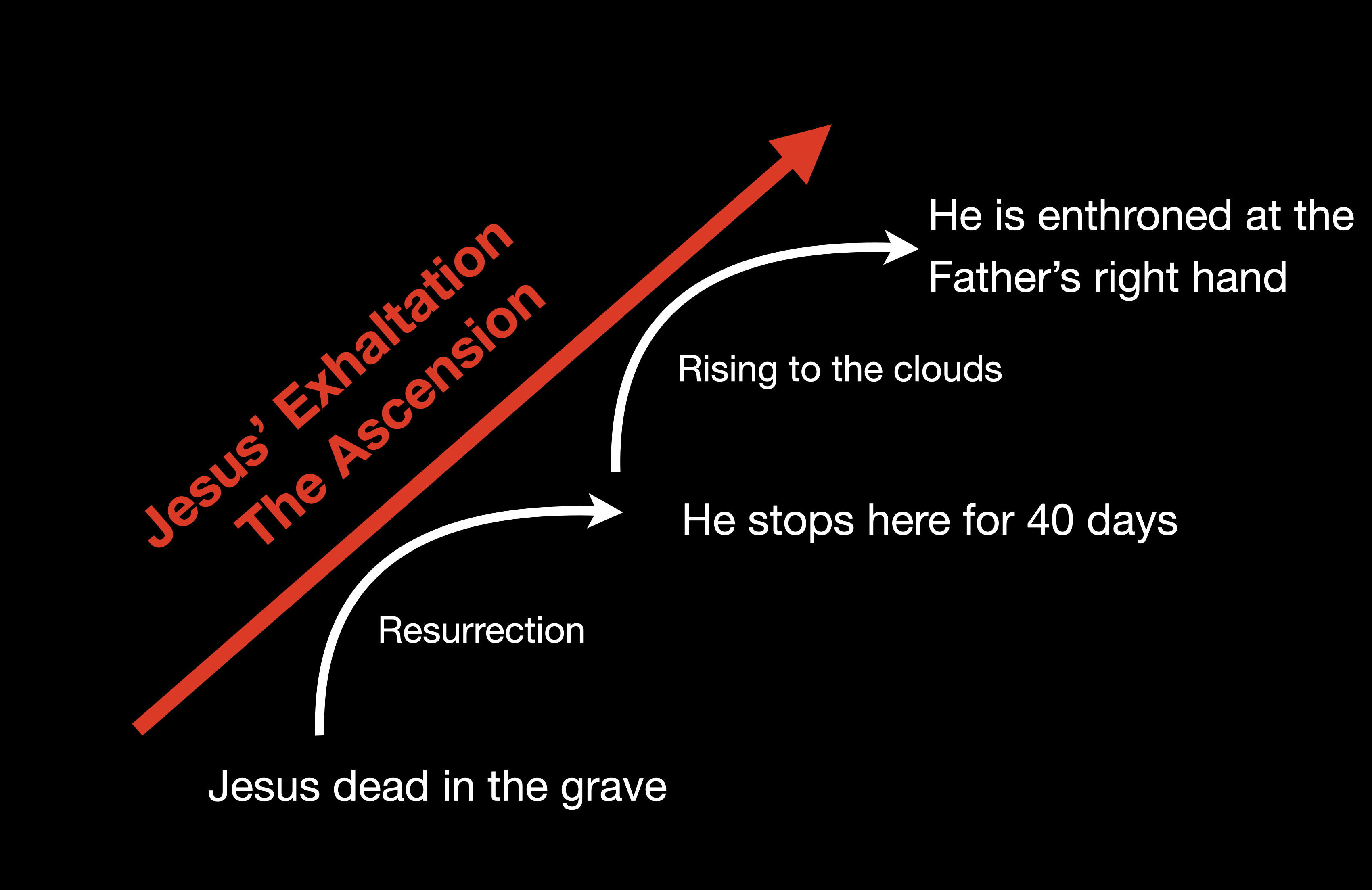
The Bible discusses the ascension almost as part of the resurrection.  Jesus was dead, then he rose from the grave in bodily form, but a glorified body (It was recognizable but not so easily.  He was able to pass through walls or appear instantly.).  But it is still a human body, bearing the scars of his crucifixion.  He rises from the dead, then stops off here, like a short layover for 40 days for some unfinished business.  He wants to ensure the disciples accept his return to life by seeing him.  He needs to make sure their guilt over denying him does not keep them from doing the work, and then he needs to give them final instructions on their ministry and the need to wait on the gift of the Spirit.

Then he ascends in his glorified human body to sit at the right hand of the Father.  So we have Jesus, in his human body, in God’s space.  The New Testament writers often speak of Jesus’ exaltation: his resurrection, rising to heaven, and enthronement as one process, the ascension.  Jesus has opened the door for us to be with God again one day.

Jesus tried to explain this to Nicodemus:

John 3:13-15   No one has ascended into heaven except the one who descended from heaven, the Son of Man.  And as Moses lifted up the serpent in the wilderness, so must the Son of Man be lifted up, that whoever believes in him may have eternal life.

No one ascends to God’s space except Jesus.  The only way we go is if we go with him.  There is no other way.  The Son of Man must be lifted up — This encompasses the crucifixion, the resurrection, and the ascension.  Jesus was lifted up on the cross, lifted up from the grave, and then lifted up into the skies.  Because of this, we may have “eternal life,” which is life in God’s space.

And what is Jesus doing there?  Jesus is at the right hand of God, acting as our high priest.  In the Bible, priests served God and God’s people by mediating between God and man before God’s altar, where God’s space and our space meet.  The book of Hebrews is full of statements of how Jesus is fulfilling the priestly role in God’s space now.  I will discuss three of these priestly roles Jesus is doing now:  He intercedes for us; He presents a sacrifice for us, and He provides a blessing to us.

Hebrews 7:25  Consequently, he is able to save to the uttermost those who draw near to God through him, since he always lives to make intercession for them.

What does Jesus’ intercession look like? You have heard Romans 8:31, “If God is for us, who can be against us?” But did you realize that verse was talking about Jesus’ intercessory role?

Romans 8:31-34   “What then shall we say to these things? If God is for us, who can be against us? He who did not spare his own Son but gave him up for us all, how will he not also with him graciously give us all things? Who shall bring any charge against God’s elect? It is God who justifies. Who is to condemn? Christ Jesus is the one who died—more than that, who was raised—who is at the right hand of God, who indeed is interceding for us.

Who can be against us?  Who can be our accuser?  Remember in the book of Job, when the Satan (the accuser) comes to bring a charge against Job?  Paul tells us no one can bring a charge against those in Christ.  Let the accuser come.  He has no charges to bring against us because Jesus has taken them all away on the cross.  Jesus is at God’s throne, so no one can come to accuse.  If Jesus is for us, then no one can come against us.  He is always making intercession for us, speaking to the Father on our behalf.   

As Jesus in His final days prayed for Peter:

Luke 22:31   Simon, Simon, behold, Satan demanded to have you, that he might sift you like wheat, but I have prayed for you that your faith may not fail.

Jesus is in heaven, praying for you that your faith will not fail.   And Jesus understands your temptation.  Look at this passage in Hebrews 4:14-16.  First verse 14:

Hebrews 4:14  Since then we have a great high priest who has passed through the heavens, Jesus, the Son of God, let us hold fast our confession. 

The fact that Jesus is present as our high priest in the throne room of God should encourage us.

Hebrews 4:15  For we do not have a high priest who is unable to sympathize with our weaknesses, but one who in every respect has been tempted as we are, yet without sin.

Humanity is represented in heaven right now, because Jesus is there in his human body, his glorified human body.   Jesus did not give up his humanity, so he can better represent us there.  He understands us.  He has been where you are, experiencing all the temptations, all the weaknesses.  Jesus knows us.  He gets us.  And he speaks to the Father on our behalf.

Hebrews 4:16   Let us then with confidence draw near to the throne of grace, that we may receive mercy and find grace to help in time of need.

So then, we can come to God’s throne when we are in need with confidence. We don’t approach God’s throne as a lowly subject fearful of the King’s response, but we come sure in the grace of our Lord Jesus, confident that he has paved the way to the throne with intercession.

Remember a few weeks ago we talked about the difference in the 2 fig trees (April 27, 28 A.D.  – Jesus rides in a parade, rearranges furniture, and kills a tree.— The Year of the Lord’s Favor #80). Jesus tells a parable in Luke 13:6-9 of a fig tree that should have fruit but does not for three years. The owner wants to dig it up and discard it, but it is given another chance.   Then, in his final week, Jesus sees a tree that should have fruit, but does not, and it dies.  Why does this tree wither, but the other gets another chance?   Because the tree in the parable has an intercessor, someone to speak for it and ask for another chance.  Jesus is our intercessor, sitting by the Father, seeking mercy and forgiveness for us.

We often ask our friends to pray for us, to intercede for us.  And that is a good thing.  But sometimes we may forget to pray for each other.   Jesus is at the Father’s right hand, praying for you.  He is lifting you up by name.  He is speaking to the Father, calling you his brother or sister.  He is praying, O Father, help her see the truth of this scripture.  Father, help her understand how she should respond.  Oh, what a Savior!

Secondly, Jesus, our High Priest, provides a sacrifice for us.

Hebrews 5:1 “For every high priest chosen from among men is appointed to act on behalf of men in relation to God, to offer gifts and sacrifices for sins.”

Just as the altar stands between the holy place and the people, the priest stands between the people and God.  He offers a sacrifice to God on behalf of the people and then offers a blessing from God to the people.  And once a year, and only once a year, on Yom Kippur, the Day of Atonement, the High Priest would make an offering and prepare himself, then ascend the 12 steps leading up to the thick curtain that separated the holy place from the Holy of Holies.  This curtain or veil was embroidered with cherubim, signifying the priest was entering God’s space.  He would take the blood of the offering to present to God by sprinkling it on the mercy seat.  

Every year, this would be repeated to make atonement for the sins of all the people.  But it was not a perfect system.  The priests were also sinners and had to make offerings for their sins constantly.  But they looked forward to a time when there would be a great high priest who could ascend to God’s space without sin.

David asked in Psalm 24:

Psalm 24:3-4  “Who shall ascend the hill of the LORD? And who shall stand in his holy place?
He who has clean hands and a pure heart, who does not lift up his soul to what is false and does not swear deceitfully.”

And this would be fulfilled in Jesus.  He was without sin, he had clean hands and a pure heart.  He is the only one worthy to ascend to God’s space and stand in God’s presence.  And because we are covered with his righteousness, we will stand in God’s presence.

Hebrews 9:11-14   “But when Christ appeared as a high priest of the good things that have come, then through the greater and more perfect tent (not made with hands, that is, not of this creation) he entered once for all into the holy places, not by means of the blood of goats and calves but by means of his own blood, thus securing an eternal redemption. For if the blood of goats and bulls, and the sprinkling of defiled persons with the ashes of a heifer, sanctify for the purification of the flesh, how much more will the blood of Christ, who through the eternal Spirit offered himself without blemish to God, purify our conscience from dead works to serve the living God.”

The sacrifice Jesus makes for us is himself, a perfect sacrifice. Though the high priest would enter the holy of holies only once a year,  priests in Israel would make many sacrifices every day.  Besides the offerings that people brought, twice a day, every day, a lamb was sacrificed, called the tamid offering, for the sins of the people.  Tamid means “continual” or “constant.”  Their sacrifices were never complete.

Hebrews 10:11-14   And every priest stands daily at his service, offering repeatedly the same sacrifices, which can never take away sins. But when Christ had offered for all time a single sacrifice for sins, he sat down at the right hand of God, waiting from that time until his enemies should be made a footstool for his feet. For by a single offering he has perfected for all time those who are being sanctified.

Unlike the earthly high priest who had to make sacrifices daily, Jesus’ perfect sacrifice is once for all.  His crucified body, still bearing the scars, is always before the Father as our perfect sacrifice.  No other blood sacrifices are needed.

The third aspect of the work of the high priest that Jesus is fulfilling for us is blessing. In the Old Testament, when the high priest completed his sacrifices, he left the tent of meeting, lifted up his hands, and blessed the people.  We see this initiated with Moses and Aaron:

Leviticus 9:23   And Moses and Aaron went into the tent of meeting, and when they came out they blessed the people, and the glory of Yehovah appeared to all the people.

And the book of Numbers gives us the blessing they would use.

Numbers 6:22-27   Yehovah spoke to Moses, saying, “Speak to Aaron and his sons, saying, Thus you shall bless the people of Israel: you shall say to them,
‘Yehovah bless you and keep you;
Yehovah make his face to shine upon you and be gracious to you;
Yehovah lift up his countenance upon you and give you peace.’
So shall they put my name upon the people of Israel, and I will bless them.”

Aaron and the priests were to place God’s name, Yehovah, on them and bless them.  The blessing is the presence of God among them, shining his face on them, regarding them, and giving them peace.  Peace is shalom, wholeness, peace with God and man.

And what blessing does our High Priest, Jesus, grant us from the heavens?  Jesus enters God’s presence and then, as priests of old did, sends us the blessing of God’s presence.  But this blessing of presence comes not as the priests of old placing God’s name on them.  This blessing of presence comes by placing God himself in us, in the person of the Holy Spirit, sent in the name of Jesus, Yeshua, to dwell with us.  This presence of God within us will enlighten us and give us shalom.

John 14:25-27  “These things I have spoken to you while I am still with you.  But the Helper, the Holy Spirit, whom the Father will send in my name, will teach you all things and bring to your remembrance all that I have said to you.  Peace I leave with you; my peace I give to you.

John 16:7   Nevertheless, I tell you the truth: it is to your advantage that I go away, for if I do not go away, the Helper will not come to you. But if I go, I will send him to you.

Like the High Priests of old, Jesus had to present himself as the sacrifice before the Father in God’s space, the heavenly temple. After presenting the sacrifice, He gave the blessing of the Holy Spirit. That is why Jesus had to ascend before the Spirit could be sent down.

With his ascension, the door was opened from God’s space to our space. He has not only made our eventual ascension possible but also opened the door for God to come in a more tangible way into our space.  Individuals in the Old Testament were temporarily clothed with the Holy Spirit to do specific deeds: leaders like Saul and David, craftsmen like Bezalel, and prophets like Ezekiel and Daniel. But when Jesus enters God’s space in his glorified human body, He opens the door for God’s spirit to come upon all believers, not just temporarily, but to live with us. He cleanses us from sin so we can be fit vessels of God’s Holy Spirit.  

What about those who think it would be better if Jesus had stayed on earth?  Wouldn’t it be great for Jesus to be right here now?  We could ask him questions, get his advice, and watch him work.  Yes, but remember when Jesus was here in 28 AD, he was limited in his human form.  He could only be in one place at a time.  And this is a big world.  He was only able to minister to a relative few.  But now that same spirit of Jesus, the Holy Spirit, is with every believer, every day, every hour.  He is available to answer our questions and give us advice.  Oh, we need to learn to listen to his voice and open our eyes to see him at work all around us.

So we have seen that Jesus had to ascend to God’s space to complete his work of salvation, to continue his work of intercession, and to convey his blessing of the Holy Spirit from God’s space to ours.

The ascension is Jesus’ enthronement.  He sits on the throne at the Father’s right hand to do all these things and then one day to come again, to establish his complete rule by making God’s space and Man’s space one again.  And so shall we ever be with the Lord.

  1. Schreiner, Patrick.  The Ascension of Christ: Recovering a Neglected Doctrine (Snapshots).   Page 7.
  2. Isaiah 32:15-20, 44:3-5, Ezekiel 11:19, 36:26, Joel 2:28-3:1, Zechariah 12:8-10

An addendum on the Gospel of Mark ending that contains the ascension:
There are two Gospel passages that tell about Jesus’ ascension.  However, most scholars agree that the passage in Mark is not part of the original document of Mark’s Gospel, but was appended by some unknown person over two hundred years later.  The early church fathers, before 300 AD, did not have Mark 16:9-20 in their copies of Mark.  Church historian Eusebius, in 320, had access to many manuscripts of Mark, and he remarked that this passage was missing in almost all manuscripts.  Ending the Book of Mark at 16:8 is a rather abrupt conclusion, and apparently someone ‘borrowed’ material from other gospel writers to make a more thorough conclusion.  

This is one of just a few passages that scholars agree have been appended to the scriptures.  You may find them enclosed in brackets or with a footnote in modern versions of the Bible.  None of them are important variations, theologically speaking.  

I cannot find any source that discusses where the verses on drinking poison and picking up serpents came from.  There is a verse in Luke 10:19, and Paul was inadvertently bitten by a viper with no ill effects, but nothing else I can find.  (If you know of something, please let me know.). In the Tyndale Commentary, Alan Cole says this: “It would be unwise, however, to build a theological position upon these verses alone; and this no responsible Christian group has ever done.”

And I sat in the furthest back pew (there were only 5), one evening at a small church near Kingston, Georgia, who did just that.  They had that verse from Mark inscribed around the tops of the walls at the front of the church.  There was a lot of music, several snakes were handled, but no one took the Coke bottle with clear liquid on the altar.  While I can’t agree with their theology or practice, I admired their resolve.  May we be so bold as to do what Jesus asks us to do.

June 3, 28 A.D.  –   The Great Commission — The Year of the Lord’s Favor #85

Week 68 — The Great Commission
Matthew 28:16-20

We are almost to the end of our study, which began last January, going through the four Gospel accounts of Jesus’ ministry week by week. This week, we will discuss Jesus’ final teaching before his ascension.  Our scripture is found in Matthew 28.

Matthew 28:16-20   “Now the eleven disciples went to Galilee, to the mountain to which Jesus had directed them. And when they saw him, they worshiped him, but some doubted. And Jesus came and said to them, “All authority in heaven and on earth has been given to me. Go therefore and make disciples of all nations, baptizing them in the name of the Father and of the Son and of the Holy Spirit, teaching them to observe all that I have commanded you. And behold, I am with you always, to the end of the age.”

Look at verse 17: “They worshiped him, but some doubted.“  Does this verse bother you?  

It sure seems to bother a lot of Bible commentators.  Some feel uncomfortable attributing this ‘doubt’ to any of the eleven.   After all, this is not the first time they had encountered the risen Jesus.  He appeared on the evening of resurrection day to all but Thomas, and then all of them with Thomas 8 days later, specifically to solve Thomas’s issue of doubt.  They have had several weeks to get used to the idea of Jesus being alive again. So, some theologians have trouble attributing doubt to the eleven at this point.  Some are so troubled that they even try to force this appearance to be the one Paul referred to in 1 Corinthians 15:6, where he tells us Jesus appears to 500 people, just so someone besides the eleven could be the doubters. There is no evidence for that, and Matthew has specifically limited this encounter to the eleven.  So let’s ask the question that bothers them.  Why, at this point, would some of the 11 disciples have doubts?

We discussed doubt several weeks ago (if you missed it, check out “Doubting Thomas” — The Year of the Lord’s Favor #82).   But let me review:  Jesus is not bothered by the mental uncertainty we today describe as ‘doubt’.  He deals with uncertainty, like Thomas, by coming to him to resolve it.  To understand what bothers Jesus and what he defines as doubt, look again at his response to Peter’s episode of walking on the water and sinking in the waves in Matthew 14.  Jesus asks Peter, “Why did you doubt?”  But Jesus is really asking, “Why did you stop walking?”  For Jesus, the only problem with uncertainty is if it leads to a lack of obedience.   For the word our English Bibles translate as ‘doubt’ actually means to ‘hesitate or waver.”  Jesus is only concerned with mental uncertainty if it causes us to hesitate or waver in our obedience. 

Eleven disciples are worshipping Jesus.  They know he is alive and worthy of worship.  They have no uncertainty about this.  But some are hesitant or still wavering about what they should do now.  So, how does Jesus respond to this? The scripture says next:   And Jesus came and said to them….

Why does it say “Jesus came” if he is already standing before them being worshipped?

Jesus is drawing close to them.  This is my Jesus, responding in love and concern.   For those who feel that their doubts, wavering, or hesitation to act drives Jesus away, look closely.  Jesus is not offended by their doubt; he is compassionate and draws close to help them resolve their concerns.  When you have a problem, even if it is of your own making, Jesus will respond in love.  If we could only grasp how much he loves us and wants to help us with every part of our lives, even (as we discussed the past few weeks) in our doubts and failures.   Thomas is uncertain, Jesus comes to him in love and says, “Hey, if you need to see my hands and side, look here”.  Peter is at his lowest of lows, having failed miserably as a disciple and denied Jesus in his hour of need.  And how does Jesus respond?  He doesn’t come to chastise him; he comes to cook him breakfast and let him know he is forgiven and loved.  But these disciples have been through a lot.  Everything has changed for them after the crucifixion and resurrection, and they don’t know what they are supposed to do next.

“Oh, you have doubts?   You are not sure what you should do?  Let me tell you…..”

So Jesus comes and gives them directions.  We call those directions the Great Commission.

The disciples worshiped and doubted.  This describes a large percentage of the modern church.  They come to church once a week and worship Jesus.  They have no uncertainty about who Jesus is, and they are clear about what they believe. But no action follows the worship. They sing praises in the church on Sunday but have no idea what to do when they walk out the door.  They leave their churches the same way they walked in.  They have no clear plan for what to do next.  So they don’t do anything.  And like Peter, when he stopped obeying Jesus’ command to walk on the water, they sink.  They have heard Jesus’ command to be at work in the world, but they waver because they are unsure how to fulfill it.   And like he treated Peter after his denial, Jesus doesn’t come to punish them for their lack of obedience; He sticks out his hand to help.  Jesus wants to solve this hesitation and wavering, so like these disciples, He gives a task.  And that task, in general terms, is what we call the ‘Great Commission’. 

I am sure you have heard many sermons on the Great Commission.  I have listened to quite a few.  They are usually accompanied by a call for people to consider becoming a missionary to some foreign land.  I really wanted to become a foreign missionary.  I always thought that was what I would do.  I have done many short-term mission trips in Central America, South America, and Africa, but God never opened the door for me to become a foreign missionary full-time…yet.  (As my friend George says, “We’ll see what God gives.”)  As I study this scripture in Matthew 28, I have come to realize that it is not simply a call to me to go to the whole world.  The eleven disciples will indeed go to most of the known world then.  As we said last week, Thomas went as far as India (and perhaps China).  But some of them never left Israel.  And yet those who never left Israel fulfilled this verse right where they were.

Skip Moen says of this verse:
“The Evangelical world has enshrined this verse as Jesus’ Great Commission.  Over and over, we hear these words as a command to spread the good news.  So, we mount our campaigns, run our revivals, and make sure that there is an altar call at the end of every service, just in case someone in the audience hasn’t yet proclaimed faith.  From D. L. Moody to Billy Graham, we have become so accustomed to evangelism by appeal that we no longer read this verse the way it was written.”1

Apparently, Dr. Moen thinks that our traditional reading of these verses may be off base.  Let’s take a look.

Go make disciples.    One of these three words is an imperative.  A command.  Can you guess which one?  … I’ll wait… Did you guess “Go”?  Then you are wrong.  “Go” is not an imperative.  It is not a command. In Greek, it is an aorist passive participle.   Now I know nothing is more boring than talking about Grammar.  But when you are translating, it is essential to understand verb tenses.  It makes a difference whether something has already happened, is happening, or will happen.  You may remember participles from your high school grammar class.  A participle is a verb turned into an adjective by adding the suffix “ing.”  For example, you take the verb “work” and add an “ing” suffix to make it “working,” and it then is an adjective that describes the noun “man.”  Working man — the participle ‘working’ modifies the noun “man”.    So, in this commission, it is not ‘go’ as a verb, but ‘going’ or ‘as you are going.’   But this is in the passive voice, not the active, which means someone else caused your going.  And for these disciples, it is God who caused them to be going people. (The primary action is also past tense, so God did something in the past that has caused you to now be going.).  So this word “Go” could be more clearly translated as “As God has led you to be going.”

Remember what is happening here.  They see Jesus and consider him worthy of worship. They worship him.  But they hesitate to do anything because they don’t know what to do.  So Jesus tells them,  Because you recognize me as worthy of worship, I have the authority to tell you how to walk in this world.  I write the rules for your life.

You don’t just go and live any old way you want to live.  You are expected to walk as Jesus walked.  And you don’t just go wherever you want to go.   You listen for your King to give directions, then go to that place.  But it doesn’t make sense if I say I will follow someone and then take off in a different direction without them.   Say I invite you to lunch at a new restaurant after church today.  I tell you to follow me in the car and I’ll lead you there.  But then you pull out in front of my car, even though you don’t know where we are going.  You are no longer following me.  We often say we will follow Jesus, but we don’t stop to see where Jesus is going before we start off to a different place.  If we are going to live life as Jesus asks us to, then we have to go the way he is going.  So the command is not the word go. 

Is “make” the command?  No, “make” is not the command either.  In fact, the word “make,” which you see in your English version, is not present in the Greek.  Our translators inserted this word so the sentence would make sense to them.  Unfortunately, however, it just clouded the issue.  We can’t ‘make’ disciples.  We can’t force someone to become a disciple, and we can’t produce disciples.  We can only be obedient in how we live our lives, and we have to trust Jesus for the results.  

So the command has to be the word ‘disciple.’  It is a noun in our English version, but in the original Greek, ‘disciple’ is not a noun but a verb. It is the Greek word, mathēteuō, which is the word for a disciple, but changed to be a verb.  The action in the sentence, the command, is to “Disciple!”  So we better translate the command, “As you are going through life, disciple!”  Go about your daily life, living as God commands, and you will disciple others.

So let me get this straight.  To help us understand the Greek phrase, our translators took a Greek participle and turned it into a verb, took a Greek verb and made it into a noun, and then added another verb that wasn’t even in the Greek.  Hmmm… I’ll give them credit, their “Go and make disciples” is much simpler than “As you are going through life, disciple!”  But I think they have missed Jesus’ meaning.

Discipling is not the same as teaching.  It is not about gathering information.  It is more like an apprenticeship.   An apprentice joins up with a master of a craft and learns to do everything by closely watching and imitating the master.  He spends many hours with the master.  He might even live with him for a time.  He watches closely every move and later tries to imitate what he has seen.  That is the way people learned trades for thousands of years.  And that is the way these eleven were discipled by Jesus.  The goal of a disciple is not to know everything the Rabbi knows but to be who the Rabbi is.  It is not informational, but transformational.  

Our command is to disciple as we walk through life.  Some will be called to go to foreign lands like the disciples, but not many.  Most of us will live life where we are, but live it in such a way that as we go about our daily lives, what we do disciples others.  Jesus chose 12 people to follow him for a year.  He poured into their life, and they watched him as he walked through life, following his every move. How does Jesus deal with frustration?  How does he deal with trouble?  How does he deal with sorrow?  What does he do at a party?  Jesus taught much more by how he lived life and how he dealt with people than how he preached.   On his last night with them before his crucifixion, he demonstrated an important aspect of how they should act as he took on the role of a servant and washed their feet.  He was discipling until the end.  

Paul said:         1 Corinthians 11:1. Be imitators of me, as I am of Christ. 

Paul says this is discipling.   Obviously, you cannot disciple others unless you are a disciple yourself.   We are all still in the process of being disciples of Jesus.  So we study the scripture to see how Jesus acted in situations and how he treated people.  And we then try to imitate Jesus’ behavior.   I know “What would Jesus do?” became a trite saying because someone sold a bunch of plastic bracelets, but the idea is a valid one.`  We would all be better disciples if we asked ourselves that question a hundred times daily.

 If we recognize that Jesus is worthy of worship, we must acknowledge that he has the authority to tell us how to live. Then, we must be obedient to live that way.  Once we have truly become disciples, we must disciple others.  And Jesus says we do that simply by living as he taught us.  We have to be intentional about this discipling, though.  Like Jesus, we need to seek out people to share our lives with whom we can positively influence. We need to make time to be with them and have meaningful conversations.  We have to spend enough time with them so they can see how we live, as it reflects how Jesus taught us to live.  

Who have you sought out to have a positive influence on?  You have done it, but may not think of it this way.  The process of discipleship is demonstrated well with parenting.  You already know that your children learned more from watching how you lived life than they learned from your teaching or lectures.  You disciple your children.  If you are like me, you look back and want to apologize for those times you didn’t act in a way that reflected Jesus, and you taught the wrong lesson.  We have all failed at times, but the lesson of learning from your failures is an important one. They can learn that from us, also.  Even after your children have left your house, you still have opportunities to disciple.  They are still watching.  And then you have the blessing of grandchildren.   Another great opportunity to disciple.  What amazing benefits to the kingdom of God from just living life as God has told us to live.  You have already been discipling.  But don’t stop there.  You have friends and co-workers.  Have you considered that you might have a responsibility to disciple them?  They are already sharing part of your life.  They are already watching how you live life.  

Finally, don’t underestimate the effect you can have on people you happen to encounter every day. If we believe that God is sovereign, in charge of this world, and is active and working in our lives, then we have to realize that our lives are not a series of random events. We will discuss this more in a few weeks, but (spoiler alert) I will show you in scripture how God is arranging our encounters with others with much more intent than we realize.  

As you go about your daily life, see each person entering your life as if they were ushered into your presence by God Himself.  What would you say to someone, and how would you act differently if you knew God had specifically arranged for them to meet you that day? 

Think about it.  What if that person who happened to bump into you was put in that place by God so that you could have a moment of influence on them?  Would you act differently?  Would your conversation be different?   God is more intentional in the details of our lives than we often recognize.  I think most of what we see as “chance meetings” are divine appointments.   So, how can you demonstrate Jesus to that person God just dropped in your life today?   Every interaction we have is a chance to disciple, to reveal God to someone, as you just go about your life.  So as you live daily, live in a way that people will want to know the God you know, and demonstrate life lived the way Jesus demonstrated it to us.

Skip Moen was right about this.  We have focused too much on what he calls “evangelism by appeal” (Stadium Revivals, Crusades, Altar Calls, Witnessing programs).  We already know that most people who come to a church for the first time don’t come because the pastor invited them; they come because someone they know invited them.  Someone watched them live their life—someone who, by living life like Jesus, has been discipling them.  Many people make decisions at mass events, but never really commit to Jesus and never follow through.  

There is a place for “evangelism by appeal” in soul-winning campaigns, mass revivals, and door-to-door witnessing.  They can be important.   But they are not what Jesus is talking about in the Great Commission.   Jesus is talking about evangelism by discipleship..

As you are going through life, disciple!  Or as Eugene Peterson translates the Great Commission in The Message:

Matthew 28:19 Go out and train everyone you meet, far and near, in this way of life,

99% of Jesus’ followers today will never preach a sermon to thousands in a stadium.  But more people will enter the Kingdom of God because those 99 discipled their children, families, neighbors, or co-workers than will enter because of mass revivals.

You may be reading this, but not knowing how you should personally respond to Jesus’ command to disciple.  You may feel you are totally inadequate to disciple someone else.  But remember that Jesus is giving this instruction to a bunch of very young men, some teenagers.  We tend to think of the disciples as later in their lives, boldly ministering to everyone in the Book of Acts.  But when Jesus gave this command, they weren’t there yet.  They were young kids.  You have seen in the Gospels their immaturity in the faith, just a few months ago arguing over who gets to sit where in the kingdom of Heaven, having trouble understanding the simplest teachings, and then just a few weeks ago scattering and hiding, abandoning Jesus when things got hard.   If you feel inadequate and are unsure how or if you should be discipling anyone, then congratulations.  You are in the very same state of mind as these 11 young men.   They worshiped, but they doubted.

You don’t know how to disciple someone?  No problem, says Jesus.  Just go out the door and live life like I told you to.  Love your neighbor as yourself, follow me when you walk out that door.  I heard a preacher say the other day that too often we forget that we are the temple of the Holy Spirit and that we take God everywhere we go.  And he was right.  But I’ll add that we aren’t supposed to take God anywhere.  We aren’t the leaders, we are the followers.  We shouldn’t take God places; we should follow God to the places he wants us to go together.

Look again at what is happening in Matthew 28. Jesus tells these young men they are responsible for disciplining the whole world. These 11 very young men have only had a year with Jesus, and it has not been an easy year for them.  And now Jesus is turning over the responsibility of spreading the Gospel to these guys?  Is that crazy or what?  It would be crazy except for two things. First, they. go under His authority. Look at the verse in the middle of the passage that we haven’t discussed yet.  Right before he gives the Great Commission, he says this:

Matthew 28:18. All authority in heaven and on earth has been given to me. 

Why is that important?    God the Father has granted to Jesus all authority.  How much?  All.  The disciples are not their own authority; Jesus is.  They don’t have to decide on the best plan.  That is Jesus’ job.  He will make the decisions.  All they have to do is follow.  They don’t have to figure it out.  The pressure is off them to decide the best path.  They just need to be obedient to the path Jesus places them on.  In the military, there is a strict chain of command.  There are specified ranks that say who is in authority over whom.  Now, if someone is in authority over you, and they give you an order, then you don’t question it, you do it.   In case you haven’t figured it out yet, Jesus outranks you.  All we have to do is follow directions.  And because he is the supreme authority, he can grant us authority as needed.

Look at what Jesus is doing here. He did this several months ago when he sent the 12 out on a mission without him.

Matthew 10:1   And he called to him his twelve disciples and gave them authority over unclean spirits, to cast them out, and to heal every disease and every affliction.

He gave them authority and sent them out.    He did it again later, sending out 72.  The scripture tells us they returned with great joy, reporting the great things they had seen done, healings, casting out demons, etc.  He is about to send them out again, reminding them of their previous “practice missions.”   I have all the authority, and  I am sending you out again.  

Not only do they go with his authority, but they go in His power.  In just a few days, Jesus leaves the eleven and ascends to heaven.  And he will tell them to sit and wait for 10 days. These are his last words:

Acts 1:8   But you will receive power when the Holy Spirit has come upon you, and you will be my witnesses in Jerusalem and in all Judea and Samaria, and to the end of the earth.

He just gave them this impossible task of changing the world. But they go under his authority—they don’t have to decide how to do it, they aren’t responsible for figuring it out, and they go in His Power—more about that in a few weeks.

The Great Commission:  As you are going through life, disciple!

It applies to us also.   When you stop reading this and stand up, you walk into a world desperately needing Jesus.   It is our job to disciple others.  We do it simply by living life the way Jesus instructed us to.  By following Him wherever he leads us.   And we can go confidently, because we go in His authority and His power.

  1. Moen, Skip. “Osmosis Evangelism.” at skipmoen.com. February 15, 2008.

May 26, 28 A.D.  – How Jesus Responds to Failure — The Year of the Lord’s Favor #84

Week 67 —  Peter’s Denial and Affirmation
John 21:1-19

Last week, we talked about Thomas, who is unfortunately remembered as “Doubting Thomas.”  We saw how Jesus spoke about the concept of doubt, that questioning is not a problem for Jesus, and mental uncertainty is not a sin.  Jesus comes not to punish uncertainty but to resolve it.   Thomas needed to see Jesus’ hands and side.  Jesus obliges.  Doubt is only a sin if it leads to disobedience.  So while some people see Thomas’ doubting as a failure, Jesus doesn’t.

That brings us to the next resurrection appearance of Jesus in the Gospels, where Jesus responds to an actual failure of one of his disciples.  Last week, we saw how Jesus dealt with doubt; now, we see how He deals with failure. It seems no disciple has more highs and lows than Peter.  Remember when Jesus took the disciples north to Caesarea Philippi and asked them who people said that he was?  And Peter gives the answer that gets the gold star. 

Matthew 16:16-17  Simon Peter replied, “You are the Christ, the Son of the living God.” “And Jesus answered him, “Blessed are you, Simon Bar-Jonah! For flesh and blood has not revealed this to you, but my Father who is in heaven.

This is the first open proclamation in the Gospel of Matthew of Jesus as the Messiah, one who has a special relationship with God, the Father. Jesus tells Matthew that this answer is straight from God.  However, in the following passage in Matthew, Jesus tells them that he will go to Jerusalem, suffer, and die.  And Peter pulls him aside and tells Jesus there is no way that will happen.  And Jesus tells Peter he is talking like the snake in the Garden.  

Matthew 16:23  (Message) “Peter, get out of my way. Satan, get lost. You have no idea how God works.”

From the best answer to the worst answer.  It seems Peter is a jumble of highs and lows, of successes and failures.  He is jumping out of the boat to walk on water in one moment, then sinking into the waves and being called out by Jesus for having no faith in the next.  Peter’s series of failures climaxes after Jesus’ arrest, when he denies Jesus.

Matthew 26:31-35   “Then Jesus said to them, “You will all fall away because of me this night. For it is written, ‘I will strike the shepherd, and the sheep of the flock will be scattered.’ But after I am raised up, I will go before you to Galilee.” Peter answered him, “Though they all fall away because of you, I will never fall away.” Jesus said to him, “Truly, I tell you, this very night, before the rooster crows, you will deny me three times.” Peter said to him, “Even if I must die with you, I will not deny you!” And all the disciples said the same.”

(A small teaching point.  If you find yourself arguing with Jesus, then you are wrong. 100% of the time.)

Then they go to the Mount of Olives, and Jesus tells the disciples to stay awake and watch while he prays.  Peter and the others had just told Jesus they would stand with him no matter what, but they couldn’t even stay awake with him.  Jesus is then arrested and taken to the home of the high priest for questioning. 

Matthew 26:58   “And Peter was following him at a distance, as far as the courtyard of the high priest, and going inside, he sat with the guards to see the end.”

In the 4th chapter of Matthew, Jesus asked these fishermen to follow Him.  And they had followed him for months wherever he went.  But this is a different type of following.  Matthew says Peter is “following at a distance.”   There is a significant difference between following Jesus as a disciple and following from a distance.   

John adds more detail to this story. 

John 18:15-18   “Simon Peter followed Jesus, and so did another disciple. Since that disciple was known to the high priest, he entered with Jesus into the courtyard of the high priest, but Peter stood outside at the door. So the other disciple, who was known to the high priest, went out and spoke to the servant girl who kept watch at the door, and brought Peter in. The servant girl at the door said to Peter, “You also are not one of this man’s disciples, are you?” He said, “I am not.” Now the servants and officers had made a charcoal fire, because it was cold, and they were standing and warming themselves. Peter also was with them, standing and warming himself.”

This is the first of Peter’s three denials that come in this courtyard.  John adds some details that seem unnecessary.  It was a cold night.  They had built a fire in the courtyard to keep warm.  He even tells us what kind of fire they had.  When you see details like this that seem to be thrown in, you had better pay attention.  John, in his Gospel, tells you he doesn’t have room to tell all the things Jesus did.1  So, why would he waste several sentences on these details?

John shifts the scene to the interaction between the high priest and Jesus, and then returns to Peter outside.

John 18:25-27  “Now Simon Peter was standing and warming himself. So they said to him, “You also are not one of his disciples, are you?” He denied it and said, “I am not.” One of the servants of the high priest, a relative of the man whose ear Peter had cut off, asked, “Did I not see you in the garden with him?” Peter again denied it, and at once a rooster crowed.”

In case you forgot, John reminds you that Peter was by the fire, warming himself.  It is by this charcoal fire that Peter denies Jesus three times, just as Jesus told Peter he would.  Twice, Peter says, “I am not.”  We have discussed the seven signs or miracles in the Gospel of John, the seven table meals, and the seven confessions about Jesus.  There are seven I am statements of Jesus in John’s Gospel.

I am the bread of life.  I am the light of the world.  I am the door.  I am the good shepherd. I am the resurrection and the life.  I am the way, the truth, and the life.  I am the true vine.

“I am” is the first answer God gives to Moses when Moses asks for His name.

Exodus 3:13-14   Then Moses said to God, “If I come to the people of Israel and say to them, ‘The God of your fathers has sent me to you,’ and they ask me, ‘What is his name?’ what shall I say to them?”  God said to Moses, “I AM WHO I AM.” And he said, “Say this to the people of Israel: ‘I AM has sent me to you.’” 

God is the great “I am.”  What God is telling Moses here at the burning bush is the explanation of his name. As you know, in biblical times, names often carried meanings that revealed aspects of a person’s character: Abraham meant ‘father of many’, Jacob meant ‘trickster’, and Jesus meant ‘Yehovah is salvation’.

In Hebrew, “I am” is the word “ehyeh” (אֶֽהְיֶ֖ה), which means “I exist.”  The explanation of his name is that he is the God who actually exists, different from the idols of Egypt, who only exist in the minds of men.   So “I am” is the explanation. He gives his actual name in the next verse.  

Exodus 3:15  “God also said to Moses, “Say this to the people of Israel: ‘Yehovah, the God of your fathers, the God of Abraham, the God of Isaac, and the God of Jacob, has sent me to you.’ This is my name forever, and thus I am to be remembered throughout all generations.”

When God says this is my name, the name he gives is Yehovah, not “I am” and not ‘lord.’  And this name, ’Yehovah’, is written in Hebrew in the Old Testament almost 7000 times (actually, 6827).  Your English translation says ‘LORD’ in all capital letters because the rabbis who taught the English translators Hebrew taught them the tradition of reading Yehovah as ‘Adonai’, which means ‘lord’.    Yehovah (יְהוָ֞ה) is a combination of three Hebrew words, “Hayah, hoveh, and yiheh,” which mean “He was,” “He is,” and “He will be.”  God has existed forever, and He is the same yesterday, today, and forever. (see Malachi 3:6 and Hebrews 13:8.)

Because of the association of “I am” with the explanation of God’s name, Yehovah, “I am” statements in the Bible merit special attention.  It is no accident that John’s Gospel has Peter denying Jesus by saying “I am not” as he tries to disidentify with Jesus.

Then, in the courtyard around the charcoal fire, after his third denial, Peter hears the rooster crow.  And Jesus looks at Peter.  That sound signifies the rising of the sun, light dawning on the world, just as Peter sinks into darkness.  Can you imagine how Peter felt after this?  He has just renounced the one he said he would give up his life for.  He just did the very thing he swore he would not do less than 12 hours ago.  Luke tells us:

Luke 22:61-62   “And the Lord turned and looked at Peter. And Peter remembered the saying of the Lord, how he had said to him, “Before the rooster crows today, you will deny me three times.” And he went out and wept bitterly.”

Despair.  The worst failure imaginable for a disciple. Peter is learning an important lesson we all need to learn.  We are not as strong as we think we are.2   We all like to think we know what we would do in certain situations, but we don’t really know until we face them.  We are all a lot more like Peter than we’d like to admit.

How does Jesus respond to Peter’s failure? Peter may have surprised himself with this denial, but it didn’t surprise Jesus.  

Luke 22:31-32   “Simon, Simon, behold, Satan demanded to have you, that he might sift you like wheat, but I have prayed for you that your faith may not fail. And when you have turned again, strengthen your brothers.”

And when you have returned (when you have repented), strengthen your brothers.

He will strengthen his brothers by being an example of how you can fail miserably and still be used in a mighty way by God.  We have a terrible problem in our churches today.  We are afraid to talk about our faults and our failings.  “How are you?” someone asks.  And you answer, “I’m fine.”  But you are not fine, at that moment, you are broken.3  But we pretend like we have it all together.   We are a collection of people who live in a world that is terribly broken.  We are all sinners who are all in various stages of failure.   But around others, we pretend we have it all under control.  

We need to let the story of Peter strengthen us, and then strengthen one another by sharing our own stories.  The Bible instructs us to confess our sins and failures to one another.  The place I have seen this the most is at a Celebrate Recovery service—a worship service for people who have drug, alcohol, or other addictions or hang-ups.  Every week, you see someone come forward and celebrate that they have been free of drugs or alcohol for a year or 5 years or a month.  And the people in the congregation cheer wildly.  Then you see someone stand up and confess to everyone there that they have failed.  Last week, they slipped up and took that drink or used that drug.  And how do the people in the congregation react to this failure?  They cheer wildly.  They are not celebrating the failure, but celebrating the confession, the first step back towards recovery.  They understand that confession and repentance are essential to change.  And they are strengthening their brothers with their failure and new commitment.

How does Jesus respond to Peter’s failure?   You know you learn as a parent that sometimes, when your child does wrong, sometimes you don’t need to punish them, sometimes you don’t even need to talk with them about what they have done wrong.  Sometimes their mistakes cause them so much suffering and anguish that there is no need for you to add to it.  

There have been times in my life when God has chastised me for my wrongdoings.  The Bible says God chastises those he loves.  And the discipline God dispenses to us is instructive.  It is to lead us to awareness of our failures and repentance.  If we are already aware of our sin and we have grieved it and repented of it, then the chastisement is not necessary.  

Peter was grieved.  He wept bitterly.  And I think he shows his repentance. So Jesus doesn’t need to chastise Peter.  So, how does Jesus respond to Peter’s failure?  He doesn’t come with accusations.  He doesn’t say “I told you so.”  He doesn’t say, “Hey, how about that rooster?”  How does Jesus respond?  He cooks him breakfast.   Here is the story:

John 21:1-6   After this, Jesus revealed himself again to the disciples by the Sea of Tiberias, and he revealed himself in this way.  Simon Peter, Thomas (called the Twin), Nathanael of Cana in Galilee, the sons of Zebedee, and two others of his disciples were together.  Simon Peter said to them, “I am going fishing.” They said to him, “We will go with you.” They went out and got into the boat, but that night they caught nothing.  
Just as day was breaking, Jesus stood on the shore; yet the disciples did not know that it was Jesus.  Jesus said to them, “Children, do you have any fish?” They answered him, “No.”  He said to them, “Cast the net on the right side of the boat, and you will find some.”

John 21:6-11   So they cast it, and now they were not able to haul it in, because of the quantity of fish.  ….
When they got out on land, they saw a charcoal fire in place, with fish laid out on it, and bread.  Jesus said to them, “Bring some of the fish that you have just caught.”  So Simon Peter went aboard and hauled the net ashore, full of large fish, 153 of them. And although there were so many, the net was not torn. 

John 21:12-16   Jesus said to them, “Come and have breakfast.” Now none of the disciples dared ask him, “Who are you?” They knew it was the Lord.  Jesus came and took the bread and gave it to them, and so with the fish.  This was now the third time that Jesus was revealed to the disciples after he was raised from the dead.
When they had finished breakfast, Jesus said to Simon Peter, Simon, son of John, do you love me more than these?” He said to him, “Yes, Lord; you know that I love you.” He said to him, “Feed my lambs.” He said to him a second time, “Simon, son of John, do you love me?” He said to him, “Yes, Lord; you know that I love you.” He said to him, “Tend my sheep.”

John 21:17-19   He said to him the third time, “Simon, son of John, do you love me?” Peter was grieved because he said to him the third time, “Do you love me?” and he said to him, “Lord, you know everything; you know that I love you.” Jesus said to him, “Feed my sheep.  Truly, truly, I say to you, when you were young, you used to dress yourself and walk wherever you wanted, but when you are old, you will stretch out your hands, and another will dress you and carry you where you do not want to go.”  (This he said to show by what kind of death he was to glorify God.) And after saying this, he said to him, “Follow me.”

When writing a screenplay or novel, as the author of a story, you can craft the narrative so that it includes hints about what will happen later, leaving subtle details like a trail leading to the story’s climax.  You can write a scene in a way that allows you to recreate it later.  But when you are the author of the universe, the creator, you can arrange the details of life so that they will paint a picture.  You can arrange events to occur on specific days or during certain seasons that will help people understand the message you are trying to convey.  God often uses details like this to paint a picture for us.  Look at what Jesus is doing here to paint a picture for Simon Peter.

At the beginning of his ministry, Andrew is a disciple of John the Baptist, and he brings Simon Peter to meet Jesus.  This happened at the end of March, 27 AD.  They begin to follow him, off and on. They see miracles in Cana and elsewhere, but are not full-time disciples.4  They are still fishermen who follow Jesus at a distance.  Then, in July, we have the story in Luke 5, where Jesus meets them at the Sea of Galilee after they have been fishing all night with no luck, and they catch more fish than they know what to do with.  A miracle of fish.  At that point, Jesus calls them to be full-time disciples.  He says, “Follow Me.”  Peter now follows Jesus not at a distance, but closely, day by day; however, his commitment is not yet complete.  He thinks he is willing to die for Jesus, and he boldly declares this to him.  But Jesus tells him the test will come, and he will fail. Then Jesus is arrested.

When Jesus is on trial, John tells us that Peter follows Jesus from a distance. Then, in the courtyard of the High Priest, Peter denies Jesus three times by the charcoal fire.  Jesus is crucified  and 3 days later resurrected.   They meet again on the Sea of Galilee (Just as before) after a night of unsuccessful fishing.  Jesus tells them to drop their nets again, and they catch a vast number of fish.  Then Jesus gives Peter a chance to affirm his love three times, at one of all places, a charcoal fire.  Then Jesus says (as he did back in July) Follow me.  Peter now follows Jesus closely with complete commitment. Jesus tells him, “You will stretch out your hands and go where you do not want to go. You will pass the test the next time; you will be crucified.

Jesus is replaying the circumstances of Peter’s first call to set up this calling him back. He is replaying some circumstances from Peter’s denial to give him a chance to repent.  He brings in the warmth and smell of that charcoal fire — Look Peter, you are getting a second chance, now are you willing to die for me?

Peter is not through making mistakes.  Read the book of Acts.  He has some mistakes left to make.  Me too, Peter.  We all continue to make mistakes.  And this is not a problem for Jesus if we repent and grow from them.   

The story is told of a man who lived near a monastery and passed by it every day, often wondering how the monks there lived, and what went on behind the walls of this ancient building.  One day, he spotted the abbot of the monastery in town and asked him what life was like there.  The abbot is said to have replied.  “We fall down, we get up.”  

This is the life we lead.  As long as we walk in this sinful world, we repeat this cycle.  We fail.  We fall down in sin, we repent and then get up and walk again, trying to live the next day closer to the life God wants us to live.  This is the cycle we repeat until one day, we fall down in worship, humbling ourselves and laying our crowns before the throne of God.  

Proverbs 24:16   For a righteous man falls seven times and rises again.”

Do you ever stay awake at night reliving your past mistakes?   Are there things you have done in your life that you wish you could go back in time and do differently?  Do you find it hard to escape the memories of your failures?

The Bible excels at highlighting the mistakes of its characters.  There is no attempt to hide their faults.  Abraham lied about his wife and put her and others in danger to save his own neck.  Abraham and Sarah both laugh when God tells them they will have a child in their old age.  They treat their Egyptian handmaiden, Hagar, horribly, sexually abusing her and then banishing her to the wilderness with her child to die.  And after all that, how does God think of Abraham?

Isaiah 41:8   [God speaking]  But you, Israel, my servant, Jacob, whom I have chosen, the offspring of Abraham, my friend;

After all his mistakes and failures, God called Abraham His friend. And here is Paul in his letter to the Romans discussing how God views Abraham:

Romans 4:20-22   No unbelief made him waver concerning the promise of God, but he grew strong in his faith as he gave glory to God, fully convinced that God was able to do what he had promised. That is why his faith was “counted to him as righteousness.”

“No unbelief made him waver.. ”    Did you read the book of Genesis, Paul?  There is quite a bit in there about Abraham’s wavering.  Yes, but that is not how God remembers Abraham.  He remembers Abraham as his friend who never wavered in his faith.

Then I turn to Hebrews 11, the Faith All-Star Roster.  Look at that line-up.   Many on that list lived lives full of failures.  After it goes through the Patriarchs of the Bible and Moses, the next on the list is Rahab the Prostitute.   The hooker who told lies to save spies.  You have David (the adulterer/murderer), Jephthah, who made a rash vow that went really bad, and then you have Samson.  A guy whose story is in the Bible for the primary purpose of showing how to do everything the wrong way.  Samson’s life is one bad sin after another, one failure after another. But look at how God remembers these, not for their failures, but for their faith.  This is the roll call of faith.

It is as if God has remembered their failures no more.  Does this surprise you?  It is just as He promised in Jeremiah, and this promise is quoted in the book of Hebrews.  

Jeremiah 31:34. For I will forgive their iniquity, and I will remember their sin no more.

 He has separated their failures from them as far as the east is from the west.5  Think about this for a minute.  If Jesus were to walk in that door this morning and you were to ask him, “Hey Jesus, what was going through David’s mind when he decided it would be okay to take another man’s wife and then kill him?  Jesus would say, “Hmmm….I have no idea what you are talking about.  But David was a great king of Israel and a man after my own heart.  What an awesome guy.  I can’t wait for you to meet him.

God remembers us for our best day, not our worst days.   That is Grace

Do you see what this means?  Sometimes I lie awake at night rehashing some mistakes I’ve made and wishing I had a chance to go back and do things differently.  But look at Jesus with Peter, after Peter’s complete betrayal.   Jesus is not rehashing Peter’s mistakes.  He doesn’t even mention them.  The all-knowing God, who knows every hair on all of our heads, who sees if any sparrow falls, has forgotten that thing that you can’t seem to forget.

After that denial, Peter felt like a failure.   He had utterly failed as a disciple by renouncing his rabbi.   Was this fishing trip just a one-time thing, or had Peter decided to return to his occupation of fishing because of his failure as a disciple?  We don’t know, but Jesus came to let him know that he was not a failure, but was just one step away from leaving that sin behind and becoming the disciple Jesus called him to be – one who was willing to die for him.  We fall down, we get up.  Jesus says, Peter, if you love me, then let’s start over.    

No one who is still breathing is a failure, for they are also one step away from overcoming that failure and moving forward.  Stop worrying about your past mistakes.  Everyone who has walked on this planet, except Jesus, has failed many times.  And those of us still alive will fail again. We fall down, we get up.   Look at your failures, see your sin.  Learn from your failures; learn the lesson from your mistakes.  Then repent — turn back from whatever attitude or action that put you in that place to commit that sin.  Confess and walk away from it.  God doesn’t remember it, why should you?

Perhaps you are carrying guilt for the mistakes of your past.    You don’t have to walk with that burden anymore.  Lay the burden of your past mistakes down here at this altar.   You don’t need to carry things that God has already forgotten.  Leave them here and walk away.

Today is a great day to let go of past mistakes and failures and start anew.

Psalms 37:23-24   Yehovah makes firm the steps of the one who delights in him, though he may stumble, he will not fall, for Yehovah upholds him with his hand.

Yes, you and I will make mistakes again.  We may stumble, but we will not fall, for God is holding our hand the whole time.6

  1. John 21:25   “Now there are also many other things that Jesus did. Were every one of them to be written, I suppose that the world itself could not contain the books that would be written.”
  2. Rich Mullins wrote a song by that title with powerful lyrics.  You should listen to it.
  3. Speaking of songs, Matthew West has a song entitled “Truth Be Told” that addresses this topic.  Put this one next on your playlist.
  4. See the explanation of this in June 13, 27 A.D.  “Jesus invites Four Fishermen to Join Him for Sabbath” #36]
  5. Psalm 103:12.
  6. One more for your playlist:  DC Talk’s “What if I Stumble.”

May 19, 28 A.D.  – “Doubting Thomas” — The Year of the Lord’s Favor #83

Week 66 — “Doubting Thomas”
John 20:24-29

John 20:24-29   Now Thomas, one of the twelve, called the Twin, was not with them when Jesus came. So the other disciples told him, “We have seen the Lord.” But he said to them, “Unless I see in his hands the mark of the nails, and place my finger into the mark of the nails, and place my hand into his side, I will never believe.”
Eight days later, his disciples were inside again, and Thomas was with them. Although the doors were locked, Jesus came and stood among them and said, “Peace be with you.”  Then he said to Thomas, “Put your finger here, and see my hands; and put out your hand, and place it in my side. Do not disbelieve, but believe.”  Thomas answered him, “My Lord and my God!”   Jesus said to him, “Have you believed because you have seen me? Blessed are those who have not seen and yet have believed.”

Poor Thomas, so famously known for one moment in his life.  This is how we often perceive people.  We tend to reduce them to that one moment that we remember.   And sadly, like Thomas, it may be a moment we view negatively.  Thomas is not the only person who, unfortunately, becomes known for one moment in their life.

If you are a baseball fan, there is one name that comes to your mind.  Bill Buckner.  It is Game 6 of the 1986 World Series.  The Red Sox lead the Mets in the series, three games to 2.  A win in this game will mean Boston will have their first World Series Championship since 1918.  Boston was leading this game, but the Mets tied it up, and the game went into extra innings.  In the top of the 10th inning, Boston scored two runs to go ahead again, 5-3.  In the bottom of the 10th, the Mets scored twice to tie the game again at 5-5.  The Mets had a man on second, but there were two outs, and they were down to their last strike.  One more strike and the game goes to the 11th inning.

Mookie Wilson hits a slow roller down the first baseline.  Bill Buckner is there to field the ball, but it goes between his legs and rolls into right field.  The runner scores and the Mets win.  The Mets go on to win the World Series, denying Boston yet again.  The term ‘Buckner Play’ became synonymous with a costly sports blunder.

Bill Buckner played Major League Baseball for 21 years. He ended his career with over 2,700 hits and almost 500 doubles, having batted over .300 seven times. He retired as one of the most effective first basemen in major league history, but is still remembered for one error.

“Doubting Thomas.”  Does he deserve this title?  Should he be known for this one event?  We don’t have as much written in the Gospel accounts about Thomas as we do Peter or John, but there is more to him than this one story.  Thomas was a bold, dedicated follower of Jesus.  When Jesus says he is going back to Jerusalem, and the disciples say, “Wait, you know they are looking to kill you there?”  It is Thomas who steps up and says, “Let us also go, that we may die with him.”

Another time, Jesus tells the disciples:

“And if I go and prepare a place for you, I will come again and will take you to myself, that where I am, you may be also.   And you know the way to where I am going.”

But none of them understood, and they were scared to admit it.   Only Thomas has the courage to speak up.”

“Lord, we do not know where you are going. How can we know the way?”     

And because Thomas was bold enough to ask, we get this from Jesus:

Jesus said to him, “I am the way, and the truth, and the life. No one comes to the Father except through me.”

The reason we have this verse is that Thomas was bold enough to ask the question that the others were scared to ask.  But what do we remember about Thomas?  He was the doubter.    And is doubt really that bad of a thing?  Do we even understand what doubt means in the Bible?

According to modern dictionaries, doubt is “a feeling of uncertainty or a lack of conviction”. If that is what doubt means, then we might think of the opposite of doubt as faith, which is defined as “complete trust or confidence in someone or something.”  These would seem to be near opposites.  But these modern-day dictionary definitions don’t fit with the way the Bible uses these words.  You see, this is the Greek view, not the Biblical view.

Our thinking is significantly influenced by the ideas of Greek thinkers.  We tend to want proof with absolute certainty before we ‘believe’ something. In fact, the very idea of proving something is Greek.  It comes from the Greek mathematicians Euclid and Thales, who devised a method of proof for mathematical theorems.  (I am suddenly having flashbacks of writing proofs in Geometry in High School.  Anyone else nauseous?)

 However, in life, absolute certainty is rare.  So, then it takes a leap of faith.  You finally have to be convinced enough to accept something.  So the Greek idea of faith is what you mentally agree with.  If you have Greek faith, then you are mentally convinced, your mind is made up. 

However, the Biblical notion of faith is not from the Greek mindset but from the Hebrew.  Faith in Hebrew is ‘emet’ (from which we get our word ‘Amen’); it is about reliability, trustworthiness, and consistency of actions.  God is always consistent.  He always keeps his promises.  He is faithful.  Faith is about actions, not thoughts.  It is what you do, not what you think.  (It helps us to read “faith” as “faithfulness” as it is an action, not a thought.)

So, biblical faith is not just accepting God and His word, but acting in obedience to His word.  But if Biblical faith is about action, then what is doubt in the Bible?  The Biblical Hebrew word for Doubt is — wait, there is no Biblical Hebrew word for doubt.   Does that surprise you?  There is a word for doubt in modern spoken Hebrew (safek), but you won’t find that word in the Bible.  While we view doubt or mental uncertainty as a negative thing, the Old Testament doesn’t even assign a word to it.

You do see people in a time of mental uncertainties in the Bible, but it is not called doubt.  Abraham and Sarah both laughed when God told them they would have a child in their old age.  And while God corrects them, he does not rebuke them.  Twice, Gideon seeks confirmation of God’s plan before he acts because he is unsure.  Similarly, Moses needs assurance from God because he is uncertain that he is the right man for the job.

God doesn’t rebuke any of these people for having some mental uncertainty.  He helps them through it.  Jesus does the same with Thomas, yet you don’t hear “doubting Abraham” or “doubting Sarah.”  Instead, you see the author of Hebrews put all of these people who had uncertainties in the Hall of Fame for faith in Hebrews 11.  And for all of the “heroes of faith,” in that ‘roll call of faith, ’ you read not what they believed, but what they did.  Their faith is not what they thought about God, but their actions.  (Abraham offered up Isaac, Noah built an ark, Moses kept the passover, sacrificed the lamb, walked through the sea, etc.)

While there is no word for doubt in the Old Testament, you do see the word doubt in the New Testament a few times.  There are 2 Greek words that are translated as ‘doubt’:
Diakrino, which means to distinguish between two things, is occasionally translated as ‘doubt.’
Distazo, which means to waver, hesitate, or delay, is translated as ‘doubt’ twice.  However, it is clear that neither word accurately captures our modern understanding of doubt. The best example of how these words are used is the story of Jesus walking on water.  We reviewed this back in the fall, but let’s revisit it here to see what Jesus says that gets translated as ‘doubt.’

The disciples are in a boat in a storm.  Jesus is casually walking on the water by them.  Peter says, “Lord, if it is you, command me to come to you on the water.”  Jesus replies, “Come.”  Peter hops out of the boat and begins walking on the water. 

Matthew 14:30-31   But when he saw the wind, he was afraid…    

Wait a minute.  Can you see the wind? No, you can only see the results of the action of the wind.  Hang on to that thought for a minute.

Matthew 14:30-31   But when he saw the wind, he was afraid, and beginning to sink, he cried out, “Lord, save me.”

What is going on? Why is Peter sinking?  Peter is wavering between two thoughts:
1. Jesus told me to walk on water, so I should be obedient.
2. It is impossible to walk on water (do you see those waves?)
And Peter is stuck.  He stops walking and becomes stuck in his thoughts, pondering between these two ideas.  This is similar to our concept of doubt.

Some call this Analysis Paralysis – His mental confusion led to an inability to do what Jesus commanded.  His mental uncertainty causes him to stop obeying Jesus’ command to come.  So, how does Jesus respond to Peter?

Matthew 14:31     Jesus immediately reached out his hand and took hold of him. “Lord, save me.”

This is important.  Jesus does not punish Peter for having mental confusion; he reaches out his hand to pull him up, and says, 

“Oh, you of little faith, why did you doubt?”

Why does Jesus say Peter has “little faith”?  First, remember that Jesus said if you have faith as small as a mustard seed, you could move mountains.  A mustard seed was the smallest item he could show them, smaller than a grain of sand.  So the point is any faith at all is sufficient, even the smallest amount, because the outcome is not dependent on the amount of faith you have, but the amount of power God has.  “Little faith” really means no faith.

Why does Jesus say Peter has no faith?  Faith is like the wind.  You can’t see it, but you can see the result of it.  Remember when the paralyzed man’s friends let him down through the roof to Jesus?  The Bible says, “Jesus saw their faith.”   You can see faith because faith is an action.  Biblical faith is characterized by reliability, trustworthiness, and consistency of action.  Peter stops walking.  He is inconsistent in his actions. Therefore, he has no faith.

“Oh, you of little faithfulness, why did you doubt?”  Jesus isn’t asking Peter if he is theologically confused or has doctrinal issues.  He is asking Peter why he stopped walking.

This Greek word doesn’t mean ‘doubt’ as we think, but instead has the meaning of hesitating and/or delaying.  To Jesus, the problem is not mental questioning or uncertainty; the problem is his hesitation or refusal to do what he called Peter to do.  To Jesus, the issue with doubt is the lack of obedience.

The Bible doesn’t call us to be certain in our minds.  (It is not Greek.). Proofs are not necessary.  The Bible leaves room for uncertainty.  But it does not leave room for disobedience.

Jesus never said, “Understand everything I say and don’t ask questions.”  He said, “Follow me.”  It’s all about the action, all about obedience.  Jesus is fine with your questions.  He has no problem with your consideration as long as it does not lead to disobedience.

We see that with Thomas.  Thomas was an eyewitness to Jesus’ life; he knew Jesus had died.  If Jesus were alive again, Thomas would need to see Him again.  Jesus doesn’t fuss at him. He gives him exactly what he needs.  You need to see my hands and side.  Here they are..  Jesus solves his uncertainty.  Mental uncertainty is fine, as long as you remain obedient.

But there can be a huge potential problem with resolving mental uncertainty.  We need to go back to Genesis. There is a tree in the garden.  Eve says, “That fruit looks delicious!  It looks so good to me, but God said, ‘Don’t eat it.’”  So, where does Eve go when she has uncertainty?  Where does Eve go when she is confused?  She goes to the serpent and listens to what he has to say.  Then she reasons within herself.  Her mental uncertainty led to disobedience, as she sought advice from the snake and then decided that she was more capable of making decisions than God.

If Adam and Eve had some mental uncertainty or questions about the tree of knowledge of good and evil, then they should have asked God about it on their next walk in the Garden, not the snake.  The answers we need are not going to come from our reasoning, and certainly not from the snake and the world he controls.

Proverbs 3:5-6.  (Message)  “Trust God from the bottom of your heart; don’t try to figure out everything on your own. Listen for God’s voice in everything you do, everywhere you go; He’s the one who will keep you on track.”

If you find yourself confused or questioning, don’t go to the serpent for advice. Don’t go to the world that he currently runs.  And then don’t think you can decide better than God.   The next verse in Proverbs says, “Don’t be wise in your own eyes.

Luke tells us this also.  In the book of Acts, Luke writes about Paul’s ministry and says:

Acts 17:11. Now these Jews were more noble than those in Thessalonica; they received the word with all eagerness, examining the Scriptures daily to see if these things were so. 

Paul was saying some things they had trouble understanding.  You may not have noticed this, but Paul can be difficult to understand. (See 2 Peter 3:16 for Peter’s opinion on this.)   So what do you do?  You don’t go asking a snake about it.  And you don’t just sit around thinking you can reason it out in your own mind.

I frequently see this in Bible studies.   People ask, “What do you think the scripture is saying? What makes sense to you?”  I apologize, but that is not the correct way to interpret scripture. That’s what got Adam and Eve in trouble.  “The fruit looks good.  It makes sense to me to eat it!”  Use the Bible, God’s Word, to interpret the Bible, not your own understanding.  Don’t make the same mistake Adam and Eve made.  Ask questions about it, but go to the right place for answers.  Listen, if we spend hours in front of a television and never find time to study God’s word, it is no wonder we are confused.  Search the scriptures and ask God to help you understand them.

So it is all about action.   Christianity’s leap of faith is not a mental leap but a leap of action.

Remember the story of Naaman the leper?  He came to the prophet Elisha seeking healing.  He was expecting some grand gesture from the prophet, but Elisha sent a servant to instruct Naaman to wash in the Jordan.  Naaman was angry that Elisha didn’t even bother to speak to him personally, and he was mad that all he offered him was to bathe in a river.  What would that do?  But Naaman’s servant said, You’ve come all this way, what could it hurt to try the river that the prophet said?   So Naaman goes and washes 7 times in the Jordan.

Did Naaman, after his healing, understand how the water would heal him?  Did he solve his uncertainty about the prophet’s command?  No, but he was obedient, and he was healed, and his obedience led to faith. He goes back to the prophet and says, “Behold, I know that there is no God in all the earth but in Israel” (2 Kings 5:15). His obedience preceded his belief, and his obedience led to his belief.  Understanding is not a prerequisite to obedience.

Faith comes by obedience.  Let me ask you, “When has your faith grown?”  I have been in some beautiful church buildings and heard some fantastic music, and I enjoyed the time of worship, but that did not deepen my faith.  I have listened to some incredible preachers deliver great sermons, and I have learned a lot, but that hasn’t deepened my faith.    I have heard some amazing testimonies from others, but that alone didn’t make my faith grow.  However, all of these things contributed to inspiring me to do the one thing that ultimately led to my faith growing: walking out of the building and being obedient to what God led me to do.

It was when I followed God in obedience and stepped out to do something that my faith grew.  And often they were things that I didn’t really want to do or things I felt inadequate to do.   But as I stepped out, like Peter, God empowered me to do what I thought I couldn’t do.  And in obedience, faith grows.

Again, faith is not about mental agreement; it is about action.  Read the book of James.  James says faith without action is worthless.  It is dead.  It only exists if there is action with it.

Have you ever been rappelling?   Essentially, you attach a rope to the top of a cliff, hook into the rope with a harness, then lean back off the side of the cliff and walk backward down the cliff wall.  There is a big difference between believing that the rope is strong enough to support your weight and then stepping off the side of the cliff and depending on the rope.   Faith is not “believing that the rope will hold you”; it is leaning back off the side of the cliff on that rope.

James 1:6 But let him ask in faith, with no doubting, for the one who doubts is like a wave of the sea that is driven and tossed by the wind.

James is clearly thinking of Peter on the water here.  Doubt (wavering between two things) is like the back-and-forth waves in the sea, just being tossed around.  “Let him ask in faith.”  Don’t be like Peter, who stopped being obedient while he considered the physics of water-walking.

We must also guard against analysis paralysis. I don’t know about you, but I like to stop and think about things first – I’m not Peter, just quickly jumping out of the boat.  I want to follow Jesus, but sometimes I’m not quite sure it’s His voice I’m hearing.  It is okay to be sure, but it is not okay to use that as an excuse for delaying obedience.

How often have I been prompted to do something – give something away, visit someone, whatever – and I have not done it because I second-guessed myself, not believing the prompting was from God. A wise friend told me that if it were an act of kindness that could not harm anyone, then don’t hesitate.  It would certainly be tragic to miss a command from God because I was questioning my motivations.  Remember, Jesus is fine with our questioning, but not with our delay and hesitation in obedience.

So “Doubting Thomas”?  No.  Thomas was no different than any of the other disciples.  None of them believed Mary or the disciples from Emmaus when they came and told them about Jesus’ resurrection.  They had all seen him alive and seen him die.  They all needed to see him alive again.  Let’s look at the end of the story again.

John 20:26-29   Eight days later, his disciples were inside again, and Thomas was with them. Although the doors were locked, Jesus came and stood among them and said, “Peace be with you.”  Then he said to Thomas, “Put your finger here, and see my hands; and put out your hand, and place it in my side. Do not disbelieve, but believe.”  Thomas answered him, “My Lord and my God!”   Jesus said to him, “Have you believed because you have seen me? Blessed are those who have not seen and yet have believed.”

“My Lord and my God!”   The clearest confession of Jesus’ divinity in the Gospels.1  Many called Jesus ‘Lord’, but that was a title of reverence and used as a standard greeting, as we say ‘sir’ or ‘mister’.  Some called him the ‘Son of God,’ but this term is used frequently in the Bible to refer to angels, the nation of Israel as a whole, and some kings, not specifically to a divine being. ‘Son of Man’ can be used as a reference to human beings or as a special reference to the Daniel 7 exalted figure called the ‘Son of Man.’

John began his Gospel, “In the beginning was the word, and the word was with God and the word was God.”  This is a statement about the divinity of Jesus.  And now John is ending his Gospel with the same statement.  How ironic that this most bold statement of faith comes from the man we call “Doubting Thomas.”

How does Thomas’ story end?  The Bible doesn’t say, but history tells us Thomas, the disciple who stated his willingness to follow Jesus to death, traveled further than any other apostle to spread the Gospel.  He traveled the trade routes east, outside the Roman Empire, through Persia to India, likely arriving there by 49 AD.  He started numerous churches and was later martyred there.  The man known for doubting followed Jesus further than anyone.

So what is our take-home message?

  1. It is ok to question God.  He can handle our questions.  If you are drowning in uncertainties, Jesus will reach out his hand to help you.
  2. If you are uncertain or questioning, do not go to the world and do not go to the serpent, and do not think you can reason it out on your own.  Go to God’s Word and God in prayer.  Don’t make the Adam and Eve mistake.
  3. Faith is something you can see.  It is not a creed, a list of things we believe.  It is the actions of a life that is based on that creed.  It is what you do, not what you think.
  4. If God calls you to do something, do not delay or hesitate; act promptly.  Be consistent in your obedience.

God brought us into his kingdom to do the work of the kingdom.  He gave us talents to use them.  There is nothing I can say to help you grow your faith.  I hope to inspire you to walk into God’s world and do what God leads you to do.   I truly believe God is calling each of us to do something for the kingdom this week.  And as we do, our faith grows.

  1. Last week, I mentioned that the Last Supper was the seventh meal Jesus had at the table in John.  Seven is the number of completion.  And then the next meal in Emmaus was a kind of ‘first supper,’ marking the beginning of a new era in the world following Jesus’ resurrection.  There are many ‘sevens’ in John.  There are seven miracles, and the eighth one, marking a newness of life in the world, is the resurrection of Jesus.  There are seven “I am” statements by Jesus.  There are seven statements by seven witnesses that Jesus is the Messiah, followed by the eighth one after the resurrection, the climactic witness that Jesus is divine.

May 13, 28 A.D.  – Why They Didn’t Understand — The Year of the Lord’s Favor #82

Week 65 — Why They Didn’t Understand
Mark 16:12-14, Luke 24:36-49, John 20:19-23

Last week, we discussed what Jesus did on the day He was resurrected. He met the two disciples who were on their way home to Emmaus.  He opened up the scriptures to them and then opened their eyes when he broke bread with them. That day ends with the two disciples from Emmaus traveling back to Jerusalem to tell the disciples gathered there of their encounter with the risen Jesus.  We have descriptions of this in the Gospels of Mark, Luke, and John.  Mark’s account is the briefest:

Mark 16:12-14   After these things, he appeared in another form to two of them, as they were walking into the country.  And they went back and told the rest, but they did not believe them.  Afterward, he appeared to the eleven themselves as they were reclining at the table, and he rebuked them for their unbelief and hardness of heart, because they had not believed those who saw him after he had risen. 

Mark mentions the disciples from Emmaus and tells us the disciples “did not believe them.”

How frustrating when you are telling something you are all excited about, and they don’t believe a word you say.  And Mary Magdalene is over there in the corner of the room saying, “Same.  They didn’t believe me either.”   While they are discussing this, Jesus appears in the midst of them and rebukes them “for their unbelief and hardness of heart:

Why did the disciples have such a hard time believing Jesus was alive?  To us, 2000 years later, the resurrection seems so obvious. How could they have missed it?  Of course, things are always simpler when you are looking back.  It is difficult for us to put ourselves in the disciples’ shoes.  It is hard for us to imagine their trouble believing in Jesus’ resurrection.  Hadn’t Jesus explained this several times?  

I think there are three reasons why they couldn’t see what we see now. First, they were overcome with fear.  John tells us they were in a room with locked doors “for fear of the Jewish authorities” (John 20:19).1 They are in hiding.  The weeklong Feast of Unleavened Bread continues, and the city is still on high alert.  They were the core followers of a movement that the authorities had just deemed as blasphemers, insurrectionists, and traitors.  Their leader had just been dealt the most severe punishment thinkable.  They feel like they barely escaped.  Hadn’t Peter almost been discovered to be “one of them” in the courtyard of the high priest?  Peter had to lie to avoid being named as one of the conspirators.  They are scared.

Do not underestimate the effect that fear has on your thinking.  Fear activates the parts of the brain, such as the amygdala, that are designed to ensure self-preservation.  And that portion of the brain takes over.  Your body’s resources are all diverted to one goal: staying alive. Stress hormones, such as adrenaline and cortisol, are released.  Your heart rate, blood pressure, and breathing rate increase to prepare for rapid, strong physical reactions.  Your pupils dilate, allowing you to see the threat more clearly.  And as these parts of the brain take over, your prefrontal cortex gears down.  This is the part of the brain that is responsible for rational thinking and decision-making.  You can’t do higher-level thinking when you are ruled by fear.

This system is designed to help you best react to immediate physical threats.  You start to step, but you see a snake, so you instinctively jump back.  That’s good… unless you are walking on the edge of a cliff when you see the snake.  It is not good to let this fear response run loose.  You may make terrible decisions you wouldn’t usually make, because your higher-level brain functions are suppressed. 

What about people who live in constant fear?  We see this with people living in areas of warfare where bombs are dropping around them.  But we have a word for the most common scenario of chronic fear: anxiety.  Anxiety and stress produce the same fear response and the same effects on your brain.  And the incidence of anxiety has increased in the US over the past 5 years.  The National Institute of Mental Health data from last year noted that 19% of adults in the US had an anxiety disorder.  That is almost 1 out of 5 people living in a state of chronic fear. 

Maintaining this fear response over more extended periods is physically harmful to the body.  Studies show chronic anxiety causes increased cardiovascular disease, increased gastrointestinal disease, weakened immune function, and physical changes to your brain as your prefrontal cortex shrinks.  The part of your brain responsible for higher-level thinking and decision-making loses mass.

Is it any wonder that the most common commandment in the Bible is “Fear not!”?  These disciples were scared that the Romans were coming for them next, and they couldn’t see past their fear to think about what Jesus had told them.  Jesus said this fear was a faith problem.  He calls them hard-hearted.  

The second reason I believe the disciples didn’t believe the stories of Jesus’ resurrection is that they didn’t understand Jesus’ mission.  Every Jewish person was expected to pray daily for the Messiah to come.  They had been praying and waiting for hundreds of years.  Over the past year with Jesus, the disciples began to understand that Jesus was the promised Messiah, but their concept of the Messiah was tainted by tradition.  They had been taught all their lives that the Messiah was coming to overthrow the enemy, which they naturally assumed was Rome.  Toward the end of his ministry, Jesus tried to make it plain to them:

Matthew 17:22-23   As they were gathering in Galilee, Jesus said to them, “The Son of Man is about to be delivered into the hands of men, and they will kill him, and he will be raised on the third day.” 

That seems pretty plain, doesn’t it?  ‘Men are going to kill me, but I’ll only be dead for 3 days, then I’ll be back.’  But look at the rest of verse 23:  “And they were greatly distressed.”  ‘You’re going to die?  But you can’t die; you’re the Messiah.’ Fear kicks in, and the stress hormones surge, causing their brains to shut down. They didn’t even hear the ‘rise in three days’ part.  They sure didn’t process it.  Look at another time Jesus tried to tell them in Mark:

Mark 9:30-32   They went on from there and passed through Galilee. And he did not want anyone to know, for he was teaching his disciples, saying to them, “The Son of Man is going to be delivered into the hands of men, and they will kill him. And when he is killed, after three days he will rise.”

Again, look at their response in the following sentence:  “But they did not understand the saying, and were afraid to ask him.”  They didn’t understand.  Knowing what they knew and had always been taught about the Messiah, it didn’t make any sense, and they were afraid to even ask about it.  Their thoughts were captive to the erroneous teaching of their leaders.  They were unable to see the truth of scripture. They were blinded by tradition and blinded by fear.

They didn’t understand the scriptures about Jesus’ mission because they had the wrong paradigm.  A paradigm is a dominant way of understanding or interpreting the world, a framework of assumptions and beliefs that shapes how we perceive and interact with reality.  More simply put, it is your worldview that shapes how you interpret everything.  For example, some people have the basic political assumption that we need more governmental intervention, more governmental oversight, and regulation.  Other people have a completely different assumption that we need less governmental intervention, less oversight, and less regulation.  Your evaluation of a particular political candidate will depend on the paradigm you operate under. Two people can examine the same candidate and arrive at totally opposite conclusions due to their differing paradigms.

Have you ever been at a high school basketball game when there is a very close play, and people on one side of the court are completely certain their player was fouled, but the people on the other side are equally certain there was no foul? They both saw the same thing, but they have different basic assumptions.  Different paradigms.  So they came to different conclusions.

The Jews in Jesus’ day, as well as the Jews today, have the same Old Testament Scriptures that we read, the same ones Jesus explained to the disciples; however, they reach a different conclusion.  Why?  They have a different starting point, a different point of view.   So when Jesus goes through the scriptures with the disciples in Emmaus and the disciples in the room, he is not giving them new scriptures; he is giving them a new paradigm.   This is how their eyes were opened.  

We can have the same problem. Could it be that there are aspects of Jesus’ mission that we also don’t understand?  We must always be vigilant for instances where our preconceived notions influence our thinking.  We all have blind spots where our discernment is clouded by tradition.  What are yours?

To recap, why did the disciples initially refuse to believe that Jesus was resurrected?
1. They were overcome by fear.
2. They didn’t understand his mission.
And finally,
3.  They were overly focused on the natural and blind to the supernatural.

They knew Jesus as a person. Some saw him grow up from an awkward teenager. They saw him on the days he was dirty, and his breath smelled bad. They saw him trip on a rock on the path and spill his drink at the table. Sometimes we struggle to think of Jesus as a human with all the human issues we face, but the people around Jesus had a different problem.  It was all too obvious he was human.  The problem for them was seeing him as more than human.   This was hardest on his brothers, who, at one point, upon hearing him claim to be the Messiah, thought he had lost his mind.

Mark 3:21  And when his family heard it, they went out to seize him, for they were saying, “He is out of his mind.”

I can hear James talking to Jude now.
James:  “Hey, older brother has lost it.”
Jude:  “Really, what is he doing this time?”
James: “He is running around telling people he is the Messiah.”  
Jude:  “Seriously?”
James:  “Yeah, he’s gone off the deep end now.   We had better stop him before he gets in trouble.”

They knew him as their older brother, the one who never got in trouble.  As kids, they probably saw him as the brother who thought he was better than them, kind of like how Joseph’s brothers saw him.

“But,” you say, “the disciples saw all of those miracles!”  Yes, but look at how they responded.  On Thursday, September 18, the disciples witnessed the miraculous feeding of the 5000, a truly supernatural event.  Everyone is amazed.  The people wanted to make Jesus king right then.  Jesus sends the disciples off in a boat without him. That night, they end up in a storm and see someone walking on the water.  They were terrified, thinking it was a ghost (there goes the fear again).  They find out it is Jesus, and Peter walks on the stormy water.  But then Jesus gets in the boat, and the storm immediately stops.  That’s pretty amazing.  But look at the following verse:

Mark 6.52   for they had not understood about the loaves; their hearts were hardened. 

They witnessed the miracle of the loaves being multiplied; they were the ones distributing them.  But a few hours later, they have forgotten the supernatural event and are back to thinking only of the natural.  This miracle on the water surprised them. You would think that after the bread miracle that day, they would not be so shocked, but they just didn’t understand it.  They are said to be  “hardhearted”, the same thing Jesus said this about the disciples when he appeared to them in the room after his resurrection. He said this is a faith problem. But wait, there is more…

You have these very supernatural events, and six days later, they are in a different area of the country, and this happens:

Matthew 15:32-33   Then Jesus called his disciples to him and said, “I have compassion on the crowd because they have been with me now three days and have nothing to eat. And I am unwilling to send them away hungry, lest they faint on the way.” And the disciples said to him, “Where are we to get enough bread in such a desolate place to feed so great a crowd?”

It’s just been six days. This guy walks on water, calms a storm, and just 6 days ago made food appear from nowhere.  And now these disciples can’t imagine where they could find enough bread to feed these people.  Even after what they witnessed, their minds are thinking on a purely natural level, ignoring the possibility of the supernatural. 

I get it.  We tend to draw firm lines between what we call natural and supernatural. We define them this way:  the “natural” realm encompasses what we can understand and explain through science and the laws of nature. In contrast, the “supernatural” refers to events or phenomena that go beyond these natural laws, often involving spiritual or divine realms. My problem with these distinctions is that what we can understand and explain through science is a moving target.  

Many phenomena that were once thought to be supernatural have been explained by science.  In the past, lightning, earthquakes, weather patterns, and mental illness were all felt to be supernatural events. Until the 17th century, people believed that a supernatural force acted to move blood through the body.  William Harvey proved that blood was contained in tubes throughout the body, and the heart served as a pump.   What was once deemed supernatural was now considered natural.  From there, the idea emerged that science could eventually explain everything, and the realm of the supernatural shrank significantly as the “Age of Enlightenment” began.2  However, as time passes, we come to realize that the more we learn about the human body and the universe, the less we truly understand.  We have only begun to discover the complexities of science. And there is so much that science will never be able to explain.

But even the things we can currently explain with science could not have begun to exist by themselves.  We know why things fall when you drop them – gravity.  And we know gravity keeps planets in orbit.  We have also calculated the gravitational constant.  But if that number varied by the tiniest fraction (0.000000000000001), then the universe could not exist.  If it were that tiny bit smaller, then no planets or stars would have formed and stayed together.  If it were just that tiny bit larger, then the Big Bang would be followed by a Big Crunch, where everything would collapse back down to a single point.  And that is only one of many such constants that all have to be exactly as they are for us to exist.    Our universe is incredibly complex in its design.  Science shows that it could not have happened by accident.  The natural world only exists because God designed it with incredible precision.  We only have a “natural world” because a supernatural God ordained it.  

 So while we want to categorize things as either natural or supernatural, I see Jesus moving back and forth between them with complete freedom.  Notice in this passage in Luke how Jesus casually moves from “the supernatural” to “the natural” in this room with the disciples.

Luke 24:36-42   As they were talking about these things, Jesus himself stood among them, and said to them, “Peace to you!”  But they were startled and frightened and thought they saw a spirit.   And he said to them, “Why are you troubled, and why do doubts arise in your hearts?   See my hands and my feet, that it is I myself. Touch me, and see. For a spirit does not have flesh and bones, as you see that I have.”   And when he had said this, he showed them his hands and his feet.   And while they still disbelieved for joy and were marveling, he said to them, “Have you anything here to eat?”   They gave him a piece of broiled fish, and he took it and ate before them.

Remember that he just vanished from the home in Emmaus. Just disappeared. Then he suddenly materializes in a room with secured doors in Jerusalem.  You thought Star Trek transporters were cool?  Jesus was doing that two thousand years ago.   Then he gives a casual greeting.  Peace be unto you.  In Hebrew, that’s Shalom Aleikem. That’s still a standard greeting in the Middle East (Jews and Arabs).    So Jesus is like,  “Hi Guys!  Don’t be scared, it’s just me alive again.  See these holes in my hands, Yep, still there.  No worries.  Sure, stick your hand in that hole in my side.  Pretty cool, huh?  Anyhow, you got any food?  I haven’t eaten for days.  Oh great, fish!”

The disciples are flabbergasted. To Jesus, everything is just routine. They are blind to the supernatural, and to Jesus, the supernatural is just, well, natural.  Death is a mystery to us, but not to Jesus.  Resurrection is hard for us to imagine, but not for Jesus.  We draw firm lines between the natural and the supernatural.  Jesus didn’t.  Because he understood nothing was impossible for God.  The disciples hadn’t grasped that, and we haven’t either.

So if right now, Jesus suddenly appeared out of nowhere right there in the room with you and said, “Hey, everybody! How’s it going?” How would you react?  Do you believe God can do miracles?  Do you believe God is still at work in our world today?  Then why do we live our lives ignoring the possibility of God working in our midst to do God things?  Why do we look at the problems in our lives and think we have to figure them out ourselves and find a way to solve them without God’s help?  We are no better than the disciples.  We see a problem like their 4000 hungry people, and say, “That problem is just too big to solve.”   Like the disciples, the problem only seems big if you see your God as small.   Jesus said this is a faith problem.

Let’s finish the story:

Luke 24:44-49   Then he said to them, “These are my words that I spoke to you while I was still with you, that everything written about me in the Law of Moses and the Prophets and the Psalms must be fulfilled.”   Then he opened their minds to understand the Scriptures,   and said to them, “Thus it is written, that the Christ should suffer and on the third day rise from the dead, and that repentance for the forgiveness of sins should be proclaimed in his name to all nations, beginning from Jerusalem.  You are witnesses to these things.  And behold, I am sending the promise of my Father upon you. But stay in the city until you are clothed with power from on high.”

So Jesus goes through the scriptures, opening their minds by changing their paradigm. Then he tells them, ‘And by the way, you are going to be witnesses, spreading the need for repentance and the news of forgiveness through me to the whole world.  Now that is a big job.  So, if you’re going to do that, you’ll need some serious help.  You will need God’s power.  You can’t just depend on the natural; you have to learn to depend on the supernatural.. So sit tight until God empowers you.’

John gives more details:

John 20:21  Jesus said to them again, “Peace be with you. As the Father has sent me, so I am sending you.”  

 We could spend hours unpacking what it means for us to be sent to the world in the same ways that Jesus was sent to us.  However, we will focus on the one aspect that Jesus emphasized.   How is Jesus sending us?  The next verse:

John 20:22  And when he had said this, he breathed on them…

Jesus exhales a breath.  Is that odd?  Every time Jesus does something that seems weird to us, you had better pay attention, because he is teaching an important lesson.  Just like the Old Testament prophets, Jesus is a very visual teacher.

John 20:22. And when he had said this, he breathed on them and said to them, “Receive the Holy Spirit.

Now we know these disciples will receive the Spirit on the day of Pentecost, the Feast of Shavuot, and the countdown to that Feast has begun, 50 days from Passover.  What Jesus is doing now is demonstrating a lesson about receiving the Spirit.

Jesus isn’t speaking English, and when he says ‘spirit,’ it is ‘ruach,’ the same Hebrew word as ‘breath’ and ‘wind’.  Here we have Jesus, God, breathing on man.  Pay attention, we’re going back to Genesis again.  It is the beginning of creation, without form and void, and what is hovering over the face of the waters? 

Genesis 1:2   And the ‘Ruach’ of God was hovering over the face of the waters.

 The Spirit of God, the wind, the breath of God.  In Genesis 2, we see God take dust and form a person from it. How does he give life to this dust?

Genesis 2:7. Then Yehovah God formed the man of dust from the ground and breathed into his nostrils the breath of life, and the man became a living being.

God breathed life into Adam, and now, God is going to breathe new life into these disciples.

Jesus’ life, death, and resurrection draw a big vertical line in history. There was creation, when life was first made, and God dwelt with man in the Garden.  Then came the fall, when sin caused death to become a part of the world, and then God was separated from his people.  Now Jesus comes, Emmanuel, God with us, and He demonstrates what life is, then destroys the power of death. Now life reigns again.  Everything from here on out is different. God’s plan to redeem his people is happening. 

Then, 50 days after Jesus dies on the cross, it is the time of the Holy Spirit.  Now it is not God with us but God in us, God’s Holy Spirit within us.  God is breathing on humans again — to give them life again.  A life where death does not prevail and a life that is abundant.  No longer will people be separated from God.  No longer will people have to travel to a temple to commune with God, for he will be God with us and in us.  We will be the temple of the Holy Spirit.  

The Spirit descends on the face of the waters at creation.  The Spirit descends on the church in a mighty rushing wind at Pentecost, a time of recreation.  God breathes life into Adam, and God breathes abundant life into his church. So, the countdown has begun to the climax of Jesus’ ministry, the culmination of God’s plan to restore fellowship with His creation. Pentecost is coming.

However, if we are to live an abundant, spirit-filled life, then we must overcome the same issues the disciples faced.  We have to drop our fear.  We can’t be afraid of what God will do.  We can’t fear how others will react.  We can’t let fear of doing something new or something hard cause us to be disobedient to whatever God calls us to do.  We must have the faith to believe that God loves us and will be with us always.  He will work everything to good.  Fear not!

We have to understand our mission.  When I was growing up, I heard many sermons that said every Christian should be knocking on doors and witnessing to people.  And I have friends who can talk to anyone, who can do door-to-door evangelism. But I also have friends who are introverts.  Talking to people is not their gift. And for years, they had listened to the church tell them they weren’t good Christians if they didn’t go witnessing.  Do not be blinded by this traditional teaching.

God has given people a variety of gifts.  Some are evangelists, but not all of them.   We are sent to build up the Kingdom of God, but it is not just about the number of converts.  The Kingdom of God is about following God’s will, and that includes feeding the hungry, housing the homeless, comforting the grieving, loving the unloved, caring for the sick, freeing the oppressed, and giving sight to the blind.  And many times it is in doing these things that people are drawn to the Kingdom.  

Finally, we have to expect God to work in supernatural ways.   We have to expect the supernatural.  The disciples were shocked every time Jesus did a miracle.  Wow! Look at that miracle!  We’ve never seen anything like that before!  (Yes, you did!  You saw the same miracle 6 days ago.) To be people of faith is to expect God to do God things!  We can’t be hard-hearted and live our lives as if God doesn’t exist, and God still doesn’t act in this world.  

We can’t go through life trying to solve problems on our own and ignoring God’s help.  If we only attempt to do things that we can do by ourselves without God’s help, then we are living faithless, empty lives.  If we can do it without God, then where is God’s place?  How can God get glory from that? 

John 14:12   “Truly, truly, I say to you, whoever believes in me will also do the works that I do; and greater works than these will he do, because I am going to the Father.  

Read that again — Whoever believes will do Jesus things, and works greater than His!  Every believer is capable of doing Jesus-sized works!     But hold that thought… Why does Jesus going to the Father help us do greater works?

John 16:7   It is to your advantage that I go away, for if I do not go away, the Helper will not come to you. But if I go, I will send him to you. 

And 50 days after Passover, after Jesus’ crucifixion, is the day of Pentecost, when Jesus sent the Holy Spirit in power.  We will do greater works because the Holy Spirit is in us.  It took the disciples some time to grasp the concept of greater works.   But they did.  And we have to also.   Why did God put the Holy Spirit within us if we are never going to listen to Him or do the things that require His power?

  1.   The Greek term, “Ioudaios,” is often translated as “Jews,” but typically is understood to be “the Jewish authorities.”
  2. The starting date for the Age of Enlightenment or Age of Reason is typically given as 1685, when Louis XIV revoked the Edict of Nantes, followed in the next few years by Isaac Newton’s publication of “Principia Mathematica” and John Locke’s “Essay Concerning Human Understanding.”

May 6, 28 A.D.  – Raised from the dead.  Now, what do you do?— The Year of the Lord’s Favor #81

Week 64 —The First Supper
Luke 24:13-35

Here we are at week 64/70 following the ministry of Jesus week by week. And last week we talked about his final week that ended in his crucifixion and resurrection.  In 28 AD, Resurrection Day would have been as late as it could be, May 1.  So, putting the four Gospels together, let’s look at the timeline for that day of resurrection.

The Jewish day begins at sundown, so the day of resurrection, our Sunday, starts at sundown on the sabbath (Saturday). When the Sabbath ends on Saturday, May 1, 28 AD, Jesus has been in the grave for three days and three nights. So, some time after sundown on Sunday, Jesus is resurrected from the tomb.  Just before dawn, Mary Magdalene, Mary the Mother of James, and Salome head toward the tomb to anoint the body.  Before they arrive, there is an earthquake as an angel rolls the stone away. The sun rises.

The angel tells the women that Jesus is risen, as he said. They depart to tell the disciples.  Peter and John run to the tomb and see it is empty, but do not see Jesus.  Mary remains outside the tomb, weeping, and sees Jesus, but does not recognize him at first.  She goes to tell the other disciples, but they do not believe her.  Jesus then goes to the throne of God and presents the firstfruits of the resurrection to the Father in Heaven.  Jesus appears to two disciples on the road to Emmaus; they head back to Jerusalem.  

Sundown on Sunday — a new day begins.  After sundown, the Emmaus disciples arrive and report their encounter with Jesus to the disciples.  Then Jesus appeared to ten disciples, and others gathered with them (Thomas was not there).  The next morning (Monday, May 3, 28 AD), the eleven went to Galilee as Jesus had instructed them.

So on the actual day of Resurrection, Jesus does three things:  

  1. He has a brief encounter with Mary.
  2. He appears in heaven for First Fruits (we discussed this about a year ago).
  3. He has a much longer encounter with two disciples headed to Emmaus.

And this encounter at Emmaus is our focus for today.

Luke 24:13-35   That very day, two of them were going to a village named Emmaus, about seven miles from Jerusalem, and they were talking with each other about all these things that had happened.  While they were talking and discussing together, Jesus himself drew near and went with them.  But their eyes were kept from recognizing him.  And he said to them, “What is this conversation that you are holding with each other as you walk?” And they stood still, looking sad.  Then one of them, named Cleopas, answered him, “Are you the only visitor to Jerusalem who does not know the things that have happened there in these days?” And he said to them, “What things?” And they said to him, “Concerning Jesus of Nazareth, a man who was a prophet mighty in deed and word before God and all the people, and how our chief priests and rulers delivered him up to be condemned to death, and crucified him. 

But we had hoped that he was the one to redeem Israel. Yes, and besides all this, it is now the third day since these things happened.  Moreover, some women of our company amazed us.  They were at the tomb early in the morning, and when they did not find his body, they came back saying that they had even seen a vision of angels, who said that he was alive. Some of those who were with us went to the tomb and found it just as the women had said, but him they did not see.” And he said to them, “O foolish ones, and slow of heart to believe all that the prophets have spoken!  Was it not necessary that the Christ should suffer these things and enter into his glory?”   And beginning with Moses and all the Prophets, he interpreted to them in all the Scriptures the things concerning himself.

So they drew near to the village to which they were going. He acted as if he were going farther, but they urged him strongly, saying, “Stay with us, for it is toward evening and the day is now far spent.” So he went in to stay with them.   When he was at the table with them, he took the bread, blessed and broke it, and gave it to them.  And their eyes were opened, and they recognized him. And he vanished from their sight.  They said to each other, “Did not our hearts burn within us while he talked to us on the road, while he opened to us the Scriptures?”  And they rose that same hour and returned to Jerusalem. And they found the eleven and those who were with them gathered together, saying, “The Lord has risen indeed, and has appeared to Simon!”  Then they told what had happened on the road, and how he was known to them in the breaking of the bread.

These two disciples hung around Jerusalem with the eleven disciples, waiting until Jesus had been dead for three days and nights. Why? Because you weren’t completely dead in their eyes until after that time passed (remember that is why Jesus waits to raise Lazarus, so everyone would know it was a true miracle). They were hoping he wasn’t really gone. So after the three days and nights had elapsed, they gave up and went home.  

Luke 24:21. But we had hoped that he was the one to redeem Israel. Yes, and besides all this, it is now the third day since these things happened.

“We had hoped…”, but now, after 3 days and nights, hope is gone.  And Luke tells us they just stood there “looking sad.”   They were defeated, grieving the lost hope of a Messiah.  It was a difficult 7-mile walk back home to Emmaus.1 

Who were these two disciples?  They are not part of the named 12 disciples, but were in the larger group (that we know at times was over 120).  Luke tells us one of their names, ‘Cleopas.’ The other is unnamed.  But we know they were family, living in the same house as they invited Jesus to “stay with us.”  Then we have this information from John:

John 19:25   But standing by the cross of Jesus were his mother and his mother’s sister, Mary the wife of Clopas, and Mary Magdalene. 

The slight spelling difference in the Greek is not significant.  The two on the road were likely Cleopas and his wife.

So Jesus joins them on this road from Jerusalem.   But they, like Mary Magdalene at the tomb, do not recognize Jesus when they see him.

Luke 24:16 But their eyes were kept from recognizing him. 

Why did God not want them to recognize Jesus immediately?  (There is a reason.)  God intervenes and hides Jesus’ identity from them on purpose.  (This is important.)

God wants Jesus to explain the scriptures to them.  If they recognized Jesus immediately, they would be so overwhelmed at his presence that they could not focus on the very important lesson he had to teach.  God performs a miracle, concealing Jesus’ identity, just so he can teach this lesson.  

So they think Jesus is just some other pilgrim leaving Jerusalem.  The conversation goes like this:

Jesus:       Hey, what are you talking about?
Disciples:  Have you been living under a rock?
                  You must be the only person who was in Jerusalem who doesn’t know what
                  happened.2
Jesus:      What happened?
Disciples:  Concerning Jesus of Nazareth, a man who was a prophet mighty in deed and word before God and all the people, and how our chief priests and rulers delivered him up to be condemned to death, and crucified him.

(Notice that they call him a prophet, but not “the Messiah”. )

Disciples:  But we had hoped that he was the one to redeem Israel.  (We thought he might be the Messiah, but he is dead.)
Disciples:  Some of those who were with us went to the tomb and found it just as the women had said, but they did not see Jesus.3
Jesus:      O foolish ones, and slow of heart to believe all that the prophets have spoken! 

“Foolish ones” — This is a poor word choice by our translators, because if you know your Bible, you might think Jesus is calling them that word he told us in the Sermon on the Mount never to call anyone.  But this is not the same Greek word; instead, it is a completely unrelated word that means someone who just doesn’t understand, lacking in wisdom.  Jesus is saying, “You just don’t get it, do you?”

“Slow of heart”  — The Greek is ‘Bradus Kardia.’  Now that is a very familiar term to me as a doctor.  Bradycardia is a heart rate of less than 60 beats a minute (or less than 100 for a newborn).  Sometimes when you’re asleep, your heart rate might fall that slow.  Your slow heart would be normal when asleep.3  But if it goes too slow while you aren’t sleeping, you may feel lethargic and tired.  Your slow heart would make you feel and act sleepy.

So what does Jesus mean by ‘slow of heart’?  They had been disciples of Jesus for some time and had just witnessed the events of Jesus’ last week, the most important week in the Bible.  25% of the material in our Gospels is about this one week. They were there. They saw it all, but here is the problem: They could not see how these current life experiences, how the events they witnessed this past week, fit into the story of the Bible.  They were confused.

What Jesus says is:  “Come on! It’s like you’re sleeping through this!  Wake up and see what God is doing!”

Then he says, “Was it not necessary that the Christ should suffer these things and enter into his glory?”  In other words:  “You should have seen this coming.  The Scriptures said it would be this way.  Didn’t you read Isaiah?  Did you read it to understand it?   Did you just read the words, or did you spend time thinking about them?  Did you carefully consider, reflect on, and meditate on the scriptures?   The Bible is not just words on a page; it is the very wisdom of God.  We are not to read it like a first-grade reader or like the newspaper.”

The Bible is ‘Meditation Literature.’    How did the psalmists say they read the scriptures?

Psalms 119:15 I will meditate on your precepts and fix my eyes on your ways.
Psalms 77:12  I will ponder all your work,and meditate on your mighty deeds.
Psalms 119:23  Even though princes sit plotting against me, your servant will meditate on your statutes.

Even though my enemy is getting ready to attack me, I will take the time to sit and not just read the words, but think about them, meditate on your word.

This is why I like to study the Bible in the morning.  I read and ponder. I wrestle with the text.   I consider how people heard it on the day it was written.  What was going on in the world then?  What is the historical and cultural context?  What words did they hear differently than I do?  How does this part fit into the whole story of the Bible? And then, how does this fit into my life, what I am going through now, and God’s plan for my life?  And throughout the day, God gives me insight. Those scriptures keep churning around in my head all day, and then it is like a light bulb coming on as God’s Holy Spirit reveals truth.  

Then in our story, the narrator interrupts the dialogue and says,

Luke 24:27. And beginning with Moses and all the Prophets, he interpreted to them in all the Scriptures the things concerning himself.

They had the Scriptures, and they had studied them, but they didn’t see the big picture of where God was headed in them. They had no idea how the events they had just witnessed this past week fit into the story in the Scriptures. Jesus is about to connect all the Old Testament dots for these disciples. 

Who remembers doing dot-to-dot pictures? You follow the numbers and connect the dots; the lines you draw help form an image.   Jesus is going to connect the dots of the Old Testament for them.  He will show them the prophecies he fulfilled and how all of the Scriptures, the whole Old Testament, points to him.  They knew what happened, they saw it happen, but they were unable to make the connection between what they had read in scripture and what was happening right before their eyes.  So Jesus takes them on a tour of the Bible and points out how all this time the whole story of the Bible was pointing to what they saw this past week.

Does God care that we understand the Old Testament?   You bet he does.  We live in a day when some preachers shy away from the Old Testament. They say it only confuses people.  They say we don’t need the Old Testament now that we have Jesus.  But look at this story where God purposely keeps people from recognizing Jesus so he can walk them through the Old Testament Scriptures.  Because God doesn’t want people to just see Jesus, He wants people to understand Jesus.  And we can’t understand what Jesus is saying if we don’t know the context.  And the context for what Jesus says and what he does is the Scripture of the Old Testament.

But they could not see how the events they had just witnessed over the past week fit into the story of the Bible. The story of the Bible is not a complicated story.   It can be broken down into just three parts.  And here is how the Bible is divided:

  1. Genesis 1 & 2:  God created the world, made man, and placed man in a garden.
  2. Genesis 3. Humans rebelled, broke the relationship, left God’s presence, and sin and death entered the world.  There is a separation between man and God. 
  3. The rest of the Bible, from page 4 to the end, is about God’s plan to redeem mankind and restore the relationship with his creation.  God is reconciling the world to himself.    And that plan is all about Jesus.  He comes to restore a proper understanding of God’s word.  He dies and is resurrected to defeat sin and death.  He is returning to gather his people who want to be with Him and restore creation.

It is not a complicated story.

So Jesus goes through the Scriptures and helps them see how they had been predicting what they witnessed this past week all along.  We are now picking up the story in verse 28. They have arrived at their house in Emmaus. They stop, and Jesus “acted as if he were going farther.” But they encourage him to stay as it is ‘towards evening.’  “Stay” means abide. They thought he would stay the night. They prepare a meal, then a very odd thing happens. 

Luke 24:30   When he was at the table with them, he took the bread, blessed and broke it, and gave it to them. 

Now, if you don’t know the culture, you pass right by this as you are reading.  But this is totally unexpected.  This is odd because this is what the host in the home always does. Jesus is not the host here; he is the guest.  It would be like someone coming to your house for dinner, and you greet them at the door. Then they walk into the kitchen and start stirring pots, putting the rolls in the oven, setting the dishes on the table, and telling you, “OK, let’s say a prayer and eat.” That would be weird.  A guest would never assume these duties.

Now, don’t miss what is going on here. This is classic Jesus. He has just spent a while teaching them how the Old Testament predicted and explained the events of this past week. Now, he is going to demonstrate a lesson from the Old Testament. So he takes the bread, blesses God for the bread, breaks it, and gives it to them. And then, the climax of this story: their eyes were opened.

Picture what is going on here.  There is a man and his wife, and there is food, and their eyes are opened.  Can you think of any other time in the Bible when a man and his wife ate something and their eyes were opened?

Genesis 3:6-7   So when the woman saw that the tree was good for food, and that it was a delight to the eyes, and that the tree was to be desired to make one wise, she took of its fruit and ate, and she also gave some to her husband who was with her, and he ate. Then the eyes of both were opened,

Luke wants to make sure you don’t miss this connection.  This was the lie of the Satan, the adversary. He loves to tell partial truths.

Genesis 3:4-5   But the serpent said to the woman, “You will not surely die. For God knows that when you eat of it your eyes will be opened, and you will be like God, knowing good and evil.”

The “tree of the knowledge of good and evil” is not about understanding good and evil; it is all about who decides what is good and evil and who makes the rules. Before this incident, God lived in harmony with humans.  They walked together in the Garden.  God made the rules, and man followed the rules.  God is the king, he is the ruler, and he makes the rules.  This disobedience breaks all of that.  By choosing to eat the fruit, they have decided they want to make their own rules. They want to decide for themselves what is good and what is evil, what is right and what is wrong. They reject God as their king.  And because they rejected the king, they no longer live in the kingdom of God.

Oh, the serpent was sort of right.  Their eyes were opened all right. Their eyes were opened to the ways of the world.  Open to the possibility of sin, but closed to the way of the Lord.  And this is the way we have all lived since Adam, blinded to the ways of God, unable to understand the things of God.  But when we accept Jesus’ sacrifice for our sin, when we recognize him as the King who gets to make the rules, then his Holy Spirit opens our eyes again to God’s truth.

So, before the apple (pomegranate), Adam and Eve were in the garden with God, and everything was good.  God said it: “He saw that it was good.”  They were in communion with God; they walked in the garden with him.  They knew God, they heard and understood his voice. Then the Satan serves up some fruit.  Their eyes were opened (to the ways of the world), and now Adam and Eve are filled with sadness and shame.  They hide from God.  Then we see them leaving the garden.  

This opening of their eyes was actually a spiritual closing that rendered them unable to see God for who he is. They could no longer recognize their Father, who loves them. Slowness of heart, confusion, inability to see, and inability to recognize God and his designs—this is the state of Adam and Eve leaving the Garden, and this is the state of the woman and her husband, Cleopas, walking away from Jerusalem. 

They are sad and hopeless; everything is wrong.  They don’t see God, though he is standing right before their eyes.  They don’t understand the teachings of God; they don’t recognize his voice. Then Jesus serves food. Their eyes are opened to God and the things of God- they understand the scripture and how the events they just lived through fit into the story, and they see Jesus. They leave to head back to Jerusalem with joy!

Do you see why Luke wants us to recall the Genesis 3 story here?  Jesus is undoing what went wrong in Genesis 3.  Jesus is restoring what went wrong in the fall.  He told them with words, then gave them a picture by action.  All the harm done in the fall in Genesis 3 — Jesus is redeeming all of it.

But we are not done.  There is something else going on here.

Luke 24:30   When he was at the table with them, he took the bread, blessed and broke it, and gave it to them. 

Jesus at the table in Emmaus—this has to remind you of something that just happened in Jerusalem in an upper room at the Last Supper.

Matthew 26:26   Jesus took some bread, and after a blessing, He broke it and gave it to the disciples, and said, “Take, eat; this is My body.”

Took, blessed, broke, gave…..Same verbs, same order. Jesus takes over the hosting duties in Emmaus, which is unusual because he wants to reenact the Last Supper for them.  Luke’s Gospel emphasizes gathering around the table for a meal.  The ‘Last Supper’ is the seventh table meal in Luke.  Seven is the number of completion in Jewish thought, so the Last Supper is the completion of that group.  So you could call this meal Jesus serves in Emmaus the “First Supper,” beginning a new era of sharing grace around the table.

We discussed hospitality back in September (#49) and how hospitality is a demonstration of the gospel. Remember that 1 Peter 4 tells us (my paraphrase), “Hey, the world is coming to an end, so most importantly, keep loving each other and show hospitality without grumbling.”  Don’t overlook the importance of sharing meals in your home as a way to show God’s love to your community. 

It was in the breaking of bread that their eyes were opened and the resurrected Jesus was made known to them.   Even though it is getting dark, they head back the 7 miles to Jerusalem because some news is so good it can’t wait.  And they find the disciples:

Luke 24:35   Then they told what had happened on the road, and how he was known to them in the breaking of the bread.

The breaking of bread.    And remember what their problem was:  Their eyes were closed.  They couldn’t recognize Jesus or see how the events in their lives fit into the story God was telling.  I am becoming convinced that a lot of the depression and anxiety of this world stems from our eyes being closed to these things.  

If we could truly see Jesus for who He is and how the things currently going on in our lives fit into the story of our lives that God is weaving, we would see how things that appear to be disasters can be opportunities for God to show his power. The Israelites are trapped between the armies of Egypt and the Red Sea. This is not a tragedy but an occasion for God to show He is God.  The Israelites see a huge giant, Goliath, coming to fight them.  That is not a disaster but a chance for God to show his power.  Hey, disciples in Emmaus, Jesus’s death on the cross is not the end of the world; it is God’s plan for deliverance. It is the beginning of a better world.

But this blindness to the way God is working in our lives affects us all. My wife and I, like many couples, went through a time when we desperately wanted to have another child, and we chased that dream with everything in us.  We tried almost every avenue, but every surgery and procedure that promised help failed.  Several times, we were set to adopt a baby, but they all fell through at he last minute. There were many tears shed in those days.  These were some very difficult, frustrating, and depressing times.  

Why were they so hard?   Because our eyes were closed.   We couldn’t see how what was going on in our lives fit into the story that God was weaving.   Like the two disciples in Emmaus, who could not see how Jesus’ death fit into God’s plan.  We couldn’t see the big picture of God’s plan.  He had a baby for us, a specific baby picked out for us.  But it was his doing, not ours – his timing, not ours.  Our anxiety, depression, frustration, and grieving over a child we could not have could have been relieved if we had only been able to understand how this circumstance in our life fit into God’s big picture for us.

The Bible makes it clear that God loves us as his children and works everything for our good.  Trials, hardships, unfulfilled expectations, and persecution are all viewed as good because God uses them all to refine our hearts and make us more of the people we were created to be.   

The disciples in Emmaus could not see how the horrible events of their past week fit into God’s plan.  So Jesus opened the scriptures to them and then opened their eyes in the breaking of bread.

The next time you participate in The Lord’s Supper, or Communion, remember these two from Emmaus.  Remember Jesus, whose death was not the end but the beginning.  And bring to that communion table or altar your anxieties, frustrations, and sadness.  

Is there something going on in your life that doesn’t make sense?  Do you find yourself wondering: Why did this happen, Jesus?  Why is this person suffering from this illness?  Why can’t I have healing?  Why are people so mean and insensitive?  Why are so many things going wrong?  Why can’t this friend or family member do the right thing?  Why can’t I do the right thing?  Why is life so hard? 

Every remembrance, every encounter with Jesus, is an opportunity to bring those concerns to the altar, and we leave them there, knowing that Jesus, who loves us, will take whatever the situation is and turn it to our good. Our eyes need to be opened, and often, that happens in the breaking of bread.

  1. Note that they are leaving Jerusalem before the end of the weeklong feast of Unleavened Bread. Only the first day was required. Deut. 16:7 notes that it is permissible to leave after that. Jesus’ disciples may be scattering due to disappointment in the outcome and fear of being charged next.
  2. This is good biblical irony. Jesus is, indeed, the only one who really knows what happened over the past week.
  3. Luke reports, “but him they did not see.” This is more irony, as these two telling the story can not “see” Jesus, even though he is right before their eyes.
  4. Athletic people can also have a slower-than-normal resting heart rate.

April 27, 28 A.D.  – Jesus rides in a parade, rearranges furniture, and kills a tree.— The Year of the Lord’s Favor #80

Week 63 — Jesus rides in a parade, rearranges furniture, and kills a tree.
Matthew 21:18-19

As we follow Jesus’ ministry day by day, in 28 AD, this is the week of Passover, the week between Palm Sunday and the Resurrection.  At times over the past year, I had only had one short scripture passage to cover the events of that week in Jesus’ ministry.  But the week between the triumphal entry and the resurrection is so important to the story of Jesus that there is a lot of material: Seven chapters of Matthew, five chapters of Mark and Luke, and eight chapters of John.   Almost one-fourth of the material in the four gospels is about this final week.

There is no way to cover the material in those 20 chapters.   So I want to step back this week and get one aspect of the big picture of what is going on in the story of the Bible in that week.  The Bible is one cohesive story of how God is working to reestablish his relationship with his creation, and the key to that plan is what happens in this week and 50 days later.  Jesus does three symbolic acts at the beginning of that week.  We have already discussed two of them, so today, we will look at the third one and see how these fit into that big picture.

Matthew 21:18-19   In the morning, as he was returning to the city, he became hungry.  And seeing a fig tree by the wayside, he went to it and found nothing on it but only leaves. And he said to it, “May no fruit ever come from you again!” And the fig tree withered at once.  

I know what you’re thinking.  “So, out of 20 chapters of Gospel Material from Jesus’ final week, this is what you pick as a focal passage?  And why is Jesus hating on a fig tree? “

At the beginning of Jesus’ passion week, he performs three significant symbolic acts, which carry a lot of meaning to his followers who are familiar with the scriptures. He rides a donkey into the city (the Palm Sunday triumphal entry that we discussed two weeks ago). He drives the money changers and animal salespeople out of the temple area (which we discussed last year), and then he curses a fig tree.

These may seem out of character for the Jesus we have seen this past year—that meek and mild Jesus who told people not to talk about his miracles, who was leaving town when he gathered crowds to try to fly under the radar, and who mostly avoided confrontation. Here, we see him in a big parade entering the capital city, jumping into the middle of a confrontation in the temple, and then performing a miracle of destruction. What has changed? Let’s look at these events.

The cleansing of the Temple happens twice in Jesus’ ministry.  Both at the same time of the year, just before Passover..  Every Jewish person at that same time every year would, in preparation for the feast of Unleavened Bread, go to great lengths to remove every bit of yeast from their homes.  This is to commemorate the exodus from Egypt when they left after Passover and ate only unleavened bread, because they didn’t have time to let the bread rise as they hurried out of Egypt.  Yeast came to represent sin and corruption.  So every home would be cleansed to remove any traces of yeast every year.  Walls would be scrubbed, and cooking utensils boiled in water.  This still happens in Orthodox Jewish homes today.  Jesus enters the Temple and sees that the House of God is full of corruption and takes it upon himself to do some spring cleaning in preparation for the festival.  This has great symbolic meaning to the people of Jesus’ day.  (You can go back to my blog entry of April 10 last year to review.)

Then there is this episode about the fig tree, which seems odd to us.  Again, these are very symbolic acts.  To understand what is really going on in these events, you have to have a good working knowledge of the first 2/3 of the Bible.  But most people don’t spend much time in the ‘First Testament.’  We call it the ‘Old Testament.’   Why study something old when you have something newer?   I really don’t like the ‘old/new’ nomenclature.  Jesus just called the Old Testament ‘the Scriptures.’  The only Bible that Jesus and the disciples ever read is the one that very few people now ever read.

But the Old Testament is the context for the New Testament. Jesus assumes you have a working knowledge of the Scriptures when he talks. Ten percent of his teachings are quotes from the Old Testament.  If you don’t understand his quotes, then you misunderstand what Jesus is saying.  These acts are a good example.  We miss what God is communicating if we are ignorant of the context and connection to the Scriptures.  So bear with me while I go way back to give you the big picture you need to understand the fig tree.

The key to these incidents is found in Malachi, the last book of the Old Testament.  

Malachi 3:1-2a “And the Lord whom you seek will suddenly come to his temple; and the messenger of the covenant in whom you delight, behold, he is coming, says Yehovah Tzavaot. But who can endure the day of his coming, and who can stand when he appears?”

Let me put this verse in its historical context for you.  The Jews were conquered by Babylon in 586 BC.  The Babylonians destroyed the city and the temple. Most of the Jews were taken to Babylon, where they lived in exile for 70 years.  When they finally returned, they rebuilt the wall around the city and the temple.  But they didn’t have the riches of Solomon to build the temple this time, and this temple they built was a sad imitation of the grand structure that had been.  The people came back from Babylon expecting to have all the promises of the prophets come true, that the Messiah would come and set up God’s kingdom over Israel and restore the nation with a time of prosperity, justice, and peace.

But the people don’t see that, so in Malachi, they complain to God, 

“Hey God, things are going very well.”  

And God could answer, 

“You’re telling me, I allowed your country to be conquered because of your sins, hoping that the time of exile would lead to repentance and that you would come back ready to truly follow me and my commandments and abandon your idols.  But you have not repented.  You are committing the same sins as your ancestors did, which got them exiled.”

The people keep complaining to God. (The book has six disputes between the people and God), And he says, 

“You are on my last nerve with all this griping and complaining and bad behavior.”  

(Or maybe that was my wife talking to one of my sons in the backseat of the car one day.)  But Malachi says it this way:

Malachi 2:17  “You have wearied Yehovah with your words.”    [He is tired of your griping.]

They are asking, “Where are you, God?”   Why are they asking this?  They have been back in the land for almost 100 years.  They had rebuilt the temple, and everyone came to the grand opening except God.   He didn’t show up.  To understand this, we have to go back even further.

Remember when Israel first encountered Yehovah in the wilderness of Sinai.  They had escaped from Egypt, and 50 days later came to Mt Sinai.  God invited them to come up on the mountain with him, but on that day, God came on the mountain with a great cloud of smoke, and with fire and the sound of a loud shofar, like a roaring wind.  And it scared the people so that they would not go up on the mountain to meet God.   So Moses goes for them, and while up on Mount Sinai, God gives him instructions to build a tabernacle, a tent of meeting.  God told Moses, 

Exodus 25:8  “Have them build me a tabernacle, a holy place so that I might dwell with them.”

God wants to dwell with his people.  He wants to walk with us like he did with Adam and Eve in the Garden.  Sin destroyed the fellowship between humans and God in the Garden, and the whole story of the Bible is God working a way to restore that fellowship so that he may dwell with his people again.

So they built the tabernacle, and when they dedicated it:

Exodus 40:34-38   Then the cloud covered the tent of meeting, and the glory of Yehovah filled the tabernacle. And Moses was not able to enter the tent of meeting because the cloud settled on it, and the glory of Yehovah filled the tabernacle.

Leviticus 9:23-24  And Moses and Aaron went into the tent of meeting, and when they came out, they blessed the people, and the glory of Yehovah appeared to all the people. And fire came out from before Yehovah and consumed the burnt offering and the pieces of fat on the altar, and when all the people saw it, they shouted and fell on their faces.

Just like on Mount Sinai, God comes in a cloud with fire.  Since they wouldn’t come up on the mountain, God comes to dwell with them in the cloud and fire and leads them with a pillar of cloud by day and a pillar of fire by night.

 And 400 years later, Solomon builds a more permanent structure. And the nation of Israel was at the pinnacle of its wealth.  So this temple was very impressive.  And when it is time to dedicate the temple:

2 Chronicles 7:1-3    As soon as Solomon finished his prayer, fire came down from heaven and consumed the burnt offering and the sacrifices, and the glory of Yehovah filled the temple. And the priests could not enter the house of Yehovah, because the glory of Yehovah filled Yehovah’s house. When all the people of Israel saw the fire come down and the glory of the Yehovah on the temple, they bowed down with their faces to the ground on the pavement and worshiped and gave thanks to Yehovah, saying, “For he is good, for his steadfast love endures forever.”

First at Sinai, then at the tabernacle, and now at Solomon’s temple, God’s presence comes in mighty fashion.  Have you ever been in a church service where you wondered if God was present?  No one left these dedication services wondering if God showed up.  

But things go downhill in Israel, and God punishes the Northern and Southern Kingdoms by allowing them to be conquered by a foreign nation.  Four hundred years after Solomon’s Temple was built, the Jews were conquered by Babylon in 586 BC.  The Babylonians destroyed the city and this wonderful Temple. Most of the Jews were taken to Babylon, where they lived in exile for 70 years.  And that horrible day of destruction is still mourned by Israel today on their calendar on the ninth day of their month of Av.

But the worst part of this tragedy is seen in a vision by the prophet Ezekiel.  Now, most people reading the Bible miss this because Ezekiel is not exactly an easy book to read.  In his vision in Ezekiel 10, he sees God on His throne leave the temple in Jerusalem.  This is that odd vision of the throne chariot with the cherubim and the ‘wheels within wheels.’  God abandoned his temple and allowed the temple to be destroyed.  

Ezekiel 11:23. And the glory of Yehovah went up from the midst of the city and stood on the mountain that is on the east side of the city.   

(What mountain is on the east?  The Mount of Olives.)

But in Ezekiel, there is hope.  God abandoned the temple, but he didn’t abandon his people, and Ezekiel talked about God preserving a remnant and that God will one day take away the heart of stone and give them a new heart.   And in Ezekiel, we have the vision of the restoration, the valley of dry bones brought back to life.  And finally, in Ezekiel, there is a vision of God’s presence returning to the temple. Ezekiel sees God coming back from the East

Ezekiel 43:1-2   Then he led me to the gate, the gate facing east.  And behold, the glory of the God of Israel was coming from the east. 

And 70 years later, Ezekiel’s prophecies started coming true.  A remnant of the people returned from Babylon to Jerusalem and rebuilt the city and the temple, though as I said, it was nowhere near as grand a structure.  And as before, they held a dedication service:

Ezra 6:16-18   And the people of Israel, the priests and the Levites, and the rest of the returned exiles, celebrated the dedication of this house of God with joy.  They offered at the dedication of this house of God 100 bulls, 200 rams, 400 lambs, and as a sin offering for all Israel 12 male goats, according to the number of the tribes of Israel. And they set the priests in their divisions and the Levites in their divisions, for the service of God at Jerusalem, as it is written in the Book of Moses.

It was a grand service, and huge numbers of people crowded in to see the spectacle. But something was missing.  God was missing.  There is no great storm of wind, thunder, clouds, and fire that shows God’s presence in the temple.  They set up the altar, but this time, fire didn’t come from heaven to consume the sacrifice.  They have to light the fire themselves, because God doesn’t show up.

That is why the people of Malachi’s day asked, “Where is God? We rebuilt the temple, but he didn’t show up.”

They knew Zechariah had prophesied of the time when God would return.

Zechariah 8:3  Thus says Yehovah: I have returned to Zion and will dwell in the midst of Jerusalem, and Jerusalem shall be called the faithful city, and the mountain of the Yehovah Tzavaot, the holy mountain.

So we see in Malachi that they complain that God has not returned as he promised. They had conveniently forgotten the first part of Zechariah, which made it clear to them that this was a conditional promise.  

Zechariah 1:3  Therefore, say to them, Thus declares Yehovah Tzavaot: Return to me, and I will return to you, says Yehovah Tzavaot.

But God explains, “You returned to the land, you returned to the city, but you didn’t return to me.  You haven’t repented.   You are still committing the same sins your fathers did that got them exiled.  So I have not returned to you. 

But when the people complain, Malachi answers, “Oh, God is going to come back to his Temple…”

Malachi 3:1 “Behold, I send my messenger, and he will prepare the way before me. And the Lord whom you seek will suddenly come to his temple; and the messenger of the covenant in whom you delight, behold, he is coming, says the Yehovah Tzavaot.”

Malachi says that a messenger of the covenant will come, and then God is coming back to his temple, but he may not come exactly like you want him to come.  The next verse, Malachi 3:2a

“But who can endure the day of his coming and who can stand when he appears?”   

Uh-oh… he is coming in judgment.  Malachi is the last prophet in the Old Testament. There would be 400 years of waiting until another prophet comes, until the time Malachi predicted.  And the Gospels tell us the messenger did come, John the Baptist, preaching repentance, and after that, God returns to the temple 

So in his final week, Jesus is again staying at the home of Lazarus, Martha, and Mary in Bethany.  He has his disciples get a donkey from the nearby town of Bethphage.  And Jesus rides into Jerusalem on the colt of a donkey, with people shouting praise and proclaiming him as king, and he enters the temple. This is the first of those three symbolic acts Jesus did this past week. People of his time easily recognized the symbol of the king being coronated and triumphantly entering the city just as David and Solomon did.  But more than that, God, in the form of Jesus, is coming back to the temple as Zechariah and Malachi prophesied.  And he is coming just as Ezekiel predicted, from the east, from the Mount of Olives.

Ezekiel said, “Behold, the glory of the God of Israel was coming from the east.”  The Triumphal Procession on Palm Sunday – God returning to his temple.

And how does Jesus enter the temple?  As Malachi said, He comes not in peace but in judgment.  God’s presence will eventually come, never to depart again.  And it will come with a great sound of rushing and with fire.  But first, God has to deal with the problem of sin.  There has to be a cleansing of the temple first.  Jesus enters the Temple and sees that the House of God is full of corruption, and begins the process of cleaning it out.

Matthew 21:12-13   And Jesus entered the temple and drove out all who sold and bought in the temple, and he overturned the tables of the money-changers and the seats of those who sold pigeons.   He said to them, “It is written, ‘My house shall be called a house of prayer,’ but you make it a den of robbers.”

He drives out the money changers who are charging exorbitant fees for the special coin that could be used to pay the temple tax. Then he turns over the seats of those selling animals and taking advantage of people who have to purchase animals to sacrifice.  And which animals does Matthew specifically note? The pigeons. They were the sacrifices of the poor who could not afford a sheep or goat.  Religion for profit, stealing money from the poor.

He is coming to judge.  As Malachi asked, “Who can endure the day of his coming, and who can stand when he appears?”  But Jesus is just getting started with the cleansing.  Every time he comes back into the temple, the next week he is coming with his gloves off, he speaks in judgment, especially of the Scribes and Pharisees.  Matthew chapter 23 has 7 statements of woe on these leaders because they are ‘hypocrites,’ ‘false teachers,’ ‘blind guides,’ ‘all show and no substance,’ ‘dead on the inside,’ ‘sons of snakes,’ ‘people who will not enter the kingdom of God.’

This is the same Judgment God had passed on Israel in the past.  Look at the similarities from the prophet Jeremiah:

Jeremiah 7:2-11   Hear the word of Yehovah, all you people of Judah who come through these gates to worship Yehovah.  This is what the Yehovah Almighty, the God of Israel, says: Reform your ways and your actions, and I will let you live in this place.  Do not trust in deceptive words and say, “This is the temple of the LORD, the temple of the LORD, the temple of the LORD!”   If you really change your ways and your actions and deal with each other justly, if you do not oppress the foreigner, the fatherless or the widow and do not shed innocent blood in this place, and if you do not follow other gods to your own harm, then I will let you live in this place, in the land I gave your ancestors for ever and ever.

But look, you are trusting in deceptive words that are worthless.  Will you steal and murder, commit adultery and perjury, burn incense to Baal and follow other gods you have not known, and then come and stand before me in this house, which bears my Name, and say, “We are safe”—safe to do all these detestable things?   Has this house, which bears my Name, become a den of robbers to you?  But I have been watching! declares Yehovah.”

And the third symbolic act we find in Matthew 21:

Matthew 21:18-19   In the morning, as he was returning to the city, he became hungry.  And seeing a fig tree by the wayside, he went to it and found nothing on it but only leaves. And he said to it, “May no fruit ever come from you again!” And the fig tree withered at once.  

He sees this fig tree full of leaves.  And these fig trees produce an early fruit that comes when the leaves appear.  It is not as big as the later harvest of figs in the summer.  This fruit is not as good or mature, but these early figs bring the promise of more mature fruit later.   Early figs in Hebrew are ‘phage.’  And this happened in a town called Bethphage, which is in Hebrew, the house of early figs.

If you know the scriptures (the Old Testament), you know the prophets frequently used this symbol of early figs. I could give a bunch of examples, but we only have time for one.

Micah 3:9-12   Hear this, you leaders of Jacob, you rulers of Israel, who despise justice and distort all that is right; who build Zion with bloodshed, and Jerusalem with wickedness.  Her leaders judge for a bribe, her priests teach for a price, and her prophets tell fortunes for money.

Yet they look for Yehovah’s support and say, “Is not Yehovah among us? No disaster will come upon us.”  Therefore, because of you, Zion will be plowed like a field, Jerusalem will become a heap of rubble, the temple hill a mound overgrown with thickets.

Micah 7:1-4  What misery is mine!  There is no cluster of grapes to eat, none of the early figs that I crave.  The faithful have been swept from the land;  not one upright person remains.…

Now is the time of your judgment.

You are wicked and producing no fruit.  You will be judged.

So, as Malachi predicted, God would come back to his Temple, but in judgment. This condemnation of this fruit tree that was all leaves and no fruit is a symbol of Jerusalem. Its leadership is all leaves and no fruit, all show and no substance.  

You have to bear fruit.  This is the message of the messenger that Malachi predicted would come before God came back to the temple.  That messenger was John the Baptist, and he had a 2-part message.

First, “Repent for the kingdom of heaven is at hand.”  — Clean your house, God is coming back.  So all these people were coming to repent, and John said, “Hey, that’s great that you want to repent, but you can’t just say ‘I repent ‘ and then get baptized.  Your life has to change.  

Repentance is not something you say; it is something you do.

So the second part of the message is “You have to bring fruits worthy of repentance.”  You have to perform acts that are consistent with the life you have decided to live.  Don’t tell God you are going to change — show God how you have changed.  Then he warns them that a time of judgment is coming— either bear fruit or perish. And Jesus shows that symbolically with the fig tree.

Remember the reason God didn’t come back to the Temple they built in Malachi’s day?  They didn’t repent.  There is a reason Malachi saw the messenger coming before God came back to his Temple.  There is a reason John comes before Jesus.  The Messenger has to preach repentance before God returns. 

 And John told them it is judgment time, either bear fruit or perish.  Because the Kingdom of God is near.  God it about to return to his temple.  And we are in week 63 of this 70-week study.  You don’t want to miss week 70.  Because that is when God returns in power to his temple, as he did before with fire and the sound of a rushing windstorm.  But first, the temple must be cleansed.   First, there must be repentance.

Repentance is the necessary step everyone must take before establishing a relationship with God, and it is a step we must all continue to take as we walk with Jesus.  The old man dies hard.  We want to make our own rules.  We want to go the way that seems right to us, even though we are warned it leads to destruction.

Don’t miss the story of the fig tree.   But I can’t finish this morning without looking at Jesus’ other story of the fig tree Jesus tells in Luke:

Luke 13:6-9   And he told this parable: “A man had a fig tree planted in his vineyard, and he came seeking fruit on it and found none.  And he said to the vinedresser, ‘Look, for three years now I have come seeking fruit on this fig tree, and I find none. Cut it down. Why should it use up the ground?’  And he answered him, ‘Sir, let it alone this year also, until I dig around it and put on manure.  Then if it should bear fruit next year, well and good; but if not, you can cut it down.’”

Why does this tree get a second chance when the other fig tree is condemned immediately? This Fig tree has been barren for years.  It is just taking up space in the vineyard.  How do we reconcile these two stories?   What is the difference?

This tree has an advocate—a vinedresser who intervenes and asks for mercy on its behalf. Someone who will show this tree more care and love in an effort to encourage it to produce fruit.  Thanks be to God that we have an advocate.

Romans 8:34. Christ Jesus is the one who died—more than that, who was raised—who is at the right hand of God, who indeed is interceding for us.

1 John 2:1  We have an advocate with the Father—Jesus Christ, the Righteous One.

We have a loving, merciful Father who remembers his children not for the day of their trouble, but the day of their salvation.  He remembers us not for our worst day but for our best day.

And Jesus and the Spirit within us are interceding for us.   And we can intercede for each other.  We can go before the Father asking God to be merciful just as this vinedresser interceded for this tree.  We can then, as the vinedresser did for the tree, show these people love and encourage them to produce more fruit.

Time is short.  Spend time in prayer before the Father on behalf of your friends and family.  And each day, seize the opportunity to produce fruit.

April 20, 28 A.D. — Will the Real Zacchaeus Stand Up? —  The Year of the Lord’s Favor #79

Week 62 — Will the Real Zacchaeus Stand Up?
Luke 19:1-10

The date of Passover and Easter varies every year.  In 2025 it falls on April 20th, but in 28 AD, on that first Easter morning, it would have been a bit later, April 28.   So on April 20, in Jesus’ day, he had almost completed his final journey to Jerusalem.  He and all the other religious pilgrims from Galilee would have crossed the Jordan River and walked a short 5 miles into the city of Jericho, one of the oldest cities in the world.  There, he would have had a rather odd introduction to a man and then spent some time in his home.  You know the song….

“Zacchaeus was a wee little man, and a wee little man was he.  He climbed up in a sycamore tree for the Lord he wanted to see.  And as the Saviour passed that way he looked up in the tree, and he said,”Zacchaeus, you come down, for I’m going to your house today, for I’m going to your house today.”

The story of Zacchaeus is typically told as the story of a height-challenged, wealthy, and wicked chief of the tax collectors who meets Jesus, repents, and is saved. But as I looked hard at the context of the story in Luke, I began to realize that there is much more to this story than what I learned in that little song in Sunday School. 

The story of Zacchaeus is found at the very end of the long travel narrative that Luke has for Jesus on his journey to Jerusalem.   This section of Luke runs for ten chapters, beginning in Luke 9:51.

Luke 9:51   When the days drew near for him to be taken up, he set his face to go to Jerusalem.

Along his final journey to Jerusalem, Jesus had encounters and told many well-recognized parables, including the Parable of the Good Samaritan, the Parable of the Rich Fool, the Parable of the Lost Coin, the Lost Sheep and the Lost Son, the Rich Man and Lazarus, the Pharisee and the Tax Collector, and the Rich Young Ruler.  The section concludes with the Zacchaeus story and its accompanying parable.

Luke 19:1-6   He entered Jericho and was passing through.  And behold, there was a man named Zacchaeus. He was a chief tax collector and was rich.  And he was seeking to see who Jesus was, but on account of the crowd, he could not, because he was small in stature.  So he ran on ahead and climbed up into a sycamore tree to see him, for he was about to pass that way.  And when Jesus came to the place, he looked up and said to him, “Zacchaeus, hurry and come down, for I must stay at your house today.”  So he hurried and came down and received him joyfully.

Zacchaeus is the Greek version of the Jewish name ‘Zaccai’ found in Ezra and Nehemiah.  It is from the Hebrew root (‘tzaddiq’) meaning  “righteous.”  Was Zacchaeus a righteous man?  Many commentaries say this is just ironic that they would give this wicked man the name ‘righteous’.

What else do we know about him?  He is a chief tax collector, in charge of other tax collectors, overseeing them.   And no surprise, he was rich.  Rome paid these people well.  Many tax collectors were richer than they should have been, as it was not hard to fix the books and pocket extra money.  To the Jews, they were the most hated people in the land.   Tax-collector equates with ‘sinner’ in the eyes of most people in Jesus’ day.  It was a job they thought no ethical person would do.  But let’s read the rest of the story….

Luke 19:7-10  “All the people saw this and began to mutter, “He has gone to be the guest of a sinner.  But Zacchaeus stood up and said to the Lord, “Look, Lord! Here and now I give half of my possessions to the poor, and if I have cheated anybody out of anything, I will pay back four times the amount.”  Jesus said to him, “Today salvation has come to this house, because this man, too, is a son of Abraham.  For the Son of Man came to seek and to save the lost.”

So Zacchaeus comes to a moment of repentance and decides to no longer cheat people. He will now give away half of his wealth to the poor and repay anyone he has cheated four times what he took from them.  What a great story!  But is this really the story?  Is this the message Jesus wanted to teach with this encounter?  When I started studying this passage last week, I had some problems. So welcome to my world of Bible Study.

The New International Version we just read, makes it clear that Zacchaeus has just now made a decision to change his ways.  “Here and now I give half my possessions…”   I found other translations that are similar:

The Holman Christian Standard Bible  “Look, I’ll give half of my possessions to the poor, Lord!”
Contemporary English Version. “I will give half of my property to the poor.”
New Living Translation.“I will give half my wealth to the poor, Lord…”

These are all consistent with the idea that Zacchaeus heard the crowd’s grumbling, met Jesus, and decided to change his ways.  But look at the difference of these translations with the following:

Amplified Bible – “See, Lord, I am [now] giving half of my possessions to the poor
English Standard Version – “Behold, Lord, the half of my goods I give to the poor.”
New King James Version – “Look, Lord, I give half of my goods to the poor…”

These are not “I will in the future give” but “I am already giving”.  Read this way, Zacchaeus is telling Jesus what he has already been doing, defending himself against the crowds who are calling out his unrighteousness…. So, which is it?

Then I found this: The first edition of the New American Standard Bible (1977) said it this way: “Behold, Lord, half of my possessions I will give to the poor.”  Ok, that is the traditional reading, with Zacchaeus telling Jesus he is making a new decision.  The New American Standard Bible released a revised version in 2020 based on “improved scholarship and accuracy in translation.”  One of the verses changed was this verse that now reads:  “But Zaccheus stopped and said to the Lord, ‘Behold, Lord, half of my possessions I am giving to the poor…”

So I had to go to the original Greek and multiple scholars’ journal articles on this verse.  (If you want to nerd out with me on all the Greek verb discussion, let me know.  I will refrain from boring the rest of you with this.)  But here is the bottom line:  The Greek supports the idea that Zacchaeus has already been, for some time, giving away half of his income, and if he finds that one of the tax collectors that he supervises has cheated someone, he makes sure they are paid back four times the amount.

So it is not a story of a horrible, sinful tax collector who encounters Jesus and finds repentance and then salvation.  It is the story of a man who was trying his best to live a righteous life.  At some point, he had found repentance and was living very differently than other tax collectors, resisting the temptation to cheat people and being generous with the wealth he had earned.  But he is not running around bragging about his generosity, but just quietly doing the right thing.  Then he hears Jesus is coming by, and he wants to not just ‘see him’ but “see who he was.”  He wants to encounter Jesus.  And Jesus calls him by name — he sees him as an individual, not just as a tax collector.   But the crowd was grumbling because they judged this man based on his occupation.1  So he defends himself to Jesus:  “But I am not the man they think I am.  I am giving away half of what I earn and repaying anyone one of my people has cheated.” 

 He had already found repentance.  Now he finds Jesus.  And that is what we need for salvation – There is a reason John the Baptist comes before Jesus.  You must repent before you meet Jesus.

But does it really make a big difference in which way you read the story?  I believe it does.  Jesus has been trying to teach a very important lesson through the past 10 chapters of Luke, and that lesson reaches its climax in this story of Zacchaeus.  And I think it all hinges on this point in the story when the crowd grumbles because Jesus is going to the home of a wicked tax collector.  Again, tax collectors were the most hated people in the land.  They were dishonest and traitors to their people.  They became rich by cheating the poor.  So this man Zacchaeus was assumed to be wicked because of his occupation.

Well, it is a good thing we don’t judge people in our day by their occupations — or do we?

Gallup polls have for years tracked the public’s perception of the ethical standards of various occupations. The results will probably not surprise you. The jobs with the highest ratings are pretty consistent. The only ones that were rated by more than 50% of the people as having high ethics are Nurses, Veterinarians, Engineers, Medical Doctors, and Pharmacists.  The occupations with the lowest ratings are also consistent.  At the very bottom were Politicians, followed by Car Salespeople, then Advertising firms, Stockbrokers, and Insurance Salespeople.

Sadly, the last poll showed that public perceptions of ethical standards in almost all professions have dropped significantly in the past five years.  There is some good news for the politicians and car dealers: they are being challenged for the position of the worst perceived ethics by Payday loan businesses, Congressional lobbyists, and telemarketers.

But are all car dealers and politicians unethical?  No.  I can personally vouch for one car dealer who is one of the most giving people I know and a serious Bible student and follower of Jesus.  And I can equally vouch for a friend who is a current state attorney general who has the highest standards and is also a serious Bible student and follower of Jesus.  But the fact remains, we tend to judge people in groups.

So, were 100% of the tax collectors in Jesus’ day unethical?  No.  Sure, it was an occupation that tempted people to cheat others.  But Rome paid these people very well, and you could be very well off financially without being dishonest.  Jesus calls one tax collector to be a disciple, tells a parable of one who is shown to be more righteous than a Pharisee, and then we have Zacchaeus.

In the beginning of the Gospel accounts we see tax collectors coming to John the Baptist seeking repentance. 

Luke 3:10-14   And the crowds asked him [John the Baptist], “What then shall we do?”  And he answered them, “Whoever has two tunics is to share with him who has none, and whoever has food is to do likewise.”   Tax collectors also came to be baptized and said to him, “Teacher, what shall we do?”  And he said to them, “Collect no more than you are authorized to do.”  Soldiers also asked him, “And we, what shall we do?” And he said to them, “Do not extort money from anyone by threats or by false accusation, and be content with your wages.”

Notice that John does not ask the tax collectors or the soldiers to quit their jobs, just to do their jobs ethically.  Nevertheless, the public perception of tax collectors is what it is.  So when Jesus looks up in the tree and greets Zacchaeus and then invites himself over to Zacchaeus’ house, the crowd grumbles.  And as we discussed before, this isn’t the soft murmuring under your breath, this is the shouting-out-loud grumbling.   We see the word for this type of grumbling used only twice in the entire New Testament.  And these two passages are linked together.   The other time is Luke 15:

Luke 15:1-2   Now the tax collectors and sinners were all drawing near to hear him.  And the Pharisees and the scribes grumbled, saying, “This man receives sinners and eats with them.”

This is the same type of grumbling Moses heard when people complained about a lack of water or food.  Remember, these same Israelites had just seen the waters of the sea part so they could walk through on dry land.  And here they are grumbling because they didn’t believe God could deliver a 2-liter of water to quench their thirst. In the Bible, grumbling reveals the peoples’ lack of faith in God’s ability to deliver.  For Israel in the wilderness grumbled because they had no faith that God could deliver them from thirst.  They think it is impossible for God to do.  And it is the same idea in Luke 15 when the people grumble.  They just don’t believe God can deliver these people.  It’s impossible!

But Jesus doesn’t look at tax collectors the way the people do.  God counts no group of people as hopelessly lost, and Jesus is trying to teach this lesson that it is not impossible.

People see sinners who are hopelessly lost.  Jesus sees an individual he loves, a person created in his image, someone who can repent and bring great glory to the Father.  And he calls them by name.

This is such an important lesson that Jesus keeps returning to it over and over again.  Why?  

Because Israel in this day had drawn firm lines in who God could deliver and who was hopelessly lost, beyond God’s ability to save.  So they had two categories: People God can have a relationship with, and People who are hopelessly lost and beyond God’s ability to save.   And in the list of people who God will relate to is, of course, Jews.

But the Pharisees had created this rigid system of laws that were impossible for people to keep.  Oh, you might could if you were wealthy and didn’t have to work for a living.  But really, no one but the Pharisees could keep them. So a lot of people who couldn’t keep the commandments were just written off as hopeless.  So add to the ‘hopeless category’ those Jews who don’t keep all the added laws

Then, of course, there were the tax collectors and prostitutes; they were just called ‘sinners’. There was no hope for them.  And how about those who were crippled or blind or had the disease they called leprosy?  They felt that physical diseases were caused by sin.  These people had gotten what they deserved.  They had no place around God’s table.  Put them on the ‘hopeless’ list.

And then the big elephant in the room.  How about the rest of the world?  If you weren’t Jewish, you couldn’t even enter the temple.  Other nations were just pagans.  They were beyond hope.  God had written them all off.   So, who’s on the list of People God can have a relationship with?   Jews … (but only those who keep all those tedious laws the Pharisees had added.)

Do you see why Jesus had to come and fix this mess?  He chose Israel to be a kingdom of priests to all the nations, but they instead built walls to keep others away from God.  Jesus had to come to try to show them that every person mattered.  And they still didn’t really understand it even after the crucifixion.   It would take God striking a man blind on the road to Damascus to finally convince one person that Jesus’ message of grace, love, and hope was for everyone, every nation.   And Paul had to work hard to get the other apostles to understand.

But Jesus had been trying to teach this lesson all through his ministry, and we see it especially emphasized in these 10 chapters in Luke.2  He tells parables and interacts with people to try to demonstrate God’s love for all and how we can not judge other people based on race, occupation, or our cultural rules.    Look back again at some of the stories in this section of Luke.  I’ll mention a few of them:

Why did Jesus tell the story of the Good Samaritan?  He was asked the question, “Who is my neighbor?”  And his parable answers the question, every man is your neighbor that you should love as yourself, even the one that others tell you to hate.  Even the one from the race you have written off as hopeless.

Why did Jesus tell the three parables of the lost coin, lost sheep, and lost son?  Look back at the verse we read earlier:

Luke 15:1-2   Now the tax collectors and sinners were all drawing near to hear him.  And the Pharisees and the scribes grumbled, saying, “This man receives sinners and eats with them.”
Luke 15:3  So he told them these parables…

God counts no one as hopelessly lost.  The minute that you identify a group of people as undeserving of grace, as beyond God’s ability to save, then you have become the older son in the prodigal parable

Then in chapter 18, the chapter just before the encounter with Zacchaeus, we have this story….

Luke 18:10-14   “Two men went up into the temple to pray, one a Pharisee and the other a tax collector.  The Pharisee, standing by himself, prayed thus: ‘God, I thank you that I am not like other men, extortioners, unjust, adulterers, or even like this tax collector.  I fast twice a week; I give tithes of all that I get.’  But the tax collector, standing far off, would not even lift up his eyes to heaven, but beat his breast, saying, ‘God, be merciful to me, a sinner!’   I tell you, this man went down to his house justified, rather than the other. For everyone who exalts himself will be humbled, but the one who humbles himself will be exalted.”

Who is the righteous one in this parable?  The tax collector.  Tax collectors, the group that the Jews feel are the least righteous people in the land, can be found righteous by God if they confess their sins.  Again, why did he tell this parable?  Look at the verse I skipped:  

Luke 18:9  “He also told this parable to some who trusted in themselves that they were righteous and treated others with contempt.”  

God does not see as man sees.  Do you see how Jesus was trying to teach this same lesson over and over again?  Do not judge a group of people by your prejudice.  No one is beyond the grace of God.

So this could be called “The parable of the righteous tax collector.”  And little do his listeners know that in just a few days they will see Jesus encounter a tax collector whose very name is righteous.

Then in that same chapter, you have the story of the rich young ruler.

Luke 18:18-27   And a ruler asked him, “Good Teacher, what must I do to inherit eternal life?”  And Jesus said to him, “Why do you call me good? No one is good except God alone.   You know the commandments: ‘Do not commit adultery, Do not murder, Do not steal, Do not bear false witness, Honor your father and mother.’”   And he said, “All these I have kept from my youth.”   When Jesus heard this, he said to him, “One thing you still lack. Sell all that you have and distribute to the poor, and you will have treasure in heaven; and come, follow me.” 
But when he heard these things, he became very sad, for he was extremely rich.  Jesus, seeing that he had become sad, said, “How difficult it is for those who have wealth to enter the kingdom of God!  For it is easier for a camel to go through the eye of a needle than for a rich person to enter the kingdom of God.”   Those who heard it said, “Then who can be saved?”  But he said, “What is impossible with man is possible with God.”

The wealthy man becomes very sad when Jesus asks him to give up his riches.3   It is easier for a camel to go through the eye of a needle than for a rich person to enter the kingdom of God.  

So the disciples ask, “Then it is impossible for rich people to enter the kingdom?  And Jesus says, No, it is not impossible.  With God, anything is possible.  Remember, the Pharisees had that list of those beyond God’s ability to save? And here is Jesus plainly stating that, yeah, it is hard for a rich man to trust in something other than riches, but not impossible with God’s help.

No one is beyond God’s ability to forgive, God’s ability to save.  No one is beyond the grace of Yehovah. Jesus is trying desperately to hammer this point home.4

Then, a few days later in Jericho, Jesus finds a righteous tax collector—one who has already repented. He just needs to meet Jesus, and Jesus calls him by name. Though the crowd shouts out their disapproval, as they can only see the vile tax collector-sinner, Jesus sees a man who is repentant and only needs Jesus’ forgiveness and mercy.

Before this week, I had always believed the traditional telling of the Zacchaeus story: that before meeting Jesus, he was a vile tax-collector sinner.  But when I really studied the passage and looked at the context of what Jesus was teaching, I came to the conclusion that it can’t possibly be how it was.  The message Jesus is teaching in Luke culminates in this story of the crowd wrongly judging a righteous man. They thought he had no business talking to Jesus and certainly not eating with him. This man was a chief tax collector.  

In fact, if we read the story the traditional way, we have been tricked into committing the very sin that this story condemns. We, too, have assumed the tax collector is a hopeless sinner.5

Jesus has to teach this lesson.  No one is beyond the grace of God.  No one.

Let me point out one more thing.  I can’t tell you if this is true or not, but if I were writing a screenplay or movie about Zacchaeus, this would be there.  Jericho is only 5 miles from the Jordan River.  It is a short 2-hour walk downhill to the very spot where we are told John the Baptist was preaching repentance just a year before this Zacchaeus story.  Is it hard to imagine that this man Zacchaeus, who was so curious to see Jesus that he climbed a tree, would make that short walk one day to hear John the Baptist preach?  Is it possible he heard John tell the crowd they were sons of snakes and not Sons of Abraham because they were acting more like the snake in the Garden than their ‘father Abraham’?

Luke 3:7-8   John said therefore to the crowds that came out to be baptized by him, “You sons of snakes! Who warned you to flee from the wrath to come?  Bear fruits fin keeping with repentance. And do not begin to say to yourselves, ‘We have Abraham as our father.’ For I tell you, God is able from these stones to raise up children for Abraham.

Could it be that Zacchaeus heard John’s preaching and decided to repent?  Was he among the tax collectors who repented and asked John what they should do? 

Luke 3:12-13. Tax collectors also came to be baptized and said to him, “Teacher, what shall we do?”  And he said to them, “Collect no more than you are authorized to do.”

And then Zacchaeus becomes very generous and gives away 1/2 his salary and makes sure none of the tax collectors under him cheat anyone.  Then a year later, Jesus sees him not as another tax-collector but as a repentant child of God, and Jesus calls him by name.

After Zacchaeus defends himself to Jesus, proclaiming that he has already repented, Jesus says: 

Luke 19:9. “Today salvation has come to this house, because this man, too, is a son of Abraham.”6

“Son of Abraham” — In using this phrase, Jesus, like John the Baptist, isn’t commenting on Zacchaeus’ heritage but on his character.  Zacchaeus was not a ‘son of a snake’ but a ‘son of Abraham,’ because he was repentant and trying to live a life of righteousness as his father, Abraham, did.

One day, I found myself seated in a small room in a maximum security prison in Alabama.  My head bowed, my eyes closed.  And the man laying hands on me, praying over me before I went in the other room to speak to the inmates gathered, was a convicted murderer who had committed horrible acts.  He was in for life.  He had come up for parole but had refused to enter the process because he had a ministry in that prison.  He was where God wanted him to be.  There are some moments in life you never forget.  I remember his name, but I think of him, this convicted murderer, as ‘Zaccai.’  Righteous.  I can’t read the Zacchaeus story without thinking of him. And because of him, I can never pass prison inmates on a work detail without thinking, “Which ones of these has God already called?  They are all created in God’s image, and the Father is just waiting for that moment of repentance to come for them.  

The resurrection message for us today is that the resurrection is for everyone.  No one is beyond the grace of God.  Even this “wee little man.”7 We can not judge any group of people as hopelessly lost.  As Jesus told his disciples, “With men this is impossible, but with God all things are possible.”  

We must avoid making the same mistake that the religious leaders in Jesus’ day made. Remember, they said there were two groups of people: People who could have a relationship with God and People who could not have a relationship with God.  But they were so wrong about the requirements. The difference is repentance. There are only two groups of people: those who sin and repent, and those who sin and don’t repent.  Jesus came to seek and save the lost.  But God can not have a relationship with someone who is unwilling to repent.  We must learn the lesson. The only thing standing in the way of you having a better relationship with Jesus is you, your pride, and your lack of repentance.   And the Bible is clear:

2 Peter 3:9.   God is not willing that any should perish but that all should come to repentance.

I have become convinced that I do not spend enough time in prayer for those whom I know need to repent.   Paul counseled Timothy to teach and pray this way, especially for those who oppose the gospel or are enemies.  

2 Timothy 3:25-26. …God may perhaps grant them repentance leading to a knowledge of the truth, and they may come to their senses and escape from the snare of the devil, after being captured by him to do his will

  1. The people of Jericho knew Jesus was coming.  Jesus was a very big personality in the country, and they likely had made some preparations for his arrival.  Perhaps several of the important people in the town, either politically important or the religious authorities, had prepared their homes for a possible visit by this famous rabbi.  Imagine how they felt when they were passed up for a man in a tree, a wicked tax collector.
  2. You may also note Luke’s emphasis on riches and wealth.  The Greek word for ‘rich’ or ‘wealthy’, is found 28 times in the entire New Testament, but 1/3 of the instances of this word are in these 10 chapters of Luke.
  3. Contrast the rich man who went away sad, and Zacchaeus, who came ‘joyfully’ to Jesus.
  4. It is interesting that just before entering Jericho, just outside the town, Jesus heals a blind man who wants to be able to see.  Then Zacchaeus can’t see Jesus because of the crowd and was desperately “seeking to see who Jesus was.”  Then Jesus sees Zacchaeus, but he sees him not as the crowd sees him.  
  5. Kaeton, Elizabeth.  From “Trick or Treating with Zacchaeus”.  October 31, 2010.
  6. “Salvation has come to this house.”  Jesus name in Hebrew means “Yehovah’s salvation.”  Indeed, He has come.
  7. The scripture says Zacchaeus was ‘small in stature.’  The Greek for ‘stature’ (‘helikia’) can mean small of ‘age’ (young – doubtful as Zacchaeus had achieved an advanced position of overseer of tax collectors with Rome), or small of ‘height’, or small of ‘status’.  Certainly, the crowd’s reaction to Zacchaeus reveals his lack of status with them.  Perhaps he wasn’t short, but he was so hated by the crowd that there was no way he could mix in with them to get a look at Jesus, and that is why he climbed the tree. I found this explanation in several commentaries, but I am not ready to give up my ‘wee little man’ picture yet.