27 A.D.  –  Don’t Be Angry —   The Year of the Lord’s Favor #58

Week 37 ———  Don’t Be Angry
Matthew 5:21-26

Jesus sent out 70 disciples on a two-month mission. He is teaching and healing, but because all the disciples are away, we don’t have any scripture that tells us exactly what he is doing. So, we are taking this opportunity to review some of his previous teaching.

Last week, we talked about the woman caught in adultery, and I introduced the idea of how Jesus reads the Old Testament, looking for the wisdom behind the law.  God has an ideal, but that was back in the garden where everything was as God created it – good.  And God will bring his world back to that state where everything is good one day.  But for now, we live in a world where God’s will is not done as it is in heaven, so there is much evil in this world.  God chose this man, Abraham, to be the father of a people who would do God’s will and be a kingdom of priests to take the message of God’s will to all the world.    To do this, He gave them instructions to live by – The Jews call them Torah, a Hebrew word that means ‘teaching’ or ‘instruction,’ but our Bibles usually translate it as ‘law.’  Because God is good and wants us to be good, these instructions to us reveal God’s character.

We saw last week Jesus said that some of the laws were really not God’s ideal, not exactly what God wanted, but were concessions due to our rebellion.  We looked at a story in Matthew 19, where the Pharisees were confused because the Scripture said in Genesis that God never intended for divorce to exist, and later, God gave instructions for divorce.  It seemed the Bible was contradicting itself. 

They asked Jesus why the Old Testament allowed people to divorce if God never wanted that to happen.  Jesus answered, ‘Because of your hardness of heart.  That’s not the way it was in the beginning.’  In the beginning, God’s plan was for everyone to get along and treat each other appropriately.  So, in this world God built where there was no sin, marriages would never end in divorce because no one would ever treat their spouse poorly, and no one would ever be unfaithful to their partner.  There would be no need for divorce. But instead of living in the sinless world God built, we live in a fallen world where sometimes people would need to get a divorce because their partner was so deep in sin that they were not safe in the relationship.  So God made allowances for that fact and allowed divorce because sometimes there are no options.  Now, we have friends where one spouse was unfaithful, and the other could have sought a divorce, but they both decided to seek reconciliation.  And that is a beautiful thing. That is God’s heart.  However, both partners have to be willing to work through it.  And in this fallen world, that doesn’t happen often.

Some people say divorce is never the right thing to do.  No matter what.  Even if the wife is being abused.  Even if one of them has completely abandoned their vows.  They point to a verse and say, “See right here, the Bible says so.”  Many people misuse the Bible.  You have to read the Bible as a unified book. It is a story of God and people.  You can’t pick out one passage and use it however you want.  

Matthew 5:17-19   “Do not think that I have come to abolish the Law or the Prophets; I have not come to abolish them but to fulfill them.   For truly, I say to you, until heaven and earth pass away, not an iota, not a dot, will pass from the Law until all is accomplished. 

Jesus made it very clear that he was not doing away with the law.  The instructions aren’t going anywhere.  You might want to take a break, step outside for a second, and ensure the earth and sky are still here.  If they are, the Torah is still in place.  These instructions are still in place until God accomplishes everything in His mission to restore the world when Jesus returns.  

Jesus said he was here to “fulfill” the Torah and the Prophets.  Some may tell you that ‘fulfill’ means bring to an end, but that contradicts what Jesus just said.  I think Jesus said he would explain the instructions fully so that we would not view the laws as a checklist of things we must do but as a revelation of God’s character that we should imitate.

Matthew 5:20   “For I tell you, unless your righteousness exceeds that of the scribes and Pharisees, you will never enter the kingdom of heaven.”

Wait!  Weren’t the Pharisees righteous? Didn’t they keep the law meticulously?  There is a fundamental misunderstanding of the Biblical concept of righteousness.   I want you to think for a moment and come up with a definition of righteousness.  Go ahead, I’ll wait…..

Okay, perhaps your definition is like this dictionary definition:  “The quality of being morally right or justifiable.”  That may be Webster’s definition, but it is not the Biblical definition (though it is part of it). Biblically, righteousness means living in the right relationship with God, other people, and all creation. We must understand righteousness as a relational concept, not a legal one. It is about relationships, not about being right.

*Of course, part of being in a good relationship with God is following God’s rules.  It is difficult for children to have a good relationship with their parents if they never obey them.  But the goal is the relationship, not being right.  Let me illustrate that with an example.  My wife went to a conference once where the lecturer said after his first year of marriage,  he looked back and realized he had won every argument.  But in doing so, he almost lost his marriage.  His constant need to be right created such tension that it jeopardized the relationship.

It was the Pharisees who placed such emphasis on keeping every little detail of the law. Their goal was to keep the law, and they were so focused on the law that they forgot about the relationship.  Jesus says to them:

Matthew 23:23   “Woe to you, scribes and Pharisees, hypocrites! For you tithe mint and dill and cumin, and have neglected the weightier matters of the law: justice and mercy and faithfulness.  These you ought to have done, without neglecting the others.

“Justice, mercy faithfulness” — does that remind you of that verse from Micah we looked at last week?   Righteousness is not about being right but about being in a relationship.  With this in mind, let’s look at how Jesus looks for the wisdom behind one of the ten commandments: Do not murder.

Matthew 5:21-24   “You have heard that it was said to those of old, ’You shall not murder, and whoever murders will be liable to judgment.’   But I say to you that everyone who is angry with his brother will be liable to judgment; whoever insults his brother will be liable to the council, and whoever says, ‘You fool!’ will be liable to the hell of fire.   So if you are offering your gift at the altar and there remember that your brother has something against you, leave your gift there before the altar and go. First be reconciled to your brother, and then come and offer your gift.

This is the first of six examples of God’s instructions that Jesus gave, explaining the wisdom behind the law. Six times in Matthew 5, he took a very familiar Old Testament command and said, “You have heard it said….” Then he teaches them God’s wisdom behind those commands, saying, “But I say unto you.”  Again, Jesus is not changing the law or doing away with it; he is bringing it to its fullest expression of what the law means.

Jesus says he is looking for the wisdom of God that was the reason for the law.  He wants to fulfill them – express them fully, to explain the heart of God behind the law.  So, he takes some examples of God’s instructions and demonstrates the wisdom of God behind the law.  Six times in Matthew 5, he takes a very familiar Old Testament command and says, You have heard it said….” then he teaches them God’s wisdom behind those commands. “But I say unto you.”  Again, Jesus is not changing the law or doing away with the law; he is bringing it to its fullest expression of what the law means.

So, don’t murder.  That shouldn’t be too hard to follow.  What is the wisdom behind not murdering?  What gets someone to the point that they would consider taking someone’s life?   We only destroy what we do not value.  If something is worthless, we toss it in the trash.  You don’t throw things that you value in the garbage can.  To come to the point of wanting to kill someone, you must think they have no value.  Murder is the ultimate expression of saying someone has no value.  God values all of his creation. 

Matthew 10:29-31   Are not two sparrows sold for a penny? And not one of them will fall to the ground apart from your Father.   But even the hairs of your head are all numbered.  Fear not, therefore; you are of more value than many sparrows. 

If we can only grasp this concept.  God loves us. The God who created the universe knows us and values us more than you value your children.  God values all of us.  God values the person who drives slow in the left lane, the one who cuts you off on the road, the one who is rude to you in the store, the person who messes up your order, the people who vote for the other person, the people fighting in wars – the ones on both sides.  God values us all. 

God wants us to value everyone also.  Now, we don’t have to love everyone equally.  God loves everyone, but there is a special love, a covenantal love, that God loves those who have joined with him in a commitment or covenant.  The love between a man and his wife differs from how he loves others.  But God values all life. And he wants us to value all life.

Jesus looks at the commandment to not murder not as a civil law but as a revelation of the character of God.  Skip Moen said it this way:

“We don’t kill someone else because God is the author of life.  God holds life sacred and is the only judge of human behavior. Murder is an act of treason against God. Murder says, “I am god over this person’s life.” 1

Murder says, “I am the judge who decides who can live or die.” 

It all goes back to the garden.  God said eat of all the trees but one. don’t eat of the tree of “the knowledge of good and evil.” (I like to call it “the tree of who gets to decide what is good and evil.”)   So enjoy God’s good world, but the authority of deciding for yourself what is good and evil instead of depending on God to the be judge, don’t take that, it will result in death.

Genesis 3:4  But the serpent said to the woman, “You will not surely die.  For God knows that when you eat of it your eyes will be opened, and you will be like God, knowing good and evil.” 

They wanted to be their own boss and judge for themselves what was right and wrong.  They wanted to take God’s position as judge.  This is the sin of Genesis 3.

So we get ‘do not murder,’ but then Jesus says anger is the same thing as murder.  How is anger the same as murder?  What is behind the anger?  My anger says, “My way is more important than yours.” My anger says, “I deserve better than you have treated me.” My anger says, “You and I are not the same. I am valued more than you.  I have the right to judge you.  I am god over you.”  (We are still eating the fruit of that tree.)  Anger comes from the same place murder comes from.

You might say, “Well, anger is not bad because the Bible tells us God got angry.”  Yes. He did.  And it is alright for God to get angry.  Because God is God. He is not doing wrong by acting as the judge because he is the judge.  Is it that bad?  Look at what Jesus said: the punishment for murder was: “You will be liable to judgment.”  And the sentence for anger:  “liable to judgment.” This is because God looks at the heart, and both crimes come from the same place in the heart.  Now, how about insulting someone?  Your version may say “Raca.”  That is an Aramaic word that means “an empty person.”  A more modern equivalent would be to say someone is  “good for nothing”  (empty of worth, no value).  Then Jesus brings up saying, “You fool.”  That is the Greek word “moros” from which we get our English word ‘moron’  (someone of very low intelligence).  All of these have in common the devaluation of another.  It is the same judging.  Now, of course, you are going to get angry at times because we live in a world full of sin.  But you get angry, and then you get over it.  Don’t let the sun go down on your wrath… Don’t give place to the devil.

Jesus continued in Matthew 5:23-24:

So if you are offering your gift at the altar and there remember that your brother has something against you, leave your gift there before the altar and go. First be reconciled to your brother, and then come and offer your gift.

This is an ancient story that Jesus has taken from Scripture. Can anyone think of a story in the Bible about brothers who were feuding and an offering being made? Jesus has Genesis in mind because this story is told in Genesis 4.

Genesis 4:3  In the course of time, Cain brought to Yehovah an offering of the fruit of the ground, and Abel also brought of the firstborn of his flock and of their fat portions. And Yehovah had regard for Abel and his offering, but for Cain and his offering he had no regard. 

Why wasn’t Cain’s offering accepted?  I’ve heard people say it was because he brought part of his harvest and not animals, but there are many grain offerings in the Bible, so that is not it.  What does God say next?

Genesis 4:6-7  Yehovah said to Cain, “Why are you angry, and why has your face fallen?   If you do well, (the right thing) will you not be accepted?   And if you do not do well, sin is crouching at the door.  Its desire is contrary to you, but you must rule over it.”

(By the way, the wording for sin’s relationship with Cain, “Its desire is contrary to you, but you must rule over it,” is the same as God’s punishment of Adam and Eve after the forbidden fruit episode in Genesis 3.  “But your desire will be for your husband, but he will rule over you.”Don’t let anyone tell you that this verse is how marriages work.  This is about a fallen world.  God’s ideal is a chapter back.)

Gen. 4:8   Cain spoke to Abel his brother.  And when they were in the field, Cain rose up against his brother Abel and killed him. 

These weren’t their first words. Anger has been brewing in Cain for a while.  It would be hard to imagine that Cain and Abel had a perfect relationship before this incident.  Does a man kill his brother over the first difficulty between them?  Quite clearly, God expects us to initiate reconciliation with others.  Then God will look favorably upon our offerings.  Why was Cain’s offering not accepted?  He was not righteous; he was not in good relations with his brother.

So, don’t bother with your offering if you have done anything against someone and have not tried to make peace with them.  God won’t accept it.  God loves peacemakers.  There are stories after stories of this in the Old Testament.  Read the first chapter of Isaiah for one.

We are responsible for seeking reconciliation, but you are not responsible for ensuring it. If you make a sincere attempt and they do not reconcile, you are off the hook.

Paul talks about this in Romans.

Romans 12:14-18   Bless those who persecute you; bless and do not curse them.  Rejoice with those who rejoice, weep with those who weep.  Live in harmony with one another. Do not be haughty, but associate with the lowly.  Never be wise in your own sight.   Repay no one evil for evil, but give thought to do what is honorable in the sight of all.   If possible, so far as it depends on you, live peaceably with all.

“As far as it depends on you.”  You are not going to have perfect relations with everyone.  Jesus wronged no one, but many (by their choice) weren’t in good relationship with him.  Yet his mission here was to reconcile people to God who had wronged God.  That is the heart of God.  On the cross, Jesus prays for the people who are currently torturing him.  “Father, forgive them.”  And Jesus forgives us because he wants that relationship with us.  He will forgive us for everything if we confess and repent.  That is who God wants us to be: people who are slow to anger and quick to forgive.  Our ministry is a ministry of reconciliation.

Your goal this week is to consider your relationships. Before you return to church on Sunday, is there anyone you need to approach to reconcile?  

  1.   Moen, Skip. From “The Cult of Self-Esteem” at skipmoen.com.
  2. A few versions (The King James Version and the New King James Version most notably) add a phrase: “ But I say unto you, That whosoever is angry with his brother without a cause shall be in danger of the judgment…”  This phrase is not in any of the earliest manuscripts and only appeared sometime after 250 AD.  That is why every modern translation (except the two above) does not include it.

October 13, 27 A.D.  –  The “trial” of the adulterous woman —   The Year of the Lord’s Favor #57

Week 35 ———  The Woman Caught in Adultery
John 8:1-11

John 7:53-8:11     [[They went each to his own house, but Jesus went to the Mount of Olives. Early in the morning, he came again to the temple. All the people came to him, and he sat down and taught them. The scribes and the Pharisees brought a woman who had been caught in adultery, and placing her in the midst, they said to him, “Teacher, this woman has been caught in the act of adultery. Now, in the Law, Moses commanded us to stone such women. So what do you say?”  This they said, to test him, that they might have some charge to bring against him. Jesus bent down and wrote with his finger on the ground.  And as they continued to ask him, he stood up and said to them, “Let him who is without sin among you be the first to throw a stone at her.”   And once more, he bent down and wrote on the ground.   But when they heard it, they went away one by one, beginning with the older ones, and Jesus was left alone with the woman standing before him.   Jesus stood up and said to her, “Woman, where are they? Has no one condemned you?”   She said, “No one, Lord.” And Jesus said, “Neither do I condemn you; go, and from now on sin no more.”]]

This story likely happened during the Feast of Tabernacles as Jesus would not have hung around Jerusalem after his required attendance at the feast (as John noted in 7:1).  At the end of the feast, he sends out the 70 two-by-two on a mission for 2 months.  During that time (as with the previous time the 12 were sent out), we have no detailed information on Jesus’ actions or whereabouts.  So, for the next two months, we will take the time to cover some of Jesus’ teachings and then pick up the timeline of Jesus’ ministry when the 70 return in mid-December.   

(Some Bibles have this passage bracketed with a note that the story is not included in some earlier manuscripts.  For a brief discussion of the textual criticism and when this story occurred, see the footnote.)1

Now, before we can discuss this passage, we need to understand the context.  First of all, did the Jews of Jesus’ day stone people who committed adultery?  So, let’s discuss “Law and Order” in the Bible.  While no one would want to sit and read a catalog of laws (currently, the US Code is 54 volumes and 60,000 pages), people love to watch dramas about law and order.  The television series of that name began 34 years ago, and now there are seven series and over 1000 episodes.  

“Law and Order” has about 8 million viewers every episode.  Now, I bet the number of people who sit down and read the 54-volume US code is zero. Every year, about the beginning of February, I hear people doing the read-through-the-Bible-in-a-year plan moan and complain because they got to Leviticus.    It’s a long list of laws (or measurements for building a tabernacle).  But if you step back and view the Bible as a whole, the laws are interspersed with stories of people in that situation.  The Bible is not a law book.  It is a narrative.  So you get examples of laws, and then you get a section of stories about how people don’t follow the laws.  

People like stories. According to TV ratings, people like drama, and our passage today is a dramatic story from the Bible. So, let’s examine the law in the scriptures and how it was prosecuted.

Back to our question: did the Jews of Jesus’ day stone people who committed adultery?  Well, you might say that’s an easy question.  It is in the Bible twice (Leviticus 20:10 and Deuteronomy 22:22).  

Leviticus 20:10   “If a man commits adultery with the wife of his neighbor, both the adulterer and the adulteress shall surely be put to death.

But the question was, “Did the Jews of Jesus’ day actually stone people who committed adultery?”   Just because the law is on the books does not mean it is enforced.  We certainly have laws on books that are never prosecuted.

If you are judging their culture of 3000 years ago by our US cultural standards, the death penalty seems like a harsh sentence.   (In the Bible, death was the prescribed punishment for homicide, striking one’s parents, kidnapping, cursing one’s parents, witchcraft and divination, bestiality, worshiping other gods, violating the Sabbath, blasphemy, child sacrifice, adultery, incest, among others.)  Does that seem like a harsh system to you?  The famous Biblical phrase often stated as harsh is “Eye for Eye, Tooth for Tooth.”  That is also found twice in the Bible (Exodus 21:22-25 and Leviticus 24:19-20).

Exodus 21:22-25   “When men strive together and hit a pregnant woman, so that her children come out, but there is no harm, the one who hit her shall surely be fined, as the woman’s husband shall impose on him, and he shall pay as the judges determine.  But if there is harm, then you shall pay life for life, eye for eye, tooth for tooth, hand for hand, foot for foot, burn for burn, wound for wound, stripe for stripe.”

The idea of “eye for eye” is to restrict punishment and retribution.   It is meant to prevent retaliation from escalating.  You poked me in the eye, so I will kill you.  You caused the death of my lamb, so I have the right to kill your whole herd or kill your daughter.  We see this in the constant conflict in the Middle East.  One nation attacks, and you expect the other nation to respond with a similar measured response.  “Eye for eye” was seen as the opposite of harsh in the day it was written, when many cultures had extremely severe punishments for any crimes.

There is a term for severe, cruel, or harsh punishments:  Draconian.  It is named after Draco, a lawyer of ancient Athens, around 621 BC.   It is synonymous with barbaric, ruthless, cruel, and authoritarian punishments. In an attempt to standardize punishments, Draco established a system where all crimes, no matter how small, were punishable by death.  If you steal an apple, your sentence is the death penalty.  If you fail to pay taxes, you get the death penalty.   There are still places in the world that we might say have Draconian punishments.  Since we are speaking about adultery, 11 countries can still impose the death penalty for adultery:  Afghanistan, Brunei, Iran, Maldives, Mauritania, Nigeria, Pakistan, Saudi Arabia, Somalia, Sudan, and Yemen.  

But back to Israel in Jesus’ day. Did the Jews of Jesus’ day stone people who committed adultery?  The answer is no.  The death penalty was only very rarely used by the Jewish court in the hundreds of years before Jesus.  The Mishna records rabbis discussing the death penalty, and they note that a Sanhedrin (their supreme court) that executes one person in 70 years is barbaric.2   It was highly unusual for a Jewish court to sentence someone to death in Israel in the 200 years before Jesus.  And in Jesus’ day, it was even more rare.  

However, the Roman Government freely used the death penalty for non-citizens.  Now, when Rome took over Israel, the Jews could have a trial and sentence someone but then had to submit to Rome’s authority to carry out the death penalty.   By 30 AD, just a few years after Jesus’ crucifixion, the Sanhedrin completely abolished the death penalty.    That gives us even more understanding of how unusual it was for the Jewish court to sentence Jesus to death for blasphemy.  It was just never done.  His was an extremely rare exception.  (Note that Stephen’s stoning happened with no trial.  It was an act of mob violence, albeit under the approval of a prominent rabbi, Paul.)

With all this background context, let’s look at the scripture.

John 8:4-6    “Teacher, this woman has been caught in the act of adultery. Now, in the Law, Moses commanded us to stone such women. So what do you say?”  This they said, to test him, that they might have some charge to bring against him.

So Jesus is sitting down, teaching in the Temple courtyard, and people are gathered around him.  The scribes and Pharisees come marching in with a woman in tow, putting her in the middle of the listening crowd.  John tells us this is a test.  This is certainly not a trial. Only the council of the Sanhedrin can put this woman on trial.  They ask Jesus’ opinion before those listening to him, hoping to catch him saying something they can arrest him for.

If Jesus says, “She should be stoned,”  then people will turn against him.   Again, capital punishment by the Jews is unheard of at this point.  They would, like us, view this as incredibly harsh.  The crowd will turn on Jesus, just like if you posted the same thing on Facebook today. If Jesus says she should not be stoned, then they will say, “See, he does not follow the law.”  They think they have him trapped.

John 8:6-7  “Jesus bent down and wrote with his finger on the ground.  And as they continued to ask him, he stood up and said to them, “Let him who is without sin among you be the first to throw a stone at her.”

“Let him who is without sin cast the first stone.”  This comment is misunderstood because we don’t know the first two-thirds of the Bible, which gives instructions for how to stone someone.

Deuteronomy 17:7   The hand of the witnesses shall be first against him to put him to death, and afterward the hand of all the people. So you shall purge the evil from your midst.

The person who witnessed the event and testified against the accused was supposed to throw the first stone.  This was a way to show the seriousness of giving true testimony.  If you falsely testified and threw the first stone, then you would be guilty of murder.  (And two witnesses were necessary for a crime with a severe punishment as this.)  Jesus says, “Well if you feel like she should be stoned, follow the scripture.  Whichever one of you can throw the stone without sinning, go ahead.”  If you are the witness and will not sin with false testimony, go ahead.   

Now, I know you have seen a video of the men one at a time dropping their rocks.  That is so contextually wrong.  They weren’t carrying rocks with them, and they certainly wouldn’t stone her without a trial by the Sanhedrin, and certainly not in the temple courtyard.  But one by one, they left. (Isn’t it interesting that the older ones go first?)

Jesus is writing in the dirt of the temple. I have heard several people postulate what Jesus was writing. We don’t know, but my best guess is that Jesus’s finger is writing the same thing the finger of God wrote in the Bible before.  

Exodus 31:18 “And He gave unto Moses, when He had made an end of communing with him upon Mount Sinai, two tablets of testimony, tablets of stone, written with the finger of God”. 

 I imagine Jesus writing the Ten Commandments on the ground of the Temple.  He gets to number 9:  “You shall not bear false witness against your neighbor.”  They can’t testify because they didn’t see it themselves.  The witnesses are not present (by the way, neither is the man caught with her), so no decision can be reached, and they realize they have failed to trap Jesus again.  They all leave, and Jesus is left alone with the woman.

And the one without sin, the only one who could righteously judge her, does not condemn her.  But he disapproves of her actions.  He tells her, “Go and sin no more.”  Jesus knows that she made a choice that led to death, but he gives her another chance at life. That’s what God does over and over again in the Bible, Old Testament, and New Testament. Again, it all goes back to the first three chapters of Genesis. 

Genesis 2:17 …but of the tree of the knowledge of good and evil you shall not eat, for in the day that you eat of it you shall surely die.”

Adam and Eve made a choice that led to death.   But he doesn’t kill them that day.  They chose death, but God gave them another chance at life.  Don’t tell me the Old Testament is not full of God’s grace.  God would have been right to kill them then and there.  But there is something greater at work than the law.  God is full of grace and mercy.  There were consequences; they were kicked out of the garden and God’s continual presence.  But despite their rebellion, God gives them grace and offers them another chance to choose life.  

The same thing is happening with our woman here.  They present him with a case they strictly see as “law and order.”  Jesus does not ignore the law but shows a more excellent principle at work here.  God’s mercy and grace are more important than the law and (praise Jesus) greater than our sin. The possibility of capital punishment in Leviticus is there to show the seriousness of the sin.  

Like the forbidden fruit,  If you choose rebellion against God, you choose a path that leads to death.  But Jesus does what God always does.  He does not condone sin.  In fact, he commands the woman not to make that choice again.  But he shows that there is something greater than the principle of law and order: the principle of grace and mercy.  The law demands death, but was that God’s plan?  It certainly wasn’t his original plan.  He created a world where death didn’t exist.  But death comes because the world is fallen.  

And that is the way Jesus interprets Scripture.  In the sermon on the mount, Jesus takes several Old Testament laws and then asks us to see the wisdom behind them.  “You have heard that it was said do not murder.  But I say to you that everyone who is angry with his brother will be liable to judgment;“  “You have heard that it was said, do not commit adultery, but I say to you that everyone who looks at a woman with lustful intent has already committed adultery with her in his heart.”  “It was also said, ‘Whoever divorces his wife, let him give her a certificate of divorce.’ But I say to you that everyone who divorces his wife, except on the ground of sexual immorality, makes her commit adultery, and whoever marries a divorced woman commits adultery.”

Jesus is looking for the wisdom behind the law.  What does God really want?  Not murdering is great, but God really wants us to treat each other with love and not hate and disdain.  Not committing adultery is good, but what God really wants is for us to view people with respect and not as objects of lust.  

In the time of the prophet Micah, the people of Israel thought they could do whatever they wanted and then appease God with offerings.  Micah said it didn’t work that way.

Micah 6:6-8    “With what shall I come before Yehovah, and bow myself before God on high? Shall I come before him with burnt offerings, with calves a year old?  Will the LORD be pleased with thousands of rams, with ten thousands of rivers of oil?  Shall I give my firstborn for my transgression, the fruit of my body for the sin of my soul?”  He has told you, O man, what is good; and what does the LORD require of you, but to do justice and to love mercy, and to walk humbly with your God?

Micah asks them, “What does God really want? ” God’s desire is not your religious participation and sacrifices and offerings. What God wants is for you to treat other people justly, show mercy and love, and follow His path, being in a good relationship with Him.  The details of the law don’t matter if you can’t do those three things.

The Pharisees and Scribes didn’t care one bit about the woman they were bringing before Jesus.  They were treating her like an object, not a person.  To them, she was just a tool to help them defeat Jesus.  

Let’s look at one more example of how Jesus interpreted the Old Testament law:

Matthew 19:3-6   And Pharisees came up to him and tested him by asking, “Is it lawful to divorce one’s wife for any cause?”   He answered, “Have you not read that he who created them from the beginning made them male and female, and said, ‘Therefore a man shall leave his father and his mother and hold fast to his wife, and the two shall become one flesh’?   So they are no longer two but one flesh.  What therefore God has joined together, let not man separate.”  

The Pharisees asked Jesus a much-debated question of the day.  There were two camps: one said the law allowed for divorce for any cause, and the other said only for reasons of sexual immorality.  Jesus quotes Genesis 2:24.  You want to know what God thinks about divorce?  It should not exist.  “Let not man separate.”  In the world God created, there would be no divorce; there would be no sexual immorality.   Neither of those were intended to be part of God’s world.  

So the Pharisees ask a follow-up question:

Matthew 19:7-9 They said to him, “Why then did Moses command one to give a certificate of divorce and to send her away?”   He said to them, “Because of your hardness of heart Moses allowed you to divorce your wives, but from the beginning it was not so.   And I say to you: whoever divorces his wife, except for sexual immorality, and marries another, commits adultery.”

“Because of your hardness of heart.”   Because you just couldn’t be the kind of people God wanted you to be.  Because you choose death instead of life.  “From the beginning, it was not so.”  God gave you an accommodation because you are sinful, but that was not God’s plan.  Jesus is saying that the laws are not God’s best.  They are God’s attempt to start in the place you are and move you toward where you should be.  They are not his ideal.

When Jesus goes to scripture to answer a question about divorce, He doesn’t go back to Deuteronomy; He goes to Genesis.  If you want to know what God really wants, God’s ideal, you must go to when God saw everything was good (Genesis 1-2).  If you want to know God’s marriage ideal, don’t go to Genesis 3.  You know the story: They eat the fruit, they hide because they think God is going to kill them, God curses the serpent, God curses the ground that man must now painfully work, and God tells the woman: 

Genesis 3:16  “Your desire shall be contrary to your husband, but he shall rule over you.”You and your husband will have different needs and desires that cause conflict, and He will dominate you.”

You and your husband will have different needs and desires that cause conflict, and He will dominate you.  Put that verse in context!  That is not God’s ideal.  That is God’s punishment.   That is God’s compromise situation in a sinful world.   Do you see how picking and using a scripture out of context can be so dangerous?  

You can pick out an Old Testament law and say it’s ok to kill people for committing adultery.  Even the rabbis in Jesus’ day knew that was not what God intended.  They never used that maximum punishment and ended up abolishing it.   You can pick out a law about divorce from 3000 years ago and say, Look, this is what God said to do!  Just write out a certificate, and you’re done.  But Jesus says no!  Those rules are for when you were in complete rebellion and sin.  That is not God’s ideal.  You can pick out a scripture from Genesis 3 about marriage, but that is for people in sin.  God’s ideal is in Genesis 2.

The Bible is not a law book or a systematic theology book. It is a story, and stories develop over time. This is why some people look at the Old Testament and the New Testament and say, “My how God has changed.”  But God doesn’t change. God is working His plan to bring His people back to the ideal he had in the garden. And he works with us as he finds us.  

This is why we can wear clothes made of two different kinds of fabric and why some of you can eat shrimp. We need to study the laws to seek the wisdom behind them, as Jesus did. It’s not just murder… it is about how we see other people. It is not the details of laws but the idea of doing justice, loving mercy, and walking humbly with God.

Say there is a man trying his best to be who God wants him to be.  He wants to follow God.  But he fails. He wants to abandon sin; he wants to do good.  But he fails. That man is me.  That person is you.  That man is David in the Bible, a man after God’s own heart who committed adultery and murder.  That man, David, deserved death.  We all have chosen the path of death.  That is why Paul says:

Romans 3:20,23-24  Therefore no one will be declared righteous in God’s sight by the works of the law…for all have sinned and fall short of the glory of God, and all are justified freely by his grace through the redemption that came by Christ Jesus.

To the woman in our story today, Jesus chose not condemnation, not law and order, but mercy and grace.  Like Adam and Eve, like King David, like you and me, He gave her another chance to go and sin no more.  Jesus sees us today, and we may stand condemned by others for things we do, but Jesus looks and says to us, “I don’t condemn you, go and from now on, sin no more.”   Paul summed it up:

Romans 8:1  There is therefore now no condemnation for those who are in Christ Jesus.

So, yes, study and meditate on the law.  Understand God’s heart and wisdom behind the law so that we may be the people he wants us to be.  But not people who focus on the law, but people who treat other people right, people who love mercy, who choose to be in a relationship over being right, People who walk in God’s path, in proper relation to God.

1.  We don’t have original manuscripts of any book of the Bible.  There are many early versions with minor differences.  Textual criticism seeks to determine which versions are the most reliable.   John 7:53 – 8:11 is not in the earliest manuscripts we currently have.  However, it is found in many reliable manuscripts.  Augustine said that “Some men of slight faith” and others “hostile to true faith” removed the passage for fear that it would encourage adultery.  (Elowsky, J. C. (Ed.). (2006). John 1–10 (p. 272). Downers Grove, IL: InterVarsity Press.)  There are phrases and some words found in the story that are not used elsewhere in John’s Gospel  (“Scribes,” “Mount of Olives,” “Scribes and Pharisees,” “he sat down and taught them”) that make it sound more like one of the stories in the synoptic Gospels.  The primary reason scholars give for the story not fitting in John is that it doesn’t fit the storyline.  It breaks the flow of the text or adds another day to the Feast of Tabernacles.   I agree that its placement in the narrative is troublesome.

As Michael Rood noted in The Chronological Gospels (page 231), in several ancient texts, this section of John 7 immediately follows John 7:36. Jesus is staying on the Mount of Olives and teaching in the temple during the day.  This would seem to be during the Feast of Tabernacles.  After the feast, Jesus sends out disciples in 35 groups of two, and with all the disciples on mission, we have no specific information about Jesus’ actions or whereabouts.  He likely left Jerusalem as the required feast had ended, and the pressure from the Pharisees and Sadducees was increasing.  The ESV, and many other versions, translate the particle ‘de’ as ‘but’ and make a nice sentence with the previous verse (7:53), making it easier to read in English.  The Greek reads, “Jesus ‘de’ (and or but or moreover, or now) went to the Mount of Olives.”  In his commentary of John in The New International Commentary of the New Testament, Leon Morris says, “The story was attached to some other narrative, but we can only guess.”  

I believe the story happened, was left out (could Augustine be correct?), and reinserted in the wrong location.  It is a passage worth studying because it explains how Jesus understands the scriptures and contains the gospel in practice.  All have sinned, all deserve death, only God can judge, God gives grace to all who have chosen death, God instructs us to live lives worthy of the grace we have been given – Go and sin no more. 

2.  Sanhedrin 41a.

October 13, 27 A.D.  –  Jesus at the Feast of Tabernacles —   The Year of the Lord’s Favor #56

Week 35 ———  Jesus at the Feast of Tabernacles
Luke 9:51-62    John 7:1-52

This is week 35 in our 70-week walk through the ministry of Jesus.  The Day of Trumpets and the Day of Atonement have passed.  On this day in 27 AD, October 13, on the final day of the Feast of Tabernacles, Jesus stands up in the temple area and says, “If anyone thirsts, let him come to me and drink.”  You know this scripture.  But do you know the context for that verse?  I want you to understand it like the people in Jesus’ day understood it. 

John 7:1-9   After this Jesus went about in Galilee. He would not go about in Judea, because the Jews were seeking to kill him.   Now, the Jews’ Feast of Booths was at hand.   So his brothers said to him, “Leave here and go to Judea, that your disciples also may see the works you are doing.  For no one works in secret if he seeks to be known openly. If you do these things, show yourself to the world.”  For not even his brothers believed in him. Jesus said to them, “My time has not yet come, but your time is always here. The world cannot hate you, but it hates me because I testify about it that its works are evil.   You go up to the feast. I am not going up to this feast, for my time has not yet fully come.”  After saying this, he remained in Galilee.

We are now at the halfway point of Jesus’ 70-week ministry, and things continue to heat up.  He has had several confrontations with the Pharisees and Sadducees, and they are seeking to kill him.  So going to Jerusalem or the surrounding province of Judea, where they have firm control, seems like a bad idea.  But it is time for the Feast of Booths (the Feast of Tabernacles), or in Hebrew, Sukkot. This is one of the three appointed times for which attendance in Jerusalem is mandatory. God commanded it way back in Leviticus. 

Jesus’ brothers come to him and ask him to join them in departing for the feast.  People making the 3-4 day trip down to Jerusalem usually traveled together in families for the feast.  There was safety in numbers.  You know the story of the robbers on the road and the good Samaritan.  Jesus’ brothers were watching his ministry. They saw that many had left Jesus after the feeding of the 5000, and they knew that performing miracles in front of thousands of people at the feast might bring his followers back.  John adds,   For not even his brothers believed in him.  Notice how the Bible uses the phrase: “Believed in him.”  These were Jesus’ brothers. They knew Jesus did miracles and wanted others to know, too.  They may have felt he was the Messiah.  But he was not their Messiah.  They had a relationship with Jesus as brothers, but he was not their deliverer, their Lord.  Only one relationship with Jesus matters.  Jesus can be your friend; he can be your brother.  But if he is not your Lord, then he is not your savior.

Spoiler alert:  his brothers will believe in him later.
After his resurrection, we know Jesus’ brother, James, became a leader in the church and wrote the Book of James.  He comes to have this relation with Jesus and in James 1:2 calls him “our Lord Jesus Christ, the Lord of glory.”  Another of Jesus’s brothers wrote the book of Jude, and he begins his epistle, “Jude, a servant of Jesus the Messiah…”  That is the only relationship that matters.  Jude is the servant of his Lord, Jesus.

Jesus tells his brothers:  You go ahead without me; I’m staying here.  “My time has not yet come.”  You see this phrase or “my hour has not yet come” often in the book of John.  It is essential to understand the Biblical concept of ‘The Fullness of Time. ‘    Paul speaks of it in Ephesians:

Ephesians 1:7-10  In Him we have redemption through his blood … making known to us the mystery of his will, according to his purpose, which he set forth in Christ as a plan for the fullness of time, to unite all things in him, things in heaven and things on earth.

God’s plan for the world is on a timetable.  What Jesus did on the cross and what will happen in the Last Days are all according to the fullness of time.

The most commonly used Greek words in the NT for ‘time’ are chronos and kairos. Chronos is what we usually think about when we think about time. It is clock and calendar time. This is the time of your watch and your day planner.  Kairos is the particular time when God has arranged circumstances to be ripe for action. It is the time of the decision that anointed time when God brings you to a fork in the road. It is ‘the opportune time’.  Some versions of the Bible even translate ‘kairos’ to ‘opportunity.’ 

Do you know where the word ‘opportune’ comes from?  Years ago, people living in seaside towns based their lives on the tides. The rise and fall of the tides determined when ships would depart and arrive and thus ruled all commerce and transportation. Ships would come to the entrance of the harbor to enter the port but had to wait until the tide would rise enough to make the harbor deep enough to enter into the harbor.  That moment was called ‘ob portu’.  ‘Ob’ in Latin means ‘toward,’ and ‘portu‘ means ‘port’ or ‘harbor.’  So they had to wait until the ob portu time. Thus, our phrase ‘opportune time.’

Kairos is where chronos meets God’s opportune moment.  Let me use it in a sentence:

Galatians 6:10   So then, as we have opportunity [kairos,] let us do good to everyone, and especially to those who are of the household of faith.

As we have opportunity…  We should be like the ship waiting at the harbor’s edge, ready to enter when the opportune moment arrives.  This is how we should go through this world, sitting on ready, waiting to do good to someone as soon as the opportunity arises.

Jesus was very aware of kairos.  He knew God’s plan had its own timetable.  In John 2, when his mother asks him to solve the lack of wine at the wedding, Jesus tells her, “My hour has not come”  (John 2:4).  Twice, people came to arrest him, including on this occasion at the feast of Tabernacles in John 7, but they could not  “Because his hour had not come.”  Jesus is on a schedule.  It is not his mother’s schedule, nor his brother’s.  It is the Father’s timetable.  God set up appointed times in the beginning.  He will keep his schedule.  

God will arrange events so that they only happen at the opportune moment.  When the week before Passover arrives, Jesus says, “The hour has come for the Son of Man to be glorified.”  (John 12:23)   On the night he will be betrayed and arrested, Jesus prays in the garden, “The hour has come; glorify your Son that your Son may glorify you.”  (John 17:1).  God is making very sure that Jesus will die on the cross at the exact time as the Passover lambs are being slain.  God wants us to understand what is happening, so He is painting a picture in history that we can’t miss.  (Assuming we study the scripture as He asked us to.)

God has a timetable for history.  He will make sure things happen on his schedule.   We have discussed the appointed times God set up on the calendar when Israel left Egypt and headed toward the promised land.  God appointed seven times on the calendar: four spring feasts and three appointed times in the fall.

The spring appointed times are Passover, Unleavened Bread, Firstfruits, and Pentecost. We have seen how God fulfills these appointed times on the same exact day that he set up over a thousand years before.  Jesus dies on Passover and is resurrected on the day of Firstfruits.  The Holy Spirit comes on Pentecost.  All of these things happened at the same time the Jews had been celebrating for over a thousand years. It is not a coincidence.   God is making history happen on His timetable.  I think the future fulfillment of the fall feasts will also occur on the day God has determined.

In the past few weeks, we discussed the Day of Trumpets and the Day of Atonement.  The Day of Trumpets announces the first day of the festival month. It lets people know that the Day of Atonement is coming, so there are ten days of confession and repentance in preparation for the Day of Atonement when the high priest will enter the holy of holies and make atonement for sin.  We talked of how these appointed times will be fulfilled in the future.  One day, the final trumpet will sound.  There will be a final day of judgment, and Jesus, our High Priest, will be the atonement for our sins before the Father.  We don’t know the day or the hour1, but I bet the final trumpet sounds on the Day of Trumpets.  That brings us to the final appointed time of the year, The Feast of Tabernacles.

Jesus’ brothers ask him to travel to this feast with them, but Jesus tells them to go ahead without him. Remember, God’s law commands all Jewish males to travel to Jerusalem for this feast.  Is Jesus going to break one of God’s laws by failing to go to the feast?  Obviously, the answer is no.  Jesus will be without sin; he will not break one of God’s commandments.  So Jesus sent his family ahead, and he did not travel with the large group of pilgrims headed to Jerusalem.

John 7:10  But after his brothers had gone up to the feast, then he also went up, not publicly but in private.

If Jesus goes with the crowd from Galilee, he will be immediately recognized by everyone, and it will be quite the parade when he arrives in Jerusalem.  He will make this journey precisely this way next Spring on the pilgrimage to Passover.  But this is not the time yet.  Jesus can wait a day to leave but still arrive at the same time as his brothers because he takes the straight route through Samaria instead of the longer route east of the Jordan River that avoids Samaritan territory. 

The Feast of Tabernacles was commanded in Leviticus 23 and received by Moses on Mt Sinai.

Leviticus 23:39-40   “On the fifteenth day of the seventh month, when you have gathered in the produce of the land, you shall celebrate the feast of Yehovah seven days. On the first day shall be a solemn rest, and on the eighth day shall be a solemn rest.  And you shall take on the first day the fruit of splendid trees, branches of palm trees, and boughs of leafy trees and willows of the brook, and you shall rejoice before Yehovah your God seven days.

So, it is a whole week of celebration beginning on the 15th of the month. The first day is a day of rest.  Then, there is an eighth day, which is called “The Last Great Day,” which is also a day of rest. It is a time of rejoicing.  What is rejoicing with fruit and tree branches?  Now I understand rejoicing with fruit; that’s part of a feast.  But rejoicing with tree branches?  Let’s read a little further in Leviticus:

Leviticus 23:41-43    You shall celebrate it as a feast to Yehovah for seven days in the year. … You shall dwell in booths for seven days. All native Israelites shall dwell in booths so that your generations may know that I made the people of Israel dwell in booths when I brought them out of the land of Egypt: I am Yehovah your God.”

It is a harvest festival where they dwell in ‘booths.’  Here is a picture of a ‘booth’ or ‘tabernacle’ that I saw in a farmer’s field in Egypt.  It is a temporary structure built for the harvest time.  As the farmers would spend days (and perhaps nights) in their fields to harvest, these temporary structures were constructed to provide a break from the sun or minimal shelter at night.  After escaping Egypt, the Israelites dwelled in similar temporary shelters during their time in the wilderness.  And to remember that time, the Jews today still stay in temporary shelters during this week.

The ‘booth’ (Hebrew ‘sukkah’) is supposed to be a temporary shelter.   It is not that sturdy and offers little protection from the elements.   The sky should be visible through the roof.  This is to remind them that they should not depend on their own resources for protection but depend on God for their defense.  There is a message there for us:  We tend to feel protected in our homes, with cameras and security systems, and perhaps weapons to defend ourselves.  We need to remind ourselves that God is our refuge and our strength.  The Psalmist said:

Psalm 20:7  ”Some trust in chariots and some in horses, but we trust in the name of the Lord our God.”

For our protection, we don’t trust in our weapons or walls but in God, who knows us, sees us, and watches over us.

But this Sukkot, many people were looking for Jesus, and everyone had an opinion of him.

John 7:10-13   The leaders of the Jews were looking for him at the feast and saying, “Where is he?”   And there was much muttering about him among the people. While some said, “He is a good man,” others said, “No, he is leading the people astray.”   Yet for fear of the Jewish leaders, no one spoke openly of him.

But everyone was scared to speak of him.  Everyone knew the religious leaders were looking to kill him.

And Jesus shows up at the feast in Jerusalem and teaches in the temple area.  And the temple guards were told to arrest him. But they did not.

John 7:25-27   Some of the people of Jerusalem, therefore, said, “Is not this the man whom they seek to kill?   And here he is, speaking openly, and they say nothing to him! Can it be that the authorities really know that this is the Christ?   But we know where this man comes from, and when the Christ appears, no one will know where he comes from.”

Jesus showed up at the feast in Jerusalem and taught in the temple area. The temple guards were told to arrest him, but they did not.

John 7:25-26   Some of the people of Jerusalem therefore said, “Is not this the man whom they seek to kill?   And here he is, speaking openly, and they say nothing to him! Can it be that the authorities really know that this is the Christ?”

The last day of the feast of Tabernacles (the eighth day) was called ‘The Last Great Day,’ in Hebrew, ‘Hosannah Rabhah.’  Rabhah means ‘great,’ and Hosannah means ‘save us’ or ‘deliver us.’    So this is the day to ask God for deliverance.  Deliverance from hunger now and the future deliverance of the Messiah.  First, since this was a harvest festival after all the crops were in, there was a time of thanksgiving and then prayer for rain.  Following harvest, the ground needed to be plowed and broken up.   But with no heavy equipment, it was essential to have the fall rains to soften the ground so it could be tilled.  There was a ceremony where a priest would go to the Siloam pool to draw water and come and pour some around the altar as an offering.  As he did this, the people waved palm branches (praising God with the branches of trees) and shouted out these two verses:

Isaiah 12:3   With joy you will draw water from the wells of salvation. 
Isaiah 44:3   For I will pour water on the thirsty land, and streams on the dry ground; I will pour my Spirit upon your offspring, and my blessing on your descendants.

These were prayers for deliverance today and for the deliverance of the Messiah to come.  So picture it.  Thousands of people are gathered in the temple.  The priest comes to offer water on the altar as a thanksgiving offering for the harvest and for the coming rain that will soften the ground and the future hope of the spirit that will be poured out on the people. It is a grand celebration.  Everyone is singing the Hallel Psalms and waving palm branches.  This is the setting for John 7:37.

John 7:37-39  On the last day of the feast, the great day, Jesus stood up and cried out, “If anyone thirsts, let him come to me and drink.  Whoever believes in me, as the Scripture has said, ‘Out of his heart will flow rivers of living water.’”   Now this he said about the Spirit, whom those who believed in him were to receive, for as yet the Spirit had not been given, because Jesus was not yet glorified.

Jesus is saying, “I am the Great Hosannah.  I am your salvation. I am the source of living water. And I will give the holy spirit to those who believe in me.  That Messiah you are praying for right now — I am here.”  Now you know why Jesus said what he said. Jesus is the source of living water. Just as he offered it to the Samaritan women at Jacob’s well, he offers it today.  

We talked about the future fulfillment of the seven appointed times. Again, the four spring feasts were all fulfilled by Jesus about 2000 years ago with his death, resurrection, and the gift of the Holy Spirit.  The fall appointed times have yet to be fulfilled.  

One day, the final trumpet will sound, fulfilling the Day of Trumpets and announcing the Last days.  There will be a final day of judgment, and Jesus, our High Priest, will be the atonement for our sins before the Father, fulfilling the Day of Atonement.  And the Feast of Tabernacles, a harvest festival, will be fulfilled when God gathers all his family in for a time of rest, praise, and thanksgiving in His tabernacle – a harvest of souls.  One day we will enter into our final rest.  It will be a grand celebration for those who believe in Him.

1.  The Day of Trumpets is the one appointed time that no one can know the day or the hour until it happens.  According to scripture, it begins when the new moon is sighted from Jerusalem for the seventh month of the year.  If the moon is obscured, then it will be the day following.  When the moon is sighted and verified, then the trumpets are blown, and the fires are lit to spread the word (see TAY #52  https://swallownocamels.com/2024/09/24/september-21-27-a-d-yom-teruah-the-year-of-the-lords-favor-52/ )

September 28, 27 A.D.  –  Who is Jesus to You? —   The Year of the Lord’s Favor #55

Week 33 ———  An Important Question in an Unusual Place
Matthew 16:13-20      Mark 8:27-9:1    Luke 9:18-27

Matthew 16:13-20   Now, when Jesus came into the district of Caesarea Philippi, he asked his disciples, “Who do people say that the Son of Man is?”   And they said, “Some say John the Baptist, others say Elijah, and others Jeremiah or one of the prophets.”   He said to them, “But who do you say that I am?”   Simon Peter replied, “You are the Christ, the Son of the living God.”   And Jesus answered him, “Blessed are you, Simon Bar-Jonah! For flesh and blood has not revealed this to you, but my Father who is in heaven.   And I tell you, you are Peter, and on this rock I will build my church, and the gates of hell shall not prevail against it.   I will give you the keys of the kingdom of heaven, and whatever you bind on earth shall be bound in heaven, and whatever you loose on earth shall be loosed in heaven.”  Then he strictly charged the disciples to tell no one that he was the Christ.

The day of trumpets passed for Jesus in 27 AD, and they are in the ten days of Awe.  It is a time of reflecting on their lives over the past year.  A time of repentance before the Day of Atonement.  The one day of the year that the High Priest enters the Holy of Holy and makes atonement for the nation’s sins.  Today in 2024, we had the Day of Trumpets last Wednesday, and we are in the days of Awe before the Day of Atonement this year, which begins at sunset on Friday.  

In this most holy time of the year, in the days of repentance, Jesus takes his disciples to a most unusual place.  It is one of the most pagan sites in the world, a place where idol worship began in Israel in 900 BC and where idol worship was rampant in his day.  And they are there because it is time to consider who they will follow.    Jesus asks them, who am I to you?   Am I just your teacher, or am I your Messiah?  Am I your high priest who will make the ultimate sacrifice for your sins?

Jesus heads north again, this time to what was once the furthest reaches of Israel, where the tribe of Dan settled.  In Old Testament times, the northeastern area of Israel became a center for Baal worship. In the nearby city of Dan, Israelite king Jeroboam built a high place that angered God and eventually led the Israelites to worship false gods.  When the Greeks conquered the land, it was called Panius, and the worship of the baals was replaced with worship of Greek fertility gods, specifically Pan (the city named for his honor). It became the religious center for Pan worship.  The Hebrews translated that to Banius.

Years later, when the Romans conquered the territory, Herod Philip rebuilt the city and named it in honor of Caesar and after himself. But Caesarea Philippi continued to focus on the worship of Greek gods. On the cliff above the city, local people built shrines and temples to Pan.  

It must have been quite a sight in those days. The Banius River (one of the tributaries to the Jordan) originated from a cave carved out of a sheer cliff face. Water gushed from the mouth of the cave until an earthquake in 1202 relocated the outflow to a lower flat section, from which it flows today.  A great temple was built for Pan near the cave’s mouth, and many niches were carved in the face of the cliff for idols.

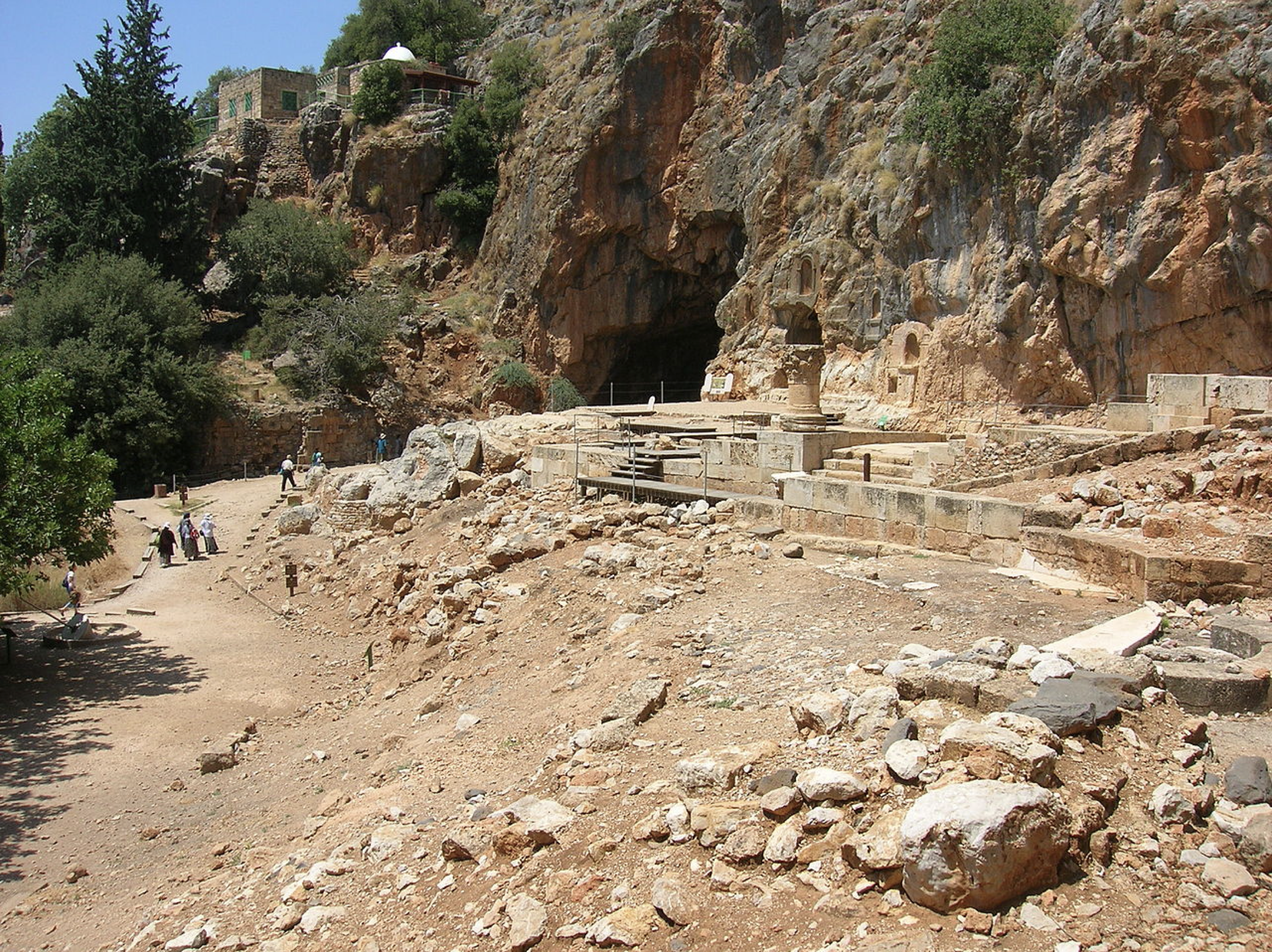
Here is what it looks like today: you can see the large cave opening and where the river would flow out.  You can see the remains of the temples of false gods that stood in Jesus’ day.

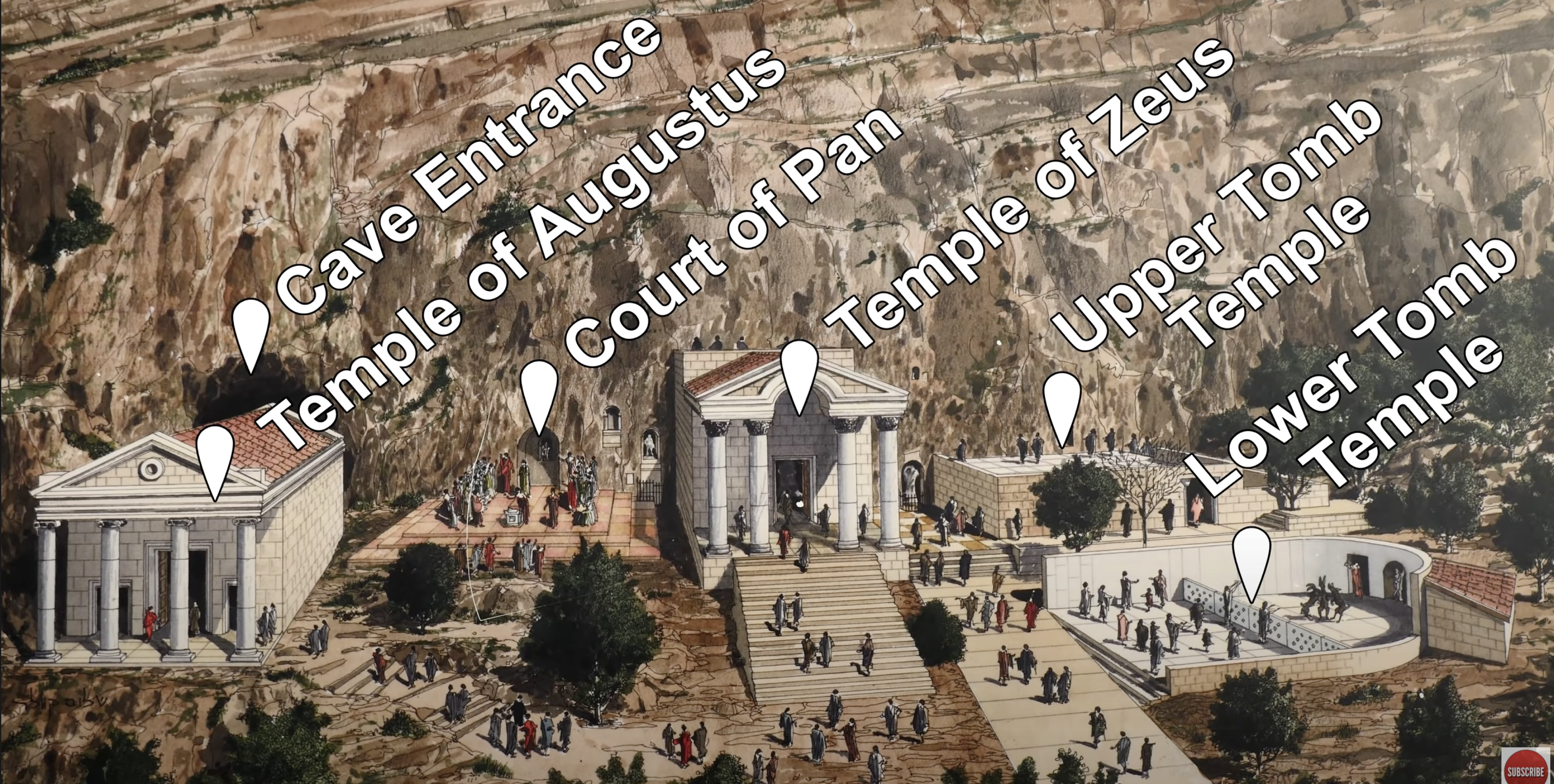
Here is an artist’s conception of what it looked like in Jesus’ day.

If you want to know the interesting story of who the false god Pan was and how the ancient portrayals of Pan became how we picture “the devil” with horns, pointed ears, and part goat, and if you want to know how we got the name Lucifer mistakenly inserted into the Bible around 300 AD, you’ll have to read my blog entry later this week.

But this was a substantial pagan center of worship.  Some say that people in that day felt the mouth of the cave was the “gates of hell” and that all the fertility gods used it as a passage to the underworld.  (I can’t find any direct sources for this.)   It is this place that Jesus chooses to go to ask this most important question.

On the way there, Jesus asks, “Who do people say that the Son of Man is?”   ‘Son of Man’ is Jesus’s most common title to refer to himself.  In Hebrew, ‘son of man’ can have two meanings.  It can just be the son of Adam, a human, a descendant of Adam, as Luke records in his genealogy of Jesus.  Or it could be a reference to the Son of Man figure in the book of Daniel.

Daniel 7:13-14   “I saw in the night visions, and behold, with the clouds of heaven there came one like a son of man, and he came to the Ancient of Days and was presented before him.  And to him was given dominion and glory and a kingdom, that all peoples, nations, and languages should serve him; his dominion is an everlasting dominion, which shall not pass away, and his kingdom one that shall not be destroyed.

So, this “son of man” comes before God to be crowned as king.  (Not coming on the clouds as in a second coming.)   

Look at the encounter Jesus has with the High Priest at his trial before some of the Sanhedrin.

Matthew 26:62-64  And the high priest stood up and said, “Have you no answer to make? What is it that these men testify against you?”  But Jesus remained silent. And the high priest said to him, “I adjure you by the living God, tell us if you are the Christ, the Son of God.” Jesus said to him, “You have said so.

Jesus wasn’t the first to claim to be the Messiah.  Josephus said there were at least a dozen before Jesus.  You could claim to be the Messiah, and the Jewish leaders would sit back and watch to see what happened.  And “son of God” can refer to an earthly king (as in David).   It was not considered blasphemy to make this claim.  But Jesus doesn’t stop there.

Matthew 26:64-66   But I tell you, from now on you will see the Son of Man seated at the right hand of Power and coming on the clouds of heaven.”   Then the high priest tore his robes and said, “He has uttered blasphemy. What further witnesses do we need? You have now heard his blasphemy.  What is your judgment?” They answered, “He deserves death.” 

Jesus has claimed to be the Son of Man from Daniel 7.  This claim to deity would be considered blasphemous because they did not recognize his deity.

But Jesus is not asking, ‘Who am I?’ but, ‘Who do people say I am?’

Am I just a man, the son of Adam (son of man), or am I Daniel’s “Son of Man” who comes on the clouds?

Some say John the Baptist…
Why would they think Jesus was John the Baptist?  Indeed, we know Herod Antipas believed that Jesus was the reincarnation of John the Baptist, whom he beheaded.  

Matthew 14:1   At that time Herod the tetrarch heard about the fame of Jesus, and he said to his servants, “This is John the Baptist. He has been raised from the dead; that is why these miraculous powers are at work in him.”

Some say, Elijah…
Why would they say that?  It is well known that before the Great Day of the Lord came, Elijah would come.  And in Jesus’ day, and still today, at every Passover seder every year in every Jewish household, they set the table with an empty chair for Elijah.  At a certain point in the meal, they ask a child present to open the door and look outside to see if Elijah is coming.  They are looking forward to the great day.

Malachi 4:5  “See, I will send you the prophet Elijah before that great and dreadful day of the Lord comes.

But Jesus has already told the disciples that John the Baptist was the one who came in the spirit of Elijah…

Matthew 11:13-14  “All the prophets and the law prophesied until John. And if you are willing to receive it, he is Elijah who is to come.”

Jeremiah or one of the prophets…

This concept is not seen in Scripture but was noted in the folklore of the day.

Interestingly, among these opinions of who people think Jesus is, “Messiah” is not one of them.

Not after the feeding of the 5000.  Remember, after the miraculous feeding, they wanted to force Jesus to be king, but he refused.  They wanted a Messiah with an earthly kingdom who would defeat the Romans, make them independent again (and feed them free bread.)  But that was not the Messiah Jesus was to be.  (This was one of the temptations in the wilderness.)  They wanted a different Jesus.  So many left him after that.   No longer would the crowds see Jesus as a potential Messiah.

“But who do you say that I am?”

This is the critical question.  It is not “Who is Jesus?”   Because no matter what you believe, Jesus is who he is.  Despite millions who may not recognize it yet, Jesus is the Son of God who came to deliver us.  And one day, every knee will bow, and every tongue will confess that Jesus is Lord of all.   The important question is:  “Who is Jesus to you?”  If you don’t have a relationship with Jesus as your Lord, if he is not the one who tells you what to do (and you are obedient), if you haven’t pledged your life to him, then Jesus is not your Messiah; he is just a Messiah.  He is not your deliverer; he is a deliverer.  

“Blessed are you, Simon Bar-Jonah! For flesh and blood has not revealed this to you, but my Father who is in heaven.

Notice that Jesus calls Peter “Simon Bar-Jonah” here? You get only the Hebrew name Simon, son of Jonah. He doesn’t use the nickname he gave him the first time Jesus met him.

John 1:42 He [Andrew] brought him to Jesus. Jesus looked at him and said, “You are Simon the son of John? You shall be called Cephas” (which means Petros). 

It is a fairly common nickname today.  Just ask Sylvester Stallone (“Rocky”) or Dwayne Johnson (“The Rock”).   Jesus calling Peter ‘the rock’ probably brought snickers from other disciples, for Simon was often not rock-like until the future.  But that is the way Biblical names frequently work.  Names usually reflect a character trait or destiny yet to be revealed.

Abram is renamed Abraham, father of many when he is 99, a year before Isaac is born.  Jesus’ name means “Yehovah saves” to tell of his future actions.  But here, Jesus uses his original Hebrew name.  Shimon is from the Hebrew ‘shema’ to hear, so the name Simon means  “the one who hears.”  Then Jesus says, “Flesh and blood have not revealed it to you.”  God gave this understanding to Simon Peter.  It was a divine gift.  Over and over in the gospels, we see people who can’t understand the things of God.  God will give the gift of understanding to those who seek him and are willing to accept gifts from him.  If you only get your knowledge about God and the things of God from a person, you are missing it.  You must study God’s words in Scripture and pray for understanding.  People may mislead you.  There are many wolves in sheep’s clothing out there.  God will never mislead you.  So Jesus is really saying, “Blessed are you, Simon, the one who hears because you have heard it from above.”

When Peter said, “You are the Messiah, the son of the living God,” what did he mean?  Did he understand what ‘Messiah’ meant, or did he accept the common belief of the time – that the Messiah would be a military/political/religious leader who would free the Jews from Roman rule and reinstate the powerful reign of David?  Check out verse 22.  Obviously, Peter didn’t understand all of what this meant.

Jesus continues:
“And I tell you, you are Peter, and on this rock I will build my church, and the gates of hell shall not prevail against it.  I will give you the keys of the kingdom of heaven, and whatever you bind on earth shall be bound in heaven, and whatever you loose on earth shall be loosed in heaven.”

There is a lot to unpack here because so many have taken this verse and made it mean what they wanted it to mean.  The Catholic Church has used this verse to say that Peter is the Rock on which the church was built, and he has the authority to govern and make theological decisions.  I can’t agree with this interpretation.  First, I don’t believe Jesus calls Peter the rock on which the church is built.  If you look at the Greek, the two words for rock in that verse are different.  Jesus says to Peter, “You are Petros.”  A petros is a small rock, a pebble.  Then Jesus says, “And on this petra, I will build…”  A petra is a massive stone formation.  (Think of the city of Petra, carved into a solid rock cliff face.)  Let’s see how the Bible uses the word ‘petra.’  

Matthew 7:24   “Everyone then who hears these words of mine and does them will be like a wise man who built his house on the rock (petra).

You build on a solid foundation on the bedrock.  No one builds anything on a pebble (petros).  

So what is this bedrock that will be built upon?   Jesus’ disciples, familiar with the Old Testament, would know the answer.  (So would we if we read the Old Testament.)  Here  is a verse you likely know:

Psalm 19:14    Let the words of my mouth and the meditation of my heart be acceptable in your sight,  O LORD, my rock and my redeemer.  

If you memorized this in the King James version (as I did), God is “my strength and my redeemer.”  That is not a bad translation because the idea of strength is what the psalmist was going for with ‘rock.’    Let’s look at some other verses:

Deuteronomy 32:4    “The Rock, his work is perfect, for all, his ways are justice.  A God of faithfulness and without iniquity, just and upright is he.
1 Samuel 2:2    “There is none holy like the LORD: for there is none besides you; there is no rock like our God.
2 Samuel 22:32    “For who is God, but the LORD?  And who is a rock, except our God?
2 Samuel 22:47    “The LORD lives, and blessed be my rock, and exalted be my God, the rock of my salvation,
Psalm 62:2 He alone is my rock and my salvation, my fortress; I shall not be greatly shaken.
Psalm 78:35 They remembered that God was their rock, the Most High God their redeemer.
1 Corinthians 3:11  For no one can lay a foundation other than that which is laid, which is Jesus Christ.

Peter was not the rock to build on.  He was but a stone (petros) built on the bedrock (petra) of the Father built on the cornerstone of Jesus, with all the prophets and apostles being part of the foundation.

“…and on this rock I will build my church, and the gates of hell shall not prevail against it.”

So upon this rock I will build what?  In your English version, it says, “church.”  But Jesus would not have said ‘church’ for many reasons.  First, he didn’t speak English.  ‘Church’ is from the German ‘Kirika’, which comes from the Greek ‘kyriakon’, an adjective that means “of the Lord.” This Greek word was used for houses of Christian worship since around 330 A.D.  (Before Constantine, there were no Christian houses of worship legally.  The first “followers of the Way” met in synagogues (for almost all were Jewish).  Later, as the synagogue congregation got tired of the talk of Jesus, they were forced to worship in homes.)  But ‘kyriakon’ is not the Greek word we find here.

“…and on this petra, I will build my ekklesia…”

An ekklesia is an assembly or gathering.  It had no religious connotation at the time Jesus used it.  In the Greek Old Testament (the Septuagint that Paul often quoted from), ekklesia was used for various assemblies.  (The group gathered at Sinai was called an ‘ekklesia’ (Deuteronomy 9:10), and Psalm 26:5 speaks of an “assembly (ekklesia) of evildoers.”)  There was a Greek word for a religious assembly — ‘synagogue’- a word for any religious assembly that, upon adoption into Latin, became used explicitly for Jewish religious assemblies.  

Our English translations are not consistent with how they translate these Greek words.  

Ekklesia’ occurs 114 times in the New Testament.  It is always translated as “church” except in these instances:

Acts 7:38 This is the one [Moses] who was in the congregation (ekklesia) in the wilderness with the angel who spoke to him at Mount Sinai, and with our fathers. He received living oracles to give to us.

Acts 19:32  Now some cried out one thing, some another, for the assembly (ekklesia) was in confusion, and most of them did not know why they had come together. [This was a town hall meeting in Ephesus.]

Heb. 2:12 [quoting Psalm 22:22]  “saying, “I will tell of your name to my brothers; in the midst of the congregation (ekklesia) I will sing your praise.”

There is a clear effort in our English translations to use “church” for ekklesia when it is only Jesus’ follower’s meeting.  ‘Synagogue’ is in the New Testament 56 times and is translated (or not translated) as ‘synagogue’ except on one occasion:

James 2:2 For if a man wearing a gold ring and fine clothing comes into your assembly (synagogue), and a poor man in shabby clothing also comes in…

Apparently, our English translators didn’t want people to think that James was writing his letter to a synagogue, even though we know that is where the believers were meeting.  (Again, we see this forced separation from anything Jewish.)

I don’t believe it was Jesus’s intention to build a church as we think of it.  What did Jesus say his primary mission was? He came to regather the lost sheep of Israel.  He was not here to make a new organization.  He is assembling a called-out community of people who recognize the living God and see Jesus as the Messiah.  Jesus’ movement is not a synagogue, nor is it a church.  It is the recovery of God’s reign and rule in the hearts and actions of men and women. as it was established at Sinai. After all, it is His assembly, the same assembly called to hear the word of God at the base of the mountain.  He is calling all to join his Kingdom.  

We get so tied up in how best to build a church.  Hundreds of books exist on the best way to build a church.  But I don’t think Jesus wanted us to build churches.  He wants us to build up the Kingdom of God.  We think too small, building our own little kingdoms, recruiting and proselytizing members.  We think the Great Commission is all about church planting, but Jesus’ Great Commission is all about making disciples.  Jesus is most concerned with pouring life into other lives so that others will experience God’s presence in their midst first-hand. This is what we should be doing.

But ‘Church’ is big business.  People love to build empires, People love to build buildings, People love to build organizations.   When we were in Egypt, our teacher showed us the magnificent temples and pyramids the pharaohs built.  Egypt was all about building huge buildings.  And he said…”The Kingdoms of this world build buildings. Our God builds people.  

Matthew 16:19-20  I will give you the keys of the kingdom of heaven, and whatever you bind on earth shall be bound in heaven, and whatever you loose on earth shall be loosed in heaven.”  Then he strictly charged the disciples to tell no one that he was the Christ.

There is so much to unpack in these verses but I’m going to be brief.  If you go to a church or museum and see statues of the apostles, it is always easy to pick out Peter.  He is the one holding a bunch of keys. (It is also from this verse we get the idea of Peter being the gatekeeper of Heaven.)   I agree with John Piper, who said the key to heaven is the knowledge of the true identity of Jesus.  That is what this whole passage is about.  Piper said, “When any faithful Christian who speaks the words with the bedrock of Jesus’s identity at the center — when you speak those words faithfully, you are using the keys of the kingdom to open the kingdom in people’s lives.”  Knowing Jesus as your Messiah is the key.

Binding and loosing are rabbinic idioms that say what is allowed and what is not.  (

think of binding an animal to a hitching post.  If you bind it there, it is restricted.  If you loose it, it is free to roam around.)  What does it mean to observe the Sabbath?  Who decides what is permitted or allowed?  The Pharisees had taken that authority and run with it (and never stopped running.)  What could you carry, how far could you walk, etc.  But Jesus said they did this poorly.

Matthew 23:4  They tie up heavy burdens, hard to bear, and lay them on people’s shoulders, but they themselves are not willing to move them with their finger.

But someone has to interpret the law.  So Jesus is passing that authority on to these disciples. It is not to Peter only, because the ‘you’ in verse 19 is plural, “I am giving y’all the keys to the kingdom….”  (Jesus restates the binding and loosing in Matthew 18:18 with the plural ‘you.’)

Jesus went on a several-day journey to the northernmost reaches of the promised land.  It was a place none of the disciples had ever been.  It was the place where things went wrong in Israel.  It was where 900 years before Jesus, King Jeroboam built altars to idols, the baals, and fertility gods, and told the people of Israel — this is your God who brought you out of Egypt. This place, where in Jesus’ day, thousands came to worship a fertility god they called Pan.  A place some called the ‘Gates of Hell.’  And Jesus brings his disciples there to ask them this question:  “Who do you say that I am?”  Because if you really understand who I am and if you follow me, you will be part of a community of believers that the Gates of Hell can not stand against.  In Jesus’ day, gates were defensive structures built to withstand the enemy.  Jesus said if you accept me as your Messiah and as your Lord (meaning you follow my orders), then you will storm the Gates of Hell.  It is not a defense against hell but an offense against it.  And there are people in your community, some of your neighbors, who are bound for hell, and we need to stop hiding in church buildings and go on the offensive.

Jesus brought them here because they have to make a choice.  When they came into this promised land, Joshua called them all together and said you have to choose

Joshua 24:14   “Now therefore fear Yehovah and serve him in sincerity and in faithfulness. Put away the gods that your fathers served beyond the river and in Egypt, and serve Yehovah.  And if it is bad in your eyes to serve Yehovah, choose this day whom you will serve, whether the gods your fathers served in the region beyond the river or the gods of the Amorites in whose land you dwell.  But as for me and my house, we will serve Yehovah.”

Years after Joshua, 10 of the 12 tribes chose to follow the idols.  Right here in this place.  In Jesus’ day, people still chose to worship Pan there and said he was the god who would make their land fertile so they could be rich.  Jesus says am I a prophet?  Am I just your teacher?  Am I just a Messiah, or am I your Messiah?  And now, you and I have to choose, and we choose every day.  I don’t have to take you to a pagan place of idols.  You walk among idols every day.   We walk among people who worship the idols of this world and say they will make them rich, healthy, and successful.  What are we building?  Are we building our own little kingdoms and buildings?  Or are we building people for the kingdom of God?  Are we making disciples?  Who is Jesus to you?

September 24, 27 A.D.  –  Thousands turn to Jesus, Because of One Man —   The Year of the Lord’s Favor #54

Week 32 ———  Another Miraculous Feeding
Matthew 15:32-38      Mark 8:1-9

Jesus feeds the 5000(+), and the following day, they want him to feed them again.  But he challenges them to think deeper and tells them he is the Bread of Life.  They are disappointed in Jesus and unable to understand his teaching about eternal life because they are only concerned about earthly things.  Many of his disciples quit following Jesus.  Then, on the Day of Trumpets, Jesus has a confrontation with the authorities from Jerusalem about purity.  Then Jesus goes north to Gentile territory and at first refuses to heal a Gentile woman’s child.  She challenges Jesus that Gentiles should at least get the scraps from the Messiah’s table, and Jesus commends her for her faith. We often underestimate the importance of this encounter.  Jesus traveled 16 miles north, talked to this woman, and healed her child; then, the next day, they traveled 20 miles south to put the discussion with this woman into action on a larger scale.  (If you haven’t read #53, stop now and read that one first.)

Jesus doesn’t return to Capernaum but travels further east to the east side of the Sea of Galilee, to the Decapolis, which is Gentile territory.

Jesus and the disciples have been here before.  It was where they landed in the boat after the stormy night when Jesus calmed the seas.  They encountered the demoniac, and Jesus sent the demons into the pigs that hurled themselves into the sea.  After losing about 2000 pigs, the people did not favor Jesus staying around.  So they insisted he leave.  The former demoniac asked to go with Jesus, but Jesus said:

Mark 5:19-20   “Go home to your friends and tell them how much the Lord has done for you, and how he has had mercy on you.”  And he went away and began to proclaim in the Decapolis how much Jesus had done for him, and everyone marveled.

Now, I like the ESV translation, but they missed it here.  “Go home to your friends…”  This man didn’t have any friends.  He was the scary, strong man who lived in the graveyard and busted out of chains when they tried to restrain him.   That Greek says, “Go home to yours.”    The NIV gets it right: “Go home to your people.”

Jesus is saying: “Don’t come with me; I’m going back to the Jewish side of the lake; you go witness to your people, the Gentiles.”

The last time he was in the Decapolis, just a little over a month ago, Jesus was there only a few hours and was kicked out of the country.   Wait until you see what happens this time…

Matthew 15:29-31   Jesus went on from there and walked beside the Sea of Galilee. And he went up on the mountain and sat down there.  And great crowds came to him, bringing with them the lame, the blind, the crippled, the mute, and many others, and they put them at his feet, and he healed them, so that the crowd wondered, when they saw the mute speaking, the crippled healthy, the lame walking, and the blind seeing. And they glorified the God of Israel.1

This time, he is welcomed by huge crowds who stay with him for three days of teaching.  The Gentile crowds come to Jesus for healing, and Jesus starts healing them without hesitation.  This is possible because of what happened before.  God had a plan.  God led Jesus to this area to cast the demons from this man who would be his witness.  God led Jesus to Syria and then brought this desperate mother to him.  God’s plan worked because that man who was formally demon-possessed was willing to be a witness and because this woman would not consider letting Jesus go without healing her daughter and because she insisted that Jesus was the Messiah of this Gentile also.  She spoke for more than her daughter; she spoke for all the non-Jewish people in the world.   God used these two individuals to bring about his centuries-old plan.  All these people are being healed because two people were obedient to the task God gave them.  They are the unsung heroes of this story.

So here they are, healing and teaching a huge crowd of Gentiles.  And look what happens next:

Matthew 15:32-34   Then Jesus called his disciples to him and said, “I have compassion on the crowd because they have been with me now three days and have nothing to eat. And I am unwilling to send them away hungry, lest they faint on the way.”   And the disciples said to him, “Where are we to get enough bread in such a desolate place to feed so great a crowd?”   And Jesus said to them, “How many loaves do you have?” They said, “Seven, and a few small fish.”  

This story should sound familiar.  It was just a week ago he fed the 5000.  But this is different.  These are Gentiles 

This is the big difference:  In the last miracle of feeding the 5000, the disciples had compassion for the crowd. This time, both Matthew and Mark make a point of saying it was Jesus who had compassion on the crowd after three days.  Why the difference?  Could the disciples not have the same level of compassion because these people were Gentiles?  Remember that these Jewish disciples had been taught by their religious leaders that eating with Gentiles was forbidden.  It brought on all kinds of uncleanness. It was much like the lunch counters in Birmingham in 1960, when African Americans were not allowed.  There were just some things you didn’t do.

Just two days ago, Jesus confronted the Pharisees about their traditions.  “You don’t wash your hands the right way, Jesus;  everyone knows that.”  You don’t eat with Gentiles, Jesus.  They are unclean.  There are just some things you don’t do.”

If these disciples are going to fulfill Jesus’ command at the end of Matthew’s gospel to “Go into all the world,” then they are going to have to drop their racist viewpoints. Are they there yet? Unfortunately, not.  

Peter still holds on to the false traditions he learned as a child.  It takes a miraculous vision of a sheet in the 10th chapter of Acts and a devout Roman Soldier to convince Peter that Gentiles can accept Jesus as their lord.   People were still preaching that you had to become Jewish to be saved.  So, a church council is convened to answer the question in Acts 15: can Gentiles be saved without becoming Jews?  Gentiles are finally completely welcomed in.  

Don’t miss how these stories fit together.   The events in Jesus’ ministry are not random.   Four weeks ago, we discussed how Jesus cast the demons out of this man.  It is a great story but only the prequel to the greater story.  This was the scary, crazy, strong man who lived in the graveyard and broke chains.   Jesus heals him, and he wants to go with Jesus, but Jesus says, no, tell people what God has done for you— he spent four weeks telling what Jesus did for him, and thousands of people came to Jesus.  This story of the persistent mother seems so odd at first glance — God used her as the catalyst to drive the plan to take his kingdom to all the nations in the world.   

God had a plan to reach the whole world.  But God wants to partner with us to accomplish it.  Isn’t this how prayer works?   There are things Jesus won’t do until his disciples come in bold and persistent faith- asking him to be who they know he is.  This woman knew Jesus loved all people; she knew the time was coming for the Gentiles to share in the kingdom.  She merely asked Jesus to be who she knew he was.  Jesus, you are compassionate.  Have compassion for my daughter.

God doesn’t need people to do any work, but God chooses to use people to do his work.   He chooses to partner with us to bring about his kingdom.  And some healings don’t occur because we don’t come before his throne like this woman came to Jesus. She would not give up!  Is this how you pray?   There are people who suffer pain, hunger, depression, and many other things because we refuse to partner with God to take care of them.  We pray the Lord’s Prayer and ask God to do his will on earth, just like it is always perfectly done in heaven.   But some of God’s will is not done on earth as it is in heaven because we are not bold and courageous in approaching God with our requests like this Syrian woman and because we are not willing to follow his will like this Gentile man who had been possessed.    

We Christians have a problem.  We read the Bible, and we say: 
One day, there will be no more sickness or pain.
One day, children will not go hungry
One day, there will be no depression or loneliness.
One day, there will be no homelessness.
One day, there will be no more broken marriages or broken relationships,
One day, God will fix all that

And while we are so focused on that one day, I think God is shouting, “Why not today?”  Why can’t this happen now in your community? Why can’t God’s will be done today?  That is the message of the Syrian mother.  Yes, one day, Jesus will tell his disciples to go to the Gentiles, but why not today?  Why can you not be the Messiah for me and my daughter today?   And I think Jesus was waiting for that one person to ask for his ministry to reach out past the Jews.  So he left the next morning, walked 20 miles, and started healing thousands of Gentiles.

Do you think God wants children to be abused or to go hungry?  Do you think God wants that person who lives near you to be depressed or lonely?  Does God want people to sleep in the cold?  No!  Look at the lessons we have seen in the stories of the past few weeks:

From the disciples at the feeding:   Look at the people around you.  Be compassionate.  Oh, the disciples notice they are hungry.  Then Jesus says, “You feed them.  I will enable you to do it, but you need to do it.” From the mother in Syria:  Be bold and courageous in your requests to Jesus. Ask Jesus to be who you know he is.  From the former demoniac:  It is not enough to sit in the boat (or church) with Jesus.  We need to go back to our people and tell them what Jesus has done for us.  And from all three together, no one in any country or situation is beyond the grace of God.  The Kingdom of God is for all people.

But I can’t let this end without bringing this story home today.  The story of the Syrian woman happened in the area ruled by Tyre and Sidon, what is now the country of Lebanon.  Lebanon is a primarily Muslim country that is home to Hezbollah, an Iran-funded terrorist group.  Hezbollah has been shelling northern Israel for almost a year since the Oct 6 attack from Gaza, forcing over 50,000 from their homes.  Israel has been retaliating with some directed missile attacks.  In the past few weeks, Israel began an intense campaign to stop these terrorists.  There were the exploding pagers and devices and now intense missile attacks.  Hezbollah, like most terrorist groups, hides among the innocent civilians in the country.  Their headquarters was in the basement of a residential building.  So Israel’s attempt to stop the terrorists has resulted in much harm to civilians, in the very area Jesus was in our story and up to Tyre and beyond.

My friend, Chris Todd, lives in Tyre.  Chris was a chicken farmer in Marshall County, Alabama, but he is now a missionary there.  He works with several Christian churches in this primarily Muslim country and serves the Syrian refugees that flooded into Lebanon in Syria’s recent war.  The bombing was initially south of Tyre, and four families were sheltering in his apartment there.  Some in these families converted from the Muslim faith and are now workers in his trauma center and the church there. In the past week, there has been heavy bombardment in Tyre and his neighborhood and at the ministry center.  Since this area is no longer safe, they are seeking shelter further north.   

Jesus went to this area, and one mother begged for his help.  Jesus used her plea to teach his disciples that his kingdom was not just for the Jews but for the whole world.   My friend, Chris, is fulfilling Jesus’ call in the very place where this story happened.  But they are in crisis, and he needs help.  I want to ask you to prayerfully consider donating to help provide shelter to these Christian brothers and sisters who are fleeing the bombing.2

God is waiting for us to join him in working miracles in our community. 

  1. Matthew lets you know this is a Gentile territory by saying, “They glorified the God of Israel.”  Had it been a Jewish crowd, he would have said, “They glorified God.”
  2. Donations can be given through Chris’s Ministry, Words of Isa. Words of Isa, PO Box 1398, Albertville, AL 35950. (Checks payable to “Words of Isa”.) Venmo: @wordsofisa You can also donate easily online through Paypal: http://paypal.com/us/fundraiser/charity/1879050

September 22, 27 A.D.  –  The Woman Who Would Not Give Up —   The Year of the Lord’s Favor #53

Week 32 ———  The Woman Who Would Not Give Up
Matthew 15:22-28      Mark 7:24-30

Several weeks ago, Jesus fed the largest crowd recorded in his ministry (5000 men plus women and children). Last week, he taught on the Bread of Life and spoke for the first time to a crowd plainly of eternal life resurrection on the last day because that evening began the Day of Trumpets. I told you then that we were at a turning point in his ministry.

His popularity was at its highest after the feeding of the 5000.  It was so popular that John tells us the people wanted to force him to be king.  And Jesus is king, but not the kind of king they think.  So he withdrew (John 6:14-15).  The next day, the crowd finds him again.  They want him to repeat the bread miracle.  But Jesus tells him he is the Bread of Life.  They cannot understand what he is saying because their mind is stuck on earthly things.  And that brings us to one of the saddest verses in the Bible:

John 6:66  After this many of his disciples turned back and no longer walked with him.

But God granted understanding to Simon Peter:

John 6:66-69  So Jesus said to the twelve, “Do you want to go away as well?”   Simon Peter answered him, “Lord, to whom shall we go? You have the words of eternal life, and we have believed, and have come to know, that you are the Holy One of God.” 

That evening, the new moon is visible, and it is the Day of Trumpets, which is a required day of rest.  (So both Saturday and Sunday were Sabbath rests that week.)  A group of Pharisees from Jerusalem had been waiting for Jesus to return to Capernaum.  On the Day of Trumpets, they confront Jesus because he and his disciples don’t wash their hands the way the Rabbis had instructed them to keep ritually pure.  (Note that this was not a law from scripture, but something the rabbis added and Jesus found unnecessary.)  It would be like you visiting a church one Sunday, and one of the church elders comes to you and fusses at you because you didn’t wear a jacket and tie.  “Everyone here wears a suit to church.  Next time you come, dress correctly.”    Jesus was all about rules, but only God’s rules.  He had no trouble ignoring their traditions that seemed more important to them than God’s rules.  And this was not a friendly discussion but a confrontation.  The disciples realized that contradicting these authorities could be a problem, and they asked Jesus:

Matthew 15:12  Then the disciples came and said to him, “Do you know that the Pharisees were offended when they heard this saying?”

Jesus answered by telling the disciples that the Pharisees were ‘blind guides’ and challenging their whole concept of purity.  

The following day, Jesus and the disciples traveled north out of Galilee, out of Jewish territory, into Syria, the region controlled by the two large cities, Tyre and Sidon. These were very wealthy coastal cities, profiting from their position in the spice trade.  They controlled the region of Syria north of Galilee, and it was not Jewish.1

Now, the people in Syria had already heard about Jesus.  As Matthew noted just before the sermon on the Mount:

Matthew 4:24-25   So his fame spread throughout all Syria, and they brought him all the sick, those afflicted with various diseases and pains, those oppressed by demons, those having seizures, and paralytics, and he healed them.

 So, some of the people from Syria had already come south to Galilee, blended in with the crowds around Jesus, and found healing. But now, Jesus goes there.

Matthew 15:21-28   And Jesus went away from there and withdrew to the district of Tyre and Sidon. And behold, a Canaanite woman from that region came out and was crying, “Have mercy on me, O Lord, Son of David; my daughter is severely oppressed by a demon.”   But he did not answer her a word. And his disciples came and begged him, saying, “Send her away, for she is crying out after us.”  He answered, “I was sent only to the lost sheep of the house of Israel.”   But she came and knelt before him, saying, “Lord, help me.” And he answered, “It is not right to take the children’s bread and throw it to the dogs.” She said, “Yes, Lord, yet even the dogs eat the crumbs that fall from their masters’ table.” Then Jesus answered her, “O woman, great is your faith! Be it done for you as you desire.” And her daughter was healed instantly.

Jesus enters the southernmost part of this region, and his disciples are likely thinking he is leaving to have some time away from the crowds and the religious leaders who are becoming increasingly antagonistic to him. But Jesus has a hidden agenda.  He doesn’t seek out anyone, but a woman whose child was possessed by a demon hears that Jesus is in the area, so she comes to ask for healing for her child.  The fact that she is not Jewish is much emphasized in the Scriptures.  Matthew (writing to a Jewish audience) describes her as a “Canaanite woman,” using a term that recalls the Old Testament history of Canaanites being the enemy whose worship of idols was a persistent threat to the proper worship of the Israelites.  That the Messiah of Israel would bring healing to a Canaanite, of all people, would be a shocking statement to Matthew’s readers that Jesus’ ministry is for all people.  Matthew furthers the shock value of the story, recording that the pagan woman then addresses Jesus as the “Son of David,” a Jewish messianic title.  

This is an odd Bible story. You probably won’t get it in Vacation Bible School, so we must examine it more closely.

Mark adds the detail that Jesus is trying to escape notice from the people. 

Mark 7:24   And from there he arose and went away to the region of Tyre and Sidon.   And he entered a house and did not want anyone to know, yet he could not be hidden. 

He is not there to minister.  He doesn’t seek out anyone, but a woman whose child was possessed by a demon hears that Jesus is in the area, so she comes to ask for healing for her child.  Both Mark and Matthew emphasize the fact that she is not Jewish.  Mark says, “Now the woman was a Gentile, a Syrophoenician by birth” (Mark 7:26).   Matthew (writing to a Jewish audience) describes her as a “Canaanite woman,” using a term that recalls the Old Testament history of Canaanites being the enemy whose worship of idols was a persistent threat to the proper worship of the Israelites.  This was a derogatory term.  That the Messiah of Israel would bring healing to a Canaanite, of all people, would be a shocking statement to Matthew’s readers.  Matthew furthers the shock value of the story, recording that the pagan woman then addresses Jesus as the “Son of David,” a Jewish messianic title.

She “comes out” of her village to seek out Jesus, leaving her daughter at home.  She begs for mercy.  How would you expect Jesus to respond to this woman desperate for healing for her daughter?   Jesus does not even respond to her at all.  But she is persistent, and she will not be turned aside.  Eventually, the disciples ask Jesus to send her away “for she is crying out after us.”  They begged Jesus to heal her daughter so she would leave.  But Jesus responds:

“I was sent only to the lost sheep of the house of Israel.”

We have heard Jesus use that phrase before, when he was sending out the 12.

Matthew 10:5-7   These twelve Jesus sent out, instructing them, “Go nowhere among the Gentiles and enter no town of the Samaritans, but go rather the lost sheep of the house of Israel.  And proclaim as you go, saying, ‘The kingdom of heaven is at hand.’

So Jesus ignored this woman’s request for help because she is a Gentile?  He has healed some Gentiles before.  What is going on?  Still, she doesn’t give up.2

But she came and knelt before him, saying, “Lord, help me.”
And then Jesus replies:  “It is not right to take the children’s bread and throw it to the dogs.”

Whoa, Jesus.  That sounds bad, even in our culture, where we love dogs and some treat them like children.  But in the Jewish world of Jesus’ day, dogs are not pets. They are scavengers, a nuisance, unclean animals. It is definitely a derogatory reference.   The disciples were not surprised at all when Jesus said this.  They probably were thinking the same thing.  What is Jesus doing?

But this woman won’t let that comment slow her down. She is a mother with a sick child.  She will not be dismissed so easily.  “Even the dogs eat the crumbs that fall from the master’s table.”  She embraces the derogatory comment and continues to make her case.  Somehow, this Gentile woman has got it into her head that Jesus is her Messiah also.

After his death and resurrection, Jesus told the disciples to go into all the world.  His ministry will be for all, not just the Jews.  But this woman begs Jesus to take that future hope for the Gentiles to be part of God’s kingdom and make it happen now.  

And suddenly, everything changes.  

Jesus turned and said, “O woman, great is your faith! Be it done for you as you desire.” Her daughter was healed instantly.

Jesus has a crucial lesson to teach these disciples.  But this lesson is so contrary to their thinking that he knows he will have to take extreme measures to teach it.  He has emphasized several times that his mission was first to the Jews, which is just what was foretold in Scripture. Jesus is being faithful to the story of the Bible.

Once, there was only one nation in the world, but they rebelled against God, building a tower they hoped would rise to heaven.  So, God divides them into many nations.  And God chooses one man from all the nations to be the way he will restore the world.  This man, Abraham, will be the “father of many nations,” and his family will be the means of redemption for all.  His people are rescued from slavery in Egypt,

After deliverance from Egypt, God tells the children of Israel they are to be a kingdom of priests to carry his message through the world.  But they fail to follow God and be that kingdom of priests. So God chooses a king to lead the people in justice, mercy, and obedience, but David fails also.  Then God promises that one day, a king will come from the house of David who will succeed in keeping God’s covenant and be the leader that will bring all nations together under God.  And that king is Jesus.

Isaiah had predicted a time when all nations would come to the house of the God of Jacob.

Isaiah 2:2-4   It shall come to pass in the latter days that the mountain of the house of the LORD shall be established as the highest of the mountains, and shall be lifted up above the hills; and all the nations shall flow to it, and many peoples shall come, and say: “Come, let us go up to the mountain of the LORD, to the house of the God of Jacob, that he may teach us his ways and that we may walk in his paths.” For out of Zion shall go forth the law, and the word of the LORD from Jerusalem.  He shall judge between the nations, and shall decide disputes for many peoples; and they shall beat their swords into plowshares, and their spears into pruning hooks; nation shall not lift up sword against nation, neither shall they learn war anymore.

“I ain’t gonna study war no more.” the old spiritual song says.  Why? Because all the nations will one day be united under Jesus.  There will be no more war.  But this is all in the future.  First, Jesus must come and reach out to the lost sheep of Israel.  He plans to take his gospel to the rest of the world, but all in due order.  Jesus has to fulfill a covenant promise to Abraham.  How many disciples are there?  How many tribes of Israel were there?  Jesus is rebuilding the house of Israel so that they will finally become the kingdom of priests. Are these 12 ready to fulfill that mission?  Unfortunately, not yet. 

Like us, the disciples are slow learners.  Something drilled into you from your childhood is difficult to shake off.  Many of my generation grew up in families where racism was the norm.  Some of my friends have struggled to shake off those old prejudices and hate.  Changing your mind often takes a real-life experience with someone who surprises you by not meeting your negative expectations.  When people found out we were adopting a biracial girl, some people thought we were crazy.  But they watched this girl grow up, and they grew to love her.  Those same people who were so against our adoption would now fight anyone who made a racial statement around our girl.  

Racism is removed through relationships.

We have seen that in our churches who minister to our homeless community.  As part of our program, we encourage churches to sit at the dinner table and have discussions with our ‘neighbors without homes.’  This helps in two ways.  Our church members discover that our ‘neighbors without homes’ are real people with real problems.  They lose many of their prejudices and become more interested in helping.  Secondly, our neighbors, many of whom have had poor encounters with churches, meet church people who care about them.  Conversations around a table go a long way to remove their memories of bad experiences with people who see them as worthless.

Prejudice is overcome through experience.

So, what happened in Syria with this woman is a critical step in God’s plan.  I think God set Jesus up.  God sent Jesus and the disciples walking about 16 miles to this region in Syria, and Mark tells us Jesus doesn’t want to be seen.  But God makes sure this woman with a sick child finds out Jesus is there.  God is using her as the catalyst to begin Jesus’ ministry to the Gentiles.  They walk 16 miles from home, encounter this persistent mother, and the next morning, get up and start walking 20 miles back south.  Something profound has happened.  Look at where Jesus goes.  This time, he doesn’t return to his home base in Capernaum but goes further west to the Decapolis, an area of the Gentiles.   Here, Jesus will test his disciples to see if they learned anything from his interaction with the Gentile woman the previous day.

Jesus and the disciples have been here before.  It was where they landed in the boat after the stormy night when Jesus calmed the seas.  They encountered the demoniac, and Jesus sent the demons into the pigs that hurled themselves into the sea.  After losing about 2000 pigs, the people did not favor Jesus staying around.  So they insisted he leave.  The former demoniac asked to go with Jesus, but Jesus said:

Mark 5:19-20   “Go home to your friends and tell them how much the Lord has done for you, and how he has had mercy on you.”  And he went away and began to proclaim in the Decapolis how much Jesus had done for him, and everyone marveled.

Now, I like the ESV translation, but they missed it here.  “Go home to your friends…”  This man didn’t have any friends.  He was the scary, strong man who lived in the graveyard and busted out of chains when they tried to restrain him.   That Greek literally says, “Go home to yours.”    The NIV gets it right: “Go home to your people.”

Jesus is saying: “Don’t come with me; I’m going back to the Jewish side of the lake; you go witness to your people, the Gentiles.”

The last time he was in the Decapolis, just a little over a month ago, Jesus was there only a few hours and was kicked out of the country.   Wait until you see what happens this time…

Peter will not understand this concept of the expansion of the Kingdom to the Gentiles until Acts 10, and it will take a vision of a sheet from heaven and a devout Roman soldier to convince him.  The tradition that God was for the Jews alone ran very deep in the psyche of all the Jews.  Jesus will take extreme measures with this woman to begin the lesson.  He demonstrates their own racism in how he initially treats her.  Sometimes, we can see things in others we cannot see in ourselves.

Jesus is being very intentional. He began his ministry only to the Jews but, as predicted in the scriptures, will eventually expand his kingdom to everyone. In Matthew 28, he tells the disciple, “Go into all the world…”   And we are at a turning point.  He makes this journey into Syria and will go to the Decapolis, another primary Gentile territory, and then up to Caesarea Philippi all in the next week.  He will test the disciples to see if they have learned the lesson to have compassion for the nations.  (And they will fail.)

Like us, the disciples are slow learners.  Something drilled into you from your childhood is difficult to shake off.  Many of my generation grew up in families where racism was the norm.  Some of my friends have struggled to shake off those old prejudices and hate.  Changing your mind often takes a real-life experience with someone who surprises you by not meeting your negative expectations.  We have seen that in our churches who minister to our homeless community.  As part of our program, we encourage churches to sit at the dinner table and have honest discussions with our ‘neighbors without homes.’  This helps in two ways.  Our church members discover that our ‘neighbors without homes’ are real people with real problems.  They lose many of their prejudices and become more interested in helping.  Secondly, our neighbors meet church people who care about them.  Conversations around a table go a long way to remove their memories of bad experiences with people who see them as worthless.

Jesus has already shocked his followers by offering to go to the centurion’s home after the sermon on the mount, by touching a leper, and by ministering to a Samaritan woman.  But he is now going to push them further.  Let’s see what he does next.

  1. It is interesting to note some similarities between the visit of the prophet Elijah to this same region.  Elijah encounters a widow in Zarephath (felt to be modern-day Sarafand, a city between Tyre and Sidon.)  This is another woman whose child is healed.  It is amid a famine in the land, and God multiplied her oil and flour so that the little she had never ran out, just as Jesus multiplied the loaves and fishes. 
  2. Don’t miss how the Bible displays this woman’s initiative in a positive light.  This is atypical of narratives about women in this day.  And this is not the only gospel story that does this.  (See also the initiative of the women with the 12 years of bleeding and the woman in the parable Jesus tells in Luke 18 of the woman who would not stop pleading with the unrighteous judge for justice.

September 21, 27 A.D.  Yom Teruah The Year of the Lord’s Favor #52

Week 32 ———  Yom Teruah- the Day of Trumpets
John 6:25-65

Jesus had just fed the 5000, dismissed the crowds, and went up on a mountain to pray. He made the disciples get in a boat and go ahead of him, but he caught up to them by walking on the water. But they can’t escape the crowds. When they got to the other side of the Sea of Galilee, the crowds gathered again.

John 6:25-34   When they found him on the other side of the sea, they said to him, “Rabbi, when did you come here?”  Jesus answered them, “Truly, truly, I say to you, you are seeking me, not because you saw signs, but because you ate your fill of the loaves.   Do not work for the food that perishes, but for the food that endures to eternal life, which the Son of Man will give to you. For on him, God the Father has set his seal.”  Then they said to him, “What must we do, to be doing the works of God?”  Jesus answered them, “This is the work of God, that you believe in him whom he has sent.”  So they said to him, “Then what sign do you do, that we may see and believe you? What work do you perform?   Our fathers ate the manna in the wilderness; as it is written, ‘He gave them bread from heaven to eat.’”  Jesus then said to them, “Truly, truly, I say to you, it was not Moses who gave you the bread from heaven, but my Father gives you the true bread from heaven.  For the bread of God is he who comes down from heaven and gives life to the world.”  They said to him, “Sir, give us this bread always.”

John 6:35-40   Jesus said to them, “I am the bread of life; whoever comes to me shall not hunger, and whoever believes in me shall never thirst.   But I said to you that you have seen me and yet do not believe.  All that the Father gives me will come to me, and whoever comes to me I will never cast out.   For I have come down from heaven, not to do my own will but the will of him who sent me.   And this is the will of him who sent me, that I should lose nothing of the all that he has given me, but raise it up on the last day.   For this is the will of my Father that everyone who looks on the Son and believes in him should have eternal life, and I will raise him up on the last day.”

Crowds surrounded Jesus.  And the miracle of the multiplication of the bread and fish ramped that up tremendously.  Jesus’ popularity with the crowd reaches its zenith after the feeding of the 5000.  Why is Jesus so popular?  Do you want to be popular?  Give away free food, free medical care, or free anything that usually works well.  It is election season, right?  All the candidates know if they promise to give you what you want, they will get your vote.  This is one of the problems with democracy.  The idea of democratic voting is that each person will decide what is best for them, and then the vote will represent what is best for the majority of people.  Unfortunately, that may not represent what is best for the country because most people don’t think past today.  Yes, lower my taxes and, at the same time, get the government to send me more free money and more benefits.  But that is why our country has a debt of over 35 trillion dollars.  Because people vote for what is best for them today, not what is best for the country in the coming days.   So we discussed Jesus handing out free food to thousands of people last week. How did they respond?

John 6:15   Perceiving then that they were about to come and take him by force to make him king, Jesus withdrew again to the mountain by himself.

Jesus is the king, but not that kind of king.  So he leaves them.   But the crowds found him the next day, and Jesus said to them:

John 6:26   Jesus answered them, “Truly, truly, I say to you, you are seeking me, not because you saw signs, but because you ate your fill of the loaves.

Jesus tells the crowd, “Stop it!”  You are here for the wrong reason.  You are looking for the wrong thing.  Yes, I can give you bread, but you are thinking too shallow.  Sure, bread is good and necessary for life, but even when God rained bread out of heaven daily, what happened to all those people?

John 6:49   Your fathers ate the manna in the wilderness, and they died.

Well, of course, they are dead, Jesus; that was over a thousand years ago. But there is a different kind of bread from heaven they should be seeking:

John 6:50  This is the bread that comes down from heaven, so that one may eat of it and not die.  I am the living bread that came down from heaven. If anyone eats of this bread, he will live forever. 

Jesus uses the metaphor of bread that sustains earthly life to show them that he is the bread that gives eternal life.  Do they understand?  Look at their response:

John 6:52  The Jews then disputed among themselves, saying, “How can this man give us his flesh to eat?”

 No, they didn’t get it at all.  Jesus uses the metaphor of bread to describe himself, just like he used the metaphor of “living water” when talking to the woman at the well.  Drink this water and never be thirsty again.  Eat this bread and live forever.  The woman at the well understood him.  The crowd is hopelessly lost.  Their level of understanding is zero.  Instead of understanding Jesus’ metaphor, they think he wants them to be cannibals and eat his flesh and drink his blood. You want to grab them by the face and say, “It is a metaphor!” Why can’t they understand?  It is not that difficult.  The problem is not that what Jesus is saying is hard.  The problem is their hearts are hard.

Thousands of people experienced the miracle of the multiplication of the loaves and fishes, but there were two primary responses.  They all witnessed the same thing but got two very different messages.  One group saw the miracle and said, “Wow!  Isn’t God great!”  The other group saw the same thing and said, “Wow! Isn’t free bread great!”

There were those so focused on this world that they couldn’t see the hope of something else.  These weren’t starving people.  Remember the disciples discussing that they could have just broken up the meeting and let them go home to eat?  But Jesus filled this short-term need for food to teach a lesson.  So Jesus filled that need but wanted them to know there is more to God’s world than today.  There is more to life than what we see with our eyes.  Jesus is interested in how we are doing today, but he is more interested in the infinite number of days to come.   

If we look back at the passage we read earlier, we will notice Jesus is directing them toward a theme. You may not have noticed it as we read it before, so let me point it out.

6:27  Do not work for the food that perishes, but for the food that endures to eternal life, which the Son of Man will give to you. 
6:39  And this is the will of him who sent me, that I should lose nothing of all that he has given me, but raise it up on the last day
6:40 For this is the will of my Father, that everyone who looks on the Son and believes in him should have eternal life, and I will raise him up on the last day.
6:44  No one can come to me unless the Father who sent me draws him. And I will raise him up on the last day.
6:47  Truly, truly, I say to you, whoever believes has eternal life.
6:50  This is the bread that comes down from heaven, so that one may eat of it and not die.
6:51  If anyone eats of this bread, he will live forever.
6:54   Whoever feeds on my flesh and drinks my blood has eternal life, and I will raise him up on the last day.
6:58  Whoever feeds on this bread will live forever.

Do you think Jesus is trying to make a point? There is more to life than day after day trying to earn your daily bread. He is pushing the idea of eternal life and being raised up on the last day. Matthew and Luke only mention eternal life twice, and Mark only mentions eternal life once. John mentions it in Jesus’ conversation with Nicodemus in John 3, here in chapter 6, and in the upper room.  If I were to take a poll of people leaving a church service on Sunday morning and ask, “What is eternal life?”  What answers do you think I would get?  My very informal poll got these top four answers:  “To live forever,” “To go to heaven,” “To be with Jesus forever,” and “To never die.” All of the answers define eternal life as a length of time or a destination.  But what did Jesus say?

In the upper room, Jesus prays to the Father and says, “And this is eternal life, that they know you, the only true God and Jesus Christ whom you have sent”  (John 17:3).

What is eternal life?  To know God, to know Jesus.  But again, to Jesus, who grew up with Hebrew scriptures, ‘to know’ does not mean to know about something.  Knowing about God is not enough.  The demons know about God.  This is the fourth or fifth time I have mentioned this, but it is so important here.  The verb “to know” in Hebrew is ‘yadah’ from the root word ‘yad’ which is the palm of your hand.  To know something in Hebrew is to hold it in your hand, experience it, and have a relationship with it.  To know God is to have an ongoing experience with Him and be in a relationship with him.

Let me give you an example:
Lots of people know who the Attorney General of their state is.  They may know a good bit about him.  But they don’t have a relationship with him.  But he is my friend.  I have a relationship with him.  We met every Tuesday at 6 am for seven years to discuss the scriptures and talk about things that mattered.  So, one day, I needed some help.  A woman was being abused by her husband, and we took her into our home because she was not safe with him.  Her husband ended up in the psychiatric ward in the hospital and threatened to kill me because we helped her.  So I needed some legal advice, and because we have a relationship, I could call the State Attorney General on his personal cell phone.  And, of course, he knew what I should do and helped me out. Now he would do that for anyone who needed help, but knowing his name and having a relationship with him are two very different things.

Similarly, many people know about God but don’t have a relationship with God.  They may have attended church all their lives and know a lot of Bible stories but still not have a relationship with the Father.  If so, they do not have eternal life.  Eternal life means an ongoing relationship with God and his Son, our Messiah, Jesus.  That is eternal life, which is forever, but it begins now.  It is a life that is so much more than just waking up, eating, working, and sleeping and then doing it again another day.  Eternal life is a different way of living, where you are focused on more than just your next meal or free bread.  It is the abundant life Jesus talked about. 

But the crowd in our passage doesn’t get it.  They are like voters in America, only thinking about what will improve my life today.   Free food is more important to them.  Jesus wants them to think beyond the daily grind and consider what is essential.

Jesus says those who have this relationship with him and the Father will be “raised him up on the last day.”   He uses that phrase four times in this passage, which is interesting because only one other time in the gospels does Jesus mention the “last day.”  There is a reason Jesus picked this time to discuss the “last day.”  Setting and context are so important.

Jesus is teaching on the Sabbath in the synagogue in Capernaum.   That Saturday at sundown, people in Jerusalem were scanning the horizon for the appearance of the new moon.  God told them in Exodus and Leviticus that the appearance of the New moon in Jerusalem would mark the beginning of their month.1  In their calendar, the month began on the new moon.  But this is not just any month.  This is the month of the fall festivals, the month of the most holy day in their year.  

The tenth day of this month is the Day of Atonement, Yom Kippur, when the priest would once a year enter the holy of holies and make atonement for all of their sins.  And the ten days before Yom Kippur are a significant time.  They are called the “Days of Awe,” a time for everyone to search their hearts, confess their sins, and repent.  

But how would people throughout the country know what day it was?  They didn’t have calendars on their walls and no calendar app on their cell phones.  And the new moon must be sighted from Jerusalem and verified by two witnesses before the Sanhedrin.

So, as Jesus is teaching about being raised on the last day, the new moon would become visible in Jerusalem, and a trumpet would blow, and signal fires would be lit on the mountain. People on nearby mountains would see the fire and light theirs and blow the trumpet, and it would spread throughout the land. Because this is the first day of the month. This is Yom Teruah, the Day of Trumpets. 

We have previously discussed the spring Jewish festivals: Passover, Firstfruits, Unleavened Bread, and Pentecost. The Jews have celebrated them for thousands of years. The Old Testament calls them moedim, appointed times. We talked about how Jesus is the fulfillment of all the spring feasts. Let’s do a quick review.

Passover — You remember the 10th plague in Egypt.  The Israelites were commanded to slaughter a one-year-old lamb without blemish, paint the doorposts of their homes with the blood, and eat the lamb. And in every house that did not have the blood on the door, the firstborn would die.  Every year for over a thousand years, the Israelites would slaughter a lamb, put the blood on the altar, eat the meal, and remember the deliverance of the firstborn of Israel from death and the people from captivity in Egypt.  On the same day (at the same time), as the Passover lamb is being slaughtered, Jesus is slain on the cross.  A lamb without blemish; Jesus was without sin.   Jesus became our Passover lamb who delivered us from the curse of death and from captivity to sin.  (What a coincidence that happened the same day of the year at the same time.)2

The Feast of Unleavened Bread follows Passover as a memorial to the Jews who quickly escaped from Egypt with no time for their bread to rise.  Yeast became a metaphor for corruption and sin.  They were to remove the leaven (yeast) from their homes as a reminder of their ancestors’ journey and that God had called them to live differently and not follow other nations’ ways.  Jesus comes to Jerusalem just before Passover when everyone is cleaning out their homes and removing the leaven.  Jesus sees the sin and corruption in God’s house, the Temple, and cleanses the Temple, throwing out the moneychangers.  Jesus becomes the Bread of Life for us without leaven (sin).3 4

Firstfruits is an appointed time to dedicate the barley harvest to God.  This is done at dawn of the first day of the week (Sunday) after Passover.  This offering to God is the first of the harvest, and it represents the whole harvest.  If that sacrifice is acceptable to God, the entire harvest is acceptable.  No one is allowed to touch the harvest until God receives his share first.  This is to remind them that everything they have is from God. Jesus is resurrected from the dead on the same day, at the same time as the firstfruits are harvested.  He tells Mary not to touch him as he has not yet gone to the Father.   Jesus is the firstfruits of the resurrection.  Because God accepts Jesus’ sacrifice, he can accept the whole harvest of people who follow Jesus. 5 

“But in fact Christ has been raised from the dead, the firstfruits of those who have fallen asleep.”      1 Corinthians 15:20

Because Jesus is resurrected, the whole world, the fields white unto spiritual harvest, are accepted.

The Feast of Weeks – Pentecost
Daily, for seven full weeks, a sheaf of barley is presented to God for the harvest.  The next day, the fiftieth day, celebrates the current harvest and the incoming wheat harvest.  It is also the day that Moses received the gift of the Law on Sinai.  The law that one day God promised he would write on our hearts.  This feast was fulfilled 50 days after Jesus’ crucifixion on the day of Pentecost when God came in power as he did at Sinai, with a rushing wind and fire, with the gift of the Holy Spirit to the disciples in Jerusalem.

It is no accident that God has these events happen on the exact same days.  He is painting a picture in history for those willing to look for it.  Now that Jesus has fulfilled all the spring feasts, we turn to the three fall feasts that have yet to be fulfilled.  They all happen in a month’s time.  The first is Yom Teruah, which our translations call the feast of trumpets.   

Again, the Day of Trumpets is a day that marks the beginning of a very holy time.  It is currently celebrated by Jews as Rosh Hashanah (literally, the head of the year) as a new year’s day, but the Biblical reason for the day was to announce the coming of the Day of Atonement in 10 days and the days between the Day of Trumpets and the Day of Atonement, the “Ten days of Awe,” a time to prepare for the coming day of Atonement by looking back on your life and seeking repentance.  The day had no formal ceremonies other than a day of rest, a special offering, and, most importantly, the blowing of the shofar.  (Now your translation probably says ‘trumpet.’  But the original trumpets were made from the horns of animals: rams or kudus or antelope. A band’s trumpet and brass instruments are still called the ‘horn section’ today.) More than anything else, it was an announcement of the coming Day of Atonement and the days of Awe.

The shofar is prominent in the story of the Battle of Jericho.  As they blew their shofars, they saw God fight the battle for them.  As they continued to use their shofars in battle and saw God continue to deliver them, they began to call God “the horn of our salvation.”  He is their deliverer.  David said it this way:

Psalm 18:1-3   I love you, Yehovah, my strength.  Yehovah is my rock and my fortress and my deliverer, my God, my rock, in whom I take refuge, my shield, and the horn of my salvation, my stronghold.  I call upon Yehovah, who is worthy to be praised, and I am saved from my enemies.

It was Zacharias, the father of John the Baptist, who prophesied about Jesus:

Luke 1:68-69   “Blessed be the Lord God of Israel, for he has visited and redeemed his people and has raised up a horn of salvation for us in the house of his servant David.

It was the loud blast of a shofar that heralded the presence of God on Mt Sinai.

Exodus 19:16   On the morning of the third day, there were thunders and lightning and a thick cloud on the mountain and a very loud trumpet blast, so that all the people in the camp trembled.
Exodus 19:19 And as the sound of the trumpet grew louder and louder, Moses spoke, and God answered him in thunder. 

We reviewed how Jesus fulfilled the spring feasts.  I imagine you are already figuring out the coming fulfillment of the Day of Trumpets.  It will be the sound of the shofar that will herald the coming of Jesus again.

1 Corinthians 15:51-52   Behold! I tell you a mystery. We shall not all sleep, but we shall all be changed, in a moment, in the twinkling of an eye, at the last trumpet. For the trumpet will sound, and the dead will be raised imperishable, and we shall be changed.
1 Thessalonians 4:16   For the Lord himself will descend from heaven with a cry of command, with the voice of an archangel, and with the sound of the trumpet of God. And the dead in Christ will rise first. 

Now you can see why Jesus is choosing this time to talk about being raised on the last day.  Put yourself in the story.  The people that Jesus is teaching are just thinking about today and how they can get free bread.  In his teaching, Jesus plants the idea of eternal life and being raised on the last day.   Even though he said it several times, they are just focused on the idea of the bread.  But on their way back to their homes, it is sunset, and they hear the shofar blow, and they know what it means.  They can’t miss the lesson here.  Jesus wants them to consider the day the last shofar blows.  Eternal life matters.

We can also be caught up in the business of this world. It is easy to be distracted by the cares of this life.  In Jesus parable of the soils it was the seed that fell among thorns.

Mark 4:18-19   Now these are the ones sown among thorns; they are the ones who hear the word, and the cares of this world, the deceitfulness of riches, and the desires for other things entering in choke the word, and it becomes unfruitful.

What matters is eternal life, your daily relationship with God.  Let that be our focus.

One day, the final trumpet will sound, the last days will begin, and the day of the fulfillment of the Day or Trumpets will come, soon followed by the fulfillment of the other two fall feasts.  When?  Jesus said no man knows the day or the hour.   But I do know that God arranged for all of the fall feasts to be fulfilled on the very same day they had been observed for over a thousand years.  I can not help but think that God’s Trumpet will sound on the day he set aside for the blowing of trumpets. In 27 AD, that day was September 21, the day Jesus spoke of being raised on the last day.  This year, the Day of Trumpets (according to the Rabbinic calendar) will begin at sundown on October 2.  Listen for the shofar.  I’ll be blowing mine.

  1. First, you must know that the Hebrew word for the month, chodesh, is also the Hebrew word for the new moon.  They used a lunar calendar with months being either 29 or 30 days, the length determined by whether the new moon could be sighted or not.  To avoid seasonal drift, they inserted a leap month into their calendar every 2-3 years.  The need for a leap month was determined by the stage of ripeness of the barley crop every year.  If it was time for the month of Aviv/Nisan (the month in the spring for Passover), but the barley had not entered the stage of ripeness, then an extra month was added to allow the barley to mature.  (Remember that the first day of the week after Passover is the Feast of Firstfruits where the barley is harvested.)   When the Jews had no access to sight the new moon from Israel, they had difficulty with setting the calendar, so a calendar that calculated the months was established in 359 AD. A calculated calendar is still used today (except by Karaite Jews that still sight the new moon and ripeness of the barley in the spring as in ancient days.)  Today’s technology allows us to back-calculate new moons astronomically, enabling people to determine dates for events in Jesus’ ministry and has made this chronological study possible. 
  2. For more information on Passover, see https://swallownocamels.com/2024/03/31/march-29-27-a-d-behold-the-lamb-the-year-of-the-lords-favor-22/
  3. For more information about cleansing the temple, see https://swallownocamels.com/2024/04/10/april-10-27-a-d-jesus-cleanses-the-temple-the-year-of-the-lords-favor-25/ 
  4. For more information about the appointed times and the Feast of Unleavened Bread see https://swallownocamels.com/2024/04/17/april-11-18-27-a-d-jesus-celebrates-the-feast-of-unleavened-bread-the-year-of-the-lords-favor-27/
  5. For more information on Firstfruits, see https://swallownocamels.com/2024/04/23/april-11-18-27-a-d-jesus-and-the-appointed-time-of-firstfruits-the-year-of-the-lords-favor-28/

September 18, 27 A.D.  Jesus Walks on the Water #51

Week 31 ———  Jesus Walks on the Water
Matthew 14:22-33 — Mark 6:45–52 — John 6:16-21

Jesus got the bad news about John’s death.  He wanted to go off by himself to grieve but ended up healing and teaching a large crowd and then performing a miracle to feed them.  

Matthew 14:22-23  Immediately, he made the disciples get into the boat and go before him to the other side, while he dismissed the crowds.  And after he had dismissed the crowds, he went up on the mountain by himself to pray. When evening came, he was there alone.

Jesus made (not asked)1 the disciples get in a boat to go to the other side of the lake.  He finally gets some time alone and goes to the mountain to pray.

Matthew 14:24-25  …but the boat by this time was a long way from the land, beaten by the waves, for the wind was against them.  And in the fourth watch of the night…

You remember the last time the disciples made a night trip in a boat a few weeks ago.  The storm was so bad they thought they would die, but Jesus was in the boat with them, and he calmed the storm.  Well, the wind was against them again, and this trip should have only taken a few hours in the boat, but now it is the fourth watch (between 3-6 am).  They have been rowing a boat against the wind for 6 hours.  They are exhausted and getting nowhere.  Matthew tells us they are “many stadion.” (A stadia is about 600 feet2)   The sea is beating them down, and Jesus is not in the boat with them this time.  They are on their own.  During the last storm, Jesus said they had no faith, zero faith.  Jesus is now testing their faith.  Have they learned anything from the previous storm, from the last few weeks of teaching and miracles?   

Matthew is telling these stories to let us know how Jesus taught them what it means to be a disciple — a disciple of one who controls the wind and waves, one who always acts out of compassion, one who fills the needs of people when there aren’t resources.  A disciple must have the faith to do what is asked despite any circumstances.   So he made them get back in the boat and gave them another storm.  And the Bible doesn’t say they are scared to death- good, maybe they have faith now.  But the test is not over.

Matthew 14:26   But when the disciples saw him walking on the sea, they were terrified and said, “It is a ghost!” and they cried out in fear.

So the wind and waves don’t scare them. But they see this figure walking on top of the water (this same water that is so churned up they can’t get anywhere).  And they are terrified again.

Mark 6:48-50   And about the fourth watch of the night he came to them, walking on the sea. He meant to pass by them, but when they saw him walking on the sea, they thought it was a ghost and cried out, for they all saw him and were terrified.  But immediately, he spoke to them and said, “Take heart; it is I. Do not be afraid.” 

He meant to pass by them.  (Thanks for the smile, Mark.) In the last storm, Jesus was sleeping; this time, he was just out for a stroll.  What’s the message?  Don’t be afraid of storms.  Don’t be scared of ghosts.  What is the most common command in the Bible?  Do not fear!   

Matthew 14:28  And Peter answered him, “Lord, if it is you, command me to come to you on the water.” He said, “Come.” So Peter got out of the boat, walked on the water, and came to Jesus.

Peter wanted to be a disciple.  Again, the goal of a disciple is not to know what the rabbi knows; it is to be who the rabbi is.  To do what he does.  To follow.  And this is not Peter’s brashness talking.  He wouldn’t step out of the boat unless Jesus told him to.  At this point, we would all say of Peter, “Wow! he sure has a lot of faith!”   I don’t see the other 11 disciples stepping out.  But keep reading…

Matthew 14:30-31   But when he saw the wind, he was afraid, and beginning to sink he cried out, “Lord, save me.”  Jesus immediately reached out his hand and took hold of him, saying to him, “O you of little faith, why did you doubt?”

What happened?  Jesus says Peter has no faith.  We talked last week about how Jesus defines “little faith.”  It is less faith than the smallest thing in their world, a mustard seed.  It is zero faith.  Jesus seems to say that you either have faith or don’t.  It is not a measurable commodity.  And here, Jesus says Peter does not have faith.  But let’s look at that scripture:

Luke 17:5-6   The apostles said to the Lord, “Increase our faith!”   And the Lord said, “If you had faith like a grain of mustard seed, you could say to this mulberry tree, ‘Be uprooted and planted in the sea,’ and it would obey you. 

The disciples thought faith was measurable and that you could get more of it. We know this because they asked Jesus for more faith. Then Jesus tells this parable that, at first, looks odd.

Luke 17:7-10  “Will any one of you who has a servant plowing or keeping sheep say to him when he has come in from the field, ‘Come at once and recline at table’?  Will he not rather say to him, ‘Prepare supper for me, and dress properly, and serve me while I eat and drink, and afterward you will eat and drink’?  Does he thank the servant because he did what was commanded?   So you also, when you have done all that you were commanded, say, ‘We are unworthy servants; we have only done what was our duty.’”

The story’s point is that the slave is just doing what he is supposed to do.  His position is to be obedient to his master.  And when he is obedient, he is not greatly rewarded for his obedience.  He is not invited to the table to eat but is expected to serve the meal. The master does not lavish honor and thanks on the servant; he is just doing what he is supposed to do.  And when the slave has completed his tasks he says: “I don’t deserve a reward; I have done only what was expected of me.”

What a strange answer to a request for more faith!  But wait, maybe it isn’t so strange.  What it tells us is that faith is not something I am given as a reward.  It is not something given as a sign of privilege.  Faith comes by obedience – and obedience is expected!  We are not obedient to God to earn a reward or honor.  We are obedient because it is our position to be obedient.  He is God.  We are not.  And God does not owe us anything for our obedience.  What God gives us, especially salvation, is not due to our obedience but out of his love, mercy, and grace.  

If you ask for more faith, God will not just go to his cabinet, get out a bottle of faith, and pour more on you.  He will simply give you more to do.  If you obey Him, you will discover that your obedience is the faith you desire.  To request an increase in faith is to ask for the opportunity to be more obedient.  The times in my life that I have felt my faith was the strongest was after I had been obedient to some difficult things.

You don’t need more faith; you just need to continue being obedient. The power to fling mulberry trees or mountains around is not dependent on the measure of our faith but on the measure of God’s power, which is limitless.  

Paul said that faith comes through obedience, in a much-misunderstood verse.  

Romans 10:17   So faith comes from hearing, and hearing through the word of God.

Paul is not saying that you get faith by reading the Bible.  This verse is only valid if you remember that Paul is a Jewish Rabbi.  To Paul, hearing is not just listening but obedience. Shema (Hebrew for ‘to hear’) means to hear AND obey.  So, in this verse, Paul says, “Faith is a result of hearing the word of God and doing it.  Faith is not the prerequisite for obedience but the result of obedience.  First, I am obedient to what God calls me to do, and by doing so, I discover that I can stand on his word.  That is faith.  Faith is impossible without obedience. If you do not obey God, you have no faith.

Peter steps out and stands on the water, but he ‘sees the wind’ and then starts sinking.  Of course, you can’t see the wind; you can only see the results of the action of the wind.  You can’t see faith either; you can only see the actions of faith  – because faith is obedience.)  What did Peter doubt?  He didn’t doubt Jesus; Jesus seemed to be just fine standing on the water waiting for him.

What is doubt?  There is no Hebrew word for doubt.  Why not?  The answer is in Genesis 3.

The serpent asks, “Did God really say that?  You won’t really die.  You will be like God, able to make your own decisions and decide for yourself.”  So Eve looks at the fruit, and to her, it looks good, so she weighs that against what God said, decides for herself, and is disobedient.  It is what makes sense to her.  She didn’t doubt God; she just decided that she was a better judge of what was best for her.  

The Greek word for doubt is ‘distazo.’  It comes from a root meaning ‘two.’  Peter looks at the wind and waves and how crazy this is. Like Eve, he weighs that against what Jesus has shown him and decides for himself.  He should have kept walking but stopped and considered the two options.  Is God right, or is my understanding of physics right?  He hesitates to walk any further while he tries to decide between the two viewpoints.  And he sinks.  

It is okay to ask God ‘why’.  It is not okay to wonder if God is telling the truth, if God means what he says, or if God is God.  What kind of arrogance does it take for someone to think they are smart enough to decide if God is right or wrong?  It takes Adam’s and Eve’s kind of arrogance, yours, and my kind of arrogance. This is the opposite of faith, and it is sinful.  When Jesus asks Peter why he doubted, he is asking why he stopped walking.  Doubt is hesitation; it is stopping your obedience to consider if God is right.  James said it this way:

James 1:6-8  But let him ask in faith, with no doubting, for the one who doubts is like a wave of the sea that is driven and tossed by the wind.  For that person must not suppose that he will receive anything from the Lord; he is a double-minded man, unstable in all his ways.

I have to think James is thinking about the story of Peter on the water, comparing doubt to a wave in the sea.  Doubt is being double-minded, wavering between two worldviews.  

Let’s tie this all together.  Jesus is trying to teach these young men what it means to be a disciple.  Look at the world and have compassion for the people.  Don’t walk through the world with blinders on.  We pass by people who are hungry and homeless and depressed and sick and tired and hopeless without Jesus every day.  See the needs around you.  Then, take it to Jesus.  Pray to Jesus:  these people need help!  And Jesus will smile at you and say, “Good, you go help them.”  And then bring whatever you have to Jesus to solve the problem.  Even though there is no way your little can begin to solve a huge problem.  Bring it to Jesus; be willing to bring your all.  And Jesus will multiply it and give it back to you to hand out.  Don’t waver.  Don’t be double-minded.  Don’t hesitate on your obedience by stopping to consider how it doesn’t make sense.

It doesn’t make sense that you can feed thousands of people with five loaves and two fish; it doesn’t make sense that you can treat a hundred children with four antibiotics.  It doesn’t make sense that you can walk on water.  It doesn’t make sense that God would love us, despite our rebellion, that he would send his Son to suffer and die for our sins.   And the issue is not how strong your faith is but how strong the object of your faith is.  It is not the power of your faith but how powerful God is.  We don’t need faith in our faith, but faith in Jesus.  And faith comes by obedience.  

  1. The Greek verb for ‘made’ (the disciples get into the boat) is ‘anagkazo’, a very forceful verb, elsewhere in the New Testament translated as ‘compelled’ or ‘forced’.  It makes you wonder if the disciples might have hesitated to get back in a boat in the evening after their most recent evening trip that ended in a storm that scared them to death.
  2. The Greek stadia was a measure of length equal to 1/8 of a Roman mile or about 600 feet (or about 1 furlong for horse racing fans). This is the distance of two 100-yard football fields. Interestingly, the plural ‘stadion’ came to refer to the race track itself. The track at Olympia was 192 meters or one stadia. From this, we get the word ‘stadium’ to refer to the facility with the running track and then to any sports event.

September 18, 27 A.D.  Jesus feeds the Multitude #50

Week 31 ———  Jesus feeds the Multitude
Matthew 14:1-21 — Mark 6:14–44 — Luke 9:7-17 — John 6:1-15

We will talk about the only miracle Jesus did that is found in all four Gospels, one of the most familiar miracles, the feeding of the 5000.  But the context is important.  Matthew goes to a lot of trouble to ensure you know what happened before.  Jesus had sent the 12 out on their 3-week mission.  They have returned, but then Jesus gets some bad news.  John the Baptist’s disciples came and found Jesus to let him know John was dead.  And you know the story.  John was not guilty of any crime but preaching the truth.  Herod’s family conspired to have him beheaded at the king’s drunken birthday party.  

Matt. 14:1-12   At that time, Herod the tetrarch heard about the fame of Jesus, and he said to his servants, “This is John the Baptist. He has been raised from the dead; that is why these miraculous powers are at work in him.”  For Herod had seized John and bound him and put him in prison for the sake of Herodias, his brother Philip’s wife, because John had been saying to him, “It is not lawful for you to have her.” And though he wanted to put him to death, he feared the people, because they held him to be a prophet.   But when Herod’s birthday came, the daughter of Herodias danced before the company and pleased Herod,  so that he promised with an oath to give her whatever she might ask.   Prompted by her mother, she said, “Give me the head of John the Baptist here on a platter.”   And the king was sorry, but because of his oaths and his guests, he commanded it to be given.   He sent and had John beheaded in the prison, and his head was brought on a platter and given to the girl, and she brought it to her mother. And his disciples came and took the body and buried it, and they went and told Jesus.

A corrupt government kills an innocent man.  We shouldn’t be surprised.  The kingdoms of this world will do what the kingdoms of this world do—lust, greed, power, revenge…..some things never change.

How does Jesus react?  His close cousin has died. He just lost a family member, and not only a family member but also the one who baptized him as his ministry began, the one who was preaching the same sermon he was preaching.  Not only has he just found out about this death, but it was a senseless, horrible murder by an evil king.  And not only was it murder, but this same evil king may now have his sights set on Jesus.   This is a lot.  What would you do?  Jesus needs some time apart from the crowds.  

Matthew 14:13   Now when Jesus heard this, he withdrew from there in a boat to a desolate place by himself.  But when the crowds heard it, they followed him on foot from the towns.

You know that the Sea of Galilee is just a big lake.  You can see the boats from the land, and the people see where Jesus is headed and follow him along the shore.

Matthew 14:14  When he went ashore, he saw a great crowd…

I can see it now. They get out of the boat. And, of course, it is Simon Peter who jumps out and tells the crowd to disperse because Jesus needs some time alone to mourn.  But Jesus does what Jesus always does, “and he had compassion on them and healed their sick.”  He pushes aside his grief, has compassion on the crowd, and spends the whole day healing them.  

Matthew 14:15-21  Now, when it was evening, the disciples came to him and said, “This is a desolate place, and the day is now over; send the crowds away to go into the villages and buy food for themselves.”   But Jesus said, “They need not go away; you give them something to eat.”   They said to him, “We have only five loaves here and two fish.”   And he said, “Bring them here to me.”   Then he ordered the crowds to sit down on the grass and taking the five loaves and the two fish, he looked up to heaven and said a blessing. Then he broke the loaves and gave them to the disciples, who gave them to the crowds.   And they all ate and were satisfied. And they took up twelve baskets full of the broken pieces left over.   And those who ate were about five thousand men, besides women and children.

As I’ve said before, when you are studying a familiar story, list all the characters in the story and read it slowly from each of their perspectives.  So let’s imagine you are one of the disciples; say you are Bob the disciple.  Jesus ends up healing all day, and you realize the crowd will get hungry (and Jesus really needs some time off).  So you go and tell Jesus — “It’s getting late, we are out in the middle of nowhere, and we have no food. We need to send them home. And Jesus smiles because he is glad you recognized their need (good job, Bob, you were thinking about someone else for a change. Maybe Jesus’ compassion is rubbing off.)   And then Jesus says,  “They don’t need to leave, Bob. You give them something to eat.”  And you are thinking, uh… no, they do need to go because the only food we can find is one boy’s lunch.  So you try to talk some sense into Jesus because you don’t even have near enough money to feed half of these people, even if there was a place to buy food.   So you bring the five loaves and two fish to Jesus, expecting him to say. “Oh, that is all you have. You are right, Bob; we do need to send them away.“  Except that is not how it goes.  Instead, Jesus says, “Great! that little bit is just what we need!”  So Jesus told the crowd to sit down, and he took the tiny bit of food, looked up to heaven, said a blessing, broke the bread, and started handing it out to you to go and feed everyone.  (And you are thinking Jesus has lost it.)  But you start passing out the food to, say, the first dozen people, and you go back, and Jesus somehow has even more, so you take more and keep on giving it away, and every time you give it all away, you go back to Jesus, and there is still more.  Jesus has more than enough to take care of everyone.  Just imagine this experience!

But I don’t have to use too much imagination here because I have seen Jesus do something similar.  Jesus is still doing this.

For several years, I went with a mission group to Guatemala over Thanksgiving.  We spent a week doing medical missions in an underserved area of the country.  Many we saw had no access to medical care, and we were able to help a lot of people.  One difficulty of medical missions in foreign countries is getting permission to bring medications into the country.   We would typically need 30-40 large bins of medicine each trip to treat 300-400 patients daily.  That had never been a problem because, on one of their first trips, the team had treated a child they later discovered was a relative of the Minister of Health for the country.  This official had written a letter that we showed to customs at the airport on each trip, and they gave us a quick look and let us all through.  But this year, we showed them the letter, and they tore it up.

We did not know that the Minister of Health had been replaced in a government shake-up before our trip.  They confiscated all of our medicine.  We felt defeated.  We went to the missionary’s home to decide what to do.  We prayed.  God had brought us there, and people were counting on us.  The missionary told us there were four to five bins of medicine in his basement left over from the last trip there six months ago.  We went down to see what was there, but we weren’t optimistic because the previous trip’s leftovers were not likely to be what we would need, and it had been six months.  There wasn’t much there.  Some of the medicine was still in date.  There were some chewable vitamins, but they looked off.  Mike, our pharmacist, tasted one.  That is when we found out multivitamins with iron can rust.  We couldn’t use those.  I looked to see what medications we had for children.  There were four 10-day courses of antibiotics in powder form that were still usable and that we could mix and treat four children.  I knew I would see hundreds of children in a day and usually use 20-30 courses of antibiotics for children who have skin infections, pneumonia, or chronic ear infections.  We decided to proceed with the clinic as scheduled the following day and treat as many as possible.  

So, starting clinic the following day, I knew I had to be very careful only to give antibiotics when it was absolutely necessary.   There was only enough for four patients.  We arrived to see the usual long line of people already waiting for the doctors.  The second and third patients I saw were brothers who both had a chronic draining skin infection for weeks.  There was no way to avoid using antibiotics on them.  Then, a few patients later, a 6-year-old boy came in, and his mother said he hadn’t been able to hear for a month.  Both ears were filled with a raging infection.  If we didn’t treat him, he would probably permanently lose his hearing.  Now, one antibiotic left.  Several patients later, an infant with a severe cough is brought in.  Right lower lobe pneumonia.  Now, we are just 45 minutes into what is typically a 10-hour clinic with no antibiotics left.    Ten minutes later, there is another small child with pneumonia.  I write a prescription for them to carry over to the pharmacy tent.  It said, “Mike, I think we are out, but this kid really needs an antibiotic.  Maybe there is one I missed.  If you don’t have anything, let me know, and we will find some way to treat him.”  I keep seeing patients expecting Mike to come any minute to tell me what I already knew, that we had nothing.  Then I see a child with an infected bite and give him a prescription with the same instructions: “If you don’t have something, come let me know.”   That happened several more times, and I wonder if the government released our medicine to us.  So, I take a break and walk over to the pharmacy tent.  There is Mike and the five medicine bins, and they are still almost full.  “What are you giving the kids for an antibiotic?” I asked him.   Mike says, “Just write for whatever medicine they need.  I keep digging in the bin, and what I need is always there.  God was supplying their needs.  By the end of the day, I had seen over 150 children and given out 40 courses of antibiotics.  We started the day with four, and by the end of the day, there were still four antibiotics.  God is good.  We saw patients for two more days and never ran out of medication to treat anyone.

There is no problem in this world too big for God to solve.  If we seek him, he will give us the resources and tell us to handle it.  I say that not because I read it somewhere, not because I want it to be true; it is not just a theological concept to me.  I say it because I have seen him do it.   I have seen God respond, not just with the medicine in Guatemala, not just with the medical equipment in Ghana1, but over and over in our homeless ministry, supplying needs when we thought there was no way.

But when we tell of these miracles, one person in the room usually asks a question like this:  “If God can miraculously make food appear, then why is there hunger in the world?  Where is God when people are starving?  Why didn’t God stop 9/11?  Where was God when 6 million Jews were killed in Nazi Germany?”  You need to be able to answer these questions.  People who don’t know God will ask you these questions.  Are you ready to answer them?

If we ask God a question like, “Why didn’t you stop the holocaust?”  If you asked God that question, I believe he would answer your question with a question  (Didn’t Jesus frequently do that?)  God’s question:  Why didn’t you stop it?  You had the chance.   I can hear the echo of the disciples and Jesus.  “These people are hungry.  Don’t send them away; you feed them.”

Let’s talk about the history.  Are you aware of the Evian Conference of 1938?  The League of Nations (the precursor to the United Nations) called a meeting of 32 countries and 24 organizations to solve the problem of the hundreds of thousands of Jewish refugees in Germany.  Germany had already stripped them of their citizenship and ability to live there (they could no longer own land or have a job.)  The persecution was ramping up, but Hitler wasn’t murdering them (yet).   So they met at this beautiful spa in France and discussed the problem for nine days.

Just before the conference, Hitler had sent word that he was all for the idea of all the Jews leaving Germany.  He even volunteered to pay to transport all of the Jews out of Europe, even using cruise ships.   Here is a translation of what he said:

“I can only hope and expect that the other world, which has such deep sympathy for these criminals [Jews], will at least be generous enough to convert this sympathy into practical aid. We, on our part, are ready to put all these criminals at the disposal of these countries, for all I care, even on luxury ships.”

Unfortunately, before the conference, The United States and Great Britain had made a pact not to discuss the fact that the US would only take a paltry 30,000 Jewish refugees a year if the US didn’t bring up the fact that Great Britain was not going to consider letting any of the Jews go back to Israel (then under British governance.)  Anti-semitism ruled the conference just like it was ruling Germany.  The Australian delegate said, “As we have no real racial problem, we are not desirous of importing one.”  So 32 countries and 24 organizations sat around and talked for nine days and, ultimately, decided to ……. do nothing.  Only one of the 32 countries agreed to take more refugees, the tiny Dominican Republic, which agreed to take 100,000. The US refused to increase its 30,000 amount.

Chaim Weizmann (who later became the first president of Israel) said at the time, “The world seemed to be divided into two parts – those places where the Jews could not live and those where they could not go.”   Four months later (November 1938), the persecution of the Jews got much worse.  Kristallnacht (German for ‘the night of broken glass’), when hundreds of synagogues and over 7000 Jewish businesses were destroyed, and 30,000 Jewish men were arrested and taken to concentration camps.  When word got back to the US that children were being orphaned and imprisoned, and under threat of death, two Senators introduced a bill to the US Senate (the Wagner-Rogers bill) to allow 20,000 more endangered children to enter the US above the current visa restrictions.  However, the bill was defeated in committee because people feared the refugee children would deprive American children of aid.  Most of those children would instead be murdered.

Since the Jews could not leave Germany (or the surrounding countries Germany was beginning to occupy), Hitler decided to implement his “Final Solution,” which started with death squads and then mass killings in concentration camps. The plan was for the slaughter of 11 million Jews across all of Europe.  The war stopped Hitler, but only after he had successfully murdered over 6 million men, women, and children.

All of those deaths were needless.  If the League of Nations would have acted, they could all have been saved.  All died because the countries of the world decided to do nothing.  I hear echoes of the disciples again:  “Jesus, these people are going to die.”  Jesus replies: “Don’t send them away. You help them.”   How dare we ask God where he was?  He gave us the chance to stop this.  We chose to do nothing and let 6 million innocent people die a violent death.  The kingdoms of this world are going to do what they do.  

So this feeding of the 5000 teaches us how God works.  From Jesus, we learn compassion.  We see someone hurting, in danger, or hungry, and we have compassion for them.  We bring the matter to Jesus.  He says great! You take care of that.  Bring me whatever you have.  But it’s not enough!  Just bring me what you have.  I will provide the resources for you to join me in taking care of it in ways you can’t even imagine.  I can even get the most wicked man on earth to pay for it, to put them on luxury ships.   

So let’s review— I want to connect some dots to another story you know:  A righteous man, John the Baptist, dies a violent death at the hands of an evil King.  Jesus grieves over his friend, his cousin, and co-worker.  He really needs some time away from the crowds.  Instead, he ignores his needs and has compassion for the people who need healing and are hungry.  So he takes the bread, blesses it, and gives it to his disciples.  

Fast forward seven months to the end of April, the day before Jesus, the righteous man, suffers a violent death.  This is the day he will grieve over disciples who will betray him and grieve his suffering to the point of sweating drops of blood.  The day Jesus ignores his own needs and gives his life on the cross to show compassion to the people who need salvation and freedom from the curse of death.  On that day, in the upper room, he again takes the bread, blesses it, and gives it to his disciples.

 Now stay with me because I think we have missed something here.  Then Jesus says:  “This is my body, which is broken for you.”  Despite my grief and the pain and agony I will suffer tomorrow, I choose to act in compassion towards you.  Then he says, “Do this in remembrance of me.”   And I have always heard this interpreted as ‘do the bread and the cup, the Lord’s Supper, as a way of remembering what Jesus did for us.’   And that is all well and good.  But for Jesus, a Jewish teacher, ‘remembering’ is not simply a mental process.  Hebrew doesn’t have thinking verbs.  Remembering implies doing something. When the Bible says, “And God remembered Noah” (Gen 8:1), the Bible does not say God had forgotten about Noah and the animals who had been in the ark on the flooded earth for 150 days.  It means God is  going to act.  And he does.  “God sent a wind, and the waters receded.”  In the Bible, remembering is not just thinking about something but doing something about it.

Jesus said, “Do this in remembrance of me.”  Do what, Jesus?  What is the action we should do?

If we want to honor the memory of Jesus, reenacting the bread and the cup is good.  But that is not the climax of Jesus’ story.  I believe Jesus had much more in mind for us to do than just reenact the bread and the cup.   He said, “This is my body which is broken for you.  Do This…”

In the feeding of the 5000, Jesus ignores his own needs to show compassion to the people who need healing and then are hungry. Despite what is going on with you personally, no matter what pain, grief, or suffering you endure, act out of compassion for the crowds who need healing, deliverance from evil, and salvation. 

Matthew 16:24   “If anyone would come after me, let him deny himself and take up his cross and follow me. 

“My body is going to be broken for you.  Do This.”

Paul said it this way:  

1 Corinthians 10:16  The cup of blessing that we bless, is it not a participation in the blood of Christ?  The bread that we break, is it not a participation in the body of Christ? 

We are not students in a classroom; we are not just observers. We must join with Jesus, partner with him, and participate in his sufferings—that is the cup and the bread.

If you read the Gospel of John, you will see Jesus’ last teaching before his crucifixion.  John 13-17  are four chapters of teaching Jesus does in the Upper Room at the Last Supper.  Jesus makes it very clear to the disciples that they will suffer.

John 15:20   If they persecuted me, they will also persecute you. 
John 16:2  They will put you out of the synagogues. Indeed, the hour is coming when whoever kills you will think he is offering service to God.

And all the disciples (but Judas) are persecuted, and all but one die a horrible martyr’s death.

Paul, sitting in prison, says in Philippians, “I have lost everything, but I count everything I used to value as rubbish….. that I may know him and the power of his resurrection, and may share (partner) his sufferings, becoming like him in his death.”

My body is going to be broken for you.  Do This.

What did Matthew list as Jesus’ final teaching before the Last Supper?  

Matthew 25:34-36   Then the King will say to those on his right, ‘Come, you who are blessed by my Father, inherit the kingdom prepared for you from the foundation of the world. For I was hungry and you gave me food, I was thirsty and you gave me drink, I was a stranger and you welcomed me, I was naked and you clothed me, I was sick and you visited me, I was in prison and you came to me.’  

My body is going to be broken for you.  Do This.

Paul warns us to take the Lord’s Supper seriously.

1 Corinthians 11:27   Whoever, therefore, eats the bread or drinks the cup of the Lord in an unworthy manner will be guilty concerning the body and blood of the Lord. Let a person examine himself, then, and so eat of the bread and drink of the cup. 

For years, we read that in the King James Version, which says, “For he that eateth and drinketh unworthily, eateth and drinketh damnation to himself.”  So, people got the idea you had to be worthy.  You had to ensure you didn’t have any unconfessed sin.  So, examine yourself to see if you are worthy.   Let me make that easy for you.  No, you are not worthy…on your own.  You are only worthy if Jesus makes you worthy by giving you his righteousness.  So the Lord’s table is for those who have been made worthy by Jesus, those who know him as savior and lord.  Don’t get me wrong; any time is an excellent time to search your heart and see if there is an unconfessed sin in your life.  Do that every day, not just before communion.    So what is the “unworthy manner”?

In Paul’s time, they were doing the Lord’s Supper as a complete meal, called a “Love Feast.”  Paul said (1 Corinthians 11:19, 21), “I hear that there are divisions among you…For in eating, each one goes ahead with his own meal. One goes hungry; another gets drunk.”  For in Paul’s day, the wealthiest members of the church in Corinth provided most of the food, which could have been a wonderful expression of Christian love and unity towards the poor of the congregation.  But the poor had to finish their work before they could come to the meeting, and the slaves would find it very hard to arrive on time.   But the rich did not wait.  They ate and drank in their little groups, eating their own dinner, and by the time the poor arrived, there was little to nothing left.  “One goes hungry, another gets drunk.”  They were not eating in a worthy manner.  Instead of following Jesus’ example of putting others’ needs first, they are doing the opposite. 

To eat in a worthy manner is to examine yourself and see if you are following Jesus’ example of putting others first.  Are you denying yourself?  Are you taking up your cross?  If you want to do something to honor the memory of what Jesus did for us, he told us how in the Upper Room, right after he washed their feet:  “For I have given you an example, that you also should do just as I have done to you”  (John 13:15).   

The next time you partake of the bread and the cup, remember.  And the action of your remembrance is taking the bread of life to those in the world who are hungry, sick, or hurting – to those who need Jesus.  Do these things in remembrance of him.

1.  See https://swallownocamels.com/2024/07/10/july-9-27-a-d-a-miraculous-catch-of-fish-39/ 

September 8, 27 A.D.  Jesus Sends Out the Twelve #49

Week 30 ———  Jesus Sends Out the Twelve
Matthew 10:1 – 11:1 — Mark 6:7-13 — Luke 9:1-6

Mark 6:7-13   And he called the twelve and began to send them out two by two, and gave them authority over the unclean spirits.   He charged them to take nothing for their journey except a staff—no bread, no bag, no money in their belts—    but to wear sandals and not put on two tunics.   And he said to them, “Whenever you enter a house, stay there until you depart from there.  And if any place will not receive you and they will not listen to you, when you leave, shake off the dust that is on your feet as a testimony against them.”  So they went out and proclaimed that people should repent.  And they cast out many demons and anointed with oil many who were sick and healed them.

Jesus is busy. There are crowds all around him, and he can’t minister to them all. A few weeks ago, Jesus stayed up all night praying. The next day, he appointed these 12 guys to be his core group. Mark tells us, “And he appointed twelve (whom he also named apostles) so that they might be with him and he might send them out to preach” (Mark 3:14). Apostles, from the Greek ‘Apostolos,’ which means one who is set apart and sent out.

Jesus realizes he has limited time left with these men.  The religious leaders are already plotting to kill him.  He will be leaving these disciples in about seven months, and they will be the ones to continue the ministry he started.  He has to get them ready to move from students to teachers, from the ones who watch and learn to the ones who do the work and teach.   These young men (all but Peter are less than 21) will need to become the core of his movement, the missionaries of his gospel.  And again, this will all happen in just seven months.   

Are they ready to be sent?   If you asked them, I’m sure they would say, “No way!” There is still so much they don’t understand.  As we saw last week, they still don’t understand that Jesus is God in the flesh, though he began to make that evident last week.  But Jesus sends them out on a mission.

When I say the word ‘missions,’ what do you think about? We think of sending missionaries or someone going to Africa or Asia.  The word ‘mission’ is from the Latin ‘missionem’ which is from the Greek ‘apostolos’ so it is also defined as the act of sending or being sent.   Isn’t it interesting that we immediately focus on sending others and supporting missionaries overseas rather than seeing ourselves as being sent?  Our default way of thinking is to consider missions someone else’s job. 

Jesus is asking them to fulfill the role of disciple. Being sent out is the next step in being a disciple.  Remember that we talked about a disciple as an apprentice.  An apprentice watches everything his mentor does; he listens to every word, and when he is ready, he begins to imitate his mentor.  Under the mentor’s close supervision, he begins to do what the master does: act like the master acts.  Then, one day, the training is over.  The master determines that the apprentice is ready to go out on his own and one day have his own apprentices.  So it is with discipleship.

We all know of someone or have heard of someone who seems to be a perpetual or career student.  They are always in school, degree after degree, but they never do much with them.  One of the most famous I’ve read about is Michael Nicholson.  As of 2016, he was 75 years old and held one bachelor’s degree, two associate degrees, three specialist degrees, 23 Masters degrees, and one doctorate.  At that time, he was still in school and took a part-time parking attendant job to get a tuition discount.  Or there is Benjamin Bolger, who is 49 years old and as of 2024 has degrees from Yale, Harvard, Stanford, Brown, Boston College, Dartmouth, the University of Georgia, William and Mary, George Washington University,  Ithaca, Cornell, Georgetown, Oxford, University of Tampa, Ashland University, Brandeis, Columbia, Skidmore College, University of Michigan, West Virginia Wesleyan College, University of Pennsylvania, University of Cambridge, and Muskegon Community College.  That is a lot of degrees— but Mr. Bolger, what are you doing with them?

A professional student becomes full of knowledge but is empty of wisdom.  What are we after, knowledge or wisdom?  There is a big difference between those two things.  Knowledge is the facts and information you have accumulated.  Wisdom is an action.  It is the ability to put knowledge into action in a practical way.  Knowledge is what you know.   Wisdom is what you do based on that knowledge.  Charles Spurgeon once wrote:  “Wisdom is the right use of knowledge. To know is not to be wise. Many men know a great deal and are all the greater fools for it. There is no fool so great a fool as a knowing fool. But to know how to use knowledge is to have wisdom.”1

Biblical knowledge is obtained over time through the study of the Scriptures. Through this study, I hope to increase your Biblical knowledge.  But that is only the beginning.  What I really want is for you is not just to increase your knowledge but to increase your wisdom.  I want you to take this knowledge and do something with it. This is why I often end my teaching with some action step you can take or a challenge. Knowledge understands that the red light means stop; wisdom applies the brakes. Knowledge sees the patch of ice on the walkway; wisdom walks around it. Knowledge memorizes the Ten Commandments; wisdom obeys them. Knowledge learns of God; wisdom loves Him.  But there is this great disconnect we see in the church. Listening to someone teach about the scriptures is good—it increases knowledge. But if we don’t ever make a decision to change something in how we live because of what we have learned, then we fail to obtain wisdom.

Proverbs 2:6  ‘For Yehovah gives wisdom; from his mouth come knowledge and understanding.’

The four years of medical school are a great demonstration of the difference between knowledge and wisdom.   The first two years of medical school are all in the classrooms and labs.  It is hard, and there is a lot of material thrown at you at a rapid pace.  Those two years are all about gaining knowledge.  But then the third year comes.  And suddenly, you aren’t just a student sitting and learning.  You are expected to apply the knowledge gained during the first two years to practical use in treating actual patients.

 As a medical student or resident, someone is usually looking over your shoulder, making sure you do the right thing, but you are doing the work.  The mantra in that part of med school is “See one, do one, teach one.”2  This phase originates with William Stewart Halsted, one of the four founding doctors at Johns Hopkins Hospital.  Halsted firmly believed that you don’t understand something until you have experienced it and then done it yourself.  This is the core of the Hebrew meaning of knowing.  You don’t know something until you have experienced and participated in it. 

The first few years in the classroom in medical school are filled with anxiety.  There is a lot of pressure to do well, and examinations are often brutal.  But when you enter the hospital, the hands-on portion of medical school, the anxiety level dramatically increases.  You are assigned a number of patients.  You are the first to talk to them, examine them, and try to find out what is going on to make a diagnosis. You must order the proper tests and labs to confirm your diagnosis.  You report to your resident, the more experienced doctor overseeing you, and they either agree with you or tell you that you are missing something important and ask you why you are trying to kill this patient.

It was my first night in the surgery rotation at Grady Hospital in Atlanta.  We finished all the work and did our evening rounds on patients, where each student and resident on your small team would discuss each patient and how they were doing, what the plans were for them, and what to watch for during the night (so no one would die on your watch.)  It was about seven pm, and everyone would go home and be back at four or five the following morning to check on their patients and be ready to present them for morning rounds.  Everyone went home except the designated students and residents to stay overnight on-call.  And I had the first night on call.  Usually, there would be some surgeries to do overnight, emergency appendectomies, or some major trauma.  But on my first night in the hospital, there were no surgeries.  So, after we ate a quick dinner in the cafeteria, we went to the ER to learn how to sew up wounds.  In those first two years of medical school, we studied all the processes involved in wound healing.  I had the knowledge.   I have heard about some medical training programs where you learn to suture wounds by practicing on pigs’ feet, which you get from the grocery store.   Later, you practice more delicate work by skinning grapes and sewing the skin back on.  But no pig’s feet or grapes for us that night. 

 My supervising resident introduced me to Frank, a man who had gotten into a drunken brawl at a bar the night before and had been waiting in the ER for about 20 hours to be sewn up.  He had been beaten all about the head with a pipe but had been cleared of any other injuries, so he was put in the row of people waiting for stitches.  So, the resident set me up with the tools I needed and taught me about sterile procedures.  Then he put in a couple of stitches while I watched.  He then stood up and said, “You finish.”  He stayed and watched me struggle through the first two sutures, and then he was off to teach someone else.  182 sutures later (and 4 hours later), I was done.  Let me tell you, the last ten went in much better than the first ten (and looked better, too.)   There was much trial and error as I moved from knowledge to wisdom.  And that was the theme for the next five years through residency.

So, let’s bring this home.  Months ago, we talked about discipleship.  We are all called to be disciples, and we discussed the idea of discipleship like an apprenticeship.  Somehow, in the modern church, many people have gotten the idea that some people are called to be ministers, and some are called to be ministered to.  But God never intended anyone to sit in the pew and learn their whole life.   There are no professional students at the University of Jesus.  We should always be learning, but practical application begins quickly.  We are called for a purpose. 

Ephesians 2:10   For we are his workmanship, created in Christ Jesus for good works, which God prepared beforehand, that we should walk in them.

We are his workmanship; we are his creation.  And what did he create us for?  Not to sit, but to do good works.  Now, you don’t have to go out and find your purpose.  God already decided it.  He has prepared some works for you to do ahead of time.  Like the resident who found the patient, and laid out all the tools and sterile equipment that I would need, God has put you in the place where you have works to do.   It is all ready for us to begin.

God made us do these works and set them up for us.  It may be uncomfortable to leave the classroom and begin to apply what you have learned, but that is what you were created to do.  We can’t just sit here learning. We need to step out of the classroom into the world and begin the work. We already know what God wants us to do.

What is the first great commandment, Jesus?
“Love the lord with all your heart, soul, and strength.   Love your neighbor as yourself.”

Let me remind you that love is an action word.  Sorry, Hallmark, it is primarily something you do, not something you feel.  Our mission begins with loving our neighbor.  Jesus insisted on this mission they stay with their own people, their immediate neighbors.  So, I want to challenge you to go on mission to your neighbors.  Now, I will leave you to decide who your neighbors are, but Jesus said it is anyone you happen to encounter.  And the mission is to love them.  The small church I attend is very good at loving each other.  That is so important.  Jesus said, “By this all people will know that you are my disciples, if you have love for one another”  (John 13:35).   The next step is to take that into our greater community.  And it must be a personal ministry.  As important as it is to donate money, supplies, clothes, or coffee, that can’t be the extent of our mission work.

Shane Claiborne, in his book The Irresistible Revolution, said:

“When we get to heaven, we will be separated into those sheep and goats Jesus talks about in Matthew 25 based on how we cared for the least among us. I’m just not convinced that Jesus is going to say, “When I was hungry, you gave a check to the United Way and they fed me,” or, “When I was naked, you donated clothes to the Salvation Army and they clothed me.” Jesus is not seeking distant acts of charity. He seeks concrete acts of love: “you fed me…you visited me in prison…you welcomed me into your home…you clothed me.”

We think of the church as a ministry, but often it is just “a distribution center, a place where the poor come to get stuff and the rich come to dump stuff. Both go away satisfied (the rich feel good, the poor get clothed and fed), but no one leaves transformed. No radical new community is formed. And Jesus did not set up a program but modeled a way of living that incarnated the reign of God, a community in which people are reconciled and our debts are forgiven just as we forgive our debtors”3

It is essential to support missionaries financially and with prayer. It is very important to support our local ministries, like the Salvation Army, that reach people we don’t know. But Jesus is a very personal savior. He didn’t just send a donation of grace and mercy from heaven; he left his throne in heaven and came here to interact with his people personally.  

I will give you two steps:

The first step is to reach out to your neighbors.   Invite neighbors over for a meal. Now, if you don’t cook, you can go out to eat with them. You could spend time with these neighbors in other ways, but sharing a meal is easy because everyone eats. And there is something special Biblically about sharing a meal with others.  You could call them random acts of kindness; while they might seem random to others, they should be intentional to you. The object is to show your neighbors love by showing hospitality. 

If you trace the theme of hospitality through the Bible, you will see how important it is. God commends Abraham for his hospitality to strangers.  One of the main reasons the Bible says God allowed Babylon to conquer Judah was that they didn’t care for the widows and orphans and didn’t show hospitality to strangers in the land.  

In 1 Peter 4:7, Peter says, “The end of all things is at hand…”  If you thought the world was about to end, what would be at the top of your ‘to do list’?

1 Peter 4:7-10  “The end of all things is at hand, therefore, be self-controlled and sober-minded for the sake of your prayers.   Above all, keep loving one another earnestly since love covers a multitude of sins.  Show hospitality to one another without grumbling.

The world is about to end so “above all” (most importantly) love one another and show hospitality.  Hospitality builds friendships and relations.   It is a demonstration of the gospel.

The next step:   Invite neighbors or friends to discuss the Bible together.  Now, you may feel like you are not ready to do this.  You may not feel like you are equipped to do this.  Congratulations! Jesus’ disciples felt the same way.  You may not feel you know enough about scripture.  Remember that the disciples didn’t even realize exactly who Jesus was at this point.  You know more now than they did then.  But he equipped them, and he will equip you.

.Why do you think Jesus told them to take no money, extra tunic, or food?  He didn’t want them to depend on their own resources but learn to depend on him.  If they went out totally prepared, they wouldn’t learn the lesson that He would provide for them.  Similarly, if you feel like you aren’t fully prepared to do what God is asking you to do, then perfect.  Now, you will have an opportunity to see God work.  There are many excellent books and materials for group Bible studies. You don’t have to be the expert teacher. The group will study together, and everyone will teach each other.

We all have visions of what our life would be like.  These disciples did. And we make decisions every day in ways to make life the best we think it can be for us.  But God has a different vision of what life is, of what the good life is.  Jesus said, “I came that they may have life and have it abundantly” (John 10:10).  Your creator has a bigger dream for your life than you do.

The Bible has a story of a very religious man who thought he was living life to its fullest.  But then God came and challenged his vision for his life.  God asked Jonah to preach to his people’s enemies in Nineveh.  But Jonah takes off in the opposite direction on a boat. And Jonah thinks he is running for his life, but he is running from the abundant life God wanted for him.  God wanted Jonah to be part of the greatest outpouring of grace in the largest city in the world, the biggest revival ever.  But Jonah doesn’t want to give up on his own vision of his life.  Some disciples were fishermen and dreamed of big fish catches and better boats.  But Jesus had a bigger dream for them: to change the world.  

You may think a great evening this week would be to sit in your recliner with some snacks and watch a good football game or sit on the sofa with some popcorn and watch a good movie.  But God has a bigger vision for you.  He wants you to be an influencer for him with your neighbors.  If you have ever thought your life was boring or stuck in a rut, I have good news for you: God wants abundance in your life.  He wants you to have a hand in bringing people into His kingdom, bringing joy to someone who needs it, and living your life like you are the very image of God, demonstrating His love and grace as you live day to day. 

Jesus says, “Follow Me.”  He is asking these young men to take the next step.  Jesus is asking us today to take the next step.  Begin by showing hospitality to those around you.  Find a neighbor you don’t know well, or that person you always run into somewhere, or that person you used to be close to but haven’t talked to in a while, or the neighbor you don’t know, or the grumpy old guy you know who has no friends because, well, he is a cranky old guy.  Then, consider if God is calling you to begin a group of people who can look at the Bible together.  

Jesus is sending us out into the world.  It is time to take our knowledge and turn it into wisdom.  I challenge you to take that step this week.

  1. Spurgeon, C. H.  From the sermon “Christ and the power of God and the wisdom of God.”  Delivered 5/17/1857 at the Music Hall, Royal Surrey Gardens.
  2. Cameron, J. L.  “William Stewart Halsted, Our surgical heritage.”  Annals of Surgery, 1997;225:445-8.
  3. Claiborne, Shane.  The Irresistible Revolution.  Kindle Edition. Location 1320.