
December 17, 2025 –  Unlikely Choices and Impossible Tasks— Acts #25

December 17, 2025 –  Unlikely Choices and Impossible Tasks— Acts #25
Acts 9:10-19

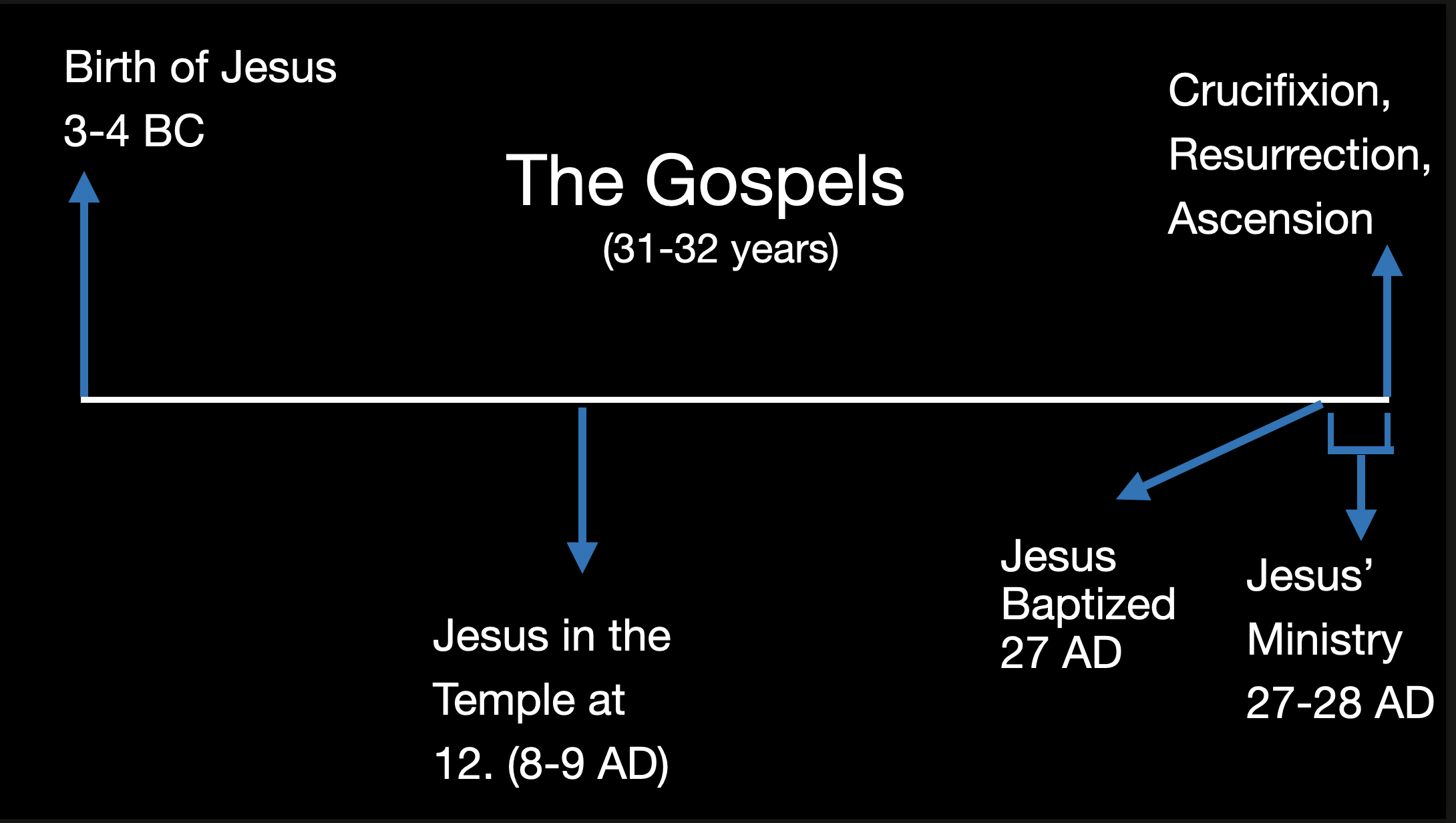
Before we continue in Acts, I want to talk about the timeline.  (You will not find universal agreement on the actual dates, but it is the division of time I want you to see here.)   The Gospels begin with the story of John the Baptist’s and Jesus’ birth around 4 BC and end with his crucifixion, resurrection, and ascension in 28 AD, covering 31-32 years.  But other than the birth narrative and the visit to the temple at 12 years old, everything else in the Gospels happens in this 1 1/2 year or 70-week period.  When we covered the ministry of Jesus, we went pretty much week by week, following him through the Gospels in real time.
The Timeline for Acts is also around 30-35 years, but the action is not concentrated at a single point.  Acts begins with the Ascension of Jesus and Pentecost, which would have been in June of 28 AD. So we have covered the first 8.5 chapters of Acts in the past 6 months, but that encompasses 2-3 years.  By the 9th chapter of Acts, it is now 2-3 years since Jesus’s crucifixion, resurrection, and the events of Pentecost.  The church has grown in numbers, and persecution has begun.  The rest of Acts covers the 3 years Paul spent in Arabia and his three missionary journeys.
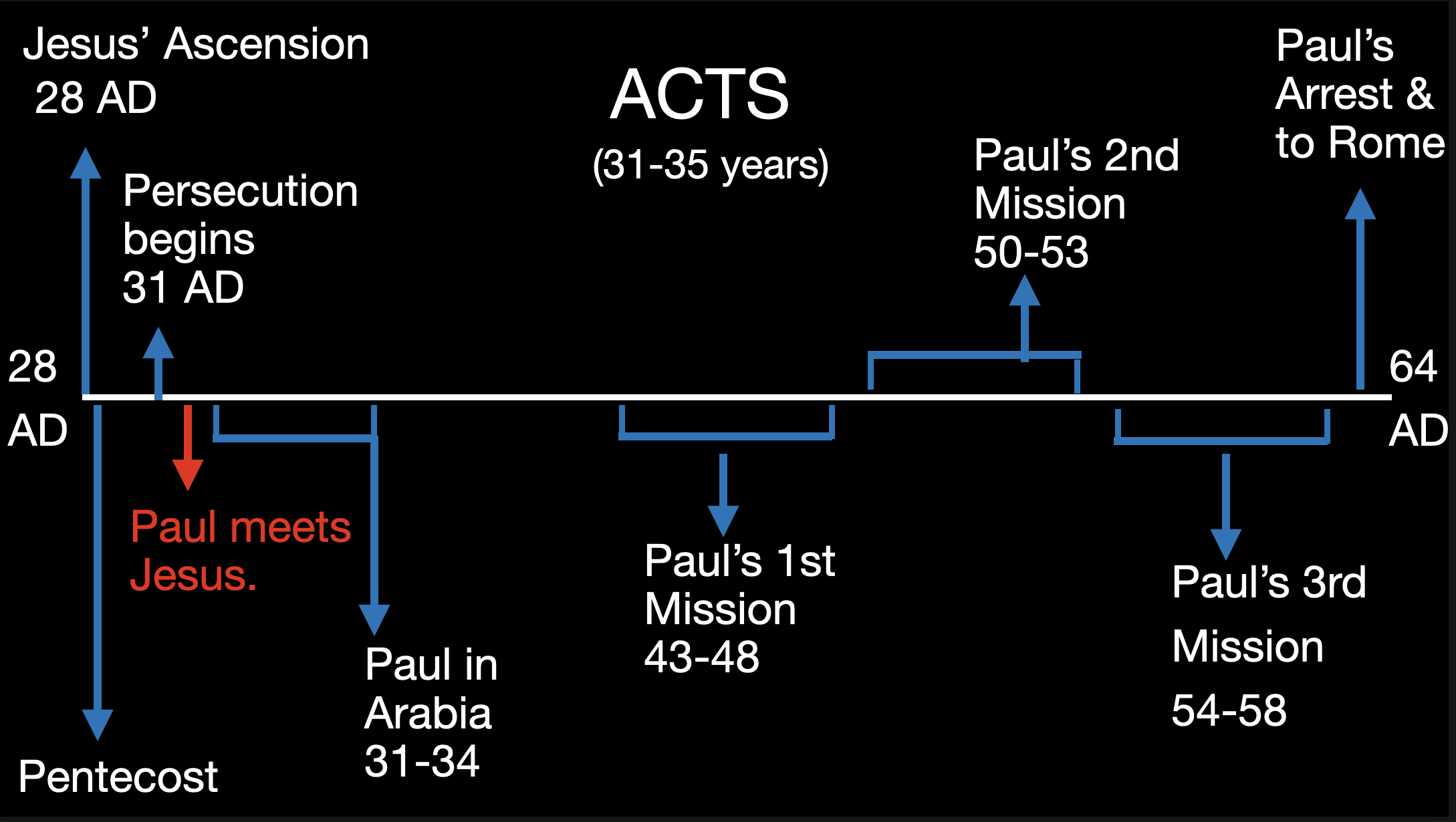
Again, today, in Acts 9, we are at the red arrow above.  Saul met Jesus near Damascus and had been in the city for 3 days.

Acts 9:10-19   Now there was a disciple at Damascus named Ananias. Yehovah said to him in a vision, “Ananias.” And he said, “Here I am, Lord.” And Yehovah said to him, “Rise and go to the street called Straight, and at the house of Judas look for a man of Tarsus named Saul, for behold, he is praying, and he has seen in a vision a man named Ananias come in and lay his hands on him so that he might regain his sight.” But Ananias answered, “Lord, I have heard from many about this man, how much evil he has done to your saints at Jerusalem. And here he has authority from the chief priests to bind all who call on your name.” But Yehovah said to him, “Go, for he is a chosen instrument of mine to carry my name before the Gentiles and kings and the children of Israel. For I will show him how much he must suffer for the sake of my name.” So Ananias departed and entered the house. And laying his hands on him he said, “Brother Saul, Yehovah Jesus who appeared to you on the road by which you came has sent me so that you may regain your sight and be filled with the Holy Spirit.” And immediately something like scales fell from his eyes, and he regained his sight. Then he rose and was baptized; and taking food, he was strengthened.

“Now there was a disciple named Ananias.” (Acts 9:10)   Where did this disciple come from?  Saul is on his way to Damascus to find the followers of Jesus who escaped from Jerusalem.  But Ananias is not one of this group, for in his conversation with Jesus, he says this:

Acts 9:13   But Ananias answered, “Lord, I have heard from many about this man, how much evil he has done to your saints at Jerusalem.

He may be a new follower of Jesus through the gospel spread by these escapees from Jerusalem, but it is more likely he has been a follower of Jesus in Damascus for some time.   Saul says in his personal account of the story in Acts 22:

Acts 22:12   And one Ananias, a devout man according to the law, well spoken of by all the Jews who lived there…

Notice that Ananias is considered a devout man by all the Jews in Damascus.  And we have already seen that he was a disciple of Jesus.  Don’t miss that followers of Jesus can worship alongside Jews in the synagogue.  And these Jews consider the Christians devout, because the Christians are keeping the law.  Again, these followers were not changing religions when they went from the Judaism they grew up in to a belief that their Jewish Messiah had come in Jesus. 

So somehow, Ananias became a follower of Jesus some time ago.  But Jesus never went to Damascus.  Damascus is a long way from anywhere Jesus went.  The closest Jesus came was Caesarea Philippi (about 40 miles away), and there was no public ministry by Jesus there that we have recorded.  

But the message spread through people whose names have never been recorded.  Someone shared the gospel of Jesus with Ananias, and now God has chosen him to correct Saul’s vision problem.  We are not told he is a leader in the church.  He has no title.  He is just an ordinary guy worshiping with all the Jews in the synagogue every Sabbath.  And they all speak well of him.  He is a man of character, well respected by all. 

God calls this ordinary man, Ananias, to do a task.   Go to Judas’ house on Straight Street to see a man for me.  The “street called straight” would be the major east-west street in the center of the city, called the decumanus maximus.  (The major North-South street is called the cardo.) You can see this street in the old town of Damascus today.  But in Ananias’ day, it would have looked more like this colonaded Roman decumanus (Straight Street) in Jerash, Jordan.
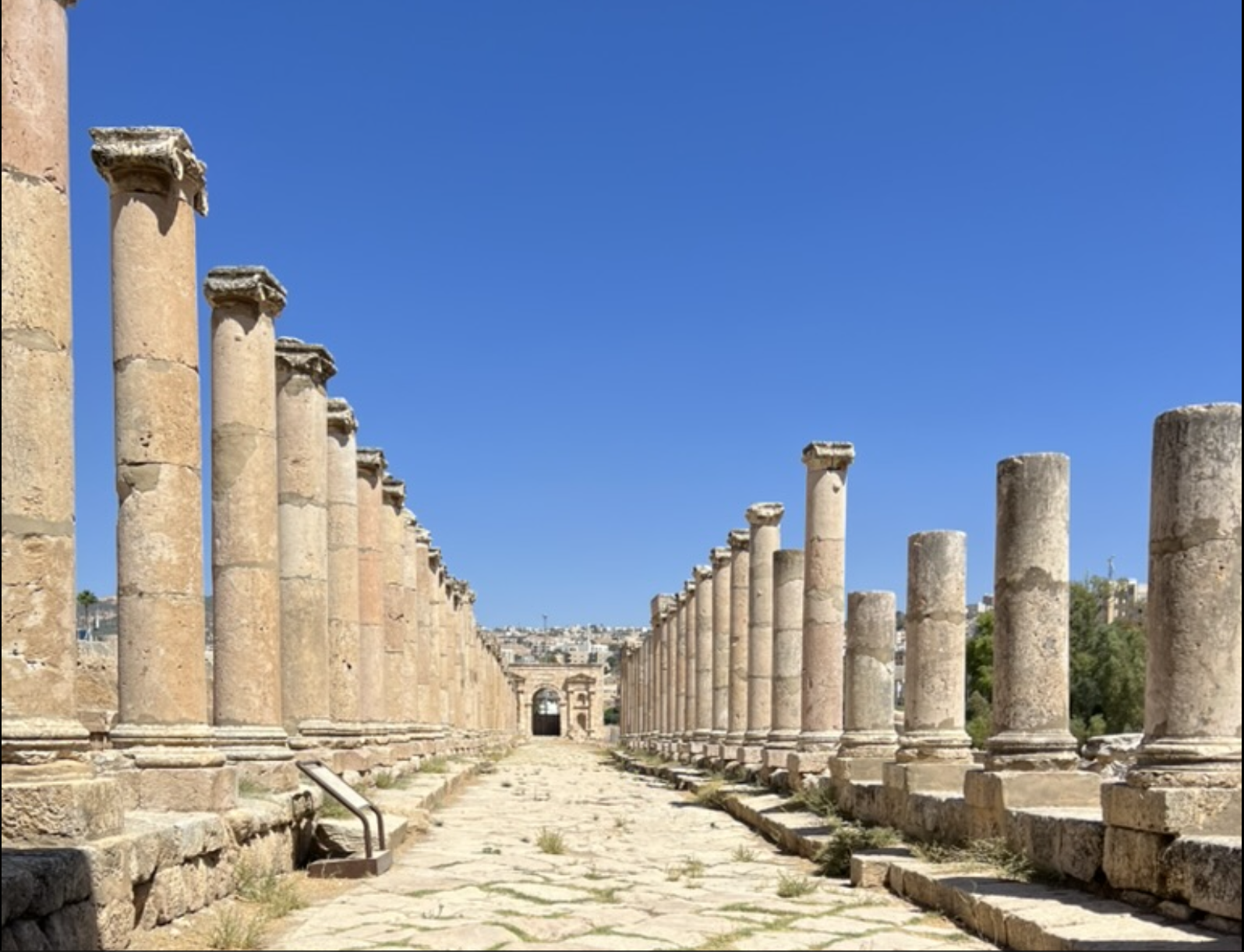
In Saul’s day, there would have been houses and shops all along these streets.  So God tells Ananias to go to the home of Judas to see a man named Saul, who has been praying, and who God had shown in a vision that you are coming.  God has really set the table for Ananias.  Have you had a witnessing experience like this: God performed a miracle to get someone’s attention, told you that you personally were coming to help them, and then told you exactly where to go?  I wonder if it wouldn’t happen more if we made a practice of listening for God’s voice.  

But this is no ordinary person that Ananias is being sent to.  Imagine Ananias’ surprise: “His name is Saul?   Saul from Tarsus?    Wait a minute!   You mean the guy who put all the Jesus followers in prison in Jerusalem, the guy who chased some of them all the way up here to tie them up and take them back there to be beaten or worse?    And you want me to go see him?” Well, to cut to the end, Ananias does go; he lays hands on Saul, and his blindness is healed, and Saul is given his call to be a minister.

Two things I want us to see in this story.  First, that God uses ordinary people like Ananias to do his work. Secondly, that God works through very unexpected ways, seeing the potential in people that we often do not see.  And I want to illustrate that by comparing this story in Acts to a very similar story in 1 Samuel. So let’s take a look at 1 Samuel 16:1-13.  Remember 2 weeks ago when we talked about King Saul?  He disobeyed God so often that God fired him as king.  So God tells Samuel to anoint someone else to be king.

1 Samuel 16:1-13   Yehovah said to Samuel, “How long will you grieve over Saul, since I have rejected him from being king over Israel?  Fill your horn with oil, and go. I will send you to Jesse the Bethlehemite, for I have provided for myself a king among his sons.” And Samuel said, “How can I go? If Saul hears it, he will kill me.” And Yehovah said, “Take a heifer with you and say, ‘I have come to sacrifice to Yehovah.’ And invite Jesse to the sacrifice, and I will show you what you shall do. And you shall anoint for me him whom I declare to you.

Samuel did what Yehovah commanded and came to Bethlehem. The elders of the city came to meet him trembling and said, “Do you come peaceably?” And he said, “Peaceably; I have come to sacrifice to Yehovah. Consecrate yourselves, and come with me to the sacrifice.” And he consecrated Jesse and his sons and invited them to the sacrifice.

When they came, he looked on Eliab and thought, “Surely Yehovah’s anointed is before him.” But Yehovah said to Samuel, “Do not look on his appearance or on the height of his stature, because I have rejected him. For Yehovah sees not as man sees: man looks on the outward appearance, but Yehovah looks on the heart.” Then Jesse called Abinadab and made him pass before Samuel. And he said, “Neither has Yehovah chosen this one.” Then Jesse made Shammah pass by. And he said, “Neither has Yehovah chosen this one.” And Jesse made seven of his sons pass before Samuel. And Samuel said to Jesse, “Yehovah has not chosen these.”

Then Samuel said to Jesse, “Are all your sons here?” And he said, “There remains yet the youngest, but behold, he is keeping the sheep.” And Samuel said to Jesse, “Send and get him, for we will not sit down till he comes here.” And he sent and brought him in. Now he was ruddy and had beautiful eyes and was handsome. And Yehovah said, “Arise, anoint him, for this is he.” Then Samuel took the horn of oil and anointed him in the midst of his brothers. And the Spirit of Yehovah rushed upon David from that day forward. And Samuel rose up and went to Ramah.

In both stories, God chooses one of his followers to anoint someone who will become a great leader.  He chose the prophet Samuel to anoint David and an ordinary man, Ananias, to anoint Saul.  Notice that both of these choices for future leaders are people who would not have been chosen by popular vote at the time.  David was the youngest son of an unremarkable family in a tiny town.  He had no political experience, no political connections, and no political aspirations.  His family was not wealthy.  Anyone alive then would tell you there was no good reason to choose this shepherd boy as king.  Yet he was God’s choice.  David had the one requirement God seeks – obedience. 

Because anything else, God can provide.  You don’t have the wealth?  God can take care of that.  You have no experience?  God has already supplied you in ways you don’t even realize, and he will continue to give you what you need.  You don’t have the right connections?  God knows everyone you need to know.  Rest assured that the creator and sustainer of this universe is quite capable of supplying all your needs.

Philippians 4:19 “And my God will supply every need of yours according to his riches in glory in Christ Jesus.”

But as we discussed several weeks ago, there is one thing God can not supply — your obedience.  God’s plan for our lives will fail if we are not obedient.  Notice I said his plan for your life will fail if you fail him.  But God will see to it that His plan is carried out.  He will give you another chance, or he will find someone else who is willing to work with him.   

Over and over in the Bible, God chooses people to do a task for which they are not fully equipped.   David does not have the prerequisites to become a king.  At the burning bush, Moses gives God all the reasons he is a poor choice.  Moses provides all his excuses, and God answers him, “I will be with you, and I will empower you.”  None of the young men Jesus chose to be disciples would have been selected by any other rabbi of the day.   Poor untrained fishermen, rash impetuous Peter, a tax collector hated by everyone, a zealot?

As with Ananias, God isn’t looking for anyone exceptional.  He doesn’t choose the wisest or the richest or the smartest.   And Saul of Tarsus … he was the one in charge of hunting down and punishing any followers of Jesus.  If you were choosing someone to be the greatest missionary of the first century and the writer of 1/4 of the New Testament, he would have been the unanimous last choice.  What do we learn from this?  Don’t judge people as you see them.  What did God tell Samuel when Samuel thought he had found the best choice for king among Jesse’s boys? 

1 Samuel 16:7   Do not look on his appearance or on the height of his stature, because I have rejected him. For Yehovah sees not as man sees: man looks on the outward appearance, but Yehovah looks on the heart.

We have to learn not to trust our own perception of people, because we tend to see only the surface, while God looks at the heart.  In the same way, we are not to trust our own judgment of right and wrong, because our vision is limited.

The first sin in the Bible was when Adam and Eve decided that the fruit looked okay to them.   They said, “I don’t see anything wrong with this fruit.”  But the sin was that they were not to decide what is right or wrong.  Only God can determine what is good and what is evil.  The minute we begin asking ourselves if something is good or bad, we have sinned.  The correct question to ask is, “Does God say this is good or bad?”  And it is the same with judging people.  It is not up to Samuel to decide which of Jesse’s sons would make a great king.  That is for God to choose, because he is God and we are not.  Isaiah said it this way:

Isaiah 55:8-9  “For my thoughts are not your thoughts, neither are your ways my ways, declares Yehovah.  For as the heavens are higher than the earth, so are my ways higher than your ways and my thoughts than your thoughts.

God is brighter than any of us.  And the level that he thinks about things is as much higher than our level of thinking as the sky is higher than the ground.  We are stuck thinking earthly, while God thinks heavenly.  So we should not be surprised when God does things very differently from the way we would.

This was a problem for the religious leaders in Jerusalem with Jesus.  No one would choose a country boy from the podunk town of Nazareth to be the Messiah.  He was not from the right family.  He had no formal rabbinic training. He did not follow all of their traditions.  He didn’t even spend much time in Jerusalem, but mainly stayed in the sticks up in Galilee.  He was nobody’s choice.  But God chose to send him specifically this way.  And part of the reason is that God wanted to show us what really matters.  

Search the Scriptures.  You will see God using unconventional methods and people no one would choose to get the job done over and over.   Say it is 1400 BC, and you want to take the most heavily defended fortified city in the world?  Not a single General in the Pentagon would come up with this strategy:   Take no weapons but trumpets and walk around the city seven times, and shout.   But that was how God had the Israelites take Jericho.

God wants Israel to defeat the army of Midian. How does he accomplish that?  First, He chose this unknown guy as a leader for the people.  A person you would have never selected because he is so scared of the Midianites that he’s hiding underground to thresh his wheat.  And then God looks at the Midianite army with over 130,000 soldiers, and then at Gideon’s army with his 32,000 soldiers, and He says, “Okay, Gideon, they outnumber you 4 to 1.  You clearly have too many soldiers, so send most of them home.”  “Okay, now you have 300 soldiers against their 130,000; they outnumber us over 400 to 1. That is much better, God says, I like those odds.

The children of Israel escape from Egypt, but Pharaoh decides to pursue them.   The Israelites are trapped by a body of water behind them, and the Egyptian army is charging at them with hundreds of chariots and the finest weapons of the day, while they have no weapons at all.  And God says, “Now we have the Egyptians right where we want them.”  Why does God consistently want to accomplish his mission with the odds stacked so high against his people? Paul answered this question in one of his letters to the Corinthians:

1 Corinthians 1:26-2:1 (NIV)   Brothers and sisters, think of what you were when you were called. Not many of you were wise by human standards; not many were influential; not many were of noble birth. But God chose the foolish things of the world to shame the wise; God chose the weak things of the world to shame the strong. God chose the lowly things of this world and the despised things—and the things that are not—to nullify the things that are, so that….

“So that…”  Wait a minute.  Slow down here.  We don’t often get explanations of why God does things.  (That is probably because we are not able to understand the explanations, much like my parents telling 3-year-old me why I shouldn’t cross the street by myself.)  So here comes the why:

…so that no one may boast before him. It is because of him that you are in Christ Jesus, who has become for us wisdom from God—that is, our righteousness, holiness, and redemption. Therefore, as it is written: “Let the one who boasts boast in the Lord.”

God does this so that no one can boast, saying, “Look what I did.”  Do you think any of Gideon’s 300 soldiers went home after that battle and bragged to their wives about how they fought so well and defeated the 130,000 Midianites?  Nobody would believe them.  God fixed it so everyone would know He won the battle.  He defeated the Egyptians in the Sea of Reeds.  Everyone left those situations praising God and boasting of God’s power and his victory.  Salvation – whether it is deliverance from the enemies of this world or deliverance from the enemy of sin and death, salvation has always been about what God does; it is not of our works, lest any man should boast.  Paul repeats it:

Ephesians 2:8-9   For by grace you have been saved through faith. And this is not your own doing; it is the gift of God, not a result of works, so that no one may boast.

See, soldiers of Gideon, it was by God’s grace you were saved.  Hey Israelites strolling through dry ground between walls of water, guess what?   God did this, and you didn’t do anything to deserve it; he did it out of his chesed (his loyal covenant love and grace).  Hey church member, you can’t earn your salvation either.  Your obedience is your way of telling God you love Him.

I sat in a deacon’s meeting one day and listened to a discussion about whether our church should join with other local churches to form a mission to the poor and marginalized of our county.  And the debate went as you would expect, with men raising reasonable questions, such as: “Do we have the financial resources to participate in this?”  “Do we have the people who will volunteer to fill the roles needed?”  “Is this something we are capable of doing?”  “How long a commitment would we be making?”  There were 20 minutes spent analyzing the situation as a CEO would consider the pros and cons of opening a new business location, or as a general would consider the options for fighting a battle.  I asked the question that I thought was the only important one: “But does God want this to be done?”

But the discussion soon returned to the logistics. Someone actually said, “Well, if God wanted us to do it, He would have already given us the resources to do it.”   And in the end, it was decided that we would not participate in the project.  Without this large church’s support, the plan for that mission fell apart. And I believe that day, God’s plan was temporarily delayed by our disobedience.  But God wanted this mission to happen, so he found another church that would do it.   And it became a very successful outreach to many poor and marginalized in our community for many years.  The idea that was missed in that meeting was that God calls and then, as you go about being obedient, He equips you for the task, supplying your every need.  

If we only attempt to do the things we currently have the resources for, we have no faith.  If we only attempt tasks we are capable of doing, there is no need for God to join us.  We complete the task, but there is no growth in our faith, no growth in our relationship with God.  If we are called to attempt impossible tasks, then we leave room for God to join with us.  We do the task under his power, not our own. With resources He supplies from His riches.  That experience deepens our faith in God and strengthens our relationship with God.  Of course, God could do all these things without us.  He could have rescued the Israelites without Moses; He didn’t need Moses’s staff to part the sea or win a battle.  But he chooses to call us alongside him to do the work because he wants our relationship with him to grow.  

We looked at two stories of two different Sauls.  Acts 9 of Saul and Ananias, and 1 Samuel 16, of King Saul and Samuel.  The Hebrew word Shaul is a verb meaning ‘to ask’. As a name, it means ‘one who is asked’.  Saul in the Old Testament was asked to be king of Israel.  He was asked to be a king who was obedient to God, who would lead the people in the way God directed.  Saul in the New Testament, was asked by God to be a leader, a missionary to Jews, Gentiles, and kings.  Two Sauls, one a colossal failure and the other recorded in the Bible as one of God’s best servants, and the difference is obedience.

And these two stories illustrate the unlikely people God chooses to do his work.  We see them as unlikely because we don’t see them as God sees them.  The people in Acts 9, including Ananias, looked at Saul and saw a threat.  A man who could cause them harm.  What did God see when he looked at Saul?   A man who wanted to fight for God.  A man who was not comfortable just complaining about a problem but was willing to give 100% to solve a problem. A man of high commitment and zeal.  Sure, Saul was wrong, but in God’s thinking, what a fantastic missionary a man like this could be if he turned toward the truth.  We need to see people with God’s eyes. 

Where we see threats and danger, God sees purpose and commitment.  Where we see Insignificance, God sees potential.  Where we see impossibility, God sees opportunity to grow our faith.  And where we see broken pasts, God sees redeemed futures.

Let us seek to see the world through God’s eyes, not our own.  Let us see people as God sees them, looking for the potential within them.  And let us always be open to respond obediently to God’s call on us to do things that are beyond our ability, for then we partner with Him and grow in Him. 

August 5 –  The Beggar at the Gate — Acts #7

August 5 –  The Beggar at the Gate — Acts #7
Acts 3:1-10

Acts 3:1-10   Now Peter and John were going up to the temple at the hour of prayer, the ninth hour. And a man lame from birth was being carried, whom they laid daily at the gate of the temple that is called the Beautiful Gate to ask alms of those entering the temple. Seeing Peter and John about to go into the temple, he asked to receive alms. And Peter directed his gaze at him, as did John, and said, “Look at us.” And he fixed his attention on them, expecting to receive something from them. But Peter said, “I have no silver and gold, but what I do have I give to you. In the name of Jesus Christ of Nazareth, rise up and walk!” And he took him by the right hand and raised him up, and immediately his feet and ankles were made strong. And leaping up, he stood and began to walk, and entered the temple with them, walking and leaping and praising God. And all the people saw him walking and praising God, and recognized him as the one who sat at the Beautiful Gate of the temple, asking for alms. And they were filled with wonder and amazement at what had happened to him.

Peter and John are going to the Temple for the 3 pm service of prayer and sacrifice.  And they encounter a man who has been paralyzed since birth.  

There is much discussion among theologians about exactly where this man was begging.  Luke tells us that it was at the gate to the temple called the “Beautiful Gate.” A gate is an excellent location if you were a beggar.   It’s a place where many people would have to pass by.  But no other sources except the scriptures use the term “the gate called Beautiful”.   There are eight gates by which to enter the 36-acre Temple Mount, and then several more to enter the inner courts of the Temple.

Many place the “Beautiful Gate” as one of the inner gates.  The historian Josephus describes a magnificent gate made of fine Corinthian brass and plated with gold and silver, so heavy it took 20 men to move the doors.  But experts differ on whether this inner gate was the entrance to the court of women or the gate from the court of women to the court of Israel.

But the scripture we read this morning lets us know that neither of these gates within the temple could be correct.   Because this was no ordinary man, he was lame from birth.  His legs had shriveled from disuse and were twisted and disfigured.  He was not allowed to go into the temple like other men could because he had a defect.

In Leviticus 21, there are requirements for a priest who could make offerings at the altar or enter the holy place:

Leviticus 21:16-19   And Yehovah spoke to Moses, saying, ‘Speak to Aaron, saying, None of your offspring throughout their generations who has a blemish may approach to offer the bread of his God. For no one who has a blemish shall draw near, a man blind or lame, or one who has a mutilated face or a limb too long, or a man who has an injured foot or an injured hand…

And the list goes on.  But the first mentioned is the blind and lame.  Now these ‘blemished’ priests could do other priestly duties, but they could not approach the altar or the holy place.  Just as the sacrifices had to be unblemished, so too did those offering them.  That rule only applied to priests, but by Jesus’ day, many laws for purity intended for priests were made requirements of all people.  For example, in the Mishnah, a record of the Pharisees’ rulings, Mishnah Kelim 1.8 discusses that people with discharges of impurity could not enter the Temple Mount at all.1  

And we know those with the disease lepra could not enter the temple area.  And many add that people who were lame or blind were not allowed to enter the Temple Mount.2  (And the Rabbis’ scriptural basis for this comes from this passage in Leviticus and a rather odd interpretation of 2 Samuel 5:8)3.

So this lame man was likely placed daily at one of the primary entrances to the Temple Mount.  The primary entrance at the southern side of the Temple Mount was a massive double gate with elaborately carved arched ceilings in a tunnel that led up to the Temple Mount.  (Portions of these beautiful carved ceilings can still be seen today.)  It was the gate with the most traffic, so it was the best place to beg.  And this was as close as this lame man would ever get to the temple itself.  As he had no hope for healing, he had no hope of ever going inside.  So he is left begging at the gate, never able to go in and see the riches and grandeur inside.

Does this remind you of a story Jesus told?  I am thinking of the story of the “Rich Man and Lazarus.”  Lazarus was the beggar at the rich man’s gate, and it makes me wonder if the people in Jesus’s day didn’t see something in that story we miss.  Whenever Jesus’ listeners went to the temple, they would pass by many poor beggars at the gate who were never allowed inside to see the opulence of the Temple.  They may have seen this story as yet another condemnation of the wealthy religious officials who oversaw the Temple. 

There is another story in Matthew 21 that brings attention to the blind and lame who were not allowed in the Temple. After Jesus’ triumphant entry into Jerusalem, he turns over the tables of the money changers and drives out the animals.  This is in Matthew 21

Matthew 21:12-13   And Jesus entered the temple and drove out all who sold and bought in the temple, and he overturned the tables of the money-changers and the seats of those who sold pigeons. He said to them, “It is written, ‘My house shall be called a house of prayer,’ but you make it a den of robbers.”

However, there is more to this story that we didn’t have time to talk about in April when we discussed it.  There is something else going on that caused Jesus to be fed up with the poor state of religion that day.  And there is something else that happens before the chief priests and scribes get mad at Jesus.  Let’s read the rest of the story in the following two verses:

Matthew 21:14-15. And the blind and the lame came to him in the temple, and he healed them. But when the chief priests and the scribes saw the wonderful things that he did, and the children crying out in the temple, “Hosanna to the Son of David!” they were indignant…

And the blind and lame came to him in the Temple, and he healed them.   Jesus has the nerve to invite these unclean, blind, and lame people into the temple.  And he rewards their law-breaking with healing for which he is praised. At this point, the priests and scribes become furious.  But they are not the only ones angry.  Jesus was angry.  And now we can see why Jesus was so angry that day, and why he was moved to drastic action.  

Jesus is angry because they are taking advantage of the poor with their businesses in the Temple and because they leave the beggars outside the gate of the Temple, not only offering them no assistance, but also refusing them the opportunity to participate in worship.  It was the responsibility of the Temple to care for these people.  There were offerings designated for them.  They should never have to beg.  But instead of distributing these funds to those in need, the Temple officials devised ways to make themselves even richer while these beggars starve.

So on the day of his triumphant entry, Jesus enters the temple and passes by the blind and lame beggars who are starving because the temple rulers are hoarding the money donated in the temple and not using it to care for the poor.  Jesus sees this as he enters the temple, and the next thing he sees is the money changers and the animal merchants cheating the people, again enriching the temple rulers at the expense of the poor.  And Jesus is not going to stand for it.  He disrupts the money changers and drives out the animals, and then he invites the deaf and blind into the temple, where he heals them. 

About a year ago, we discussed what makes God angry.  Do you remember the first time in the Bible that God is described as angry?  It is when he tries to get Moses to lead his people out of Egypt.  At the burning bush, God told Moses that he saw his people, Israel, in their affliction, how the Egyptians were abusing them, how the Egyptians were killing their children, and God had compassion on them.  But five times, Moses refuses to go and lead the people, even though they are his people.  Even though Moses was one who, as a baby, was rescued from the Egyptians’ plan to kill all male children.  It is Moses’s lack of compassion for his own people and his refusal to help the afflicted that angers God.  

We discussed the New Testament story where Jesus was about to heal the man with the withered hand, enabling him to work and provide for his family instead of being a beggar.  But the Pharisees only see this poor man as a chance to trap Jesus if he heals on the Sabbath.  Jesus became furious with the Pharisees because of their lack of compassion for this man, more interested in their petty rules than in this man’s well-being.

 And on this day, He sees them taking advantage of the poor, refusing compassion to the blind and lame, and using His Temple to do these things.  They have turned his Temple into a den of criminals.  This is why the Temple is going to fall.  This is why God uses the Roman army as a tool in his hand to knock down every stone. God will not stand by and watch his people refuse to help the poor, the needy, the ill, the sick, while they are inside the walls pretending to worship.

With this background, let’s look at today’s story again. Peter and John approach this lame man who is begging.  He sees them.  Alms!  Alms!  It comes from the Greek word for mercy.  Now they could have passed by him just like everyone else had passed by him so many times.   He has been there every day for 40 years.  Perhaps they had passed by him before.  But not today.  Today, they “directed their gaze at him”.   This man was right in front of their eyes, but was unseen by most, overlooked, and ignored. 

It is a wonderful thing to be seen, to be noticed. There are plenty of people in this world who feel invisible, overlooked by everyone.  In moments of distress, we’ve all felt like no one understands what we are going through, that no one truly sees our dilemma. But know that God sees you. When Hagar was mistreated and abused and fled to the wilderness, God sent an angel to her to tell her that he saw her in her distress and that he was looking out for her.  She called him El Roi, “the God who sees me.”   God saw the affliction of his people in Egypt and delivered them.  God saw us in the hopelessness of our sin and sent Jesus to deliver us. No matter how invisible you think you are to the rest of the world, know that God is still El-Roi. He sees you and desires to heal you, to deliver you.

And if we are his children, we need to learn to see as God sees.  We need to seek out those the world has tossed aside, those deemed unfit—those seen as unproductive or damaged.  We need to see the forgotten at the gate.  If Jesus has given us a new heart and God’s Holy Spirit lives in us, we cannot just pass by those in need.

Peter and John looked at this man.  And they asked him to “Look at us.”   Where had the man’s attention been?   Was he searching the crowd for someone who appeared wealthy enough to give him some money?  Was he just hoping to make eye contact with someone to garner some sympathy?  Or was he just so defeated that his gaze never left the ground?  But he looks at Peter and John.  And you can almost feel his relief that finally someone has noticed him and will contribute so he can eat today.  

And Peter says, “I don’t have any money.”  Now you can almost feel his disappointment.  Just my luck, he thinks to himself, the one person who pays me any attention, and they are broke.  But look at what Peter actually says.  In the Greek construction, it is:  “Silver and gold do not exist through me.”  Peter is saying, “What you are begging for is of no importance to me.  It doesn’t exist through me.” Peter has his priorities right!  This paralyzed beggar doesn’t see it yet, but what does exist through Peter?  God’s Holy Spirit exists through Peter, so Jesus exists through Peter.  Peter is Jesus’ hands and feet and voice in a world full of beggars, and this beggar is about to see Jesus through Peter.  But I get ahead of myself.  

At this point, the beggar realized he wasn’t going to get what he was hoping for: money to buy food.  He has been begging his whole life.  40 years.  He had long ago given up hope that he would be healed.  He had long ago given up hope that he would ever be able to work and make his own money.  He had long ago given up hope that he would ever see the inner courts of the temple and be able to worship there.  Everyone who passed him by daily lived in a different world than he did.  His world had been upside down since he was born.

A few months ago, he had heard about this man called Jesus, a healer.  He had even heard that he had healed some people who were lame like him in the Temple.  He had hoped to have a chance to encounter Jesus, but he had missed him.  And then he heard Jesus was dead.  Now he is a man with no hope.  

But then it happened. Peter continues, Silver and God do not exist through me, but I am going to show you who does exist through me.  You are about to see the power of who exists through me. “In the name of Jesus Christ of Nazareth, rise up and walk!”  At the mention of this name, Jesus Messiah, Peter reached out his hand to the beggar.  And somehow, the man raised himself upright for the first time in his life.  Never had he ever stood.  And now, yes, not only could he stand, but he could walk.  And he could leap.  And his world turns right-side up for the first time in his life.

These two men, Peter and John, continued into the temple, but he sure wasn’t going to let them get away.  He was healed, and for the first time in his life, he too could enter the temple.  He stayed right with them.   And everyone he passed was shocked.  They had seen him for years with his misshapen, shriveled limbs, and how he was leaping and dancing about.  He was creating a scene.  And a crowd followed them to Solomon’s Porch in the Temple.  They were asking how it happened, and some people were praising the two men who healed him.   And the man Peter begins to preach to them right there. And next week, we will discuss Peter’s sermon and the response, but there is so much we need to see here.   

We don’t use the word ‘lame’ much to refer to people anymore.  You have probably heard it more often in the context of horses being lame.  But it is a slang use of ‘lame’ that has become more common in the past 50 years.  “That was a lame joke.”  What we have to see, before we move on, is that this story in Acts 3 is the story of “A Lame Man and a Lame Religion”.  A man who could not walk and a religion that does not work.  A man with useless legs and a religion that is useless.  We have to see where these first-century religious leaders went wrong so we can avoid making the same mistake.

Before Peter and John showed up, it was just another day in the temple.  Business as usual.  They were going about their usual schedule of worship and prayer services.  They were doing all the required sacrifices.   They were probably commenting on the great job the choir did on the psalms that morning.  And didn’t the high priest look especially nice today?  And we’ve got a pretty good crowd for a hot summer day, don’t we?  Business as usual.  Hey, look at us; we are doing God’s work here.  

But just outside the gates were those who needed mercy, those who needed compassion, those who needed healing. Those who needed to be seen.  This is not new.  God has dealt with this before.  Let’s go back 700 years before our story today—the time of Isaiah.  Let’s look at Isaiah chapter 1.  There is a verse there you will recognize. 

Isaiah 1:18  Come now, let us reason together, says the LORD: though your sins are like scarlet, they shall be as white as snow; though they are red like crimson, they shall become like wool.

But do you know the context for that verse?  Let’s back up to verse 11, and we will use The Message version:

Isaiah 1:11-18   “Why this frenzy of sacrifices?”  GOD’S asking.
“Don’t you think I’ve had my fill of burnt sacrifices, rams and plump grain-fed calves?
Don’t you think I’ve had my fill of blood from bulls, lambs, and goats?
When you come before me, Whoever gave you the idea of acting like this,
Running here and there, doing this and that— all this sheer commotion in the place provided for worship?
“Quit your worship charades. I can’t stand your trivial religious games:
Monthly conferences, weekly Sabbaths, special meetings
meetings, meetings, meetings—I can’t stand one more!  Meetings for this, meetings for that. I hate them!
You’ve worn me out! I’m sick of your religion, religion, religion,
while you go right on sinning.  When you put on your next prayer-performance,
I’ll be looking the other way. No matter how long or loud or often you pray, I’ll not be listening
And do you know why? Because you’ve been tearing people to pieces, and your hands are bloody.
Go home and wash up. Clean up your act. Sweep your lives clean of your evildoings
so I don’t have to look at them any longer. Say no to wrong.  Learn to do good.
Work for justice. Help the down-and-out. Stand up for the homeless. Go to bat for the defenseless.

And then comes the verse we know….

“Come. Sit down. Let’s argue this out.” This is GOD’S Message:
“If your sins are blood-red, they’ll be snow-white.
If they’re red like crimson, they’ll be like wool.

There is a great sin they need to be cleansed of.  You see, the same thing is going on in 700 BC as is going on in Jesus’ day.   They are going through the motions of worship.  They are busy with sacrifices, busy with offerings, busy with praises, busy with prayers.  But God is sick of their worship services, because they are not busy with obedience.  They are not busy with compassion.  

Last week, we discussed what God really wants from us, and I asked the question, “What does God really want?”  The answer: obedience.  Today, from our story of the lame man in Acts 3 and now from Isaiah 1, we see what else God wants from us: compassion.  God wants us to have compassion for those who are poor, homeless, sick, and defenseless.

Why was God sick of their worship?   It is because they have a lack of obedience and a lack of compassion.  Look at verses 15-17 again and see the call to obedience and the call to compassion:

Go home and wash up. Clean up your act. Sweep your lives clean of your evildoings
so I don’t have to look at them any longer. Say no to wrong.  Learn to do good.
Work for justice. Help the down-and-out. Stand up for the homeless. Go to bat for the defenseless.

Do you see that this is the same problem Jesus had with the temple leaders in his day?  God is serious about obedience and compassion.  This is the reason that Northern Israel was destroyed by Assyria in 721 BC. This is the reason that Judea was destroyed by Babylon in 586 BC. This is the reason that the temple in Jerusalem was destroyed by Rome in 70 AD. And every day up until the Temple was leveled to the ground, they were performing useless sacrifices and praying useless prayers — pretending to worship a God that would not listen to their prayers or pay attention to their worship.

It does not matter how we worship.  God does not care if it is contemporary or traditional.  God does not care if worship is in a vast, beautiful sanctuary or a tiny shack.  He does not care if there are 10 people there or 10,000.  God’s primary concern is not how good the music is, or how great the preacher is, or how nice everyone dresses.  He doesn’t care if worship lasts 30 minutes or 4 hours. What God really wants from your church is not what happens on the printed ‘order of worship’ and not what happens within the four walls of your sanctuary.

What does God really want from us?  Obedience and compassion for others. This is what Jesus said.  He tried to make it clear to us.  Remember, they asked him what the most important verse in the Bible was, and what was the greatest commandment?

Matthew 22:37  You shall love the Lord your God with all your heart and with all your soul and with all your mind.

And what is God’s love language?  Jesus said:

John 14:15  If you love me, you will keep my commandments.

We reveal our love to God by our obedience to him.  And the second most important commandment?

Matthew 22:39 (quoted from Leviticus 19:18) Love your neighbor as yourself.

So, what does God want from us? First of all, God wants our obedience, and secondly, he wants us to have compassion.  This is the message that runs all through the Bible.

This man was laid by the gate for 40 years.  He saw thousands of people pass by.  But Peter and John that day didn’t just pass by.  And they didn’t just take a second to drop a coin in his bowl.  They had an encounter with him and became the hands and feet of Jesus to him.  They let the Holy Spirit within them be known to him.   It was Jesus who existed through them that day, not silver or gold.

How many people do you pass by?    How many do we not even see?  We worship the God Hagar called “El-Roi,” the God who sees.   If the Holy Spirit is within us, we should see as God sees.  And God became blind to their worship because they were blind to the poor around them.

I pray God will open our eyes to the beggars at our gate, that we may meet their needs and invite them in to relationship with us and into worship with us.   I pray that our compassion would take the form not just of a few dollars in their pocket but in the gift of the presence of God in their lives.  Because, like the beggar at the gate, they think what they need most is money, and we can fill that need.  But we can give them more.  We can give them Jesus through our love and compassion.

This week, I challenge you to follow the example of Peter and John.  Do not be a passerby.   See the needs around you and then reach out to fill the needs.  Be obedient.  Be compassionate.  That is what God really wants.

1.  The Mishnah is a collection of oral teachings of religious scholars that was finally composed in written form in 220 AD, though the teachings themselves dated much earlier. (The Temple was destroyed in 70 AD.)
2.  Razafiarivony, Davidson.  “Exclusion of the Blind and Lame from the Temple” in The American Journal of Biblical Theology.  Vol 19.  August 26, 2018.
3.   2 Samuel 5 has the story of King David conquering the city of Jerusalem.  The inhabitants (Jebusites) taunted David by telling him the city was so well fortified that they let the blind and lame guard the walls.  David says in 2 Samuel 5:8, “Whoever would strike the Jebusites, let him get up the water shaft to attack ‘the lame and the blind,’ who are hated by David’s soul.”  And the narrator adds, “Therefore it is said, ‘The blind and the lame shall not come into the house.’” Indeed, David did not hate men because they were blind and lame, but because they were Jebusites.  And we know David went out of his way to show great care for Mephiboseth, a descendant of Saul who was lame and lived in David’s house.  Nevertheless, that verse was used as proof that the blind and lame should not enter the temple.

September 18, 27 A.D.  Jesus Walks on the Water #51

Week 31 ———  Jesus Walks on the Water
Matthew 14:22-33 — Mark 6:45–52 — John 6:16-21

Jesus got the bad news about John’s death.  He wanted to go off by himself to grieve but ended up healing and teaching a large crowd and then performing a miracle to feed them.  

Matthew 14:22-23  Immediately, he made the disciples get into the boat and go before him to the other side, while he dismissed the crowds.  And after he had dismissed the crowds, he went up on the mountain by himself to pray. When evening came, he was there alone.

Jesus made (not asked)1 the disciples get in a boat to go to the other side of the lake.  He finally gets some time alone and goes to the mountain to pray.

Matthew 14:24-25  …but the boat by this time was a long way from the land, beaten by the waves, for the wind was against them.  And in the fourth watch of the night…

You remember the last time the disciples made a night trip in a boat a few weeks ago.  The storm was so bad they thought they would die, but Jesus was in the boat with them, and he calmed the storm.  Well, the wind was against them again, and this trip should have only taken a few hours in the boat, but now it is the fourth watch (between 3-6 am).  They have been rowing a boat against the wind for 6 hours.  They are exhausted and getting nowhere.  Matthew tells us they are “many stadion.” (A stadia is about 600 feet2)   The sea is beating them down, and Jesus is not in the boat with them this time.  They are on their own.  During the last storm, Jesus said they had no faith, zero faith.  Jesus is now testing their faith.  Have they learned anything from the previous storm, from the last few weeks of teaching and miracles?   

Matthew is telling these stories to let us know how Jesus taught them what it means to be a disciple — a disciple of one who controls the wind and waves, one who always acts out of compassion, one who fills the needs of people when there aren’t resources.  A disciple must have the faith to do what is asked despite any circumstances.   So he made them get back in the boat and gave them another storm.  And the Bible doesn’t say they are scared to death- good, maybe they have faith now.  But the test is not over.

Matthew 14:26   But when the disciples saw him walking on the sea, they were terrified and said, “It is a ghost!” and they cried out in fear.

So the wind and waves don’t scare them. But they see this figure walking on top of the water (this same water that is so churned up they can’t get anywhere).  And they are terrified again.

Mark 6:48-50   And about the fourth watch of the night he came to them, walking on the sea. He meant to pass by them, but when they saw him walking on the sea, they thought it was a ghost and cried out, for they all saw him and were terrified.  But immediately, he spoke to them and said, “Take heart; it is I. Do not be afraid.” 

He meant to pass by them.  (Thanks for the smile, Mark.) In the last storm, Jesus was sleeping; this time, he was just out for a stroll.  What’s the message?  Don’t be afraid of storms.  Don’t be scared of ghosts.  What is the most common command in the Bible?  Do not fear!   

Matthew 14:28  And Peter answered him, “Lord, if it is you, command me to come to you on the water.” He said, “Come.” So Peter got out of the boat, walked on the water, and came to Jesus.

Peter wanted to be a disciple.  Again, the goal of a disciple is not to know what the rabbi knows; it is to be who the rabbi is.  To do what he does.  To follow.  And this is not Peter’s brashness talking.  He wouldn’t step out of the boat unless Jesus told him to.  At this point, we would all say of Peter, “Wow! he sure has a lot of faith!”   I don’t see the other 11 disciples stepping out.  But keep reading…

Matthew 14:30-31   But when he saw the wind, he was afraid, and beginning to sink he cried out, “Lord, save me.”  Jesus immediately reached out his hand and took hold of him, saying to him, “O you of little faith, why did you doubt?”

What happened?  Jesus says Peter has no faith.  We talked last week about how Jesus defines “little faith.”  It is less faith than the smallest thing in their world, a mustard seed.  It is zero faith.  Jesus seems to say that you either have faith or don’t.  It is not a measurable commodity.  And here, Jesus says Peter does not have faith.  But let’s look at that scripture:

Luke 17:5-6   The apostles said to the Lord, “Increase our faith!”   And the Lord said, “If you had faith like a grain of mustard seed, you could say to this mulberry tree, ‘Be uprooted and planted in the sea,’ and it would obey you. 

The disciples thought faith was measurable and that you could get more of it. We know this because they asked Jesus for more faith. Then Jesus tells this parable that, at first, looks odd.

Luke 17:7-10  “Will any one of you who has a servant plowing or keeping sheep say to him when he has come in from the field, ‘Come at once and recline at table’?  Will he not rather say to him, ‘Prepare supper for me, and dress properly, and serve me while I eat and drink, and afterward you will eat and drink’?  Does he thank the servant because he did what was commanded?   So you also, when you have done all that you were commanded, say, ‘We are unworthy servants; we have only done what was our duty.’”

The story’s point is that the slave is just doing what he is supposed to do.  His position is to be obedient to his master.  And when he is obedient, he is not greatly rewarded for his obedience.  He is not invited to the table to eat but is expected to serve the meal. The master does not lavish honor and thanks on the servant; he is just doing what he is supposed to do.  And when the slave has completed his tasks he says: “I don’t deserve a reward; I have done only what was expected of me.”

What a strange answer to a request for more faith!  But wait, maybe it isn’t so strange.  What it tells us is that faith is not something I am given as a reward.  It is not something given as a sign of privilege.  Faith comes by obedience – and obedience is expected!  We are not obedient to God to earn a reward or honor.  We are obedient because it is our position to be obedient.  He is God.  We are not.  And God does not owe us anything for our obedience.  What God gives us, especially salvation, is not due to our obedience but out of his love, mercy, and grace.  

If you ask for more faith, God will not just go to his cabinet, get out a bottle of faith, and pour more on you.  He will simply give you more to do.  If you obey Him, you will discover that your obedience is the faith you desire.  To request an increase in faith is to ask for the opportunity to be more obedient.  The times in my life that I have felt my faith was the strongest was after I had been obedient to some difficult things.

You don’t need more faith; you just need to continue being obedient. The power to fling mulberry trees or mountains around is not dependent on the measure of our faith but on the measure of God’s power, which is limitless.  

Paul said that faith comes through obedience, in a much-misunderstood verse.  

Romans 10:17   So faith comes from hearing, and hearing through the word of God.

Paul is not saying that you get faith by reading the Bible.  This verse is only valid if you remember that Paul is a Jewish Rabbi.  To Paul, hearing is not just listening but obedience. Shema (Hebrew for ‘to hear’) means to hear AND obey.  So, in this verse, Paul says, “Faith is a result of hearing the word of God and doing it.  Faith is not the prerequisite for obedience but the result of obedience.  First, I am obedient to what God calls me to do, and by doing so, I discover that I can stand on his word.  That is faith.  Faith is impossible without obedience. If you do not obey God, you have no faith.

Peter steps out and stands on the water, but he ‘sees the wind’ and then starts sinking.  Of course, you can’t see the wind; you can only see the results of the action of the wind.  You can’t see faith either; you can only see the actions of faith  – because faith is obedience.)  What did Peter doubt?  He didn’t doubt Jesus; Jesus seemed to be just fine standing on the water waiting for him.

What is doubt?  There is no Hebrew word for doubt.  Why not?  The answer is in Genesis 3.

The serpent asks, “Did God really say that?  You won’t really die.  You will be like God, able to make your own decisions and decide for yourself.”  So Eve looks at the fruit, and to her, it looks good, so she weighs that against what God said, decides for herself, and is disobedient.  It is what makes sense to her.  She didn’t doubt God; she just decided that she was a better judge of what was best for her.  

The Greek word for doubt is ‘distazo.’  It comes from a root meaning ‘two.’  Peter looks at the wind and waves and how crazy this is. Like Eve, he weighs that against what Jesus has shown him and decides for himself.  He should have kept walking but stopped and considered the two options.  Is God right, or is my understanding of physics right?  He hesitates to walk any further while he tries to decide between the two viewpoints.  And he sinks.  

It is okay to ask God ‘why’.  It is not okay to wonder if God is telling the truth, if God means what he says, or if God is God.  What kind of arrogance does it take for someone to think they are smart enough to decide if God is right or wrong?  It takes Adam’s and Eve’s kind of arrogance, yours, and my kind of arrogance. This is the opposite of faith, and it is sinful.  When Jesus asks Peter why he doubted, he is asking why he stopped walking.  Doubt is hesitation; it is stopping your obedience to consider if God is right.  James said it this way:

James 1:6-8  But let him ask in faith, with no doubting, for the one who doubts is like a wave of the sea that is driven and tossed by the wind.  For that person must not suppose that he will receive anything from the Lord; he is a double-minded man, unstable in all his ways.

I have to think James is thinking about the story of Peter on the water, comparing doubt to a wave in the sea.  Doubt is being double-minded, wavering between two worldviews.  

Let’s tie this all together.  Jesus is trying to teach these young men what it means to be a disciple.  Look at the world and have compassion for the people.  Don’t walk through the world with blinders on.  We pass by people who are hungry and homeless and depressed and sick and tired and hopeless without Jesus every day.  See the needs around you.  Then, take it to Jesus.  Pray to Jesus:  these people need help!  And Jesus will smile at you and say, “Good, you go help them.”  And then bring whatever you have to Jesus to solve the problem.  Even though there is no way your little can begin to solve a huge problem.  Bring it to Jesus; be willing to bring your all.  And Jesus will multiply it and give it back to you to hand out.  Don’t waver.  Don’t be double-minded.  Don’t hesitate on your obedience by stopping to consider how it doesn’t make sense.

It doesn’t make sense that you can feed thousands of people with five loaves and two fish; it doesn’t make sense that you can treat a hundred children with four antibiotics.  It doesn’t make sense that you can walk on water.  It doesn’t make sense that God would love us, despite our rebellion, that he would send his Son to suffer and die for our sins.   And the issue is not how strong your faith is but how strong the object of your faith is.  It is not the power of your faith but how powerful God is.  We don’t need faith in our faith, but faith in Jesus.  And faith comes by obedience.  

  1. The Greek verb for ‘made’ (the disciples get into the boat) is ‘anagkazo’, a very forceful verb, elsewhere in the New Testament translated as ‘compelled’ or ‘forced’.  It makes you wonder if the disciples might have hesitated to get back in a boat in the evening after their most recent evening trip that ended in a storm that scared them to death.
  2. The Greek stadia was a measure of length equal to 1/8 of a Roman mile or about 600 feet (or about 1 furlong for horse racing fans). This is the distance of two 100-yard football fields. Interestingly, the plural ‘stadion’ came to refer to the race track itself. The track at Olympia was 192 meters or one stadia. From this, we get the word ‘stadium’ to refer to the facility with the running track and then to any sports event.