July 28, 2026 – How to Respond to a Miracle— Acts #48
Acts. 14:1-7
Last week, we looked at Acts 14 and how God healed the man in Lystra who had never been able to walk. This week we will talk about how people reacted to this miracle.
Acts 14:8-18. Now at Lystra there was a man sitting who could not use his feet. He was crippled from birth and had never walked. He listened to Paul speaking. And Paul, looking intently at him and seeing that he had faith to be made well, said in a loud voice, “Stand upright on your feet.” And he sprang up and began walking. And when the crowds saw what Paul had done, they lifted up their voices, saying in Lycaonian, “The gods have come down to us in the likeness of men!” Barnabas, they called Zeus, and Paul, Hermes, because he was the chief speaker. And the priest of Zeus, whose temple was at the entrance to the city, brought oxen and garlands to the gates and wanted to offer sacrifice with the crowds. But when the apostles Barnabas and Paul heard of it, they tore their garments and rushed out into the crowd, crying out, “Men, why are you doing these things? We also are men, of like nature with you, and we bring you good news, that you should turn from these vain things to a living God, who made the heaven and the earth and the sea and all that is in them. In past generations he allowed all the nations to walk in their own ways. Yet he did not leave himself without witness, for he did good by giving you rains from heaven and fruitful seasons, satisfying your hearts with food and gladness.” Even with these words they scarcely restrained the people from offering sacrifice to them.”
These people see an undeniable miracle, which leads them to call Paul “Zeus” and Barnabas “Hermes,” and to want to worship them. They are bringing in animals to sacrifice to Paul and Barnabas. To understand this, we need some context.
Currently, a movie titled “The Odyssey” is playing in theaters. It is an adaptation of one of two major epics of Greek literature attributed to Homer. The first, “Iliad,” tells the story of the Trojan War (which itself has inspired several movies, most recently “Troy” in 2004). The Odyssey is the story of the heroic king Odysseus (you may know him by his Latin name, Ulysses), whose 10-year journey home from the Trojan War takes him through many trials, including the Cyclops, multi-headed monsters, giant whirlpools, and the Sirens. Homer is credited with authoring these two epics around the eighth century BC, originally passed along orally.
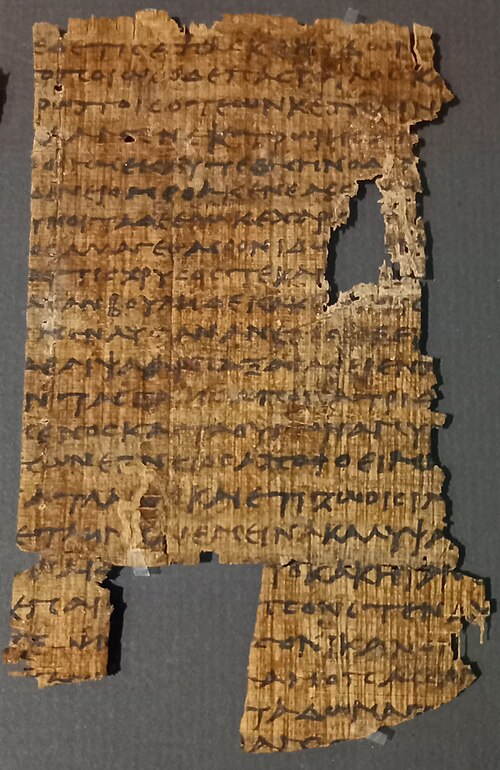
Here is the earliest known manuscript fragment of the Odyssey, from the third century BC, discovered in Egypt. These stories were over 800 years old in the time of Jesus.
But the people in Lystra were familiar with a much newer piece of literature. Metamorphoses, a 15-book narrative by the Roman poet Ovid, was written when Jesus was about 10 years old. One of the myths there tells of a visit by two gods, Zeus and Hermes, to the city of Lystra. They come disguised as mortal travelers looking for a place to rest but are turned away by everyone. They finally find rest in the humble, small home of a poor elderly couple. The story tells how Zeus and Hermes seek vengeance on the people who refused them a place to rest as they flood the whole city of Lystra, and only the elderly couple survive.
So when these people see this miracle, they assume Paul and Barnabas were gods. Now the local images of Zeus and Hermes in Galatia show Zeus as an aged man with a beard and Hermes as his young assistant. Ben Witherington III, in his book on Acts, notes that the people of Lystra may have thought Paul and Barnabas even resembled their images of these gods, and their identification suggests Barnabas was the elder of the two men, with Paul at this time in his forties at most.1
So they see the miracle and interpret it according to their understanding of the world. Only the gods can do miracles, and here are Zeus and Hermes back again to our town. We know what happened last time they came. This time we sure won’t make them angry, so let’s worship them and offer sacrifices. We need to understand that we all view the world through our own lenses, and so we can all see the same thing and come away with totally different understandings.
For example, when there is a rainbow in the sky after a storm, everyone sees the same colors, but what they believe about the rainbow determines what they think it means.
The physics professor says: “A rainbow is the result of sunlight entering water droplets. The light slows, refracts, reflects inside the droplet, then refracts again as it exits. Each wavelength bends at a slightly different angle, producing the colors arranged in our visible spectrum.”Everything he says is true. But when he’s finished, you only know how a rainbow forms. You still haven’t answered why. Physics explains the mechanism. It does not explain the meaning.
The meteorologist smiles and says, “This formation in the atmosphere tells me the rain is moving away. The sun is now behind us, less than 42 degrees above the horizon, while moisture remains in front of us.” Again, this is all perfectly true, and the rainbow becomes a weather report. It tells what the atmosphere is doing.
The artist sees something entirely different. “The colors are incredible. Look how the light blends from red into violet.” The rainbow becomes a thing of beauty. The artist is captivated by color, contrast, and composition.
Meanwhile, the photographer immediately reaches for the camera. “The light won’t last long!” She sees the rainbow as an opportunity, thinking about lenses, exposure, composition, and timing.
Irish folklore would tell you that there is a pot of gold at the end of the rainbow. But the physics professor would add that you can never find the end of the rainbow because the visual phenomenon will always move as you move.
And there is the small child. He looks up at the rainbow and says simply, “Wow!” No analysis, no explanation, wonder. Sometimes children experience creation more deeply than adults because they have not yet learned to reduce everything to categories.
Someone with a Biblical worldview sees a rainbow as a reminder of God’s response to Noah after the flood.
Genesis 9:12-15 And God said, “This is the sign of the covenant that I make between me and you and every living creature that is with you, for all future generations: I have set my bow in the cloud, and it shall be a sign of the covenant between me and the earth. ‘ When I bring clouds over the earth and the bow is seen in the clouds, I will remember my covenant that is between me and you and every living creature of all flesh. And the waters shall never again become a flood to destroy all flesh.
The rainbow is not merely light, not merely weather, not merely beauty, not merely folklore. It is a reminder of God’s covenant mercy. Every rainbow silently proclaims: “I keep My promises.” The Christian doesn’t deny physics. The Christian believes physics explains how God makes the rainbow, not why He gave it significance.
Like the rainbow, all of God’s miracles are a sign. And signs are only valuable if they point beyond themselves to the true destination.
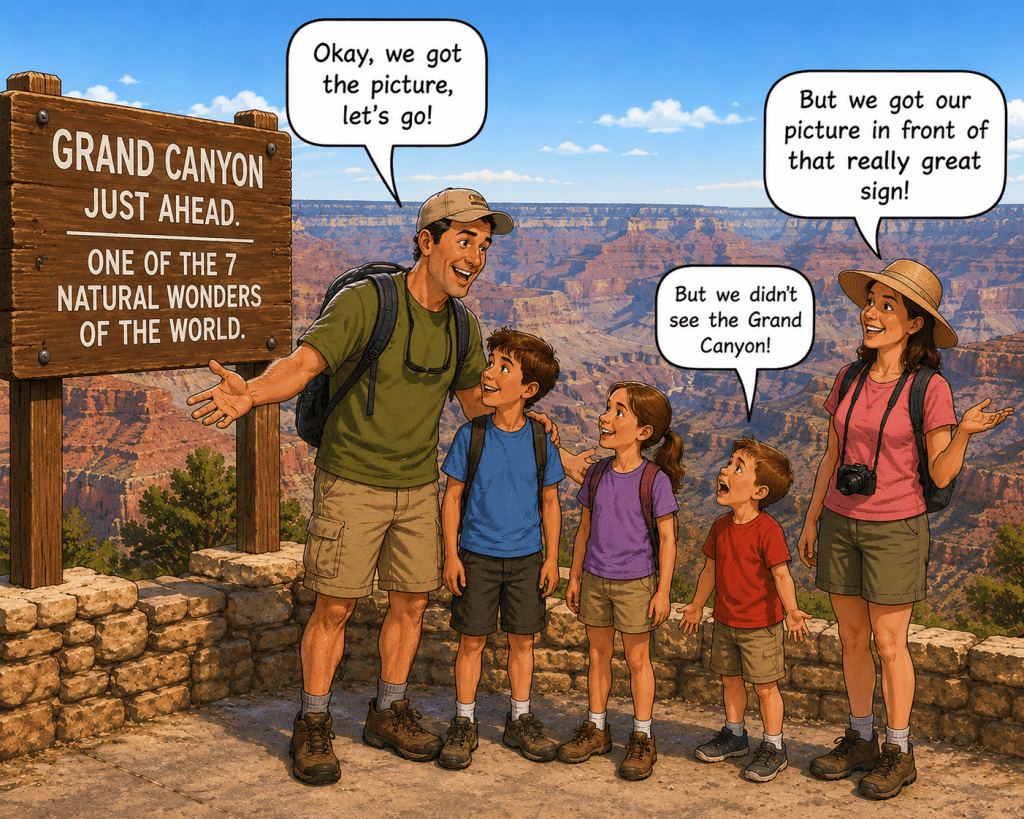
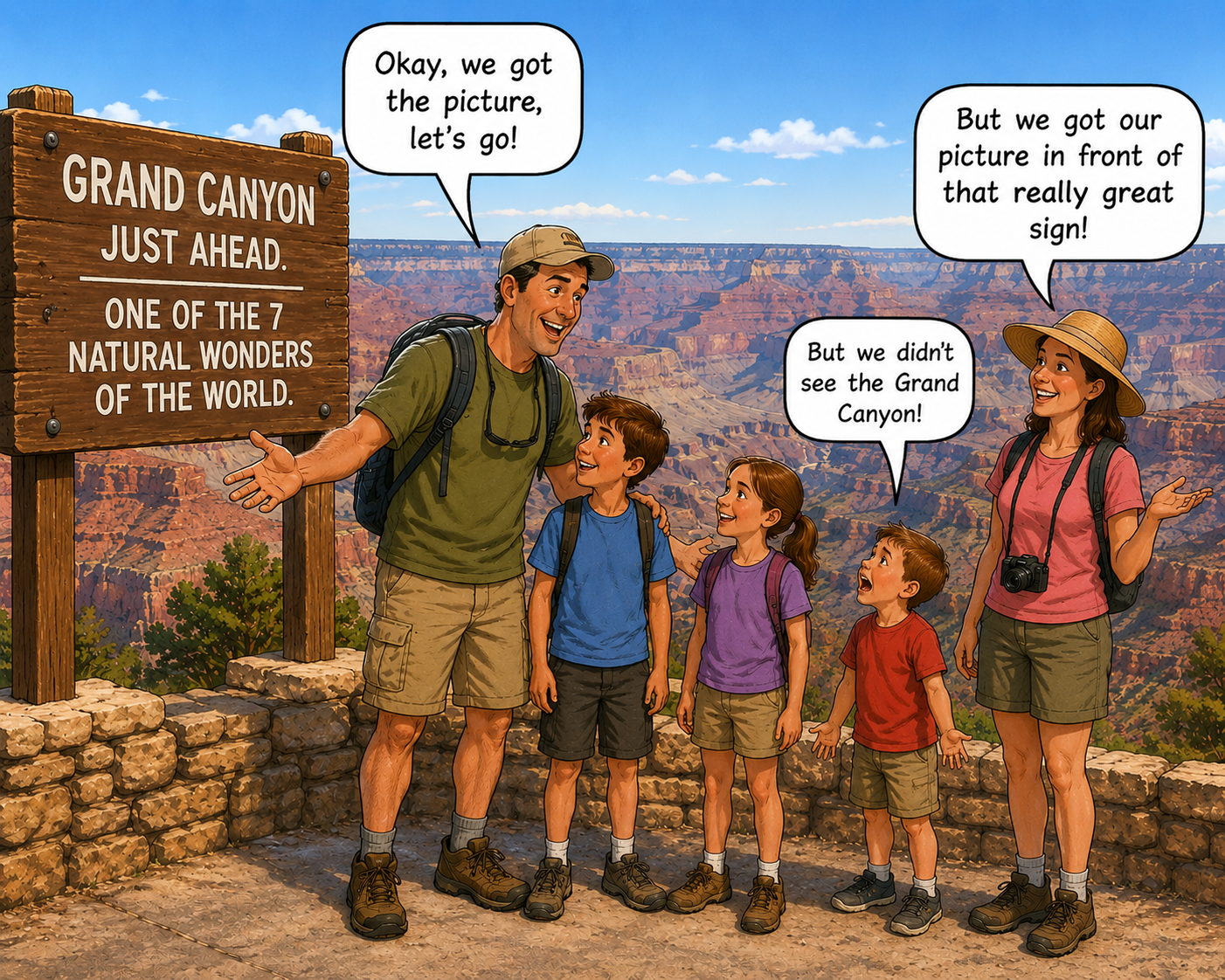
Take this cartoon of a family on vacation in the American West. They stopped their vehicle to take a family selfie in front of the sign that says “Grand Canyon just ahead.” Having snapped their picture, they jump in the car and head on their way. And the small boy is saying, “But we didn’t even see the Grand Canyon.”
Shirley and I once traveled to France with a couple, and the man was like the dad in the cartoon. We went to the small town of Amboise and stood across the street from Leonardo Da Vinci’s home, which is now a museum. And this guy says, “Okay, let’s go to the next town.” And Shirley and his wife say, but we want to see Da Vinci’s house.” To which he replies, “Well, there it is. We’ve seen it now; let’s go.” We didn’t want just to see the sign and the outer wall on the street; we wanted to see the house, to see where he painted, to see the workshop where he designed his inventions. So we made another trip back (without him).
A view through a fence across the street is not the same as seeing the house. Having your picture taken in front of a sign is not the same as seeing the Grand Canyon. Some people think the miracle is the thing. But it is only a sign pointing to the real importance.
We can all see the same miracle and explain it in different ways. We had supper with some friends this week and were telling them about another friend’s miraculous recovery from an incurable cancer. One of them said, how do you explain that? Was it just luck? I said I believe God did it. Now they regularly attend a church, but he had not even considered the possibility of God intervening in her situation.
When I was a resident physician at Boston Children’s Hospital, on the oncology (Cancer) wards, in a few months we saw three children healed of diseases that our science could not explain. One had stage 4 cancer with large tumors that suddenly disappeared without treatment. Two diagnosed with Leukemia had unexpected sudden remissions. Sitting around the conference table at rounds the next day, someone asked the head physician how these things could happen.
Their cases seemed to have nothing in common; they were different types of Leukemia with different presentations. He just said that odd things happen sometimes and it was just a coincidence that these happened together. He said, “It’s random; they had nothing in common.” I pointed out that these two cases had one thing in common, and that got the team’s attention. “What was that?” he asked. Before the infusion, these two families met together and prayed for each other, and they are convinced that is the reason for their healing.
The attending said, “Well, you will run into people who see every little thing as an intervention by God. Even though we all know better, you should not challenge their opinion about this. We don’t interfere with their religious beliefs.” We immediately went on to discuss the other patients, and perhaps I was the only one in the room who didn’t consider their healing “a little thing.” But it got me thinking not just about healing, but about all the “little things.”
These people in Lystra saw the healing and immediately attributed it to the stories of the gods they knew.
Acts 14:11 And when the crowds saw what Paul had done, they lifted up their voices, saying in Lycaonian, “The gods have come down to us in the likeness of men!”
At first, Paul and Barnabas didn’t know what was going on because they were speaking in their native language, Lycaonian, which our missionaries didn’t understand. But they soon figured it out when the priest of Zeus brought out the sacrifice. And the scripture tells us they “tore their clothes.” This is a Jewish expression of horror and grief, always done in the presence of blasphemy. And what do they tell the people?
Acts 14:15 We also are men, of like nature with you, and we bring you good news, that you should turn from these vain things to a living God, who made the heaven and the earth and the sea and all that is in them.
We are just like you. Don’t worship us. Contrast that with Herod Agrippa from Acts 12. You remember he had James killed and was going to kill Peter, but an angel helped Peter escape. And remember how this Herod died. He came out in the theater in Caesarea Maritima dressed in his robes of silver, and the people proclaimed him a god. Herod did not refute this but accepted their praise, and for that act of blasphemy he died.
This is a sin that God does not tolerate. But many today are tempted towards that same sin. Anytime you elevate a person to a status greater than others, you have made them an idol. Paul said, “We also are men, of like nature with you.” We are no different than you. We are no better than you. Do not elevate us to any position above you. We are the same.
But our society elevates many people to a status better than others. Sports stars are honored and worshiped. Politicians are honored and worshiped. Entertainers are honored and worshiped. Social media influencers are honored and worshiped. For 24 years, there has been a television show called American Idol. We see the same thing even in organized religion, where some pastors or worship leaders are placed in some elevated status. Paul said, “We are of the same nature as you.” No one deserves praise and honor except our God.
Jesus warned of this temptation in the church:
Matthew 6:1-6 Beware of practicing your righteousness before other people in order to be seen by them, for then you will have no reward from your Father who is in heaven.
“Thus, when you give to the needy, sound no trumpet before you, as the hypocrites do in the synagogues and in the streets, that they may be praised by others. Truly, I say to you, they have received their reward. But when you give to the needy, do not let your left hand know what your right hand is doing, so that your giving may be in secret. And your Father who sees in secret will reward you.
And when you pray, you must not be like the hypocrites. For they love to stand and pray in the synagogues and at the street corners, that they may be seen by others. Truly, I say to you, they have received their reward. But when you pray, go into your room and shut the door and pray to your Father who is in secret. And your Father who sees in secret will reward you.
Whenever you are placed in a position of honor, be quick like Paul and Barnabas to remind people that you are just like them. If I have done any good in my life, then it is only because of God in my life. All honor and glory go to Him who created me, sustained me, and directed me.
Genesis tells me that without God, I am literally nothing but dust. We are all creatures of dirt, filled with life through the breath of God, filled with hope and love in the image of God, filled with the righteousness of His Son Jesus, and filled with the glory of His Holy Spirit.
Don’t honor the dust; honor the God who made us more than dust.
Then Paul talks to the people of Lystra about rains and harvests (which may seem like an odd thing to say).
Acts 14:17 He [God] did good by giving you rains from heaven and fruitful seasons, satisfying your hearts with food and gladness.
Paul is telling them that this miracle is not the first time they have seen God work. He created the whole world, and He had been blessing them all through their lives with rain to grow their crops and food to eat, and He has blessed them with joy and gladness. Through all these things, God has been working all along. And I think again about what my attending said in Boston: “Well, you will run into people who see every little thing as an intervention by God. Even though we all know better, you should not challenge their opinion about this. We don’t interfere with their religious beliefs. I later told this attending that I didn’t know better, that I too believed God did intervene in our world. He smiled and said, “That’s nice,” and walked off. Paul didn’t know better. He saw every “little thing” as an intervention by God.
We tend to divide the world into the natural and the supernatural. There are things that are ordinary, like rain and sunshine, and things that are out of the ordinary, like miracles. But the Bible does not have this division at all. The Bible sees that God is behind everything that exists. Modern philosophy views the cosmos as governed by a fixed set of laws, such as gravity. Gravity is a natural rule of the universe. It is natural for things to fall down. But if, say, someone walks on water, then that is supernatural.
But again, this false dichotomy is not how the Bible describes the world. This division is man forcing his construct on the Bible. And the danger of viewing the world this way is that you incorrectly imply that anything natural, like rain and storms and illness and death, occurs outside of the influence of God. And this is not the way the Bible describes the world.
Paul attributes all of these things to God. Natural processes like rain, harvests, and the birth of a baby are only natural because God made and sustains the world that way. I have seen thousands of births. And I saw God in every single one. Yes, I know the science of reproduction. I spent months studying all the intricacies of Embryology. But I am convinced that none of those births I witnessed was outside the hand of God. God gives life and no other. It is God who causes the rain to fall on the just and the unjust. It is God who supplies our daily bread, and it is God who gives joy and gladness.
Shirley and I were driving home from Atlanta a few nights ago, and watched the sunset’s changing colors ahead of us. God brought us joy through the sunset he made. Yes, my esteemed Harvard-trained attending physician in Boston, I am one of those who see every little thing as an intervention by God. Because I am very sure of this:
John 1:3 All things were made through him, and without him was not any thing made that was made.
God made it all, and he is sustaining it all. He is at work in this world all the time. This is what we have been talking about for some time. God is constantly working all things for good for those who love him. This day of my life is a gift from God. My next breath, my next heartbeat, is a gift. So when you witness a miracle like healing, or the miracle of birth, or the miracle of the ocean, or a sunset, or the gladness of a feast, remember that the miracle and the birth and the ocean and the gladness are only a sign pointing to God and revealing His character to us. There are no little things and big things. All things were made by Him. And He is sustaining and at work in all things. Paul said it this way:
Ephesians 4:6 One God and Father of all, who is over all and through all and in all.
Nothing is outside of God’s creation and influence. The people of Lystra were amazed by the miracle, but they misunderstood its meaning. They stopped at the sign instead of following it to the One who performed it. Paul would not allow that. He tore his clothes because the greatest tragedy was not failing to see the miracle—it was seeing the miracle and missing God.
That remains the danger today. Just as some people fail to see the hand of God in the sunset and the rain, we can admire the healing, celebrate the provision, applaud the gifted servant, or treasure the answered prayer, yet never be drawn into deeper worship of Christ. Every act of God’s power and every expression of His daily kindness is a signpost saying, “Look beyond this gift. Look to the Giver.”
So how should we respond to a miracle? It’s okay to be like the child with the rainbow or like Shirley and me at the sunset this week. Stand in awe at the beauty of the picture God paints every day. But we must go further. Again, the miracle, the sunset, and the rainbow are just signs that point to God. And our response to any of God’s actions is not amazement alone.
It is repentance, worship, and faith in the living God. Remember, after Jesus fed the five thousand, great crowds followed him. The problem was that they followed him because they wanted more free bread. They wanted only the miracle, the sign, but that sign was pointing to Jesus as the Bread of Life. They missed God because they were satisfied with only the sign. Every miracle in Scripture and every miracle today ultimately points beyond itself to the person and work of Jesus Christ, who is God’s greatest revelation to the world.
God is constantly at work in this world, so walk through this world with your eyes wide open. Look for the work of God in nature and in others. Appreciate the little miracles of life and the big ones. Be grateful for the sunshine and the rain. Be grateful for the fruit of His labor. Thank Him for a good meal. Thank Him for the joy he brings in our lives. But do not worship the gifts; worship the giver of all gifts.
1. Witherington, Ben. The Acts of the Apostles: A Socio-Rhetorical Commentary. 1998. Eerdmans Publishing Co. Location 11207.


Leave a Reply