August 30, 2026 – Something is Missing— Acts #53
Acts. 15:22-35
We spent the past 3 weeks looking at the controversy in Acts 15. The leaders of the Jesus movement in Jerusalem determined that the Gentiles did not have to be circumcised in order to be saved. Salvation comes throughout the Bible only by the grace of God. We have faith to believe that God will deliver us from our sins through what Jesus did for us on the cross, not by anything we do.
But there were some requirements for these Gentiles after they decided to follow Jesus. The requirement was to follow through with the decision to follow. They were to go only where Jesus led them. And one place that Jesus would never lead them was to a pagan temple. They had to give up any practices of idolatry. And they were to study the scriptures to learn even more of what God would have them do
We spent 3 weeks on this because it is important for us to understand that we come to Jesus the same way. There is nothing we do for salvation other than accept the free gift that God gives us. But accepting the gift comes with responsibilities. We commit to follow Jesus as He leads us. This is the conclusion of the meeting in Jerusalem, and the information was transmitted to the followers of Jesus in Antioch by a letter from the council and by two church leaders who traveled to Antioch to deliver the message.
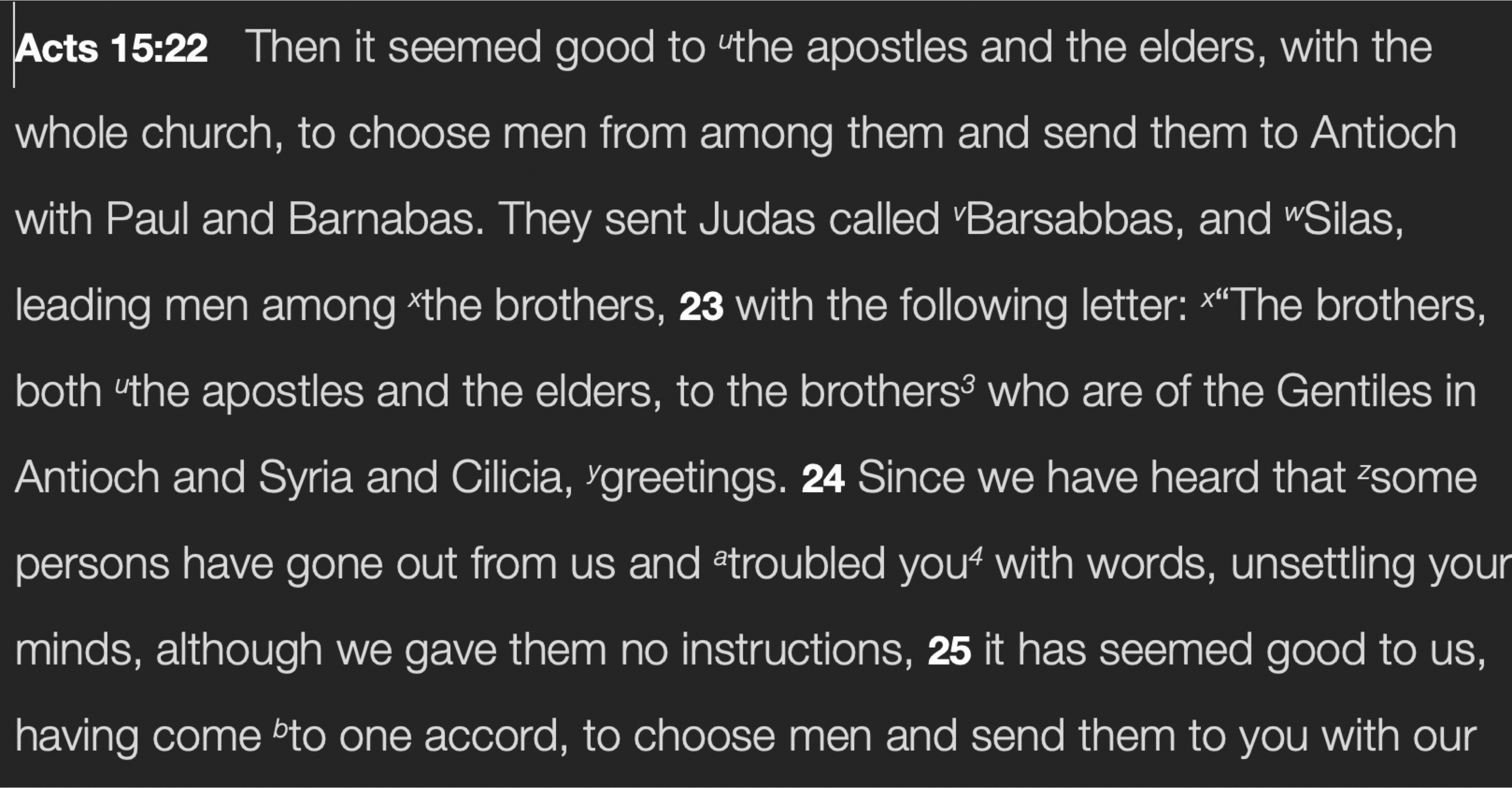
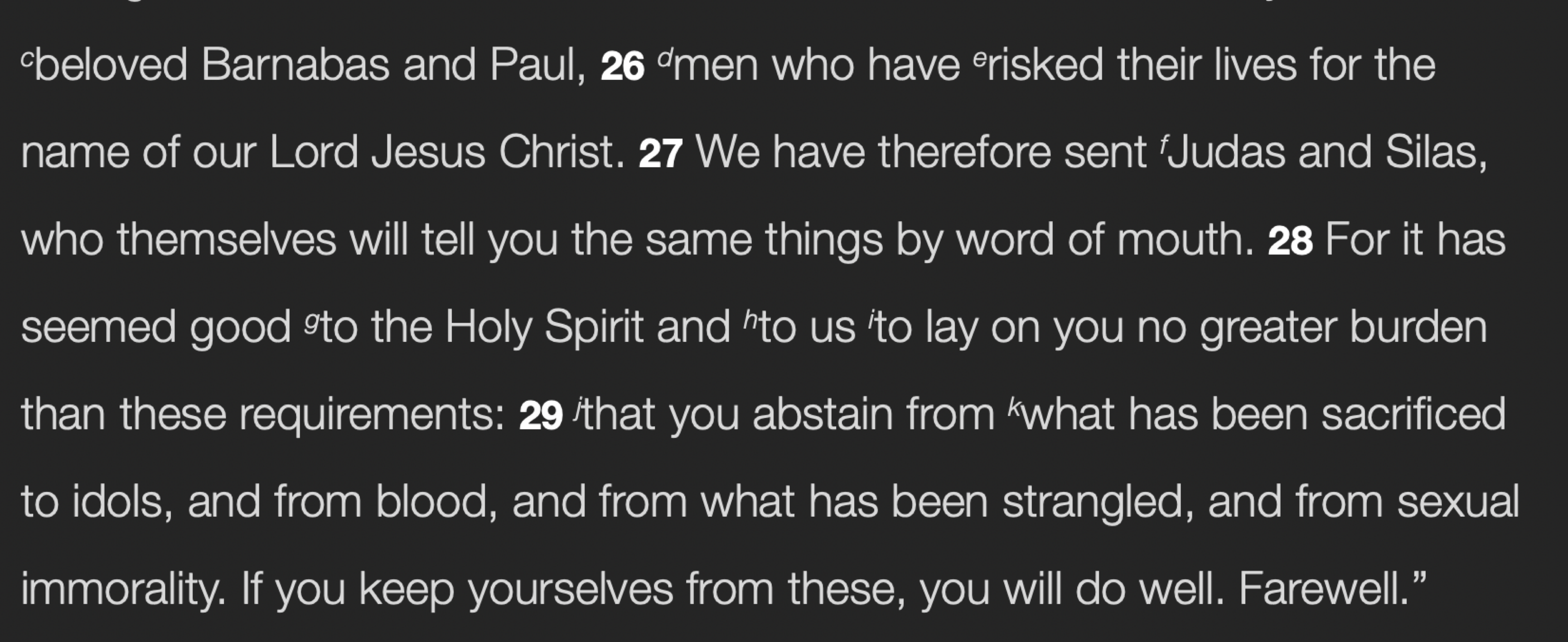
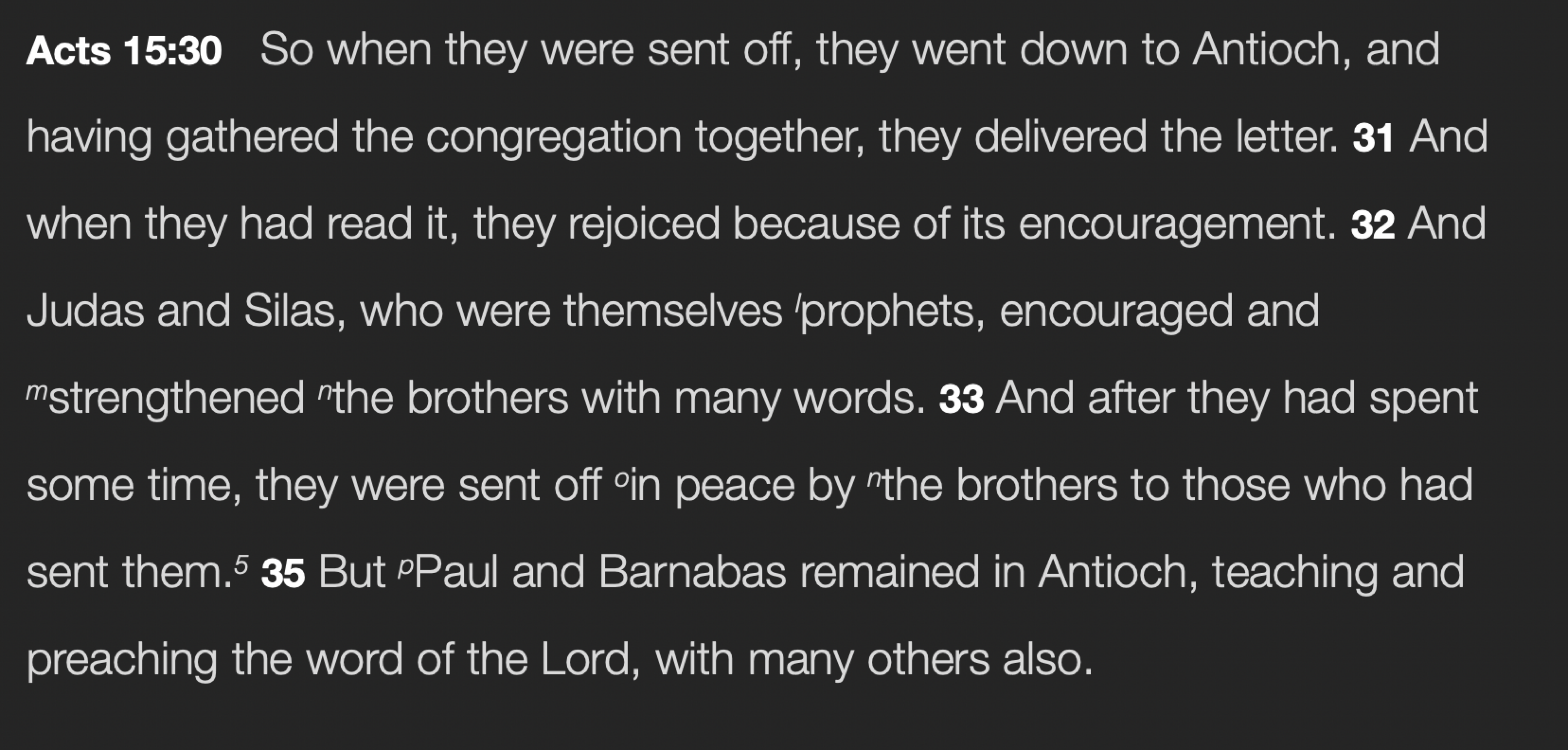
But wait a minute. How carefully do you read the Bible? Do you really pay close attention to what you are reading? Because take a look again. This section, chapter 15, verses 30-35 is copied from the ESV. Check the verse numbers….
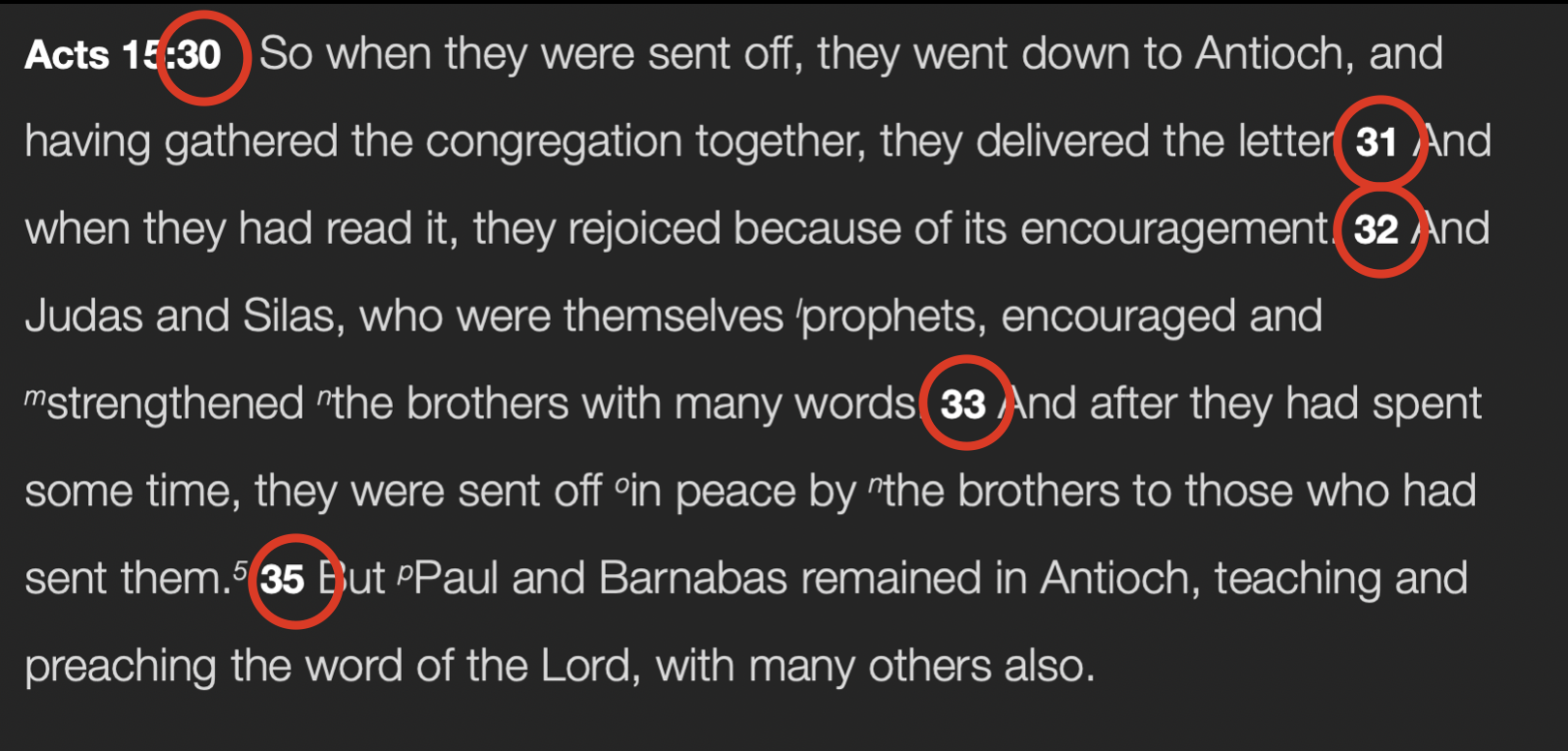
What happened to verse 34?
There is a footnote there. #5 in the ESV. And it says:

And here is the King James Version:
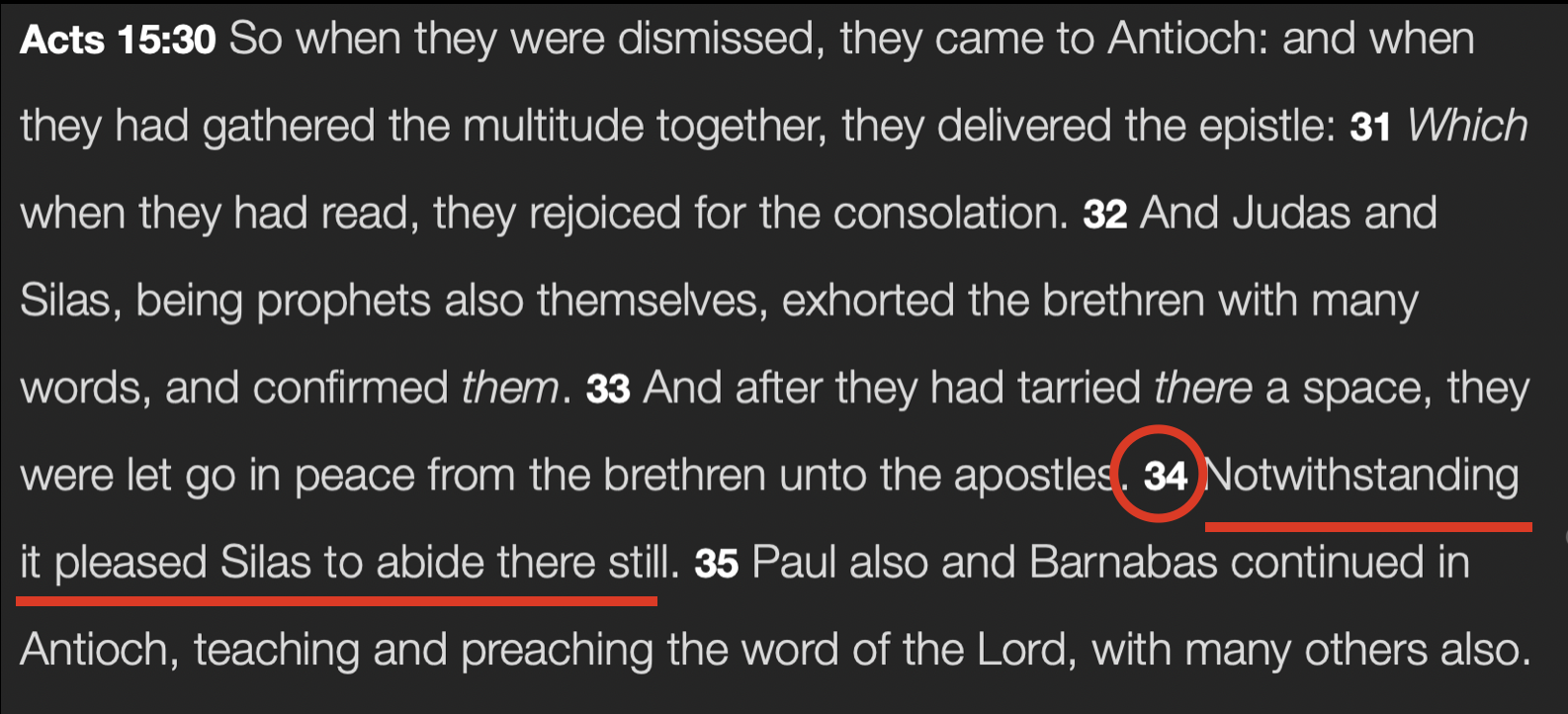
There is your verse 34. So why did the ESV remove a verse from the Bible? or… Why did the KJV add a verse? Does this happen often in the Bible? If so, how do we know we can trust our Bible?
Now I could have just read right past that missing verse in the ESV translation and kept going, and none of you would have noticed. I could have just pretended this issue didn’t exist and saved myself the trouble of talking about it. But this issue matters to me because the Bible matters to me. It is how I learn of God and of His character, how I find instruction for how to live my life, and how I know that God loves me and sent His Son to bear the burden of my sins.
It is too important to just gloss over things. If we base how we live our lives on this book, we must approach it honestly and have confidence in what Scripture says. First, in case any of you aren’t going to make it through this blog, let me give you the answer you’ll reach in about 10 minutes.
Bottom line: Our scripture is reliable. You need have no doubt that this is the Word of God. You can have confidence in these words.
First of all, lets look at this particular instance.We are told in verse 22 that the gathering of the leaders sent Judas and Silas back to Antioch with Paul and Barnabas to ensure the followers of Jesus there understood the meeting’s decision. Remember that the controversy began when some leaders in Jerusalem came to Antioch insisting the followers there be circumcised. So sending some delegates from Jerusalem was important. Then verse 33 tells us that after they spent some time in Antioch, they were sent back to Jerusalem:
So it seems that Silas and Judas return to Jerusalem. But then, Luke says, “after some days”. on down in verse 40 we read:
Acts 15:40-41 Paul chose Silas and departed, having been commended by the brothers to the grace of the Lord. And he went through Syria and Cilicia, strengthening the churches.”
Now we have Paul choosing Silas and leaving Antioch to begin his second missionary journey. If Silas left Antioch and went back to Jerusalem in verse 33, then how is he back in Antioch in verse 40, leaving with Paul?
This is solved by the verse in the KJV, verse 34:
Acts 15:34 Notwithstanding, it pleased Silas to abide there still.”
So now we have Silas staying in Antioch, where he can then leave with Paul in verse 40. Problem solved. We will talk about where verse 34 came from in just a moment. But was it really necessary?
We read the Bible at times without realizing there can be a long gap of time between verses. Sometimes entire decades pass from one verse to the next. When Luke says “After some days,” we think he means “in a matter of days,” a time you would count in days, not in weeks or years. But the Greek phrase here can mean any amount of time. So we don’t know how long Paul and Barnabas preached and taught before we get to verse 40.
Really, should we care whether Silas stayed in Antioch or went down to Jerusalem and then returned? Does it make a difference? No. It doesn’t really matter. But if we are going to discover the answer to the verse 34 issue, we have to realize that it did matter to someone…
Remember that we don’t have Luke’s original handwritten copy of the Acts of the Apostles. It would be almost 2000 years old, and unfortunately, not many originals of any writings last that long. What we have are copies of copies of copies. And those copies were produced by hand. That means we should expect differences. Have any of you ever been given a hand-copied recipe only to later discover that an ingredient was left out or a measurement was changed? Has this ever happened to you? It turns out that cookies are not nearly as delicious if you leave out the sugar.
Imagine that I give ten people a paragraph and ask each of them to copy it by hand. Then I give their copies to ten more people; then they all give their copies to ten more. After several generations, you will discover some errors. And of course, earlier copies will be more likely to be accurate than later copies. The more copies, the more errors produced: a word spelled differently, a word accidentally skipped, or a sentence repeated. You might even find a word added for clarification, or a marginal note copied into the text.
That’s exactly the sort of thing that happened with biblical manuscripts. There are several times that someone made a note in the margin of a scripture copy, much as you would make a note in the margin of your Bible. Now when the next scribe is making a new copy of the scripture, he sees that note in the margin and says, “Oh, they left this verse out and had to write it in the margin. So I will put it back in the text.” And now it becomes a verse. In the case of Acts 15:34, at some point, someone, disturbed by Silas moving around, just added verse 34.
And that actually gives us an important insight: The existence of textual variants isn’t evidence that the Bible is unreliable. It shows the Bible was copied and transmitted by human beings. As we discussed last week, God partners with us to do ministry. Even though he doesn’t need us, even though he could do everything himself, he chooses to involve us in His work. Why? So our relationship with Him will grow. God could have dropped an English version of the Scriptures out of the sky one day, but that is not the way He works. He partners with us.
This is where the discussion becomes important. Some people hear about textual variants and immediately conclude: “Then we don’t know what the Bible says.” But that’s not what the evidence shows. We have thousands of Greek New Testament manuscripts, along with ancient translations and quotations of Scripture in the writings of early Christian authors. And because there are so many witnesses, scholars can compare them. This discipline is called textual criticism.
It doesn’t mean criticizing the Bible. It means comparing surviving manuscripts to determine, as carefully as possible, the original wording. And here’s the remarkable thing: The enormous number of manuscripts, rather than making the task impossible, gives us an enormous amount of evidence to work with.
Think About It Like a jigsaw puzzle. Suppose you have a thousand-piece jigsaw puzzle, but as you assemble it, you discover that you are missing more than a few pieces. But suppose you have ten different copies of the same puzzle. One copy is missing the right top corner, and another is missing three pieces from the middle. Another puzzle has some damaged pieces on the left edge. But when you put all the copies together, you can reconstruct the original picture. That’s a little like textual criticism. We don’t have the original manuscript sitting in a museum. But we have many witnesses to what the original said. When we compare those witnesses, we can often determine the original wording with remarkable confidence.
Now let’s look at today’s passage in Acts 15 through the lens of textual criticism .
Why is verse 34 in the KJV, but not in any of the more modern translations? Remember, the KJV translation was done in the early 1600s, using the accepted copy of Scripture available at the time. The Greek New Testament they used, which we call the Textus Receptus, was published in 1516. Let me quote New Testament scholar Daniel Wallace:
“The man who edited the text [Textus Receptus] was a Roman Catholic priest and humanist named Erasmus. He was under pressure to get it to the press as soon as possible since (a) no edition of the Greek New Testament had yet been published, and (b) he had heard that Cardinal Ximenes and his associates were just about to publish an edition of the Greek New Testament, and he was in a race to beat them. Consequently, his edition has been called the most poorly edited volume in all of literature! It is filled with hundreds of typographical errors, which even Erasmus would acknowledge.”1
And besides all the errors in this hastily produced text, Erasmus only had 6 Greek manuscripts available to him to use for his work. None of his available manuscripts contained the last 6 verses of Revelation, so he just back-translated from the Latin Vulgate Bible back into Greek, making up his own Greek version that matched none of the manuscripts found since then. But all he had were these 6, and they were all fairly recent copies. The earliest copy he had was from the 10th century, 900 years after they had been written.
But since 1510, thousands more Greek versions have been discovered and studied. We also have Greek New Testament copies hundreds of years older than the ones used to produce the KJV, some produced only 50 years after the original. And you do not find Acts 15:34 in any of the older versions. In fact, you don’t find it in most of the copies since then. It just happened to be in the one that Erasmus had available to him, so it was inserted into the KJV.
And as we have discussed, errors can be introduced with copies, so the older documents are usually closer to the original than later copies. That is why the King James Version, which I often reference and from which I memorized many scriptures, is not the best version available today for study. It is good, and its translation of the Psalms is often beautiful poetry, but you just need to understand it is not the most accurate version.
Now, this verse, Acts 15:34, is a wonderful example of these differences in translation because, like most variants, it really doesn’t make much difference. Whether Silas remained in Antioch at this particular moment does not change the Christian gospel. It doesn’t change the deity of Jesus, the resurrection, salvation by grace, or anything. If Acts 15:34 is omitted, nothing essential about Silas or the story disappears. And that’s true of the overwhelming majority of textual variants. Let’s look at another: in a story we talked about a few months ago, the man from Ethiopia whom Philip witnessed to. This man was reading the book of Isaiah.
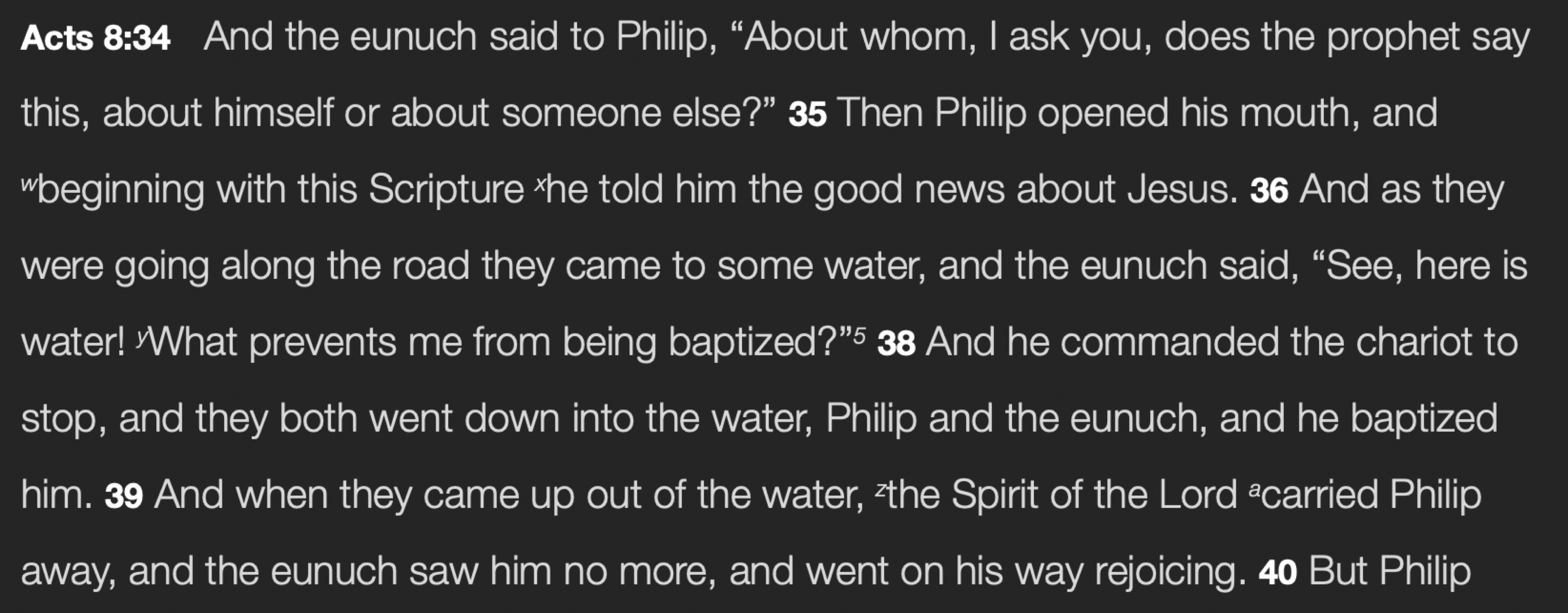
Now, perhaps you are looking more closely and noticed something was missing. There is no Verse 37. (Again, you will notice there is a footnote there.)
But it is in the KJV:
Acts 8:37 And Philip said, If thou believest with all thine heart, thou mayest. And he answered and said, I believe that Jesus Christ is the Son of God.”
This verse contains a beautiful confession of faith: “I believe that Jesus Christ is the Son of God.” But removing that verse doesn’t remove the doctrine that Jesus is the Son of God. The doctrine is found throughout the New Testament. Having it present or absent does not change the message of the Bible. That’s one of the reasons we should be cautious about claims that Christianity depends upon one particular disputed verse. Christian theology is built on the broad witness of Scripture, not isolated verses.
And notice that our Bibles are very transparent of these differences. There is always a footnote, not hiding uncertainty, but being transparent about the evidence. And that should actually increase our confidence. Now these two examples are minor differences, just a single verse.
But there are some larger textual questions. There are the last 11 verses of the book of Mark, and the story in John 7:53-8:11, the story of the woman caught in adultery. Neither of these two passages is in the oldest manuscripts. This is more than we can cover in this blog entry. And, by the way, I love the story of the woman caught in adultery. But even if it is not an original part of the Gospel of John, it is still a great story consistent with how Jesus treats people.
And that is important: none of these verses change our theology. Removing these verses doesn’t remove the doctrine the Bible teaches us. But this is one reason we should be cautious about building theology on one verse.
Shirley and I were in a church one evening in Kingston Ga that had one of the verses in the end of Mark displayed prominently in the church.
Mark 16:18 “they will pick up snakes with their hands; and when they drink deadly poison, it will not hurt them at all; they will place their hands on sick people, and they will get well.”
And that one verse became a regular important part of their worship. Picking up snakes. That’s another story for another time. Christian theology is built on the broad witness of Scripture, not isolated verses.
So the Bible we have today isn’t the Result of one perfect copy. The fact that we can see the Bible’s transmission history is not evidence that God failed to preserve His Word. It is evidence that God preserved His Word through real people, real manuscripts, real copying, and real history. The Bible didn’t fall from heaven as a bound English book. God worked through human authors, human languages, human history—and even human copyists.
Sometimes Christians unconsciously imagine that the Bible was transmitted like this:
Original → perfect copy → perfect copy → perfect copy → our Bible
That’s not how it happened. It was more like:
Original → many copies → many more copies → many manuscript traditions → comparison of those witnesses → reconstructed text → translations
That looks less tidy. But it is actually much more robust. Why? Because we’re not dependent on one chain of transmission, but many, individuals in many locations all transmitting the scripture as best they can.
So, Can We Trust the Bible?
We need to answer that question carefully. If by “trust” we mean: “Can I prove that every modern English translation contains every letter exactly as it appeared in every original manuscript?” No. But if we mean: “Do we have sufficient manuscript evidence to know what the New Testament authors wrote, and can we trust the Bible’s message?” The answer is yes.
The manuscript evidence allows scholars to reconstruct the New Testament text with a very high degree of confidence.
But there a deeper question underneath this question. Ultimately, we’re asking: Can we trust the God who gave us the Bible? And this brings us back to the very passage we’ve been studying. Acts 15 is about God’s faithfulness. The apostles are trying to determine what God requires of Gentiles. Peter says: “We believe that we will be saved through the grace of the Lord Jesus, just as they will.” The entire story is about a God who keeps His promises. And that same God is the God who gave us Scripture.
Christian faith isn’t: “Don’t ask questions.” It isn’t: “Ignore the evidence.” It isn’t: “Just believe because someone told you to believe.” It is not about ‘blind faith.’ The Bible itself invites examination. Luke begins his Gospel by explaining that he carefully investigated the events.
Luke 1:3 I myself have carefully investigated everything from the beginning
The apostles appealed to eyewitness testimony. Christianity is rooted in events that happened in history. Jesus encourages inspection. Thomas doubted, and Jesus invited him to feel his scarred hands and put his hand into his side. Paul encourages us not to take what some preacher (even himself) says, but to study Scripture and see whether what he says is true.
Acts 17:11 “Now these [Berean] Jews were more noble than those in Thessalonica; they received the word with all eagerness, examining the Scriptures daily to see if these things were so.”
That is the way we are to listen to sermons. Investigate. Study the Scripture. And that brings us back to Acts 15. They told these Gentile followers of Jesus in Antioch that there were two things they must do. Two major requirements for being a follower of Jesus. First, follow Jesus, and he will never take you to pagan temples to partake in idolatry. Secondly, study the Scriptures. By these you will know God and know how best to follow Him.
This is the message to us today — Are you following, only going where Jesus goes? And are you studying His book, carefully reading and meditating on it and letting it speak to you?
- Wallace, Daniel. Article “Why I Do Not Think the King James Bible Is the Best Translation Available Today” from Bible.org.
 Swallow No Camels
Leave a comment