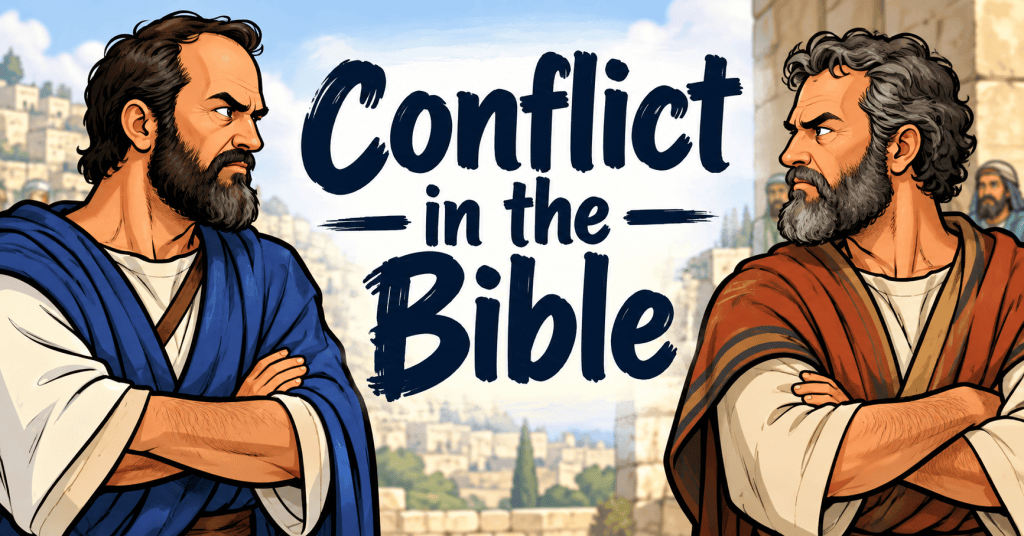
We just wrapped up our multi-week discussion of the controversy in Acts 15, and now we run right into another conflict. And this conflict is between the two missionaries, Paul and Barnabas.
Acts 15:36-40 And after some days Paul said to Barnabas, “Let us return and visit the brothers in every city where we proclaimed the word of the Lord, and see how they are.” Now Barnabas wanted to take with them John called Mark. But Paul thought best not to take with them one who had withdrawn from them in Pamphylia and had not gone with them to the work. And there arose a sharp disagreement, so that they separated from each other. Barnabas took Mark with him and sailed away to Cyprus, but Paul chose Silas and departed, having been commended by the brothers to the grace of the Lord.
You remember that on their first journey, John Mark, Barnabas’ cousin, joined Paul and Barnabas. They started in Antioch, then sailed to Cyprus, traveled the length of the island, and headed north to Perga. And Luke explains:
Acts 13:13-14 Now Paul and his companions set sail from Paphos and came to Perga in Pamphylia. And John left them and returned to Jerusalem, but they went on from Perga and came to Antioch in Pisidia.
Luke doesn’t say why John Mark left, but Acts 15 shows that Paul apparently felt John Mark had deserted them in Perga. From there, Paul and Barnabas continued on to start Jesus communities in Antioch, Iconium, Lystra, and Derbe. And it was a difficult journey. They were run out of town, and their lives were threatened. Then Paul was stoned and dragged out of the city and left for dead. John Mark wasn’t there for any of this.
So in Acts 15, Paul has no room for a deserter on his next mission trip. And these two men, who had risked their lives for the gospel together, who had seen great success together despite many hardships, who had shared all these experiences, have such a “sharp disagreement” that they have to go in different directions.
First, let me ask: Why did Luke include these details? He is covering much of the history of the Jesus movement over 35-40 years, so he can’t put everything in his book. He has to leave a lot out. So why didn’t he say that they decided to go on different journeys with different partners? Why did he feel the need to add the verses about this conflict when most people would have likely just skipped over anything like this?
The Bible doesn’t hide the faults of its “heroes.” It doesn’t conceal their sins or shortcomings. And there is an important reason. This book was not written to serve as a tribute to its characters. The goal is not to show how great people can be, but to show how great God is and how God is always at work in people’s lives to make them better. That is why Scripture does not sugarcoat its heroes.
So a harsh, bitter conflict arises between Paul and Barnabas. And they can’t resolve it, so they part ways. But before we can discuss this situation with Paul and Barnabas, we need to put it in context. And the context is all of Scripture — how does the Bible talk about conflict resolution?
Let’s look at the first conflict in the Bible: Cain gets angry with Abel. You know the story. They both make offerings to God, but Abel’s was accepted, and Cain’s was not. And the Bible tells us:
Genesis 4:5 So Cain was very angry, and his face was downcast.
His brother was accepted, but he was not. (Someone is jealous of their brother.) What does God do about this first conflict? He comes to Cain and asks him What is the reason for your anger? Don’t you know that if you do the right thing, you will be accepted? God tells Cain he is on the verge of a horrible sin; he says,
Genesis 4:7 Sin is crouching at the door. Its desire is contrary to you, but you must rule over it.
“Sin is crouching at your door.” There’s a picture. Cain needs to drop this jealousy and anger and reconcile with his brother. But Cain just opens the door wide to that sin and kills his brother. In case you are wondering, assassination is not a good plan for conflict resolution.1 So this conflict is never resolved.
Let’s look at another famous conflict in the Bible. How about Joseph and his brothers? Joseph and his brothers were in constant conflict as they grew up. It got so bad that when they had the chance, they threw him in a pit. They thought about killing Joseph, but then decided it was easier just to sell him into slavery and tell their father that a wild beast killed his favorite son. (Oh yeah, that’s a lot better.) That is some pretty serious conflict.
But Joseph wasn’t completely innocent, and neither was his father. Animosity grew from the favoritism shown to Joseph through the fancy coat his father gave him, and from Joseph telling his brothers he had dreams in which they would all bow down to him. I’m not sure what the Hebrew equivalent of ‘Little Brat’ is, but I’m sure they said it. This is a story where conflict resolution takes a long time.
You know the story: Joseph ends up, through a series of miraculous events, as the number 2 guy in Egypt, the most powerful country in the world. Not bad for someone who entered the country as a slave. (We call that upward mobility.) And because God gave Joseph insight about a seven-year famine, they were able to store grain and save many lives, not just in Egypt, but in much of the known world.
When Joseph spoke to his brothers after his father’s death, he came not with revenge in his heart but with forgiveness. He said this:
Genesis 50:20 You planned evil against me; God planned it for good to bring about the present result—the survival of many people.
And finally, the beginning of conflict resolution for these brothers. And it began with the innocent one forgiving the guilty. You see, it wasn’t a matter of who was most wrong; it was a matter of who was most filled with grace, who was most willing to forgive.
As with Cain and Abel, an unresolved conflict between the brothers grew until it became murderous. But God took that evil and worked the events of the world so that great good came from their evil action. And God used all this to finally bring about the reconciliation of these brothers. These guys who sold their brother into slavery and told their father that a beast killed his son — it is these brothers who would be the head of the twelve tribes of Israel. It was their names on the breastplate of the high priest. And Revelation 21 tells us the names of these brothers will be carved on the 12 gates of the New City of Jerusalem in the world to come.
You see, God wants more than just conflict resolution. He wants reconciliation. For God, it is more than just agreeing on a specific dispute; it is restoring a relationship… as much as possible. This is why Paul said….
Romans 12:18 “If possible, so far as it depends on you, live peaceably with all.
It is not always possible. Ask Abel. It is hard to reconcile with someone who wants to kill you. You can restore the relationship only if both parties want to. And some relationships should not be restored unless the guilty party undergoes a miraculous change in life. But if the relationship can’t be restored for these reasons, we are still obligated to forgive and show love (even to enemies). Why do we have all this conflict in the Bible?
From the beginning, God chose to work with people. A holy, unfailing, faithful God continues to choose to work with humans who are prone to failure and faithlessness. Why? Because he wants a relationship with us. Even though he knows that we will make a mess of things, he still chooses to bring us beside him to do the work. Again, it’s like the grandmother who asks the 5-year-old grandchild to help make cookies. She doesn’t need the help. It will be messier and more difficult if she helps, but she wants not the help but the relationship that grows from working together.
And our Bible is story after story of how God chooses people for a task, how they fail to do as they are told, and how God has mercy and gives grace to these people. It is a story of how God pursues us and then returns our unfaithfulness with His faithfulness. And God reacts to our failure in the same way every time. He takes the mess we make and works it for our good. There is my theme verse for the year again: Romans 8:28.
Romans 8:28 “And we know that for those who love God all things work together for good, for those who are called according to his purpose.”
God causes all things to work together for good. And these things that God is causing to work for good- – they are bad things. Because it takes no special skill to cause good things to work for good; that just happens. But to cause bad things to work for good, that’s harder. That’s what God does.
How many of the bad things in your life is God working to make good? All of them. How about all the mistakes you’ve made and sins you have committed? How many of those is God working in the background for you to work for good? All of them. This is what Joseph understood 1500 years before Paul wrote Romans. Remember, he told his brothers:
Genesis 50:20 You planned evil against me; God planned it for good to bring about the present result—the survival of many people.
Joseph said, “You planned bad things, but God turned it all to be a great thing.” This is how God works. God hasn’t changed the way He works from the Old Testament to the New Testament. Now let me show you another way God works:
Let’s say you run a company and you decide to retain a firm to do your staff recruiting and hiring. You interview several firms, and a representative for one of them sits with you and says, “Let me tell you how our company does staff acquisition: We gather a list of available people and then narrow the list to people who are unqualified and likely to fail. In fact, we choose people with a history of failure. Then we place them in a position they can’t possibly do by themselves.” (I don’t think you are retaining this company.)
But this is the way God works. God chooses people whom He knows will likely fail, and then he gives them tasks to do that they can’t possibly do by themselves. Why does God work this way? So that we will learn to have dependence on Him, so that we will see, over and over, how much He loves us and is constantly working even our errors to work out for good.Paul and Barnabas chose to go their separate ways. Did God want this to happen? I don’t think so, because I don’t think God was the author of this sharp disagreement. God is not the author of conflict. He is the author of reconciliation. But there is a failure here. Paul and Barnabas failed. They decided to go their separate ways. But look what God does. He takes this error and turns it for good. Now there are two missionary journeys instead of one. And next week we’ll see God arrange it so John Mark is redeemed and reconciled with Paul. God took Paul and Barnabas’ error and used it for good. This is the story of the Bible.
Let’s look at one more Old Testament story of conflict. Abraham and Lot. Lot was the son of Abraham’s brother, Haran. When Haran died, Abraham took young Lot with him on his journey to wherever God would show him.
Genesis 13:1-7 So Abram went up from Egypt, he and his wife and all that he had, and Lot with him, into the Negeb. Now Abram was very rich in livestock, in silver, and in gold. And he journeyed on from the Negeb as far as Bethel to the place where his tent had been at the beginning, between Bethel and Ai, to the place where he had made an altar at the first. And there Abram called upon the name of Yehovah.
And Lot, who went with Abram, also had flocks and herds and tents, so that the land could not support both of them dwelling together; for their possessions were so great that they could not dwell together, and there was strife between the herdsmen of Abram’s livestock and the herdsmen of Lot’s livestock. At that time the Canaanites and the Perizzites were dwelling in the land.
So God has blessed these nomads greatly. So great that their flocks are too numerous to be together and the herdsmen are in constant conflict. So let’s keep reading and see how Abraham and Lot will resolve this conflict.
Genesis 13:8-13 Then Abram said to Lot, “Let there be no strife between you and me, and between your herdsmen and my herdsmen, for we are kinsmen. Is not the whole land before you? Separate yourself from me. If you take the left hand, then I will go to the right, or if you take the right hand, then I will go to the left.”
And Lot lifted up his eyes and saw that the Jordan Valley was well watered everywhere like the garden of Yehovah, like the land of Egypt, in the direction of Zoar. (This was before Yehovah destroyed Sodom and Gomorrah.) So Lot chose for himself all the Jordan Valley, and Lot journeyed east. Thus they separated from each other. Abram settled in the land of Canaan, while Lot settled among the cities of the valley and moved his tent as far as Sodom. Now the men of Sodom were wicked, great sinners against Yehovah.
So what do you think of Abraham’s solution to this conflict? Was it a good one? Did God approve? I’ve heard people talk about Abraham’s generosity in offering Lot whichever portion he wanted. Of course, Lot took the one that looked the most fertile. So they separated. Conflict resolved, right? But wait, remember that God is more interested in reconciliation than in conflict resolution. God wants preservation of relationships.
To God, peace is more than the absence of conflict; it is the presence of good relationships. That is the concept of Shalom. It is a Hebrew word we translate as ‘peace,’ but it means more than we think. So while many applaud Abraham for this decision, I think he missed it. What would you have done if you were Abraham? What is the original problem? Go back to the Scripture:
And Lot, who went with Abram, also had flocks and herds and tents, so that the land could not support both of them dwelling together; for their possessions were so great that they could not dwell together, and there was strife.
So what was the problem? Too many sheep. If the problem is “too many sheep”, why would the answer be “break up the family”? The answer seems simple to me: get rid of the excess sheep that are causing the problem. You can talk about Abraham’s generosity, but I want to point out that their many possessions caused the problem.
Greed led to this parting of the ways. God did not want this. And we know what happened: Lot ends up in Sodom, which was an awful place for him and his family. Lot gets kidnapped there, and Abraham has to go to war to rescue him. And then Sodom is destroyed, and many, including some of Lot’s family, died in the destruction. This was not the right way to resolve this conflict.
Paul and Barnabas both thought they were right. And their need to be right was apparently greater than their need to be in relationship with each other. They valued their “rightness” over their relationship. We will look at this specific conflict next week, but this week we have been discussing the context: how the Bible deals with conflict.
Why is there conflict in church? Because there are people in the church. And we are all failures. If we only allowed perfect people in churches, then there would be no churches. So every church is full of sinners. Now we are sinners that God has forgiven, but guess what? Have we stopped sinning? I don’t know about you, but I’m not there yet. So you mix all these sinners together who are constantly making mistakes, and then you ask how in the world God could ever expect any church not to devolve into conflict that ends the fellowship?
All these people fall prey to the sins of selfishness, pride, greed, anger, hypocrisy, and judgment. How could this ever work? How in the world? Well, not “How in the world,” but “How in God’ could this ever work? Because God has something that the world finds tremendously lacking: love, mercy, grace, and forgiveness.
So conflict is inevitable. We will have conflict because we all sin. And it is very hard to stop sinning. But why does so much conflict remain unresolved? Why does it just continue? Why do people go 30 years refusing to speak to a friend or a family member? Why does conflict persist? You know the answer. If the problem that causes conflict is sin, tell me what the answer to sin is? Forgiveness.
So much conflict remains unresolved because we fail to extend grace and forgive our brothers’ sins. This is our failure. Joseph was willing to forgive his brothers’ sins. They tore him from his family, and he was carted off to a foreign country where he spent years as a slave. But he was willing to forgive them, and that is how God redeemed this family and why it is their names on the gates of the New City in the life to come.
We commit the sin that ensures conflict will persist when we fail to extend grace and forgiveness. Oh, we want God to give us grace and forgiveness. We pray to God for his grace and forgiveness. But we don’t think we are responsible to extend that same grace and forgiveness to others. But guess what Jesus had to say about that?
Matthew 6:14-15 For if you forgive other people when they sin against you, your heavenly Father will also forgive you. But if you do not forgive others their sins, your Father will not forgive your sins.
That is what we pray in the prayer Jesus taught us. We pray, please God, forgive us in the same way we forgive others. If you are a person who holds grudges, I would not recommend praying this prayer.
Then Jesus tells an interesting parable in Matthew 18 about a man who owed a large sum of money but could not pay it. But his debt was forgiven. And then he refuses to forgive others for their debts to him.
Matthew 18:34-35 In anger, his master handed him over to the jailers to be tortured until he should pay back all he owed.
“This is how my heavenly Father will treat each of you unless you forgive your brother or sister from your heart.”
This is harsh. How we extend grace and forgive others is a reflection of our standing with God.
So often, the church is known for what we stand against rather than who we stand for. According to the media, the Catholics are against contraception; the Baptists are against alcohol and dancing, oh, and women preaching; and some of the Methodists and Presbyterians are against homosexuality. It seems the church is always in the spotlight for what or who it opposes..
Why aren’t we known for being people of grace and mercy and love? We will discuss this a lot more later, but the bottom line is that we profess a God of grace and forgiveness, but we, who are supposed to be the image of God, reflecting his character, are often just seen as judgmental. Meanwhile, our God is in the business of reconciliation.
Colossians 1:19-20 For God was pleased to have all his fullness dwell in him [Jesus], and through him to reconcile to himself all things, whether things on earth or things in heaven, by making peace through his blood, shed on the cross.
God, through Jesus, is reconciling all things. He is redeeming the world that mankind has contaminated by sin and death, and He is redeeming all of the people who will let Him redeem them. Jesus is making peace (Shalom) and restoring our relationship with God. And as we have been discussing, God chooses us to partner with Him in this work….
2 Corinthians 5:17-19 Therefore, if anyone is in Christ, the new creation has come: The old has gone, the new is here! All this is from God, who reconciled us to himself through Christ and gave us the ministry of reconciliation: that God was reconciling the world to himself in Christ, not counting people’s sins against them. And he has committed the message of reconciliation to us.
God has partnered with us in this ministry of reconciliation. The message is that God, through Jesus, for those who accept him, is not counting people’s sins against them. This is how Jesus is the prince of peace, the prince of shalom, giving people peace with God and peace with people.
God has committed the message of reconciliation to us. We are not called to be the judge. That’s God’s job. We need to present a different message. Now it may be hard to present a message of God not counting people’s sins against them if the church is constantly known for counting people’s sins against them.
We have seen many types of reconciliation in our ministry to people without homes in Alabama. We see people who come to accept Jesus for the first time and begin a relationship with God. We also see people who have wandered far from God return to him and restore the relationship. We see people who have felt wronged by the church being restored to fellowship with local churches. And we have seen people who had not talked to family members in years restored. Let me conclude with one such story, as told by my wife.
Bill arrived at Room In The Inn one snowy afternoon in a white work van with Kentucky plates. His traveling companion continued on, but Bill registered and loaded up with the other neighbors to go to St. Paul Methodist Church, which was hosting for their very first time. St. Paul had their team in place and a wonderful meal prepared. Bill fixed his plate and sat down at a round table with a gentleman from St. Paul named Charlie.
Charlie was not part of the Room In The Inn team that night, but had come by to see “what his church had gotten mixed up in.” Charlie and Bill struck up a conversation about fishing – favorite fishing holes, favorite fishing buddies. Bill had been living in Kentucky but was actually born and raised in Marshall County. As it turned out, Charlie’s favorite fishing buddy was Bill’s uncle. Bill explained that he had left Marshall County 25 years before, a very angry young man, and he had not been back since. Charlie asked Bill if he wanted his uncle’s phone number. Bill reluctantly took it.
The next morning Bill came back to the day program and into my office. He described the incident with Charlie and asked if he should call his uncle. I encouraged him to do so. He said, “Mrs. Chupp, I haven’t talked to anyone in my family in 25 years. I said a lot of awful things when I left, and I haven’t been back, even when family died.” I listened as Bill called his uncle, who then gave Bill his mom’s phone number. The second call from my phone that morning was to Bill’s mom. In the time it took to drive from Boaz to Guntersville, his mom was there. And we all watched as this 70-year-old mom embraced the son she had not seen in 25 years!
Bill could not wait to go back to St. Paul to tell Charlie. But what none of us knew was that Charlie had passed away two days after he sat at the table with Bill. God is a God of reconciliation, that is what the cross is about. But He also makes us ministers of reconciliation. Charlie had a divine appointment two days before his death, an appointment to reconcile and restore a family.
1. Nor is character assassination, by the way.
 Swallow No Camels
Leave a comment