October 4, 2026 – How God Leads — Acts #57
Acts. 16:6-10
Acts 16:6-10 And they went through the region of Phrygia and Galatia, having been forbidden by the Holy Spirit to speak the word in Asia. And when they had come up to Mysia, they attempted to go into Bithynia, but the Spirit of Jesus did not allow them. So, passing by Mysia, they went down to Troas. And a vision appeared to Paul in the night: a man of Macedonia was standing there, urging him and saying, “Come over to Macedonia and help us.” And when Paul had seen the vision, immediately we sought to go on into Macedonia, concluding that God had called us to preach the gospel to them.
Paul is on his second missionary journey. He left the church in Antioch for Galatia, and last week we discussed how he met Timothy in the town of Lystra and asked him to join him. Paul planned to go into Asia. This is not the Asia you think of today, the continent, but the Roman province of Asia, now the western part of the country we call Turkey. Paul was likely headed towards the town of Ephesus. That would be a natural destination for Paul because it was a huge city and an active commercial seaport.
But Luke tells us that Paul was “forbidden by the Holy Spirit to speak the word in Asia.” Now why do you think that God didn’t want Paul to go there? Did God not want the gospel to go to Ephesus? At this point, I can almost hear Paul quoting Proverbs to Silas and Timothy:
Proverbs 19:21 Many are the plans in the mind of a man, but it is the purpose of the LORD that will stand.
This proverb isn’t advising against planning; it says God’s purposes will be fulfilled, and we should adapt our plans as His purposes are revealed. That is different from what you may have heard: “Man plans, and God laughs.” That’s from an old Yiddish proverb, which I think came from Psalm 2, where the Psalmist asks, “Why do the nations rage and the peoples plot in vain?” (He is talking about the nations plotting against the ways of God.) And then he answers, “He who sits in the heavens laughs.” The Bible is not against planning unless you are plotting against the ways of God.
Well, Paul wasn’t plotting against God, so I don’t think God is laughing. But it isn’t God’s will for Paul to go to Ephesus right now, so God puts up a roadblock. Why? We don’t know. And that is the point. Paul doesn’t know either. God looks at the world from a very different perspective than we do. He sees a much bigger picture. And I mean a much bigger picture.
We see our little corner of the world, while God sees the whole world at once, people and places we have never even imagined. We view things through our knowledge and experience, but God has all the knowledge and all the experience. We can look at people and guess their motives and thinking, but God knows the hearts of all men.
1 Kings 8:39 For you, you only, know the hearts of all the children of mankind.
1 Samuel 16:7 For Yehovah sees not as man sees: man looks on the outward appearance, but Yehovah looks on the heart.
Jesus talking to the Pharisees:
Luke 16:15 You are those who justify yourselves before men, but God knows your hearts.
This is very clear in Scripture:
We know that Paul will eventually go to Ephesus. In fact, he will go there on the way back from this missionary journey. He will spend years there. But why not now? Again, from our perspective, we can not know. But everything God does affects the whole world, and He has to coordinate these events so it all works out in the proper time.
Now theologians debate whether God can look ahead to the future. Some say He can, while others say that because of our free will, the future is not yet determined. The Bible does seem to show several times when God was surprised by what man did. To me, this argument doesn’t matter because Scripture clearly shows that God has far greater power. God has far more power than the ability to look into the future—He can make the future.
If God wishes something to happen, he has the power to make it happen. God’s will will be done. He did not create this world and then just sit back and watch it go on its own. He is actively and intimately involved in the day-to-day workings of all of our individual lives. He is constantly at work (it’s Romans 8:28 again). God is working all things in this world together for good for those who love him and are called according to his purpose. Paul knows this. In fact, it is his pen that put those words on parchment.
How many things is God working for good? All of them. How about all the bad things? How many of them is God working to good for those who love him? All of them. How about even the mistakes we make? How many of your sins is God working to turn out good in the world? All of them.
We pray the prayer that Jesus taught us. “Thy Kingdom come, thy will be done on earth as it is in heaven.” We pray for the day when God’s kingdom comes completely. And then God’s will will be done perfectly here, just as it is done in heaven now. Currently, because God gave man a will of his own, bad things happen. People sin. They steal, they murder, they cheat. So God is currently busy, as Romans 8:28 says, turning all those bad things around for good. But on the day God’s kingdom comes, God’s will will be done on earth as it is in heaven, because everyone in the world will seek not their own will but God’s will. Come, Lord Jesus.
But for now, God is constantly working to fix the wrongs we do, or waiting for us to do the right thing. Whether or not God can see the future, we know He can see our hearts, so he can easily predict what we will do next. But then God waits until we act before he intervenes again. We see in Scripture times when God waits for man to reach a certain point before he acts.
When God tells Abraham he will one day lead his descendants to live in the promised land, he says it won’t happen for a long time. He tells Abraham his people will have to be afflicted as slaves in another land. They must wait for generations to be saved. Why?
Genesis 15:16 “For the iniquity of the Amorites is not yet complete.”
God sees the hearts of the Amorites and knows they are going deeper and deeper in sin, and He is waiting for the sins of the Amorites to accrue to the point that they are to be judged by removal from the land. God sees the bigger picture. He is not only looking at His desire to deliver Israel from slavery in Egypt, but He also has to have a place for them to go when they leave. And He is a just God. He will not kick out the Amorites until they are deemed worthy of that judgment. He waits until the Amorites cross that line and deserve to be kicked out of their land.
Think of this the next time you are wondering why God isn’t doing what you think He should. There is a much bigger picture than we can even comprehend. So God had to wait 400 years to deliver Israel from Egypt. And God waited 100 years for Noah to finish building a boat. The world was ripe for destruction, but remember, God partners with people, so he has to wait for Noah to finish the ark. It is all about timing.
God will send Paul to Ephesus, and he will spend 3 years there. But this is not the right time. So how does Paul feel when he planned to go there, but the Holy Spirit forbade him? Have you ever had a door slammed in your face? Have you ever started a project only to see your best plans fall apart in the beginning? So what does Paul do?
I hear people say, “I am really not sure exactly what God’s will is for me, so I am just waiting on God to reveal His will to me.” Well, that is not Paul. He is not just going to sit around and wait for God to reveal His will. Because Paul already knows God’s will. Jesus told us:
John 6:40 For this is the will of my Father, that everyone who looks on the Son and believes in him should have eternal life, and I will raise him up on the last day.
Everyone knew that. Peter said it well in his second letter:
2 Peter 3:9 The Lord is not slow to fulfill his promise as some count slowness, but is patient toward you, not wishing that any should perish, but that all should reach repentance.
This is God’s will. That none should perish, but that all come to repentance and have eternal life. No one should sit around waiting to hear God’s will. Look what Paul did: One door closes. And if he can’t go to Asia, then he will go somewhere else. Paul knows God wants everyone, Jew and Gentile, to come to repentance. He knows he has been called to spread the Gospel. People are perishing without Jesus, and he has no time to sit around.
So instead of heading west to Asia, he turns north to go to Bithynia. But when he gets up to the border of Bithynia near Mysia, Luke tells us:
Acts 16:7-8 The Spirit of Jesus did not allow them. So, passing by Mysia, they went down to Troas.
Again, God says no. You can’t go to Bithynia. It says “the Spirit of Jesus”, but that is just another way of saying the Holy Spirit, because Jesus is the one who sent the Holy Spirit.
So Paul has traveled over 200 miles north, so he can make a right turn and head east to Bithynia, but God puts up another roadblock. Now, if you were Paul, you might be getting a little discouraged after traveling this far on foot, only to find another “Do Not Enter” sign. But Paul is not deterred.
I wonder how many of us would have been discouraged. You may have been there. You started something that you felt sure God wanted you to do, but it just didn’t happen. You hit a roadblock, and things fell through. So you tried again, but again, it seemed like God didn’t make the way clear for you to do what you planned. Some people would just quit. We all know God wants us to do things that further His kingdom, but how do you know what to do? How does God lead us?
First, notice Paul’s reaction to these roadblocks. He doesn’t whine or murmur. Paul didn’t get upset about the roadblocks. He didn’t complain because things didn’t go his way. He didn’t see the roadblocks as a problem, but he saw them as confirmation that God was leading him on his path. Paul says, “Look, Timothy! God has gone to the trouble of slamming this door shut in Bithynia. Isn’t that great! See how God loves us so much that He is leading us to go where we need to go!”
When Paul left on this journey, he went in full confidence that God would direct his path. So when the path to Ephesus shut down, he didn’t sit and complain or wait for God to spell out his destination in the stars. He just headed somewhere else, talking all the way to anyone who would listen about Jesus, knowing that when the way he was headed wasn’t where God intended, God would direct him another way.
Paul understood these closed doors as God’s direction. And that gives us an important principle: A closed door isn’t necessarily failure. Sometimes we assume: “If God wants me to do something, everything should work out easily.” Acts 16 says otherwise. Paul was doing something unquestionably good: preaching the gospel. Yet God stopped him.
Not because preaching was wrong, but because God didn’t want him preaching there at that moment.
That’s an important distinction. Sometimes God doesn’t close a door because the thing behind it is bad. He closes it because He has something else better. So when the Holy Spirit shut down the road to Bithynia, Paul just took a left turn instead of a right and headed to Troas.
Troas, or Alexandria Troas (named for Alexander the Great), was a Greek seaport in what is now Northwestern Turkey. It was a thriving Roman city in Paul’s day. (I wonder if Paul took the opportunity to travel 12 miles north of Troas to see the ruins of the ancient city of Troy. You know Troy: Helen and Achilles and the Trojan Horse and all that. At the time that Paul was in Troas, Troy had already been a tourist destination for at least 400 years. We know Alexander the Great visited the site in 334 BC and made sacrifices at tombs associated with Achilles and others.)
So Paul is in Troas, presumably to head west by ship to Greece or Rome. And God intervenes in his plans again, this time in a night vision or dream.
Acts 16:9 And a vision appeared to Paul in the night: a man of Macedonia was standing there, urging him and saying, “Come over to Macedonia and help us. And when Paul had seen the vision, immediately we sought to go on into Macedonia, concluding that God had called us to preach the gospel to them.
They immediately departed for Macedonia, a country just north of Greece, the birthplace of Alexander the Great. He went to the cities of Philippi (named after Alexander’s father), Thessalonica, and Berea before traveling south to Athens and Corinth. You see how Paul’s path unfolded only as he obeyed on his journey.
We often want God to give us the destination before we take the first step. We say, “God, show me exactly where I’m going, and I will start walking.” But God often says, “Start walking, and I will show you how to get there.” Think about Abraham. In Genesis 12:1, God tells Abram:
Genesis 12:1 Go from your country and your kindred and your father’s house to the land that I will show you.
Notice what God does not say. He doesn’t give Abraham a complete itinerary. He doesn’t say: “Here is your five-year plan. Here is the route. Here are the towns where you will stop. Here is what will happen to you along the way.” He says: “Go… and as you are going, I will show you the way. Abraham had to start walking before he knew everything God intended to show him. That’s very similar to Acts 16.
Proverbs 3:5-6 Trust in the LORD with all your heart, and do not lean on your own understanding. In all your ways acknowledge him, and he will direct your paths.
This is Acts 16. This proverb is about trusting God and not ourselves. It is about how, in our trust and obedience, God will direct our paths. God will show you where to go and when. You see, being in God’s will and walking on God’s path requires trust. Trust means you start walking even though you don’t know the path or where it leads. Then, as you go, you look to God to direct your path, rather than trusting your own direction.
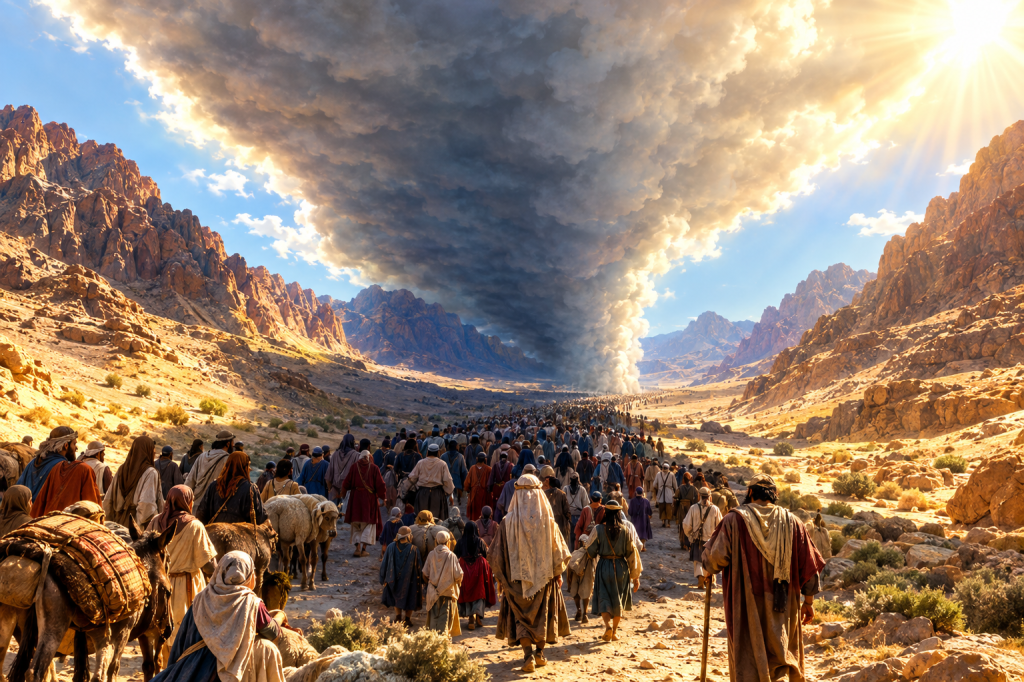
Let’s look at another example. How did God lead the Israelites out of Egypt? First of all, it wasn’t a straight shot. If you left Egypt and headed to Israel, you’d go north along the coast, an easy 1-2 week journey. But they didn’t go that way. They went due east and then south, the “wrong” direction. They spent a whole year at Mt. Sinai before turning north again, and eventually wandering around for 40 years.
Why this detour to the south? God knew they weren’t ready to face what lay ahead. They needed to come together as a nation and learn to trust God. God often sends people down the dirt road; it is not the fastest or easiest way, but the lessons learned on those dirt roads are necessary. And how exactly did God lead these former slaves of Egypt?
Exodus 13:21 And Yehovah went before them by day in a pillar of cloud to lead them along the way, and by night in a pillar of fire.
Have you thought about why God chose a pillar of cloud by day and a pillar of fire by night? He could have had them follow a white horse, or put giant arrows on the desert floor. Why this way? If you had ever spent a day and night near Mt. Sinai, you would understand.
The Sinai Peninsula gets oppressively hot. The sun becomes so intense. What would make it better? There are almost no trees there. In fact, this almond tree is the only tree I saw anywhere near Mt. Sinai. There is no shade at midday.

But what if a big cloud hung over you all the time, so you could follow it around and always have shade? This is why the pillar of cloud. On my first hike up that mountain in 2009, it was so hot. Temperatures that day were above 100. And let me tell you, at night it gets cold. I thought I would freeze to death the night we slept out on top of that mountain. It dropped to 36 degrees, and the wind howled.
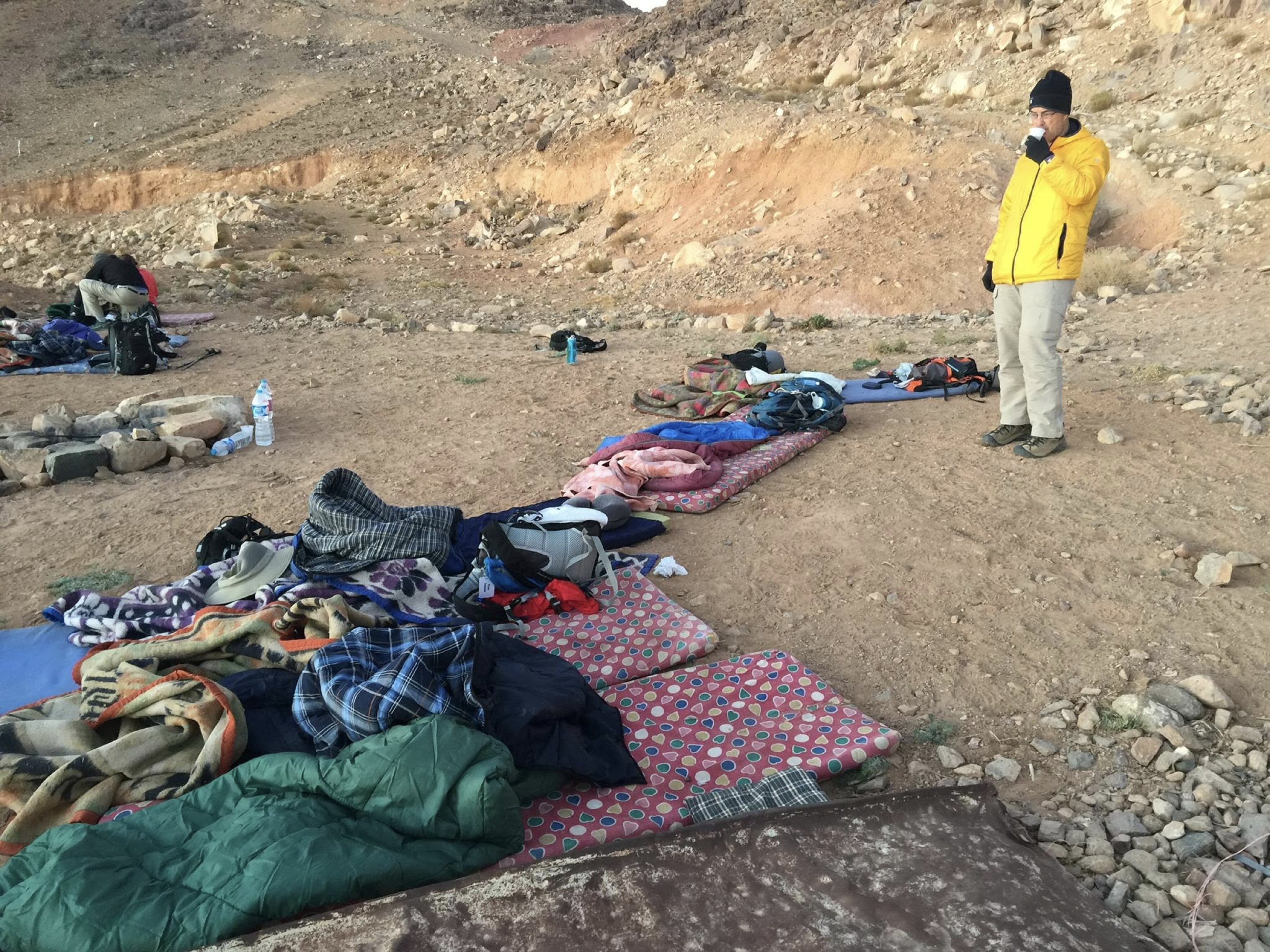
This is a view of our sleeping quarters the next morning, circled around the fire. Note my friend in the coat, hat, and gloves. But what if, by night, you had this huge pillar of fire? It would provide heat to keep you warm and light so you could see and not stumble on the rocky paths. (That would have come in handy the second time I spent the night on that mountain when I tripped on a rock and broke my arm.) A pillar of fire lighting up the camp and lighting your path was a good choice. And that reminds me of a psalm.
Psalm 119:105 Your word is a lamp to my feet and a light to my path.
But have you thought about what it means? A lamp unto my feet. I remember walking a path in Ghana, Africa, one night, and it was pitch black. No moon, no electric lights anywhere. I was very grateful for my flashlight. Especially since I had treated 3 patients in the hospital that day for poisonous snake bites. A light to see your feet on the path is a good thing.
And I have a really bright flashlight that will light up the path for quite a way. But in the Psalmist’s day, they didn’t have flashlights. They had oil lamps; most were made of clay, with a hole to pour in oil and a place for the wick. But with an oil lamp like this, how do you see the ground so you don’t stumble? Like this:1
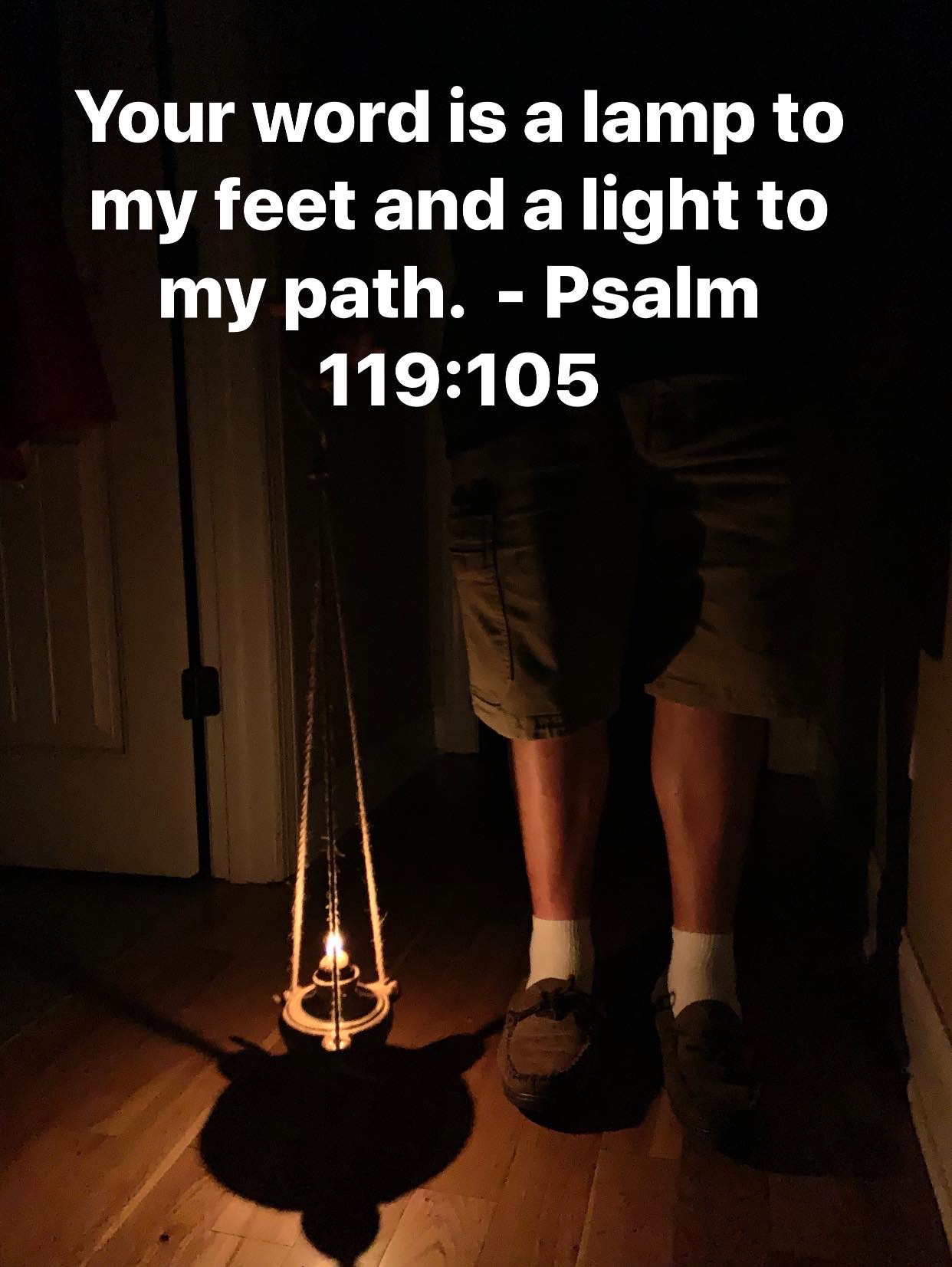
But this lamp doesn’t put out much light. Not like my flashlight, which could see far ahead. The oil lamp only gives you enough light for the next step. You can’t see the whole path at once or see your destination ahead; you can only see one step at a time.
So you take that step, and only then will the light illuminate the path for your next step. This is how God leads. This is how God led Abraham. And this is how God led Paul, and this is how God wants to lead you. That builds trust in God. Because you can’t see where you are going until you get there. Only by walking forward do you see the light for the next step. His word, his instruction, his direction is a lamp unto our feet and a light for our path, one step at a time.
Let me remind you. We read Acts 16:6-10. It only took us a few seconds, but in those 5 verses, Paul, Silas, and Timothy traveled about 1000 miles (on foot). It took them at least 3 months. During those 3 months, they likely talked to hundreds of people about Jesus, and Luke could have included many stories. But we have none of those.
Luke decided that, of all the stories he could tell from these 3 months and this 1,000-mile journey, the most important was to tell about how God led Paul, the closed doors, the detours, and the call to go to Macedonia. Luke knew that we needed to understand how God leads.
We say that we are followers of Jesus. We need to study how God led people in the Bible so we can recognize Jesus’ leadership in our lives. Start walking, Abraham, and I will show you where we are going when we get there. Move when the cloud moves, Israel, and stop when it stops, and the pillars of cloud and fire that lead you will provide comfort and safety as you follow in obedience. Look, Paul says, the problems we face, the roadblocks in our path—they prove God is leading us on His path. And we walk as the Psalmist said, in the light of his word.
John 8:12 “Again Jesus spoke to them, saying, ‘I am the light of the world. Whoever follows me will not walk in darkness, but will have the light of life.”
- Photo Credit: Keith Monk.


Leave a Reply