August 16, 2026 – Controversy, Part 2— Acts #51
Acts. 15:1-21
Last week we began to look at a controversy in the early years of the church. It had only been about 12 years since Jesus ascended to heaven, and there was already a heated debate over a critical issue in Acts 15. The disagreement is about what is required for salvation — do you have to be circumcised and follow the Jewish ceremonies and laws, or is salvation by grace alone? Let’s re-read the scripture we covered last week:
Acts 15:1-5 But some men came down from Judea and were teaching the brothers, “Unless you are circumcised according to the custom of Moses, you cannot be saved.” And after Paul and Barnabas had no small dissension and debate with them, Paul and Barnabas and some of the others were appointed to go up to Jerusalem to the apostles and the elders about this question.
So, being sent on their way by the church, they passed through both Phoenicia and Samaria, describing in detail the conversion of the Gentiles, and brought great joy to all the brothers. When they came to Jerusalem, they were welcomed by the church and the apostles and the elders, and they declared all that God had done with them. But some believers who belonged to the party of the Pharisees rose up and said, “It is necessary to circumcise them and to order them to keep the law of Moses.”
These men came from Judea because they wanted these new Gentile followers of Jesus to do the right thing. They were concerned about their salvation. All of these Gentiles in the church had accepted Jesus, but they didn’t think that was enough. They wanted them to be truly saved, which, in their minds, meant they had to adopt the Jewish faith. If they didn’t become practicing Jews, were they really saved? Did they need to be circumcised, wear tassels and phalacteries, and follow the laws of ritual purity to have eternal life?
They were so convinced of this that they traveled from Jerusalem to Antioch to convince these Gentiles, about 350 miles. And it is such an important issue that the Antioch church sends a delegation with Paul and Barnabas back down the 350 miles to Jerusalem to discuss it with the elders of the church there. Listen, I don’t travel 350 miles unless it’s for something very important, and for me, that is 6-7 hours of driving. For them, this is a 2-3 week journey. This debate is that important. The question is:
What is required for Jesus to save you?
This is the question in Acts 15 that sparked the huge debate. A very important question for them and for us also. So all the church leaders met in Jerusalem as a council to decide what God requires.
Last week I showed you a pattern that runs throughout the Bible of how God delivers people. So we went through the Old Testament, and we found this consistent pattern:
First, Deliverance —God delivers or saves people only because of grace.
Then, Instructions — After God delivers, He gives instructions on how to live.
We saw this over and over in the Bible. Adam and Eve did nothing to earn the right to live with God in the garden. Abraham did nothing to become the one God called to be the father of the nations. Israel did nothing to merit salvation from Egypt. It was God’s grace that led Him to deliver the children of Israel from slavery in Egypt. They did nothing to merit God saving them from the Egyptian army by dividing the waters of the sea. They did not earn it; it was only Grace.
Then, after God saves them, he takes them to Mt Sinai, where he gives them instructions on how to live. If you want to live in the Kingdom, you have to follow the laws. There were certain expectations for how they were supposed to act, among them the Ten Commandments. But the most important expectation was to know that there was only one God and no others, and to worship the true God rather than idols of their own making. These rules were the rules of the kingdom. This is what God expected of them if they were going to live in his kingdom.
But first comes the deliverance, the salvation, then the instructions. This is a consistent pattern.
But this group from Judea in Acts 15 wanted to impose requirements for salvation, even though that is never the way God has worked with people. You see, the missionaries, Paul and Barnabas, told these Gentiles that this was the path to salvation.
Accept Jesus as your Lord —> God saves you.
But this group in Jerusalem said that God’s act of grace wasn’t enough. You had to join the Jewish faith. You had to follow the rules. They said the way to salvation was more like this:
Accept Jesus as your Lord, get circumcised, and follow all the rules —> God saves you.
It is as if they had forgotten that God rescued the children of Israel before he even told them what the rules were. But they felt the Gentiles had to meet this standard before they were saved. And this council in Acts 15 will conclude that salvation is based on grace alone.
We are going to read what Luke tells us about their discussion, but first you need to know that, since the days of Deuteronomy, Jewish thought has held that any serious matter requires the evidence of two or three witnesses.
Deuteronomy 19:15 Only on the evidence of two witnesses or of three witnesses shall a charge be established.
So Peter stands up in this court and calls a witness to testify. Look at Peter’s speech in Acts 15 and see if you can identify the witness.
Acts 15:6-10 The apostles and the elders were gathered together to consider this matter. And after there had been much debate, Peter stood up and said to them, “Brothers, you know that in the early days God made a choice among you, that by my mouth the Gentiles should hear the word of the gospel and believe. And God, who knows the heart, bore witness to them, by giving them the Holy Spirit just as he did to us, and he made no distinction between us and them, having cleansed their hearts by faith. Now, therefore, why are you putting God to the test by placing a yoke on the neck of the disciples that neither our fathers nor we have been able to bear?
So the first witness is God Himself, who sends the Holy Spirit to the Gentile believers. The gift of the Holy Spirit is God’s stamp of approval on these Gentiles. Peter argues that God would not have sent the Holy Spirit to them had they not been truly saved. Peter continues:
Acts 15:10-11 “Now, therefore, why are you putting God to the test by placing a yoke on the neck of the disciples that neither our fathers nor we have been able to bear? But we believe that we will be saved through the grace of the Lord Jesus, just as they will.
What is the yoke Peter says this group wants to place on the necks of these Gentile believers?
(For you city-slickers, a yoke is a heavy wooden beam used to join a pair of work animals so they can pull a heavy load together, or plow.) The yoke is the burden of believing you have to do all of the law perfectly to be saved. This is important. There is nothing wrong with all the laws in the Old Testament. The laws were not bad. The Bible testifies that the law is good; it is perfect. The problem is that no one could keep it.
Adam and Eve only had one law in the garden, and they couldn’t keep it. The law in the garden was good. “ Don’t eat the fruit that represents disobeying God by deciding right and wrong for yourselves.”That is still a good law. God gets to decide what is good and what is evil. That is still not our business. (But people are still breaking that law of the garden.) So Peter calls them out and says that the yoke of the law is too heavy to bear. No one could keep it. Paul said it this way in Romans 3:23 “For all have sinned and fallen short of the glory of God.” Again, there is nothing wrong with the law, just with our ability to keep it. So Jesus comes along and bears the burden of the yoke for us.
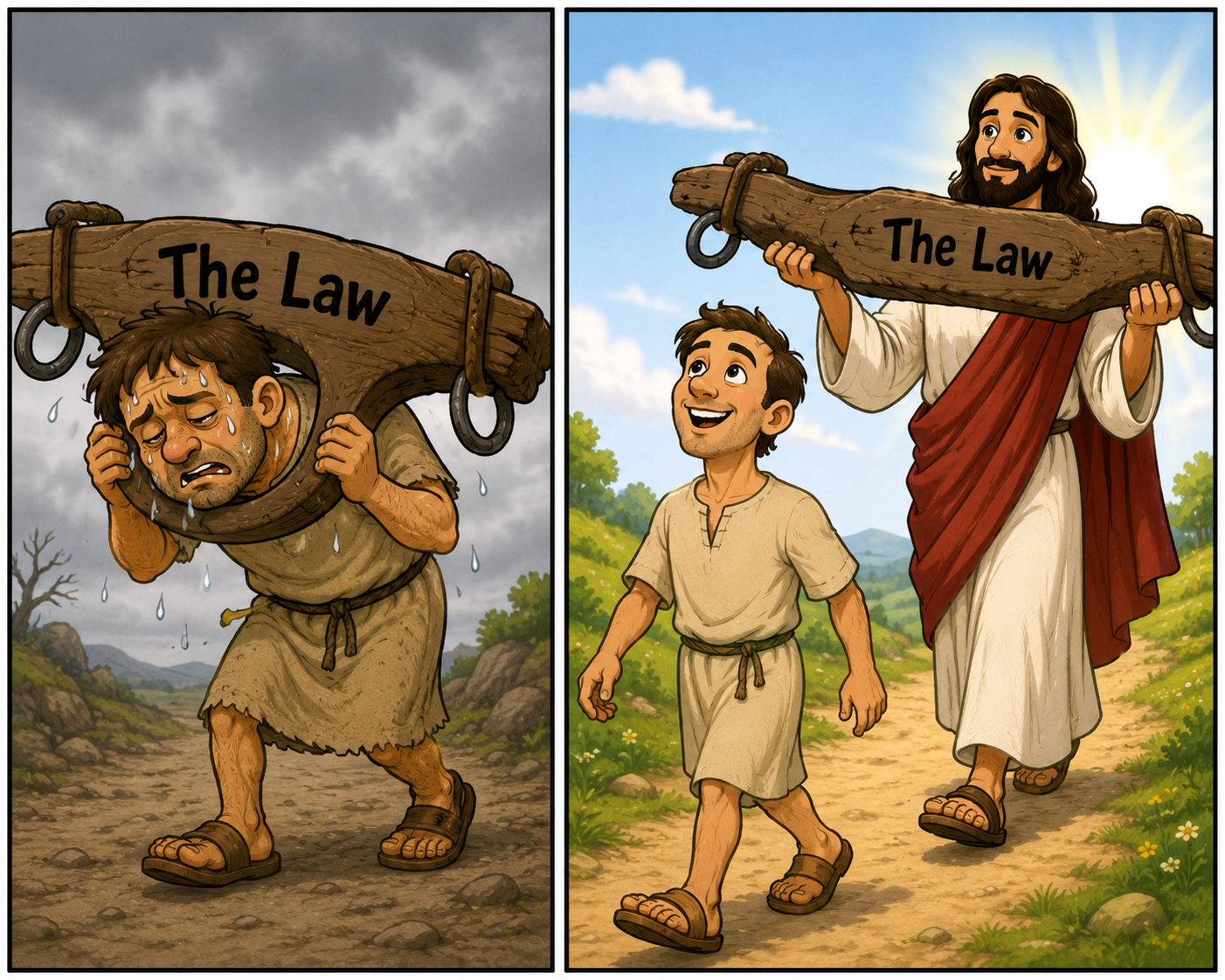
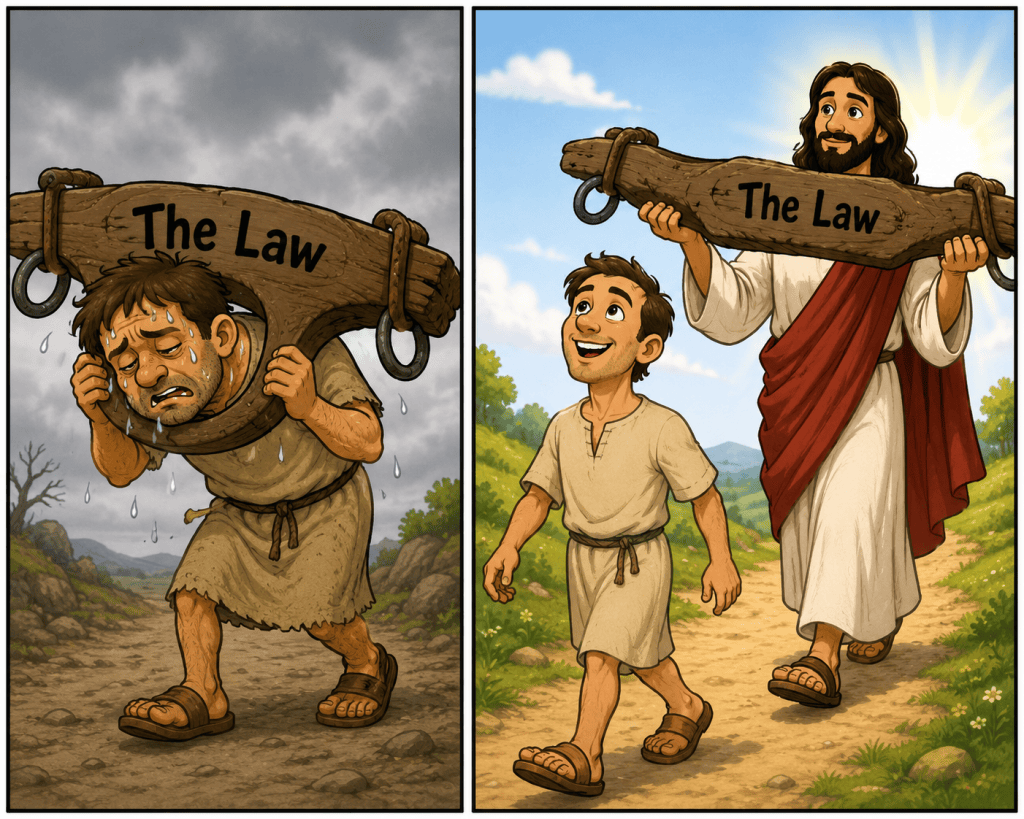
Jesus carries the yoke with us, but he bears all the weight. He can carry the yoke. Jesus kept the law perfectly and carries the weight of our sins for us.
Jesus tells us:
Matthew 11:30 For my yoke is easy, and my burden is light.
So Peter asks them why they would want to put this heavy yoke back on the neck of the Gentiles when they couldn’t even keep it themselves? He continues:
Acts 15:11 “But we believe that we will be saved through the grace of the Lord Jesus, just as they will.
Listen, my Jewish friends, says Peter, we are all saved not by the law but by grace through Jesus. And the Jewish people for thousands of years have always known that they have had to depend on the grace of God, because they had all committed sins for which there was no sacrifice. They have always depended on the grace of God. Peter says these Gentiles, like us, could never do anything to earn their salvation; it is only through grace. And the gift of the Holy Spirit to the Gentiles is God’s “amen” on their salvation.
Then James, leader of the group in Jerusalem, speaks up and calls the second witness:
Acts 15:12-18 “And all the assembly fell silent, and they listened to Barnabas and Paul as they related what signs and wonders God had done through them among the Gentiles. After they finished speaking, James replied, “Brothers, listen to me. Simeon has related how God first visited the Gentiles, to take from them a people for his name. And with this the words of the prophets agree, just as it is written:
After this I will return, and I will rebuild the tent of David that has fallen; I will rebuild its ruins, and I will restore it, that the remnant of mankind may seek the Lord, and all the Gentiles who are called by my name, says the Lord, who makes these things known from of old.’”
James is quoting from Amos. (Amos 9:11-12 LXX). Most of the book of Amos is a prophecy of God’s judgment first on the nations and then on the Northern Kingdom of Israel. It is a bleak book full of God’s wrath and judgment until the very last paragraph, where there is a prophecy of hope that after God’s judgment, he will one day restore. He will restore the house of David that fell. The kingdom ruled by a descendant of David will be rebuilt.
And James sees that Jesus is that messiah who restored the rule of the house of David. And the surprising part of this prophecy was that when this messiah comes, even the Gentiles will seek him.
James brings the second witness to this controversy. The first witness was God, as he sent His Holy Spirit. The second witness is the Word of God. Having presented the necessary two witnesses, James summarizes the judgment.
Acts 15:19-21 Therefore my judgment is that we should not trouble those of the Gentiles who turn to God, but should write to them to abstain from the things polluted by idols, and from sexual immorality, and from what has been strangled, and from blood. For from ancient generations Moses has had in every city those who proclaim him, for he is read every Sabbath in the synagogues.
James refutes the idea that anything further is required for salvation. God saves based on grace alone. Aren’t you glad about that? If works were the way to God instead of Jesus, we would be singing “Amazing Circumcision, How Sweet the Sound”, or “What Can Wash Away My Sins, Nothing But the Law of Moses”. You enter the kingdom of God solely by the grace of God through the work of Jesus. This will be the council’s decision. But remember the pattern,
After deliverance, instructions are given for how to live as a member of the kingdom.
You don’t have to do anything to be saved; only accept the free gift God has for you. But what do you do after you are saved? This is another very important question the council deals with. Let me give you a couple of other ways to think about this:
We don’t obey Jesus in order to become His people; we obey Jesus because we have become His people.
Grace gets us in the door. Discipleship teaches us how to live in the house.
Look at the instructions James gives:
Acts 15:19-21 “Therefore my judgment is that we should not trouble those of the Gentiles who turn to God, but should write to them to abstain from the things polluted by idols, and from sexual immorality, and from what has been strangled, and from blood. For from ancient generations Moses has had in every city those who proclaim him, for he is read every Sabbath in the synagogues.
To us this seems like an odd list. Avoid these four things: things polluted by idols, sexual immorality, things strangled, and blood. We easily understand staying away from sexual immorality and idols. But what about the other two? There is an important reason James includes these four things, but it only makes sense if you understand the culture these people lived in. What these four things have in common is that they were all things done in pagan temples. It was commonplace for all Gentiles to participate in pagan temple celebrations and feasts. It was the socially acceptable thing to do, and in many places, socially required.
The whole town would go to these temples and feast on the food offered to the idols. Every pagan temple had temple prostitutes, and the Greek word James uses for sexual immorality in this passage refers specifically to these pagan rites. What about “that which has been strangled, and from blood”? We have evidence from papyri that in many pagan temples of the day, they would attempt to choke the animal sacrifice in front of the idol to transfer its life-breath or vitality into the idol, or use the blood of the sacrifice similarly to give life to the idol. So these four things are all about taking part in pagan temple rites.
The Gentiles are being told that they need to give up something that has been a regular part of their lives. Every holiday celebrated one pagan god or another. Participation in these pagan temple celebrations and rites was important socially. Giving this up will cost them. They may lose friends. They may not be invited to other parties because others feel they look down on them. It may cost them financially, as they will lose business contacts. People in the community would worry that the gods would punish their town because the Jesus followers were rejecting their gods. If there were a bad harvest or a lack of rain, these followers of Jesus would be blamed for angering the gods. And in Roman cities, failure to pay homage to the gods and the emperor could be considered treason, punishable by death. This is not an insignificant requirement the council has made.
It is interesting to notice what James didn’t say. He doesn’t say, “Now that you are saved, keep the Ten Commandments.” He doesn’t give them a long listing of Levitical laws. He gives them a starting point. These Gentiles have turned to the true God; they must then turn away from idolatry and the associated acts of immorality. They must begin by following the first and greatest commandment: there is only one God, and you only worship him. That is the first rule that every Jewish child learned, the first rule that Joseph and Mary taught Jesus, the Shema.
“Hear, O Israel: the Lord our God is one. He alone is God.”
That is where every young Jewish child started. That is where we should start.
In John 17, Jesus gives what many call his “in the world but not of the world” speech. He means that while his followers live on Earth and participate in daily life, they should not adopt the corrupt values, selfish habits, or ungodly systems of human society. Our daily choices- the places we go, our conversations, the way we treat others, and how we spend our money should all be different once we place our lives in Jesus. If we speak and act just like others who are not followers of Jesus, then we aren’t doing it right. That is why I don’t often use the term ‘believer’ and rather use the term ‘follower.’ Because following Jesus literally means going where Jesus goes, talking like Jesus talks, treating people like Jesus does, and doing the things Jesus does. It is becoming more like Jesus. When you decide to follow Jesus, then your tomorrow will not look like your yesterday.
So James gives them this starting point: Now that you belong to Jesus, don’t continue acting as if you belong to the world you came out of. If you have been saved, act like it. First, stop going to pagan temples. Now for the rest, James says this:
Acts 15:21 For from ancient generations Moses has had in every city those who proclaim him, for he is read every Sabbath in the synagogues.
They have Moses’ books read every Sabbath in the synagogues. What does James mean by that? Remember that these Gentile followers are primarily meeting in local Jewish synagogues to worship the Jewish messiah Jesus. There they will take part in the regular synagogue service, just like Jesus did. There will be readings from the Scripture. (Remember: The only Scripture these Jesus followers have at this point is what we call the Old Testament. None of the New Testament books have been written yet. We think 1 Thessalonians was the first one written, but in Acts 15, Paul hasn’t even been there yet.)
So every Sabbath, every Saturday, they will gather and read the Scripture and pray the same prayers Jesus prayed. James says they will have plenty of opportunities to discover their next steps in following Jesus by reading our Old Testament. So the Gentiles, just like the Jews, are saved by grace, through faith in Jesus. And then come the instructions. The first step is to change your life to avoid any connection with idols. And James says the next steps will be revealed through their study of our Old Testament.
But what does that mean for us? We came into the kingdom of God just like they did, by grace through the work of our Messiah Jesus. But what are our instructions? First, avoid connections with idols. We aren’t typically tempted to go into pagan temples and participate in strangling and blood sacrifices, but we are tempted by idols just the same. There are plenty of socially acceptable forms of idolatry today.
Celebrity culture is a very common form of idolatry, with musicians, athletes, and internet personalities elevated to a revered status. Physical comfort or financial security becomes an idol for some who devote their entire lives to it. Individualism and self-worship is another common form of idolatry, where some people’s primary goal in life is their appearance, their public image, their social media following, or their personal autonomy. And these are just a few. But like in the days of Paul and Barnabas, it may cost you socially if you don’t participate in our society’s forms of idolatry.
To sum it all up, this is the pattern of how God saves people in the Bible. There are no requirements for us to be saved except to accept the gift God gives. But after we are saved, we receive instructions on how we are to live as followers of Jesus. We first must make sure we don’t participate in idol worship. And like the followers in 45 AD, the next steps will be revealed as we study the Scriptures. And that is the topic for next week.


Leave a Reply