May 13, 2026 – Open Your Door to a Miracle — Acts #40
Acts. 12:6-17
So last week, we continued the story in Acts 12 of Peter’s miraculous release from prison. It was the night before Peter was to be put to death by Herod Agrippa. Luke tells us that the followers of Jesus were together that night, praying earnestly for Peter. And we discussed what Luke meant by this type of prayer. The adjective he used for this prayer was ektenos, the same word he used for the prayer Jesus prayed in the garden. This is intense, fierce, giving it 100% prayer. God sent an angel to escort Peter from his cell. Let’s review the scripture and continue the story.
Acts 12:6-17 “Now when Herod was about to bring him out, on that very night, Peter was sleeping between two soldiers, bound with two chains, and sentries before the door were guarding the prison. And behold, an angel of the Lord stood next to him, and a light shone in the cell. He struck Peter on the side and woke him, saying, “Get up quickly.” And the chains fell off his hands. And the angel said to him, “Dress yourself and put on your sandals.” And he did so. And he said to him, “Wrap your cloak around you and follow me.”
And he went out and followed him. He did not know that what was being done by the angel was real, but thought he was seeing a vision. When they had passed the first and the second guard, they came to the iron gate leading into the city. It opened for them of its own accord, and they went out and went along one street, and immediately the angel left him. When Peter came to himself, he said, “Now I am sure that the Lord has sent his angel and rescued me from the hand of Herod and from all that the Jewish people were expecting.
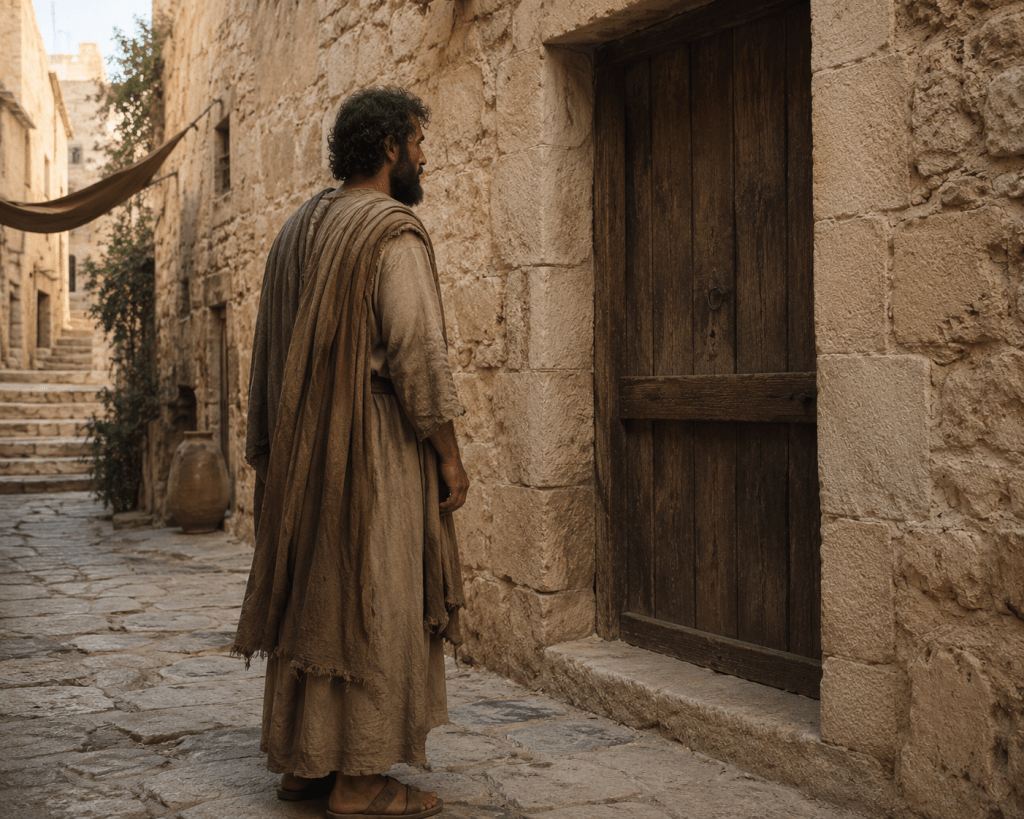
“When he realized this, he went to the house of Mary, the mother of John whose other name was Mark, where many were gathered together and were praying. And when he knocked at the door of the gateway, a servant girl named Rhoda came to answer. Recognizing Peter’s voice, in her joy, she did not open the gate but ran in and reported that Peter was standing at the gate. They said to her, “You are out of your mind.”
But she kept insisting that it was so, and they kept saying, “It is his angel!” But Peter continued knocking, and when they opened, they saw him and were amazed. But motioning to them with his hand to be silent, he described to them how the Lord had brought him out of the prison. And he said, “Tell these things to James and to the brothers.” Then he departed and went to another place.
When Peter realizes this is not a dream or vision, he first goes to let the other Jesus followers know that he has been miraculously freed. Remember that, at this point, there are no “church” buildings for the Jesus followers, so they are meeting in various homes. Peter goes to the house church that meets at the home of Mary, the mother of John Mark. (You will hear a lot more about John Mark, the author of the gospel of Mark, as we continue through Acts.) John Mark’s father is likely deceased, for it is recorded as Mary’s home. And it is described as a large home with a courtyard and exterior gatehouse.
Peter knocks on the outer door. The servant girl, Rhoda, comes to the door but does not open it. “Who is it? ” she asks. “Please let me in,” Peter responds. Now look at what Luke tells us happens next:
Acts 12:14 Recognizing Peter’s voice, in her joy, she did not open the gate but ran in and reported that Peter was standing at the gate.
So Peter is left standing in the street. Remember, he has just escaped from prison, likely in the Antonia Fortress, where hundreds of Roman soldiers are garrisoned. He is a fugitive, and he would really like not to be standing out in the open on an empty street right now. Especially at the house where the Jesus followers meet, which would be the first place the authorities would look for him.
And Rhoda leaves him outside to report to the crowd praying for Peter that Peter is at the doorway. Luke says, “in her joy,” she did not open the gate. I get it. She was so overjoyed that Peter is there that her brain stops communicating with her body. Often when people are overjoyed, they don’t act logically. (Proof of this is watching any contestant who wins on The Price Is Right.)
While Peter is waiting outside trying not to look like an escaped criminal, Rhoda interrupts the prayer meeting to tell them that Peter is at the door. And they all shout out, “Yay! Of course he is; that is exactly what we were praying for! God has answered our prayers. Praise Jesus!” Well, no. Instead, they say this:
Acts 12:15 They said to her, “You are out of your mind.”
The Greek word Luke uses, which the ESV translated as ‘out of your mind,’ is μαίνομαι mainomai, where we get our word ‘manic’ or ‘maniac.’ They don’t believe her. Peter couldn’t possibly be here; he is in prison.
There was a Jewish thought in the day that each person had a guardian angel, and a person’s angel resembled them in appearance. Is there any scriptural evidence for this? Or is this just a superstition of the time? Let’s look at a few other passages that suggest this.
Matthew 18:10 “See that you do not despise one of these little ones. For I tell you that in heaven their angels always see the face of my Father who is in heaven.”
Psalm 91:11-12 For he will command his angels concerning you to guard you in all your ways. On their hands they will bear you up, lest you strike your foot against a stone.
Psalm 91 is addressed to “all who have chosen to ‘live in the shelter of the Most High,’ a Psalm for every true follower of God. We know it as a verse quoted by the satan to Jesus when he was tempted. It is for all of us on this earth, and how much more for God’s only son? Angels are watching over us. I have often said we have no idea how many disasters we avoid due to divine intervention. So I think there is clear scriptural evidence that God uses angels to protect us. But an individual guardian angel? That is not as clear from scripture.
I have met one person whom I believe God gave the gift of seeing the heavenly beings. And he believed that we all had our own angel assigned to us, as well as other angels when we needed them. He always saw the same angel around my wife, sometimes with other angels also. So do we all have our own angel? He thought so, and he saw a lot more angels than I have seen.
Meanwhile, we have still left Peter in the street, knocking on the door, hoping it is loud enough for the people inside to hear but not so loud as to wake the neighbors.
Acts 12:16-17 But Peter continued knocking, and when they opened, they saw him and were amazed. But motioning to them with his hand to be silent, he described to them how the Lord had brought him out of the prison. And he said, “Tell these things to James and to the brothers.” Then he departed and went to another place.
So they open the door and see Peter, and they are all celebrating and shouting, and Peter is motioning for them to be quiet. (And I am sure Peter is thinking that these people have clearly never been part of a prison break before.) This is a great story that Luke included in his book. It has drama, suspense, humor, and a miracle. And last week, we concentrated on the type of prayer that Luke said the people had gathered to pray for Peter. This week I want to consider the idea of the miracle.
So, what is your experience with miracles? Some denominations believe that God stopped performing miracles after the time of the Bible. They are called “Cessationists”, saying that miracles like healing, prophecy, and other spiritual gifts ceased after the time of the apostles and the completion of the New Testament. They say God is out of the miracle business now.
Let me say that I find no suggestion in Scripture that God stopped doing God things after 90 AD. Instead, I see promises that He will continue to intervene in our lives in mighty ways. But even more, I can not deny what I have experienced myself. I have told you of several of the miracles that I personally witnessed: of God supplying hundreds of doses of medicine for children in Guatemala from an empty bin. Of rain that paused only in a circle over us in a meeting in Mexico. Of miraculous provision of a rare medical item that was needed in Ghana, found in a box of discarded medical supplies in a shipping container that arrived that week. (The box had been thrown on the shipping container when it was sent 6 months earlier, only placed there because there was a little room left.) I have taken care of a child with stage 4 cancer who was given no hope of recovery, and got a repeat MRI only to find his large tumors had suddenly disappeared with no medical treatment. I have seen chronic diseases that should end life cured. I have seen children on the brink of death recover completely overnight from nothing we did medically. I saw my dad’s tumor on his face fade away and then watched his oncologist stand in shock, telling us that the medicine did not work that way.
I can tell you this morning that God is still God. That He did not stop intervening in our world 2000 years ago. That He is still working all things out for our good. But some people will never be convinced.
How extraordinary must an event be to be called a miracle? What does it take to convince someone of a miracle? It depends on your worldview. Those who trust God may see miracles in the small details of life, whereas people who do not believe in God may say that miracles are impossible. The most extreme example of this is in the book of Exodus. The Pharaoh of Egypt watched the Nile turn to blood; he saw plagues of frogs, flies, lice, boils, locusts, hail, and darkness descend on his country, striking fear into his people. And then the death of the firstborn. All of this as announced by Moses. But he still did not believe in the God of Moses or in his power. He stood in his chariot and watched as a sea parted and his former slaves walked across on dry land. But still, he did not believe. Pharaoh, who thought himself a god, could never believe in miracles from the God of Israel.
And how about the people who witnessed the resurrection of Lazarus? Jesus made sure he didn’t arrive until Lazarus had been dead for 4 days. He wasn’t just cold, but he was decaying. You would think everyone there would have to believe that Jesus had performed a miracle and that he must be who he said he was. But John, in his gospel, tells us this:
John 11:45-46 “Many of the Jews therefore, who had come with Mary and had seen what he did, believed in him, but some of them went to the Pharisees and told them what Jesus had done.”
Many were impressed, and they believed. But others reported Jesus to the people who wanted to kill him. Some people’s minds were made up, and they would never be convinced about Jesus and his works. But look what Jesus says:
Matthew 11:20 “Then he began to denounce the cities where most of his mighty works had been done, because they did not repent.”
Luke 10:13-14 Woe to you, Chorazin! Woe to you, Bethsaida! For if the mighty works done in you had been done in Tyre and Sidon, they would have repented long ago, sitting in sackcloth and ashes. But it will be more bearable in the judgment for Tyre and Sidon than for you.”
Those too hard-hearted to see God working miracles right before their eyes receive the stern rebuke of Jesus and the warning of coming judgment.
The word our Bible uses for miracles is ‘signs’. They were to be a sign that God is who He said He is, that He is powerful, that he is compassionate. And there should only be one response to a display of God’s power. It is the response of Isaiah when he witnesses God’s glory: to fall on his knees in repentance.
And indeed, we still see this happening in our world. Just 50 or 60 years ago in Nepal, there were no Christians. And today there are over half a million. And the head of Nepal Theological Seminary stated that over 80% of the Christian conversions in Nepal were due to healings or deliverance from spirits. God is still using miracles as signs pointing to Himself, leading people to repentance and to His kingdom.
I read that story about the miracles in Nepal in a great book entitled “Miracles Today” by Craig Keener, a well-respected theologian. Keener received his PhD from Duke University, and he is currently a professor at Asbury Theological Seminary. In this book, Keener reviews the theology of miracles, the scriptural evidence for them, and then documents hundreds of miracles he has personally investigated. It is a condensed version of his original book on miracles, considered the most exhaustive on the subject. That one, entitled “Miracles, The Credibility of the New Testament Accounts,” is almost 1300 pages.
Another good book on the subject is “The Case for Miracles” by Lee Strobel. Strobel is the journalist from the Chicago Tribune who was an atheist and, following his wife’s conversion to Christianity, set out to prove that Jesus wasn’t who he said he was. As a result of his investigation, he became a Christian. Strobel interviewed Craig Keener for his book and leans heavily on Keener’s theology and experience.
Again, what is your experience with miracles? Someone stated to me that miracles happened all the time in Jesus’ day, but rarely happen now. While I agree that when God walked on the earth as Jesus, there were many miracles during his very short ministry. But looking back on my life and reading Keener’s book, I cannot agree that miracles are rare today. Dramatic healings don’t happen every day in our town, but when you look at our nation or the whole world, miracles are happening daily. This is one of the benefits of reading a book on miracles today.
Let me tell you just one of the many stories from Keener’s book that is set in Suriname. Suriname is a multicultural nation in South America whose national language is Dutch. Suriname was not devoid of Christians, but in Nickerie, the northern coastal province of Suriname, it had another dominant faith [Hindu] and had resisted the Christian message for centuries. For generations, only a few hundred Christians lived there, and churches competed with each other for the same members.
In his book, Craig Keener said, “I met with Dr. Douglass Norwood in 2006, and he shared with me his eyewitness experience from twelve years before, also recounted in his dissertation. He was a Moravian pastor, and Moravians had been among the pioneers of churches there.
In November 1994, after he preached, the churches there repented of their divisions and cried out to God for an outpouring of the Holy Spirit. Believers went out and began to share their faith with surprised neighbors, who had never known the Christians to act this way before.
That night, many non-Christians gathered at the church—a few of them hostile. One hostile visitor, perhaps in his seventies, had been paralyzed on his right side virtually all his life. Because he could not walk, his friends had brought him on a blanket or rug and plopped him down on the ground in front of Norwood. This man was not happy. “Your religion is garbage!” he shouted. “My religion is garbage too! I’ve prayed to Shiva, and to Vishnu, and to my other gods, and nothing happens. Now you want me to pray to Jesus?”
As he uttered the name Jesus, his paralyzed arm suddenly shot up into the air. He stared at his own arm, shocked. No one had prayed for him, but when he mentioned Jesus, God healed his paralysis. Norwood reports, “At that instant, he jumped up, grabbed my mike, and began screaming, ‘Look what Jesus did for me!’ as he danced around, waving his now-healed arm in the air.”
The other visitors were converted almost as quickly as he was. This was the beginning of a movement that, over the next few years, brought tens of thousands of people to faith in Christ, most of whom had previously had little exposure to him. The massive growth of the Christian movement in Nickerie in recent decades is well known.”
When John the Baptist sent his disciples to ask if Jesus really was the Messiah, the Son of God, this is what Jesus said.
Matthew 11:4-6 “Go and tell John what you hear and see: the blind receive their sight and the lame walk, lepers are cleansed, and the deaf hear, and the dead are raised up, and the poor have good news preached to them. And blessed is the one who is not offended by me.”
Let me tell you this morning that Jesus is still Jesus. He is still the Son of God, and He is still our Messiah. And He is still doing what he was sent to do. He is up in heaven interceding for us with the Father even now. He sent His Holy Spirit to dwell in us and among us. And the Holy Spirit comes with power. The power to heal, to resurrect, to calm storms and to provide all we need.
Do not be offended by the idea of miracles. Do not be like the villages that Jesus rebuked for their unbelief. Because these followers of Jesus in Acts 12 did not believe Peter had been released from prison. Let me remind you that this group of people has gathered while the rest of the city is sleeping to pray for God to intervene for their friend in prison. And they are praying seriously. Luke has told us that they were praying ‘ektenos’, the kind of fierce praying that Jesus did in the Garden of Gethsemane. They are desperate for God to interrupt Herod’s evil plans for Peter. And these are people of faith. It has been just around 15 years since the resurrection. Likely, some of these people had encountered Jesus after he was raised from the dead. They have seen miracles with their own eyes.
So how could it be that they are unable to believe God has performed another one here this night?
They remind me of a story I heard a preacher tell once about a farming community in a severe drought. They called for a special prayer meeting at the church one night. So they all gathered to pray for rain. But only one little girl brought an umbrella.
I think we have the same problem these followers in 45 AD had. While they had witnessed a miracle or two or three, they also had seen many more times when miracles didn’t happen. They were in the city when Stephen was stoned. God did not intervene then. They saw their friends and family hauled off to be whipped and beaten. Some may have experienced this persecution themselves. And they had just seen James, the brother of John, taken by Herod Agrippa and beheaded in public. And there was no miraculous intervention by God.
And it seems that their personal experience of times without a miracle overshadowed the miracles they did see.
Is every prayer answered with a miracle? No. Jesus prayed hard in the garden for his cup of suffering to be taken from him, if possible. His prayer was not answered just like he wanted. Hundreds of people I know prayed long and hard for a little girl who was going blind. She lost her vision. While miracles aren’t as rare as you might think, they don’t happen all the time. If they did, they wouldn’t be miracles, the extraordinary signs God uses to bring people to him.
You see, one day God will bring about a full restoration of all the world’s wrongs. One day God’s will will be done on earth as it is in heaven. One day there will be no blindness, no lameness, no sickness, no cancer, no death. One day, God will bring ultimate healing to all. Until then, we have these occasional glimpses of glory as God heals, provides, and moves mountains here. Miracles are just a foretaste of the full restoration of all the world’s wrongs that God will do one day. Lazarus was raised from the dead, but years later he died again, and his body remained buried that time. All those people Jesus healed eventually developed other health problems and didn’t recover. All of the healings and miracles we see on this earth are temporary. But one day we will all be healed forever.
Yes, John the Baptist, Jesus is the messiah who has come to make everything right. But everything in its own time. The kingdom starts as a tiny seed before it grows into a mighty tree.
So what is our lesson from this story in Acts 12? They have gathered to pray while others sleep, praying fiercely. We need to pray like that. But when a miracle walks right up to their door, they don’t open it. They are pleading with God to do something, but when He does, they are slow to see it.
Let me testify that God is doing miracles in our world, but many people’s minds are just as closed as that door in Peter’s face. We miss so much of God’s goodness because we are so busy with the things of this world that we miss that miracle knocking on our door. Do not miss the miracle.
 Swallow No Camels
Leave a comment