May 20, 2026 – Who Is on the Throne Now? — Acts #41
Acts. 12:6-17
This week, we come to the end of the story of Peter’s miraculous escape from prison and the end of Herod Agrippa. Remember, Agrippa had come to power through his friendship with Caligula, one of Rome’s most immoral emperors. And to gain favor with the religious elite in Jerusalem, he killed James and then put Peter in prison until he could have him publicly executed also.
And several weeks ago, we looked at the evil of Agrippa and asked ourselves whether it is ever possible to forgive someone so evil. And looking at scripture, we concluded that for us, forgiveness is not an option. We are called to imitate Jesus, who from the cross pleaded for forgiveness for those who were torturing him. We must be people who show grace and forgiveness just as God has shown grace and forgiveness to us.
Then we looked at the type of prayer that the people were praying for Peter. The word used to describe their prayer, the Greek ektenos, is only used for prayer one other time in the Bible. They were praying as Jesus did in the garden, praying with every ounce of energy and strength they had. That is how we should pray.
Then last week, we looked at Peter’s miraculous escape and miracles, and how God is still doing miracles all around us today. God is still answering prayer and intervening in our world. He is still making the blind to see, the lame to walk, and the deaf to hear. He is still healing people before our eyes. And I urge you to read one of the books I mentioned so you can see for yourself how God is still working today.
This week we come to the end of the story of Peter’s miraculous escape from prison. And there is one more lesson to learn here. And it is about the greatest sin.
So to finish the story, Peter escapes and goes to the house church at John Mark’s house. When he finally gets them to open the door, Peter quickly tells the house church of his escape, and then Luke tells us:
Acts 12:17 Then he departed and went to another place.
We will not see Peter again until Acts 15. We have no idea where he went after this. That is not what Luke sees as important here. Luke doesn’t think it is so important that we know what happened to the apostle Peter, but he thinks it is very important that we know what happened to the evil king, Herod Agrippa. Sometimes it is very interesting to pay attention to what is not included in the Bible. So let’s discover why this part of the story is so important to Luke.
Acts 12:18-19 Now when day came, there was no little disturbance among the soldiers over what had become of Peter. And after Herod searched for him and did not find him, he examined the sentries and ordered that they should be put to death. Then he went down from Judea to Caesarea and spent time there.
Agrippa is very displeased that his prized prisoner escaped. He was ready to have another public beheading. Luke says there was “no little disturbance.” That is his way of saying that Herod went to look for Peter himself and he went ballistic. The usual punishment for a soldier who let a prisoner escape was to be given the punishment the prisoner was due. And Agrippa sure isn’t going to miss a chance to kill another person. So he has the soldiers put to death. Then Herod leaves Jerusalem to head back to his coastal palace in Caesarea. Let’s keep reading…
Acts 12:20 Now Herod was angry with the people of Tyre and Sidon, and they came to him with one accord, and having persuaded Blastus, the king’s chamberlain, they asked for peace, because their country depended on the king’s country for food.
Apparently, the people of Tyre and Sidon had done something to upset Agrippa, and he was withholding food exports from them. ‘You made me angry; then you and your people can starve.’ There is no end to the evil of this man. I’m sure there were lots of people living then who prayed that God would strike Herod dead. And God did. But what was the sin that led God to put an end to Agrippa finally? That is the story that Luke finds important enough to tell.
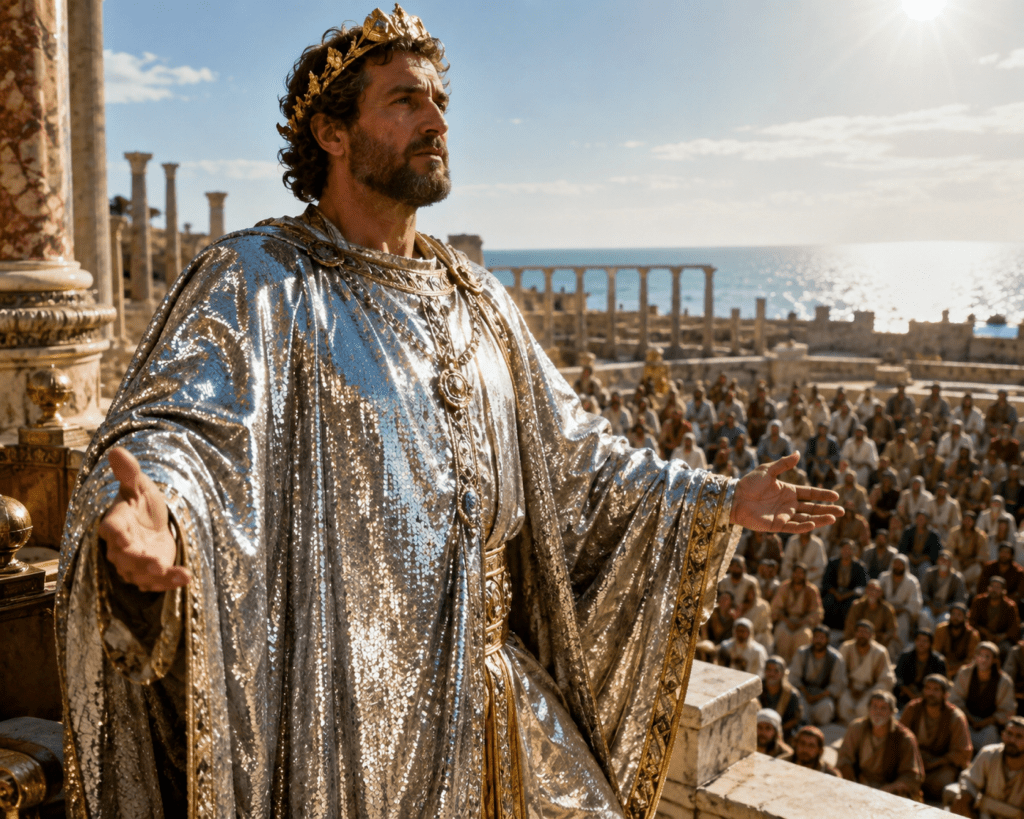
Acts 12:21-22 On an appointed day Herod put on his royal robes, took his seat upon the throne, and delivered an oration to them. And the people were shouting, “The voice of a god, and not of a man!”
This is another time when historians of the day corroborate the Bible’s story and even give us additional details. Let’s read what the historian Josephus says about this event, from his book Antiquities of the Jews:
“At Caesarea, Agrippa exhibited shows in honor of Caesar, knowing that this was celebrated as a festival for his welfare. There came together for this occasion a large number of provincial officials and others of distinguished position. On the second day of the shows, Agrippa put on a robe made of silver throughout, of quite wonderful weaving, and entered the theatre at break of day. Then the silver shone and glittered wonderfully as the sun’s first rays fell on it, and its resplendence inspired a sort of fear and trembling in those who gazed at it. (Josephus “Antiquities of the Jews” 19:343-50)
The New International Commentary on the New Testament tells us that the “appointed day” on which the people of Tyre and Sidon were to be publicly reconciled with Agrippa was a festival celebrated every 5 years on March 5 in honor of the founding of Caesarea. Josephus tells us Agrippa comes out to the celebration at the break of day wearing a robe made of silver. Now I have seen sequinned dresses and my friend Tim has several sequinned jackets, but I have never seen a robe made of silver.
And it is in this theater in Caesarea Maritima, originally built by Agrippa’s just-as-evil grandfather, Herod the not-so-great. It is in a beautiful setting right on the shores of the Mediterranean Sea and would hold about 4,000 people. It has been refurbished and is still used today for concerts, recently by Foreigner, Alanis Morissette, and Eric Clapton.
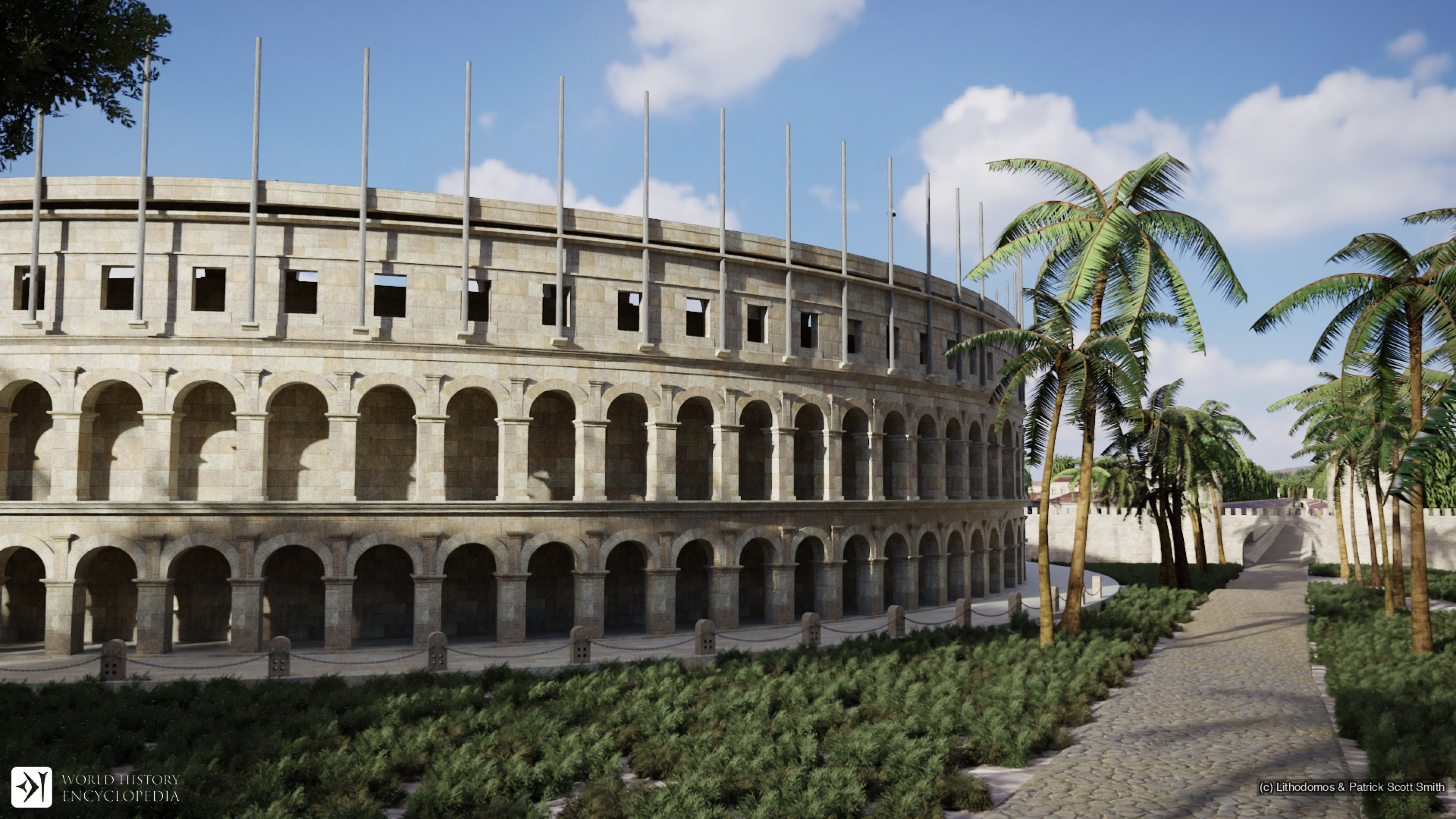
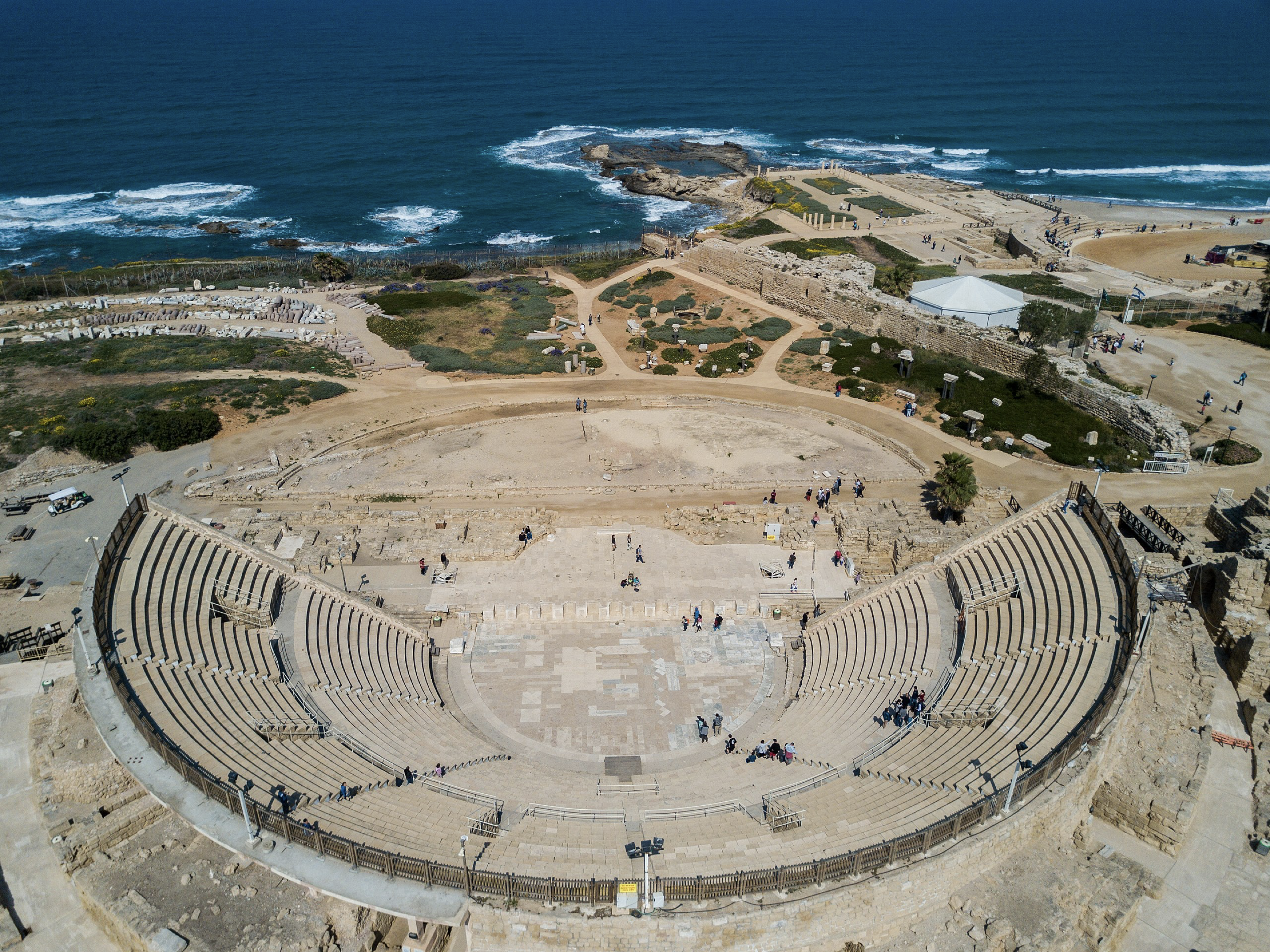
But on this day, in 44 AD, the attraction was Herod Agrippa himself. This theater faces the West. So Agrippa comes out in his silver robe out front for everyone to see. And Josephus tells us it was the break of the day. So I am sure he arranged it so that he came out just as the sun rose behind the backs of those seated, and it hit that silver robe, making Herod shine like the sun. Let’s go back to Josephus’ account again:
“Then the silver shone and glittered wonderfully as the sun’s first rays fell on it, and its resplendence inspired a sort of fear and trembling in those who gazed at it. Immediately his flatterers called out from various directions, in language which boded him no good, for they invoked him as a god: ‘Be gracious to us!’ they cried. ‘Hitherto we have reverenced you as a human being, but henceforth we confess you to be of more than mortal nature.’ He did not rebuke them, nor did he repudiate their impious flattery.
At the same time he was seized with a severe pain in his bowels, which quickly increased in intensity.… He was hastily carried into the palace, and … when he had suffered continuously for five days from the pain in his belly, he died, in the fifty-fourth year of his life and the seventh year of his kingship.” (Josephus “Antiquities of the Jews” 19:346-50)
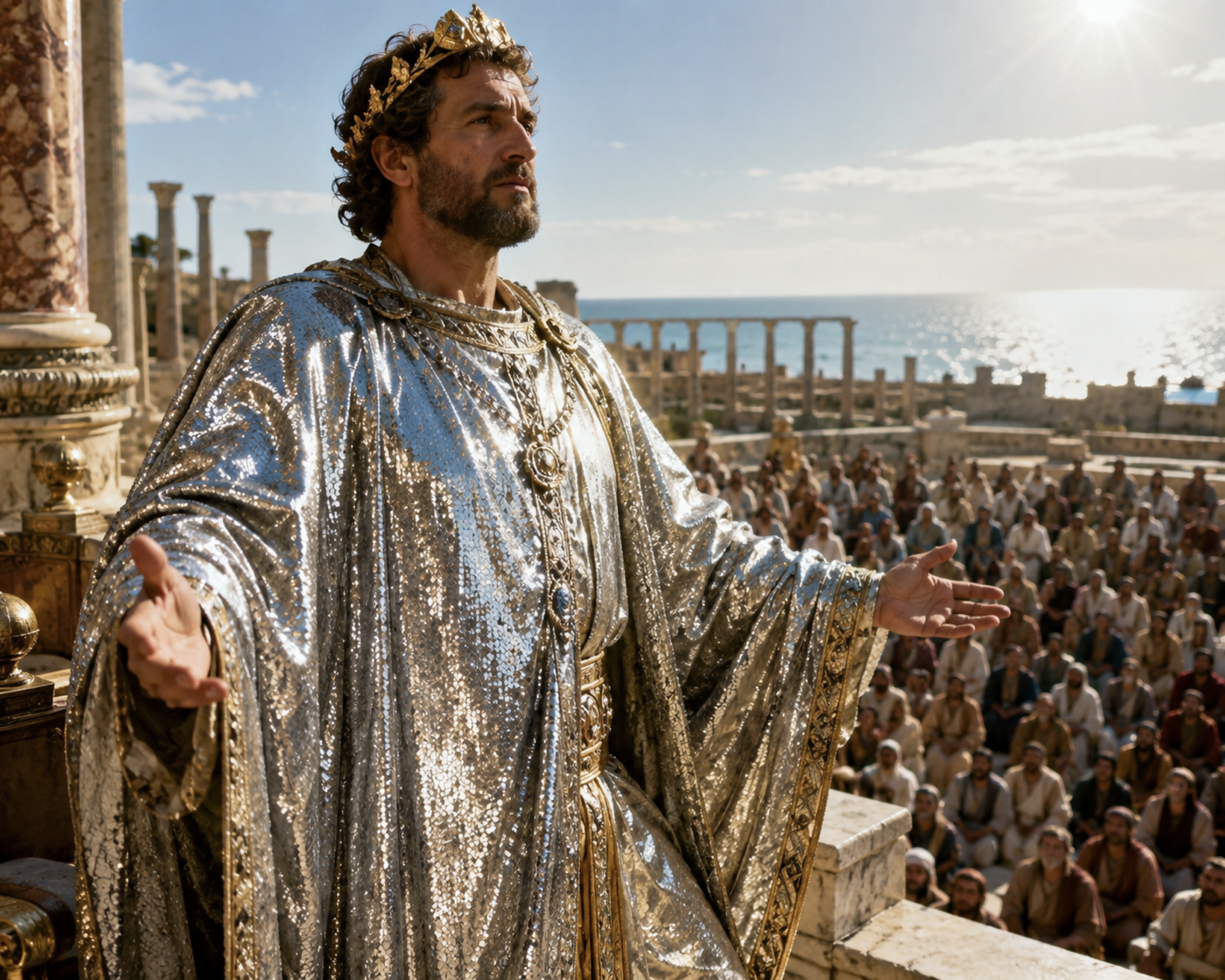
This meshes well with Luke’s telling of the same story in Acts:
Acts 12:21-23 “On an appointed day Herod put on his royal robes, took his seat upon the throne, and delivered an oration to them. And the people were shouting, “The voice of a god, and not of a man!” Immediately, an angel of the Lord struck him down, because he did not give God the glory, and he was eaten by worms and breathed his last.”
“Eaten by worms” is a common way ancient writers described the death of people worthy of such an end. The historian Josephus describes his sudden attack of pain and hints that God caused it, but he doesn’t come out and say it. Luke is very clear. An angel of the lord struck him immediately, and then he soon died.
This passage is not merely a historical account of a ruler’s death. It is a warning about one of humanity’s oldest sins. So what exactly is Herod’s sin?
At first glance, Herod’s sin appears to be ordinary pride. He accepted the crowd’s praise when they called him a god. He enjoyed their worshipful flattery rather than correcting them. But he is breaking the very first commandment given to Israel at Mt Sinai and the one that Jesus said was the greatest commandment.
Exodus 20:3 You shall have no other gods before me.
This is the first of the 10 commandments. The second is closely related.
Exodus 20:4-5 You shall not make for yourself a carved image, or any likeness of anything that is in heaven above, or that is in the earth beneath, or that is in the water under the earth. You shall not bow down to them or serve them…
In fact, some theologians group these two as one, the first of the 10 commandments. Because making an idol, a representation of something you might worship, is putting another god in place of Yehovah. But what does Jesus say? Remember when he was asked what the greatest commandment was….
Mark 12:28-30 “Which commandment is the most important of all?” Jesus answered, “The most important is, ‘Hear, O Israel: The Lord our God, the Lord is one. And you shall love the Lord your God with all your heart and with all your soul and with all your mind and with all your strength.’
Jesus is quoting from Deuteronomy 6:4,5, a prayer that Jesus, his disciples, and every other practicing Jew for hundreds of years before Jesus and every practicing Jew today would say 2-3 times daily. The Shema, the first prayer a child would learn and, traditionally, the last words spoken before death. According to Jesus and the entire Jewish nation, these are very important words.
This question and response are also found in Matthew and Luke, but Mark is the only one of the three gospel writers to include the first phrase of the Shema. And it is very important. When we see in Mark Jesus say, “The Lord is one,” he is quoting the verse that says.
Deuteronomy 6:4 Hear, O Israel! Yehovah is our God, Yehovah alone.
There is only one God, and God is god alone. This is #1 in the commandments, the first and the greatest. You see how the first phrase of the Shema, the first part of what Jesus said was the greatest commandment, is a restatement of the first of the 10 Commandments.
We often focus on the first 2 commandments as idolatry, and think of it only as worshipping an idol, some representation of a god carved in wood or metal. But bowing down before a carved idol may not be a huge temptation for us today. We don’t have stores downtown selling images of gods that you can take home and worship. (As far as I know.) And nothing like this is in this story of Agrippa, but he is breaking these first two commandments here. We are very much like Agrippa, for you don’t see our greatest temptation to worship an idol sitting on a shelf. To see the subject of our idolatry and Agrippa’s idolatry, don’t look in a foreign temple, but look in a mirror.
Herod’s idol was himself. Our greatest temptation is to idolize ourselves. Now, before you think, “Oh, that’s not me, I see all my faults, I see all my flaws.” Just bear with me a bit. Anything that takes God’s rightful place as ruler and object of worship becomes a god, an idol. This is the essence of idolatry: putting self where only God belongs. And this is the oldest sin in the book.
In Genesis chapter 3, the serpent tempted humanity with these words: “You will be like God”, “you can discern good and evil for yourself”, “you can make your own rules.” The appeal was not simply knowledge or power. It was autonomy—the desire to define good and evil for ourselves, to rule ourselves rather than live under God’s rule. This is the root of all sin. Every time a person says:
“I will decide what is right for me.”
“No one tells me how to live.”
“I will do whatever I want to do.”
These are all repetitions of the rebellion of Eden.
Herod embodied this spirit publicly. He enthroned himself not only politically, but spiritually.
He was the king over his land. He made all the rules. If he wanted to kill some Christians, he did. If he wanted to withhold food from the people of Tyre and Sidon and let them starve, he did. And he was convinced that he alone would decide if these things were right or wrong.
And this attitude of self-worship naturally leads to a change in the way you treat other people. Once you see yourself this way, you begin to treat other people differently, for they are less than you. That is why when Jesus was asked what the greatest commandment was, Jesus answered not with one but with two commands because they are inseparable. When God is displaced, self takes the throne, and everyone else becomes a servant, a rival, or an obstacle. Pride always climbs by stepping on others.
And God said that is no way to do life. All the rules God gives are to lead us to live better, more productive, good lives. From the beginning in the garden: God says, ” Enjoy all these trees, but watch out for that one; it will kill you.” His torah, his instruction, is to guide us in the correct way to live. And as our creator and sustainer, he knows best. If we could only follow what Jesus said were the two greatest commandments, then all of our lives would be so much richer and better. And while Herod Agrippa, with his shiny silver robes and people proclaiming him as God, is an extreme example, we have to admit to ourselves that we are tempted to put ourselves first. How do you make your decisions? Do you consult God or do you decide for yourself? Do you ask God what is best, or do you use your best judgment? Agrippa accepted this divine honor from the people on that day because he had already enthroned himself in his heart.
You will probably never sit on a literal throne like Herod. But every heart has a throne. The question is simple: Who sits on your throne? When you come to commit to Jesus, you promise God that you will turn over control of your life to Jesus and that you will no longer decide for yourself what is right and wrong. Anytime we ignore Jesus and make our own decisions, we are rebelling against god and setting ourselves up as our own god, taking his place.
But learn the lesson from this story of Herod Agrippa: self-rule, self-importance, and self-worship are all just illusions. Herod looked powerful. He wore shiny royal robes. He sat on a throne. Crowds praised him as divine. Yet Luke shows how fragile that illusion was.
Acts 12:23 “Immediately an angel of the Lord struck him down, because he did not give God the glory, and he was eaten by worms and breathed his last.”
The man who appeared godlike, all-powerful, was reduced to dust and decay. This is the lie of self-rule: it promises control, but we are never truly sovereign. We cannot rule over our own mortality. We can not control our circumstances. We are not sovereign over our final destiny. We cannot even guarantee our next breath. Herod imagined himself above accountability. In reality, he was accountable every second to the God he ignored. The same is true for all of us.
Look at the striking contrast between Herod’s end and the last verse of the passage:
Acts 12:24 But the word of God increased and multiplied.
Herod’s life comes to a bitter end. But the word of God flourishes. Earthly rulers rise and fall, but God’s kingdom advances. God opposes the proud but exalts the humble. Herod sought glory for himself and lost everything. Jesus, by contrast, humbled Himself to death on a cross and was exalted above every name.
So the question for us today is the same question Adam and Eve had to answer: “Who rules your life?” Who sits on the throne of your heart? Who decides right and wrong in your life? Who makes the decisions? Who is the leader and who is the follower? The great temptation to forget or ignore God in everyday life is the temptation to idolatry, putting someone else in God’s place.
If we insist on ruling ourselves—defining truth, pursuing our will as ultimate, living for our own glory—we commit the same essential sin as Herod. We make ourselves god. The first commandment calls us to tear down that idol and return the throne to its rightful King. True freedom is not found in self-rule. It is found in joyful surrender to the rule of God.
 Swallow No Camels
Leave a comment