May 20, 2026 – Manaen — Acts #42
Acts. 13:1-3
We are back in the city of Antioch today, and you will recall that Antioch was the third-largest city in the Roman Empire, about the size of Atlanta today. It was the place where Jews and Gentiles really began to worship together, following Messiah Jesus. Barnabus was sent there from Jerusalem to find out what was going on with the Gentiles, and he brought Saul there, and the two of them spent a year teaching “great numbers” of followers of Jesus. (Acts 11:25). Our scripture today tells of a particular worship service they held there:
Acts 13:1-3 Now in the church at Antioch there were prophets and teachers: Barnabas, Simeon called Niger, Lucius of Cyrene, Manaen (who had been brought up with Herod the tetrarch), and Saul. While they were worshiping the Lord and fasting, the Holy Spirit said, “Set apart for me Barnabas and Saul for the work to which I have called them.” So after they had fasted and prayed, they placed their hands on them and sent them off.
Simeon called Niger. Simeon is from the Hebrew name Shimon, the same as Simon Peter, so he was Jewish. Niger is a Latin word meaning ‘black’ or ‘dark,’ and it was used in a descriptive, not a derogatory fashion. It is tempting to associate him with Simon of Cyrene, who was made to carry Jesus’ cross on the way to the place of execution (Luke 23:26), and that is possible. Cyrene was on the Northern coast of Africa (modern-day Libya). And he is mentioned with Lucius of Cyrene.
But Shimon was a very common name for Jews. There are 9 Simons in the New Testament, and two in Jesus 12 disciples (Simon Peter and Simon the Zealot). Lucius was also a very common name for Romans. In fact, Lucius was one of the standard 18 given names for Romans
Yes, almost all Roman men at this time were given one of these 18 names. (Later expanded to 36 names.)
Aulus Lūcius Quintus
Appius. Mārcus Servius
Gāius Mānius Sextus
Gnaeus Māmercus Spurius
Decimus Numerius Titus
Kaesō Pūblius Tiberius
Romans typically had three names, such as Gaius Julius Caesar (given name, family name, and a specific branch of the family name or honorific). Daughters were given the feminine form of their father’s name. So the daughter of Gaius Julius Caesar was named Julia. If there were more than one daughter, they added tags like Maior (the elder) or Minor (the younger).
The other prophet and teacher mentioned in our passage this morning is Manaen. All we are told of Manaen is that he had “been brought up with Herod the tetrarch.” Your Bible probably has this in parentheses, and you are likely to read right past it. The Greek phrase being translated here is often translated as “foster brother” and refers to boys of the same age as royal princes, who were taken to court as babies or very young children to be brought up with them. So Manean was brought up with Herod the tetrarch, as if they were brothers. Here we go with the Herods again.
Herod the tetrarch we are talking about today is not Herod Agrippa that we discussed two weeks ago, the ruler with the shiny silver robes who accepted praise as a god and was struck dead. That Herod was a grandson of Herod the not-so-Great. Today we are talking about Herod Antipas, who was a son of Herod the not-so-great. He would have been an uncle to Agrippa.
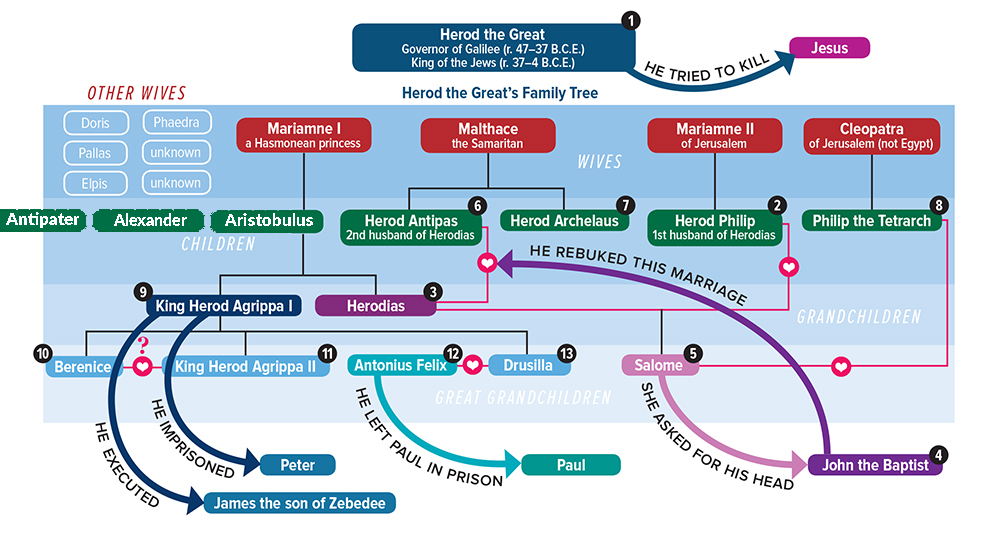
When Herod the not-so-great died, Herod Antipas took over 1/4 of his father’s kingdom and ruled Galilee and Perea from 4 BC to 39 AD. We remember him as the one that John the Baptist called out for marrying his brother’s wife, Herodias. (This Herodias was the sister of Herod Agrippa.). Herod Antipas had John imprisoned and then had his head chopped off as requested by Salome, who, by the way, was the half-sister of the shiny-robed Herod Agrippa. And you thought TV soap opera families were mixed up. As ruler of Galilee, Herod Antipas had some interaction with Jesus.
Matthew 14:1-2 At that time Herod the tetrarch heard about the fame of Jesus, and he said to his servants, “This is John the Baptist. He has been raised from the dead; that is why these miraculous powers are at work in him.”
Antipas was afraid that the man he had murdered, just to satisfy his wife, Herodias, and Salome, was back from the dead. So what does Antipas decide to do?
Luke 13:31-32 At that very hour some Pharisees came and said to him [Jesus], “Get away from here, for Herod wants to kill you.” And he said to them, “Go and tell that fox….
And Antipas finally gets the opportunity to meet Jesus on the morning of his crucifixion. When Pilate questions Jesus, he learns that Jesus is from Galilee, so he sends him to Antipas, the ruler of Galilee.
Luke 23:6-11 When Pilate heard this, he asked whether the man was a Galilean. And when he learned that he belonged to Herod’s jurisdiction, he sent him over to Herod, who was himself in Jerusalem at that time. When Herod saw Jesus, he was very glad, for he had long desired to see him, because he had heard about him, and he was hoping to see some sign done by him. So he questioned him at some length, but he made no answer. The chief priests and the scribes stood by, vehemently accusing him. And Herod with his soldiers treated him with contempt and mocked him. Then, arraying him in splendid clothing, he sent him back to Pilate.
Antipas basically gave his stamp of disapproval on Jesus to Pilate. This was just what Antipas wanted. Pilate could do what he could not do: kill Jesus publicly.
In the last years of his reign, Antipas was at war with the king of Arabia, primarily because he had divorced the daughter of the king of Nabatea to marry Herodias. He lost that war and was then accused of rebellion against Rome by his nephew/brother-in-law, Herod Agrippa. So Antipas was stripped of all of his money and land and exiled to Gaul (modern-day France).
Now, if you think we have spent a lot of time talking about all of these Herods, then you are correct. But we keep finding them woven into the story of the Bible. They are part of the context of this book, and if we don’t understand the political climate, then we miss part of what the original readers got from the scripture.
Now that I have reminded you of how evil the Herods were, especially Herod Antipas, let’s look back at this man, Manaen. He grew up with Antipas; they played together as children. They were exposed to the same family, the same education, and the same religion. The person Manaen knew as father was Herod the (not-so) great. And remember that Herod the not-so-great killed 3 of his sons, who were also Manaen’s foster brothers. Imagine growing up with this crazed, murderous ruler as your father, and your closest friend being another evil despot, Herod Antipas. Not the best start
And yet Luke tells us that this Manaen is a prophet and teacher in Antioch and helped launch the missionary movement that carried the gospel to the Gentile world.
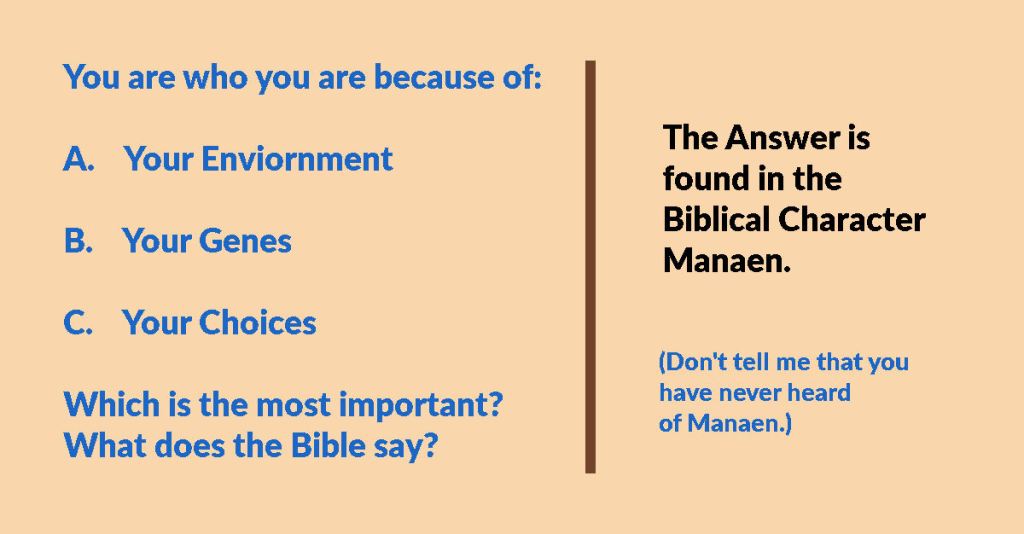
Two boys raised in the same environment. One becomes part of a kingdom built on pride, power, and compromise. The other joins a kingdom based on sacrifice, grace, love, and mercy. Acts 13 quietly reminds us of a profound truth: Your environment may have some influence on you, but it does not determine your destiny. Your choices make the biggest difference.
We see this over and over in the Bible and in our lives. In Genesis 4, we have Cain and Abel. They were raised by a mother and father who walked in the garden with God. They heard firsthand of God’s love and grace, but also of His judgment. These brothers both brought offerings to God. Abel’s offering was accepted. Cain’s offering was not accepted.
Genesis 4:2-5 Now Abel was a keeper of sheep, and Cain a worker of the ground. In the course of time, Cain brought to Yehovah an offering of the fruit of the ground, and Abel also brought of the firstborn of his flock and of their fat portions. And Yehovah had regard for Abel and his offering, but for Cain and his offering he had no regard.
You have probably heard that Abel’s offering was accepted because it was a choice animal sacrifice, and Cain’s was rejected because it was not. But if you have read Leviticus, you know that grain and other harvested crops are certainly acceptable sacrifices. The problem was not Cain’s offering, but it was Cain’s heart.
Genesis 4:6-7 Yehovah said to Cain, “Why are you angry, and why has your face fallen? If you do well, will you not be accepted?
God does not say “will your offering not be accepted” but “will you not be accepted.” Again the problem is Cain, not the offering. Remember what Jesus said:
Matthew 5:23-24 So if you are offering your gift at the altar and there remember that your brother has something against you, leave your gift there before the altar and go. First be reconciled to your brother, and then come and offer your gift.
Jesus spoke these words as if he were speaking to Cain’s situation. God is much more concerned with the heart of the one offering than He is with the gift itself.
And Cain then kills his brother Abel. And I can not for a minute believe that this one instance of jealousy led to murder. Resentment had been building up inside of Cain for some time, and Genesis merely tells us the straw that broke the camel’s back. And it is in this state of resentment of his brother that Cain makes an offering that God can not accept.
Genesis 4:6-7 The LORD said to Cain, “Why are you angry, and why has your face fallen? If you do well, will you not be accepted? And if you do not do well, sin is crouching at the door. Its desire is contrary to you, but you must rule over it.”
God makes it clear to Cain. Cain was not trapped by fate. He was confronted with a choice. Do well and be accepted, or do not do well and be conquered by sin. And this is the difference between Cain and Abel. They were raised the same, but they made different choices. Abel is remembered as a man of faith. Cain is remembered as a man who fell prey to sin.
Another example is Jacob and Esau. Twin brothers. Same parents. Same household. Same God. Yet Esau treated spiritual things casually. He sold his birthright for a bowl of stew. He shunned his parents’ advice to be obedient and not take a wife from the Hittites. The book of Hebrews later describes Esau as someone who was “sexually immoral” and “unholy” because he traded eternal things for immediate gratification. Jacob certainly was not perfect. He had flaws and failures, but he desired God’s blessings and promises. One brother lived for the moment. The other eventually learned to pursue God. Again, similar upbringing, different decisions, different priorities.
And I could talk of other brothers in the Bible who were raised in the same family but had different outcomes. We could speak of Joseph and his brothers and the difference in their lives due to the decisions they made. Or we could talk of the brothers in Jesus’ story of the prodigal son. But look at the deep contrast here in Acts of Manaen and Herod Antipas.
Herod Antipas sought to gain authority through harsh rule and murder.
Manaen surrendered himself to the authority of God.
Antipas imprisoned and killed a prophet.
Manaen became a prophet and teacher.
Herod Antipas scorned and mocked Jesus.
Manaen chose to follow and worship Jesus.
Antipas tried to shut down the spread of the Gospel.
Manaen participated in sending the gospel to the nations.
This is one of the best contrasts of life choices in Scripture.
Antipas and Manaen both learned from Herod the (not-so) Great. Antipas became just like Herod, leading a kingdom through treachery, deceit, and murder. Manaen chose to go the opposite direction, joining the kingdom of God, in opposition to the kingdoms of this world. Regardless of what kind of environment you grow up in, you choose your own path. And, like Antipas and Manaen, it seems that children either follow their parents’ path or take a completely opposite path.
It is like the story of a man who was a violent drunk who beat his two sons every day. There was never a day he wasn’t drinking. The first son went on to be a violent drunk like his father; the second never touched alcohol and avoided all forms of violence. When asked why they became who they were, both of the sons said, “With a father like that, how could I not end up like this?” We cannot choose our circumstances, but we can choose how we react to them.
And we could talk of modern-day examples. Adolf Hitler grew up in a home with a strict, physically abusive father. His father died when he was 14, and his mother 4 years later. This difficult childhood definitely influences a person, but it does not determine their destiny. His sister Paula grew up in the same household but lived a quiet life, never joining the Nazi Party. Or we could talk about Malcolm X and his siblings, or Jimmy Carter and his brother, or many more.
Everyone must choose which kingdom they will serve. Moses said it this way:
Deuteronomy 30:19-20 I call heaven and earth to witness against you today, that I have set before you life and death, blessing and curse. Therefore choose life, that you and your offspring may live, loving Yehovah your God, obeying his voice and holding fast to him, for he is your life and length of days, that you may dwell in the land that Yehovah swore to your fathers, to Abraham, to Isaac, and to Jacob, to give them.
Joshua said this:
Joshua 24:15 …choose this day whom you will serve … But as for me and my house, we will serve Yehovah.
In his poem The Road Not Taken, Robert Frost said this:
Two roads diverged in a wood, and I—
I took the one less traveled by,
And that has made all the difference.
And Jesus, in the Sermon on the Mount, said:
Matthew 6:24 No one can serve two masters…
Every person must choose what kingdom they will serve. Herod chose an earthly kingdom of fame and fortune, murder and deceit. Manaen chose the Kingdom of God. And all of us today are who we are based on the choices we have made.
But I want to focus for just a few minutes on something that we don’t know about Herod Antipas and Manaen. We know of the negative influence of Herod and his family on Manaen. But for Manaen to become a prophet and teacher in one of the world’s largest Christian communities, there had to be someone who was a major positive influence on him. Someone had to show him the possibility of a path different than the path of the Herods. There is someone not mentioned here who spoke life into Manean. Someone who told him about Jesus. Someone who invested time in him.
Now I have a theory about who it could have been. Luke mentions Joanna in Chapter 8 of his gospel as a woman Jesus healed of evil spirits. She was the wife of Chuza, the head of Herod Antipas’ household. Joanna was a disciple of Jesus and supported his ministry financially. She is present at Jesus’ tomb with Mary Magdalene and other women. And her place in the household of Manaen’s foster brother means she would certainly have known Manaen. It could have been her who led Manaen to Jesus and helped him choose not to follow the way of the Herods.
Think for a moment about the people outside your immediate family who had a strong positive influence on you. Who showed that they believed in you at a time when you needed it? Who was there for you?
We need to share our stories. I want to encourage you to share with someone this week the story of the person who influenced you. If they are still around, you might give them a call or send them a note. But I am asking you to tell someone else the story, over lunch today or sometime this week. This story of Manaen and Herod is in our Bibles for a purpose. This story needs to be told, and your story needs to be told.
Secondly, I want you to ask God to direct you to at least one person that you can pour into over the next few years. Someone that you can be intentional to build up, to encourage, to pray for. Someone that you will reach out to weekly. It may be a young person, or it could be someone of any age. Everyone needs someone to believe in them and lift them up.
I want to encourage you to commit to “Go Deep” with someone. Most of our relationships are way too shallow. We have so many people that we talk with, but we never seem to talk about the really important things in life. Consider committing to long-term impact with one or a few people. To have regular contact with them. You can’t pour into a lot of people this way, but you can make a difference for a few. Andy Stanley says it this way, “Do for one what you wish you could do for everyone.”
Be intentional! Choose someone who is unchurched, or someone who really needs a friend or someone to cheer for them. Look at this story in scripture. Someone spoke life into this man, Manaen, and instead of following the way of the Herods, he chose to follow the path of Jesus. He did not become like his father, Herod the not-so-great, or his brother Herod Antipas. Instead, he strove to become more like his Heavenly Father. And by being a part of the group that sent out the first missionaries, he changed the world. And someone unknown to anyone today except God helped make that difference in Manaen’s life.
 Swallow No Camels
Leave a comment