June 30, 2026 – The Journey Begins— Acts #45
Acts. 13:4-12
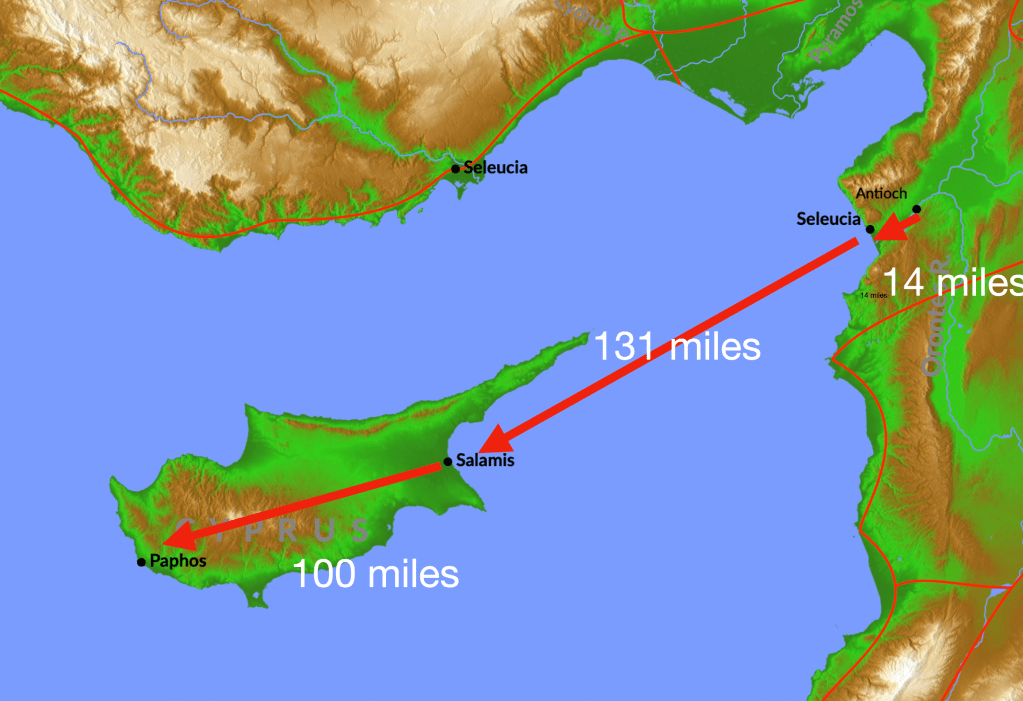
Acts 13:4-6 The two of them, [Saul and Barnabas], sent on their way by the Holy Spirit, went down to Seleucia and sailed from there to Cyprus. When they arrived at Salamis, they proclaimed the word of God in the Jewish synagogues. John was with them as their helper. They traveled through the whole island until they came to Paphos.
First, let’s understand the geography. Paul, Barnabas, John, and Mark first traveled the 14 miles from Antioch to Salamis, the seaport downriver from Antioch. Then they would have to arrange passage on a ship. No passenger ships were traveling these routes. They would make arrangements to pay for passage on a cargo ship.
They would bring their own supplies and food (and, on longer voyages, perhaps a tent to sleep on deck). The trip from Seleucia to Salamis, about 131 miles, would take anywhere from 8 hours to a full day, depending on the prevailing winds and time of the year. There was very little travel in the Mediterranean by sea in the winter. And you had to wait to leave the port until the winds were favorable. If you have spent much time at the beach, you know that in the afternoon the wind blows towards the shore, so departures were usually at night or in the mornings.
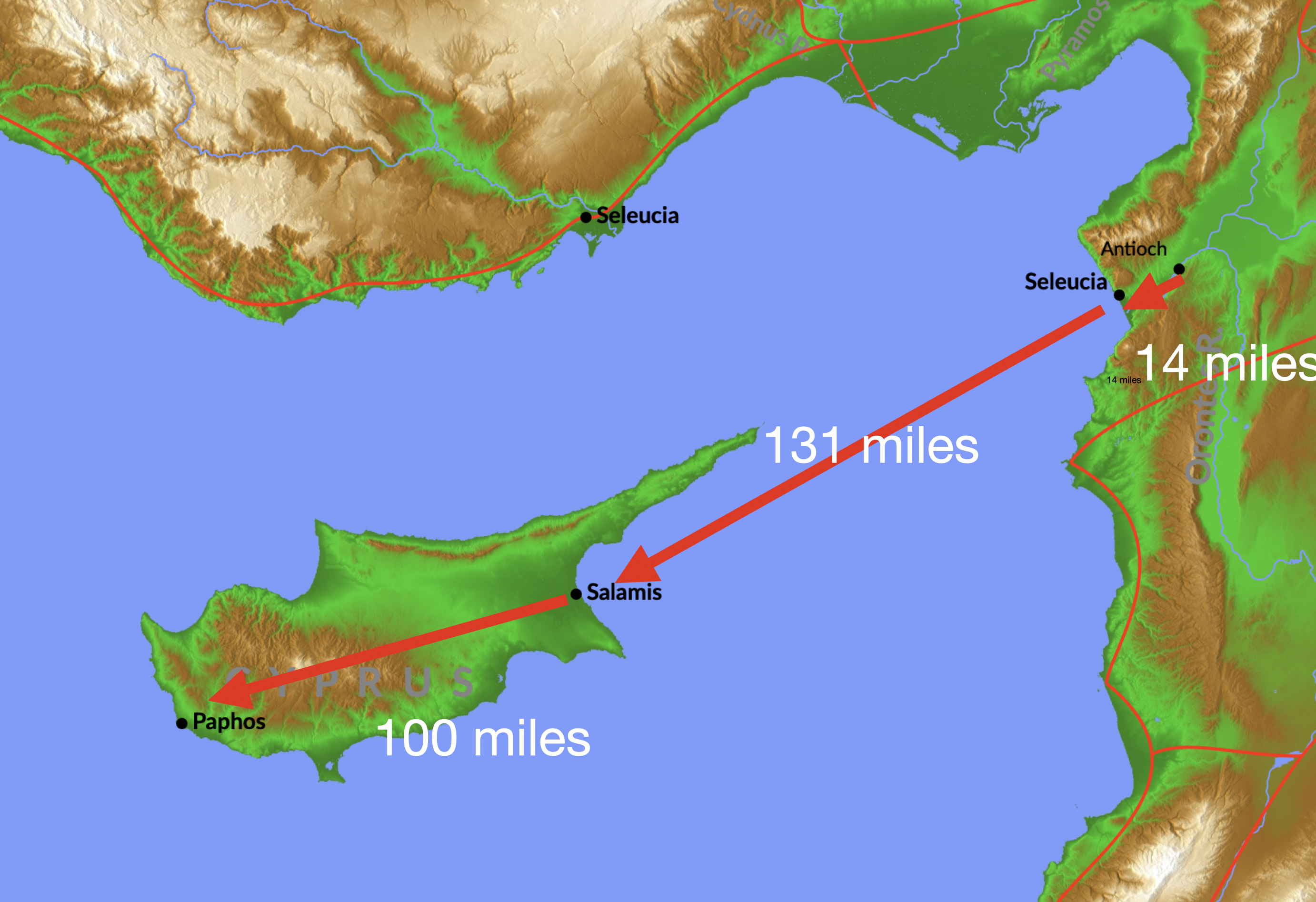
After arriving at the port of Salamis, they began preaching their way through all the Jewish Synagogues from one end of the island of Cyprus to the other, a distance of around 100 miles. They arrived in the city of Paphos, where our story today takes place.
Acts 13:6-12 When they had gone through the whole island as far as Paphos, they came upon a certain magician, a Jewish false prophet named Bar-Jesus. He was with the proconsul, Sergius Paulus, a man of intelligence, who summoned Barnabas and Saul and sought to hear the word of God. But Elymas the magician (for that is the meaning of his name) opposed them, seeking to turn the proconsul away from the faith.
But Saul, who was also called Paul, filled with the Holy Spirit, looked intently at him and said, “You son of the devil, you enemy of all righteousness, full of all deceit and villainy, will you not stop making crooked the straight paths of the Lord?”
You know the first three characters in this story: Saul, Barnabas, and John Mark. For Barnabas, going to Cyprus is returning home, as he was born there. And they have Barnabas’s cousin, John Mark, with him. Remember that it was John Mark’s mother’s home where Peter went when he was released from Prison. And Saul and Barnabas take John Mark with them from Jerusalem to Antioch and then on this voyage as a “helper”.
Luke mentions for the first time that Saul is also called Paul. From this point forward in the book of Acts, Luke will refer to him as Paul. This is not a change in name. Most Hebrews in this time had two names from birth: their Hebrew name and a Greco-Roman name. And since Paul is now traveling primarily among the Gentiles, he will be known as Paul.
Next we have the proconsul, Sergius Paulus. He held supreme authority over this province of Rome. He controlled the government and the military, acting like a king over this area, and Rome appointed him. He is the ultimate authority in the land. And he summons Paul and Barnabas “to hear the word of God.” It would not be uncommon for the ruler of a province to want to hear what traveling teachers had to say.
And then our last character. One of the proconsul’s advisors is present. And he is another Jew with two names: his Hebrew name, Bar-Jesus, and his Greco-Roman name, Elymus. Bar-Jesus is Hebrew for “son of Joshua”. You will recall Jesus is from the Hebrew Yehoshua, which our Bible translates as Joshua. Luke makes sure we don’t miss that he is Jewish. But he is a Jewish false prophet and magician. That is the same Greek word, magos, that we see in Matthew 2; the wise men from the east are magi (the plural of magos) who brought gifts to Jesus.
These magicians are not stage illusionists like David Copperfield or Penn and Teller, but are practitioners of the occult. They served as government advisors who based their counsel on astrology, divination, sorcery, and magic. Typically, the king or ruler sought them out to provide answers for problems that no one else could solve.
In the Bible, we frequently see these court magicians offering advice to the king, often by interpreting dreams and signs. We see them in Pharaoh’s court in Exodus when Pharaoh asked them to interpret his dream, but they could not, so Joseph was called in. They would have been the ones who tried to imitate the first few plagues and also Moses’ rod turning into a snake. We also saw them in the king’s court in Daniel. And just a few weeks ago, we discussed Simon the Magician, who had been baptized by Philip but then tried to purchase the power of the Holy Spirit from Peter (Acts 8:9-24).
Again, they were the ones the king would turn to when he didn’t know what to do. For example, say the king has a medical problem that no one can treat, like a toothache. The historian Pliny the Elder, in his book Natural History, discussed many recommendations given by the Magi. For a toothache, Pliny said the Magi would suggest applying the brain of a boiled dogfish, or ground deer antlers, to the tooth. Or, of course, you could place the warm corpse of a mouse against the tooth.
Or my personal favorite, catch a frog under a full moon and spit into its mouth. (If you try this, let me know how it works.) By the way, medicine had advanced so much that over 1000 years later, in the 1300s, doctors were still recommending Pliny’s description of the Magi’s treatment of a toothache by boiling earthworms in oil and pouring it into the ear. At this point, as a retired doctor, I should probably give a Disclaimer: The medical information in this blog is for educational purposes only and is not a substitute for professional health care. Please consult your physician.
This magician, Bar-Jesus, also called Elymas, “opposed them.” Why did he oppose them? He likely perceived Paul’s message as a threat to his influence on the proconsul. You remember that in the book of Daniel, it was the jealous Magi (advisors) of King Darius who plotted to have Daniel thrown into the lion’s den. Bar-Jesus realizes that if the proconsul accepts the gospel message, he is likely out of a job, for the good news of the gospel is that everyone has access to God, not just a special few.
But a Jewish magician? The book of Deuteronomy is clear:
Deuteronomy 18:10-12 There shall not be found among you anyone who burns his son or his daughter as an offering, anyone who practices divination or tells fortunes or interprets omens, or a sorcerer or a charmer or a medium or a necromancer or one who inquires of the dead, for whoever does these things is an abomination to the LORD.
Any method of predicting the future, or seeing the answer in the stars or anything to do with the occult is forbidden. Yet this Elymas believes he can continue to be Jewish and yet practice these things. But Paul is not going to stand for this.
Acts 13:9-10 “But Saul, who was also called Paul, filled with the Holy Spirit, looked intently at him and said, “You son of the devil, you enemy of all righteousness, full of all deceit and villainy, will you not stop making crooked the straight paths of the Lord?”
So the Holy Spirit and Paul waste no time in calling him out. I’m sure Paul was bothered that he went by the name “son of Jesus” when they were trying to bring the good news of Jesus of Nazareth to this man. So Paul says he is actually the “son of the devil,” an “enemy of all righteousness, full of all deceit and villainy.” Paul is clear that he will have no tolerance of occult practices. What about occult practices today?
Just because we don’t boil earthworms or spit in frogs’ mouths anymore doesn’t mean we no longer are influenced by things of the occult. Astrology, using the signs of the stars and planets to reveal your character or predict the future, is still big business and found in almost every newspaper and a huge online community. There are psychic readers, palm readers, and Tarot readers on the main streets of our town. Deer antlers and dead mice have given way to crystals and chakras, energy patterns and focus. And again, you can find shops dealing in this most towns.
The occult is all around us. TikTok has its own massive subculture, Witchtok, where modern pagans, Wiccans, and spiritual practitioners share spell tutorials, tarot readings, and mythological education. Currently, there are over 9.2 million posts, some of which have billions of views. Ghost hunting and parapsychology, communicating with the dead, have also become more popular, driven by reality TV shows.
But remember what we just read in Deuteronomy. Let me be clear. God’s opinion of occult practices has not changed. It is an abomination, on the same level as sacrificing your child to a false god. You can not partake of any of this and follow Jesus. And like Bar-Jesus, many of the people involved with the occult are offended by the gospel. Well, let’s see how this story ends.
Acts 13:9-12 But Saul, who was also called Paul, filled with the Holy Spirit, looked intently at him and said, “You son of the devil, you enemy of all righteousness, full of all deceit and villainy, will you not stop making crooked the straight paths of the Lord? And now, behold, the hand of the Lord is upon you, and you will be blind and unable to see the sun for a time.” Immediately, mist and darkness fell upon him, and he went about seeking people to lead him by the hand. Then the proconsul believed, when he saw what had occurred, for he was astonished at the teaching of the Lord.
“You will be blind and unable to see the sun for a time.” Who does that remind you of? Saul.
Perhaps this blindness should not be viewed as punishment, but rather as what happened to Saul on the road to Damascus. God made Saul blind for 3 days to give him a “time out”. Take a few days with no distractions and think about this, Saul. And it was not until Saul was struck blind that he saw the truth of this world, the truth of the Gospel. We don’t know what happened to this Bar-Jesus, but we can hope that in his blindness he saw the light. And how about the proconsul’s response?
Acts 13:12 Then the proconsul believed, when he saw what had occurred, for he was astonished at the teaching of the Lord.
The proconsul believed. He saw this miracle imposed on his own magician, and he believed. That is much different than Pharaoh’s reaction when Moses bests his magicians. He just became harder-hearted. But Sergius Paulus believed. Does that mean that he accepted Jesus as his Lord and King, that he gave his heart to Jesus that day? Or does it simply mean that he believed what he saw. Remember that the Bible says in the book of James:
James 2:18-19 “But someone will say, “You have faith, and I have works.” Show me your faith apart from your works, and I will show you my faith by my works. You believe that God is one; you do well. Even the demons believe—and shudder!”
So the proconsul believed. And I would like to think that he repented and accepted Jesus as his Lord also, but the Bible does not tell us. Or does it? Sergius Paulus was a real historical person. We have several stone inscriptions bearing his name that were found on the island of Cyprus and in Rome. And two more inscriptions were found in Psidian Antioch.
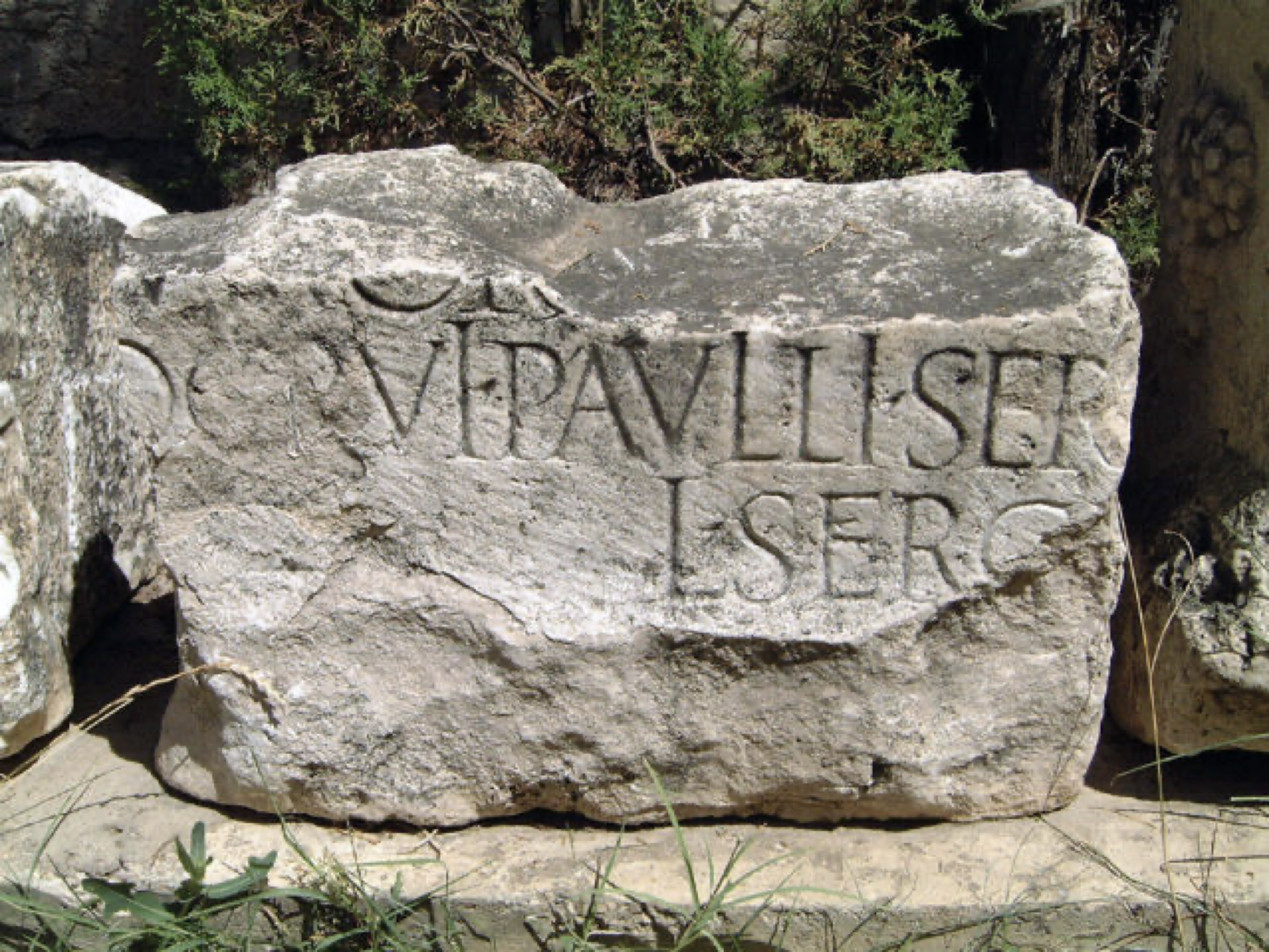
This one bears the name L. Sergius Paulus. Another stone inscription mentions his son, of the same name, as being an official in the city of Psidian Antioch. Several more have been found outside that same city in what archaeologists believe was the Paulus family estate. So we know Sergius Paulus was originally from Psidian Antioch, where his extended family lived.
Our story with the proconsul is here in Paphos, on the island of Crete.. Psidian Antioch, where his family estate is located, is in the Galatia region of Asia Minor. Now, where do you think Paul, Barnabas, and John Mark go after leaving Cyprus?
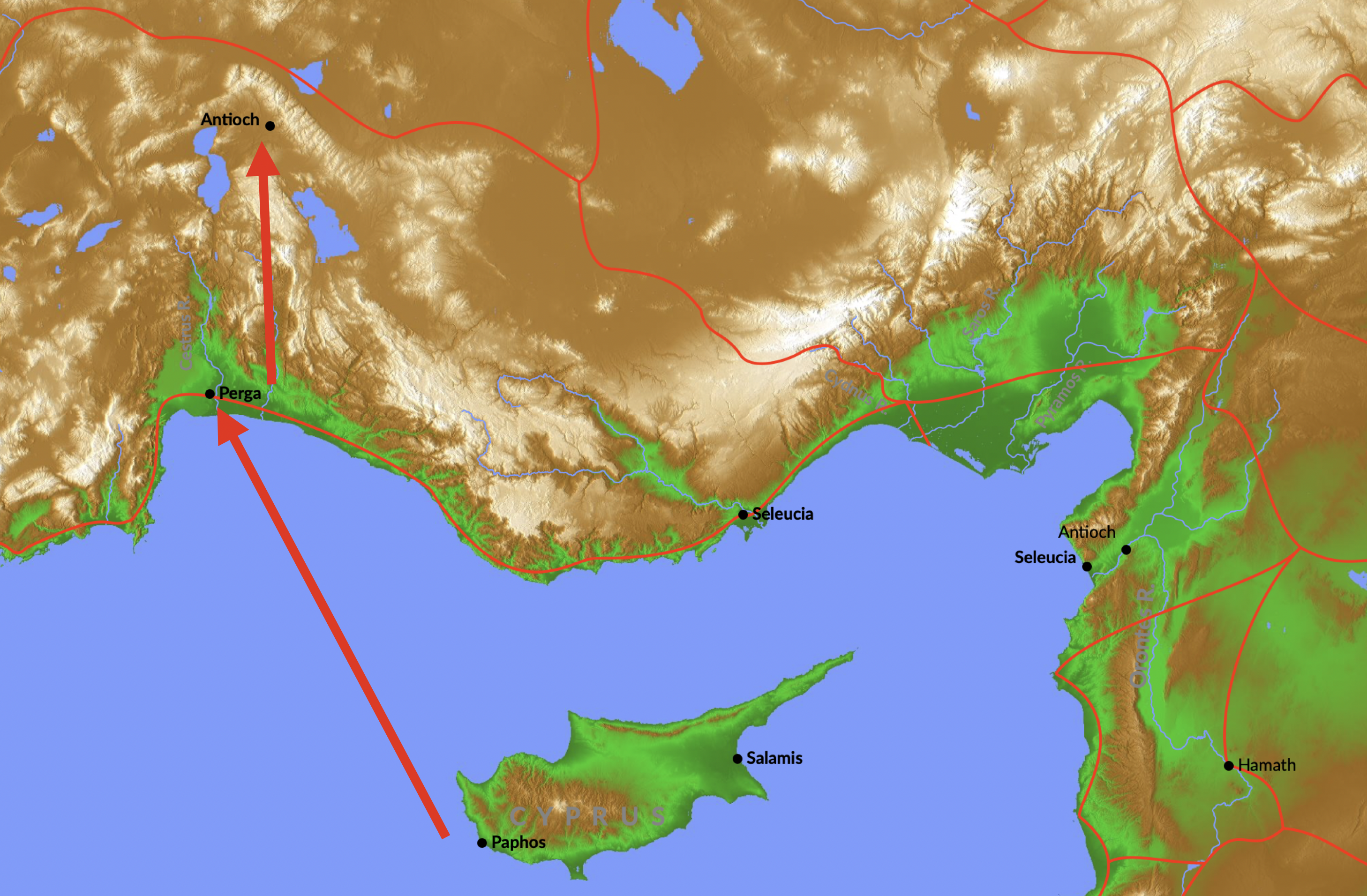
They travel from Cyprus to Perga by ship, then overland to Psidian Antioch. Could it be that the reason Paul and Barnabas leave Cyprus and travel 270 miles is that they are making a beeline to share the gospel with the family of this proconsul who found Jesus? We don’t know, but it is an interesting theory.
We don’t know how the proconsul’s story ends. Did he accept Christ and follow him, or did he just believe? And we don’t know how Bar-Jesus’s story ends. Did he repent and seek God? We don’t know. But the important question today is not how their story ended, but how your story ends. Because your story is still being written, it is not finished yet. What you do today, this next week, and the next year will become part of your story.
Let’s decide to end our stories well. Let’s decide today to live like someone who doesn’t just believe the facts about Jesus but also lives like Jesus. And 50 years from now, when someone in your family is telling your story, it will not be just the story of someone who worked at a job and was a good father or mother, but it will be the story of someone who followed Jesus well. Let’s write our story so that it ends well, a story of victory in Jesus.
 Swallow No Camels
Leave a comment