June 16, 2026 – Fasting to Seek God — Acts #44
Acts. 13:1-3
This week we continue looking at Acts 13, at that particular worship service held in 45 AD in the city of Antioch. This was a momentous day in the New Testament, for it was on this day that the Spirit of God spoke to the church and told them to send out Saul and Barnabas on a missionary journey that would change the world. This is a church service I want to attend, where the Spirit speaks and reveals exactly what the church’s mission is. We need to hear the Spirit’s voice today. We need God’s direction for our church and for every church.
So we are looking at the elements of this particular worship service in Antioch. At this service, we are told they were praying and fasting. It is prayer and fasting this day that sensitizes their hearts to hear the Spirit of God. And it is after more prayer and fasting that they follow the Spirit’s instruction and send out Paul and Barnabas. We can not underestimate the importance of prayer and fasting in the life of the church.
So last week we went back to the Old Testament and looked at the basics of prayer. And how prayer is a fulfillment of God’s desire for us to have a relationship with Him. We were created to relate to God. That is why God was with Adam and Eve in the Garden. That is why he delivered Israel from Egypt and had the tabernacle constructed — so He could live among them. That is why He sent Jesus to conquer sin and death. Everything God has done in the Bible after Genesis 3 is for the purpose of restablishing a relationship with us and living with us forever.
Sadly, though, to many people, prayer is just a few words said before a meal, a structured prayer quickly said with a child before bedtime, or a request for something from God. God gave His Son so that we could have a relationship with Him, yet so many don’t bother to speak to or listen to Him. We do not know God as we could, and we do not experience the power of God in our world because we do not pray as we should. And if prayer is underutilized in our churches today, how much more is fasting ignored by God’s people in our time?
People are very confused about fasting. The world has defined fasting in very different ways than the Bible. Fasting for health benefits, especially intermittent fasting, has become very popular. The church, however, has, except for a few denominations, once a year, completely ignored the concept of fasting. And even in the season of Lent, fasting bears little resemblance to fasting in the Bible.
Most Christians I know today treat fasting as if it were optional for followers of Jesus. So let me ask you, “Is fasting a command or is it optional?” If we look in the Bible, we find one day each year when God commanded fasting.
Leviticus 16:29 And it shall be a statute to you forever that in the seventh month, on the tenth day of the month, you shall afflict yourselves and shall do no work, either the native or the stranger who sojourns among you.
The Hebrew phrase that is translated “afflict yourselves” here is an idiom for fasting in the Bible. Fasting on the Day of Atonement is mandatory for Israel. Nowhere else can I find a command to fast. However, many scriptures make it clear that while there is no other specific day on which a fast is commanded, fasting is certainly expected.
As followers of Jesus, we are supposed to follow the example of Jesus. And we know of one particular fast Jesus did immediately after his baptism. He went to the wilderness of Judea and fasted for 40 days. And then Matthew gives us this verse:
Matthew 4:2 And after fasting forty days and forty nights, he was hungry.
Listen, sometimes scripture is hard to understand, and we are supposed to study and meditate on it. This is not one of those times. Jesus is in a desert land by himself with just a few scrub brushes and no food for over a month, and Matthew says, guess what? He got hungry. Okay, I think most of us would have figured that out.
But seriously, it is at this time that the adversary comes to tempt him. (Side note: This is when you get tempted. When you are at your weakest, when you are all alone, when you are desperate for something.) And Jesus’ response was to quote a verse from Deuteronomy.
Matthew 4:3-4 And the tempter came and said to him, “If you are the Son of God, command these stones to become loaves of bread.”
But he answered, “It is written, “Man shall not live by bread alone, but by every word that comes from the mouth of God.’”
Jesus tells the tempter that His fast is not over yet and that He needs to spend time with the Father more than He needs food. His relationship to the Father is more important than food, even when he hasn’t eaten in 40 days. So we know Jesus fasted.
And he is our model. If we are followers of Jesus, we do as he did. You can’t call yourself a follower of Jesus if you don’t walk the path he walked. Jesus also expected his followers to fast. In the Sermon on the Mount, Jesus discusses how we should not be outwardly showy in our religious observances. He speaks of 3 aspects of worship there.
Matthew 6:2 Thus, when you give to the needy, sound no trumpet before you, as the hypocrites do in the synagogues and in the streets, that they may be praised by others.
Matthew 6:5 And when you pray, you must not be like the hypocrites. For they love to stand and pray in the synagogues and at the street corners, that they may be seen by others.
Matthew 6:16 And when you fast, do not look gloomy like the hypocrites, for they disfigure their faces that their fasting may be seen by others.
Interestingly, no one would ever question the importance of regular prayer or the need to give to the poor, but Jesus lists fasting with these two spiritual practices and makes it seem that fasting should be an important part of your walk as well. Notice that Jesus expects us to do all of these things. He doesn’t say “if you give” but “when you give”. It is not “if you pray” but “when you pray”. And likewise, it is not “if you fast” but “when you fast”. Jesus expects his followers to fast, and, like his examples of prayer and giving, expects you to do this without applause or praise from others.
One reason the topic doesn’t come up often in the gospels is that Jesus did not ask His disciples to fast while He was with them. But fasting was such a regular part of their religion that John the Baptist’s disciples were shocked to discover that Jesus’ disciples did not fast.
Matthew 9:14 Then John’s disciples came and asked him, “How is it that we and the Pharisees fast often, but your disciples do not fast?
And how does Jesus answer?
Matthew 9:15 Jesus answered, “How can the guests of the bridegroom mourn while he is with them? The time will come when the bridegroom will be taken from them; then they will fast.”
Jesus said when He is gone, His disciples will fast. While I am with them is not the time to fast. But after I’m gone, then it will be time to fast. So, according to Jesus, we should be fasting now. But let me point out that it is not a command… we will look at that later.
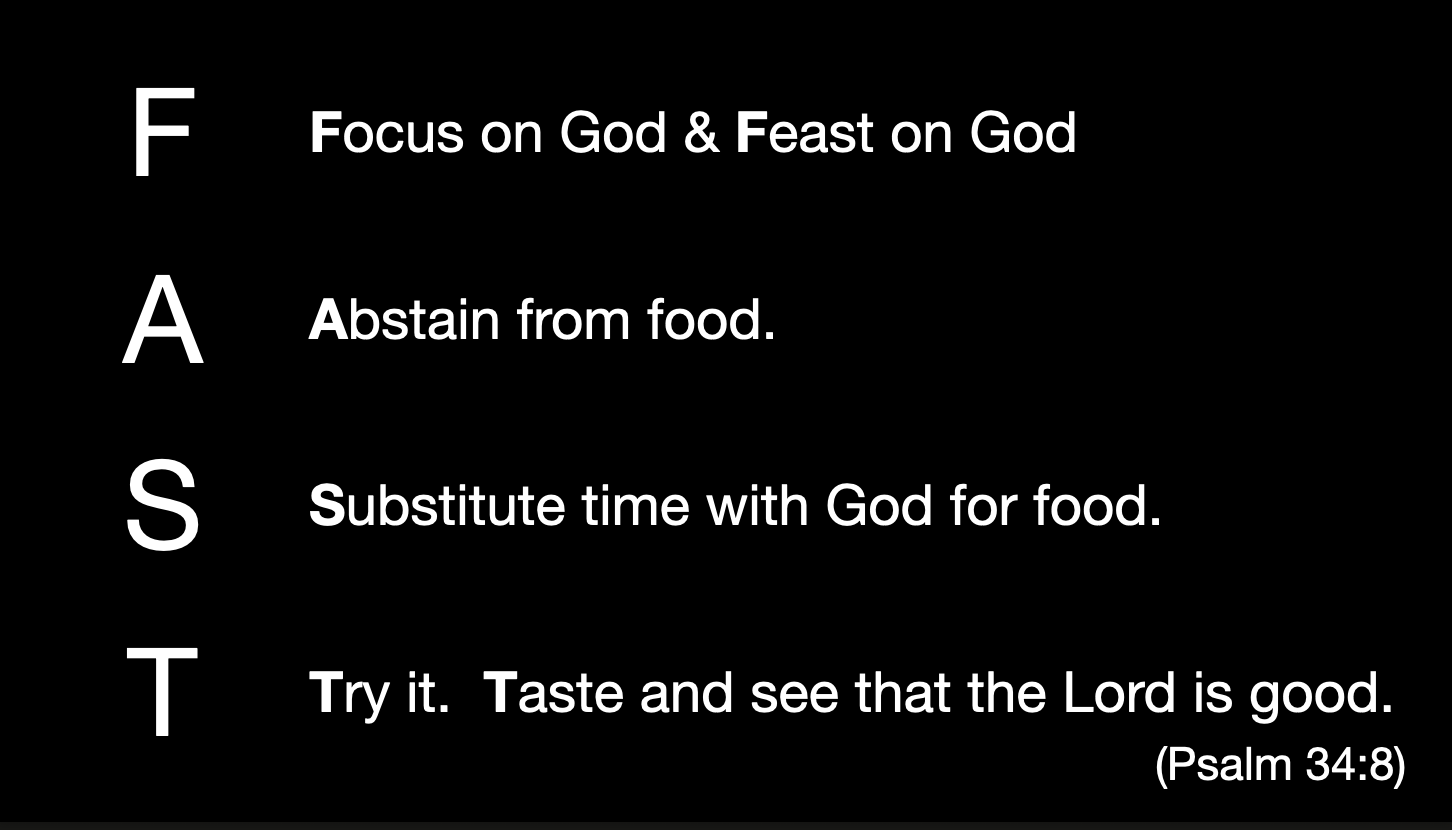
And I will again be leaning heavily on David Platt’s discussion of this topic. He uses an acrostic to help people remember the Biblical concept of fasting.
F is for Focus on God and Feast on God. That is the reason we fast. It is not to draw attention to ourselves; it is not to lose weight or for other health benefits. It is to fulfill God’s plan for us to build a relationship with him. And in fasting, we grow closer to God because we take that time to feast on God. When we fast, we are saying that we need God more than we need food. We need God more than we need His blessings.
Last week, when we were talking about the prayer of petition, I said that we can come dangerously close to idolatry when we pray for things, because we may show that we desire the things of creation more than we desire the Creator—and putting anything before God is idolatry. Fasting is a physical demonstration of our desire for God and a relationship with God above all else. It is putting our belief that God is above all into action.
When we fast, we show in our bodies that our relationship with God is indeed the most important thing to us. That we desire the blessing of His presence more than the blessings of creation. Fasting is a proof of our desire. It is putting your money where your mouth is, because the first part of fasting is focusing on God and feasting on God. We fast because we are hungry for God’s presence in our lives.
Hunger and thirst are the most basic drives for humans. Before birth, babies get a continuous infusion of glucose from their mother. At the time of birth, when the umbilical cord is cut, for the first time in their lives that supply is gone. For the first time, they know hunger. And they must satisfy that desire to live. Babies have to eat, and they get really loud when they don’t.
You really don’t appreciate how good food is until you are hungry. I am willing to bet that few of you have gone days without food other than in medical situations where they are giving you a constant infusion of IV glucose, much like before you were born. But hunger is a powerful thing. And see what God said to Israel,
Deuteronomy 8:3 And he humbled you and let you hunger and fed you with manna, which you did not know, nor did your fathers know, that he might make you know that man does not live by bread alone, but man lives by every word that comes from the mouth of the LORD.
God let them get hungry before he fed them so that they would learn dependence on Him. So they would learn that God is more important than food. So they would learn that they need God more than bread. This is the idea that Jesus refers to in the prayer he taught his disciples.
“Give us this day our daily bread.”
When you pray that prayer, remember that daily bread is not simply food, but every word that comes from the mouth of God. God supplies all we need, but more than His food, we need Him.
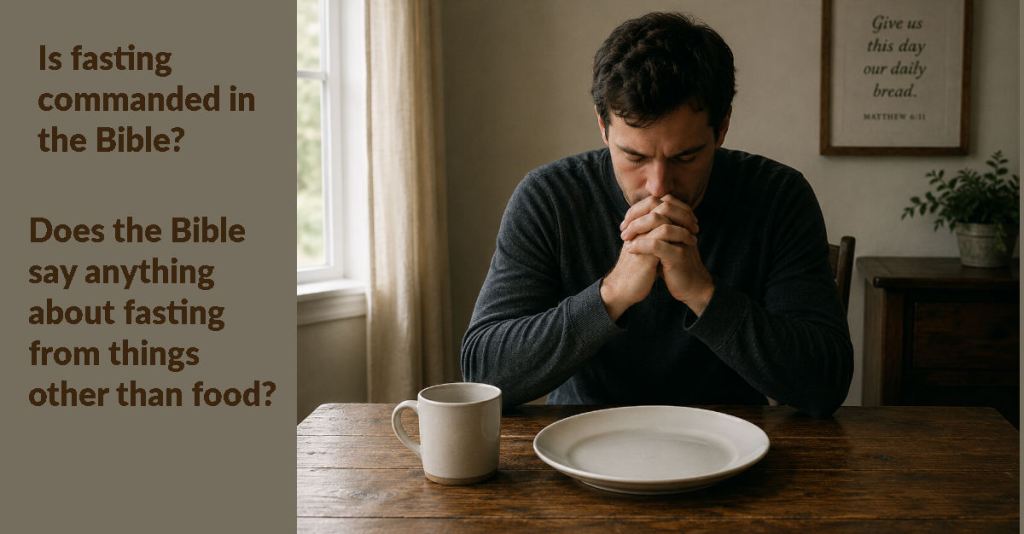
A.– Abstain from food. True biblical fasting is abstention from food. Now people speak about fasting from many other things. During Lent, you hear people say that they are fasting from social media, television, or some pleasure in life. Now, there is nothing wrong with giving up these things for a time. In fact, there is a lot right with giving up these things for a time. But this is really not a fast as the Bible defines it. Fasting in the Bible is always about food.
We put aside not just a comfort or something we enjoy, but something we have a true physical need for. Something we have to have to live. Something all humans crave if they have gone without it. And by putting that need aside to focus on God, we are saying, “Yes, I need food, Yehovah, but I need you more. That is the message in several psalms.
Psalm 42:1-2 As a deer pants for the water, so pants my soul for you, O God.
Psalm 63:1 O God, you are my God; earnestly I seek you; my soul thirsts for you; my flesh faints for you, in a dry and weary land where there is no water.
Fasting is not about what you don’t do (eat); fasting is about what you do instead. So you take the time you would usually spend obtaining or cooking food, and the time you would spend eating, and you spend that time in prayer, study, and meditation with God. If you don’t do this, then you are not eating, but you are not fasting (from a Biblical definition). Every time you feel a pain of hunger, you can voice a prayer to God. God, I am really feeling hungry right now, but that reminds me to tell you that I love you more than food.
When we fast like this, we show God that He is more important to us than anything else. That we desire a relationship with Him above all else. Rich Mullins stated this so well in his song, “One Thing”:
Everybody I know says they need just one thing.
And what they really mean is that they need just one thing more.
And everybody seems to think they’ve got it coming.
Well, I know that I don’t deserve You, Lord
.Still I want to love and serve You more and more
You’re my one thing.
Save me from those things that might distract me
Please take them away and purify my heart
I don’t want to lose the eternal for the things that are passing
‘Cause what will I have when the world is gone
If it isn’t for the love that goes on and on with my one thing.
He likely got this idea from Paul:
Philippians 3:13-14 But one thing I do: forgetting what lies behind and straining forward to what lies ahead, I press on toward the goal for the prize of the upward call of God in Christ Jesus.”
And what is that prize, Paul?
Philippians 3:10-11 “that I may know him and the power of his resurrection, and may share his sufferings, becoming like him in his death, that by any means possible I may attain the resurrection from the dead.”
And Paul got this from Jesus, who tells a short parable with this same message.
Matthew 13:45-46. Again, the kingdom of heaven is like a merchant looking for fine pearls. When he found one of great value, he went away and sold everything he had and bought it.”
We were created to have a relationship with God. If we do not have that in this life, we have nothing. That should be our one thing. That is worth giving up everything else we have or pursue. This is why fasting is not commanded. Because if you love someone, you don’t have to be commanded to spend time with them; you want to spend time with them. We are to love the lord our God with all our heart, mind, and strength. If we love God this way, then we don’t have to be commanded to pray or fast, because we want to spend time with the one we love.
So let’s take a look at ourselves. Ask yourself: Do I pursue God as the psalmist did? Do I want that relationship with God more than I would want water if I were thirsty in the desert?
What is that one thing I am pursuing in my life? If you don’t see that desire for God in your life right now, if the way you live does not demonstrate that God is your “one thing”, then it is time to get very serious about your relationship with God. If that is where you are, then you need to spend some time talking with God and saying, “I am sorry that I have ignored you.” I am sorry that I let the things of this world distract me. You may need to pray the prayer that Rich Mullins penned in his song:
Save me from those things that might distract me
Please take them away and purify my heart
I don’t want to lose the eternal for the things that are passing
‘Cause what will I have when the world is gone
If it isn’t for the love that goes on and on with my one thing.
And let me tell you, from personal experience, as one who spent a few years ignoring God, if you go to Him in this way, and then you begin to spend time with God, with prayer and then with fasting. Your life will change. As you begin to spend time with God, that time that at first may seem awkward and hard will become easy and wonderful. Prayer will take on a whole new meaning for you. And as your relationship with God grows, your desire for Him and for the things of God will grow also.
So the last part of the acrostic for Fast is T – Try it. (Taste and see that the Lord is good.)
Give it a try and see how God responds. Consider it a “taste test”. I am not asking anyone to fast for 40 days, or a week, or even a whole day. Just give it a try. Commit to fast just one meal a week, just for the next month, and spend that time seeking God. I feel sure that God will honor your time with Him, and you will continue it.


Leave a Reply